THE DUKE LAY IN A COMA FOR 3 DAYS… THEN TWO MAID’S CHILDREN CLIMBED ONTO HIS BED, CALLED HIM “PAPA” IN FRONT OF THE WHOLE HOUSEHOLD, AND HIS FINGER MOVED
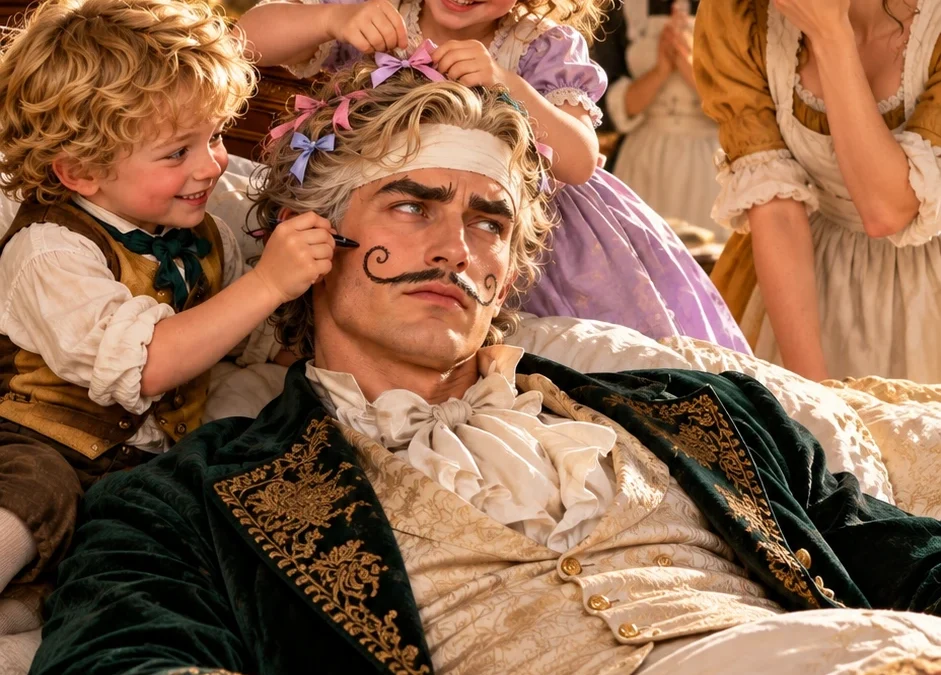
THE DUKE LAY IN A COMA FOR 3 DAYS… THEN TWO MAID’S CHILDREN CLIMBED ONTO HIS BED, CALLED HIM “PAPA” IN FRONT OF THE WHOLE HOUSEHOLD, AND HIS FINGER MOVED 😱
Part 1
“Papa, wake up.”
Six-year-old Nolan pressed both small hands against the Duke’s chest.
Beside him, his twin sister Kora climbed onto the bed, carrying a paper crown and a brass bell.
Their mother, Willamina Dover, froze in the doorway.
She was the Duke’s nursery maid. The twins’ father had died years ago. The Duke was her employer, not their father.
Yet the children had just said it, loudly, in front of half the household. 😳
Montague Bellford, Duke of Evershade, lay motionless beneath a white coverlet. His handsome face was pale. His dark hair spread across the pillow. For three days, he had not opened his eyes.
Kora set the paper crown carefully on his head. It slid over one eyebrow and stopped there.
“Papa is sleeping too long,” she said.
Then she rang the bell.
The sound echoed through the sickroom. Every servant waiting by the door heard it. The physician turned sharply from the window.
“What do they call him?”
“A word children use when they are confused,” Willamina said quickly.
Nolan frowned. “We are not confused.”
The Duke could not deny them. That was the trouble.
He had fallen from his horse when the bridge at Hearthcross collapsed. He had saved two tenants and a cart driver before a broken rail struck him down. He had been carried home through the rain, breathing but unresponsive.
Since then, the servants had spoken of him only in whispers. The physicians had measured his pulse. And his cousin had already asked which keys belonged to the estate office. 🗝️
Now two children were sitting on the sickbed, calling him papa.
Willamina crossed the room. “Nolan. Kora. Come down.”
Nolan tightened his grip on the Duke’s waistcoat. “He told us to climb. When he could not answer.”
She stopped. “When did he say that?”
“At the bridge.”
The physician’s face went white.
“He was sitting on the ground,” Nolan said. “He was bleeding. He gave us his glove.”
“Then he said, ‘You would understand,'” Kora added.
Willamina looked at the riding glove on the bedside table. Dark brown leather, closed at the wrist with a small silver button.
The twins had carried it home after the accident and slept with it between their pillows. She had assumed the Duke gave it to them as comfort.
The word Papa changed the shape of the memory.
The door swung open.
Lord Harold Bellford entered with two lawyers and a woman from the timber company. He was the Duke’s cousin, though he wore the expression of a man arriving to inspect a property after its owner had died.
His eyes moved from the twins to the paper crown.
“Remove those children.”
Willamina stepped between him and the bed. “They are mine.”
“They are servants’ children.”
“They are six years old. Their station does not make them furniture.”
Harold glanced at the physician. “Are they disturbing His Grace?”
“They have not altered his pulse,” the physician admitted.
Nolan leaned close to the Duke’s ear. “Papa, the rude man is here.”
The Duke did not move.
“He does not like you,” Kora informed Harold.
“Children do not know what they say.”
“We know he gave us the glove,” said Nolan.
A lawyer opened a folder. “Miss, until His Grace regains consciousness, Lord Harold may petition for temporary guardianship of the estate.”
“He may request it,” Willamina said. “He cannot receive it simply because he is impatient.”
The lawyer’s eyebrows rose.
Then, on the coverlet, the Duke’s hand shifted.
Everyone turned. The movement stopped.
“He heard us,” Nolan whispered.
“It may be a reflex,” said the physician.
Kora pushed the bell into her mother’s hands. “Ring it again.”
“No.”
“Why?”
“Because everyone is already awake.”
“Papa is not.”
Willamina studied the man in the bed. His breathing was slow and even. The hard expression she remembered from the nursery corridor had gone from his face.
Before the accident, he had visited the twins often. Reserved, but attentive. He had mended their broken cartwheel. He had listened to Nolan describe an imaginary kingdom for twenty minutes. He had let Kora tie a ribbon in his hair while pretending not to notice.
He had never once said the children were his.
And she had never asked, because a maid did not interrogate a duke.
She began to regret her politeness.
She leaned over the bed. “Your Grace. Your cousin wants to take this house. Your physician wants to remove your children. Your children want you to wake. I would very much like to know which of them you support.”
Nothing.
“That is rude,” Nolan told the Duke.
Kora laid the bell against his chest. The metal gave a soft chime.
The Duke’s fingers curled. 🔔
The physician seized his wrist. “A response!”
“Then ask him whether I may act for him,” Harold said eagerly.
The physician bent close. “Your Grace, if you can hear me, move one finger for yes and two for no. Do you consent to Lord Harold managing the estate?”
The hand lay still.
“He is thinking,” Nolan whispered.
“He thinks Harold is a turnip,” Kora whispered back.
Willamina heard both. She also heard the anger in the silence.
She placed her hand over the Duke’s. “Your Grace, do you want the children to leave?”
His index finger moved. Twice.
Nolan cheered. The lawyer dropped his folder.
“And Lord Harold?” Willamina asked quietly. “Should he stay?”
The finger did not move at all.
Harold’s calm cracked. “You will give me that glove!”
“Why?”
“It is the Duke’s property!”
Willamina slipped it into her apron pocket. “Then ask him.”
Harold’s eyes snapped to the Duke’s face.
The Duke’s fingers closed in the air. Twice.
No. No.
Kora’s voice was small and certain. “He says no.”
Harold backed toward the door, white with fury. But before he left, he looked at the twins and said something that chilled the room.
“Those children do not belong here. And before the week is out, neither will their mother.”
The door slammed.
Willamina stood trembling. Then Nolan climbed onto the bed again and whispered into the Duke’s ear.
“Papa says we do.”
And the Duke, who had not opened his eyes in three days, who could not speak and could not stand, slowly closed his hand around the glove… and would not let go. 🧤
Part 2
The Duke closed his hand around the glove and would not let go.
Willamina sat beside his bed until sunset. The twins slept on a rug by the fire. The physician objected. She ignored him.
“You should have told me,” she whispered to the silent man. “I know you cannot answer. But when you wake, you will explain every secret in this house.”
His brow moved faintly.
The next days became a war. Harold sent notices to the tenants claiming the Duke had lost his reason. Willamina found them in the servants’ hall and read them aloud to the cook.
“His Grace has never used reason before breakfast,” the cook said.
Every servant signed Willamina’s page of testimony beneath it. It was not a legal document. It was a beginning.
And the twins kept ringing their bell. 🔔
On the fourth day, the Duke’s lips moved. Kora pressed the glove into his palm.
He opened his eyes. They were dark, alert, and furious.
He looked at the twins. Then at Willamina. His lips formed one word.
“Leave.”
The children gasped. Willamina’s heart dropped.
And Harold, standing in the doorway at that exact moment, smiled. “You heard him. He wants them gone.”
Nolan backed away. Kora began to cry.
But the Duke’s fingers were striking the blanket, desperately, pointing at the glove, then the door, then the children.
Willamina understood.
“Your Grace,” she said. “Do you want Lord Harold to leave?”
One finger. Yes.
Harold left, gray-faced. 😤
Over the following days the Duke recovered in small, inconvenient pieces. He could move his hands before he could sit. He could glare at Harold long before he could stand. And one morning, tired and half-delirious, he looked at the children laughing and said the sentence that changed everything.
“They are your children.”
Willamina set down the bowl.
“I did not mean—”
“You did.”
Silence fell. Nolan whispered, “Mama is angry.” Kora whispered, “Papa is frightened.”
Willamina walked out. She went as far as the old nursery, where a row of small boots waited beneath the window. And there, Lady Ria Bellford, the Duke’s small, gray-haired aunt, found her.
“He did not hide it to control you,” Ria said gently.
“Hide what?”
Ria did not pretend. “Your twins’ father was Leopold Vale. He was Montague’s half-brother. Their father had an affair before his marriage. Leopold was raised away from the family. Montague found him when he was nineteen, and they grew close.”
The nursery seemed to lose all its sound.
“Leopold begged him never to tell you. He wanted his children to belong to their mother, not to a duke’s family story. And before he died, Montague promised your own mother the twins would never be separated or hungry.”
“My mother?” Willamina took a step back. “She knew?”
“She believed the help would stop if you did.”
Willamina thought of the money that had appeared after the twins’ birth. The lease on the cottage. The school books. The winter coal. She had always assumed it came from a distant aunt.
It had come from the man in the sickbed.
Below, the brass bell rang again. 🔔
She returned to find the Duke trying to reach it himself. The bell rolled off the table. Nolan caught it.
“Ria told you,” the Duke said quietly. It was not a question.
“She told me about Leopold.”
“I was going to tell you—”
“When?”
He had no answer.
Then, from the corridor, came the sound of boots. Harold had returned with a carriage order, a solicitor, and a cold, satisfied smile.
“The London physician has approved it,” he announced. “His Grace will be moved before dusk.”
Willamina reached into her pocket. She pulled out a folded page she had found caught beneath the Duke’s saddle after the accident. A letter. Harold’s name sat on it in bold ink beside the words timber company… and the bridge.
Harold’s smile died.
Part 3
“You read private correspondence,” Harold said, his voice suddenly thin.
“I read a page caught beneath the Duke’s saddle,” Willamina answered. “It names you. And it names a commission offered by the timber company three weeks before the bridge fell.”
The room went silent.
“There is no proof,” said Harold.
“The proof is at the bridge. The repair crew found iron shavings in the broken bolt. Someone cut the rail and replaced it with a weaker piece.”
Harold looked at the Duke. “You believe a maid over your own family?”
The Duke’s voice was weak, but it cut like a blade. “I believe the evidence. She kept me alive while you counted keys.”
Harold left, shaking with rage.
The lawyer followed him. The physician quietly closed the door. 🚪
The bridge investigation became a village effort. Tenants brought broken bolts, fragments of rail, and memories of strangers on the road. Willamina set it all out on the schoolroom table like a map. Nolan lined up the metal pieces in a row. Kora arranged the witnesses by hat color.
The blacksmith identified the shavings. They came from a cutting tool used by the timber company. The stable master found hoofprints near the bridge that belonged to no estate horse. A child from Hearthcross remembered a man in a green coat carrying a box of tools.
But Harold could still petition for guardianship. And the Duke could still be declared unfit if he failed his examination before the estate court.
He needed to stand. He could barely walk across a room without leaning on Willamina.
One afternoon, he tried the library stairs. The twins sat on the first step as supervisors. Willamina stood at his left. Ria stood at his right.
“The court meets tomorrow,” Willamina said. “You do not have to do this today.”
“I refuse to be carried into my own hearing.”
His knee buckled on the second step. Willamina caught him around the waist, and for one moment, on the landing, the world belonged only to them.
“Thank you,” he said quietly. “For catching me. And for not pretending I did not need catching.”
“Do not make gratitude romantic.”
“You look at the door when you want to escape,” he said. “You are not looking at it now.”
She said nothing. But her hand stayed on his waist. 💛
In the library, hunting for a book about estate law, she found the passage that mattered: a guardian may be appointed only if no suitable household authority can be established.
“You could be that authority,” the Duke said slowly. “Then… marry me.”
The words fell like a dropped plate.
Nolan gasped. Kora dropped her ruler. The Duke looked horrified at himself.
“That is not what I meant.”
“It sounded exactly like what you meant.”
“I meant the law may treat marriage as proof of a household—”
“You asked because a court might take the children.”
“I thought the law could use it.”
“And what could I use?” she asked quietly.
He had no answer. “I do not know.”
“That is the first honest thing you have said to me today.”
She walked out.
She did not go to the nursery. She went to the village schoolhouse and finally opened Leopold’s letters. His handwriting was lively and impatient. He wrote about the first time he held Nolan and Kora. And the last letter was addressed to the Duke.
If I fail to return, protect the children without making them indebted to you. Let their mother choose whether your family belongs in their lives.
Willamina read the sentence three times. Montague had broken that promise. He had also tried desperately to keep it. It left her angry in two directions at once. 💔
He found her there twenty minutes later, leaning on a cane, with the twins holding his hands.
“I asked you out of fear,” he said. “That was unfair. I should have asked whether you wanted me, not whether the court needed a wife.”
“Do you want me?”
“Yes,” he said at once. “But wanting you does not give me the right to keep you. I want you for the days I am well. For the days I am weak. For the arguments about soup. For the way you read accounts as though numbers had personally offended you.”
Nolan whispered, “That is a long answer.”
“It is a good one,” whispered Kora.
Willamina folded Leopold’s letter. “I cannot decide today.”
“You do not need to.”
“But I will help at the hearing.”
“Thank you.”
“That is not a promise to marry you.”
“I understand.”
“It is a promise to tell the truth.”
“Then I will tell mine.”
The court met in the covered carriage house, because rain had flooded the lower hall. Tenants stood beyond the open gates. The twins carried the bell and the paper crown.
Harold’s petition claimed the Duke lacked capacity and that Willamina had manipulated an unconscious man through his children.
“That is rude,” Nolan said, and Kora rang the bell.
The magistrate leaned forward. “Duke Bellford, do you believe yourself capable of managing your estate?”
The Duke searched Willamina’s face. She did not answer for him.
“Not alone,” he said. “No one should.”
Harold smiled. “He admits incapacity!”
“I admit that I need competent people. I do not admit that I need you.”
The magistrate looked at the twins. “And what is your connection to the Duke?”
Nolan turned toward the chair. “He is Papa.”
Willamina’s heart stopped.
She stepped forward and told the truth before the whole court: that the children called him papa because he had cared for them since birth, and because their father was his half-brother. She held up Leopold’s letters.
Then the evidence arrived. Not in a dramatic pile, but in wet coats and muddy boots. The blacksmith brought the shavings. The stable master brought the bolt. The tenants brought the broken rail.
The London physician tested the Duke. He tired before the end.
“He cannot even complete a simple examination,” said Harold.
“I completed it,” the Duke said. “I am tired because I was in a coma. That is not the same as being incapable.”
The magistrate nodded.
Then the Duke did something no duke guarded more fiercely than power itself. He gave it away.
“The timber trust will be administered by a board of tenants, the village apothecary, and my aunt. Miss Dover will hold the children’s portion. No timber will be cut without their consent.” He looked at Harold. “I no longer believe I must control every person I love.”
The court erupted.
The magistrate approved the board. Harold was ordered to surrender the estate keys. The timber agents withdrew their offer. The bridge sabotage was sent to the county court. ⚖️
And then the Duke fainted in his chair.
The physician shouted for a carriage to London. Harold lunged for the keys. The twins rang the bell. Every servant in the court turned.
The Duke’s eyes opened. “No London.”
“Your Grace, you need better equipment—”
“Here.”
His hands searched for hers. She gave him one.
“Stay,” he whispered.
It was not a command. It was a request.
“I am here,” Willamina said.
The tenants stepped forward in a silent wall. Harold looked at the crowd and realized the valley no longer belonged to his argument. He moved aside.
The recovery took a month. The Duke learned to walk with a cane. He learned that twins could hide a cane more efficiently than a horse could hide in a drawing room. And he learned that Willamina would not let him carry heavy crates simply because he was tired of being treated as fragile.
“I told you not to treat my weakness as a reason to control me,” he said. “Carrying a crate is not a moral decision.”
“Only when you ask the wrong question,” she replied.
One evening, he found her in the apothecary garden, sorting lavender into jars.
“Would you marry me if the estate were placed entirely in the tenants’ hands?” he asked. “I am trying not to confuse love with property.”
Her heart moved. “You are improving.”
“I have been practicing. Since I woke.”
“You were awake before you spoke.”
“I was awake enough to hear you. I was not awake enough to answer.”
“Did you hear when the children called you papa?”
“That was the first thing I heard clearly.” He paused. “I thought it was a dangerous word. Because I wanted it to be true. Not to replace their father. I wanted to belong to the life you had made after losing him. I did not know how to say that without frightening you.”
“So you said nothing.”
“I am ending that habit.”
She stepped closer. “If I marry you, I will not be a duchess who manages your recovery while you make decisions alone.”
“I do not want that.”
“And when you are ill, you will ask for help. You will not pretend your hand movements are enough.”
“I will ask.”
“Then ask now.”
He drew a breath. He was still thin. His hand trembled against the cane. But he was standing, not to prove he was strong, but to ask her himself.
“Willamina Dover, will you marry me because you want a life with me? Not because the children call me papa. Not because a court needs a household. And not because this estate needs another signature.”
“Yes,” she said.
He closed his eyes. “Are you fainting?” she asked.
“I am attempting to remain dignified.”
“You may stop.”
The kiss was careful at first. When he lost his balance, she steadied him, and he smiled against her mouth. 💋
The schoolhouse door creaked open. Nolan stood there, Kora behind him.
“Papa asked first,” Nolan announced.
Kora rang the bell with decisive force. “It is allowed.”
She placed the paper crown on the Duke’s head. “Now you can marry Mama.”
“That is not how marriage works,” said Willamina.
“It helps.”
The Duke lifted the crown and set it on her head too. The paper bent between them, crooked and absurd. They stood beneath the lavender, sharing it, while the twins argued over whose side was higher.
No one had planned the moment. That made it trustworthy. 💛
They married six weeks later in the schoolhouse, not the chapel. The tenants’ board attended. Ria brought the letters. The twins carried the rings. When the vicar asked whether Montague took Willamina as his wife, Nolan rang the bell once. When he asked Willamina the same question, Kora rang it twice.
“One for yes,” Nolan explained. “Two for Mama is yes.”
“She is more important,” Kora added.
The Duke looked entirely pleased. Willamina looked at him. “Do not encourage that.”
“I would never.”
He was encouraging it with his whole face.
Harold lost the right to approach the bridge without witnesses. The apothecary school received a new roof. The old sickroom became a guest room, and the white coverlet was cut into bandages for the school clinic. The brass bell moved to the schoolhouse door.
“Will Papa wake if someone rings it?” Nolan asked.
“I will wake whenever you ring it,” said the Duke.
Kora looked at her mother. “Even when he is old?”
“Especially then,” Willamina said.
The Duke took her hand. “I promise.”
Montague kept Leopold’s glove in a drawer beside his wedding ring. When the children asked which mattered more, he always gave the same answer.
“The ring means your mother chose me. The glove means your father trusted me. I will spend the rest of my life earning both.”
And one spring afternoon, when he fell asleep in a schoolhouse chair while Kora read a story and Nolan practiced sums, Kora looked at the sleeping Duke and sighed.
“Papa is in a coma again.”
Nolan rang the bell.
The Duke opened one eye.
He woke before anyone asked him to. ❤️🔔
THE END
This story is entirely fictional and created for entertainment purposes only. It does not represent any organization or individual, nor does it encourage inappropriate behavior. The content was generated with AI assistance.








