The Duke Left a Frozen Bride to Die in the Snow… Then the Wrong Man Found Her, and He Hated Her Fiancé More Than Anyone Alive
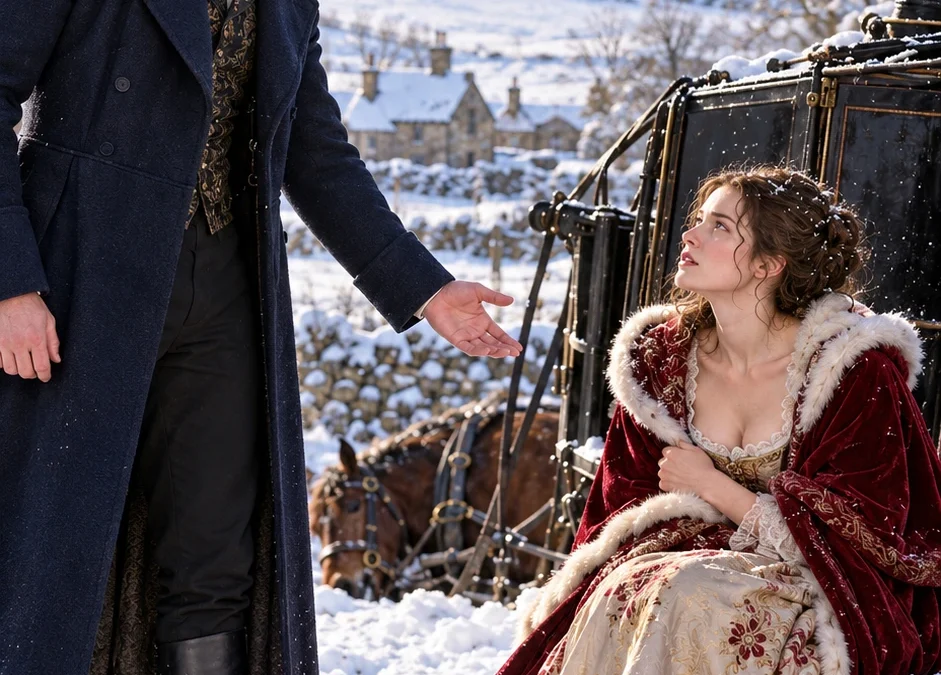
😱 The Duke Left a Frozen Bride to Die in the Snow… Then the Wrong Man Found Her, and He Hated Her Fiancé More Than Anyone Alive 🥶🔥
PART 1
❄️ Snow doesn’t care about bloodlines. It freezes a duke just as thoroughly as a ditch digger.
The winter of 1814 did not arrive. It invaded.
Roland Pendleton, Duke of Westford, sat in the dark of his traveling coach on the Yorkshire moors, wrapped in three layers of wool, unable to feel his toes. He was thirty-two, scarred by a musket ball that still ached when the weather turned, and thoroughly sick of his title. Outside, the wind howled like a beaten dog.
Then the carriage lurched to a halt.
“Obstruction, your grace!” Bates, the driver, bellowed. “Dead horse in the road. Carriage overturned!”
Roland shoved the door open himself. The wind hit him like a closed fist. He waded forward through snow past his knees, and there, in the swinging yellow beam of the lantern, lay a light shay with its axle snapped in two, and a horse already half buried in the drifts.
And then he saw her. 😨
A woman sat on a leather trunk in the lee of the wreck, in a dark blue velvet pelisse, expensive, stylish, and useless against a blizzard. Her silver-blue silk hem was frozen stiff, clinging to the snow like shattered glass. She wasn’t moving.
Roland dropped to one knee and pressed his bare fingers to her neck. Skin like marble left out in the frost. But beneath the ice, a pulse. Slow. Thready. There.
“Look at me,” he demanded.
Her frost-caked lashes fluttered. Slowly, agonizingly, she lifted her head. High cheekbones, a sharp aristocratic jaw, eyes a dark, stormy gray. She did not look terrified. She looked profoundly, deeply annoyed.
“Are you real?” she rasped. “Or am I hallucinating a duke in a ditch?”
Roland froze. He knew society’s faces. He made it his business to know the players, even if he despised the game.
“Lady Clara Lynfield,” he said. The name tasted like ash. The impoverished daughter of the Earl of Trent. The woman who, to save her father from debtors’ prison, had agreed to marry Lord Joseph Carmichael.
His eyes dropped to the trunk. The brass plate bore a crest: a stag bleeding from the neck. The Carmichael crest. 💔
Joseph Carmichael, the man who had abandoned his post in the war, forged a dispatch to cover his cowardice, and left Roland’s twenty-year-old brother to take the blame. The court-martial that followed had driven Edward to a pistol in a quiet London study.
Roland looked down at the woman freezing to death. Joseph’s prize. Joseph’s future wife. A cold, dark venom curled in his stomach. It would be so easy. He could climb back into his carriage and leave her to the ice, and Joseph Carmichael would face a dead bride and a scandal he could never buy his way out of.
Clara saw it all in his eyes. The recognition. The hatred. Her cracked blue lips curled into a bitter, trembling smile.
“Go on, then,” she whispered, teeth clicking. “Leave me. I would.”
She wasn’t pleading. She wasn’t crying. She was waiting for the end with a defiant, cynical dignity that caught him entirely off guard.
Roland swore, a harsh, ugly word swallowed by the storm. Then he bent down, lifted her out of the snow, and carried her to his carriage.
“Put me down,” she groaned, though she clung to him harder.
“Shut up. If you die in my carriage, I’ll be questioned by the magistrate, and I don’t have the patience for the paperwork.”
Inside, he draped his heavy greatcoat over her, peeled off her soaked gloves, and rubbed her icy hands between his palms. She hissed in pain.
“It’s supposed to burn. It means the blood is moving.” His voice was gravel. “Where is he, Clara?”
“The axle snapped. The post boy was thrown. He broke his neck.” Her voice was monotone. “Joseph cut the remaining horse from the traces.”
Roland’s hands stilled for a fraction of a second.
“He said he was riding for help. He said he would send a carriage from the Red Lion.” A harsh, broken sound escaped her throat. It took him a moment to realize it was a laugh. “That was this afternoon.”
Roland looked out the frosted window. Past nine o’clock. The Red Lion was barely four miles back. Joseph could have ridden it in an hour. He was almost certainly sitting by a roaring fire, drinking hot brandy, telling the landlord it was too dangerous to send a rescue party until morning. 🥃
“He sold you out, Lady Clara,” Roland said quietly. His voice was a scalpel. “He traded your life for a warm hearth.”
She opened her gray eyes. She did not look shattered. She looked utterly, fundamentally cold.
“I know,” she whispered.
Before he could reply, the carriage gave a sickening lurch. A wheel cracked. The horses screamed. And through the swirling white, Roland spotted a dark shape on the hillside: an abandoned shepherd’s toll house.
He hauled her over his shoulder like a sack of grain and began the brutal march through thigh-deep snow. He kicked the swollen door open and dumped her on a bench before a stone hearth. He shattered a broken chair into splinters, struck flint to steel, and coaxed a flame to life.
“Take the cloak off,” he commanded. “The velvet is frozen. It will melt against your skin and you’ll freeze from the outside in. The gown too.”
Her pride flared even through the hypothermia. “I will not strip for the Duke of Westford in a ruined barn.”
“I have seen men blown to pieces, Lady Clara. Your collarbones do not interest me.” His eyes were hard, unsentimental. “Wet means dead.”
She searched his face for cruelty. She found only brutal pragmatism. When her cramped fingers failed at the buttons, he undid them himself, clinically, never lingering, and draped his own dry jacket over her shoulders. Then he sat across the fire and passed her his flask. She swallowed, choked, and swallowed again, and a bruised pink crept back into her cheeks. 🔥
“Why did you do it?” Roland asked at last. “Agree to marry him.”
“My father owes forty thousand pounds to the Crown. We have no sons. When he dies, the estate reverts, and my sisters and I are put out on the street. Joseph offered to pay.”
“Joseph is a liar, a fraud, and a coward.”
“I know,” said Clara. “I am a woman, your grace. I do not have the luxury of honor. I have a price. Joseph met it. I did not require him to be a good man. Only a rich one.”
“And tonight? When he left you to die in a snowbank?”
She looked into the flames, and the dark anger rising in her eyes danced with them.
“Tonight I learned that even a pragmatist can miscalculate. He thought I would die. He thought he would keep the dowry agreements and play the grieving widower.”
Roland watched her. She wasn’t crying over a broken heart. She was calculating the tactical error of her alliance. And with startling clarity, he realized he respected her.
“So,” he said softly, a dark, dangerous smile tugging at his mouth. “What are you going to do about it, Lady Clara?”
The air between them went heavy and charged.
“I am going to survive this night,” she said, her voice dropping to a harsh whisper. “And then, your grace, I am going to ruin him.”
PART 2
The storm broke just before dawn, leaving a silence so absolute it made Roland’s ears ring.
Through the long night, as the fire burned low, he had told her what he had never told anyone. About Edward. A romantic who thought war was a painting. A boy who took a forged order from a gentleman’s hand because gentlemen do not question the honor of other gentlemen.
“I found him,” Roland said, throwing an iron spike into the dirt. “I tracked Joseph to his club the night after the funeral. I was going to beat him to death on the steps of White’s. My uncle stopped me. If I hanged, the dukedom fell to a cousin who’d gamble it away in a year. So I waited. I watched him buy his way back into favor. I watched him buy you.”
“He didn’t buy me,” Clara said softly, her chin lifting. “He rented me. The lease is officially broken.”
She didn’t offer him pity. She knew men like Roland despised it. Instead she explained how ruin truly worked. Joseph was a creature of society. He breathed invitations and the nod of the Prince Regent. “A man who leaves his bride to freeze so he can drink port by a fire? That offends the ladies of Almack’s. That offends the mothers who decide who is received and who is cut dead.”
“Get some sleep,” Roland said at last, something rougher than harshness in his voice. “Tomorrow you get your ruin.”
At dawn, he shoved his own dry boots onto her feet, lifted her onto a carriage horse, and led it three miles through chest-deep snow to the Red Lion. When they arrived, Clara gripped the horse’s mane, eyes fixed on the inn with terrifying intensity.
“Ready?” he asked.
“Help me down.”
Roland threw open the tap room door. The heat hit like a wall, thick with bacon and stale ale. And there, in the corner by the fire, wearing a fresh burgundy waistcoat with a plate of eggs and thick-cut ham before him, sat Lord Joseph Carmichael, laughing with the innkeeper. 🍳
The door slammed like a cannon shot. The room fell silent, table by table. Joseph turned, irritated, and saw Roland. His face lost all color. His fork clattered to the plate.
Roland stepped aside.
Clara walked in wearing nothing but a man’s oversized greatcoat and boots, hair wild, face pale as death. The whole tap room gasped.
“How am I alive, Joseph?” Her voice cut through the silence like a whip.
“Clara, my God. I sent men! I told the landlord to send a party the moment the snow stopped!”
“You lied,” the innkeeper said bluntly, arms crossed. “You told me the carriage was safely lodged at the way station. You ordered hot water and a roast.”
A murmur of disgust rippled through the room. Joseph’s panic curdled into cornered fury. He lunged and seized Clara’s wrist. “Come upstairs, now, before you make a fool of us both!”
Roland moved.
His hand wrapped around Joseph’s throat. With one effortless shove he slammed the smaller man against the stone mantle, boots off the floor, forearm crushing his windpipe.
“She told you not to touch her,” Roland whispered.
Clara stepped forward. She looked at the man she had almost married, at the sweat on his forehead, the pathetic terror in his eyes, and felt nothing but cold, clean relief.
“The engagement is broken, Lord Carmichael. My father’s solicitors will call on your man of business Monday. If you speak my name in London, his grace has graciously offered to explain the exact nature of your cowardice to every club in St. James’s.” She looked at Roland. “Let him go. He isn’t worth the dirt on your boots.”
Roland held him three more seconds. Then he let go. Joseph slid down the stone, coughing, and looked around. Every face wore raw, unadulterated contempt. Lord Joseph Carmichael was entirely, irrevocably ruined. 😤
They left at noon in a hired post-chaise. Clara wore a borrowed gray wool gown, too broad at the shoulders and too short at the hem. The silence stretched twenty miles before Roland broke it.
“He is dead in society. But you spent the night unchaperoned in a derelict building with me. You walked into a public inn wearing my coat. Your reputation is as ruined as his. No gentleman will offer for you now.”
Her hands tightened in her lap. “If you intend to gloat, Westford, get on with it. I gave you the weapon to destroy your brother’s killer. You owe me nothing.”
“I am not mocking you. I am assessing the battlefield.” His dark eyes locked on hers. “You require a husband with the capital to clear forty thousand pounds and the power to make your ruin irrelevant. Such a man exists. He is sitting across from you.”
The carriage hit a rut. Neither of them moved. 😳
“You are mad,” she whispered.
“I am entirely rational. I require a wife. The dukedom requires an heir. My mother has spent three years parading giggling debutantes through my drawing room, and none would survive a week in the north without weeping. You sat in a blizzard, calculated the odds of your survival, and plotted the destruction of your enemy. You did not weep. You do not require me to pretend to be a romantic.” He laid out his terms. Her father’s debts paid in full. Independent fortunes for her sisters. In exchange, she would marry him, manage his estates, and stand beside him in London. “And Joseph Carmichael will spend the rest of his miserable life knowing the woman he abandoned became the most powerful duchess in England, married to the man he fears most.”
It was not a lifeline. It was a fortress.
“Why?” Clara’s voice shook for the first time since the cold. “You could have any woman in England. Why me?”
“Because you didn’t ask me to save you,” Roland said quietly. “You asked me for the coat, and you saved yourself.”
She thought of her father, drinking himself to sleep in terror of the bailiffs. Of her sisters, naive and unprotected. Of Joseph choking against a stone mantle. Then she reached her hand across the narrow carriage.
“Pay the debts by Friday, your grace, and I will marry you on Monday.”
He gripped it. Warm, massive, calloused. “It is a bargain, Lady Clara.”
It wasn’t love. It was something far more dangerous. 💍
They were married on a Tuesday, in a sleet-lashed, empty church. No white roses. No organ. Roland did not kiss her. He simply handed the Earl of Trent a thick sealed envelope containing the final discharge of forty thousand pounds.
London did not react with shock. Shock needed a breach of decorum they could comprehend. This was a tectonic shift. Within two days, the new Duchess of Westford had demanded five years of ledgers, found three separate instances of embezzlement in the first hour, and fired the steward before lunch.
Roland watched from the doorway of his study, arms crossed, a rare, genuine smile tugging at his scarred mouth.
Two weeks after the wedding, the invitations arrived. “They want to see the damage,” Clara said, dropping the gold-embossed card on the breakfast table.
That night, Roland came to her door himself, carrying a flat velvet box. Inside lay the Westford diamond collar, ancient, heavy, brutal, stones so large they looked like chunks of frozen ice. He fastened it around her throat, his bare fingers brushing her nape. Her breath hitched.
“You are not a victim, Clara. You are my wife. Let them look. And let them realize they cannot touch you.”
When they descended the staircase at the Leven ball, five hundred pairs of eyes turned. The crowd parted. The matrons who had meant to cut her dead took one look at the diamonds and the cold violence in Roland’s eyes, and curtsied. 👑
But it was mid-June, at a masquerade, when the ghost returned.
Clara stepped out onto a moonlit terrace, champagne in hand, seeking air.
“Clara.”
The glass trembled. She turned.
Joseph Carmichael stepped from the shadows. His coat was a season out of date, his cuffs frayed, his arrogant sneer replaced by a feral twitch. He smelled of cheap gin. He was bleeding money, and he had nothing left to lose.
“Does your great duke know,” Joseph hissed, “that you let me into your bedchamber at Trent Park? That you’re damaged goods?”
It was a pathetic, desperate lie. Clara looked at him like a scientist examining a dying insect. “He didn’t marry a virgin, Joseph. He married a weapon.”
Joseph lunged and seized her bare arm in a bruising grip.
And a massive hand in a white evening glove clamped down on the back of his neck. 😱
PART 3
Roland stepped into the moonlight. He didn’t look angry. He looked empty. It was the terrifying hollow calm Clara remembered from the toll house, the face of a man who had already decided to kill.
“I told you what would happen if you ever spoke her name in London,” he whispered.
Joseph’s knees buckled. His face turned a mottled red as he clawed at the iron grip.
“Roland,” Clara said. She didn’t shout. She simply said his name.
He did not look at her.
“He touched me. He stained my glove. That is all he did.” Her voice was smooth as silk. “Do not break his neck on Devonshire’s terrace. The paperwork will be exhausting.”
The muscle fluttered wildly beneath his scar. Five agonizing seconds he held Joseph on the edge of unconsciousness. Then he threw him. Joseph crashed over a stone bench and hit the paving, gasping and coughing, entirely broken.
“If I see you in England again, I will not warn you,” Roland said. “I will simply bury you.”
Joseph scrambled backward on hands and knees like a beaten dog and vanished into the dark garden, never to be seen on English soil again. 🐕
The terrace fell silent. A waltz drifted faintly from the ballroom. Roland turned and saw the red marks blooming on her arm. His chest heaved in one great, shuddering breath. He stripped off his white glove, hurled it over the balustrade, and traced the marks with his bare thumb, incredibly gently.
“Did he hurt you?” The gravel in his voice was thick with an emotion he could barely hold.
“No.” She looked up into his face. The cynical mask had cracked, and beneath it she saw the raw, terrifying depth of what he felt. He hadn’t protected his property. He had protected his wife. “Let us go home, Roland.”
The carriage ride back to Grosvenor Square mirrored their first journey. The squabs were warm, the air smelled of rain and not ice. But the silence was just as heavy. It was no longer the silence of two predators circling. It was the silence of two people who had run out of armor. 🌧️
She did not go up to her separate wing. She followed him into his study, dark but for a low fire in the marble hearth. Roland poured two brandies, his back to her, shoulders rigid.
“I should have killed him at the Red Lion. I should have saved you the indignity of ever seeing his face again.”
“If you had killed him, you would have hanged, and I would have been left with nothing.” She took the glass and set it down on his desk, untouched. “We made a bargain. A functional, cold bargain. I gave you vengeance. You gave me security. We have achieved both. Are you satisfied, Roland?”
He stared into her gray eyes. He thought of the empty, sprawling years spent nursing his brother’s ghost. He thought of the cold, dead thing that had lived in his chest, keeping him sharp and alone. He looked at the woman who had frozen in the snow, plotted her own rescue, worn his diamonds, and crushed his enemies.
“No,” he said, barely a whisper. It was a confession. “I am not satisfied.”
He closed the distance between them.
“I told myself I married you to punish him. It was a lie. I realized it the moment you walked into that tap room wearing my boots. I married you because I looked at you and understood you were the only person in the world who knew what it meant to survive.” He cupped her face in his large, scarred hands. “You don’t have to be strong anymore. You don’t have to calculate the odds. You are safe. I swear to God, Clara, you are safe.”
A single hot tear broke loose and tracked down her cheek. It wasn’t sorrow. It was the crushing relief of laying down a burden she had carried far too long. 🥹
“I don’t want to bargain anymore.”
“Neither do I.”
He kissed her. It was not the polite, clinical kiss of a political marriage. It was deep, desperate, and entirely consuming, tasting of brandy and fire and the sudden, violent rush of a long, brutal winter finally breaking. Her hands tangled in his dark hair. His arms wrapped around her, holding her as though she were the only solid thing in a collapsing world.
The walls she had built over a lifetime, the careful defenses of a woman sold for debt, shattered completely. And there was no cold left in the room. There was only heat. 🔥
Later, as the fire burned down to glowing embers, Clara lay with her head against his bare chest, listening to the steady, powerful thud of his heart. His arm was wrapped heavily around her.
“It stopped snowing,” she whispered into the dark.
Roland pressed a kiss to the top of her head and tightened his hold.
“Yes,” said the Duke, his voice finally, entirely at peace. “It stopped.” ❤️
The story of the Duke and Duchess of Westford became the stuff of legend in London drawing rooms. Society never did decide whether it was a scandal or a romance, and the Duchess never bothered to correct them. The Westford estates prospered under her ledgers. Her sisters married for love, with fortunes of their own. And every winter, when the first snow fell, the Duke would find his wife standing at the window, and he would quietly wrap his coat around her shoulders.
Revenge might have brought them together, but it was their shared survival that forged a bond stronger than any scandal society could throw at them. Sometimes the coldest nights lead to the warmest fires, and the most broken people make the strongest alliances. 🕯️
💬 Did you expect Roland to use Clara as a weapon, or did you see their romance coming from the moment he found her in the snow? Tell me in the comments below, and let me know where you’re reading from tonight! 👇
Disclaimer: This story is entirely fictional and created for entertainment purposes only. It does not represent any organization or individual, nor does it encourage inappropriate behavior. The content was generated with AI assistance.








