THE DUKE LET HIS BRIDE RIDE HIS DEADLIEST STALLION IN FRONT OF 47 GUESTS… BUT WHEN SHE LIFTED THE SADDLE FLAP AND FOUND WHAT WAS HIDDEN BENEATH, SHE ASKED HIM ONE QUESTION, AND HIS ANSWER ENDED THE ENGAGEMENT FOREVER
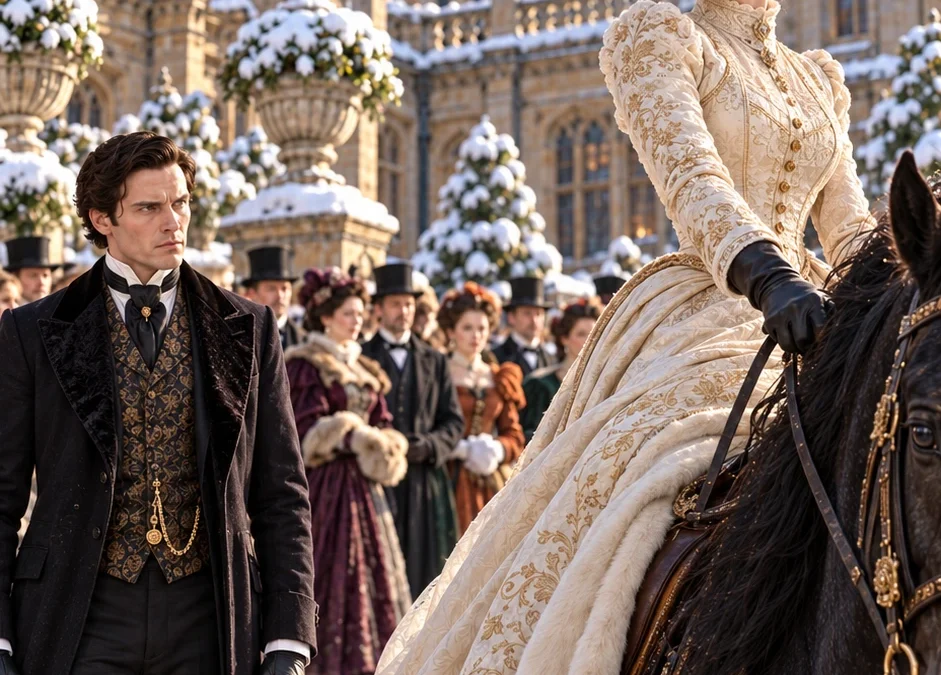
THE DUKE LET HIS BRIDE RIDE HIS DEADLIEST STALLION IN FRONT OF 47 GUESTS… BUT WHEN SHE LIFTED THE SADDLE FLAP AND FOUND WHAT WAS HIDDEN BENEATH, SHE ASKED HIM ONE QUESTION, AND HIS ANSWER ENDED THE ENGAGEMENT FOREVER 😱
Part 1
In the final days before her wedding, Eleanor Whitmore opened a velvet box sent by her future husband.
Inside lay a breathtaking strand of pearls. But the back of the pendant did not carry her name.
It carried words meant for another woman. 💔
When she asked Adrien Blackwood, the Duke she was about to marry, he only smiled and called it an old family joke.
Three days later, her wedding gown no longer fit. A secret letter warned that Adrien meant to end the engagement. And on a hunt through the winter snow, he would let her ride the most dangerous black stallion at Blackthorne Hall.
Eleanor did not yet know that this horse would be the one to finally show her the truth.
The winter of 1885 came to London early, and stayed without mercy. Snow had fallen for three days straight, burying the cobblestones of Regent Street beneath a thick white silence. The wind threw itself against the tall windows of Bellamy and Sons, the finest dressmaker in the city, and rattled the panes as if it wanted to be let inside.
But inside, everything was warm. A fire crackled in the marble hearth. The air smelled of new silk and beeswax candles. And in the center of the fitting room, standing very still on a small velvet platform, was Eleanor Whitmore.
She was twenty-seven, and she had been told more than once that she was nearly too old to marry well. The Whitmores were an ancient family, older than most of the houses that now looked down on them. But age does not pay debts. Her father’s estates had been shrinking for a decade. Eleanor understood, with the clear-eyed practicality that had always set her apart, that her marriage to Adrien Blackwood, Duke of Blackthorne, was not only a matter of the heart. It was land. It was security. It was the future of her father and her young cousin Clara, who lived with them and depended on them.
Still, when she looked at Adrien, she had allowed herself to hope it could be love as well. 🕯️
Mrs. Bellamy knelt at the hem of the gown, pins between her lips. The dress was ivory satin with a bodice of delicate lace, and it fit as though it had grown around her.
The bell above the shop door chimed. A footman in the dark green livery of Blackthorne Hall stepped inside, snow melting on his shoulders, carrying a small box wrapped in deep blue velvet.
“A gift, miss, from his grace.”
Eleanor stepped down, took the box in her gloved hands, and opened the lid. Resting on cream silk was a strand of pearls so perfect they seemed to hold their own light. At the center hung a pendant shaped like a lily, its petals worked in gold so fine that each vein could be traced with a fingertip. The women around her sighed.
Eleanor lifted the necklace, and the pendant turned in the firelight.
On its back, engraved in a graceful script, were words. For the woman who was always meant to wear it.
She read the line once. Then again.
It was not her name. It was not her initials. The warmth of the room seemed to drain away. She asked the footman, in a voice so calm no one noticed anything wrong, whether there had been a letter with the gift.
“No letter, miss. Only the box.”
She thanked him and closed the lid slowly, the way one closes a door on a room one does not wish to enter again. 😶
That evening she rode through the snow to Blackthorne Hall. Adrien received her in the library, tall and composed as always, firelight touching his dark hair. She set the box between them and turned the pendant so he could read it.
He glanced at the engraving and smiled. “It belonged to the family collection. My late mother purchased it many years ago. The words are only an old family joke. Nothing more.”
“Then whose name should have been here?”
For one breath, he said nothing. Then: “It is a family matter.”
She took the box back without another word. She was beginning to understand that the man she was about to marry was choosing very carefully not to tell her something.
On her way out she took a wrong turn in the long east corridor, where the gas lights burned low and the portraits of dead Blackwoods watched from gilded frames. Between two paintings hung a small photograph she had never noticed. A much younger Adrien, standing in a summer garden, laughing in a way she had never seen him laugh. Beside him, a woman with dark hair and a knowing smile, her hand resting on his arm as though it had always belonged there.
Beneath it, in faded ink, someone had written her name.
Vivien Ashcombe. 😨
Twelve days before the wedding, Vivien Ashcombe arrived at Blackthorne Hall for dinner.
Eleanor had been seated only a few minutes when the doors opened and a woman in midnight blue swept in. She did not pause at the threshold the way guests do. She walked straight to the chair on Adrien’s left, nearest the fire, as though her body remembered the way. She greeted the butler by his first name and asked after his daughter. She moved through that room like someone who had lived in it.
Then she rested two fingers lightly on Adrien’s shoulder and said, “Adrien, darling.”
It was such a small touch. It lasted less than a second. No one at the table noticed.
But Eleanor noticed the way Adrien’s shoulders shifted beneath it. Not away. Not toward. Simply a stillness, as though something old inside him had been disturbed and was waiting to see what would happen next.
Vivien was charming. That was the most difficult part. She was witty and warm, and asked Eleanor polite questions about her family and her favorite novels. If Eleanor had been a little less observant, she might have liked her.
Then the talk turned to the winter hunt, held every year on the frozen grounds of Adrien’s country estate, a few days before the wedding. Adrien mentioned that Eleanor would ride with them.
Vivien set down her glass. “And which horse does he intend to give her?”
She went on in the same light, musical voice. The winter ground at Blackthorne was treacherous. Newcomers so often found the terrain unfamiliar. And of course, Adrien had always preferred riders who could keep pace with him.
Each sentence was a small blade, slipped in so neatly it barely drew blood.
After dinner, Eleanor found Adrien alone by the window. She did not waste words.
“How long has she been in love with you?”
He did not pretend to misunderstand. “Since we were young.”
“And does she know about the necklace?”
A long silence. “She might.”
“And you still sent it to me.”
“I thought it suited you.”
Standing there with the cold radiating from the glass, Eleanor understood something she would carry for the rest of her life. Adrien did not necessarily want to hurt her. He was not a cruel man. But he had chosen, again and again, not to face the truth. And a man who refuses to face the truth will allow almost anything to happen in its shadow. 💔
Nine days before the wedding, a letter arrived at the Whitmore townhouse. No seal. No return address. Signed only, A Friend.
Adrien, it said, had told certain members of his household that he intended to break the engagement before the wedding day.
Eleanor read it three times. She did not cry. She put on her cloak and went to find him in the stables at Blackthorne Hall, among the warm smell of hay and horses, his hand running along the neck of a gray mare.
She held up the letter. She asked one question. “Do you intend to end our engagement?”
Adrien did not answer. The horses shifted in their stalls. The silence stretched on and on, and it told her everything a spoken word could have told her, and perhaps a little more.
And seven days before the wedding, at the dressmaker’s, Eleanor would step behind a screen, slip into her ivory gown, and discover that someone had destroyed it… 😱
Part 2
Someone had destroyed it.
Eleanor did not storm through Blackthorne Hall demanding answers. She did something far quieter and far more effective. She began to pay attention. She asked the housekeeper gentle questions about the family’s history while admiring the tapestries. She took tea with Lady Margaret Blackwood, Adrien’s widowed aunt, who loved nothing more than a willing listener. She listened to the maids chatting on the back stairs.
Within a few days, the shape of the truth emerged like a figure slowly appearing through falling snow. Adrien and Vivien had known each other more than twenty years. Their families had been neighbors, and for most of that time, everyone assumed the two would one day marry. But the Ashcombe fortune had faded. And when Adrien’s mother died, the family solicitors began to speak seriously about land, about the valuable stretch of Whitmore property bordering the Blackthorne estate. A marriage to Eleanor would unite those lands and settle a quarrel three generations old.
And Adrien had never truly argued against it. He had not chosen her. He had simply allowed himself to be steered toward her.
Seven days before the wedding, Eleanor returned to Bellamy and Sons for another fitting. Snow fell in thick white curtains outside. Lady Margaret came with her, and a companion from the Blackthorne household, and, to Eleanor’s quiet surprise, Vivien Ashcombe, who had declared she simply adored weddings.
Mrs. Bellamy brought out the gown with great ceremony. Eleanor stepped behind the screen and was helped into it.
Something was wrong at once. The waist had been taken in too far and sat painfully high. The bodice pulled to one side. The back gaped open where it had once fit like a second skin. The sleeves had been shortened so that her wrists showed pale beneath the lace.
When she stepped out and faced the mirror, the room fell silent. Mrs. Bellamy went white. With trembling hands she produced a sheet of paper: a new set of measurements, delivered to the shop with instructions that the gown be altered accordingly.
Eleanor studied it. The numbers were neat and confident, and not one matched her body.
“Who delivered these?”
Mrs. Bellamy glanced toward the companion who had arrived with Lady Margaret. The young woman flushed and looked at the floor. Eleanor followed the line of her gaze a little farther, to the window, where Vivien stood in pale blue silk, looking out at the snow as if she felt the attention settle on her.
Vivien turned. And she smiled.
It was the smallest smile in the world, the corner of her mouth lifting for an instant. But Eleanor saw it. 😠
She did not raise her voice. She folded the paper. “Mrs. Bellamy, I would like to keep this.” Then she crossed to the window.
“That shade of blue suits you beautifully.”
“Thank you.”
“Adrien has always said you have wonderful taste.” She let the words fall between them, delicate as snowflakes. “How fortunate to still be remembered so well, after so many years.”
For the first time, the smile on Vivien’s face faltered. In that moment she understood that the woman before her was not foolish, not naive, and not nearly as easy to push aside as she had believed.
That evening, Eleanor laid the paper on Adrien’s desk and told him everything. He listened without interrupting. Then he said he would speak with Vivien.
“She deliberately humiliated your future wife in front of a room full of people.”
“I will make it perfectly clear that such behavior cannot be tolerated.”
Eleanor almost laughed, though nothing about it was funny. “Do you hear yourself? Every time something happens, you appear afterward with calm words and a careful plan. You manage the consequences. But you never, not once, prevent anything from happening in the first place.”
“I am not letting this pass.”
“No,” Eleanor agreed. “You are managing it. And those are two very different things.”
She walked out. Beyond the windows, the snow began to fall harder, erasing the footprints in the courtyard as quickly as they were made. 💔
In the farthest stall of the east stable at Blackthorne’s country estate lived a horse that most of the grooms refused to approach.
His name was Black Winter. Sixteen hands tall, a coat so dark it seemed to swallow the lantern light, a mane that fell across his neck like spilled ink. He had thrown two experienced riders in a single season. He shied at shadows, bolted at sudden sounds, flattened his ears at anyone who came near. Everyone called him dangerous.
None of those stories told the truth. Black Winter was not vicious. He was afraid.
Only one man truly understood that. Samuel Mercer had been master of the Blackthorne stables for thirty years, a weathered, soft-spoken man with hands like old leather and eyes that missed nothing. So when a note arrived for him on heavy cream paper, in a graceful hand, bearing the authority of the household, he read it twice with a deepening frown.
It was from Vivien Ashcombe. It instructed him to bring Black Winter into the yard on the morning of the hunt, and prepare him for the future duchess. In thirty years, Black Winter had never been handed to an unfamiliar rider without weeks of careful preparation. And Vivien Ashcombe understood horses very well.
Samuel folded the note into his coat. He did not take it to Adrien. He had served the Blackwoods long enough to know the Duke preferred not to hear about trouble until it could no longer be avoided. Instead, he kept the paper close, and his eyes open.
Five days before the wedding, the household traveled to the country estate for the hunt. In the stable yard, Adrien told Eleanor she would ride Silvercrest, a gentle gray mare. She glanced down the row of stalls toward the far end, where a dark shape paced restlessly in the shadows.
“And what about Black Winter?”
He answered almost too quickly. “He is not suitable.”
“I am not a beginner.”
“I know.” But he offered nothing more. Only that same careful stillness she had begun to recognize as the place where his honesty stopped.
That night, just after midnight, she heard a faint whisper of paper against the floorboards. An envelope had been slipped beneath her door. The handwriting was rough and careful, the hand of a man who wrote rarely and chose every word. It was signed Samuel Mercer.
I believe you need to know something about Black Winter.
He wrote that he had received written instructions from Miss Ashcombe. He did not claim to know the whole of what was intended. He was a stableman, not a detective, and would not accuse anyone of what he could not prove. But he had spent thirty years among horses and the people who owned them, and he knew when something was wrong.
Whatever else happens, you must not let anyone put you on that horse.
Eleanor read it four times. Then she folded it and placed it beside the lily pendant and the false measurements. Three quiet pieces of evidence, side by side on a little writing desk.
She did not sleep. By dawn, she had made a decision.
The morning of the hunt arrived in a swirl of fresh snow. In the great courtyard, forty-seven distinguished guests had gathered, lords in scarlet coats, ladies in fur-trimmed riding habits, carriages lining the drive. Eleanor stepped out in charcoal gray, gloves buttoned, face calm. Everyone expected her to be led to Silvercrest.
But the horse the grooms brought forward was not the gentle gray mare.
It was Black Winter. 😱
He came into the yard fighting every step, tossing his head, stamping the snow. And Eleanor, to the horror of every guest, turned and said she wanted him…
Part 3
The great stallion tossed his head and yanked at the reins. He swung his hindquarters away from anyone who reached for him. His nostrils flared. His breath came in hard, ragged bursts, and every time a carriage door slammed or a hound barked, his whole body jolted as though he had been struck.
A murmur ran through the crowd. Several ladies stepped back. One gentleman muttered that the beast ought to be shot.
Adrien pushed through, pale. “Eleanor. That is not your horse.”
She did not look away from the stallion. “No. But today I want him.”
A hush fell. Adrien lowered his voice. Eleanor did not lower hers. She asked him a question clearly and evenly, so that everyone within hearing could understand every word.
“Did you know that this horse would be brought out for me this morning?”
He hesitated. “I knew there had been a suggestion.”
“Yes,” said Eleanor, holding his gaze. “Or no.”
The silence seemed to last forever. Then Adrien answered.
“Yes.”
Forty-seven people heard it. 😶
Eleanor turned away and walked toward Black Winter. She did not reach for the reins. She did not try to mount. She stopped several paces away and simply raised one gloved hand, palm open. The stallion threw his head back and retreated, hooves skidding on the snow.
She stopped. She waited. She let her breathing slow, let her shoulders soften, let the stallion see that she was not going to chase him. When his ears flicked forward, she took a single step. Then stopped again. Another long wait. Another step.
The courtyard had gone utterly silent.
At last Black Winter lowered his great dark head. Eleanor laid her hand on his neck. The stallion trembled beneath her touch, and then slowly let out a long, shuddering sigh. The breath of an animal braced for pain for so long that he had forgotten any other way to stand. 🥹
At the edge of the crowd, Samuel Mercer watched with arms folded and jaw tight.
Eleanor’s hand moved down the stallion’s neck, to his shoulder, to the saddle. She bent and slid her fingers beneath the girth strap, and went very still.
Something was wrong. The girth had been cinched brutally tight, far tighter than any competent groom would allow. Worse, the saddle had been set too far forward, so that its hard front edge pressed directly into the tender muscle behind the shoulder. Every step drove that edge deeper. Every breath strained against the strap.
She understood now why he had been fighting since he entered the yard. He was not wild. He was in pain. And a horse in pain does not think. It jerks. It panics. And when it can bear no more, it throws whoever is on its back as hard and as far as it can. On frozen ground, among stone walls and iron gates, a fall like that could break a rider’s neck. 😨
“Who saddled this horse?” she asked the young groom holding the lead.
He stammered. Helplessly, his eyes slid toward the edge of the crowd, where a servant in the Ashcombe livery stood beside Vivien.
Samuel Mercer stepped forward through the snow.
“I did not approve this.” His rough voice carried across the courtyard. He drew out a folded sheet of cream paper and held it up so the household mark at the top could be seen. “These are the instructions I received.”
Vivien laughed lightly, though the sound was thin. “It was obviously a servant’s mistake. A careless boy.”
Samuel did not raise his voice. “Three men saw your servant enter the tack room at dawn this morning. They saw him leave with this saddle.”
The courtyard seemed to freeze solid. Forty-seven faces turned toward Vivien Ashcombe. For the first time in all the years anyone at Blackthorne had known her, she had nothing at all to say.
Eleanor did not join the argument. She turned back to Black Winter and, with steady hands, began to unbuckle the girth. The stallion flinched, and she paused, murmuring until he stood still. She loosened the strap. She lifted the saddle, moved it back to where it belonged, smoothed the blanket, and fastened the girth again at a fair and gentle tension.
Almost at once, the change in the animal was visible. His head came down. His ears softened.
Eleanor rested her forehead briefly against his neck. “You are not a monster,” she whispered. “You never were.”
Then she put her foot in the stirrup and swung into the saddle.
A gasp rippled through the crowd. Black Winter shifted, uncertain, and she let him stand until he settled. She walked him in a slow circle. Then a trot. Then an easy, rolling canter across the packed snow, his black mane streaming, his hooves throwing up bright sprays of powder. Forty-seven guests watched in stunned silence as the most feared horse at Blackthorne moved beneath this quiet woman with perfect calm, as though he had been waiting his whole life for someone to simply listen to him. 🔥
She brought him to a halt in the center of the courtyard and looked down at Adrien.
“Did you know?”
“I knew the horse was unsettled.”
“No. You knew they meant to give him to me.”
He was silent. Then, at last, he admitted it. Vivien had told him Eleanor ought to prove she could manage a difficult horse before she became mistress of the estate.
“And you thought I needed to prove it?”
He looked up at her. “Yes.”
One word. But in that single word, everything Eleanor had suspected over the past twelve days came together and locked into place. The necklace engraved for another woman. The anonymous letter. The ruined gown. Vivien’s knowing smiles. The long, careful silences. And now Black Winter, standing in the snow with a saddle designed to make him throw her.
Adrien had not planned any of it. But he had seen enough to understand, and he had let it happen.
Somewhere deep inside Eleanor, a door that had stood open for months quietly swung shut.
She turned Black Winter toward the gate. The forty-seven guests parted before her without a word. She did not cry. She did not shout. She did not look back at the man she had been about to marry. She rode out of the courtyard at a slow and steady walk, the black stallion calm and sure beneath her. 💔
Eleanor rode alone across the snowbound fields for most of the morning. When she returned, she led Black Winter to the stables herself and handed his reins to Samuel Mercer. The old man took them with a bow that meant more than any words.
Then she walked up to the library, where Adrien waited by the fire. Before she could speak, he began to apologize. He was deeply sorry. He would see to it that Vivien understood the seriousness of what she had done.
Eleanor let him finish. Then she asked a question he did not expect.
“What do you owe Vivien?”
He frowned.
She explained it slowly, the way one explains something to a person who has spent a lifetime refusing to see it. Vivien had used his servants. His household paper and his household seal. His stables, his grooms, his dressmaker, his house, his name. She had used every piece of his power to humiliate his future wife, and then to put her in danger. And through all of it, his only answer had been that he would speak with her.
“You have already spoken with her,” said Eleanor quietly. “Many times. And look where it has brought us.”
Later that afternoon, she found Vivien alone in the conservatory, sitting among winter ferns, gray light falling through the glass roof. The perfect composure was gone. Vivien was crying in the ragged, graceless way of someone who has held everything in for far too long.
“This house is mine,” she said.
She did not mean the deeds or the lands. She meant the memories. Twenty years in these rooms. Riding these fields at Adrien’s side since they were children. Every Christmas at this table. She had sat with his mother through the long final weeks of her illness and held her hand when she died. And she had believed with her whole heart that one day she would be the Duchess of Blackthorne. Then Eleanor had arrived, a stranger with a bordering estate and a convenient name, and in a few months been given everything Vivien had spent her life waiting for.
“He is mine,” Vivien whispered. “He has always been mine.”
Eleanor looked at her for a long moment. “He was never mine,” she said. And then, more gently: “But I am not your enemy either.”
She did not wait for an answer. She understood Vivien’s grief. She did not excuse what that grief had done. Both things could be true at once. 🥹
She returned to the library one last time. Adrien stood where she had left him.
“Did you know Vivien sent that anonymous letter?”
He looked at the fire. “I suspected it.”
“And you never confirmed it?”
“No.”
“Because if you had confirmed it,” said Eleanor, “you would have had to make a decision.”
He did not answer. The silence answered for him, as his silences always had.
She drew the engagement ring from her finger, a heavy sapphire ringed with diamonds, a Blackwood heirloom that had once seemed like a promise. She laid it on the polished table, and the small sound it made seemed louder than anything that had happened in the courtyard.
“I need someone who chooses me. Not a man who ends up marrying me because it is convenient. Not a man guided toward me by his family and his solicitors. Not a man who drifts along with whatever circumstances bring him. I need someone who looks at me and chooses me deliberately, with his eyes open. And you have never done that, Adrien. Not once.”
He opened his mouth, but no words came.
As her hand touched the door, he spoke at last. “She will never be happy.” It was impossible to tell whether he meant it as a warning or a confession.
Eleanor looked back over her shoulder.
“That is her life. It is not mine.”
She stepped through the doorway, and the door closed quietly behind her. 💔
That night, by the light of a single lamp, Eleanor wrote two letters, to her father and to her cousin Clara. In both she said the same thing in plain words. The engagement was over. She did not apologize. She did not blame anyone. She simply stated what was true, signed her name, and sealed the envelopes.
When she finished, she was surprised to find that what she felt was not grief. It was relief, like setting down a burden she had not known she carried.
In the morning, as her trunks were carried to the carriage, Lady Margaret came to find her in the hall. She looked tired, and much older than she had the day before. She took Eleanor’s hands.
“I owe you an apology. For years I watched Vivien’s behavior and Adrien’s silence and told myself I was keeping the peace. We so often call what is convenient keeping the peace. And it is nothing of the kind.”
Eleanor squeezed her hands. She did not say it was forgiven. But she did not leave in anger either.
The carriage rolled out through the iron gates and onto the long white road. Snow fell thickly, blotting out the hedgerows. Eleanor watched the great gray house grow smaller until it vanished into the storm. She did not look for it again.
She knew what awaited in London. A woman who broke an engagement with a duke only days before the wedding would be whispered about in every drawing room. But she had two things no gossip could take from her. A modest inheritance from her late mother, held in trust until her marriage or her twenty-eighth birthday, whichever came first, and her birthday was only weeks away.
And a skill she had spent her whole life perfecting, often in secret, often to the disapproval of those who thought a lady had no business in a stable. She understood horses.
On her first evening home, Clara sat beside her by the fire, wrapped in a shawl, face full of worry. “What will you do now?”
Eleanor was quiet a long time. She thought of Black Winter, the way he had trembled under her hand, how quickly his terror faded once someone took away the thing that was hurting him. Then she told Clara about a place in Hampshire called Wintermere Estate. Small and neglected, with a stone house, a long stable block, and a few hundred acres of pasture. Its elderly owner had died, and the property was for sale. On it lived twelve horses no one wanted. Horses called vicious, stubborn, untrainable, dangerous.
“Maybe they are not broken.”
“Then what are they?”
Eleanor looked into the fire. “Maybe they have only been misunderstood.” 🌟
Three weeks later, on the morning after her twenty-eighth birthday, she signed the papers that made Wintermere her own. She traveled to Hampshire alone and stood at the gate, looking over fields buried under deep, untouched snow. The stable roof sagged. The fences leaned. Somewhere inside, a horse whinnied nervously at the sound of the carriage.
Eleanor pulled off her gloves, took a deep breath of freezing air, and spoke to no one but herself.
“Let us begin.”
The work was harder than anything she had ever done, and she loved every hour. The twelve horses of Wintermere had been abandoned in every way that mattered. Some flinched at a raised hand. One mare, kept so long in a dark stall that she panicked in open air. One young gelding who would not let anyone near his head because a careless groom had once struck him across the face with a bridle. Each had been given a label by someone who had not bothered to ask why. Dangerous. Stubborn. Mad. Worthless.
Eleanor accepted none of them. She kept a thick leather journal, and for each horse wrote everything she could learn. Where it came from. What had been done to it. What made it panic and what made it calm. She never used force. She never used the whip. She used patience, observation, and a willingness to wait far longer than anyone else would. She would sit on an upturned bucket outside a stall for an entire afternoon, reading quietly, until a horse that had never trusted anyone chose, on its own, to come and rest its nose against her shoulder.
The winter was long. Snow buried the fences and weighed on the stable roof. But inside the long stable block, Eleanor kept the stove burning day and night, working from before dawn until long after dark, hands chapped, boots always wet, hair always coming loose from its pins. And slowly, one by one, the horses began to change. Ears pinned back for years began to prick forward. Eyes rolling white with fear began to soften. 🥹
In the second month, a large wagon came laboring up the snowy lane with a letter tucked into the driver’s coat. It was from Adrien. He had transferred full ownership of Black Winter to her, with Samuel Mercer’s strong approval. The horse, he wrote, belonged with the only person who had ever truly understood him.
And there in the back of the wagon stood the great black stallion. He came down the ramp slowly, testing every step. At the bottom he raised his head and looked out over the white fields, the low stone house, the smoke rising from the stable chimney. He did not bolt. He did not rear. He simply stood and breathed.
Eleanor walked to him and laid her hand on his neck, exactly as she had in that frozen courtyard.
“Welcome home.”
By spring, word had spread. First a farmer with a draft horse no one could shoe. Then a widow managing her late husband’s estate alone, told her carriage horses were unsound. Then families with frightened ponies, gentlemen with ruined hunters. Eleanor helped every one. And she noticed that more and more, they did not come only for help with their horses. Women especially began to linger over tea in her kitchen, asking her advice about their estates, their accounts, their lives, without quite intending to. Eleanor Whitmore had become the kind of woman others sought out when they needed someone to tell them the truth. 🤍
Near the end of that first year, another letter arrived from Adrien. It was not a plea. It was not a demand. It was a confession.
He wrote that he had spent many months thinking about everything that had happened, and had finally understood something. He had always believed that if he simply allowed Eleanor to see a problem, that was enough. He had shown her the necklace. He had admitted what he knew when asked. He had never lied outright. But he had come to see that transparency is not the same as honesty. Honesty, he wrote, means explaining the truth and then acting upon it. He had done the first only when forced. He had never done the second at all.
Eleanor read the letter twice by the fire. She did not write back to say she would return. She had no intention of returning. But she folded it carefully and kept it, and admitted to herself, quietly and without bitterness, that Adrien Blackwood was changing.
Then, on a still winter morning, almost a full year after she had ridden out of that courtyard, a carriage came up the lane and stopped at the gate of Wintermere. Adrien stepped down into the snow.
He stood at the gate a long moment without calling out. Eleanor watched him from the stable doorway. The arrogant ease was gone from his posture. So was the cool authority of a man who has always been obeyed. He wore a plain dark coat and held his hat in his hands, turning it slowly, the way a nervous visitor does. He was no longer the Duke of Blackthorne in his own courtyard. He was only a man who had come to see a woman he had once lacked the courage to choose.
Eleanor opened the gate. She did not embrace him, and she did not turn him away. She simply invited him in and showed him Wintermere. The long rows of stalls, each with a name painted neatly above the door. The mare who had once been terrified of daylight, now grazing contentedly in the open paddock. The gelding who had once been struck across the face, now lowering his head eagerly for her hand.
Adrien followed in silence, looking at everything, saying very little.
At last they came to the farthest paddock, where a great dark shape stood against the white field. Black Winter lifted his head. When he saw Eleanor, he came toward her at an easy trot, snow flying from his hooves, and pressed his muzzle against her coat.
“He is different now,” Adrien said softly.
“No. He is exactly the same. He is only somewhere he is finally allowed to be himself.”
Adrien was quiet. Then he spoke, and his voice was not steady.
“I have been trying to become a man who acts.”
“I know. I read your letter.”
He drew a slow breath. “And is it enough?”
The question hung in the cold air between them, fragile as the frost on the fence rails. It was the most important question he had ever asked her, and they both knew it. 😶
Eleanor let herself remember everything. The lily pendant. The anonymous letter. The ruined gown. The saddle cinched to cause pain. The forty-seven faces in that frozen courtyard. The single word he had spoken. The sapphire ring on the library table. And then she thought of everything she had built since. The twelve horses. The warm stable. The women at her kitchen table. A life that was hers and no one else’s.
“You are a better man than you were,” she said at last. “I believe that.” She paused. “But I am not the answer to whether you have changed enough, Adrien. That question belongs to you. It always did.”
She did not say it to wound him. Not out of hatred or pride or any wish for revenge. She said it because it was true.
Adrien looked at her a long moment, and she saw in his face that he understood. He nodded slowly. He did not argue. He did not plead. He put on his hat, bowed to her with a simple dignity she had never quite seen in him before, and walked back down the lane toward his carriage. 💔
Eleanor stayed by the fence. Light snow began to fall again, soft and silent, settling on her shoulders and in her hair. Black Winter lowered his great head and rested it gently on her shoulder, his warm breath clouding in the cold air.
She thought of the first day she had seen him, fighting in that crowded courtyard while grown men called him a beast that ought to be destroyed. And she thought of herself in those same days, whispered about in drawing rooms as the convenient bride, the replacement, the woman chosen by solicitors rather than by love.
Both of them had been defined by other people. But the truth was simple. Neither of them had ever been broken. They had only been placed where they did not belong, misunderstood, mistreated, forced into shapes that were never theirs. ✨
Some of the most dangerous things in this world are not wild horses in the snow. They are men who see a wrong being done, who understand exactly what is happening, and who still choose to remain silent. Eleanor Whitmore had learned that lesson in a single winter. She would never again mistake calm for character. And she would never again wait for someone else to act on her behalf.
She opened the pasture gate. Black Winter stepped out into the snow-covered field, and this time no one pulled at his reins. No one forced him to become something he was not.
And the same was true for Eleanor.
She walked forward into the white morning, and she did not look back. 🤍
Was Eleanor right to walk away, or would YOU have given Adrien another chance? Tell me in the comments, and share this with someone who needs to remember that they were never broken, only misunderstood. 👇
This story is entirely fictional and created for entertainment purposes only. It does not represent any organization or individual, nor does it encourage inappropriate behavior. The content was generated with AI assistance.








