“The Duke Must Be Eighty by Now,” She Told the Stranger Beside Her at the Inn. He Smiled and Agreed. By Morning, a Horse From the Duke’s Own Stables Was Waiting for Him…
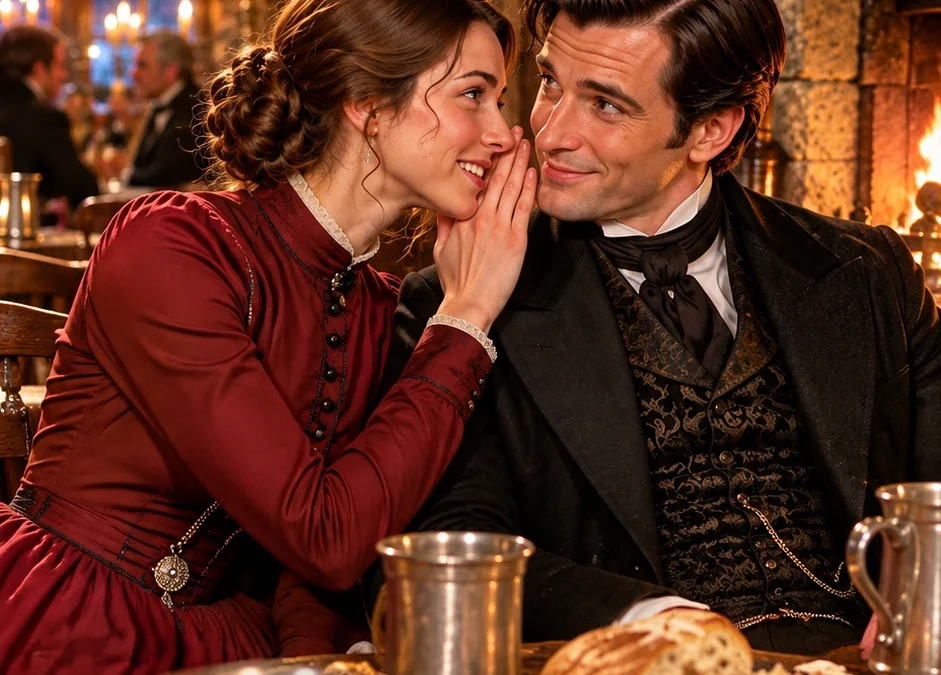
“The Duke Must Be Eighty by Now,” She Told the Stranger Beside Her at the Inn. He Smiled and Agreed. By Morning, a Horse From the Duke’s Own Stables Was Waiting for Him…
Part 1
“The Duke must be eighty by now,” Elellanena Whitcombe remarked, warming her frozen hands beside the crackling fire of a country inn.
The gentleman sitting across from her merely smiled.
And agreed. ❄️
Outside, snow was burying the roads of Northern England, leaving the two of them stranded together for the night. Elellanena had never met the mysterious Duke of Ravenshire, but she had plenty of opinions about him. Ancient. Distant. Probably as dull as the hills surrounding his estate.
The gentleman listened to every word without correcting her.
What Elellanena did not know was that he was the Duke himself.
And he was thirty-four. 😳
Winter came early to North Yorkshire that year. By mid-December it had settled over the moors like a guest with no intention of leaving.
Elellanena was twenty-six, the eldest daughter of a widowed mother from a long line of country lawyers. She was traveling north from York to the market town of Bellwick, where a wool merchant named Walter Fenwick had hired her to put his accounts in order.
She carried very little. A small valise. A basket of bread and cheese her mother had packed that morning. A leather notebook filled with columns of her own careful figures. And a silver pocket watch that had belonged to her late father.
The watch ran two minutes slow. It always had. Elellanena had never once considered having it corrected, because her father had liked it exactly that way. 🕰️
Somewhere past the last milestone before Bellwick, with the light failing and the snow thickening, the carriage lurched, groaned, and came to rest at an angle no carriage should ever hold.
The driver climbed down, inspected the wheel by lantern light, and returned with the face of a man delivering news he had no power to change. The linchpin had sheared clean through. No blacksmith in the county would ride out on a night like this. There was an inn a quarter mile back, the Fox and Lantern. They would have to wait there until morning.
Elellanena looked at the white road, the darkening sky, and the crooked wheel in the drift. She decided that complaining would not mend iron.
She gathered her valise and basket, tucked the notebook firmly under one arm, and followed the swinging lantern back through the snow, her cheeks stinging in the wind.
The Fox and Lantern was an old stone building with low ceilings, crooked oak beams, and windows glowing amber against the storm. The innkeeper, Mr. Edwin Pritchard, was a stout man of considerable years whose small, bright eyes missed very little. He took one look at the young woman shaking snow from her cloak and led her straight into the common room.
A fire roared in the wide hearth.
Only one other guest occupied the room, a gentleman in his early thirties, dressed in a coat of fine dark wool that was beautifully made and entirely without ornament. He rose politely when she entered, inclined his head, and returned to his newspaper without a single word.
Elellanena appreciated that more than any speech.
Mr. Pritchard settled her in the chair nearest the fire, promised her tea, and disappeared toward the kitchen. For several minutes there was only the crackle of the logs and the soft hiss of snow against the glass.
Then the gentleman lowered his paper.
“Are the roads to the south as bad as the roads to the north?” he asked, in a quiet, unhurried voice.
“I can only speak for one stretch of road,” Elellanena said. “It defeated my carriage entirely.”
“My own journey ended much the same way. Though my horse at least had the good manners to refuse before anything actually broke.”
Elellanena laughed.
They spoke of the weather, of carriages that always failed in the worst possible places, and of the peculiar English habit of being astonished by winter every single year. He listened when she spoke, she noticed. He did not rush to fill silences with stories about himself.
When she opened her basket, she tore a loaf of bread in half without asking and handed him the larger piece.
He accepted it with a gravity that suggested no one had shared bread with him in a very long time. 🍞
Above the mantel hung an old painted sign, faded by decades of smoke, its gilt letters still legible in the firelight.
By appointment to His Grace, the Duke of Ravenshire.
Elellanena studied it while she ate. “Do you know anything about this duke? He apparently owns half the county.”
“A little,” the gentleman said.
She nodded thoughtfully and held her hands closer to the flames.
“The Duke must be eighty by now. These great titles always seem to belong to very old men. I imagine him in an enormous cold house, surrounded by portraits of other old men, being mentioned the way people mention the hills. Always there. Never visited. And rather dull.”
The gentleman considered this with every appearance of seriousness.
“That sounds entirely reasonable.”
Encouraged, she went further. A duke, she supposed, once you removed the title and the land and the gilded carriages, was probably just an ordinary man who happened to be very rich. And the richness did most of the work.
He smiled, a slow and private smile. “I suspect you are not far wrong.”
He did not correct her. When she finally asked his name, he said only that he was called Vale.
Mr. Pritchard, returning with a fresh pot of tea, caught the last of the exchange. He glanced once at his other guest, and set down the tray without a word. 🤐
When the clock struck ten, Elellanena gathered her things and said good night. As she rose, the silver watch slipped from her pocket on its chain. She caught it, checked it against the inn’s clock, and smiled at the familiar two minutes of difference.
The gentleman watched her climb the narrow stairs. He had noticed the watch. He had noticed how she held it, as though it were the most precious thing she owned.
Outside, the snow kept falling until the whole valley lay silent and white.
Inside, beside the dying fire, Nathaniel Ashcombe, who was thirty-four years old and had held the title of Duke of Ravenshire for eleven years, folded his newspaper, looked up at the faded sign above the mantel, and laughed quietly to himself for the first time in many months.
Elellanena came downstairs before dawn, when the windows were still gray. She chose a small table near the hearth, set her father’s watch beside a cup of hot tea, and opened the bundle of papers Mr. Fenwick had sent ahead to York.
Ledger extracts. A summary of debts. A thick stack of letters about raw fleece and finished cloth.
She read them the way other people read novels. The figures did not agree with one another, and she wanted very much to know why.
Nathaniel came down later and paused in the doorway, watching her bent over the columns, a cold slice of bread forgotten in her hand. He chose not to interrupt. He took a seat by the window and drank his coffee while the light grew.
When she finally closed the notebook, he asked what had held her attention so completely.
“The figures tell the story of a business in trouble,” she said. “But not yet in ruin. Troubled, but not beyond repair.”
“A fairly accurate description of most things in December,” Nathaniel said. “The roads. The horses. My own temper.”
Elellanena laughed, and the sound surprised them both.
Then Mr. Pritchard appeared to announce that the blacksmith had come through after all. At almost the same moment, the front door opened and a groom stamped in from the yard, shoulders white with snow. He touched his cap.
“A horse from the stables at Ravensmere Hall, sir. Brought round, as you requested.”
Elellanena looked up.
She looked at the gentleman who called himself Vale. Then at the faded sign above the mantel. Then back at her tea. 😨
Ravensmere Hall was the seat of the Duke of Ravenshire. Everyone in the north knew that.
She drew the obvious conclusion: Mr. Vale was connected to the estate. A steward, perhaps. A land agent. A distant cousin who managed some corner of the family’s affairs.
She thought, with a small inward wince, of every word she had said about his employer the night before.
But she did not ask. People were entitled to their privacy, and she had already given this one a great many of her opinions without being asked for any of them.
When the carriage was brought round, she wrapped her cloak around her shoulders and wished him a safe journey. He wished her ledgers “a swift and peaceful reconciliation.” She thanked him gravely, as if he had wished her good health. Then she smiled, and she was gone.
Nathaniel stood at the window until the carriage vanished around the bend.
Behind him, Mr. Pritchard cleared his throat. “Your Grace might have told the young lady who you were.”
“She was enjoying herself far too much to interrupt,” said the Duke of Ravenshire. “And if I am honest, so was I.”
Elellanena arrived in Bellwick believing the matter closed.
She had no idea that three weeks later, a man in a dark wool coat would walk into Mr. Fenwick’s office, ask her one question that no one had ever thought to ask, and bring a secret with him that would change her entire life.
And Mr. Pritchard, the only other person who knew the truth, had sworn to say nothing. 🤫
👉 Want Part 2? Find it in the comments, or leave any word and I’ll send it to you privately!
Part 2
Bellwick was a gray stone town built along a river. Mr. Walter Fenwick kept his offices on King Street, in an old building whose upper windows looked down on snowy roads and creaking wool carts. Every room was crowded with ledgers, bundles of letters tied with string, and the warm, greasy smell of raw wool that had soaked into the very plaster.
Mr. Fenwick himself was a broad, red-cheeked man of fifty, with the anxious air of someone who had built a good business with his own hands and now feared it was slipping through them.
He came out to greet his new bookkeeper, and stopped dead in the doorway.
The letter of recommendation had been signed E. Whitcombe, and had spoken of years of experience with a firm of lawyers in York. He had pictured a gray-haired gentleman with spectacles and a cough.
Instead he found a young woman with snow on her hat, a leather notebook under her arm, and a silver watch chain glinting at her waist.
Elellanena saw the surprise. And the doubt that followed it. She had seen that look before, and she had long ago stopped arguing with it.
She sat down at the desk he showed her, opened her notebook, and asked three questions.
How did he record payments that arrived in installments? Was his finished cloth counted at cost, or at the price he hoped to sell it for? When had his previous bookkeeper last closed the year’s accounts?
Each question went straight to the heart of a problem Mr. Fenwick had been circling for months without being able to name.
By the third answer, he was looking at her very differently. 😮
For her first week, she worked through the books line by line, arriving before the clerk, Mr. Leonard Briggs, and leaving after him. Mr. Briggs, thin and inquisitive, with ink-stained cuffs, set each stack of ledgers down with a thud that suggested he did not expect them to be opened.
She traced every payment back to its letter and every letter forward to its payment. Gradually, a picture formed.
The previous bookkeeper had not stolen a penny. He had simply been a man of private habits who invented his own abbreviations, recorded debts and settlements under entirely different codes, and kept the key to it all in his head. When he left, the key left with him.
On the sixth day, she placed a four-page report on Mr. Fenwick’s desk. It explained, in plain language, why the figures disagreed, which debts were truly overdue, and how the accounts could be brought into one system within a month.
Mr. Fenwick read it once. Then sat back. Then leaned forward and read it a second time.
“I expected this to take the whole winter.”
“It would have, if the man had been dishonest,” Elellanena said. “Honest confusion is much quicker to untangle than deliberate deceit.”
Mr. Briggs, who had overheard every word, began to look at her with something between suspicion and respect.
She never announced her abilities. Competence, in her experience, was not something one claimed. It was something one demonstrated quietly, and repeatedly, until there was no argument left to have. ✨
Then, one morning in the second week, the bell above the office door rang.
Mr. Fenwick nearly upset his inkwell in his hurry to leave his desk. Elellanena heard his voice in the front room, suddenly higher and more careful than usual, offering chairs and tea and the warmest spot by the stove.
She did not look up. Then a familiar quiet voice said that the visitor had come to discuss the spring order of wool for the estate.
She raised her head.
The gentleman from the Fox and Lantern stood in the doorway, brushing snow from the shoulders of that same dark coat. 😳
She greeted him with a polite nod, exactly as she would any client, and returned to her figures. But she noticed that Mr. Fenwick was bowing a good deal more than a wool merchant usually bowed to a steward.
When the order was settled, the visitor did not leave. He crossed the room to her desk and asked whether she might explain Mr. Fenwick’s forecasts for the coming season.
Mr. Fenwick hovered behind him, making urgent little gestures that meant do whatever the gentleman asks.
She walked him through it line by line. The expected price of fleece. The output of the mills. The timing of payments from the buyers in Leeds. The narrow margin that remained.
He listened without interrupting. Then he asked one question.
What would happen to the entire forecast if the spring shearing came three weeks late, as it had two years before, and the buyers in Leeds held to their original delivery dates?
Elellanena paused. It was precisely the right question. It was precisely the question Mr. Fenwick had never thought to ask.
She answered honestly, showing where the shortfall would fall and how it might be covered. And as she spoke, she understood something about the man before her. He was not someone who merely spent money. He understood how it was made, and how easily it could be lost.
He came back the following week with another question. And the week after that.
His remarks made her return to her own forecasts and revise them, which irritated her slightly and pleased her considerably more. She began to look forward to the bell above the door, though she would not have admitted it to anyone, least of all herself. 🔔
Mr. Briggs, who missed nothing, began to keep count. The gentleman from the estate never asked Mr. Fenwick a single question about figures. Only Miss Whitcombe. And the spring order had been settled on the very first visit, so there was no commercial reason for the others.
Within a fortnight, a small and pleasant rumor had traveled the length of King Street and back. Mr. Pritchard heard it while polishing glasses behind his counter. He knew exactly who the gentleman was. He said absolutely nothing, but he smiled more than usual for the rest of the evening.
Near the end of January, on a night when the snow came down thick and silent, Elellanena stayed late to finish the quarter’s accounts. Mr. Fenwick had gone home to his supper. Mr. Briggs had gone home to his opinions. The office was dark except for the single lamp on her desk.
She did not hear the footsteps on the stairs until there was a soft knock on the open door.
The gentleman stood there, hat in hand. He said he had been passing on his way to the inn, had seen the light in the window, and wondered whether she needed assistance.
She thanked him and said she preferred to finish herself. He did not argue. He did not tell her a young woman ought not to work alone at such an hour.
“I shall be at the Fox and Lantern, beside the fire, if you wish for company afterward.”
Then he put on his hat and went back down the stairs.
Elellanena sat looking at the empty doorway.
Then she finished her columns, every one. And when the last figure was checked, she put on her cloak, locked the office, and walked through the falling snow to the inn.
He was there, exactly as he had said. The chair nearest the fire was empty and waiting for her.
Mr. Pritchard brought two cups of coffee without being asked, then withdrew to the far end of the room. Outside, the wind flung snow against the old windowpanes in long white sighs.
The gentleman turned his cup slowly in his hands.
“I owe you an apology.”
“For what?”
“On the night we met, by this very fire, I was not entirely honest with you about who I am.”
Elellanena set down her cup. Her heart began to beat a little faster. She had suspected, she realized. Since the morning. Since the horse from Ravensmere Hall.
“Say it plainly,” she said. “I do not care for riddles, and I do not care for being managed. If there is something I ought to know, I would rather hear it in one sentence than in twenty.”
He looked at her directly.
“My name is Nathaniel Ashcombe. I am the Duke of Ravenshire. I am thirty-four years old, and I have held the title for eleven years.”
The fire popped and settled.
Elellanena did not speak. She was remembering, one by one, every single thing she had said about him in this room.
Eighty. The hills. Just an ordinary man who happened to be very rich. 😱
And then the Duke of Ravenshire saw her face change, and he realized he could not tell whether she was about to laugh… or walk out into the snow and never speak to him again.
👉 Want to know how she answered, and what he offered her next? LIKE or COMMENT “REVEAL” to unlock Part 3! Part 3 will be posted after enough comments. 🔔
Part 3
Elellanena covered her face with one hand.
Her shoulders shook. It took Nathaniel a moment to realize she was laughing.
“I said the Duke must be eighty by now,” she managed at last.
“You did.”
“I compared you to the hills.”
“A particularly memorable comparison.”
“I said a duke was probably just an ordinary man who happened to be very rich.”
“I found that one difficult to dispute.”
“Why did you not simply correct me?”
He answered with perfect gravity. There was no way to argue against being called eighty without revealing that one was not. There was no way to defend the honor of the Duke without confessing to being the Duke. And on the whole, he had preferred to sit quietly and eat her bread. 😄
When she recovered, she grew serious and apologized properly. It had been unfair of her to pass judgment on a man she had never met. She was not in the habit of doing so.
Nathaniel shook his head. He had not been offended for a single moment. On the contrary, it had been one of the most honest and entertaining conversations he had enjoyed in years.
“Most people speak to the title. You spoke to the man sitting beside you, and told him exactly what you thought.”
Then he admitted something else. He had not come to Mr. Fenwick’s office purely because of the spring wool. He had wanted to discover whether she was that frank about everything, or whether it had only been the fire and the snow and the bread.
“I am always like that,” Elellanena said, without hesitation.
“I had already guessed. I watched you refuse to accept any figure you had not personally verified. A woman who cannot lie to a column of numbers is unlikely to lie to anyone else.”
Behind the counter, Mr. Pritchard polished a glass that was already perfectly clean, watching them with quiet satisfaction. He had kept his Grace’s secret for nearly six weeks, and he was relieved to be done with it.
Elellanena’s eyes drifted up to the faded sign above the mantel. By appointment to His Grace, the Duke of Ravenshire.
For the first time, she understood that the title was only the frame. The man inside it sat across from her, holding a cup of coffee, waiting patiently to see whether she would forgive him.
She found that she already had. 💛
The next morning, Mr. Fenwick called her into his office and closed the door, which he had never done before. His face was pale beneath its usual redness.
A letter had come from Ravensmere Hall. His Grace wished Miss Whitcombe to conduct a formal review of the financial condition of the firm. The estate was one of Mr. Fenwick’s largest customers, and the results would determine whether Ravensmere continued to buy his cloth or took its business elsewhere.
“There is nothing to fear,” Elellanena told him. “The books are in far better order than in December. A review will only show what is already true.”
She did not soften a single figure to please her employer. She did not sharpen a single figure to impress the Duke.
The review showed a business that had been badly recorded, but soundly run, and that was now recorded properly at last.
During one of his visits to collect it, Nathaniel asked her a question that had nothing to do with wool. Did she intend to remain with Mr. Fenwick for the rest of her career?
She answered thoughtfully. She liked the work, and she was grateful. But she had always regarded it as one step along a longer road. Her ambition was to manage the accounts of a much larger enterprise, one where the books did not merely record money but shaped decisions.
“The estate at Ravensmere needs precisely such a person,” Nathaniel said.
He explained honestly. His estate manager, Mr. Edmund Harkort, was a man of rare ability with land, but ledgers baffled him. For years, the estate’s finances had been kept by a succession of clerks, each with a different method, and the result was a tangle no one fully understood.
He wanted her to examine the records and decide for herself. He did not want her to accept the position as a favor. He did not want her to accept because of who was offering it.
Elellanena did not say yes.
“I will need to see the books before I give any answer at all. I would no more agree to manage accounts I have never examined than buy a horse I have never seen.”
“That,” said Nathaniel, “is exactly the answer I hoped for.”
Within two days, a sturdy wooden box of records arrived at her lodgings, and she spent three long evenings reading by lamplight.
The accounts were disordered, certainly. But beneath the disorder lay a remarkably consistent pattern. Year after year, money had gone to repairing tenant cottage roofs before they leaked rather than after. Money had gone to draining low fields so families would not lose their crops to winter floods.
And every year, without fail, a fixed sum had been paid to support a village school.
The school generated no income. It never would. Yet the payment had been made on the same date every year for a decade, and it had increased twice.
Elellanena sat back and looked at that line for a long time.
A sum that regular was not a habit. It was a decision. 💭
She wrote Nathaniel a four-page proposal. The work she would undertake. The authority she would require. The assistance she would need from Mr. Harkort. The salary she considered fair. The terms under which either party might end the arrangement.
He accepted every condition without alteration. Beneath his signature, he had added a single line, asking what she had made of the payments to the school.
She wrote back that evening. The people who recorded the money had clearly not been the people who decided what it was for. Someone with a long view had made those choices, and the clerks had merely written them down without ever asking why.
His answer arrived the next morning. It consisted of four words.
You are entirely correct.
Mr. Fenwick was sorry to lose her, and delighted for her, in almost equal measure. He shook her hand for a long time and told her his firm would never forget what she had done.
On a snowy morning in early February, Elellanena sat in the common room of the Fox and Lantern with her valise at her feet, waiting for the carriage from Ravensmere Hall.
It arrived nearly an hour early.
When the door opened, Nathaniel was sitting inside. He stepped down to help with her bag and admitted, before she could ask, that he had no other business in Bellwick that morning whatsoever. He had simply wanted to collect her himself.
She looked at him for a long moment. Then she accepted his hand and climbed in.
After a mile of comfortable silence, he turned to her and asked, quite formally, whether he might hold her hand.
Elellanena considered the question as seriously as she considered everything.
Then she said yes.
They rode on together, his gloved hand around hers, watching the snowy hills slide past. At the crest of a long rise, Ravensmere Hall came into view. It was not one building so much as several centuries in conversation with one another. A medieval tower at its heart, flanked by a Tudor wing of mellow stone and a later wing with tall, orderly windows, all softened by snow.
She did not gasp. She did not count the chimneys in awe. She noticed that the gutters had recently been cleared, that the paths to the stables were swept, and that smoke rose from the cottages beyond the park as well as from the great house.
A place could be grand and neglected, she thought. This one was clearly neither.
He led her to the East Office, a generous room with three tall windows over the winter garden, a stone fireplace already burning, and shelves of ledgers rising nearly to the ceiling. She placed her father’s watch on the corner of the desk and immediately began examining how the records had been shelved. 📚
Mr. Edmund Harkort arrived shortly after, a weathered man in his late fifties with mud on his boots and a cautious expression. He had managed Ravensmere’s land for twenty years, and he was not certain what a young bookkeeper from Bellwick intended to do with it.
She told him she had seventeen questions and would begin with the simplest. By the sixth, he had pulled up a chair. By the tenth, he was sketching a map of the lower farms on the back of an old envelope. After an hour, they were working together as though they had done so for years.
At midday, Nathaniel invited her to lunch in the small dining room. Mrs. Beatrice Henshaw, the cook, a round and kindly woman who had served the family since Nathaniel was a boy, brought in a pie and a pot of strong tea, and looked Elellanena over with open approval before withdrawing.
Elellanena laid out her plan. Six weeks to unify the records. A clerk two days a week. Full access to every account of the past decade.
Nathaniel agreed to each condition. Then he mentioned, almost in passing, that his mother wished to meet her.
Lady Margaret Ashcombe had read Elellanena’s letter about the school. The school had been his mother’s idea before it was ever his. In all the years since, no clerk, steward, or visiting relation had ever understood why the estate kept paying for it. She simply wanted to meet the woman who had understood it from a column of figures.
“Not every member of the family shares that view,” he added dryly. A cousin, Lady Adelaide Wycliffe, had already written to say that employing a lawyer’s daughter in the East Office was most irregular. His mother had answered in two lines. Nathaniel declined to repeat them.
Elellanena looked out at the snowy hills beyond the garden. She remembered what she had said at the Fox and Lantern. Always there. Never visited. Rather dull.
She began to suspect she had misunderstood the hills as well.
Steadiness, she was learning, was not the same as dullness. Something that stayed in one place for years, quietly bearing weight and sheltering what lay below, might be one of the most valuable things in the world.
“I imagined a very different duke,” she told him. “I shall need some time to find new words for the real one.”
“I have time,” said Nathaniel. 🌨️
January deepened into a hard, beautiful cold. Late in the month, a fierce storm swept down from the moors, and by afternoon the drifts on the lane stood taller than the horses. Mr. Harkort declared that no one would travel that night or the next. Mrs. Henshaw had a room made ready, with a fire in the grate and a warm brick wrapped in flannel at the foot of the bed.
On the second night, Elellanena was still at her desk long after the household had dined, determined to finish reconciling the mill accounts. A knock came at the door. Nathaniel stood outside holding a tray with two covered plates, two glasses, and a small pot of coffee.
He asked whether she would mind very much if he took his supper here. The dining room was cold and empty, and the East Office was neither.
She said she would not mind at all.
He served her a plate, then settled into the armchair by the fire with a book. For a long while neither of them spoke, and neither felt any need to. When the fire burned low, he rose without a word and added two logs, arranging them carefully so the flames would not crackle and distract her. When the lamp on her desk began to flicker, he trimmed the wick and turned it up, then returned to his chair.
She thanked him.
“Naturally,” he said, and turned a page.
She looked at him a moment longer than she meant to. She realized she was entirely at ease, more at ease than she had been anywhere since her father died. And that his presence was the reason, rather than the obstacle. 💗
Near midnight, she closed the ledger and asked about the school.
There were thirty-one pupils at present, he told her. Children of tenants, laborers, and mill workers. The schoolmistress was paid a full and proper wage rather than the pittance most village teachers received.
“I guessed as much,” Elellanena said. “The payment arrived on the same date every year. It was never reduced in a bad harvest. It was raised twice. Money that behaves like that belongs to someone who intends to keep a promise for a very long time.”
Nathaniel looked at her across the lamplight. For eleven years he had explained his decisions to agents, lawyers, relations, and neighbors, most of whom thought the school a sentimental extravagance. This woman had understood it without a single word from him, simply by reading what he had chosen to do.
She looked down at the open ledgers. For years she had believed accounts were merely records, neutral and cold. Now she saw that every line was a choice someone had made. The roofs mended before they leaked. The fields drained before the floods. The school funded through lean years and fat. And these quiet evenings in which a duke tended a fire so that a bookkeeper could finish her work.
All of it described the same man.
Her trust in him had nothing to do with his title. It came from the consistency of what he did when no one was watching.
Nathaniel did not return to his book. He sat forward, hands clasped loosely.
“Since the evening we met, I have been trying to find the right word for what I feel. At first I thought you merely interesting, the kind of person one is glad to have met in a snowbound inn. That word stopped being accurate a long time ago. You have become a part of my days that I do not wish to imagine without.”
He added that he knew this was a considerable thing to say to someone in his employ. She was under no obligation to answer tonight, or this week, or at all.
Elellanena did not look away.
“I came to Ravensmere to keep its accounts. I love the work. I have wanted it most of my life, and I intend to go on doing it. Whatever I feel, and I do not pretend I feel nothing, I need you to understand that affection will never persuade me to set aside my abilities or my independence.”
“I understand completely,” Nathaniel said. “I did not fall in love with a woman who might one day stop working. I fell in love with the woman who asked Mr. Fenwick three questions on her first morning and untangled his books in a week. I would think very poorly of myself if I ever asked her to choose.”
He looked slowly around the room. The fire burning steadily. The ledgers open where she had left them. The supper tray nearly empty. Beyond the windows, the snow had turned the whole world white and silent.
“Would you like to stay at Ravensmere? Not only because of the books. Because of all of this.”
She understood he was not speaking of the estate, or the office, or a position. He was speaking of a life shared in rooms exactly like this one, for as long as both of them lived.
“I need to think,” she said. “I will give you my answer when I have thought it through properly.”
He did not press her. He wished her good night and closed the door gently behind him.
Elellanena sat alone beside the fire. She thought of the Fox and Lantern, and the bread torn in half, and the gentleman who had agreed so gravely that the Duke must be eighty. She thought of the questions he had brought to King Street every week, the light he had seen in her window, the carriage that came an hour early, the gloved hand around hers on the white road north.
She thought of thirty-one children in a village schoolroom. 🏫
Long after midnight, she banked the fire and went to bed.
The next morning, she came down to the breakfast room before Nathaniel did. The storm had passed, and pale sunlight lay across the white lawns. She poured herself a cup of tea, set her father’s silver watch beside it, and opened a ledger, exactly as she had that first morning at the Fox and Lantern.
When Nathaniel came in, she looked up and said one word.
“Yes.”
He stood still for a moment. Then he sat down across from her and said, very quietly, “Thank you.”
Elellanena smiled. “Of course.”
He reached for the teapot and filled both their cups. There were no speeches. No grand declarations. Only two people who had understood each other perfectly and chosen each other freely. 💞
The last weeks of winter passed quickly. By the end of February, every account at Ravensmere ran through a single clear system, and Mr. Harkort, to his considerable surprise, found that he could use it. He began recording his work in proper ledgers instead of his battered pocketbook, and declared he had not understood his own estate half so well in twenty years.
The arrangement with Mr. Fenwick’s firm was renewed and enlarged. The village school grew from thirty-one pupils to thirty-seven. And in a separate notebook, Elellanena began drafting a plan to rebuild the drainage of the lower fields properly over the years to come.
In March, when the snow had begun to retreat into the shadows of the hedgerows, Elellanena Whitcombe and Nathaniel Ashcombe were married in the small stone church in the village.
Mr. Harkort stood near the front in a new coat. Mrs. Henshaw wept openly and without apology. Mr. Pritchard had closed the Fox and Lantern for the morning, which no one could remember him ever doing before. Mr. Briggs came up from Bellwick, very stiff and very proud. So did Elellanena’s mother, who held her daughter’s hands for a long moment at the church door.
Lady Margaret sat in the first pew, and when the vows were spoken, she smiled with the quiet satisfaction of a mother who had always hoped her son would find someone who truly understood him.
Lady Adelaide Wycliffe was not invited. She learned of the wedding a week later through a chain of servants’ letters, and was furious to discover that the lawyer’s daughter from the East Office was now the Duchess of Ravenshire. Yet there was nothing she could say in public that would not make her look small, and so she said nothing at all.
Her silence was, in its own way, the most complete acknowledgment of Elellanena’s new position that anyone could have offered. 😌
By April, Elellanena was the Duchess of Ravenshire, and she was still at her desk in the East Office every morning.
One bright day, Nathaniel came in carrying two cups of tea. He set one beside her and asked whether she wished to hear about a problem with the drainage in the lower meadow now, or after she had finished her column.
“After,” said Elellanena.
Nathaniel sat down in the armchair by the window and waited. Nothing between them had changed with the wedding. The respect was exactly the same.
When she finished the column, she listened to the problem, made a note, and said that when the lower fields were finally drained properly, years from now, she intended to be standing there to see it.
“You will be,” Nathaniel said.
She looked at him. In that moment she remembered the first night at the Fox and Lantern. The fire. The faded sign. Her own confident voice declaring that the Duke must be eighty by now.
Nathaniel, reading her thoughts with ease, reminded her that she had been wrong about his age.
Elellanena smiled. “That is the only thing I was wrong about. The comparison to the hills was entirely correct. A hill is steady. It is always there. It bears weight without complaint and shelters everything beneath it. It can be trusted completely. That is exactly the kind of man you are.”
Nathaniel considered this with great seriousness, and agreed, precisely the way he had agreed with her on the night they met. 😊
Spring sunlight poured through the three tall windows of the East Office. The silver watch lay beside the open ledgers, still running two minutes slow. Nathaniel sat across from her, his tea forgotten, watching her work. Beyond the glass, the last of the snow had melted from the hills, and the fields were turning green.
Elellanena no longer imagined a distant, ancient, unreachable duke behind a faded sign.
She saw a thirty-four-year-old man who had once sat beside her at an inn and quietly listened while she described him completely wrong.
And this time, she knew exactly who he was. 💛
This story is entirely fictional and created for entertainment purposes only. It does not represent any organization or individual, nor does it encourage inappropriate behavior. The content was generated with AI assistance.








