THE DUKE OFFERED SIX WOMEN HIS ENTIRE FORTUNE… FIVE GRABBED FOR IT. THE SEAMSTRESS ON HER KNEES WITH PINS IN HER MOUTH SAID ONE SENTENCE THAT SILENCED THE ROOM… AND THEN HER MARRIAGE CONTRACT BECAME A WEAPON 😱💍
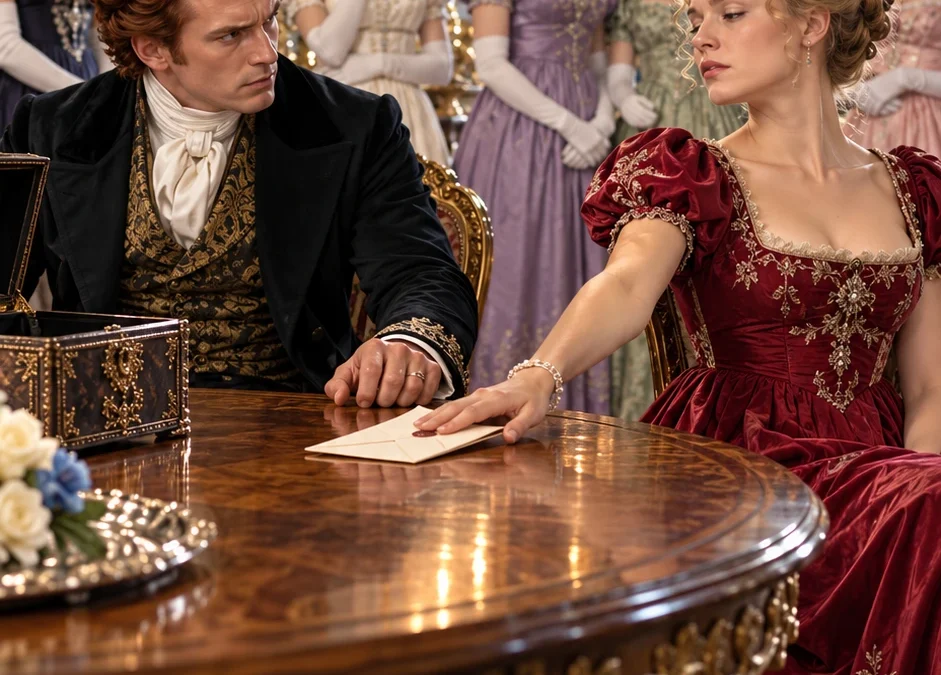
THE DUKE OFFERED SIX WOMEN HIS ENTIRE FORTUNE… FIVE GRABBED FOR IT. THE SEAMSTRESS ON HER KNEES WITH PINS IN HER MOUTH SAID ONE SENTENCE THAT SILENCED THE ROOM… AND THEN HER MARRIAGE CONTRACT BECAME A WEAPON 😱💍
Part 1
The Duke of Ashcombe asked six women what they would do with his fortune, and five answered as though the money were already theirs.
Lady Anura wanted a house in Paris. Miss March proposed a new wing for Ashcombe Hall. The Ford twins disagreed only over whether the family yacht should be painted blue or green. A baronet’s daughter promised charity with such practiced sweetness that Julian wondered if she had ever entered a room where poverty could smell her perfume. 😏
The sixth woman was not a candidate at all.
Eliza Fenwick knelt beside Lady Anura’s chair with three pins between her lips, repairing a hem the lady had torn upon entering. She wore a plain blue dress and a measuring ribbon around her wrist, with the expression of a woman trying to finish honest work while rich people discussed imaginary splendor over her head.
Julian leaned back. “And you, Miss Fenwick?”
Every face turned toward the seamstress.
Eliza removed the pins. “Your Grace, how would you spend my fortune?”
Lady Anura laughed. “She would begin with a new dress, surely.”
Eliza rose slowly. She looked at the open strongbox on the table, then at Julian.
“I would refuse it.”
The room went silent. 😶 Julian’s mother gripped her teacup.
“You misunderstand the question.”
“No, Your Grace. I understand it too well.” Eliza folded the repaired hem over one arm. “A fortune offered to six strangers is not generosity. It is either a test or a trap. I have no wish to enter either.”
Julian felt something dangerously like amusement. “Suppose it were neither.”
“Then it would be folly, and I would still refuse.”
Lady Anura snatched the gown away and demanded that the insolent creature be dismissed. Julian’s mother agreed. Eliza gathered her sewing case without apology.
“Wait,” said Julian.
She stopped at the door but did not turn. “Why did you come to Ashcombe House to fit six gowns for six women who can pay you?”
“And if I paid you to answer one more question?”
“Truth does not become more truthful because a duke purchases it.”
Then she left him with five beautiful women, and the first honest answer he had heard all season.
Julian had not designed the gathering as entertainment.
Under his grandfather’s will, he would lose control of the Ashcombe trust on his thirty-sixth birthday unless he married before midsummer. The fortune would pass for ten years to his cousin Roland Vane, who had already promised to break the trust, sell its holdings, and convert its charitable endowments into ready cash.
Julian had three months to choose a duchess, or watch schools, pensions and farms become entries in Roland’s gaming account. 😠
Eliza’s presence had been accidental. Her answer was not.
The following morning, he went to Fenwick’s dressmaking rooms in Soho. Eliza was cutting gray silk at a long table. Two apprentices froze when he entered. She did not.
“We are not accepting gentlemen’s commissions.”
“I need a wife, not a coat.”
One apprentice dropped a spool. Eliza sent both girls upstairs before facing him.
“If that is a proposal, Your Grace, it lacks several expected features.”
“It is a request for advice.”
“Then it lacks fewer.”
He explained the will, Roland, and the five answers. Eliza listened, shears moving cleanly through silk.
“You asked the wrong question.”
“What should I have asked?”
“What would they protect if marrying you cost them something?”
“Marriage to me is generally considered an advantage.”
“That may be the problem.”
Julian noticed a row of finished dresses under muslin, each beautifully made and plainly designed for women who worked rather than posed.
“What would marriage to me cost you?”
The shears stopped.
“My name on the door. My apprentices’ trust. The right to earn money without anyone calling it a charming occupation permitted by my husband.”
“You assume I would close the shop.”
“Every man assumes his permission is liberty.”
He had come intending to hire her judgment while he selected another woman. Instead he heard himself ask, “What terms would make it liberty?”
Eliza studied him as if checking a seam for hidden weakness.
“Separate ownership of my business. Wages and contracts under my signature. No dismissal of my apprentices. No claim upon the designs my mother left me. And no demand that I abandon the work after providing an heir.”
“You have considered this.”
“Every working woman considers the price of marriage.”
He laid a folded document on the cutting table. A copy of his grandfather’s will.
“Read it. Tell me whether you still think the fortune is a trap.”
For two days, Eliza read it with a solicitor who owed Julian no allegiance. She discovered that the fortune supported twelve village schools, a naval widows’ pension, and below-market leases for more than two hundred tenant families. If Roland gained control, none were safe. She also discovered that Julian could satisfy the clause with any lawful wife. Rank and dowry were irrelevant.
“Your grandfather wanted to force you to marry. He believed affection made men weak and wives made them cautious.”
“And you?”
“I believe coercion makes dead men troublesome.”
He offered a one-year marriage of convenience, followed by her choice of permanent separation with a fixed settlement. Her business would stay protected through trustees she selected. In return, the trust would stay in Julian’s hands, and its dependents would keep their homes and pensions.
Eliza refused. Then she said, “You have described what I receive and what the trust receives. You have not described what you risk.”
Julian had no answer. 😳
She left the unsigned contract on his desk.
That night, after the apprentices had gone, Roland Vane visited the Fenwick shop. He carried a cane with a gold fox for a handle, and an offer wrapped in courtesy. If Eliza persuaded Julian not to marry, Roland would buy the building and grant her a ten-year lease at half rent. If she refused, he would buy it anyway and remove her within a month.
“Why tell me?” asked Eliza.
“Because powerless people behave better when they understand the walls.”
She lifted the heavy iron from the stove.
“And powerful men behave better when they understand the door.”
Roland laughed, but he left.
The next morning, Eliza carried his written offer to Julian. She could have hidden it and accepted his protection. Instead she laid it beside the unsigned contract.
“This is what you risk. Your cousin does not merely want your fortune. He wants obedience. If I marry you, he will attack every person whose welfare can be used against us.”
“Then I will buy your building before he can.”
“No, Miss Fenwick. You are doing it again.” She said it quietly. “Replacing danger with ownership and calling the result safety.”
He set down the paper. “What do you propose?”
“I buy it myself. A loan from the settlement, repaid from my profits at ordinary interest. The deed remains mine whether the marriage lasts one year or fifty.”
Julian considered the audacity, the fairness, and the fact that no woman in his mother’s drawing room would ever have challenged the shape of his help.
“Agreed.”
Eliza extended her hand.
“Then I will marry you.”
They wed by special license eleven days later. Society assumed Julian had lost his senses, or that Eliza had trapped him, or both. 💍
But the real storm hadn’t even begun. Because the five rejected women did not vanish quietly… and Roland had one more weapon hidden in a stolen copy of the contract.
💬 Want Part 2? Comment “PART 2” or leave any word below and I’ll send it to you privately!
Part 2
Because the five rejected women did not vanish quietly.
Lady Anura returned the week before the wedding with two friends and a demand that Eliza complete the gown whose fitting had been interrupted.
“Business is business,” Anura said, standing on the fitting platform. “Unless becoming a duchess has made honest work beneath you.”
Eliza recognized the trap. Refuse, and she would be accused of abandoning trade the moment rank became available. Accept, and Anura could humiliate her at leisure.
“Honest work is never beneath me,” said Eliza. “But contempt is expensive. My fee has doubled.”
Anura’s friends gasped. Anura paid. 😏
During the fitting, she asked whether Julian had promised Eliza diamonds, whether the marriage would be consummated, and whether a seamstress knew which fork to use at dinner. Eliza answered only questions concerning the gown. When Anura twisted suddenly and tore the half-finished sleeve, Eliza removed it without anger.
“You will repair that,” said Anura.
“Yes. The additional work will appear on your bill.”
“You cannot charge me for your poor sewing!”
Eliza showed the three women the clean diagonal rip and the unbroken stitches around it. “Cloth records what happened, even when people do not.”
The phrase reached Julian through Anura’s own furious retelling. He hurried to the shop expecting to find Eliza wounded. Instead she was teaching Agnes how to reinforce a curved seam.
“Do you require assistance?”
“With Anura? I sent her a bill.”
“A terrifying response. I offered her a fortune.”
“I charged her twelve shillings. We each used the weapons we understand.”
Julian realized that marrying Eliza would never let him play rescuer. She defended herself perfectly well. What she needed from him was the restraint to stand beside her without taking the ground from beneath her feet.
Their marriage settlement took four days to negotiate. Eliza’s solicitor, Mr. Cuthbert, a narrow man with ink permanently staining his middle finger, rejected Julian’s first draft because her separate property depended on Julian’s continued cooperation.
“Good intentions are not conveyances.”
Julian’s solicitor bristled. Julian did not. He ordered a deed transferring the shop building upon completion of Eliza’s loan. Eliza added a clause protecting her apprentices if she died. Julian added one preventing her business from being absorbed into any future dowry for their children.
“You are planning for children,” Eliza observed.
“I am planning for possibilities the law otherwise mishandles. Does that alarm you less than the possibility that you think I expect it as payment?”
She looked at him for a long moment. “Keep that sentence in the final draft.” 🥹
The wedding morning brought rain and a crowd outside the church. Some came to cheer a common woman’s rise. Others came hoping to see her stumble. Her apprentices dressed her in a gown she and her mother had designed years earlier but never completed: cream silk, no excessive train, the bodice embroidered with tiny silver scissors visible only at close range.
When she reached the altar, Julian looked first at her face, then at the scissors.
“Armor,” he whispered.
“Tools. Better.”
Thunder shook the windows during the vows. Eliza did not flinch. She had entered bargains from necessity before. This was the first in which every term had been argued in her own voice.
That night, he showed her two rooms joined by a private sitting room.
“The contract gives you your own chamber. No door will be locked from my side.”
Eliza touched the key resting in the inside lock. “And if I invite you through?”
His controlled expression altered. “Then I will ask whether you are certain.”
“That sounds inconvenient.”
“I am told marriage often is.”
She did not invite him that night. They drank tea in the sitting room and discussed which trustees would stop Roland from challenging her property. When he left, he bowed as he had on their first morning in the shop. But now there was warmth beneath the formality. 💞
Life at Ashcombe Hall gave them no honeymoon. Roland filed a petition claiming Eliza had exercised undue influence over Julian. Three schoolmasters received notices that their funding would end. A rumor spread that the new duchess had diverted pension money into gowns.
Before answering the rumor, Eliza insisted on seeing the institutions the trust was meant to protect. Julian arranged a comfortable carriage. She chose a smaller one capable of reaching the hill villages after rain.
At St. Anne’s school, thirty children shared twelve books. Julian surprised the master by sitting at the back while Eliza spoke with the oldest girls. Three had stopped attending because their families could not spare them from paid mending. One girl, Martha, wanted to be a teacher but believed arithmetic belonged to boys.
“Arithmetic belongs to anyone who does not wish to be cheated,” said Eliza.
At the naval widows’ cottages, they met Mrs. Bell, whose pension had arrived late three times. Julian summoned the trust agent, Mr. Sloan, who blamed winter roads. Eliza asked to see the envelopes. The postmarks showed the money had left the office weeks after it was due.
Sloan grew pale.
“A clerical oversight,” said Eliza, “repeated only for widows unable to travel to complain.”
Julian dismissed him before sunset. 😤
On the journey home, the carriage axle cracked. They sheltered in a shepherd’s cottage, where rain trapped them until morning. There was one spare bed. Eliza was tired of contracts making every tenderness sound dangerous.
“The bed is wide enough.”
He lay beside her fully clothed, a respectful distance between them in the dark. She asked why he had never married for affection.
“My father loved extravagantly. He promised everything, kept nothing, and died owing money to people too poor to lose it. My grandfather responded by making every human bond a legal mechanism. I feared becoming either man.”
“So you became careful enough to hurt no one.”
“That was the intention.”
“Care can become absence.”
“And refusal,” he said, turning toward her, “can become a wall.”
The truth of it stung. Eliza had refused dependence so thoroughly that she sometimes refused comfort with it. She moved her hand across the blanket until it touched his.
Neither spoke. By morning, their fingers were intertwined. 🥰
Then came the day of the public pension meeting. Eliza opened her business records to the committee and invited them to inspect every payment. She proved the school and pension funds were untouched. More importantly, she discovered that Roland’s solicitor had sent cancellation notices before Roland held any authority at all.
But the victory cost her more than the newspapers reported.
Outside the hall, a stone smashed through the carriage window. Glass cut her temple. Julian pulled her down, covering her body with his own as the driver forced the horses through the crowd.
And pinned to the stone was a notice… in a hand Julian recognized.
💬 Want to know whose hand wrote it, and what Eliza did with the stolen contract? Like and comment “REVEAL” below. Part 3 will be posted once we have enough comments! 🔥
Part 3
The stone had been wrapped in a pension notice. Not a threat in words. A threat in paper.
At Ashcombe Hall, the physician called the wound minor. Julian did not leave her bedside. His anger filled the room without a sound.
“Do not close the public meetings,” said Eliza. “Someone wanted fear, not murder.”
“That distinction does not comfort me.”
“It should inform you.”
He stood abruptly, walked to the window, then came back and knelt beside the bed. “I do not know how to love you without trying to remove every danger.”
She touched the rigid line of his jaw. “Begin by believing I understand the danger I choose. And if my choice takes me from you, grief will not prove the choice was yours to prevent.”
His eyes closed. She had never seen him surrender control without first receiving something in exchange. 🥹
“The meetings remain open,” he said at last. “But the route changes daily. And you accept two guards.”
“One guard and a driver trained to recognize a mob.”
“Two.”
“One, and I carry a whistle.”
“You bargain while bleeding.”
“It is when gentlemen are most reasonable.”
They settled on one guard, the whistle and reinforced carriage glass. Then Julian rested his forehead against her hand. There was no performance in it. Only trust under construction.
Respect had come before tenderness. Now tenderness followed. He began bringing questions to Eliza rather than completed decisions. She learned that his coldness was not contempt but caution, trained by a grandfather who rewarded mistakes with public humiliation. He learned that her refusal of wealth was not pride but memory: her father had once accepted a noble patron’s investment, and the man later claimed her mother’s dress designs as payment, nearly ruining the family.
One rainy evening in the library, Eliza rubbed the scar that years of cutting cloth had left along her finger. Julian took her hand and examined it.
“Does it hurt?”
“Only when the weather changes.”
He kissed the scar. The gesture was so simple that she forgot every clever answer.
“Are you certain?” she whispered.
“No.” His mouth brushed her knuckle again. “But I would like to become so.”
This time, she opened the connecting door. 💖
The next morning did not transform the Dowager Duchess into a welcoming mother. She summoned Eliza before breakfast and placed a stack of invitations on the table.
“A Duchess of Ashcombe cannot spend every day over a cutting board.”
“This one can.”
“Society will punish Julian for your stubbornness.”
“Society has punished him for choosing me. Abandoning my work would teach it that punishment succeeds.”
Neither woman spoke for several seconds. Then the Dowager pushed one invitation forward. It came from the wives of the trust schoolmasters, who planned a sewing circle to raise money for winter books.
“Attend this. Not because it is grand. Because it is useful.”
Eliza recognized the concession hidden beneath command. “Will you come?”
“I do not sew. But I can count money.”
The Dowager attended and counted every shilling twice. She also saw women bring clothing for repair because they could not afford replacement. On the way home, she asked whether the apprentices could train widows in paid mending.
“Not as charity,” said Eliza. “As contractors.”
It was the first time they had used the same word with the same meaning.
Roland attacked that fragile alliance by sending the Dowager a copy of Eliza’s private marriage contract, the separation clause highlighted, with a note: Your son bought a temporary duchess who intends to leave once she owns her shop.
The Dowager confronted Eliza in the portrait gallery. “Did you plan to abandon him?”
“I plan to preserve the ability to leave.”
“That is the same thing.”
“No. A locked door and an open door lead to different marriages, even if no one walks through either.”
The older woman looked toward the portrait of Julian as a boy, posed stiffly beside his grandfather. “My husband believed locked doors kept families intact.”
“Did they?”
“They kept us in the same house.” She paused. “I have mistaken endurance for loyalty more than once. I will not do so again.”
She carried the contract into the drawing room where Roland waited, certain he had split the family, and placed the paper in the fire.
“That was a copy,” said Roland.
“Then bring another. I have always enjoyed a warm room.” 🔥
That night, Julian found his mother alone. “Why did you defend us?”
“Do not make sentiment of it. Vane insulted my intelligence.” She adjusted a vase that needed no adjusting. “Your wife understands doors.”
“She understands most structures.”
“Do you love her?”
He had never said the words aloud.
“Yes.”
“Then ensure she knows it before a barrister asks her in public.”
He went straight to the Soho shop. Eliza was upstairs checking the roof after the rain, among buckets, her skirt pinned above her ankles and damp hair escaping its pins.
“I love you,” he said.
She nearly dropped the lantern. “Has something happened?”
“My mother advised honesty. Then something serious happened. I am not saying it because of the contract, the trust or the hearing. I am saying it because you should not have to infer it from legal clauses and repaired sleeves.”
Eliza set down the lantern. “I love you too.”
Relief moved visibly through him. But she added, “Love does not cancel the separation clause.”
“I know.”
“Or merge the company with your property.”
“I know.”
“Or permit you to repair roofs and evening clothes.”
He looked at the spreading damp. “That last condition is unreasonable.”
Together, they moved the cutting tables away from the leak. Julian climbed a ladder. Eliza held it. And the Duke who once used wealth to test strangers spent half the night fastening canvas over a seamstress’s roof. No newspaper witnessed it. Eliza loved him partly because no witness was required. 🥰
The repaired roof mattered a week later, when heavy rain flooded two neighboring workshops. Fenwick and Company stayed dry and opened its upper rooms to the displaced workers. Among them was the niece of a woman named Mrs. Pike, who overheard Roland’s solicitor instructing a porter to plant copied designs in Eliza’s storeroom. The niece warned Agnes, who locked the room and fetched a constable.
The solicitor escaped arrest, but abandoned a satchel holding payments to Mrs. Pike and drafts of the fraudulent school notices. For the first time, Roland’s separate attacks were joined by physical evidence.
Julian wanted it taken to court immediately. Eliza insisted on a witnessed inventory so no one could claim the Duke had added papers. They counted every item before a magistrate, two guild members and the Dowager. It took six hours. It also made the evidence nearly impossible to corrupt.
“You trust procedures more than people,” said Julian.
“Good procedures allow people to be imperfect without destroying the truth.”
“My grandfather would have admired that sentence.”
“Your grandfather designed a will that endangered hundreds of people to arrange your wedding.”
“He would have admired it and misunderstood it.”
This time, their laughter came easily.
But Roland still held his last weapon: the original contract, stolen from Julian’s solicitor.
Eliza found herself holding her own copy over the library fire. “If it burns, he cannot prove our original intention. We would know. But we would also save the schools.”
Julian did not order her hand away from the flame. “What would you tell a frightened witness who proposed destroying an inconvenient fact?”
Eliza closed her eyes. Then she withdrew the contract and placed it on the mantel.
“I would tell her truth cannot become our weapon if we treat it as our servant.”
“Then we take it to the hearing ourselves.”
That decision changed everything. Roland believed he held the only copy. He did not understand that Eliza and Julian would walk into court carrying their own weakness, rather than waiting for him to reveal it. 😮
Then came Mrs. Pike herself, produced by Roland, claiming Eliza’s mother had stolen the very designs Eliza fought to protect. She displayed a portfolio with dates earlier than any Eliza possessed. London believed paper before memory. Orders vanished. A sixteen-year-old apprentice named Nell Carter, gifted with embroidery, was pulled from the shop by her frightened father, a porter.
Eliza visited their rooms without a carriage crest or a ducal servant. Mr. Carter would not let her in.
“I cannot gamble my daughter’s name on yours.”
“Then do not. Judge the evidence when it is shown.”
She placed Nell’s unpaid wages and tools on the threshold. “These belong to her. Her place remains open, but she owes me no loyalty.”
As Eliza descended the stairs, Nell called after her. “Did you steal the designs?”
“No.”
“Will you prove it?”
“Yes.”
The certainty mattered. 💪
Alone until dawn, Eliza examined the forged portfolio. The drawings resembled her mother’s hand, but the stitching notes used abbreviations developed only in the last five years. Someone had copied old designs and added modern working notes. Julian wanted to confront Roland. Eliza stopped him.
“If you denounce him without proof, the story becomes a duke crushing a poor widow for his wife. He knows how to make decency look like tyranny.”
“Then we make truth visible.”
They announced a public exhibition at the Dressmakers’ Guild. Eliza placed her mother’s surviving gowns beside Mrs. Pike’s drawings and invited experienced cutters to compare. Julian stood at the back, refusing the place of authority Roland expected him to seize.
The decisive proof came from the smallest apprentice. Agnes recognized a grease stain on the forged portfolio, from the green marking wax used in Roland’s solicitor’s office, where her brother delivered coal. Her brother confirmed he had seen the drawings there. And Nell Carter, who had returned that morning against her father’s wishes, brought a sampler stitched from one disputed pattern, proving the forged instructions produced a sleeve that could not physically join the original bodice.
Mrs. Pike broke. Roland had paid her debts and threatened her son’s apprenticeship.
Eliza declined to prosecute her in exchange for a sworn statement.
“Mercy will be called weakness,” said Julian afterward.
“Only by people who confuse punishment with strength. And if she lies again, the statement condemns her. Mercy need not be foolish.”
Julian looked at her with the expression that had first appeared when she refused his fortune. Only now it carried love he no longer managed to hide. 🥹
Roland’s final attack came at the trust hearing. The room filled with beneficiaries, reporters and the five women Julian had once considered. Eliza wore a dark blue gown from her own shop and no jewels but her wedding ring.
Roland’s barrister produced the original contract. Its one-year clause was plain. If the marriage existed solely to defeat the will, he argued, control should pass to the alternate trustee.
Julian could have saved the trust by claiming the clause had been abandoned because the marriage was now loving and permanent. It was true. But saying so publicly without Eliza’s permission would turn their private choice into legal evidence and bind her through pressure.
“The contract was genuine when signed,” said Julian. “I will not deny it.”
Roland smiled.
“My wife owes this court no performance of affection. If the trust requires a woman’s freedom to be sacrificed before it considers a marriage valid, then the defect belongs to the trust, not the wife.”
He was prepared to lose everything rather than use her love as proof.
Eliza stood beside him. “Your Grace,” said the judge, “do you wish to address the clause?”
“I do.” She looked at Julian. “The agreement gave me the right to leave after one year. It did not require me to leave. I retain that right, and I choose not to exercise it.”
Roland’s smile vanished. 😲
She laid out Mrs. Pike’s statement and the fraudulent school notices, proving a pattern of interference intended to manufacture failure before Roland had any authority. The judge suspended him from any alternate trusteeship pending criminal investigation, and upheld Julian’s control.
Outside, Julian asked, “Did you speak because the trust needed it?”
Eliza took his face between her hands. “Partly. And the rest because you were willing to lose the fortune rather than claim me.”
“I would lose it again.”
“Please do not. We have two hundred leases to protect.”
He laughed against her kiss. 💕
Roland fled to France before the fraud charges were filed. The trust recovered the money he had diverted through false legal expenses. Mrs. Pike’s son kept his apprenticeship. Eliza’s business survived, though rebuilding its reputation took months rather than one miraculous afternoon.
On the anniversary of the drawing-room test, Julian returned to the Soho shop. The sign now read Fenwick & Company. Eliza had refused the royal-sounding phrase clients suggested, because she wanted the shop’s work to stand without borrowed rank. Six apprentices worked at the long tables. Agnes supervised fittings. Eliza was cutting gray silk, exactly as she had when he first arrived.
He placed a small strongbox beside her. Every apprentice stopped.
“If you ask me how I would spend your fortune,” Eliza warned, “I shall charge you for wasting my time.”
“It is not my fortune.” He opened the box. Inside were the repaid promissory notes for her building, stamped settled. “It is the final accounting of your loan. The property is entirely yours.”
Eliza examined the papers. “You paid nothing. Not a penny. You interfered with no interest calculation.”
“Your solicitor terrifies me.”
She smiled. “Good.”
Julian looked around the room that marriage had not taken from her. “I once thought refusal was the opposite of love. Sometimes it is the beginning of respect.”
“And respect,” said Eliza, setting down her shears, “can become whatever two people freely make of it.”
She kissed him in front of six delighted apprentices. 😍
At Ashcombe Hall, the fortune remained large, but it no longer measured power inside the marriage. Julian kept the trust under rules made more transparent by independent trustees. Eliza kept her company, her designs, and the right to choose her work. They shared a household, a bed, arguments, and the responsibility of protecting people whose lives had once been treated as clauses in a dead man’s will.
When their first daughter was born, society expected an elaborate christening gown. Eliza made one from plain white cotton woven by women employed through the fair contract program. Julian carried the child through the chapel as carefully as if she were the only fortune he had ever possessed.
Later, when guests toasted the duchess who had refused a duke’s wealth, Eliza corrected them.
“I refused the trap. The man learned to open it.”
Julian raised his glass to her. Their daughter slept through the applause. Eliza reached beneath the table and took his hand, not because a contract joined them, not because a fortune required it, but because it remained offered.
Years later, the six answers were still repeated in drawing rooms, usually with the details improved by people who had never been present. Some said Eliza had thrown Julian’s banknotes into the fire. Others insisted she had demanded half his estates and magnanimously returned them. The truth was less theatrical, and far more difficult. She had refused to let wealth answer a question that belonged to character.
Julian kept the original sheet on which the six replies had been recorded. Beside five elegant ambitions stood Eliza Fenwick’s plain sentence:
I would not spend what is not mine.
He showed it to neither guests nor journalists. It stayed in the small desk they shared, beside the revised trust charter, the apprenticeship accounts, and the marriage agreement that neither had destroyed.
On winter evenings, Eliza sometimes found him there, reading tenants’ petitions or checking the school accounts twice. He no longer mistook generosity for command. She no longer mistook every offered kindness for a hidden price. Both lessons required practice.
“There is a request from the Northern School,” he told her one night. “They want a second classroom. The trust can afford it, and they need it. Twenty-three children are sharing twelve desks.”
Eliza considered. “Then why are you asking me?”
“Because I value your judgment.”
It was the answer she had once believed no duke could learn. 🥹
She drew the account toward her, and together they worked beneath the quiet lamp while snow gathered against the windows. Nothing in the scene would have interested society. No jeweled ballroom. No dramatic wager. No fortune offered before witnesses. Only two chairs placed equally at one desk, two sets of figures checked with care, and a choice made without fear.
It was the life hidden inside her first refusal. Not poverty worshiped as virtue, nor wealth treated as sin. Freedom, responsibility and love, held in the same open hand. 🤍
This story is entirely fictional and created for entertainment purposes only. It does not represent any organization or individual, nor does it encourage inappropriate behavior. The content was generated with AI assistance.








