THE DUKE ORDERED EVERY LADY AT THE PICNIC TO MEND HIS TORN COAT. ONE WOMAN HANDED HIM THE NEEDLE AND WALKED AWAY… AND THE SECRET HE FOUND BEHIND A HIDDEN PANEL CHANGED HIM FOREVER 😱🧵
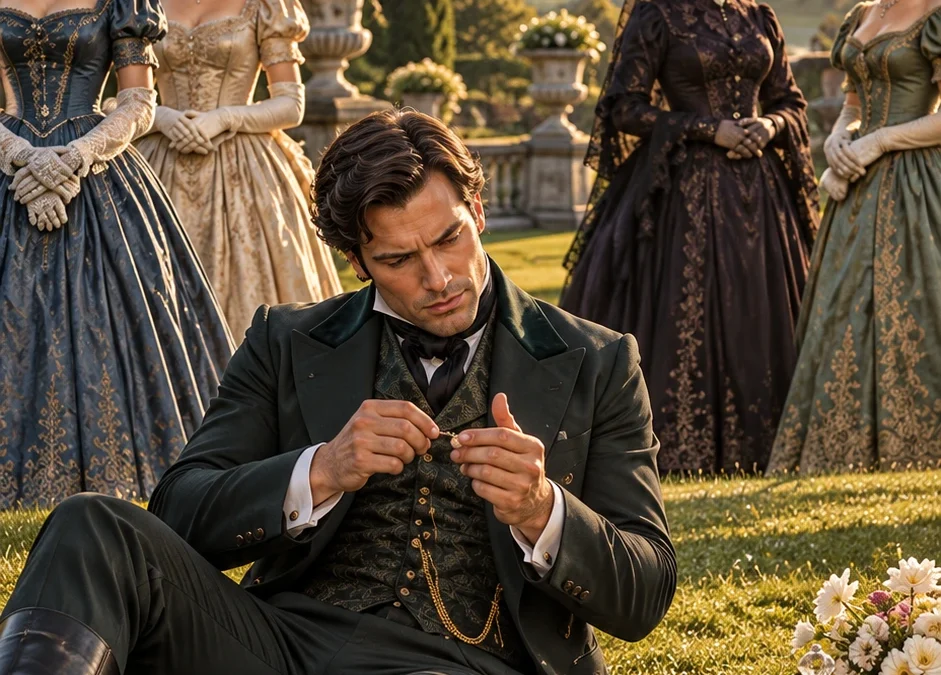
THE DUKE ORDERED EVERY LADY AT THE PICNIC TO MEND HIS TORN COAT. ONE WOMAN HANDED HIM THE NEEDLE AND WALKED AWAY… AND THE SECRET HE FOUND BEHIND A HIDDEN PANEL CHANGED HIM FOREVER 😱🧵
Part 1
The Duke of Cold Harbor asked every lady at the picnic to mend his torn coat.
Constance Larkin was the only one who handed him the needle and walked away. 🧵
It was a warm afternoon at Ravensmore, the kind of afternoon the Dowager Duchess called wasted on grass when there were floors to be swept. The Duke had torn his sleeve on a hawthorn hedge, chasing a dog that was not his. He held the coat up like evidence.
In a voice pitched to carry, he asked which of the ladies present possessed a needle and the patience to use it.
Six young women rose at once. He watched them settle again, one by one, when he named no favorite and simply waited.
Constance did not rise.
She sat at the edge of the blanket, where companions sat. A position she had occupied at every gathering for three years: close enough to be summoned, far enough to be forgotten. A needle case lay in her reticule, because a companion’s reticule always held one.
She had mended more coats than she could count. None of them her own. Each one a small tax on a woman who had no standing to refuse.
The Duke’s gaze found her last, the way a man’s gaze finds the servant he has stopped noticing. He held the coat toward her.
He did not ask. He assumed. 😶
She had expected the assumption. She had expected to be handed the coat and the needle in the same breath, as though her hands existed for exactly this.
She had not expected, with six pairs of eyes fixed on her, to feel the old obedience rise in her chest. And for the first time in three years, she simply refused to answer it.
She took out the needle, its thread already knotted at the end, and held it out to him.
“You have hands, Your Grace,” she said. “I find I no longer have the time.”
The blanket went silent, in the particular way a garden party goes silent when someone has said the thing everyone else only thought.
She rose, brushed the grass from her skirt, and walked toward the house. She did not look back to see what he did with the needle.
What no one on that blanket understood was this: Constance Larkin had been counting, for three years, exactly how many times she had been asked to mend a man’s coat without being asked her name first.
That afternoon, the tally reached its final number.
She was three-and-twenty. Three years a paid companion to a woman who introduced her at dinner as my girl, and never once as Miss Larkin.
She walked the gravel path toward Ravensmore’s east wing, spine ironed straight, hands folded out of long habit, exactly as a companion’s hands were taught to fold. She had not always been nobody. That was the part the house never asked about, and the part she had stopped volunteering.
Behind her, she heard nothing. No summons. No reprimand called after her on the wind. She had not braced for silence, and silence unsettled her more than either would have.
She reached the side door and let herself in before her composure could be seen to crack. It cracked in the corridor instead, alone, against the cool plaster.
She allowed herself exactly four seconds of it. Then she straightened and went to find Mrs. Vane, who paid her wages, and had seen none of it.
On the lawn, the Duke of Cold Harbor stood holding a needle.
He did not know how to thread it a second time if the first knot failed. Six young women watched him, with the particular hunger of an audience that has just seen someone break a rule they had not known existed. They wondered whether he would be furious.
He was not furious. That, too, unsettled them more than fury would have.
He looked at the needle. He looked at the coat. And he did what a man does who has spent thirty years being served, and has never once been refused by someone with nothing to gain from refusing him.
He sat down on the grass, in full view of the party, and began to sew.
His stitches were terrible. The thread knotted wrong. He pricked his thumb twice and said nothing. The watching ladies exchanged glances, and without a word agreed not to laugh. Something about the set of his jaw made laughter feel like the wrong response to whatever was actually happening. 😳
Three days later, a housemaid told the second footman, who told the cook, that the Duke had asked his valet who Miss Larkin was.
The valet had not known either. No one in that house had ever thought to ask.
Nathaniel Ravenscroft, Duke of Cold Harbor, was thirty-six and had been cold since before he could remember choosing it.
His father had trained the warmth out of him the way a groom trains a green horse: patience, repetition, and the absolute conviction that comfort made a man soft, and a soft man made a poor duke. Every kindness the boy had ever offered was logged. A coat given to a shivering undergroom. An extra hour granted a tired tutor. Each one his father answered with a lesson designed to correct it.
By the time Nathaniel inherited, he had learned the lesson so well he no longer needed his father alive to teach it. He gave nothing away for free. He assumed that any kindness offered him carried a price he had simply not yet been shown.
He had assumed the same of the needle.
He had been wrong, and being wrong in front of six watching women was not, he found, the humiliation his father had promised. It was something closer to relief.
He did not examine it. He was not a man who examined his own feelings. He was a man who noted facts and acted on them.
The fact before him was this: a companion with no standing at Ravensmore had refused him something every other woman on that blanket had been prepared to give for nothing but his notice.
He intended to find out why.
He found her three days later in the estate’s small library, alone, mending. Not his coat. A stack of the housekeeper’s linens, her needle moving fast and sure, in a way his own had not managed once.
“You sew a great deal for a companion,” he said from the doorway.
She did not startle. The library door announced every visitor with a groan the estate carpenter had never fixed.
“I sew a great deal for everyone but myself, Your Grace. It is the one skill no one thinks to thank a woman for.”
“You did not sew for me. Why?”
She set the linen down and looked at him directly, which companions were not generally in the habit of doing.
“Because you did not ask me. You informed me. There is a difference, and I have spent three years pretending there is not. On Tuesday I found I had stopped pretending.”
He absorbed that the way he absorbed most things, without visible reaction.
“What would you have had me do?”
“Asked. Or learned. Both are within a duke’s power. Only one occurred to you.”
It was, he would think later, the first sentence anyone had spoken to him in a decade that was not designed to please him, protect him or extract something from him. It sat in his chest like a stone dropped into still water, and the ripples did not stop for some time. 💧
Three days after that, the Dowager Duchess summoned Constance to the morning room, which smelled of hothouse roses and old ambition.
💬 Want Part 2? Comment “PART 2” or leave any word below and I’ll send it to you privately!
Part 2
Without preamble, the Dowager informed her that the household required a temporary companion for the Duke’s correspondence. His usual secretary was laid up with a fever. Constance’s hand was, unfortunately, the neatest available on short notice.
“You will attend him in the estate office,” said the Dowager, as though awarding a punishment. “You will not embarrass this family.”
Constance understood the shape of the arrangement before either of them named its terms. She understood, too, what six weeks alone with the Duke of Cold Harbor would mean. She would not do it as a woman waiting to be told what she was for.
“I will attend him,” she said. “On terms.”
The Dowager’s eyebrows rose a full inch.
“I will not be summoned without notice. I will not be addressed as girl in front of the staff. I will be paid a secretary’s wage, not a companion’s pittance, for the six weeks I do a secretary’s work. And I will be permitted to leave the room when the work is finished, without further duty invented to keep me in it.”
“You are a companion. Companions do not set terms.”
“Then find another companion who writes a legible hand and can balance a column of figures without checking it twice. I understand there are several on the estate. I have trained most of them.”
The Dowager did not find another companion. 😏
When Nathaniel was told, he asked only one question: what terms had been set. When his mother told him, he said nothing for a long moment. Then he said the terms seemed fair. His mother left the room with the distinct impression that her son had somehow lost an argument he had not been present for.
The estate office smelled of ink, old leather, and the cold ash of a fire lit too late in the morning. He did not make conversation. He dictated letters, reviewed ledgers, and corrected her figures twice in the first week. Both times she had noted correctly.
She did not mind the silence. She had spent three years learning to disappear inside a room. Disappearing inside this one at least came with a fair wage and an honest task.
What she minded, though she did not examine why, was the fifth day, when he set down his pen, looked at the ledger she had been correcting, and said, “This is wrong.”
She checked. It was not wrong.
“It is correct, Your Grace. The steward’s figure for the Hollowfield tenancy is forty pounds. Yours is thirty-eight. The steward has not accounted for the two pounds paid in kind at Michaelmas. He recorded it as a gift. By the terms of the lease he himself signed, it is a partial rent payment. His figure is wrong. Mine is correct.”
He looked at the ledger. He looked at the lease she had already set beside it, the relevant clause underlined in her own neat hand. He read it twice.
“How long have you known this?”
“Since Tuesday. I did not raise it because it was not my place to correct a steward twice your father’s age over a column he has likely been wrong about for a decade. And because no one in this house has ever asked me whether a figure was correct. They asked me to copy it.”
He was silent for the time it took the mantel clock to strike the half hour. She watched something in his face rearrange itself, the way a face does when a fact held for years is quietly proven false.
“Send for the steward. And bring the lease.”
The steward arrived white-faced. He left forty minutes later, considerably poorer in the Duke’s estimation, and two pounds richer in the estate’s true accounting. By evening the story had reached the servants’ hall, gaining a detail with every telling: the companion nobody knew had caught the steward out on ten years of error.
The Duke had not doubted her word for a moment. He noted this privately, and found it strange. Doubt was the register he lived in for nearly everyone else alive.
He began to watch her with a different attention. Not that of a man cataloguing a woman’s face, though he noticed, the way a man notices without permitting himself to dwell on it, that her eyes were a pale, clear gray that missed nothing, and that she wore her fair hair scraped back with the severity of a woman who had made a decision long ago. It was the attention of a man watching a fact prove itself true a second time, and then a third.
At the week’s end, Lady Sibyl Dracott arrived at Ravensmore for the shooting.
She had been raised on the understanding that she would one day be Duchess of Cold Harbor. Her mother had cultivated it since the cradle. Two seasons of near misses had done nothing to dampen it. She took one look at the companion seated at the Duke’s own desk, correcting the Duke’s own ledgers, and understood the arrangement at once.
“How resourceful of Cold Harbor,” she said at dinner, to the table at large, her eyes on Constance, “to find a secretary who costs so little and asks so little in return. One wonders what she does receive, to make the arrangement worth her while.”
The table went quiet, the way a table does when an insult has been delivered wrapped in a compliment. Every eye turned, not to Lady Sibyl, but to Constance. They waited to see whether the companion would break. 😬
Constance set down her fork. She did not raise her voice.
“A fair wage, Lady Sibyl, paid promptly for work done accurately. I understand it is an unusual arrangement. Most households prefer to pay less and check the figures twice.”
“I only meant…”
“I know precisely what you meant.” The silence deepened by a degree. “You will forgive me if I decline to discuss my wages further. It is, I find, a rather dull subject at table, and I would hate to keep you from your soup.”
She returned to her plate.
The room stayed silent a moment longer. Then the Dowager, of all people, asked the footman for more wine in a voice that suggested the subject was closed. It was.
Nathaniel said nothing at all during the exchange. Afterward, in the corridor, when the guests had dispersed, he found himself walking a length of hallway at an hour he had no reason to be awake. He told himself the fire in his study had gone cold.
It had not occurred to him until that dinner that he had begun defending Constance Larkin inside his own head before she had ever needed defending aloud. It occurred to him now, standing in a dark corridor. He did not examine that either. He went to bed, did not sleep well, and told himself it was the fire.
What no one at Ravensmore yet understood, not even the two people at the center of it, was this. The Duke of Cold Harbor had built his life on the conviction that warmth given was warmth wasted. His father had walled that conviction into him, stone by stone, until it stood as solid as the house itself.
A companion with a threaded needle had, without meaning to, found the one seam in the wall his father had never thought to check.
The wall had been built to keep people out. It had not been built to withstand someone who had never once tried to get in. 🧱
Two weeks into the arrangement, on an ordinary Thursday, Constance found the letter.
It was tucked behind a false panel in the ledger cupboard, water-stained, the seal long broken, addressed in a hand she recognized from the household’s older correspondence as the late Duke’s own. She had not been looking for it. She had been looking for a missing rent receipt. The panel had come loose under her hand.
She did not read it. She recognized from the date alone that it was older than she had any right to see. She set it unopened on the corner of the desk, told the Duke plainly that she had found it, had not read it, and would understand if he preferred it burned unread.
He did not burn it. He read it alone that night by a single candle, and said nothing of it to anyone.
She noticed, the following morning, that something in his face had changed.
And it was not until the fifth week, in the low golden light of a late afternoon, with the office quiet and a fire finally lit on time, that he told her what the letter said.
💬 Want to know what the letter revealed, and what the Duke asked of her afterward? Like and comment “REVEAL” below. Part 3 will be posted once we have enough comments! 🔥
Part 3
He set down his pen. He did not look at her directly. He looked at the ledger, at the letter folded beside it, at anything that was not her face.
“My father wrote that letter to his own father,” he said. “The year I was born. I found it three weeks ago behind the cupboard panel, where you found it. I have read it eleven times.”
She said nothing. She had learned in five weeks that his silences were not empty, and that the correct response to the beginning of one was to let it finish.
“I was raised to believe my father was simply cold. That warmth had never been in him, and so he could not be blamed for failing to teach me any. I built my whole understanding of myself on that belief. I was cold because he was cold, and he was cold because that was simply what he was. The way a stone is hard. There was no fault in it. No choice in it. It was only weather.”
He was quiet a moment.
“My father was not born cold. He wrote this to his own father. Begging. That is the word he uses himself, and he was not a man who used it lightly. Begging to be permitted to keep me near him, instead of sending me to school at six, as his own father had sent him.”
Constance felt her breath catch. 🥺
“He says in his own hand that he does not want his son raised the way he was raised. He says he wants to be soft with me. He uses that exact word. Soft.”
“What happened?”
“His father refused him. Told him softness would ruin me, the way it had nearly ruined my father himself. And my father, a grown man, a duke in his own right by then, did as he was told. He sent me away at six. He spent the rest of his life proving to his own dead father that he had learned the lesson after all.” His voice did not shake, but it was not steady. “I spent my childhood believing the man simply had no warmth in him to give. The truth is that he had it once, and was talked out of it, and never forgave himself enough to try again.”
He looked at her directly for the first time.
“I did not know that until three weeks ago. I have spent thirty years being cold on the theory that I had no other inheritance available to me. I find I have been wrong about the one fact I thought I knew for certain about myself.”
“Why tell me this now?”
“Because you handed me a needle instead of taking a debt. I had not earned the right to hand you anything, and I have thought of very little else since. I do not know what to do with a person who wants nothing from me. I was not raised for it. But I find I would like to learn, and I would rather learn it with you than continue not knowing at all.”
He drew a slow breath.
“I am not offering you a position, or a settlement, or anything a man of my situation is generally understood to offer a woman in yours. I am telling you a true thing about myself that no one else alive knows. I find I do not wish to be a stranger to you any longer. You may do whatever you like with the knowledge. Walk out of this room and say nothing further to me, and I will not hold it against you, and nothing in your position here will change for the worse. I am not asking for anything in return. I have simply wanted, for five weeks, to stop being the kind of man who never says a true thing to anyone. And you are the first person I have wanted to say one to.”
The fire cracked in the grate. Neither of them moved to mend it. 🔥
Constance had expected many things from six weeks in that office. She had not expected to be handed, freely and without condition, the one thing she had spent her whole adult life being denied: the choice of what to do with the truth. Offered by someone who had nothing left to gain by controlling her answer to it.
“Thank you,” she said quietly. “For asking.”
Of everything she might have said, it was the only thing that mattered. His silence afterward said the same.
She had misjudged him twice in five weeks, and both times she had believed him colder than he was. On the lawn, when she thought the demand for the needle came from a man who saw her as furniture with hands. And in the library, when she believed his silence after her answer was displeasure, rather than the sound of a man recalculating everything he had assumed about himself. Both misjudgments came from the same honest place. She had been trained, as surely as he had, to expect the worst of a title.
He had spent five weeks quietly proving the training wrong.
The following morning, the Dowager summoned Constance to the morning room a second time. This time the summons carried a different weather.
“You are aware that Lady Sibyl expects an offer before the season ends.”
“I am aware she expects one.”
“You are also aware that a companion who occupies too much of my son’s time invites exactly the sort of talk that ruins both parties. I will not have this family’s name attached to gossip over a girl with no fortune and no name worth the trouble of remembering.”
“Then you will find, Your Grace, that I have never once sought to attach it,” said Constance evenly. “I did not seek the position in the office. I was summoned to it on your own instruction, and I have done the work honestly and been paid honestly for it. If you wish the arrangement ended, you have only to say so, and I will return to my former duties without complaint.”
“And if my son objects?”
“Then that is a conversation between you and your son, and not one I am in a position to have on his behalf. I have never asked him for anything, Your Grace. I do not intend to start now, least of all through his mother.”
The Dowager studied her for a long moment, the way one studies a column of figures that will not resolve to the expected total.
“You are either the most foolish girl I have met,” she said finally, “or the only one in this house who has never once tried to manage my son. I confess I have not yet decided which.”
“I could not say, Your Grace. I have never found it useful to manage anyone. It requires a great deal of energy better spent on honest work.”
The Dowager did not summon her again that evening. 😌
The household gathered for the season’s final dinner. Lady Sibyl, sensing the ground shifting beneath a future she had considered settled, made one last effort to reclaim it. She raised her glass to toast the Duke’s excellent household management, in a tone that placed unmistakable weight on the word household.
The table waited, again, to see whether the companion would break.
“To household management,” said Constance, raising her own glass, mild as milk. “I understand it is a skill some acquire through long practice, and others through simply asking the person doing the work what the figures actually say. I have found the second method considerably faster, though I allow the first builds character.”
Lady Sibyl’s glass did not quite reach her lips before she set it down again. 😂
The table’s laughter, brief, decorous, instantly smothered, was the first genuine amusement the dining room had produced in a fortnight. Nathaniel did not laugh aloud. But Constance, watching him from the far end of the table, saw something move across his face that she had not seen there in five weeks. She had just watched a man who had not properly laughed in a very long time come within a single breath of doing it in front of his own mother’s dinner guests.
Lady Sibyl left Ravensmore three days later, a full week before the shooting was meant to conclude. The household’s official account was a sudden matter requiring her attention at her family’s estate. It satisfied no one who had witnessed the toast, though no one below stairs was foolish enough to say so above them.
The steward, whose figures Constance had corrected, did not leave Ravensmore. His accounting was reviewed twice yearly thereafter by a companion the Dowager had once refused to call by name. He made no further errors of the Hollowfield variety, or any other, for the remainder of his tenure.
The summer’s end brought the return of the Duke’s usual secretary, recovered from his fever. With his return came the natural conclusion of the arrangement. Six weeks, and it was over, at least on paper.
Constance expected the door to close quietly, as such doors generally did for a woman in her position. She had already begun privately preparing herself for the return to the edge of the blanket, to the folding of hands.
Nathaniel found her in the small library three days after the secretary’s return, mending her own gown this time. A torn hem she had not yet had occasion to fix. The first mending she had done for herself in longer than she could easily recall.
“You are sewing for yourself,” he observed.
“I find I have started. It is a slower habit to build than I expected.”
He stood in the doorway a moment, as he had weeks before. And this time, he did not inform her of anything.
He asked.
“I have need of a secretary for the estate’s affairs. Permanently. At a secretary’s full wage, and a secretary’s standing in this household, answerable to no one but myself. I have made a poor case in the past for why anyone should wish to work near me. I do not expect you to say yes for any reason beyond the wage being fair and the work being honest. I am asking. I have learned that much, at least.”
She set down her needle.
“And if I say no, then you say no, and I will trouble you with nothing further. I will think a great deal less of my own judgment than I currently do, but I will survive the disappointment. I am told it is possible to survive most things one has never properly tried before.”
She studied him for a long moment, the way she had studied every offer made to her in four years of service. Weighing what it would cost her to accept. Weighing what it would cost her to walk away.
“Yes,” she said. “On the same terms as before. Notice given. No name but my own. A fair wage, checked twice and paid on time.”
“Agreed. On all counts.”
And something in his flat brown eyes, watching her, was not flat at all. 💫
Three years later, the estate office at Ravensmore still smelled of ink and old leather, though the fire was always lit on time now. The ledgers balanced to the shilling.
Constance Ravenscroft, Duchess of Cold Harbor these eighteen months, still mended her own hems, and her husband’s coats besides, though he had long since learned to thread a needle competently enough that she rarely needed to. He had never again asked a room full of strangers to do for him what he could learn to do himself. The household had noted, without remarking on it aloud, that the Duke, who once measured every kindness as a debt, now gave a good many away for nothing. He seemed, if anything, steadier for the giving.
The letter from his father to his grandfather sat in a small box on his study desk, no longer hidden behind any panel, read often enough that its folds had softened. He had told her once, quietly, that he meant to write his own son a different letter one day, should he have the good fortune of one. And that he meant to send it, unlike the last one, before it was too late to matter. 🥹
She found him in the estate office one autumn evening, his sleeve caught on a nail he had meant to have removed for a fortnight. He held the torn fabric out toward her, wearing the particular half smile he had learned, in three years, to let show.
“I find I have torn my coat again.”
“Then I find, Your Grace,” she said, “you had better fetch your own needle.” And she did not move from her chair.
She watched him laugh, properly, fully. The sound still caught at something in her chest after three years.
He crossed the room to the sewing box, which had, without either of them quite deciding it, become his as much as hers.
He had asked every lady at that picnic to mend his coat once, expecting the asking itself to be enough. It had been true once that a duke need only ask and a room would answer. He had built a cold, correct life on the strength of that single fact. He had never once wondered what the asking cost the women who could not afford to refuse it.
It was no longer true. Not in this house. Not with this woman.
The one lady who had refused him the needle was the only one who had ever, in the end, been willing to stay and watch him learn to use it. 🧵❤️
This story is entirely fictional and created for entertainment purposes only. It does not represent any organization or individual, nor does it encourage inappropriate behavior. The content was generated with AI assistance.








