THE DUKE RETURNED UNANNOUNCED — AND FOUND A WIDOW, A CHILD, AND A SECRET THAT COULD DESTROY THEM ALL
THE DUKE RETURNED UNANNOUNCED — AND FOUND A WIDOW, A CHILD, AND A SECRET THAT COULD DESTROY THEM ALL
Part 1
The heavy oak door of Oak Haven was supposed to be locked. Arthur Hemsley, the ninth Duke of Westford, had carried the iron key across three countries like a promise — absolute solitude, no titles, no demands, just silence. He turned it. The mechanism didn’t catch. The door swung inward on well-oiled hinges, spilling warm golden hearthlight out into the freezing November rain.
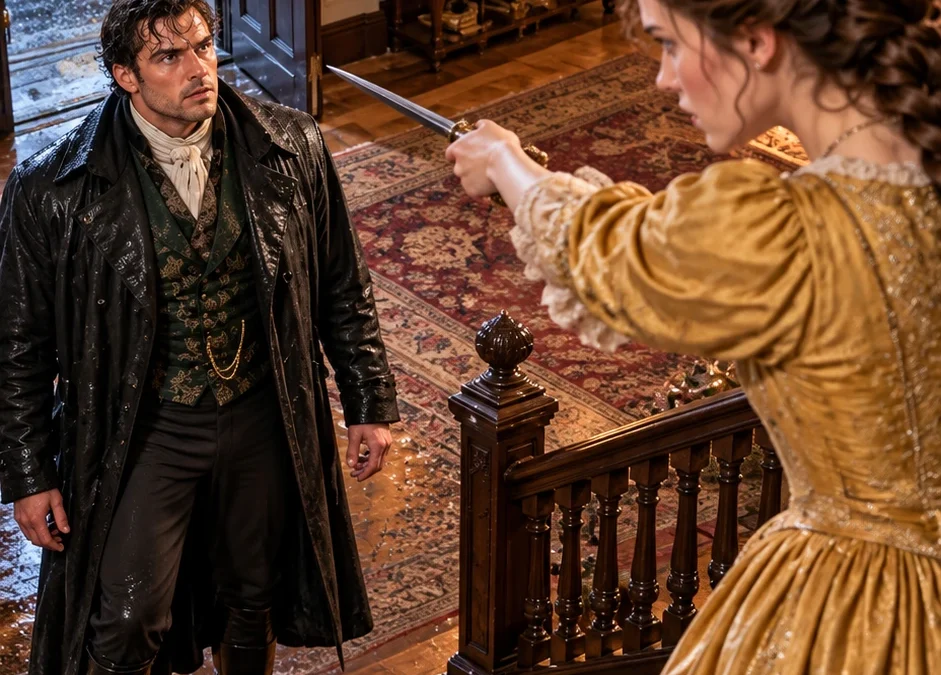
A child’s carved wooden horse lay abandoned on his finest Persian rug. And standing at the top of the stairs, gripping a heavy iron poker and aiming it straight at his head, was a woman.
The rain in Somerset didn’t fall — it assaulted, driving sideways across the moors, turning rutted roads into sucking mud. Arthur had walked the last three miles himself, leaving his carriage stuck fast near a washed-out stone bridge. He was tired in a way sleep could no longer touch — bone-deep exhaustion that had settled in six months earlier, when fever took his older brother and dropped a dukedom onto his shoulders like an anvil. Before that there had been the noise of war: artillery, screaming horses, diplomats carving up Europe over port and cigars. Oak Haven was meant to be his refuge — a forgotten manor house deep in the moors, shuttered, dust-sheeted, empty.
Instead he stood dripping on his own floorboards, staring at a fire he never lit. The scent hit him first — not stale damp and mice, but woodsmoke, baked oats, and lavender.
“Take one more step and I will split your head open.”
The voice was low, steady, entirely without panic. Arthur pushed his soaked hat back and looked up. She stood braced at the landing rail in a faded plum-colored wool dress, dark hair hastily braided down her back, knuckles white around the poker. A small face peered out behind her skirts — a boy, no more than five or six, clutching a linen shirt that hung past his knees, eyes wide and dark and silent.
“You’d have to swing it quite hard,” Arthur said, his voice rough from cold and disuse. “My skull is notoriously thick.”
“I have a good swing,” she replied, and didn’t flinch. “Get out. I have a gun in the bedroom.”
“No you don’t,” he said flatly, shaking rain from his cloak. “If you had a gun, you’d be holding it. A poker means you want this close. You don’t want me close. Ergo — no gun.”
The boy stared at him with unnerving intensity. Arthur let out a long breath — absurd, really; he owned three counties, survived a musket ball at Vitoria, and here he stood in his own hallway negotiating with a widow and a child.
“Madam,” he said, unbuttoning his heavy coat. “It is possible I’m lost — I haven’t been here in ten years. But if this is Oak Haven, you are standing on my stairs.”
She frowned, the poker lowering just a fraction. “This is Oak Haven. I leased it. From Mr. Finch — the estate manager.”
Arthur let his sodden coat drop to the floor with a heavy wet slap. “Finch. Of course. I sacked him three years ago for embezzling.”
He walked past her into the parlor before she could protest, his bad knee throbbing in the damp, and sank into a wingback chair that smelled faintly of beeswax. “My name is Arthur Hemsley. I am the Duke of Westford. You paid your money to a fraud. This house is mine. You can either come down and brain me, or put the kettle on. I honestly don’t care which — but I am staying right here.”
For a long while there was nothing but rain against the leaded glass. Then soft footsteps. He opened one eye. She stood in the doorway, poker gone, holding a chipped tin cup steaming gently.
“Willow bark and chamomile,” she said, her voice stripped of warmth. “Tastes like dirt, but it’ll stop you catching your death. I’m Clara Hayes.”
“Well, Mrs. Hayes — it appears we have a problem.”
“We do not have a problem,” she said, crossing her arms. I have a problem. You have a house.”
“How much did Finch take from you?”
“Thirty pounds.”
Arthur paused. To him that bought a decent pair of riding boots. To her — likely everything she had in the world. He looked closer: young, perhaps twenty-five, but with a hard weariness around her eyes he recognized from his own mirror each morning.
“When does the boy sleep?”
“When he feels safe,” she answered sharply.
“Lock your bedchamber door tonight,” he said, leaning his head back and already drifting. “I’ll sleep right here. We’ll untangle this tomorrow.”
He expected arguments, tears, pleas. Instead she turned quietly away. “Extra blankets in the chest by the window,” she said softly. “If you freeze to death in my parlor, the magistrate will blame me.”
“It’s my parlor,” he mumbled into the dark.
“Good night, Your Grace.”
The stairs creaked. A door closed above. A lock clicked. And for the first time in six months, Arthur slept without dreaming.
He woke to scraping sounds and pale gray fog pressing against the windows. The blanket over him carried that same faint lavender scent — he hadn’t pulled it from the chest. In the kitchen he found Clara on her knees scrubbing the hearthstone, sleeves rolled up, fire already lit, kettle singing. She looked over her shoulder without scrambling up or curtsying.
“Porridge on the stove. Tea’s real this time — no dirt.”
“I preferred the dirt,” he said, taking a seat at the rough wooden table. “Where’s the boy?”
“Leo’s dressing. I’ll have our things packed by noon. If roads clear, we walk to the village.”
Arthur’s spoon stopped halfway to his mouth. “With four shillings and a silver locket — exactly where will you go?”
Her shoulders tensed. “That is not your concern.”
“It becomes my concern when I find a woman and child frozen in a ditch on my land,” he said, practical as a surveyor. “Coroners, magistrates, paperwork — I despise paperwork.”
She turned, eyes flashing. “Do not mock me. You’ve won — why gloat?”
“I am stating facts. Bridge is washed out. Mud up to your knees. You aren’t walking anywhere. And you aren’t leaving either.” He leaned back, bracing himself. “You keep the house warm. You make terrible porridge. You scrub things. I need solitude — not servants hovering. Stay until roads freeze firm enough for travel. I’ll refund your thirty pounds, and then you go wherever you choose.”
Clara stared, searching for the trap. Before she could speak, a small figure appeared — Leo, clutching his wooden horse, trousers patched at the knees, stepping wide around Arthur to bury his face in her skirts. She rested a protective hand on his head, defiance warring with desperate relief.
“Why?” she whispered. “You don’t know me. I could steal your silver.”
“I checked the dining room,” Arthur said flatly. “You already sold it. For firewood and oats, I imagine. Don’t worry — it was hideous. Grandmother had terrible taste.” He stood, grabbing his hat. “I’m inspecting the stables. If I see you on the driveway when I return, I’ll send the dogs after you.”
“You don’t have dogs.”
“Then I’ll come myself. And I am in a foul mood before noon.”
He stepped out into the freezing fog, chest tight and strange. He came here to be alone — and had just invited a destitute widow and a silent child to stay. A fool, he thought bitterly. But as he reached the stable doors, he realized something else: for the first time since his brother died, his mind wasn’t consumed entirely by grief. It was occupied by Clara Hayes.
By the fourth day the fog lifted only to unleash driving sleet that encased Oak Haven in ice. Trees cracked under the weight like distant musket fire. Inside, a wary truce held. They orbited each other like ships in a narrow harbor — Arthur brooding in the library, Clara cleaning with a frantic, exhausting industry, Leo silent as a shadow. Then one afternoon, overhead thudding sent dust drifting onto Arthur’s book. He climbed to the freezing attic and found her balanced on a rickety stool, hammer in hand, nailing canvas over a gaping roof hole — and the hammer slipped, striking her thumb hard.
She hissed, squeezing her hand to her chest. Arthur moved faster than he had in years, catching her as she pitched backward. For a heartbeat they stood close — her breath fast, eyes wide, smelling of dust and rain and lavender. Then she pulled away, cradling her hand.
“Why do you do it all?” he asked quietly, after fixing the canvas himself. “Scrubbing things clean that don’t need it, mending what isn’t yours — as if stopping for five minutes means the world ends.”
She looked at him, eyes glistening but voice steady. “Because it would. If you stop moving, stewards run your estates. If I stop — we starve. It’s that simple.”
“Where is your husband?” The question hung blunt in the cold air.
She touched the locket at her throat. “Dead. Fever. Fleet Prison. He was an optimist. A gambler. Always the next investment, the next lucky turn… never happened. I sold everything I had to pay Finch for this place. And then you walked in.”
Arthur leaned against the rafters. “He was a fool. Finch is a predator. You were desperate — that’s why they got you.”
“And you?” she asked suddenly, cutting through the chill. “You have everything — title, lands, wealth. Yet you hide in a crumbling house like a man running from something. What happened to you?”
Arthur stared into the dark stairwell and saw his brother’s face — laughing, then pale and coughing blood, leaving him a world he never asked for. “I’m just tired,” he whispered. “Profoundly tired.”
He left her there, descending into the quiet house — the frost between them had cracked, but something far more dangerous was beginning to take its place. And neither of them knew that Clara’s past had already tracked her to Oak Haven’s very door.
👇 Find Part 2 in the comments — or leave ANY word below and I’ll send it straight to you! 💌
Part 2
The ice held fast for three days, sealing Oak Haven away from the world outside. They lived by firelight, shadows stretching long across the walls, and the quiet between them shifted — no longer wary, but softening, slowly, like frost yielding to sun.
It was Leo who broke the silence first. He appeared one morning in the library doorway, clutching his wooden horse — its front right leg snapped clean off — and walked to sit cross-legged by the hearth, watching the flames. Arthur watched him back, then pulled out his clasp knife and began to whittle.
“Your carver cut against the grain,” he said quietly, not looking up. “Doomed from the start.”
Leo hesitated, then laid the broken leg on the stones between them. Arthur heated glue, bound the joint with leather, tied it tight in a sailor’s knot — efficient, steady, no fuss, no demand for gratitude. When he handed it back, Leo traced the binding with a small thumb, then returned to his spot by the fire. Concealed behind the drapes, Clara watched — and turned away silently, hands trembling, suddenly realizing how much she was beginning to rely on the gruff, scarred man in the shadows.
The coal ran out on Thursday. Arthur found her hacking apart a mahogany dining chair with a cleaver, breath pluming in the freezing kitchen air.
“You’re destroying my furniture.”
“I’m keeping your pipes from bursting!” she snapped.
He took the cleaver from her — gentle but firm — and went out into the sleet himself, prying frozen logs free from the woodpile until his sleeves were soaked and his breath came in clouds. When he carried the first armful inside, they stood close by the fire, heat radiating between them, and for the first time she really saw him — the scar along his brow, the limp he tried to hide, the way his hands were rough and capable, not soft and privileged as she’d assumed.
“French musket ball,” he said quietly, catching her looking. “Shattered the kneecap. They wanted to take the leg. I threatened to shoot the surgeon.”
“You were a soldier.”
“Younger son — that’s what we did. Then Richard died, and suddenly… I was the Duke. Everyone orbited him. I was just the spare — the blunt instrument. Everything I touch breaks, Clara.”
She watched the flames and thought of Thomas — bright, foolish Thomas, whose optimism had drowned them. “The good ones die,” she said, steady as iron. “The rest of us survive. It’s not a punishment. It’s just… arithmetic.”
He reached out then, his large warm hand covering her frozen, raw fingers. Her breath caught. He stepped closer, shadow falling over her, and for a heartbeat the world narrowed to the space between them — until a great chunk of ice crashed from the eaves onto the window, shattering the spell. They sprang apart, breathless, flustered, and the unspoken thing hung between them, too big to name.
By Sunday the ice broke, the roads turned to treacherous mud — and reality knocked loud and sharp at the front door.
Arthur opened it to a rat-faced man in a bowler hat who pushed straight past him into the hallway, shaking rain from his coat. Clara went pale.
“Mrs. Hayes!” the man — Callaway — purred, smiling like a knife. “Been looking everywhere for you. Your late husband owed my employer two hundred pounds. Debt transfers to you, not disappears. Pay, or we send you to prison — and the boy goes to the workhouse.” He nodded toward the parlor where Leo hid. “Pack your things. Ten minutes.”
“You aren’t going anywhere.”
Arthur’s voice was low, calm — and terrifying. Callaway turned, annoyed, then froze as Arthur straightened — shoulders back, every inch the Duke he had tried so hard not to be.
“You tracked mud onto my floorboards,” Arthur said, taking one slow step forward. “I am Arthur Hemsley, Duke of Westford. Mrs. Hayes is under my protection. Leave — now — or I will ruin you and your employer utterly.”
Callaway fled. The door slammed shut — and Clara sank against the wall, silent sobs shaking her frame. Arthur gathered her close, holding her steady until the worst passed. Then she pulled away, drying her eyes, chin lifting in that familiar proud way he both admired and despaired of.
“He’ll go to Hastings — the man who holds the debt,” she said shakily. “He won’t let this go. You don’t understand what kind of people these are.”
“Then I’ll pay it,” Arthur said simply.
She flinched as if struck. “No. Absolutely not. If you pay it, I belong to you — a kept woman hidden away, owing you everything. I will not trade one master for another. I survived Thomas — I will survive this too.”
Before Arthur could reply, she turned and walked away, leaving him standing alone in the hallway. He stared after her, knowing — with a sinking heart — that she meant every word. And he also knew that Hastings would not be satisfied with anything less than payment… or Clara herself.
Type “REVEAL” below to see Part 3 and how this story ends! 👇
Part 3
Arthur stood in the quiet hallway long after she had gone, the echo of her words hanging sharp and clear: I will not trade one master for another. He understood her pride — he carried his own heavy share of it — but he also knew exactly what men like Hastings did to desperate women and children. They did not negotiate. They did not forgive. They waited until courage ran thin and then they struck.
He went to the library, pulled open the desk drawer, and took out the heavy signet ring he had shoved aside the day he arrived — gold, deeply engraved with the Westford stag, cold and heavy in his palm. He sat and wrote two letters by candlelight: one to his banker authorizing payment of two hundred pounds; a second to his solicitor instructing him to acquire Thomas Hayes’s promissory note and burn it, with witnesses present. He sealed both with red wax, pressing the stag deep into the pool.
Power wasn’t a burden if you used it to shield someone else, he realized. It was a weapon.
By dawn he was dressed — clean cravat pressed, coat brushed, every inch the Duke — and ready to leave. Clara stood at the bottom of the stairs watching him, Leo clutching his wooden horse behind her skirts. He set a heavy leather purse on the console table.
“Provisions,” he said, keeping his voice even. “Coal, food, whatever you need. Do not argue.”
“When will you return?” Her tone was guarded, brittle.
“A fortnight. Perhaps three.” He crouched to meet Leo’s eyes. “Keep the horse away from the fire — heat cracks the glue.” Leo nodded once, solemnly. Arthur stood, looked at Clara — and stopped, wanting to say everything, saying nothing. “Lock the doors.”
He stepped out into the carriage and did not look back. He feared if he did, he would never leave.
Inside, Clara stared at the purse — untouched. By evening she had made her choice. She would not wait to be summoned like a servant or visited like a secret. She would not live in the space between his pity and his preference. At first light, she packed their few things, tucked the locket inside her dress, and walked with Leo to the village, where she bought two seats on the mail coach west toward Bristol.
Arthur drove himself mercilessly in London — met his banker, marched into Hastings’s gambling den in Covent Garden at midnight, laid the gold on the table alongside evidence of Hastings’s own illegal dealings, and spoke quietly, clearly, and without threat — but with absolute certainty — that the debt was settled, the note would be destroyed, and if Hastings ever breathed Clara’s name again, Arthur would burn his world down. He left three days later, carriage racing west, ignoring the pain in his knee, driven by one thought only: back to them.
He burst through Oak Haven’s door breathless, calling her name — and stopped dead. The house was silent. Cold. The hearth swept clean, pots stacked neatly, rooms empty. The purse sat exactly where he had left it, on the library desk.
She was gone.
He found the innkeeper breathless and terrified — yes, a woman and small boy, three days past, bound for Bristol. Arthur threw himself onto a fresh horse and rode through the night, rain lashing, bone-deep cold he did not feel, fear coiling tight in his chest — the same fear he’d carried since childhood: everyone leaves. Everyone slips away.
He found her in Bristol by mid-morning — in a narrow alley behind a bakery, on her knees scrubbing wet cobblestones, dress stained, hands raw and red, Leo huddled on an upturned crate holding his wooden horse. Arthur dismounted slowly, boots splashing in dirty water, and stopped beside her.
“You missed a spot.”
Clara gasped, dropping her brush, scrambling backward until she hit the wall, staring up at him as if he were a ghost. “How —”
“I could ask you the same,” he said, voice rough with exhaustion and something deeper. “I told you to wait.”
“Wait for what?” she flared, pride rising fast as ever. “Until you were bored? Until you remembered you were a Duke and I was just… something convenient? I will not be your charity case, Arthur — I told you that!”
“And I told you I went to protect you!” he shouted, unable to hold it back any longer. “I paid Hastings. I took the note and I watched it burn. He will never come near you again — you are free!”
She went very still, rain plastering dark hair to her face. “You… you paid him?”
“I destroyed him,” he corrected softly. “Not to own you. To set you free.” He ran a hand through rain-soaked hair, suddenly deflated, stripped bare. “I’m not Richard. I don’t know how to charm or smooth things over. All I know is duty and orders and… shielding. I didn’t leave the purse to buy you — I left it because I didn’t know any other way to say I care.”
He took a step closer, not touching her, just holding out his hand.
“Oak Haven is cold and too big and the roof leaks and the furniture is terrible. I don’t want you there as a guest. I don’t want you there as a maid. I want you there because I can’t imagine waking up in that house and you not being there. Clara Hayes — will you marry me?”
Her breath caught. “Arthur… I have nothing. No fortune, no connections…”
“You have courage,” he said steadily. “And kindness, and a spine of iron. And you see me — not the title, not the estate, just… the man. That is worth more than every acre I own.”
He looked past her to Leo, who was watching wide-eyed from his crate. Arthur knelt in the mud, ignoring the pain in his leg. “The leather held,” he said gently, nodding at the wooden horse. Leo looked down at the toy, then at Arthur — and slowly, hesitantly, he leaned forward and wrapped small arms around Arthur’s neck. Arthur held him tight, closing his eyes, then looked up at Clara and held out his other hand.
“Come home.”
Clara looked at the bucket, the scrub brush, the alley — and then at the man who had ridden half across the country in the rain, offering not rescue but partnership. She took his hand, cold and calloused against his scarred palm.
“I’ll need my brush,” she said, voice steady but eyes shining. “Your hearthstone is still a disgrace.”
Arthur smiled — a real smile, the first in longer than he could remember — and helped her up.
They returned together. The wedding was small, held in the village church, with tenants and the schoolmaster and the baker in attendance. Lady Beatrice — and eventually, even his own mother — came to see what Arthur had found. Clara ran the household with firm, capable hands; she and Arthur planned improvements to the estate together, consulted on accounts, stood side by side receiving guests who once would have looked down on her. Leo grew strong and confident, his silence replaced by laughter, his wooden horse kept proudly on the mantel.
Arthur never became the charming politician his brother had been — but he became something better: honest, steady, loved. And Clara found at last that safety and respect did not mean surrendering herself. They were equals — scarred, stubborn, flawed — but choosing each other, every single day.
Months later, as winter gave way to soft green spring, they stood together watching Leo run across the lawn at Oak Haven, the repaired horse held high. Arthur wrapped an arm around her waist.
“I thought solitude was what I needed,” he murmured into her hair. “Turns out… I just needed the right company.”
Clara smiled, leaning into him. “Me too.”
This story is entirely fictional and created for entertainment purposes only. It does not represent any organization or individual, nor does it encourage inappropriate behavior. The content was generated with AI assistance.
Disclaimer: This story is fictional and created for entertainment purposes only.
Any names, characters, places, or events are fictitious or used fictitiously.
No real person or organization is intended to be portrayed.








