The Duke Rode Home at Dawn With a Sealed Paper Disowning His Newborn Son. Then the Midwife Rolled Back the Baby’s Blanket, and His Own Secret Mark Was Staring Back at Him
The Duke Rode Home at Dawn With a Sealed Paper Disowning His Newborn Son. Then the Midwife Rolled Back the Baby’s Blanket, and His Own Secret Mark Was Staring Back at Him 😱👶
Part 1
The Duke of Ravensworth rode through his own gates at sunrise with a document in his coat that would erase a child from the world. 🕯️
It was folded twice and sealed in black wax with his crest. His solicitor had read it aloud in London four days ago, and Edmund Carrow had signed it without a tremor. A sworn declaration that the infant expected at Ravensworth Hall was not his son, not his heir, not his anything.
He had expected a silent house and a wife with her chin raised, ready to fight him. Perhaps tears. He had prepared himself for tears.
He had not prepared for the front door standing wide open at six in the morning. Nor for the scullery maid sitting on the stone steps with her apron pressed over her face. Nor for the sound that drifted down from the upper windows, thin and furious and unmistakable: a newborn crying.
Mr. Thorpe, the solicitor, climbed out of the carriage behind him and cleared his throat. “Your Grace, it appears we have arrived somewhat late.”
Edmund did not answer. He was looking at the gravel, where a trail of small dark drops ran from the door toward the stable yard, as if something bleeding had been carried out of his house in the night.
The girl on the steps lifted her wet face, saw who stood before her, and whispered:
“She asked for you. All night long, Your Grace. She asked for you.” 💔
Edmund had married Rosalind Vane on a gray morning in September 1815 because his father had left him a title, four thousand acres, and debts large enough to sink them all. Her father, Sir Walter Vane, had made a fortune in Yorkshire wool and bought himself a knighthood. He wanted a duchess for a daughter. Edmund wanted a roof that did not leak and tenants who did not starve.
On the wedding day, outside the church, he had told her the only true thing he said that morning. “My name is the one thing my father did not manage to ruin. I would be obliged if no one else tried.”
Rosalind had looked up with clear green eyes. “Then we shall have to take very good care of it, Your Grace. It seems to be all either of us is getting out of this.”
He had almost smiled. He had stopped himself.
That was the pattern of their first year: almost. She would say something sharp and clever across the dinner table, and he would almost laugh. She would hum in her still room an old tune about a lark rising over the hill, the very song his mother used to sing him, and he would almost stop in the doorway to listen. Instead, he walked on.
He knew what charm was worth. His father had possessed charm the way other men possessed gout, and had kept a second household in Bath for eleven years while his wife wasted away at Ravensworth. Edmund had decided early that he would never be charmed and never be a fool. He kept his cuffs buttoned to the wrist even in summer.
He never explained why. He never explained the mark on his left forearm, a dark red stain shaped like a clover leaf, which his father had called the Caro seal and shown off at the card table like a medal. Edmund had hidden it since he was twelve years old. 🍀
Then, one night, the almost became something more.
A storm in late August knocked a branch through the library window. Edmund cut his hand clearing the glass. Rosalind came down in her wrapper with a candle and a jar of yarrow salve and bound his palm without asking permission. Her hair was loose. Her fingers were steady. The rain went on and on, and somewhere between the bandage and the burning candle, he kissed her, and she kissed him back as if she had been waiting a year for him to try.
Before dawn, she murmured into his shoulder, half asleep: “Stay until the lark.”
He meant to. He truly meant to.
But the very next night, unable to sleep, he walked out to the yew walk and saw her there at midnight, hooded, pressing a small purse into the hand of his cousin, Captain Julian Caro. Julian, his heir until Edmund produced a son. Julian, who kissed her fingers before he slipped away into the dark.
The following morning, Edmund found the letter in her writing desk. Her own neat hand: “Midnight by the yew walk. He must never know. I will bring what you ask.”
He left for London before the lark sang. He did not write.
Three weeks later, Julian came to him at his club, pale and ashamed, and confessed that the Duchess had pursued him since the spring, that he had tried to refuse her, that he was sick with guilt. Edmund believed every word. It was easier than believing anything else. 😞
Now, nine months later, he walked up the steps of his own house past the weeping maid, with the declaration pressing against his ribs like a second heartbeat.
The great hall was empty. No footman came forward to take his hat. The fire had burned down to gray ash. The air smelled of burnt lavender, the kind Rosalind threw on the fire to sweeten a sickroom, and under it something heavier, copper and salt, that he had last smelled on a battlefield in Spain.
A housemaid crossed the far end of the hall with an armful of linen. The linen was red.
“Where is Mrs. Bright?”
The housekeeper appeared at the top of the stairs, gray-faced, her cap askew. “Your Grace, we sent for Mr. Lyle at midnight, but the boy’s horse went lame on the Matlock road. He never came. He never came, Your Grace.”
On the stair runner beneath her feet was a stain the size of a man’s hand.
Edmund went up two stairs at a time. He told himself it was anger that moved him. It did not explain why his hands had gone cold.
At the end of the bright upper corridor stood the door to the blue bedchamber, his mother’s old room, the room in which he himself had been born. From inside came a woman’s voice he did not know, low and rough and commanding. “Drink this. All of it. Never mind the taste.”
And then a voice he knew too well, so faint he would not have recognized it if he had not spent a year listening to it across a dinner table.
“Don’t let him take my son, Agnes. Promise me, whatever happens to me, don’t let him take him.”
His hand closed around the brass handle. For one moment, he could not make it turn. 😨
The room was flooded with morning light. In the great carved bed, propped against a mountain of pillows, sat his wife. Her chestnut hair hung in a damp braid. Her face was the color of the pillow behind her, her lips almost gray. But her green eyes found him the instant the door opened, and they did not flinch.
Beside the bed stood an old woman in a starched apron, sleeves rolled to the elbow, holding a small bundle of white linen against her chest.
“Your Grace,” said Rosalind, her voice thin as paper. “How very punctual. You are only nine months late.”
Edmund drew the sealed declaration from his coat and held it at his side. “I have not come to quarrel. Mr. Thorpe is downstairs with the necessary papers. You will be provided for generously, but I will not give my name to another man’s child.”
“He’ll not sign anything,” said the old woman, “until he looks.”
“And you are?”
“Agnes Pell. Midwife in this parish forty-one years.” She stepped into a bar of sunlight. “I brought you into this world in this very room, Your Grace. I washed that mark on your arm, and your mother cried and said, Oh, Agnes, not his father’s mark. Not that.”
Edmund went rigid.
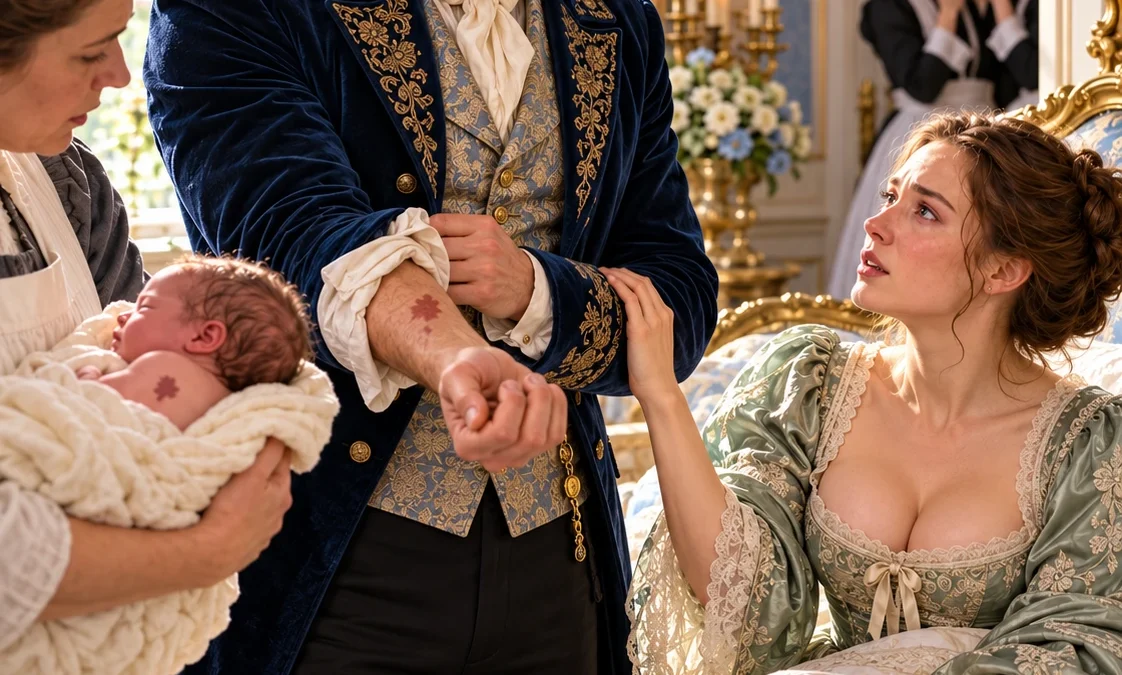
Before he could stop her, Agnes shifted the bundle and folded back the linen from the baby’s tiny left shoulder.
There, on skin so new it was almost translucent, sat a small dark red mark. Three rounded lobes. A short, crooked stem.
A clover leaf. 🍀
Part 2
For a moment, Edmund’s mind simply refused what he was seeing.
“No,” he said. His voice sounded strange, too loud. “Marks can be painted. Ink. Berry juice. You would say anything she paid you to say.”
“Then look for yourself,” said Agnes, “since you trust nobody.”
He did not decide to do it. His hands did it for him. He tore at his left cuff. The button flew off and rolled under the bed. He shoved up the black sleeve and the white shirt beneath it and bared the inside of his forearm to the sunlight for the first time in more than twenty years.
The clover leaf. Three lobes. The crooked stem.
He looked at his arm. He looked at the child. He looked at his arm again.
Not similar. Identical, as if the same seal had been pressed twice into warm wax. 😳
“You never let me see it,” said Rosalind softly from the bed.
He could not answer. The arithmetic was already happening in his head, cold and merciless. The storm in late August. The library. The yarrow salve. Stay until the lark. And now, the middle of May. Nine months.
“Your father had it,” Agnes went on, relentless. “Your grandfather before him. This lad came into the world at four this morning with it plain as a seal on a letter. Captain Julian Caro hasn’t got it, Your Grace. I delivered him, too. Clean as milk, that one.”
In the doorway, Betsy whispered to Hannah. And Edmund knew that by noon every servant at Ravensworth would know the Duke had come to deny his son and found his own mark on the child’s shoulder.
“Rosalind.”
She reached for him. Her cold fingers closed around his bare forearm, right over the mark. “Edmund. I think…”
She did not finish. Her eyes rolled upward, and her hand slid from his arm.
Agnes thrust the baby at him so suddenly he caught the bundle by instinct, and then she was at the bed, throwing back the coverlet. The sheets beneath were spreading red.
“She’s bleeding again. Lord help us.” She looked up, her old eyes fierce and utterly without fear. “Either you leave this room this minute, Your Grace, or you take off that coat and do exactly as I say.”
Edmund looked down at the child in his arms. It was the first infant he had ever held. It weighed nothing at all.
He took off his coat. 🔥
His voice, when it came, was the voice that had commanded men under cannon fire. “Betsy. Tell the head groom to take my horse, not a cart horse, and ride for Mr. Lyle. If the Matlock road is bad, he goes by the ford. Go.”
The baby made a small wet sound, and then a worse one, a choking click. His face began to darken.
“Turn him over your arm, face down, head low, pat his back. Firm, not hard,” said Agnes, not looking up. “Now hook your little finger in his mouth and clear it. He’s not made of glass. Now cover his nose and mouth with your mouth and breathe into him gently, as if you were blowing on a candle you didn’t want to put out.”
Edmund bent his head. The child smelled of milk and lavender and blood. He breathed softly, once, twice.
The baby jerked, sneezed, and let out a furious, outraged cry.
Edmund stood in the blue bedchamber in his shirt sleeves, his mark bared, his son screaming against his chest, and could not remember how to breathe himself. 😭
Agnes showed him where to set his hands on the soft swell of Rosalind’s belly and how to knead, hard and steady, the way a baker works dough. “The womb must close. Harder than that. You’ll not hurt her worse than she’s hurting.”
Rosalind’s eyes fluttered open at the pressure. She saw him bending over her, and something like anger moved across her white face. “You came to unmake him,” she whispered, “and now you hold him. Now you touch me.”
He had no answer. He kept pressing.
“I need shepherd’s purse,” said Agnes. “She makes a tincture of it. It’s in her still room.”
“Where is her still room?”
Agnes looked at him for one long moment, and the look said everything about a man who did not know where his own wife kept her medicines.
“The old dairy, behind the kitchen garden. Third shelf on the left. A brown bottle with a green ribbon. Run, Your Grace.”
He ran. The old dairy smelled of rosemary. She had transformed it. Every shelf was crowded with bottles labeled in her small, neat hand. Yarrow for wounds. He remembered the yarrow on his palm and pushed the memory away. Third shelf. A brown bottle. A green ribbon.
His elbow struck a ledger lying open on the work table. It fell. He snatched it up and saw the column of entries on the open page. J.C. £20. J.C. £20. J.C. £30. Month after month, every entry in her hand.
J.C. Julian Caro.
He stood very still. Then he shoved the ledger inside his waistcoat, and on the highest shelf saw one more bottle, small and blue, its label written larger and darker than the rest. Laudanum. He did not know why that label made the back of his neck go cold.
He had no time to wonder. He ran. 💨
Agnes measured drops into a cup of wine and tipped it between Rosalind’s lips. Her pulse, when Agnes guided his fingers to her wrist, was a thread, so faint that twice he lost it and thought it gone.
“Rosalind. Open your eyes. That is an order.” Nothing. “You were right. You are always right. It is very tiresome. I was nine months late. Do not make me later than that. Please.”
His voice broke on the word. He bowed his head over her cold hand.
The room was silent. Even the baby was still.
And then, through the open window from the meadow beyond the garden, a lark began to sing.
Rosalind’s fingers moved in his. Her eyes opened, just barely.
“You stayed,” she whispered. “Until the lark.” 💛
The bleeding slowed. Mr. Lyle arrived before noon, mud to the knees. “She will live, Your Grace, if the fever does not take her in the next three days. But she cannot nurse. The child must have a wet nurse at once, or we shall lose him.”
Before Edmund could answer, Mr. Thorpe appeared with a letter, his face carefully empty. “Your Grace, forgive me. Your London office, following your instructions, sent a copy of the declaration to Captain Caro, as heir. This has just come by express.”
Julian’s letter was everything Julian always was: warm, graceful, impossible to fault. “The poor infant is innocent. I hear the Duchess cannot nurse. I am sending ahead a most excellent wet nurse, Mrs. Doyle, who has served the best families in the county. I shall follow within the week.”
Edmund could find nothing wrong with it. That in itself should have warned him.
Mrs. Doyle arrived the next afternoon, a large, soft-spoken woman with plump white hands and a carpet bag that clinked faintly when she set it down. She called the baby little lamb. For the first time since his birth, Thomas fed properly and fell asleep with milk on his lips.
On the third evening, Edmund went to sit with his wife. The cradle stood beside the bed. He took out the sealed declaration. His own crest stared up at him, the hawk and the three oak leaves.
“Have you come to finish it, then?”
Rosalind was awake, her eyes on the paper in his hand. “Sign it here, by his cradle. It seems a fitting place.”
“I saw you,” he said. “At the yew walk at midnight, the night after the storm. I saw you give him money. I found your letter. He must never know. I am he, I take it.”
“You read a letter in my desk,” said Rosalind, “and you never once thought to ask me what it meant.”
He laid the ledger on the coverlet. “J.C. Twenty pounds. Thirty. Every month in your own hand. Do you deny it?”
She looked at it for a long moment. Then she laughed, a small, cracked, terrible laugh that ended almost in a sob.
“No. I do not deny it. I paid him every month, and I would have kept paying until I sold every jewel you gave me. Do you know what a woman is paying for, Edmund, when she pays every month and hides it? It is very rarely love.”
Part 3
“My father did not die of a fever in Harrogate,” said Rosalind. “That is what we told everyone. He died in the Fleet Prison in London under a false name, because a partner cheated him and his creditors came for him in a single month. The money for my dowry was the last of what he had hidden from them.”
Edmund stared at her.
“Julian found out. I do not know how. He came to me in the spring, very kind and very sorry, with copies of my father’s prison papers and a list of creditors who were never paid. He told me that if it came out, every drawing room in London would say the Duke of Ravensworth had sold his name for a bankrupt’s stolen money. He told me they would laugh at you.” She swallowed. “And I remembered what you said outside the church. That your name was the one thing your father had not ruined. It was the only thing you ever asked of me.”
“So you paid him.”
“To keep his mouth shut until I could find a way to stop him.”
“And you did not tell me?”
“Tell you?” Her eyes filled. “You married me for money. If you learned the money itself was tainted, what would you have done with me? I thought you would send me back to Yorkshire with a quiet allowance. And then came the storm, and for one night I thought perhaps you might not. And then you were gone.” 💔
“Julian came to me at my club three weeks after I left. He wept. He told me you had pursued him since the spring.”
Rosalind closed her eyes. “Of course he did. He told me the last time I paid him that you knew all about our meetings and found them very amusing.”
Edmund sat with the ledger on his knee and saw, all at once, the whole shape of it. Every piece of evidence he had trusted turned in his hand like a coin and showed him its other face. The purse at midnight. The kiss on her fingers, which she had not returned. He must never know, because she had been protecting him. And he had looked at a frightened woman paying a blackmailer and seen his father’s mistress in Bath, because he had been looking for her in every face for twenty years.
“I made you afraid to tell me the truth.”
She did not answer. She did not need to.
He walked to the small fireplace. He broke the black seal with his thumb, unfolded the declaration, and read the first line aloud, quietly, in the voice of a man reading his own sentence. “I, Edmund James Caro, Duke of Ravensworth, do solemnly declare that the child lately conceived by my wife is not of my body.”
Then he laid the paper on the coals. The edges curled and blackened. The wax of his own seal ran and dripped into the fire, and the hawk and the three oak leaves were gone. 🔥
“My mother told me that was simply what men were,” he said, turning. “That a wife could only pretend not to see. I decided I would never let anyone close enough to do that to me. So when I saw you at the yew walk, I did not need to ask. I had decided long before that you would betray me. And when you did not, I made you do it anyway in my own head, because it was safer than the alternative.”
“What was the alternative?”
“That I had fallen in love with my own wife during a thunderstorm, and that she might not feel the same.”
The silence went on so long he began to believe he had his answer.
“Burning paper is easy,” said Rosalind at last. “But my servants saw you come up those stairs to deny him. Will you say it in front of them?”
“Watch me do it, and judge me after.”
She looked at the cradle. “He is cold. His feet are always cold. Pick him up. Support his head. Now hold his feet in your hand.”
Edmund lifted his son as though he were spun sugar. The tiny feet were two icy knots in his palm. He folded his fingers around them.
“He needs a name. I could not give him one until I knew whether he would be allowed to keep yours.”
“What was your father’s name?”
“Walter. Why?”
“Because he died alone rather than shame his daughter. I should like our son named after a man who protected the people he loved. Thomas Walter Caro. If you would allow it.”
For the first time since he had walked into the room, Rosalind’s face softened. “Thomas. Yes.” 🥹
Over the following days, the Duke of Ravensworth learned more practical things than in five years at Eton and two at Oxford. He learned to swaddle a newborn, though his first attempts looked, in the words of Agnes Pell, like a sack of potatoes tied up by a drunk. He learned that his voice reading the Agricultural Gazette sent Thomas to sleep faster than any lullaby.
Together, they began to fight Julian. They spread Sir Walter’s papers across the bed and the floor, and Edmund sat among the trunks in his shirt sleeves, the clover mark bare, because he had simply stopped buttoning his cuffs.
On the second day, Rosalind cried out and held up a sheet of paper. A receipt from a bank in Leeds. In the last autumn of his life, her father had paid three of his largest creditors in full, every penny with interest. By the fourth day, they had found nine more. Sir Walter had not run from his debts. He had been paying them back one by one in secret, and had died owing almost nothing at all.
Julian’s list was two years out of date. It was not a lie. It was worse. It was a truth that had stopped being true, used as a knife.
“He died with clean hands,” Rosalind whispered. “All this time I believed he died a cheat.”
“He died a better man than my father lived.”
She looked up. “Is that why you hide the mark?”
He was quiet a while. “My father used to roll up his sleeve at the card table and show it to his friends. He showed it to the woman in Bath, and to her children. Two of them had it, too. I was twelve when I found that out. I buttoned my cuffs that night and never unbuttoned them again.”
“I thought it was me,” said Rosalind slowly. “You never let me see your arms. You never stayed until morning, except that once. I thought you were ashamed of the wool merchant’s daughter.” She gave a small, rueful smile. “We are a fine pair, Your Grace. Each of us hiding from the other, each certain the other was the one doing the hiding.”
“Then let us stop.”
He sat on the edge of the bed and took her hand. After a moment, her fingers turned in his and held on. 💛
That night he did not go back to his own rooms. He slept in the armchair beside her bed, and woke at dawn to find her hand had found his across the gap.
Thomas slept a great deal. More than Edmund thought a baby ought. Mrs. Doyle smiled her soft smile and said good babies always slept. Rosalind frowned. “He was not sleepy at all the first day. He screamed at you most energetically.”
“He had a great deal to say to me.” She laughed, and the moment passed.
On the seventh morning, Rosalind walked to the window on Edmund’s arm. “When he is old enough, I shall teach him to ride properly.”
“And I shall teach him to swim in the lake. My father said dukes did not swim.”
“What do dukes do?”
“Apparently they hide their arms and run away to London. This one is learning otherwise.”
She leaned her head against his shoulder, and for a few minutes Edmund believed the worst was over.
That afternoon, Agnes Pell finally went home to a farmer’s wife in labor. At the door she looked at him hard. “Keep your eyes open, Your Grace. Nothing is ever finished as fast as men like to think.”
Captain Julian Caro arrived at six that evening in a hired chaise, fair-haired and handsome, with the kind of smile that made dowagers forgive him anything. “Cousin, I came the moment I could. Tell me she is better.”
“She is better.”
“Thank God.” He produced a silver rattle hung with tiny bells. “May I see him?”
Edmund thought of putting his hands around Julian’s throat. Then he thought of Agnes. “Of course. Come up.”
Julian stood in the nursery doorway a long time. Mrs. Doyle rose and curtsied and lowered her eyes. Something passed between them, a glance so quick Edmund would not have noticed it a week ago.
He noticed it now.
“What a little angel,” said Julian softly. “And so peaceful.” 😨
At dinner, rain drummed against the tall windows. Julian raised his glass. “To the heir of Ravensworth.” And drank.
Edmund lifted his own glass and did not drink.
He was halfway through the soup when he heard it. A scream, thin and terrible, from the floor above. Not a baby’s. A woman’s.
Rosalind.
Edmund took the stairs three at a time. The nursery door stood wide open. Rosalind was on her knees on the floor. She had dragged herself out of bed and along the corridor, and he could see the marks of her hands on the silk wall. Thomas lay across her lap like a doll. His face was gray, his lips blue-white, his small arms loose.
Mrs. Doyle’s chair was empty. The servants’ door swung on its hinges.
“His breath,” Rosalind rasped. “Smell his breath.”
He bent close. Sweet, sickly sweet, like treacle and cloves. And under it something bitter he had smelled in the field hospitals of Spain.
“Opium. That woman has been giving it to him from the first day. That is why he slept. That is why he was such a good baby. Tonight she gave him enough to make him sleep forever.” 💔
Edmund was at the window. “Peters! Ride for Lyle! Now!”
“Your Grace, the river’s over the ford! The bridge at Hathersage is underwater!”
“Then go round by Grindleford! Go!”
Eleven miles in the dark on flooded roads. Three hours if the man was lucky. Edmund looked at his son’s gray face and knew Thomas did not have three hours. He owned the river, the bridge, the road, and half the hills between here and Sheffield. Not one acre could carry a doctor through a flood.
“Tell me what to do. You know more than I do.”
She was shaking, but her voice was steady as stone. “He must not sleep. The opium makes them sleep deeper and deeper, until they forget to breathe. Keep him awake. Rub his feet, his hands, his chest. Talk to him. Walk him. Never let him go still. Not for one minute. Not until it wears off.”
“How long?”
“Hours. Until dawn, perhaps.” She tried to stand, and her knees buckled; Hannah caught her. “I cannot do it. God help me. I cannot even stand.”
“You must not. Hannah, put the Duchess on the daybed. Betsy, every blanket in the house, and build the fire until the chimney roars. And send someone to lock every door. No one leaves. Not Mrs. Doyle. Not Captain Caro.”
He walked the nursery with Thomas against his chest. He rubbed the tiny feet until they were pink. He talked, and did not know at first what he said: the names of the fields of Ravensworth, Long Acre, Holland Bottom, the Priest’s Meadow, as if reading his son the inventory of his inheritance.
Thomas’s eyes fluttered half open and closed again.
“No. You don’t. Wake up, Thomas.”
An hour passed. Two. His arms ached. His back burned. He did not put the baby down. 🕯️
In the third hour, his voice gave out on the fields, and without thinking, he began to sing. He had not known he remembered it. His mother had sung it to him in this very wing, before she grew too tired and sad to sing anything.
“The lark at morning rising, rising over the hill…”
His voice was rough and badly out of tune. He sang it anyway, again and again. From the daybed, so faint it was hardly a sound, Rosalind sang with him.
The storm battered the windows. The fire roared. And Thomas grew stiller. Edmund felt the little body go heavier, looser.
“Thomas. I order you to wake up.” Nothing. “Thomas. Please.”
He sank to his knees on the hearth rug with his son held up in both hands, and heard himself speaking in a voice that was not a duke’s and not a soldier’s.
“I came here to deny you. I came through those gates with a paper that said you were not mine. And you were mine the whole time. You are the only thing in this cursed house that was ever truly mine, and I nearly threw you away, and you cannot leave me now. Not when I have only just learned your name.”
Thomas’s chest rose and did not fall, and did not rise again.
“Edmund,” said Rosalind, in a voice like breaking glass.
He looked down at the small blue face, and the whole world went silent. And in the silence he heard, as clearly as if she stood beside him, the rough voice of Agnes Pell.
Cover his nose and mouth with your mouth and breathe into him, gently, as if you were blowing on a candle you didn’t want to put out.
He laid Thomas flat across his knees. He tipped the small head back with one finger under the chin. He cleared the tiny mouth. Then he bent and breathed, gently, once. The little chest rose and fell.
“Count,” he said. “Rosalind, count for me.”
“One,” she whispered. “Two. Three. Breathe.”
He breathed. “One, two, three. Breathe.”
Ten times. Twenty. Rosalind’s voice went on counting, cracked and steady. The rain hammered on the glass.
“Breathe.”
And beneath his mouth the tiny body jerked, coughed, hiccuped. Thomas gasped a raw, ragged gasp, and another, and his face crumpled into a red knot of outrage, and he screamed. 😭
It was the most beautiful sound Edmund had ever heard in his life. He gathered his son against his chest and bowed over him on the hearth rug, and his shoulders shook, and he did not care who saw.
They did not let Thomas sleep again until the sky had turned from black to gray. Rosalind sang until she had no voice left. When at last the baby’s breathing came deep and even, his color warm, his small fists curled, Edmund lowered himself to the floor beside the daybed with his son asleep on his chest. Rosalind reached down and laid her hand on his hair.
Neither said anything at all.
Mr. Lyle arrived soon after, soaked to the waist, and listened to the baby’s chest for a long time. “Whoever kept this child awake last night saved his life.”
Out in the meadow, as if it had been waiting for permission, a lark began to sing. 🐦
Mrs. Doyle was caught by the tollkeeper at the Grindleford gate, where Peters had spread the word on his way through. She confessed everything before the magistrate finished reading the charge. The captain had paid her, she said, weeping. The captain had said a little more each day would do no harm. Babies went off quietly all the time.
Edmund found Julian in the library, composed, with a glass of Edmund’s best brandy.
“I imagine you are angry.”
“Get up.”
Julian drew a packet from his coat. “Before you do anything rash, cousin. Sir Walter Vane’s prison records. I have friends at three newspapers. The Duke of Ravensworth, who married a bankrupt’s stolen money. And I hear the Foreign Office is about to offer you Vienna. That will not survive a scandal. Your father’s name, your precious name, I can make all of it go away. A sensible allowance, and these papers go into the fire.”
A month ago, Edmund knew he would have bargained. He would have weighed his name against his cousin’s crime, chosen his name, and called it duty.
He took the packet from Julian’s hand. Then he opened the door.
Rosalind stood there in her shawl, leaning on Hannah’s arm, because she had refused to stay in bed for this. Edmund put the packet in her hands.
“These belong to my wife. Her father’s name is hers to protect or publish as she chooses. If she wishes the world to know that Sir Walter Vane died paying every debt he owed, I shall pay for the printing myself.” He turned back. “As for Vienna, they may give it to someone who cares for it. As for my name, I have stopped worrying about it. My son has it now. He will take better care of it than I did.”
Julian’s smile faded entirely.
“The magistrate is in the hall. Mrs. Doyle has told him everything. You will stand trial for the attempted murder of my son, or you will be on the next ship to New South Wales and never set foot in England again. Choose before noon. Mrs. Pell is coming up the drive, and I could not protect you from her.”
Julian chose the ship. He sailed from Liverpool nine days later with a single trunk, and no one at Ravensworth Hall ever spoke his name again. ⚓
The christening of Thomas Walter Caro took place in the little chapel on a golden morning at the end of August, a year almost to the day after a summer storm had knocked a branch through the library window. The chapel was full of tenants and servants. Agnes Pell sat in the front row in a new bonnet the Duke had bought her, which she called a ridiculous waste of money and wore anyway.
Rosalind stood at the font in green silk, holding her son, plump and pink and roaring at the cold water. Beside her stood the Duke with his left sleeve rolled to the elbow.
When the vicar had finished, Edmund held out his bare forearm, and the baby’s small fist found it and closed around his finger, right above the clover leaf. Every soul in the chapel saw it: the mark on the father’s arm, the mark on the son’s shoulder, peeping from the lace christening gown.
The same seal pressed twice. 🍀
Afterward, the vicar opened the great family Bible at the page where three generations of births were written. Edmund took the pen. Four months earlier, he had signed a paper saying this child was not his. Now he wrote slowly, in a steady hand: Thomas Walter Caro, born at Ravensworth Hall the fourteenth of May, 1817. Son of Edmund and Rosalind Caro. My son.
He pressed his signet into the wax beside it. The hawk and the three oak leaves. This time, he thought, they meant what they said.
That evening, he stood at the open window of the blue bedchamber with his wife beside him and his son asleep in the cradle at their feet.
“You know you rode through those gates in May intending to leave the same afternoon,” said Rosalind.
“I remember.”
“And now?”
He looked out at the drive running down to the gates and the London road beyond. He did not feel the slightest wish to follow it.
“Now I should like to ask you something. And I want you to know that I am asking, not ordering.”
Her eyebrows rose. “That will be a novelty.”
“May I stay? Until the lark?”
His wife looked at him for a long moment, and then she smiled, a slow, warm, wicked smile he had almost laughed at across a dinner table a lifetime ago.
“Every morning,” she said, “for the rest of your life.” 💛
Some men spend their lives guarding a name and never notice that a name means nothing until someone you love is willing to carry it. Edmund Caro came home to deny a child, and found that the child had already claimed him with a mark he could never wash off, and never wanted to again. 🐦
This story is entirely fictional and created for entertainment purposes only. It does not represent any organization or individual, nor does it encourage inappropriate behavior. The content was generated with AI assistance.








