THE DUKE SENT HER HIS THREE “USELESS” OLD AUNTS FOR WINTER… BY EASTER, HIS OWN DUCHESS WAS BEGGING FOR A SEAT AT THEIR TABLE
🕯️🍲 THE DUKE SENT HER HIS THREE “USELESS” OLD AUNTS FOR WINTER… BY EASTER, HIS OWN DUCHESS WAS BEGGING FOR A SEAT AT THEIR TABLE 💔
PART 1
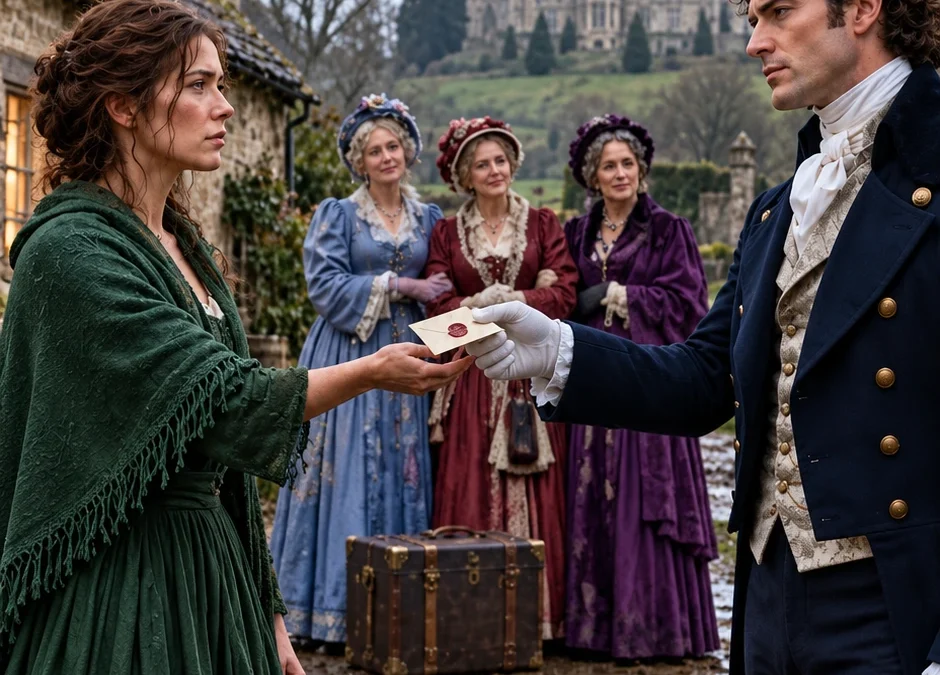
The Duke of Brackwell sent his three old aunts to Cold Harbor Farm in the steward’s cart with one trunk between them. 🌧️
Then he stepped down from his own carriage in the lane and held out a sealed note in his white glove, as if it might soil him.
Maud Lowry, who had buried her husband six weeks before, reached out her bare hand, took it, and read it in the rain.
Four shillings a week until Lady Day.
When she looked up, the Duke was already back in his carriage. It was turning in her yard without waiting for an answer.
The old ladies stood in the mud where the cart had left them, arm in arm, in faded silks and bonnets gone soft in the wet. They looked at the farmhouse door, not at the carriage rolling away. The eldest stepped forward, tall and gray, chin lifted the way a woman holds it when it is the only thing she has left to hold.
“We shall not be a trouble,” she said.
Then her knees went quite gently, and she folded onto the wet step like a dropped shawl. 😨
Maud caught her under the arms before her head struck the stone. She was light, far too light, and her cheek was cold as a plate.
“She has not eaten since yesterday noon,” said the youngest, pulling off her wet gloves to chafe her sister’s hands. “They forgot to send up a tray. They were packing the rooms.”
Together they carried her inside and laid her in the only chair.
Maud had barely got the bonnet off when the cart came back. The steward, Mr. Sneath, a thick, neat man of fifty in a caped coat, did not get down. He leaned from the seat and held out his hand.
“The key of the trunk. The trunk is the Duke’s property. His grace wants the key.”
Maud stood in the doorway with rain running off the thatch.
“The trunk is in my house. The key is in the lady’s pocket, and the lady has fainted in my chair for want of food.” She paused. “Good evening, Mr. Sneath.”
He looked at her a long moment, then at the smoking chimney. He laughed, not loudly, slapped the reins, and the cart went off into the dark.
Maud looked around her own kitchen as if she had never seen it. One bed in the alcove behind a curtain. A chimney that smoked whenever the wind sat in the west, and it sat there now, so that gray smoke curled along the beam and stung their eyes. On the board, under a cloth, half a loaf.
She soaked a piece in warm milk and fed the old lady with a spoon, the way you feed someone who has forgotten how. 🥣
That night the aunts slept in Maud’s one bed, all in a row like spoons, still in their stays because nobody had the strength to unlace them. Maud sat by the fire. On the peg by the door hung her husband’s brown coat, where he had hung it the last evening he came in from the fields. She had not been able to move it.
Now she took it down and put it on. It smelled of him still: hay, pipe smoke, rain. The sleeves came down over her hands. She sat with her face in the collar and wept for the first time since the funeral, quietly, so as not to wake the ladies. 💔
When it was done, she wiped her face on his sleeve, emptied the tin from the mantel onto her knee, and counted. The rent was due at Lady Day, and she could not pay it. The farm had been failing under him and had failed faster since. Without the rent, she would be walking to the parish with her box.
But four shillings, three times over, every week, was the rent and a little more. It was the difference between Cold Harbor and the parish.
She listened to them breathing behind the curtain, one of them snoring like a kettle, and she knew exactly what the Duke thought he had done. He thought he had put three old women out of his house where he would not have to watch them grow older.
Maud put the money back in the tin.
“Well, then,” she said to the fire. “You’ll stay.”
In the morning the eldest sat up in bed with her hair in a long gray plait and introduced everyone as properly as if they were in a drawing room.
“I am Dorcas Ferris. I am sixty-four. That is my sister Honoria, who is sixty-one, and my sister Winifred, who is fifty-eight and was always the pretty one. Our brother was the late Duke. His son has married a young wife with a great deal of taste, and it seems our rooms are wanted for her dressing. We are to be off the books by Lady Day.”
“As though we were a bad debt,” said Honoria, small and dark and quick, with ink on her middle finger. “I kept that house’s accounts for thirty years. I know to the farthing what his wife’s taste costs.”
Winifred, plump and pink, was already at the window rubbing smoke stain off the glass and humming.
Maud stood at the foot of her bed with the kettle in her hand. “I can’t give you what you had. A smoking chimney, a leaking roof, a farm that’s nearly done. You’d be better off with almost anyone.”
Dorcas looked at her a long time. “My dear. We have been better off with almost anyone for forty years. We should like, for once, to be of use.” 🤍
So Maud showed them the farm. The cracked flagstones. The bread oven with a crack across its floor wide enough to lay a finger in. The back window stuffed with a sack. The bench with one leg propped on a stone. Honoria sat down on it, it tipped, she caught the table, and all four of them laughed at once.
“Well,” said Dorcas, “we shall begin with the chimney. Nobody can cook in smoke. Not even a French cook.”
On Sunday, Maud walked them a mile to church, the old ladies arm in arm in their good silks, holding skirts out of the mud. At the lych-gate a knot of village women waited to see them come. Mr. Tebbit, the stout, gray shopkeeper with a watch chain across his middle, lifted his hat with a flourish that was not meant kindly.
“Morning, Mrs. Lowry. I see his grace has sent you his leftovers.”
Someone laughed behind him. Maud felt Dorcas’s arm stiffen in hers.
“Good morning, Mr. Tebbit,” Maud said, and walked the ladies past him into church, gripping her hymn book so tightly the corners left marks in her palms. 😠
That week they did the chimney. Maud climbed onto the roof with a rope round her waist, wind flattening her skirts, slates slick with rain. Winifred held the ladder with both hands and sang hymns at the top of her voice. “To keep her courage up,” she said, though it was Maud on the roof. Maud lowered a weighted sack down the flue and hauled it up and lowered it again, until a mass of old soot and twigs came down in a black cloud and buried the hearth. Dorcas, standing too close, came out of the kitchen door black as a sweep, only her eyes showing.
She wiped her face with her apron. “That is the first sensible thing that has happened to me since Michaelmas.” 😂
That night the fire drew. Smoke rose like a ribbon, and the kitchen was clear and warm to the corners, as it had not been since Maud came to it as a bride.
And Dorcas cooked.
A knuckle of bacon. An onion. Carrots from the garden. The end of a sack of split peas. She stood over the pot with her sleeves turned back, stirring and tasting, adding salt a pinch at a time, humming in French. The kitchen filled with a smell sweet and smoky and rich.
Maud tasted it and put her spoon down. “Where did you learn this?”
Dorcas did not answer for a moment. “There was a cook at Brackwell when I was young. A Frenchman. He taught me in the kitchens when nobody was looking. My father sent him away when he learned why I was always there.” She lifted her spoon. “I was not permitted to marry a cook. I was not permitted to marry at all, in the end. But nobody could send away what he taught me.”
Winifred reached over and put her hand on her sister’s wrist and left it there.
Nobody said anything more.
And in the lane outside, in the dark, a man with a lantern stood listening at the window. He had come to mend a gate. He stayed to smell the soup.
He would be the first of many.
👉 How did one pot of soup turn a failing farm into the most talked-about table in the county? Find PART 2 in the comments, or leave any word and I’ll send it to you privately! 🕯️🍲
PART 2
He had come to mend a gate. He stayed to smell the soup.
Abel Stroud was a laborer from the Brackwell home farm, a long, bony man of forty-one with a houseful at home and wages that would not stretch. Maud could pay him in dinner, not in money. He sat at the end of the table with his cap on his knee and ate the soup. Then a second bowl. Then he wiped the bowl round with his bread and sat looking at it.
“I’ve not eaten like that in my life, Mrs. Lowry.”
“Miss Dorcas made it.”
Abel looked at Dorcas in her faded silk, stood up, and gave her a bow, clumsy, the only one he knew. 🥺
When he had gone, Honoria narrowed her eyes. “That man would pay for that dinner. Not much, but every Sunday.”
“He hasn’t got it to pay,” Maud said.
“He has got a penny. Every man in this parish has a penny on a Sunday. And a penny from twenty men is more than your oven earns sitting cold.” She pulled a stub of pencil from her pocket and began writing on the back of an old almanac. “Sunday dinners. A penny a plate. I shall do the buying. Dorcas will do the cooking. Winifred will make them feel welcome, which she does better than any of us. And you, Mrs. Lowry, will mend the oven.”
So Maud mended the oven. She mixed clay, lime, and sand in a bucket, lay on her back on the cold oven floor with a candle beside her, and packed the crack with her fingers until it was smooth and her hair was gray with dust. She fixed the short bench leg with a piece of ash Abel brought. She pulled the sack from the back window and set in a pane of glass that Honoria had bargained from Mr. Tebbit himself, standing at his counter half an hour and not moving until he came down to her price. 🔨
On the first Sunday, six men came to the kitchen door with caps in their hands and a penny each. They sat at the long table and were fed. On the second, eleven, some with wives. By the fourth Sunday they sat on benches, chairs, and upturned buckets in the yard with bowls on their knees. Winifred went between them with bread, singing old songs from the hall in a voice cracked at the top and sweet all through. The women cried. So did one or two of the men.
The pennies went into a blue jug on the dresser. Every Sunday night, Honoria tipped them out, counted them into little towers, bought the next week’s meat, and put the rest by for the roof. By All Saints, the back kitchen roof was mended. By Martinmas, the curate came. He was thin and earnest, thirty-four, and had heard about the soup from Abel’s wife. He sat beside Dorcas while she served shin of beef stewed for hours with onions and a little dark ale until it fell apart under the spoon. He ate in silence. Then he asked her, in careful schoolroom French, where she had learned to cook like that.
She answered in French, far better than his. He blushed to the ears and came back the next Sunday with a gentleman friend. The friend was the squire’s son. After that, the squire’s wife came in her carriage to see what her son was eating in a farm kitchen, and stayed to eat it. 🥄
Then one Sunday in Advent, the lane from the farm gate to the turnpike was lined with carriages, and Winifred stood at the door turning people away very sweetly. They went away determined only to come earlier next week.
It was not only the food, the county ladies said. It was Maud going round with the jug, flour on her sleeve and a face pink from the oven, who made everyone who came in at that door, gentry and ditcher alike, feel as though they had been expected. 💛
Mr. Tebbit came in the second week of Advent. He set his penny on the table without a word and sat down beside Abel. When he had eaten, he stood by the door turning his hat in his hands.
“I spoke out of turn, Mrs. Lowry. At the lych-gate.”
“You did,” said Maud.
He nodded and went out. The next day, a side of bacon hung from the hook in the beam, and nobody had paid for it.
Up at Brackwell, the Duchess heard about the farm from her own dinner guests.
Cordelia was twenty-six, married since spring, come from a London house full of people to a great gray house on a hill with nobody to talk to. Her new rooms were all rose silk and gilt, but cold, and she sat in them in her shawl watching the rain.
“You must go, Duchess,” the squire’s wife said across the table. “The soup alone! And the old ladies are so charming. The youngest sings like an angel.”
“Old ladies,” said Cordelia.
A little silence. Then somebody told her whose aunts they were.
She set down her spoon and did not pick it up for the rest of the evening. Nobody had told her there had been aunts in those rooms. Nobody had told her anything at all. 😳
The frost came a week before Christmas, hard and white and silent. By morning the yard pump was a pillar of ice. For three nights it did not lift. On the fourth, in the small hours, there came a crack in the kitchen like a shot. Maud sat up in the chair where she slept by the fire and saw smoke pouring from the chimney breast through a split in the old mortar, as long as her arm.
She got the ladies out of bed, wrapped them in every blanket in the house, and shut them in the back room. Then she raked out the fire, threw water on it, and stood in the dark, cold kitchen with her eyes streaming.
In the morning Mr. Sneath came. He did not come in. He stayed by the gate in his caped coat, looking up at the broken chimney and at the ladies in the back window with blankets over their heads, and took out a paper.
“His grace has heard that his aunts are keeping a public eating house. His grace finds it an embarrassment to the family. The four shillings is stopped until the spring. If the ladies wish to return, there are rooms made ready over the laundry, where they will be kept quietly, as befits their station. The cart will come for them on Monday.”
Maud faced him with soot on her face. “And if they don’t wish it?”
“Then they may starve at Cold Harbor, Mrs. Lowry, and you with them.” He folded the paper. “The rent is due at Lady Day, I think.”
When he had gone, the aunts came out into the kitchen in their blankets and stood in a row. Dorcas spoke for them. “We shall go on Monday. We shall not have you ruined on our account.”
Maud looked at them. Dorcas, who could cook like a Frenchman. Honoria, who could make a penny do the work of a shilling. Winifred, who could make a room of strangers cry. And she thought of the rooms over the laundry, where they would be kept quietly.
“You’ll not go on Monday. Nor any day unless you choose it.” 🔥
That afternoon, she took her husband’s brown coat down from the peg and walked through the frozen lane to Mr. Tebbit’s shop with it over her arm.
“I need flour and meat on credit, Mr. Tebbit. Till the spring. I have nothing to give you for it but this. It’s a good coat.”
Mr. Tebbit looked at the coat, then at her. He pushed it back across the counter.
“Put that on before you catch your death. Your credit’s good here. As good as the Duke’s. Better.” He took down his slate and wrote her name at the top. “And you tell Abel I said to fetch the lads. That chimney won’t mend itself.”
👉 Will the whole county come to the farm’s rescue… and what happens when a blizzard strands forty guests of the Duchess’s ball? LIKE this post and COMMENT the word “TABLE” 🍲 to unlock PART 3! As soon as we reach enough comments, I’ll post it! ❄️🔥
PART 3
Abel came the next day with four men from the home farm. They worked on the roof in the bitter cold, breath smoking, fingers raw, pulling out cracked bricks and setting new ones in lime mortar that Maud kept warm by the stove so it would not freeze before it set. 🧱
On Christmas Eve the fire was lit again, and the smoke went up clean. The Sunday dinners carried on as though nothing had happened, except that now they ran on Mr. Tebbit’s credit, and every man who came set down his penny, often another on top of it, and would not take it back.
On Twelfth Night it snowed. It had been snowing since noon, great soft flakes out of a yellow sky, and by dark a foot lay in the lane and was still falling. At Brackwell, the Duchess was giving her first Twelfth Night ball. Forty guests were coming from all over the county. The great hall hung with greenery. The Duchess in white satin stood at the top of the stairs to receive them.
Nobody came. ❄️
The road to Brackwell ran through a deep cutting below the hill, and by seven the snow had drifted higher than a carriage. The first carriages stuck fast. The ones behind could not turn. Then somebody saw a light.
It was Maud’s kitchen window, a mile back along the lane, the only lit window in all that white country, because she set a candle in it every night for Abel’s lads walking home. The guests got down, ladies in thin satin slippers, gentlemen in evening coats, and began to walk toward it through the snow.
Maud saw them from the window: a long, straggling line of lanterns and white faces coming out of the dark. She knew at once what had happened. She put her husband’s coat on over her apron, took a lantern, and went out. She met the first at the gate, brought them in, and went back. She went back five times. The last time she found an old gentleman in the ditch at the bend, stout, white-haired, in a velvet coat, who had slipped and could not rise. She got her shoulder under his arm and hauled him out of the snow and half carried him to the farm, his arm around her neck, while he apologized to her very politely the whole way. 🕯️
By the time she reached the door, the kitchen was full. Forty of them, the county in its best, packed onto bench and chairs and buckets, snow melting off their shoulders and steaming by the fire.
And the three aunts rose from their places, calm as if they had been expecting forty people all week.
“Well,” said Dorcas. “We shall want the big pot.”
Every scrap in the house went in: the Sunday bacon, Mr. Tebbit’s flour, the last of the onions, the dried beans. Dorcas stood over it two hours with her face scarlet from the fire and fed forty people with bread from the mended oven, hot and brown. Honoria went round with the jug and gave every guest a cup of hot spiced ale and took nobody’s money. When they had eaten and the fire was banked high, Winifred stood by the hearth and sang a carol that the old gentleman said his mother used to sing to him. He wept into his handkerchief and did not care who saw. 🎶
And on the hill, the great house of Brackwell stood in the snow with every window blazing, and the Duchess in white satin sat alone at a table laid for forty and ate a piece of Twelfth cake by herself. 💔
The snow lay for a week. When the cutting was dug out and the carriages went home, every guest went home talking about Cold Harbor Farm, and about the old ladies who had been sent out of Brackwell, and about the steward who had stopped their money. By Candlemas the whole county knew it, and the Duke’s invitations began to come back refused.
The Duchess came in Lent.
She came on foot, alone, down the lane from the hill in a gray cloak and stout boots, mud splashed to her knees, on a raw March Sunday when the dinners were at their fullest. She stood in the kitchen doorway with her hood back and rain on her face, and the talk along the benches died away.
She was very pale and did not look like a duchess. She looked like a young woman who had not had anyone to talk to for a year. She looked down the long table at the laborers and their wives, the curate, the squire’s wife, and the three aunts at its head, and she did not seem to know what to do with her hands.
“I have come,” she said, and it was very nearly begging, “to ask if there might be a seat at your table on Easter Sunday. For me.” She swallowed. “I shall pay my penny.”
Maud stood by the dresser with the blue jug in her hands.
Then Winifred got up from her place, went down the whole length of the table, and took the Duchess by both cold hands. “My dear. You’d better come in to the fire. You’re wet through.” 🤍
They sat her by the fire and gave her soup. She ate it the way Dorcas had eaten the soaked bread on that first night, as if she had forgotten how. And she spoke in a low voice, the whole table listening and pretending not to. She had never asked for the aunts’ rooms. She had said once, in her first week, that the east wing would make a pretty dressing room, and the next time she looked, it was empty, and nobody would tell her why.
“I thought there had been some sadness nobody wished to speak of. I did not know he had sent you away.”
“We know you did not,” said Dorcas.
And that was when the Duke came.
He came to the kitchen door, not the front, rain running off the brim of his hat. He had followed his wife down the hill and stood in the yard some time, it seemed, before he could make himself knock. A tall man of thirty-two in a navy coat, hat in hand. When he came in before them all and saw his aunts in the high places at the table and his wife by their fire, he stood quite still, and his face went a slow, dark red from the collar up.
The room fell quiet. Nobody offered him a seat.
It was Maud who spoke. “Your grace.”
He looked at her properly, perhaps for the first time. A tired woman of thirty with flour on her sleeve, soot on her cheek, and a blue jug of pennies in her hands. She held his look and did not drop her eyes.
“Mrs. Lowry. I have come to ask what I owe you.”
“You owe me the four shillings. Every week of it, back to Michaelmas. You owe Mr. Tebbit for the flour your aunts ate while it was stopped, and Abel Stroud and his lads for the chimney they mended in the coldest week of the year. That’s the money.” She paused. “The rest isn’t money.”
“The rest?”
“The rest is that your aunts choose where they live. Not you. Not your steward. Them. And if they choose Cold Harbor, you pay their keep here, the same four shillings every week for as long as they want, and you never send a cart for them again.”
A long silence. Somebody’s spoon clinked against a bowl and stopped. The Duke turned to his aunts.
“Aunt Dorcas. Aunt Honoria. Aunt Winifred.” His voice was not steady. “I did not know what I was sending away. I thought I was sending away three old women.” He stopped. “I was wrong. I am sorry. In front of everyone here, come home.”
The sisters looked at each other the way sisters do who have not needed words in fifty years. Then Honoria spoke. It was the only time Maud ever heard her raise her voice.
“We are home, nephew. We shall be very glad to see you at Easter. You may bring your wife. The dinner is a penny a plate, and you shall pay it like everyone else.” 😂🥹
The Duke paid. He paid every farthing back to Michaelmas in gold on Maud’s kitchen table, and Honoria counted it into little towers. He paid Mr. Tebbit’s slate, and Abel Stroud and his lads. And he sent Mr. Sneath away from Brackwell before the month was out.
On Easter Sunday they came to dinner. It was a bright, cold morning with primroses along the hedge-bank and smoke rising straight from the new chimney into a clear blue sky. The kitchen was full to the door. Abel was there with his wife. Mr. Tebbit in his Sunday coat. The curate. And the old gentleman in the velvet coat who had come every Sunday since Twelfth Night and would sit nowhere but beside Winifred.
Dorcas had roasted a leg of lamb with rosemary and garlic in the French way, and the whole lane smelled of it. The Duchess sat between Winifred and the curate in a plain blue dress, sleeves pushed up, carrying plates, laughing out loud at something Abel said, and looking for once as though she belonged somewhere.
The Duke sat on the end of the bench by the door with his penny on the table before him. He ate what he was given and said very little. Dorcas served him last, gave him the best slice, and put her hand on his shoulder a moment as she did it, the way you would with a nephew who had come in late and cold. 💛
When the dinner was over and Winifred was singing, Maud went to the mantel and took down the tin. From under the money she took a folded note, worn now, with a broken red seal.
Four shillings a week until Lady Day.
Lady Day had come and gone, and the aunts were still at Cold Harbor and meant to stay. She held it a moment. Then she laid it in the fire and watched it curl and blacken and rise up the clean chimney in a thread of smoke.
When she turned, Dorcas was watching from her chair, and nodded once.
Maud went back to her place. Her husband’s brown coat hung on its peg by the door where it belonged, and three old aunts sat at her table in their faded silks, spring sun streaming through the mended window across the white cloth. And the kitchen at Cold Harbor was the warmest room in the county. 🌅
THE END
Did this story warm your heart? Who took you in once when all you had was one trunk and somebody else’s note? Tell me in the comments, drop a 🍲 if you loved it, share it with someone who deserves a seat at the table, and tell me which state you’re reading from so I can give you a shout-out in the next story!
Disclaimer: This story is entirely fictional and created for entertainment purposes only. It does not represent any organization or individual, nor does it encourage inappropriate behavior. The content was generated with AI assistance.








