The Duke Stopped at the Same Window Every Tuesday for Two Years. Nobody Noticed the Woman Standing Behind Him, or the Secret Hidden Inside His Dead Mother’s Music Box
The Duke Stopped at the Same Window Every Tuesday for Two Years. Nobody Noticed the Woman Standing Behind Him, or the Secret Hidden Inside His Dead Mother’s Music Box
PART 1
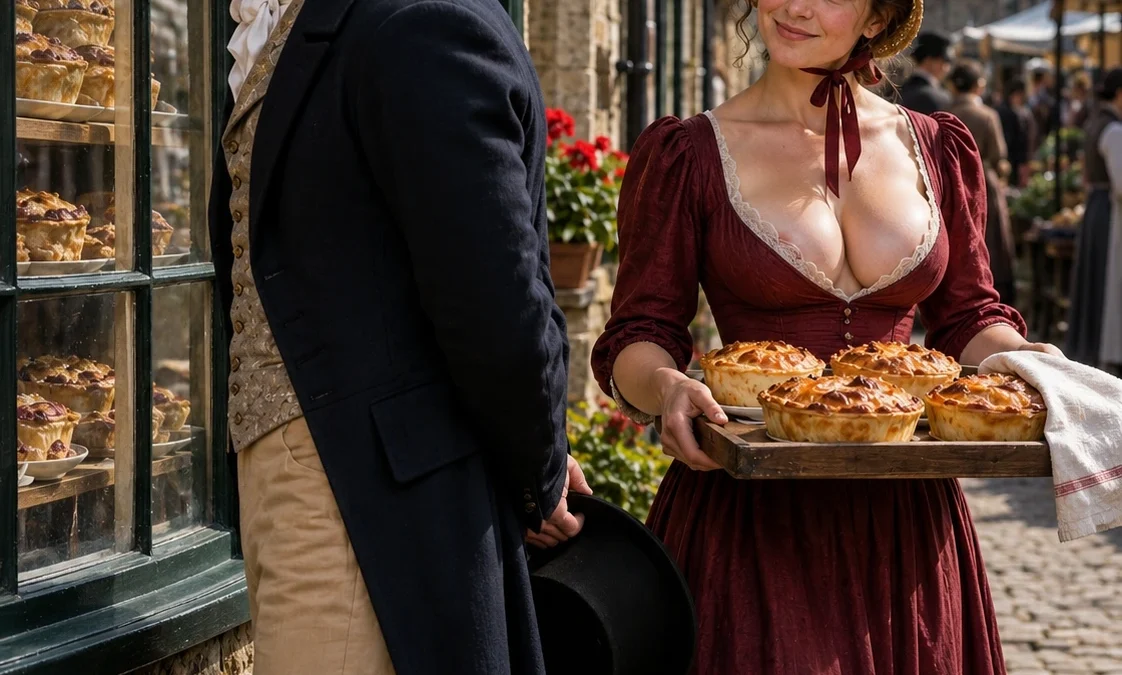
On Tuesdays, the whole town came out for the market. And on Tuesdays, the Duke of Hazelbury stopped at the window of the pie shop. 🥧
Everybody knew it. The farmers knew it, standing at their carts with their cheeses and fleeces. The ladies from the new villas along the lake knew it, the ones who came north every summer with sketchbooks and parasols to look at the mountains. Even the boys who held the horses knew it, and nudged each other when the tall man in the dark coat came down the street from the old market hall, hat in hand, his sandy hair catching the light.
He never hurried. He never spoke to anyone. He simply walked to the bow window of the tall slate house on the corner, and stopped, and looked.
The window was full of pies. Raised mutton pies with crusts the color of a polished saddle. Sweet pies stuffed with currants and spice. Small gooseberry pies with sugar sparkling on their lids, because it was June and the gooseberries were in. Above the glass, in gold letters on green, the sign said Mrs. Hathshaw’s Pies.
A lady with a parasol whispered that he must be very fond of mutton. Her friend said dukes were fond of all sorts of strange things. They laughed behind their gloves. Then the Duke went in, bought a single pie, rode home around the lake, and the town went back to its business until the next Tuesday.
Nobody ever looked behind him.
Isabelle Hathshaw was there every time. 🕯️
She came up the back lane from the bake house with the second batch of the morning on a long board, a cloth over the top, the oven’s heat still coming through it into her arms. The pavement was narrow and the door was beside the window, and every Tuesday at a quarter to noon, a duke was standing in the way. So she stopped too. She stood behind him with the board held level and the steam rising past her face, and she waited.
She had done it for two years of Tuesdays. In the rain, with water running off her bonnet. In the first heat of summer, with flour drying white on her wrists. He had never once turned round.
She told herself she did not mind. A duke had no reason to turn round. She was a young woman in a brown stuff gown and an apron, dark hair pinned under a plain straw bonnet, hands red from the oven. She was furniture. She was the board the pies came in on.
Being unseen meant being left alone. Being left alone meant the work got done.
Inside, her aunt Celeste stood behind the counter in a lilac gown far too fine for selling pies. Celeste Hathshaw was a handsome woman of forty with a smooth face and quick pale hands that had never raised a crust in their lives. She had married Isabelle’s uncle late and buried him the winter before last, and she had never once been seen with flour on her. When the Duke laid his coin on the counter she smiled as if he had paid her a compliment.
“It is all in the lard, Your Grace, and the patience. My late husband used to say I had the lightest hand in the county.”
Isabelle, setting down her board in the passage, did not turn round. Her uncle had said no such thing. On the last good day of his life, sitting by the oven with a blanket over his knees, he had said, “Isabel, you have the best hands I ever saw, and that woman will never forgive you for it.”
He had been right on both counts.
Below the shop, down worn stone steps, lay the old kitchen and the great domed oven. This was Isabelle’s country, hot and low and whitewashed, with a long scrubbed table down the middle and a window at the far end that looked out on the back lane. And in it, Polly, eight years old, all knees and elbows, with a hen’s feather in her hair, burst in with a jug of milk. “Aunt Isabelle! The brown hen laid in the coal again!”
Isabelle kissed the top of the child’s head, feather and all. Polly was her sister’s girl. Her sister had been gone three winters now, and there was nobody else in the world who belonged to Polly except Isabelle.
That was the shape of her days. She rose at four and lit the oven. She raised the crusts by hand, hot water and lard and flour worked fast while warm, pressed up around the wooden dolly with her thumbs until the walls stood on their own. The whole valley ate what Isabelle made with her two hands. And the sign above the window said Mrs. Hathshaw, and everybody thought it meant Celeste.
It was a strange thing, when she thought about it. The name on the glass was hers too. She had simply never heard anyone use it. 😔
That evening, with the last long June light lying gold across the rooftops, her aunt called her up to the parlor.
“I have news, and you may as well hear it from me before you hear it in the market. I am selling the house.”
Isabelle stood very still.
“To Mr. Garside of Kendal. He means to make it a hotel for the lake visitors. The papers will be signed on Midsummer Eve.” Celeste smiled, a pleasant smile. It always was. “He admires the pies very much. He will keep the oven. You will have a place in his kitchen. A servant’s place, naturally, with a servant’s bed.”
She paused just long enough.
“A hotel is no place for a child, of course. I have spoken to the Ritsons at the hill farm over the pass. They need a girl for the hay.”
There it was, in a few plain words. In three weeks the house would belong to a stranger. Isabelle would bake pies with another woman’s name on them. And Polly would be sent over the mountains to work in a stranger’s fields, and Isabelle would see her perhaps at Christmas, if the snow allowed. 💔
She did not cry. Tears in this room were taken as surrender. “Polly is my sister’s child, aunt. She stays with me.”
“Polly is your uncle’s great-niece, and your uncle left everything in this house to me. That includes the decision. Go to bed. You have the oven at four.”
And then, a week later, in the hot noon crowd of the next Tuesday market, someone’s elbow caught Isabelle in the back.
She felt the board tip forward out of her hands. She felt the hot pies slide toward the edge of the cloth. She made a small sound, not quite a word.
And the Duke of Hazelbury turned round. 😳
He turned the way a man turns when he has been waiting for something a very long time, quickly and completely. His bare hand shot out and caught the corner of the board. She saw his fingers close on the hot wood. She saw the pies steady and stop. He did not flinch. He held the board level for her with a hand that must have been burning, and looked at her face over the top of it.
His eyes were green. That was the first thing she noticed, absurdly, with half the town watching. A clear cool green, like the water at the shallow end of the lake, and they looked at her as if she had just appeared out of the air.
“I beg your pardon. I did not know anyone was there.”
“You never do, Your Grace,” said Isabelle, before she could stop herself. “I mean, there is no reason you should.”
Then his eyes went to her hands, to the flour in the creases of her knuckles, the old pale burns on her wrists. And something changed in his face.
“Who made these?” he said quietly.
Above his head, the gold letters said Mrs. Hathshaw’s Pies. She thought of her aunt behind the counter. She thought of Midsummer Eve. She thought of Polly asleep in the little room under the stairs.
“Mrs. Hathshaw, Your Grace.”
It was not even a lie.
He looked at her a moment longer. Then he stepped aside and held the door open for her himself. Isabelle walked through with her face burning hotter than the board.
She did not look back. But she knew without looking that the Duke of Hazelbury had not gone into the shop that day. He had stood on the pavement and watched her go.
And what she did not know, what nobody in that town knew, was why he stopped at that window. It had never been the pies. 🪟
PART 2
It had never been the pies.
Adrien rode home the long way around the head of the lake, his right hand open on his knee, the burn throbbing. He found that he did not mind it.
He had grown up in the tall slate house on the corner. Nobody in town remembered now, or if they did, they were kind enough not to say so. His father had been a younger son with charm, no money, and a great talent for losing what little he had at cards. One day he went to London to mend his fortunes and did not come back. Men came and took the furniture. Adrien was twelve, standing in the empty hall, when his mother told him they must go to her sister in Lancaster. She died the following spring.
Then a cousin drowned, an uncle died of a fever, and a title never meant for him came down through a row of graves. He had been the Duke of Hazelbury for two years now, with a great gray house on the far shore of the lake and more money than his father had ever lost.
And every Tuesday he stood in front of his mother’s window.
She had sat there every afternoon of his childhood, sewing in her lap, watching the street for his father. And on the sill beside her had always stood her music box, a small walnut thing with a brass key that played a country tune she had loved as a girl. When the men came for the furniture, they left it behind, because it had stopped playing the winter before and was worth nothing.
It was still there, behind the pies, with a price card propped against it. Nobody had moved it in all those years. He could not have said why that undid him so completely. But it did. That was what he stopped for.
And today, for the first time, he had turned round and found someone had been standing behind him all along. 🕯️
He sent for the pie that evening, and gave it to his housekeeper, Dorcas, who had been the cook in that very house when he was a boy. She ate a piece of the crust with her eyes half closed.
“Not the widow, Your Grace. Whoever made this has burned herself a hundred times over to learn it. This is a hot-water crust raised by hand, the old way, without a tin. That is the work of somebody who cares more for the pie than for the person who eats it. I would know. I was one.”
“I think she was standing behind me,” said Adrien.
Two days later he called at the house by the front door, like a gentleman. Celeste received him in the parlor, all smiles and surprise. He had not stood in that room in eighteen years. The walls were papered in a stripe his mother would have hated, but the bow window was the same, and on the sill, with its back to the room, stood the music box.
He said he wished to buy the house. Celeste’s eyes went very bright. She was so sorry. She was promised to Mr. Garside. And then a broad, handsome man in a blue coat walked in without knocking, as if the room were already his, and bowed very low.
So Adrien said nothing about money. He said only that he had lived in this house as a boy, and would take it as a kindness to see the rest of it before it changed hands.
“My niece will show you around,” said Celeste. “She knows every corner.”
Isabelle came up the stairs with flour on her apron and stopped dead in the doorway. He watched her face close like a shutter. He bowed. “Miss Hathshaw.”
He had used her name out loud, in her aunt’s parlor. The name on the window. 🥹
She showed him the house briskly, not looking at him. On the landing he laid his hand flat against a narrow door with a faint pencil mark on the frame, at about the height of a boy’s head. She did not ask.
In the parlor, he lifted the music box and wound the brass key. Nothing happened. “It has never played,” said Isabelle. “My aunt keeps it for the price cards.”
“It was my mother’s. She sat here every afternoon, waiting for my father to come home. He did not.”
And Isabelle understood at last why he stopped at the window.
“Would you like to see the kitchen, Your Grace?”
“Very much. I used to steal from it.”
Down in the golden heat of the kitchen, Polly sat crimping a gooseberry pie with her tongue between her teeth. The Duke looked at the dollies, the steaming crock, the red burn-marks on Isabelle’s arms. “You made these?” he said. It was not a question.
She could not lie twice to the same face. “Yes, Your Grace. All of them since I was sixteen. My aunt cannot boil an egg. And in a fortnight, she sells the house, and I will bake for Mr. Garside with her name on the glass, and Polly will go over the pass to a hill farm for the hay.” Her voice did not shake, quite. “I would be grateful if you said nothing.”
“I will say nothing,” said Adrien.
After that he came to the bake-house window every morning before the shops opened. By the third day Polly had decided he was her particular friend. They talked, slowly, the way a crust comes up the side of the dolly, a little at a time. Isabelle took his mother’s music box to the old clockmender by the bridge, and spent her boot money to have it repaired. And in the hayfield below Brierburn, in the golden afternoon, he took her floury hand and turned it palm up beside his own burned one, and she did not pull away.
But Celeste heard of it. She saw how it would go. A duke would buy the house, give it to the girl, and the whole town would know whose pies they had been eating. And Garside would not want the widow then. Nobody would.
It was fear that decided her.
On Monday morning, while Isabelle was out buying lard, Celeste packed Polly’s few things into a bundle and told her she was going on a holiday to help with the hay. Polly climbed onto the carter’s wagon beside a sack of salt, and waved.
By the time Isabelle learned of it, the wagon was an hour gone toward the Ritsons’ farm over the pass. 😱
She ran. Not toward the pass. Toward the lake.
PART 3
Tom rowed her across the lake so hard the oars bent. Adrien was in the stable when she came up from the landing, and took one look at her face and was across the cobbles before she reached him. She told him in plain words what Celeste had done.
“The carter goes round by the valley road, twelve miles. But there is an old pack road straight over the top that comes down above the farm. I walked it with my mother as a boy, to see the waterfall. Can you ride?”
“No.”
“Then you will ride with me.”
He put her up in front of him on the big bay and they went out of the yard at a gallop. The path climbed and climbed, a stony zigzag up the fell with the lake falling away beneath them like a dropped mirror. Near the top it ran along the edge of a crag, nothing on the left but air and the sound of falling water.
“Do not look down,” he said in her ear.
She did not. She leaned into him and shut her eyes, and felt his heart beating hard against her back. 🐎
They came over the top into a high bare valley full of wind and sheep. Far below, small as a toy, lay the Ritsons’ farm. And crawling along the road beyond it, the carter’s wagon. They had come over the mountain in less than an hour.
They reached the farm gate just as the wagon rolled into the yard. Polly sat on her sack of salt, sunburned and puzzled. She saw Isabelle and gave a shriek that sent every hen in the yard flying. Isabelle slid off the horse and held her so tightly the child squeaked. 🥹
The farmer came out, hard and square, and did not like a young woman snatching his new hay girl. But Adrien kept his voice low and even. He said who he was. He said the child was going home with her aunt. And he said he remembered the farmer’s father, who had once given a hungry boy and his mother a cup of milk at that very gate.
The farmer stared. Then he took off his hat. “I remember the lady. She sang to the cows.”
They walked home in the long evening light, Polly asleep on the saddle in Adrien’s coat. On the path above the waterfall, with the whole lake below them going pink and gold, Isabelle stopped.
“I would have reached that farm tomorrow on foot, and the man would have shut the gate in my face. You knew a road nobody else remembered. You had a name he would listen to. You came without asking a single question.” Her voice went unsteady at last. “Thank you. I will never be able to say it properly.”
That night, on the terrace at Brierburn, in the last blue light of nearly the longest day of the year, with a bird by the water that would not stop singing, he said without looking at her:
“Marry me. Marry me, and no one will ever put that child on a wagon again.”
She had felt it coming all the way down the mountain. And she found, because it went so deep, that she could not say yes.
“Do you know what they will say in the market? That the Duke wanted his mother’s house back, and the pie girl came with it, like the oven. Like the dollies on the table. And I could not even tell them they were wrong. You have stood at that window every Tuesday for two years. You still look at it as if it might give you something back. How would I ever know, Adrien, whether you were looking at me, or at the window behind me?”
He did not answer. That was the worst of it. She saw him try to find an answer, and fail, because he was an honest man and did not know himself.
“I do not know how to make you sure,” he said at last.
“No,” said Isabelle. “Neither do I.” 💔
She went back across the lake in the dark. Celeste was waiting at the cellar steps with a candle, white and pinched and frightened. “Mr. Garside gives a dinner here on Midsummer Eve after the signing. You will bake it. Do it and you will have your wages and a good character. Refuse and you leave with nothing.”
“I will bake it,” said Isabelle, and went down into the dark.
The next morning, the clockmender’s boy brought a small brown-paper parcel. The old man had sent a note in a shaky hand: The comb was jammed by a fold of paper put in through the winding hole long ago. I have not unfolded it. It is not mine to read. The box plays very sweetly now.
At a little after five, when the swallows were just beginning, she heard footsteps in the lane. He had come, after everything she had said on the terrace, the way he always came. He stood at the open window with his hat in his hand, gray about the eyes. “I will go if you want me to.”
Isabelle took the parcel down from the shelf and held it out to him. “This is yours. I took it from the sill and had it mended. I hope you will forgive the liberty. There was something inside it.”
He came round to the bake-house door and sat on the bench by the oven and unwrapped the box on his knees. The paper inside was tiny, folded many times, yellow at the edges. She did not watch him read it. But she heard him draw in a breath, and she heard it catch. When she looked up, he sat very still, tears running down his face without a sound. He held the paper out to her until she took it.
The writing was a woman’s, small and slanting, in pencil.
My darling boy, if you ever find this, it will be because you have come back for the house. Please don’t. A house is only the people in it, and we were happy here because we were together, not because of the walls. I have spent too many afternoons at this window waiting for someone who was never coming. Don’t spend your life at a window, my love. Go and knock on a door. 💌
Isabelle read it twice. She folded it along its old creases and gave it back. She sat down on the bench beside him, shoulders touching, and after a moment reached up and touched his cheek, and left a white flour-mark there. He laughed, a broken sound.
Then he wound the brass key, and in the hot little bake house at five in the morning, with the oven ticking and the swallows going over, the music box played a sweet, thin country tune neither of them had heard in years. 🎶
“She hummed it, always. When she was happy, and when she was not.” He turned the box over. “I wrote to Garside last night. I told him I would not try to buy the house. Not before the signing, not after. I have been standing at that window for two years waiting for it to give me back a boy and his mother. It never will. I am done with windows.” He put the paper into the pocket over his heart. “I am not going to ask you anything today, Isabelle. I only wanted you to know that.”
He went up into the gray lane, and was gone.
Midsummer Eve came in hot and still, with thunder grumbling far behind the fells. The papers were signed in the afternoon. By evening the parlor had been turned into a dining room, every candle in the house burning, the bow window open to the warm air. Celeste stood at the head of the stairs in a new gown of dove-colored silk she could not afford, smiling until her face ached, her heart going like a bird in a box.
Below stairs, Isabelle had been working since four. And in the middle of the great pewter dish stood the raised pie she had built for the center of the table, the finest thing she had ever made. Its walls stood straight and golden as a tower, its lid crimped in a pattern of leaves. On top she had set a small pastry swan with its wings half raised, as if it had just come in to land on the water. She did not know why. She had simply found her hands making it.
Near the end of the dinner, Bess came flying down the steps, eyes enormous. “He is saying the hotel will be called Hathshaws! He is saying there will be Mrs. Hathshaw’s pies on every table from here to Kendal! And his Grace has not said a word. Not one word all night. He is just sitting there looking at the swan.”
Isabelle stood very still in the middle of her kitchen. She thought of the gold letters on the green sign, and every table from here to the sea, and her name on all of them, meaning none of her. She thought of the Duke upstairs, keeping his promise, silent, because she had asked him to.
If anyone was going to say it, it would have to be her.
She took a small gooseberry pie from the cooling rack, still warm. She did not take off her apron. She went up the stairs. 🔥
The parlor was bright with candles and hot with wine. Garside stood with his glass raised, Celeste beside him, the parson and his wife and two gentlemen turned toward them. At the far end, Adrien saw her first. She saw him begin to rise, and shook her head very slightly, and he stayed where he was.
She walked the length of the table in her apron and rolled sleeves, flour on her arms, and set the small pie down in front of Mr. Garside, beside the great one with the swan.
“I beg your pardon for coming up. But you are naming a house after my pies, sir, and I thought you should know whose they are. My name is Isabelle Hathshaw. I have baked every pie in that window since I was sixteen years old. I baked the swan on that table this morning by hand, without a tin, the way my uncle taught me. My aunt has never raised a crust in her life. I have stood behind her counter, and behind her name, and behind every customer who ever praised her for my work. I did not mind it for a long while. But I will not have my name sold to a hotel. It is the only thing I have that is mine.” She paused. “Tomorrow I will leave this house, and I will not bake for it again.”
Nobody spoke. The thunder grumbled far away over the fells.
Garside turned slowly and looked at Celeste. Celeste opened her mouth, and nothing came out of it. The silence went on and on, and became its own answer.
“I see,” said Garside, quite pleasantly. That was the dreadful thing. “I have just put my name to a great deal of money for a corner, madam, and a name, and a pie. It seems the pie is going out of the door in an apron.” He looked at her the way a man looks at a horse he has been sold lame. “I think there is nothing more to toast tonight.”
And then Isabelle felt someone come and stand behind her.
She knew without turning round who it was. Adrien had risen from his place and walked round the table, and now he stood at her back, close and quiet and steady, not touching her, not speaking. Simply there. The Duke of Hazelbury stood behind the woman who baked the pies, in front of the whole room, and did not say a word.
He did not need to. Everybody in that parlor understood exactly what it meant. 🥹
Celeste sat down suddenly in the nearest chair, as if her legs had given way, very small in the dove-colored silk. “You have ruined me,” she said, not angrily, in a flat, wondering voice, the way a child says it has broken something.
Something turned inside Isabelle that was not triumph at all.
“No, aunt,” she said quietly. “I have only stopped holding the board.”
She went down to the kitchen without looking back.
Long after the guests had gone, Celeste sat alone as the candles burned down one by one. At some point she went to the bow window, sat in the deep seat, and looked out at the empty street. Garside had said he would call in the morning. She knew he would not. She sat with her hands in her lap and watched the street for him anyway. It did not occur to her until the sky grew pale over the fells that she was sitting exactly where another woman had once sat, years ago, waiting for a man who did not come. 💔
Isabelle did not sleep either. She sat on the bench by the oven, her bundle packed at her feet, two gowns, a shawl, her uncle’s old knife, and Polly’s old boots, and watched the lane window turn from black to gray to the first pale gold of midsummer morning. She was not frightened. She felt light and clear, like the air after a storm. She had said it out loud, in her own voice.
At five she heard footsteps in the lane. She waited for them to stop at the window, as they always did.
They did not stop at the window. They went past it to the low bake-house door.
And then, for the first time in all those weeks, somebody knocked. Three plain knocks on old wood.
She opened the door. Adrien stood on the step in the early light without his hat, his coat over his arm, the music box in his other hand. He looked as if he had not slept at all.
“My mother told me to knock on a door. This is the one I want.”
He came down the step and set the music box on the long table among the dollies. “I do not want the house. I have thought about it all night, and I find I do not want it at all. Garside can keep it or sell it or burn it down. I want you, wherever you are. If you bake in Keswick, I will ride to Keswick on Tuesdays. If you bake in a hut on the top of the fell, I will climb the pack road every week of my life. I have looked at that window long enough. I am looking at you now. I love you, Isabelle. I think I have loved you since the moment you told me I never saw anyone standing there.”
She laughed, and it came out half a sob. “You did not see me. You saw a board of pies.”
“I saw a woman with flour on her wrists who was not even angry with me. I have never in my life been so ashamed, or so glad.” He took a step closer. “I am asking you again, and properly. Not with a house. Not with the oven or the window. Only me. Will you marry me?”
She thought of the farm gate, and the pack road, and the tears on his face over his mother’s letter. She thought of him standing behind her in the parlor, silent and steady at her back. And she found that she was sure.
“Yes.”
Then, before he could move, she put up her hand. “Wait. I have something to ask too. Your mother wrote that a house is only the people in it. My aunt cannot keep this house. She has a sister in Carlisle and nothing to take to her. So I think you should buy it after all. Not for your mother. Not for the window. Buy it at a fair price, so my aunt can go home with enough to live on. And then let us put people in it. Polly, and the oven, and us. I think your mother would have liked a house with people in it again.”
He looked at her a long moment. Then something broke open in his face, something that had been shut since he was twelve years old, and he laughed, and drew her close, and kissed her, there in the bake house with flour on both of them, the oven ticking behind them, and the music box on the table among the dollies. 💛
Celeste left on the Carlisle coach a fortnight later. Adrien’s man of business paid her a fair price for the house, neither more nor less, and she went to her sister with enough to live quietly for the rest of her life. On the morning she left, Isabelle stood at the bake-house door and watched her come down the front steps in her lilac gown. Celeste paused at the coach door. She looked back at the house, and at the sign, and at the young woman in the apron at the corner of the lane. She did not smile. But she inclined her head once, very slightly, before she climbed in.
Isabelle found that her eyes were stinging, and did not quite know why.
On the following Tuesday, at a quarter to noon, the Duke of Hazelbury came down the street from the old market hall and stopped at the window of the pie shop. The whole town saw him do it. But this time there was nobody standing behind him on the pavement. The woman who baked the pies was on the other side of the glass, setting out a row of gooseberry pies along the sill beside a small walnut music box.
She looked up and saw him. He smiled at her, a real smile, the whole of it. Then he raised his hand and knocked on the glass three times, very gently, and the whole street watched Isabelle Hathshaw laugh out loud.
They were married three weeks later in the little gray church at the head of the lake, at the end of the haymaking, with the last carts going past the lychgate piled high and sweet. Polly carried a posy of meadowsweet and would not stop grinning. Dorcas cried quietly in the second pew. Bess and Tom stood together at the back, looking at each other in a way that made the parson raise his eyebrows, and they were married themselves before the apples came in.
The sign above the corner shop was repainted that autumn, gold on green, and Isabelle had the painter change a single word. Isabelle Hathshaw’s Pies. It meant her now. Everyone in the valley knew it did. 🥧
A year later, when the hay was down in the meadows again, the Duchess of Hazelbury still came across the lake on Tuesdays to bake. She would be in the bake house before dawn, sleeves rolled, raising crusts around the old wooden dollies, Polly at the end of the table crimping edges like a professional. And in the corner by the oven, out of the draft, there would be a cradle, and their daughter asleep in it under a white shawl, one small fist curled up by her face.
At noon the Duke would come down from the market hall, as he always had. He still stopped at the window. He always would. But he did not stand looking at an empty seat anymore. He stood looking at a row of pies on the sill, and a small walnut music box that played when you wound it, and a dark-haired woman with flour on her wrists, who looked up and smiled at him through the glass.
And when he had looked his fill, he went to the door and knocked, and she came out to meet him.
She did not stand behind him now. She had not stood behind him for a long time. She stood beside him, at the window of the house where he had been a boy, and the whole town saw her there. And nobody ever again had to wonder who had baked the pies. 🕯️💛
💭 Isn’t it something, how the person standing quietly behind everyone else is so often the one holding it all together?
If this story moved you, a LIKE genuinely helps. 👍 Share it with anyone who has ever held the board for someone else. And tell me in the comments: would you have spoken up at that dinner table? 👇
Disclaimer: This story is entirely fictional and created for entertainment purposes only. It does not represent any organization or individual, nor does it encourage inappropriate behavior. The content was generated with AI assistance.








