THE DUKE’S MAID SAID “I SPEAK NINE LANGUAGES” AND THE WHOLE DINING ROOM LAUGHED… BUT THAT NIGHT, A NOTE SLID UNDER HER DOOR: “LEAVE THIS HOUSE OR YOU WILL DIE LIKE YOUR FATHER”
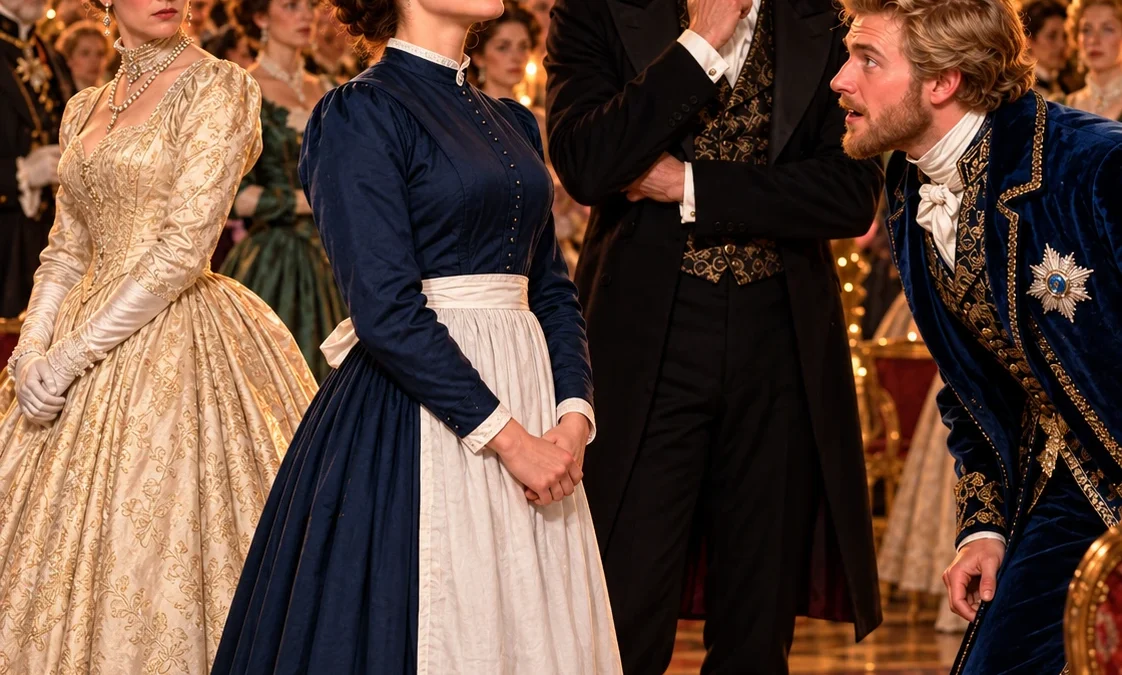
THE DUKE’S MAID SAID “I SPEAK NINE LANGUAGES” AND THE WHOLE DINING ROOM LAUGHED… BUT THAT NIGHT, A NOTE SLID UNDER HER DOOR: “LEAVE THIS HOUSE OR YOU WILL DIE LIKE YOUR FATHER” 😱🕯️
Part 1
“I speak nine languages, Your Grace.”
The words were out of Alice Lacey’s mouth before she could stop them.
She was standing at the end of the long dinner table with a silver soup bowl in her hands, and every head in the room turned to look at her.
For one moment, nobody said anything at all.
Then Lady Cordelia Thorne began to laugh. 😏
It was a light, pretty laugh, like a little bell. Lady Cordelia was the Duke’s fiancée, twenty-two years old, golden-haired, in white silk and a necklace of pearls that shone in the candlelight. When she laughed, other people laughed with her. That was how it always was.
“Nine languages,” she said. “Oh, Papa, did you hear? The maid speaks nine languages.”
Her father, the Earl of Ransford, put down his spoon. He was a large, red-faced man of sixty with thick gray side whiskers. He smiled, and the smile did not reach his eyes.
“I heard it, my dear. How very useful. Perhaps she can teach the soup to speak French.”
The table roared.
Fourteen guests sat at Caldstead Court that night, and every one of them laughed. The ladies behind their fans. The gentlemen into their wine.
Only one person did not.
George, Duke of Caldstead, sat at the head of the table. He was thirty-one, tall and broad-shouldered, dark-haired and dark-eyed, with a face people said was made of stone. He looked at Alice down the length of the table, and his face showed nothing at all.
Alice felt her cheeks burn. She set the soup bowl down very carefully before old Lady Heartwell. She knew she should apologize. She knew she should go back to the wall where the servants stood and be nobody, the way a good maid was meant to be.
But she had spoken the truth. And she was so tired of being laughed at for the truth.
It had started only five minutes before.
The Duke’s secretary and interpreter, Mr. Julian Fenwick, a thin man of forty with round spectacles, had gone suddenly white. He had pressed a hand to his stomach and said, “Forgive me, Your Grace, I feel most unwell,” and stumbled from the room.
In two days, Prince Maximilian of Renwold, from a small kingdom on the Rhine, was coming to Devon to sign a treaty. He wanted British steamships, built at the Duke’s shipyard in Dartmouth. And Mr. Fenwick was the only man in the house who could speak German and French.
Now the butler returned with grim news. A fever, perhaps. Perhaps even the cholera that had come to Exeter that summer. Mr. Fenwick would not be well for many days.
“Then who,” Lady Cordelia had said brightly, “will speak to the prince? George, you cannot speak German. Will you wave your hands at him? Draw him pictures?”
And Alice, standing just behind her, had said the words without thinking.
Now Lord Ransford leaned back in his chair.
“Name them, girl. Go on. I should like to hear this.”
Alice looked at him. Something about his face made her feel cold, though she did not know why.
“English, my lord. French, German, Italian, Spanish, Portuguese, Dutch, Latin, and Greek.”
“Greek!” cried Lady Cordelia. “Oh, Papa, perhaps she will read us Homer while she scrubs the floors!”
More laughter.
“That will do.”
The voice came from the head of the table. It was not loud. The Duke never raised his voice. But it stopped the laughter as if someone had shut a door.
“What is your name?”
“Alice Lacey, Your Grace.”
“How long have you been in my house?”
“Three weeks.”
“And where did you learn nine languages?”
Alice opened her mouth. Then closed it.
She could not tell the whole truth. If she said her father’s name, they would know that Captain John Lacey of Dartmouth had been called a smuggler and a thief nine years ago, and had died in Exeter jail before he could clear his name. She would be put out of the house before the night was over.
“My father was a sea captain, Your Grace. I sailed with him as a child to Lisbon, Cadiz, Genoa, Hamburg, Amsterdam. My mother came from Porto. An old schoolmaster taught me Latin and Greek for the love of it.”
“A sea captain’s daughter, working as a maid,” said Lord Ransford. “How sad. And how very convenient.”
“Say something in German,” said the Duke.
Alice took a breath. “Ich spreche die Wahrheit, Euer Gnaden.”
“And what does that mean?”
“I am speaking the truth, Your Grace.”
Lady Cordelia laughed again. “Well, how would we know? She could be saying I like cheese!”
And that was true. Nobody at that table spoke German except the man upstairs being sick.
“Go back to your place, Alice,” said the Duke. His voice was not unkind. It was only tired.
Alice returned to the wall, her heart hammering.
It was just after ten o’clock when the sound of wheels came up the drive. Many wheels. Many horses.
The butler pulled back the curtain and went very still.
“Your Grace. Four carriages. Men on horseback with lamps. And a flag on the first carriage, a blue flag with a white eagle.”
The Duke stood so fast his chair fell over.
“The eagle of Renwold. He is not due until Thursday.”
But it was him. 👑
Within five minutes, the front doors stood open and the whole house was in uproar. A young man with fair hair, a short beard, and very blue eyes stepped down from the first carriage in a long dark coat with a silver star on the breast. Behind him came a lean gray man with a scar on his chin and a cold face, then a very old lady in black leaning on a stick, then a small sleepy boy.
The Prince spoke warmly in German, waving at the sea and the sky.
The Duke stood and listened. He understood not one word.
The silence grew long.
Then the scarred man stepped forward. “I am Count Otto von Brandt, Highness’s adviser. His Highness asks, where is your interpreter? He was told you had a man who spoke German.”
“My interpreter is ill. Very suddenly. Tonight.”
The Count spoke to the Prince. The Prince’s smile faded.
“His Highness is sorry. Perhaps the treaty must wait.”
A murmur went through the hall.
At the back, Alice felt something go cold inside her. She had heard the kitchen talk. The Duke’s father had left nothing but debts. The shipyard was nearly closed. Four hundred men would lose their work if this treaty failed. The cook’s own son worked there. So did Sally’s two brothers.
It was not her place to speak. She had spoken once tonight already, and they had laughed.
Then Lady Cordelia stepped forward, smiling her pretty smile, her eyes full of mischief.
“Oh, but Count, we do have someone! Our little housemaid speaks nine languages. She told us so herself. Alice, come here at once and speak to the Prince!”
“Cordelia,” said the Duke quietly. “That is enough.”
“But it is only a bit of fun, George. Let her make a fool of herself in front of a prince. It will teach her a lesson.”
Every eye turned to the back of the hall.
Sally gave Alice a small push.
She walked forward in her plain black dress and white apron, her shoes making a small sound on the marble. She was twenty-three, slim, brown-haired, gray-green-eyed. Not a beauty like Lady Cordelia. But when she was frightened, her back grew straighter, not weaker. Her father used to say she had a captain’s spine.
She stopped before the Prince. She dropped a deep curtsy. She lifted her head.
“Votre Altesse Royale,” she said in clear, soft French. “Welcome to Caldstead. I am sorry you have been received so poorly tonight. The house did not expect you until Thursday, but it will be ready within the hour.”
The Prince’s blue eyes went wide.
The laughter in the hall died.
He answered in quick French. She answered back. He tried German, to test her, and she answered just as fast. He switched to Italian, and she followed, her voice light as if she had been born on the streets of Genoa.
Lady Cordelia’s smile was stuck to her face like a mask that had dried there.
At last the Prince threw back his head and laughed, a happy, astonished laugh.
“Duke!” he said in slow English. “Your maid speaks French like a lady of Paris, German like my own mother, Italian like a singer of the opera. Where do you find such a maid?”
The Duke looked at Alice. For the first time that night, something moved in his stone face.
“I am beginning to think,” he said slowly, “that she found me.”
Then the Prince spoke again in German, and Alice’s eyes widened.
“What does he say?” asked the Duke.
“He says he will not wait for a man from London, Your Grace. He wants me to speak for you both in all the talks. He says the work can begin tomorrow.”
“And what did you say?”
“That I am only a housemaid, and it is for you to choose.”
“If you wish it, Your Highness,” said the Duke, bowing to the Prince, “Miss Lacey will speak for us both.”
Miss.
Not Alice. Not the maid.
It was such a small thing. It went into her heart like a warm coal. 🔥
Then she looked up and saw Lady Cordelia’s face. All the prettiness was gone. Her blue eyes were fixed on Alice, hard and bright and full of hate.
And beside her, the Earl of Ransford was not looking at Alice at all. He was looking at Count von Brandt. And the Count was looking back at him.
It lasted only a moment. Then both men looked away.
But a cold finger seemed to touch the back of Alice’s neck.
Past midnight, when the great house was finally quiet, she climbed the narrow stairs to the little room she shared with Sally under the roof. Sally was already snoring.
Alice sat on her bed to take off her shoes. Her foot touched something on the floor.
A folded paper. Someone had pushed it under the door.
She carried it to the window, where thin moonlight fell over the sea, and unfolded it. The words were written in German, in a heavy black hand.
Verlass dieses Haus oder du stirbst wie dein Vater.
Leave this house, or you will die like your father.
Her hands began to shake so hard the paper rattled.
Nobody at Caldstead knew who her father was. She had told no one. Lacey was a common name in Devon, and nine years was a long time. She had been so careful.
Someone knew.
And someone in this house wrote in German.
Far below in the dark garden, a small light moved among the trees, like a lantern carried by someone who did not wish to be seen. It crept toward the old stables.
Then it went out. 😨
Part 2
Alice stood at the window until the moon went down. She did not sleep at all.
In the morning, she slipped the note inside her stocking, under her foot, where no one would ever look. Then she went down to Mrs. Hobbs, the housekeeper, a short, wide woman of sixty with a face like a red apple and a ring of keys at her waist.
“Well,” said Mrs. Hobbs, “you have turned the house on its head, my girl. Lady Cordelia laughed at you, and then the Prince took your hand like you were a duchess. I have not had such a good night in years.”
She took a dark green wool dress from a cupboard. “His Grace says you are to look like a lady’s companion, not a scullery girl. Put it on. And don’t make a fool of him. He is a good man, Alice. Better than his father ever was.”
At nine o’clock, Alice walked into the library in the green dress.
Maps and drawings of ships covered a long table. The Duke was there, with two men from the shipyard, the Prince, and Count von Brandt. Alice sat between the Prince and the Duke. And for three hours without stopping, she turned every word from one language to the other.
By noon, her head ached. But the Prince was smiling.
“She makes the Duke’s words sound warm,” he told the Count in German. “Fenwick always made them cold.”
Count von Brandt said nothing. He was watching Alice with his pale gray eyes. He watched her all morning. He hardly looked at the papers at all. 👁️
When they were alone at noon, the Duke poured her a glass of water.
“My father was a gambler, Miss Lacey. He was charming, and he lost everything he touched. When he died, I found the house mortgaged, the land mortgaged, and the shipyard owing money to every bank in Exeter. If the Prince does not sign, I must sell the yard. And there is only one buyer.”
“Who?”
“Lord Ransford. With a partner in Bristol named Sharp. They would pay a tenth of its worth, close it, and let four hundred men starve.”
“But Lord Ransford is to be your father-in-law, Your Grace. Why would he do that?”
The Duke looked out at the green lawns.
“That,” he said, “is a question I would also like answered.”
Over the next days, Alice noticed things.
Count von Brandt was never where he said he would be. He walked every evening, at the same hour, by the old stables. Mr. Fenwick, still “ill in bed,” had a window overlooking those same stables. And once, very early, she saw Mr. Fenwick in the garden, fully dressed and walking fast, not looking sick at all.
Lady Cordelia came every afternoon, sweeping up the drive in a new dress, hanging on the Duke’s arm.
“Oh, it is the clever maid! Have you learned a tenth language yet? George, darling, don’t you think the girl gives herself airs?”
The Duke never answered. But Alice saw his jaw tighten every time.
She also found friends. Little Felix, the Prince’s ten-year-old nephew, followed her to the stables and begged her to translate every word the horses said. And old Princess Amalia, nearly ninety, with a face like a winter apple and eyes sharp as needles, told her one afternoon that she had been born in Lisbon and had not heard her own language spoken in seventy years.
Alice knelt beside her chair and spoke in Portuguese, soft and warm, the way her mother used to at bedtime.
The old lady’s eyes filled with tears.
“Say it again. Say anything.”
They talked for an hour about oranges and fig trees and the River Douro. When Alice rose to go, the old lady held her hand tight.
“You have a sad face, child, under all that brave. Someday you will tell me why.” 🥺
On the fourth day, the Prince wished to see the river where his ships would sail. A party went down the Dart in the Duke’s old pleasure boat, the Swallow: the Prince, Count von Brandt, Felix, the Duke, two boatmen, and Alice to speak for them all.
It was a beautiful day. The water was green and deep, the hills gold with autumn. Felix pointed at herons and asked if there were sea monsters. They passed the shipyard, where the men took off their caps, and the Prince said it was bigger than he had thought.
Count von Brandt sat very still at the back of the boat, his hands deep in the pockets of his long coat.
Near the river mouth, the wind grew stronger, and the boat began to roll.
“We should turn back, Your Grace,” said a boatman.
As they came about, Alice felt something cold touch her feet.
Water. A great deal of it, rising between the boards.
“Your Grace. Look.”
“We are taking water!” the Duke shouted. “Make for shore!”
But the water came faster. The boat grew heavy and began to lean. Felix stood frozen. “Fräulein, I cannot swim!”
“Hold my hand. Do not let go.”
Count von Brandt moved quickly to the shore side of the boat.
Then a wave struck. The boat rolled. Water poured over the edge. And Felix’s hand was torn from Alice’s, and the little boy vanished over the side.
Alice did not think. She jumped. 💦
The river was so cold it drove the breath from her body. Her skirts dragged her down like stones. She kicked, found a small fair head going under, reached, missed, reached again, and caught a fistful of his coat. But she could not hold him up and herself both. They began to sink together.
Then a strong arm closed around her waist.
“I have you,” said the Duke’s voice in her ear. “I have you both. Do not fight me.”
He swam on his back, holding her against his chest while she held Felix against hers. It seemed a very long time. It was perhaps two minutes. Then his feet struck stones, and he carried the boy up onto a little beach below the old castle.
Felix was coughing and crying. The Prince ran to him and kissed his wet hair again and again.
“You saved him. You both saved him. I will never forget this as long as I live.”
Count von Brandt came up the beach slowly. His long coat was dry.
“A terrible thing,” he said in his slow English. “An old boat. Rotten wood. These things happen.”
The Duke said nothing. He walked down to the half-sunk Swallow, climbed in, and felt along the boards with his hands for a long time.
Then he went very still.
“Come and see,” he said quietly.
Alice climbed in beside him. He took her cold hand and pressed it under the water against the bottom boards. She felt a hole, a neat round hole as wide as her thumb. The wood around it was smooth and clean.
“That is not rot,” said the Duke, very low. “Rot is soft and black. This was drilled. And then it was filled with wax, so it would hold for an hour and melt away in the water.”
Alice stared at him.
“Someone wanted this boat to sink with the Prince in it. And his nephew. And me.” He looked up the beach at Count von Brandt, standing dry in his coat. “If the Prince of Renwold drowned in my river, there would be no treaty. Not now. Not ever.”
The cold of the river went all the way through her.
She thought of the note.
Leave this house or you will die like your father.
“Your Grace,” she whispered, “there is something you should know. Someone in your house wants me gone. They wrote to me in German.”
The Duke’s dark eyes held hers.
“Then from this moment,” he said, “you do not go anywhere alone.”
From that day, a footman walked behind her in the halls and a groom stayed near at the stables. Mrs. Hobbs moved her to a small room by her own, with a lock and only one key.
And every night, long after the house was asleep, Alice found herself walking down to the library, where a single lamp burned.
“Come in, Miss Lacey,” the Duke would say, as if he had been waiting.
She read him Homer in the original Greek. She read about Odysseus coming home after twenty years in disguise, and only his old dog knowing him.
“My father read it to me on the ship,” she said. “He said it was the best story in the world, because it was about a man trying to get home.”
“Did your father get home?”
“No, Your Grace. He did not.”
He did not ask again.
He told her about his mother, who died when he was eight. About his father, who finished a card game before riding to her deathbed. About a debt of twenty thousand pounds, held by Lord Ransford, that would be forgiven only if he married Lady Cordelia.
“I was sold before I was born, Miss Lacey. Like a horse at a fair.”
“You are not cold, Your Grace,” Alice said quietly. “A cold man would not have jumped into the river.”
He looked at her for a long moment, and the fire made a soft sound in the grate.
And then came the night of the musical evening, and the cloakroom, and a brown coat with a velvet collar, and a letter in Spanish with a little twisted thorn drawn at the bottom. Alice read it by the light of the passage lamp.
“The first plan did not work. The girl is a danger. We will deal with her. On the night of the treaty ball, the plans of the new engine will be in the Duke’s library. Take them to the cove. After that, there will be no treaty and there will be no Duke. Burn this.”
Footsteps sounded. She shoved the letter back into the pocket and stepped away.
Mr. Fenwick came around the corner. Beside him walked the Earl of Ransford.
Lord Ransford came close. The lamp was behind his head. Slowly, he lifted his left hand and rubbed his thick gray whiskers with his thumb.
Once. Twice. Three times.
On his little finger was a gold ring with a black stone, cut in the shape of a small twisted thorn.
Alice felt the floor go out from under her.
She was fourteen again, in her best blue dress, in a crowded Exeter courtroom, holding her mother’s hand. Her father stood in the dock in chains. And a big man with thick black whiskers stood in the witness box, swearing that he had seen Captain John Lacey bring forty barrels of French brandy ashore. Every few words, the man rubbed his whiskers three times, slowly.
On his little finger, a gold ring. A black stone. A thorn.
Henry Thorne.
Lady Cordelia Thorne.
Lord Ransford bent down close to her ear. His breath smelled of wine. His fingers closed hard on her arm.
“Hello, Miss Lacey,” he whispered. “I knew you the first night. You have your father’s eyes. And his habit of looking at things that are not his business.”
Alice could not breathe.
“Your father died in Exeter jail. It was very cold that winter.” His grip tightened. “Would you like to see the cells for yourself?”
Then he smiled his warm, public smile and said in a loud voice, “Do get some air, my dear! You look quite faint.”
And he walked away.
Part 3
Alice went out onto the dark terrace and held the stone wall with both hands until her head stopped spinning.
She did not hear the Duke come out behind her.
“Alice.”
It was the first time he had said her name alone.
“You were white as a sheet. What has happened?”
She thought of all the reasons to say nothing. He was a duke. She was a maid. Lord Ransford held his debts, his house, his future. But she was so tired of being alone with it. Nine years alone.
“Your Grace, may I tell you a story? It is not from Homer. It is true.”
She told him everything. The Mary Rose. Her father, the most honest man in Dartmouth, who had found someone smuggling brandy under his name and went to the customs house to report it. The men who came at night. The trial. The merchant with black whiskers. The fever in the cold cell. Her mother, who stopped eating and stopped singing and died the next winter. And the ring, the whiskers, and the whisper in the passage.
When she finished, the Duke stood looking at the dark garden, his hands in fists.
“You think I do not believe you,” he said at last.
“I would not blame you. It sounds mad.”
He turned to her.
“I believe you. Because it fits everything. Ransford came into his title six years ago with no money. And then suddenly he had enough to buy my father’s debts and invest in a shipyard in Bristol. Nobody asked where it came from. People do not ask an Earl where he got his money.”
Alice’s eyes filled. She had not cried in years. She had not even cried at her mother’s grave.
“Nobody ever believed me. I went to the judge. The customs office. The vicar. They all said I was a poor child who loved her father.”
The Duke did not say a word. He simply put his arms around her and held her while she cried against his coat, for her father, for her mother, for the girl of fourteen in a blue dress. He held her like a rock in the sea. 🕊️
“Do not call me Your Grace when we are alone,” he said. “My name is George.”
“I cannot.”
“You will.”
They resolved to wait. They had no proof. The letter would be burned by morning, and Count von Brandt had been the Prince’s trusted adviser for years. The magistrate, Sir Hugh Penrose, dined at Ransford’s table every Sunday.
“We let them think they are safe,” said George. “And on the night of the ball, when they go for the plans, we will be there with witnesses.”
They set Ned, the red-haired boot boy, to watch the stables. He came back breathless. The Count and Mr. Fenwick had met in the hayloft. They kept saying Reinhold, and Mittwoch.
“Wednesday,” Alice translated. “Something is happening on Wednesday.”
A few days later, walking the cliff path above the sea with Ned thirty steps behind, George stopped at an old stone bench.
“My mother used to bring me here to watch the ships. She said every ship had a story.”
Alice pointed. “And that one?”
“A Brixham fishing boat. The men are thinking about their dinner.”
Alice laughed, and George looked at her and did not look away.
“When you sang at the musical evening, I felt as if someone had opened a window in a house I had kept shut for twenty years.” His voice dropped. “I am an engaged man. I have nothing to give you but trouble. But I cannot sit beside you and not say it. I love you, Alice Lacey. I think I have loved you since you looked me in the eye at dinner and told me the truth, and the whole room laughed, and you did not drop your head.”
“George,” she whispered.
He touched her cheek as if she might break. And then he kissed her, soft and short and tasting of salt from the sea wind. ❤️
“I love you too,” she said. “I am so afraid of it. But I do.”
“If we prove what Ransford has done, I will be free. And then I will ask you a question, and I hope you will say yes.”
“You have not asked it yet.”
“I will not until I can ask it honestly, with nothing hanging over us.”
The next morning, the Duke rode to Plymouth, summoned by his bank. He would return Wednesday evening.
Wednesday.
At midnight on Wednesday, Ned scratched at Alice’s door.
“Miss! Mr. Fenwick’s gone out the back gate toward the cliff path, with a lantern and something long like a roll of paper. The Count went half an hour before him.”
“The cove. Is His Grace back?”
“His horse went lame, miss. He’s staying the night in Plymouth.”
Alice thought of locking her door. But if she waited, the plans would be gone.
“Get your coat, Ned. And not a sound.”
They crept along the cliff path in the dark. Below, in a half-moon cove, a lantern burned on the sand. Mr. Fenwick, thin and spectacled. Count von Brandt, lean and gray. And a rough fisherman beside a small boat.
Fenwick handed over a roll of paper, a careful copy of the engine plans. The Count slid it into a long leather tube. The wind carried a few words up the cliff.
“Sir Reinhold… by the end of the month… and the girl.”
Alice leaned forward. Her foot slipped. A stone clattered down the cliff and struck the sand.
Three heads turned. The Count lifted the lantern high. Its light swung up the rocks, and for one terrible moment it shone full on Alice’s white face behind a gorse bush.
Their eyes met.
“Run,” she whispered.
They ran, slipping, falling, up through the garden and in at the kitchen door, and Ned slammed the bolt. Nobody followed. The house was silent. The clock struck one.
“They saw your face, miss.”
“I know.”
In the morning, she woke to shouting.
“The Prince’s star,” whispered Mrs. Hobbs, her hands to her mouth. “The diamond star, a gift from his grandfather the king. It was on his table last night. This morning it is gone.”
Footsteps. Count von Brandt came down the passage with two guards. Behind him came Lord Ransford, riding over “early to visit.” And Lady Cordelia in pale blue.
“There she is! My maid Bessie saw her coming out of the Prince’s rooms at one o’clock this morning with her dress all torn!”
“Search her room,” said the Count.
Alice handed over the only key. She had nothing to hide.
At the bottom of her trunk, wrapped in one of her own stockings, lay the Prince’s star, eight points of silver set with diamonds, blazing like a small piece of the sun.
Lady Cordelia gave a very pretty, very surprised little gasp.
“Well,” said Lord Ransford softly. “Like father, like daughter.” 😈
In the Duke’s study, Alice told everything: Malak’s Cove, Fenwick, the Count, the plans. “The boot boy was with me. Ask him.”
But Ned stood before Sir Hugh Penrose twisting his cap. And across the room, Lord Ransford slowly rubbed his whiskers with his thumb.
“Remember, boy,” he said gently. “Your mother lives in one of my cottages. The rent is due next week. I should hate for anything to happen to her.”
Ned’s eyes filled with tears.
“No, sir. I was in my bed all night. I didn’t see nothing.”
Alice closed her eyes.
They took her to Exeter in an open cart, in the rain, twenty-five miles. She saw Sally crying at a window. She saw Felix banging on the glass with his fist. And on the front steps, Lady Cordelia lifted one white hand and gave her a small, pretty wave.
The gate of the county jail closed behind her with a sound like the end of the world.
The cell was small and dark, with damp walls and a bucket in the corner. The keeper, a bony woman named Martha Gurney, set down a jug of water.
“Lacey, you said? There was a Lacey here once. A sea captain, years ago, in the cell next door. Had the fever. Kept asking for his little girl.”
The door shut. The key turned.
Alice put her hand flat against the cold stone wall. On the other side, nine years ago, her father had lain in the dark and asked for her.
Now she was here too.
Just as Lord Ransford had promised. 🥀
The Duke came home to find the house in uproar. His horse had never been lame. There had been no message. The bank manager in Plymouth had never asked to see him at all. It had been a trap to get him out of the way.
He rode to Exeter at midnight and hammered on the jail gate.
“No visitors for that one, Your Grace. Magistrate’s orders.”
Back at Caldstead, Lord Ransford waited with news. The Prince, he said, would not sign with a house that sheltered a thief. He would sign with Sharp of Bristol at the Saturday ball.
And Lady Cordelia put her hand on the Duke’s arm. “We will announce our wedding too, darling. In three weeks.”
“No.”
“I think you mean yes, George.” Lord Ransford leaned close. “Marry my daughter, and your father’s note is torn up. Refuse, and I call it in on Monday. The yard, the house, the land. And that little thief will hang. I will make very sure of it.”
For four days, Alice sat in the dark. Nobody came. Nobody wrote. She began to wonder if George believed what they said. She told herself she could not blame him. It hurt more than the cold.
On the fifth morning, she heard an old woman’s voice in the passage, speaking furious German.
“Open this door, or I will have you cut into pieces!”
The cell door swung wide.
Princess Amalia stood there, small and gray with exhaustion, leaning on her stick. She was nearly ninety. She had driven twenty-five miles since before dawn.
She sat beside Alice and took her cold hand and spoke in Portuguese, so that nobody in England could understand.
“Now, child. I do not believe one word they say about you. I have met many thieves, and you are not one. So stop crying and tell me everything.”
Alice told her all of it. When she said Reinhold, the old lady’s hand tightened on her stick.
“I held him as a baby. He bit me. I should have known then.” She looked up. “And your Duke has not forgotten you. He came the first night. He has come every day since. They turn him away. But he has gone to Torquay, to beg a judge of the Queen’s Bench to look at your case himself.”
Alice began to cry again, but it was a different kind of crying.
“Child,” said Princess Amalia, “that man would believe you if you said the sea was made of milk.”
Two days later, a tall old man with white hair and a hacking cough sat on the bench in her cell, reading Sir Hugh Penrose’s papers. The Duke stood in the doorway.
“Alice,” he said. That was all. His hands shook.
The judge looked at the “confession” Lord Ransford had produced. He asked Alice to write her name. Hers was round and clear. The confession’s was thin and sloping.
“Not the same hand. Not even close.” He turned to the keeper. “Mrs. Gurney, you have the only key. Has anyone visited this prisoner?”
“Nobody, my lord.” Martha Gurney lifted her bony chin. “Her father was kind to me that winter. My boy had the croup, and he told me what the sailors do for it. My boy lived. I’ll say it to the Queen herself.”
“And your boot boy came to me in Torquay in tears,” the judge told the Duke. “He saw Mr. Fenwick hand a ring of keys to a young woman in a gray cloak. Bessie Croft. Lady Cordelia’s maid.”
He stood.
“There is not enough here to hold Miss Lacey for one more hour.”
Alice walked out of the cell. She stopped before the door next to it, where her father had died, and put her hand on the cold wood.
“I am out, Papa. And I am not finished.”
At the gate, George took her in his arms in front of the cathedral and the staring crowd and did not care at all.
“I thought I had lost you.”
“I thought you had forgotten me.”
“Never. Not in my life.”
On the high lonely road over Haldon Hill, the carriage lurched to a halt.
Four masked men with sticks. George stepped down without a weapon, caught the first man’s stick, twisted it, and sent him crying into the road. He knocked the second into the gorse. The old coachman cracked a third over the head with his whip handle. The fourth ran away across the heath.
Princess Amalia woke, her eyes snapping. “Bandits?”
“Lord Ransford’s men, Highness,” said Alice.
One man lay moaning, a red-faced fisherman Alice recognized from the cove.
“His Lordship sent us. Said to take the girl and drop her in the old mine shaft at Hennock. Said nobody would ever find her.” He swallowed. “I’m Jim Cole out of Stoke Fleming. I only do a bit of carrying at night. The foreign gentleman gave me a leather tube. It’s under my floor. He comes for it Saturday night after the ball, to row out to a ship from Hamburg.”
George crouched beside him.
“On Saturday, you will not give him the tube. You will bring it to me.”
“His Lordship will kill me.”
“After Saturday, His Lordship will not be in a position to kill anybody.”
That night in Mr. Fenwick’s room, among shelves of Latin, Alice found a small fat book on the sixth shelf, bound in brown leather, lettered Tacitus. Inside, the printed pages had been cut out and replaced with plain white ones, filled in a neat sloping hand.
She read slowly. Her voice shook.
“It is everything. Every payment for nine years. From H.T., fifty pounds for the matter of Captain Lacey. The captain’s papers to be put in the hold of the Mary Rose. And here: The captain will not trouble us again. And this year: Two hundred pounds for the copy of the engines. Ten pounds to J.C. for the drill and the wax.”
George took the little book as if it were made of gold.
“He wrote every wicked thing down, in Latin, to protect himself if Ransford ever turned on him.”
“Saturday,” said George. “In front of the Prince and the Lord Lieutenant and every great family in Devon. Alice, I want you to walk into that ballroom on my arm. Not as a maid. Not as an interpreter. As the woman I love.”
“Yes,” she said. “I will do it.”
On Saturday night, Caldstead Court blazed with light.
At a quarter to ten, Lord Ransford tapped his glass. “My friends! Tonight His Highness signs a treaty that will bring wealth to Devon. And in three weeks, in Exeter Cathedral, my daughter Cordelia will marry our host, the Duke.”
Applause. Lady Cordelia dropped her eyes.
Then the great doors swung open.
George stood in the doorway in black, a healing cut on his lip. On his arm walked Alice Lacey in a gown of deep blue silk from Princess Amalia’s own trunk, a single white rose in her brown hair, no jewels at all.
She looked like what she was: a sea captain’s daughter with a captain’s spine, walking into a room full of people who had laughed at her. 👑
Somebody dropped a glass. The whispers swept the room like wind through dry grass. The thief. Out of jail. On his arm.
They walked the whole length of the ballroom to the blue velvet table where the treaty lay.
“What is the meaning of this?” said Lord Ransford, his smooth voice tight underneath. “That girl should be in Exeter jail.”
“She was in Exeter jail, in the cell next to the one where her father died. And on Thursday, a judge of the Queen’s Bench set her free in one hour.” George nodded toward an old man with white hair coughing into a handkerchief. “Sir William Grantley, my mother’s old friend. My guest tonight.”
Sir Hugh Penrose, holding a plate of oysters, went the color of cold porridge.
“Your Highness,” said George, “before you sign, I ask for ten minutes.”
From the corner came the sharp rap of a stick. Princess Amalia spoke in German, loud enough for the whole room. “Max, give him his ten minutes, or I will tell everyone what you did at the age of seven with your tutor’s wig.”
The Prince went pink. “Ten minutes.”
At that moment, Count von Brandt murmured to his servant Kessler, low and quick, in German, like a man who had spoken German in English drawing rooms for years and never once been understood.
Alice turned to face the room.
“Count von Brandt has just told his servant,” she said clearly, in English, “Go now. Take the horse. Ride to the fisherman’s cottage at Stoke Fleming and get the tube from under the floor. If the girl says one more word tonight, she must fall on the stairs before morning. Make it look like an accident.”
The room went dead silent.
Kessler, already moving toward the door, stopped as if he had struck a wall.
“This is madness,” said the Count. “I asked for my cloak.”
“He did not say cloak,” said a sharp old voice. Princess Amalia had risen on her stick. “I am old, Otto, but I am not deaf. Fisherman. Tube. Stairs. Accident. You always did talk with your mouth half shut, even when you were stealing apples from my garden.”
“Otto,” said the Prince in German, white-faced. “What tube?”
The doors opened again. In came Jim Cole in his too-small Sunday coat, holding a long leather tube, with Ned beside him looking very proud.
“Begging your pardon, your lordships. I was told to bring this to His Grace.”
George took it and passed it to the Prince. “Count von Brandt gave this to this man at Malak’s Cove last Wednesday at midnight, the same night your star disappeared. Please open it.”
The Prince drew out the roll and spread it on the blue velvet, right on top of the treaty. An engine. Every curve and measurement in careful ink.
“This is the Hoffmann engine. There is no other copy in the world.” He bent closer. “But the notes in the corner are in English.”
“Mr. Fenwick’s hand, Your Highness,” said Alice. “He made the copy in the days he said he was too sick to leave his bed.”
Every eye turned to the pillar where Mr. Fenwick stood, the color of paper, his spectacles flashing.
George drew a small brown book from his coat. “Tacitus. Your favorite, Mr. Fenwick. Sixth shelf. Miss Lacey reads Latin. Did you know? Would you like her to read it aloud, or would you rather tell them yourself?”
The glass fell from Fenwick’s hand. His thin body seemed to fold.
“It was him! Lord Ransford. Henry Thorne! I was his clerk when I was twenty-five, in his shop in Dartmouth. He smuggled brandy and lace and silk. When Captain Lacey went to the customs men, Mr. Thorne made me put French papers in the hold of the Mary Rose. Then he stood up in court and swore it was the captain.” He wept. “I wrote it all down. I was afraid of him. He made me copy the engine. He made me drill the boat.”
Lord Ransford had not moved. Slowly, he lifted his left hand to his face and began to rub his gray whiskers with his thumb.
“Once,” said Alice. “Twice. Three times.”
He stopped.
“You did that in the Exeter court, my lord, every time you lied. I was fourteen. I sat in the third row in a blue dress. I have seen it in my dreams every night for nine years.” Her voice was very calm. “My father’s name was Captain John Lacey. He was the most honest man in Dartmouth. And you killed him as surely as if you had put a knife in his heart.”
For one moment, the smoothness fell away from Lord Ransford’s face, and everyone saw what lay beneath: ugly and frightened and full of rage.
“Bessie!” shrieked Lady Cordelia.
Mrs. Hobbs marched in by the side door, gripping a thin young woman in gray.
“Bessie Croft has something to say, haven’t you, Bessie?”
Bessie burst into tears. “My lady took the star off the Prince’s table and put it in her muff! She told me to hide it in the maid’s trunk and say I saw her. Mr. Fenwick gave me the keys. I didn’t want to, but she said she’d turn me off without a letter, and my mother is sick…”
“She is lying! Papa, tell them!”
But her father was staring at the doors. At every door now stood a man in a dark blue coat and tall hat, the constables Sir William Grantley had brought from Exeter. They had been waiting in the hall all evening.
The Lord Lieutenant of Devon stepped forward, gray-haired and hard-faced.
“Henry Thorne, Earl of Ransford. You will be held for smuggling, perjury, the theft of a royal jewel, and plotting to sell the secrets of a friendly crown. And there is the matter of four men on Haldon Hill, and an old mine shaft at Hennock.”
Lord Ransford looked around at the great families of Devon who had eaten at his table for six years. Not one would meet his eyes.
He let them take him.
The Prince turned to Count von Brandt. “Otto. You carried me on your shoulders. You stood by my father’s bed. And all that time you were Reinhold’s man.”
“Reinhold would have been a strong king,” said the Count coldly. “You are a soft one.”
“Tonight proves I trusted the wrong man. Take him home to Renwold in chains, to answer to my grandfather the king, and send a letter about my uncle with him.”
Lady Cordelia stood alone by the blue velvet table in white satin and diamonds. Nobody came near her.
“George, I did not know about the smuggling, or the boat. I only wanted her gone. You looked at her. You never once looked at me like that.”
“I know, Cordelia. And I am sorry for it.” His voice was only tired. “But you put a jewel in an innocent girl’s trunk and watched them take her to the jail where her father died. And then you waved. Our engagement is over.”
She gathered her white skirts and fled.
Then the Prince of Renwold did something nobody expected. He crossed the ballroom and went down on one knee before Alice.
“Fräulein Lacey. I listened to the wrong voice. I let them put you in that terrible place. I am a prince, and I have never said this to anyone. I am deeply sorry. Can you forgive me?”
“Please rise, Your Highness,” said Alice gently, in German. “You were lied to by a man you loved. That is not a crime. It only means you have a good heart.”
The Prince stood, picked up the treaty with Sharp and Ransford, tore it in half, and then in half again, and let the pieces fall.
“Duke. Will you build my ships?”
“With all my heart, Your Highness.”
The ballroom erupted. Felix jumped up and down. The orchestra struck up. The chandeliers shook. In her corner, Princess Amalia sat back with a satisfied grunt and said in Portuguese, to no one at all:
“There. Now that is done properly.” 🥹
The new treaty was signed three days later at the same long library table where Alice had first sat in a borrowed green dress: six iron steamships for the Rhine, with the Hoffmann engines, to be built at Caldstead’s yard in Dartmouth. When the news reached the town, the church bells rang all afternoon, and four hundred men threw their caps in the air.
Lord Ransford was tried at the Exeter Assizes in December. Fenwick, Jim Cole, and Bessie Croft told the whole truth. Henry Thorne was sent to prison for the rest of his life, his stolen fortune seized by the Crown, and the paper claiming the Duke owed him twenty thousand pounds was declared worthless.
Mr. Fenwick was sent to Australia. Before he left, he wrote Alice a letter in Latin. “I am sorry. I was a coward. Your father was not.”
And in the same court where Alice had sat at fourteen, Sir William Grantley read out a paper from the Queen’s own judges. Captain John Lacey of Dartmouth had been wrongly accused and wrongly imprisoned. He was an innocent man. His name was clean.
Alice closed her eyes and smiled and held George’s hand very tightly.
Afterward, in the little churchyard above the River Dart, where her parents lay side by side under a small wooden cross, there stood now a stone of gray Devon granite.
Captain John Lacey, master mariner. An honest man. He came home.
Alice laid a white rose on it.
Then George took her hand and led her along the cliff path to the old stone bench above the sea. It was a cold, bright winter day. A ship with white sails crept along the far line of the water.
“That one,” said George, “is carrying a lost princess home.”
“I am not a princess.”
“No. You are something much better.” He took both her hands. “I made you a promise on this bench. There is nothing hanging over us now. Not Ransford, not the debt, not your father’s name. I am a stern, cold, careful man, and I am not good with words. You have nine languages, and I have barely one. So I will say it in the only one I have. I love you. I want to spend every day of my life listening to you read me Homer at midnight. Will you marry me?”
Alice looked at him for a long moment, the wind in her hair, the gulls crying overhead.
Then she said it in English, and French, and German, and Italian, and Spanish, and Portuguese, and Dutch, and Latin, and Greek. Nine times, one after another, laughing and crying at once.
Yes. Oui. Ja. Sì. Sí. Sim. Ja. Ita. Nai.
“I think,” said George, “that is a yes.”
“It is nine yeses.”
He kissed her on the old stone bench above the sea, and it tasted of salt and winter and everything that was coming. 💫
They were married in April in the little gray church at Caldstead, the doors open to the spring air and the churchyard full of daffodils. All four hundred men from the yard stood outside in their Sunday coats in rows, because there was no room inside. Mrs. Hobbs cried from the first hymn to the last. Sally was bridesmaid. Ned carried the ring on a velvet cushion and did not drop it, though his ears were red the whole time. Felix swung his legs in the front row. And beside the Duke, as groomsman, stood Prince Maximilian of Renwold, the diamond star on his breast.
When the vicar asked, “Who gives this woman to be married to this man?” there was a pause, because Alice had no father to give her.
Then a stick rapped on the stone floor.
“I do,” said Princess Amalia in her strange old English. And she walked very slowly to the altar and put Alice’s hand into George’s with her own thin, shaking one.
That summer, the first of the new steamships slid down the slip at the Caldstead yard into the River Dart, with flags flying and bands playing and all of Dartmouth cheering on the hills. She was long and black and beautiful, with red paddle boxes and a tall black funnel. Her name was painted on her side in gold letters.
The Captain Lacey.
Alice stood on the shore with George’s arm around her and watched her father’s name go out onto the water, shining in the sun.
Going home at last. 🕊️
💬 Which moment gave you chills: the whisker rubbed three times, the Princess storming the jail, or Alice translating the Count’s secret in front of the whole ballroom? Tell me in the comments, and share this with someone who loves a heroine with a captain’s spine! 👇
This story is entirely fictional and created for entertainment purposes only. It does not represent any organization or individual, nor does it encourage inappropriate behavior. The content was generated with AI assistance.








