The Duke’s Monstrous Hound Drove Away 11 Brides in Terror. Then a Mud-Stained Stranger Walked Through the Gate, and the Dog Did Something No One Expected
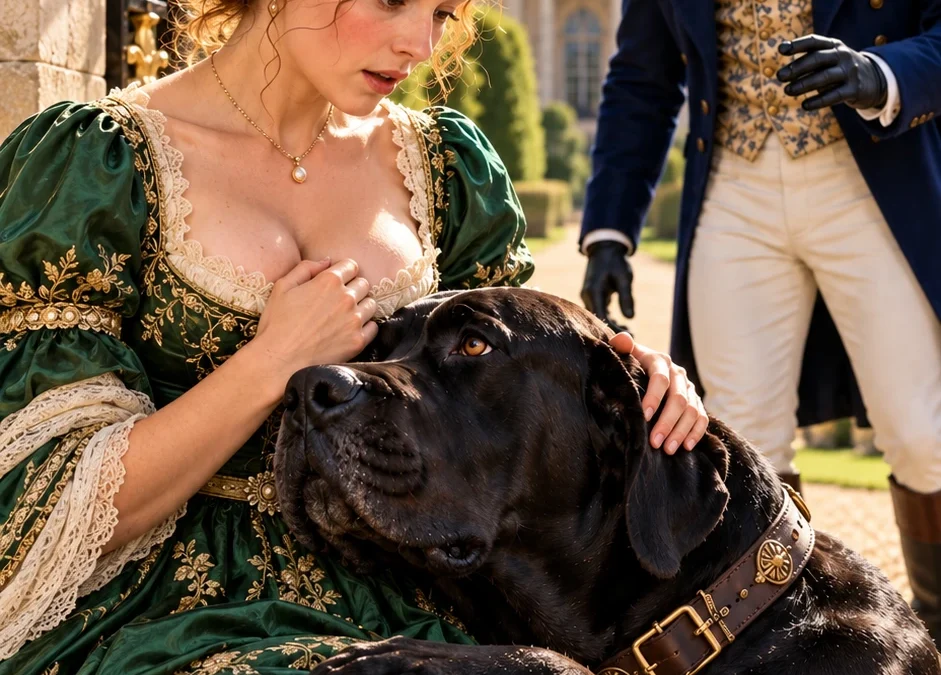
The Duke’s Monstrous Hound Drove Away 11 Brides in Terror. Then a Mud-Stained Stranger Walked Through the Gate, and the Dog Did Something No One Expected 🐺💔
PART 1
🐺 In the spring of 1814, the most feared man in England knelt in the mud of his own carriage drive, wrapped both arms around a dog’s neck, and begged it not to move.
The Duke of Ravenhurst had once silenced a room full of ministers with a single glance. Now forty guests watched from a line of carriages, and not one of them dared to laugh.
The dog was called Sovereign. He stood nearly as tall as a pony, gray as a storm cloud, with a scarred muzzle and eyes the color of old amber. In three years, he had driven eleven women from Ravenhurst Park. He had torn the hem from a countess’s gown. He had backed an earl’s daughter into a fountain, and she hadn’t stopped screaming until she reached London.
Society, which can never resist a wager, began to whisper that no woman living would ever become Duchess of Ravenhurst, because the Duke’s hound would not allow it. 😳
The Duke never corrected them. He believed that to explain oneself was to admit weakness. So he let a dog pass judgment on every lady who came up his drive, and never once asked himself why he preferred it that way.
Today, the twelfth sat in the first carriage. Lady Mary Vance, golden-haired, perfectly bred, pressed a scented handkerchief to her lips and refused to step down while the beast snarled at her through the wheels. Her mother demanded he be chained. A footman suggested, nervously, that he be shot.
The Duke answered neither, because he alone had noticed something he had told no one in three years.
Sovereign’s growl did not sound like hatred. It sounded like waiting. 👀
Then a stranger’s voice cut across the drive.
“Forgive me. Is this the way to the house?”
Every head turned. A young woman stood at the open gate in a gray cloak patched at the hem, her boots caked to the ankle with road mud. A bundle was clutched against her chest as though someone might try to take it from her. She could not have been more than twenty-four. Her dark hair had come loose in the wind, her face was pale with cold and exhaustion, yet she held her chin high with the stubborn grace of a woman who had once been taught how to enter a room and had not forgotten.
Her name was Isolde. Three years ago, her father, Baron Marlowe, had been struck from every guest list in England overnight. No one on that drive would have recognized the name.
“Who let a beggar through the gate?” Lady Mary announced, loud enough for everyone to hear. A ripple of cruel amusement passed along the carriages.
Isolde’s cheeks colored, but she did not lower her eyes. She knew nothing of the hound. She knew only that the iron gate stood open, the rain was coming, and she had nowhere else to go.
She took one step onto the drive.
The Duke’s arms tightened. “Do not move,” he ordered, and no one knew whether he meant the woman or the dog.
Sovereign went rigid. The growl died in his throat. Then, with a strength the Duke had never been able to match, he tore free. The Duke fell back into the mud. 😨
Women shrieked. A man shouted for a pistol. The great gray shape crossed the drive in four strides, and Isolde, who had every reason to run, simply closed her eyes.
The blow never came.
Instead, the hound lowered his massive head and pressed it against her, trembling from nose to tail. From his scarred throat came a sound the Duke had never heard in three years: a low, broken whine, like grief that had finally found its owner. 💔
The Duke rose slowly, mud streaking his coat, his composure shattered where half the county could see it. He did not look at the stranger’s face. His eyes had dropped to the bundle in her arms, where the dog’s nose was pushing insistently at the faded wool.
“Miss,” he asked very quietly, “what are you carrying?”
Isolde’s fingers tightened. She knew that the moment she unwrapped it, everything she had hidden for three years would end.
“A letter, your grace,” she replied at last. “It was written for you, and it will be read by you alone.”
“Absurd!” snapped Lady Vance. “The girl is a vagrant. Fetch the gamekeeper!”
“Allow me, Julian.”
A tall, fair gentleman stepped out from among the carriages, drawing off one glove with easy, unhurried fingers. Lord Percival Ravenhurst, the Duke’s first cousin and heir presumptive, was a man everyone liked on sight, which is the most useful quality a person can possess, and the most dangerous. It was Percival who had presented every one of the twelve candidates, handing each lady from her carriage with a smile. For three years, he had also sat between the Duke and the world, opening his letters, answering his callers, sparing him every unpleasantness.
He extended his hand for the bundle. “Miss, you are cold and frightened. Give that to me, and we shall see you fed and sent on your way.”
Sovereign turned his head. The whine in his throat died, and something lower took its place.
Isolde felt it through her cloak, a vibration like distant thunder. She saw the hound’s amber eyes fix on the gentleman’s face with an intensity that was almost human. Lord Percival’s hand dropped to his side. It was a small movement, quickly done. But Isolde was watching, and she saw his smile hold half a second too long, the way a painted smile does. 😶
“No,” said the Duke.
Every head swung toward him. The old authority had come back into his face, though not quite the same authority. It had a crack in it.
“The lady will come into the house. Lady Vance’s party is to be given refreshment in the blue drawing room. The rain is about to break, and I will not have my guest stand in it.” He looked down at the hound. “Sovereign. With me.”
And Sovereign went.
No one on that drive had ever seen the dog obey anything but his own temper. Now he walked beside the stranger up the long gravel sweep, so close that his flank brushed her skirts, while forty guests stood silent with their mouths open and the first fat drops of rain began to fall.
Lord Percival remained where he was, watching them go with his glove still in his hand. For one moment, his face held no expression at all. 🥶
Behind the study door, Isolde unwrapped the bundle one fold at a time. A gray-and-cream muffler, thin from years of wear. A gold signet ring engraved with the Ravenhurst heron. A folded paper bearing two signatures and a church seal.
Sovereign pushed his nose into the wool and breathed in, long and shuddering.
“My name is Isolde Ravenhurst,” she told the Duke. “Edmund was my husband.”
The silence was so complete that the rain sounded like gravel flung against the glass.
PART 2
The Duke did not move. Slowly he lifted the ring from the wool, held it to the gray light, and read the inscription worn inside the band. His face closed like a door.
“Where did you get this?”
“He placed it on my finger in the vestry of St. Aldric’s, on the fourteenth of September, 1810. We were married by license, with the curate and the sexton as witnesses.”
“I do not know your face,” the Duke said, his voice hard. “We are neighbors, madam. If you were truly what you claim, I would have seen you at church, or at the fair, or across a field.”
“You would not,” Isolde replied evenly. “You were in London for Parliament three seasons out of four. My father was too proud to push for invitations. And Edmund made certain our paths never crossed. He met me at the garden wall, never at your door. He was afraid of what your face would do when he said my name.”
The Duke opened his mouth to argue, found he had no answer, and shut it again.
“Women have come to this door before with their stories, madam,” he said at last, each word colder than the last. “It is a hard thing to bury a man and discover how many people loved him once he could no longer contradict them.”
It was the cruelest thing anyone had said to her in three years, and she had been called a great many things. 💔
Isolde stood, her knees not quite steady. “I walked four miles in the rain to put into your hands the one thing I own that has his touch on it. I do not want your name or your money. He told me you were the best man he knew. I see now that he was loyal to a fault.”
She reached the door. Sovereign was there before her.
The great hound planted himself between her and the handle, his scarred head lowered. He did not growl. He simply would not let her pass. And the Duke, watching the dog he had not understood for three years choose this stranger over his own master, felt something shift in his chest, the way a stone shifts before it falls.
“Sit down,” he said hoarsely. “Please. Tell me from the beginning. I will not interrupt.”
So, standing with her back against the door and a dog’s warm weight against her skirts, Isolde told him. A gray puppy tucked inside a young man’s coat at the Marlowe Harvest Fair. Two years of whispered conversations at a garden wall. A secret marriage, and a boy who meant to explain after, certain his brother’s coldness could not survive such happy news.
Then Edmund had found the estate books. Timber sold that was never felled. Tenant farms mortgaged against the Duke’s name. Notes of credit bearing the old Duke’s signature, though he had never put his hand to them. Edmund resolved to bring the proof and the news of his marriage on the same night.
“He left me this muffler because the evening was cold,” Isolde whispered. “He said he’d be back before dawn.”
“I remember that night,” said the Duke, in a voice she barely recognized. “We dined together. He kept trying to speak. I was tired. I told him whatever it was could wait until morning.”
The words fell into the room like stones into a well.
“It did not wait. He was found at the foot of Heron’s Leap Quarry. They said he’d been thrown from his horse in the dark. Sovereign stood over him for two days, and when they finally got a rope on him, his muzzle was laid open.” She drew a breath. “A week later, my father’s name was struck from every list. The forged notes came due. He lost everything. I wrote to you three times. I received one answer.”
She held out a creased sheet. The Duke read it standing.
His Grace regrets to inform Baron Marlowe that he has no wish to receive further correspondence from his family, and considers any supposed connection entirely closed.
It bore his seal, in a hand very nearly his own.
“I never wrote this,” he said, and his voice cracked in the middle. “I have not read my own post in three years.”
Isolde held out the last item: a letter folded very small, and across the front, in a boy’s quick, looping hand, one word. Julian.
“I have never opened it.”
The Duke sat down heavily and broke the wafer. His hands shook, and he let them.
“Julian, if you are reading this, I have been a fool again, and you are cross, and I deserve it. Three things. First, our cousin Percival has been robbing the estate for two years. I ride tonight to meet him at the old hunting lodge. Second, I have been married since September to Isolde Marlowe. She is the cleverest woman I know. You are the best man I know, Julian. You are only the worst at saying so. Third, be kind to Sovereign. He will do the right thing before any of us have understood what it is.”
The Duke of Ravenhurst laid his head down on the desk, on top of his brother’s letter. For a long time, the only sound in the room was the rain.
Then he raised his head. His face had changed. The coldness had burned off like fog, and what lay beneath was raw, clear, and very angry. 🔥
He rang the bell. “Hobbs. Who has managed my correspondence these three years?”
“Lord Percival, your grace.”
“Eleven women,” the Duke whispered, rubbing a hand across his eyes. “Eleven carriages. And who stood beside each lady to hand her down?”
“Lord Percival,” said Isolde softly. “Every single time, and always a step behind the lady. Sovereign never growled at the women. He growled at the man at their shoulder.”
The Duke’s laugh was short and terrible. “I was so ashamed of the noise that I never once looked where he was looking.”
Within the half hour, every guest was gathered in the great hall beneath the chandeliers. Lord Percival lounged by the fireplace with a glass in hand, a man who had never in his life been seriously afraid. The Duke stood with Isolde at his side and announced, in front of everyone, “This lady is Isolde Ravenhurst, widow of my brother Edmund.”
The hall erupted. Percival laughed, warm and rueful. “Julian, my dear fellow, you are overwrought. A ring any pawnbroker could have sold her…”
“I have a letter in Edmund’s hand naming you as the man who has robbed this estate.”
“Forged, surely.”
“Then explain this.” The Duke held up the forged reply. “A letter in my name, sealed with my seal, sent by the man who managed all my post.”
Percival’s eyes flickered for the first time. “You are all being played by a girl with a sad story.”
And then Sovereign stood up. 🐺
He rose so quietly that few noticed, and crossed the marble floor, claws clicking in the silence, until he stood directly before Lord Percival Ravenhurst. He did not growl. He simply looked up with the patience of an animal who had waited three years for one afternoon.
“Call him off,” Percival said, going white. “Julian, call him off!”
“Why?” asked the Duke gently. “He has never harmed a living soul in this house. I only thought he disliked women.”
The dog moved. He took the cuff of Percival’s coat between his teeth, very carefully, and pulled.
The fine cloth tore from wrist to elbow, and the white sleeve beneath fell open. 😱
PART 3
On the inside of Percival’s forearm, healed to a pale, ridged curve, was the shape of a bite. Five deep punctures, three years old and unmistakable.
Lord Whitcomb, who sat on the county bench, rose slowly from his chair.
“Percival,” said the Duke, “in the week Edmund died, you told me you had been thrown from your horse.”
Percival opened his mouth. Nothing came out. He looked at the scar, at the hound, at forty faces turned toward him in a ring, and the handsome mask came off all at once, like a coat dropped from a hook.
“A few thousand pounds! A few acres! And he meant to ruin me for it!” he cried. “He would not wait until Sunday. He said he’d ride to you at dawn. I only meant to stop him. We struggled on the quarry road, and his horse reared, and that brute came at me out of the dark. And Edmund… I did not mean him to fall. I did not.”
“You left him,” said Isolde. It was the first thing she had said in that hall, and her voice was very low, and it carried to every corner. “You left him there with the dog standing over him, and you went home and slept in your own bed. Then you destroyed my father, and you chose eleven women so that your cousin would never marry.”
Percival turned on the Duke with the desperation of a drowning man. “Julian, I am your blood. I am the last of the name. Think what a trial would mean. The scandal. The Ravenhurst name dragged through every court in England. Think of the family.”
It was the hardest choice, and every person in that hall knew it. The Duke stood with his brother’s ring in his closed hand and looked at his cousin, the last living link to a line five hundred years old, begging him to be silent one more time.
“Edmund was my blood, too,” said the Duke. “I let him wait until morning once. I will not do it again.” 💔
Lord Whitcomb crossed the hall. Two footmen stepped up on either side of Percival, and he was led out through the great doors into the rain, still calling the name of a family he had spent three years eating from the inside.
After that, the hall was very quiet.
The Duke turned and found Isolde standing beside him with her hands clasped. And he did something no one in that room had ever seen him do. He bowed to her, low, in front of everyone.
“Lady Edmund Ravenhurst. This house is yours for as long as you want it. My brother’s name is yours by right. I ask your pardon publicly for three years of silence, and for what I said to you in my study. There is no excuse for it, and I will not insult you by offering one.”
She looked at him for a long time. She thought of the forged letter. She thought of a landlady’s cold soup and a father buried without a stone. She thought of a boy with a puppy in his coat, laughing on a mounting block, and of a line that said, You are only the worst at saying so.
“Thank you,” she answered at last.
It was not forgiveness, and they both knew it. But it was the first plank laid across the gap. 🌉
The curate’s register arrived before midnight, with the entry in Edmund’s own hand and the signatures of two witnesses still alive to swear to it.
Percival Ravenhurst was tried at the summer assizes. Forgery was a hanging crime in those days, and the court was ready to make an example of him. But it was the Duke who wrote to the judge, with a steady hand. Edmund would not have wished a gallows. The sentence was commuted to transportation for life to New South Wales, and Percival sailed that autumn with the convict ships, where it is said he never quite understood how a dog had undone him.
Baron Marlowe’s name was cleared by Michaelmas. The Duke paid every debt that had ever borne a forged signature, and more besides. He raised a stone in the churchyard at Bristol, with words Isolde chose herself.
She stayed at Ravenhurst Park, not as a bride, not as a duchess, but as the widow of the man whose brother had finally learned to listen. In the evenings at first, they spoke only of Edmund. The Duke told her how Edmund at ten had tried to sail a hat across the lake. How he’d once given his own pony to a tenant’s child and then lied about where it had gone. And Isolde told him what Edmund had said of him, in the long summer of her nineteenth year.
The Duke listened to every word without once saying it could wait until morning. 🕯️
The fire was lit in the long brown study again.
Somewhere in the second winter, so quietly that neither could have named the day, the evenings stopped being only about Edmund.
On the anniversary of the quarry, they walked up to the churchyard together. The grass was green and the stone was plain, and Sovereign lay down in front of it with a long sigh, his great head on his paws. He did not growl. He did not watch the gate. For the first time in all those years, his amber eyes closed.
“He has finished waiting,” murmured Isolde.
“I think we both have,” said the Duke. He drew a breath. “I have never been good at this. I was taught that explaining oneself was weakness, and I have found it is the opposite. So let me explain, and you may refuse me, and I will not need to be cold about it. Over these two years I have come to care for you in a way that has nothing to do with my brother’s ring. I should like to court you, Isolde. Properly. With your permission, and without a single carriage.”
Isolde looked at this proud, silent, imperfect man who had once knelt in the mud and begged a dog to stay still. She thought of the twelve women who had come up that drive to be inspected and judged.
None of them had ever been asked.
“You may walk me back to the house,” she told him. “We shall see what happens on the way.”
And Sovereign, without opening his eyes, thumped his tail once against the grass. 🐾❤️
💬 Would you have forgiven the Duke as quickly as Isolde did? Tell me below, and let me know where you’re reading from tonight! 👇
Disclaimer: This story is entirely fictional and created for entertainment purposes only. It does not represent any organization or individual, nor does it encourage inappropriate behavior. The content was generated with AI assistance.








