THE DUKE’S MOTHER CAME TO HIS WEDDING DISGUISED AS A MAID… 300 GUESTS LAUGHED WHEN SHE DROPPED THE TRAY, BUT WHEN THE BRIDE KNELT IN THE BROKEN GLASS, THE DUKE’S WINE GLASS SHATTERED AND HE WHISPERED ONE WORD
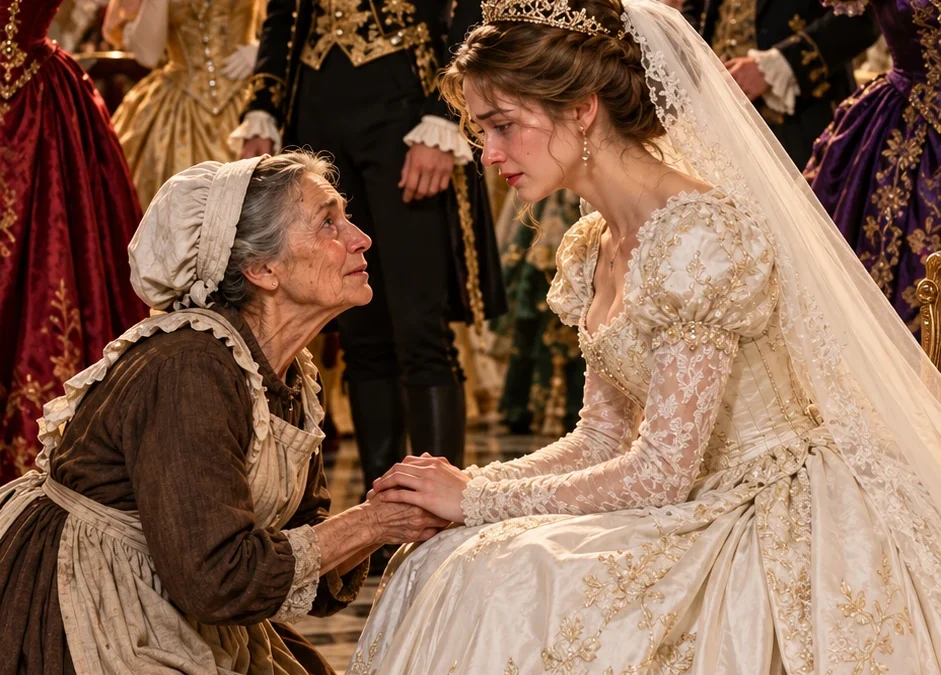
THE DUKE’S MOTHER CAME TO HIS WEDDING DISGUISED AS A MAID… 300 GUESTS LAUGHED WHEN SHE DROPPED THE TRAY, BUT WHEN THE BRIDE KNELT IN THE BROKEN GLASS, THE DUKE’S WINE GLASS SHATTERED AND HE WHISPERED ONE WORD 😱
Part 1
The tray fell at the exact moment the orchestra stopped playing.
Two dozen champagne glasses, sliding from the hands of an old woman in a gray dress, burst across the polished floor of the Halworth House ballroom like a handful of thrown ice. Golden streams of champagne ran between the white rose petals scattered for the wedding.
For one second, nobody moved.
Then Lady Isidora Crane screamed. “My gown! Look at my gown!”
Her emerald silk from Paris, with green ostrich feathers in her raven ringlets to match, was dark and dripping from bodice to hem. She held her skirts away from her body and stared at the old maid as though a rat had crawled out of the wainscot.
“You clumsy old creature. Do you know what this cost? More than you will earn in ten years.”
The old woman did not answer. She was already on her knees, gathering broken glass into her apron with her bare hands. She was small and thin, with ash-colored hair tucked beneath a white cap. Her gray wool dress hung a little too big. Her hands were red and raw, the hands of a woman who had scrubbed pans for weeks. 💔
Three hundred of the finest people in London turned to look.
And they laughed.
Not all of them. But enough.
A young lord in a yellow waistcoat mimicked her shaking hands, and his friend laughed so hard he had to set down his plate. A countess in purple raised her quizzing glass and said, loudly enough to carry, “Where on earth does Halworth find his servants? The workhouse?”
Somebody near the window tossed a shilling. It rolled across the wet floor and came to rest against the old maid’s knee.
“For your trouble, granny! Buy yourself a younger face!”
More laughter. 😶
Lady Isidora turned to the room, chin high, enjoying it now. “I want her dismissed without a character. If Julian keeps women like this in his house, he deserves every broken glass he gets.”
Nobody argued. Nobody stepped forward. The footmen stood against the walls with their eyes fixed on nothing, the way footmen are trained to do.
The old woman knelt alone in a ring of glass and spilled wine, picking up the pieces, while the best society in England looked down at her and smiled.
Then the bride stood up.
She had been sitting at the top table beneath an arch of white roses, in an ivory gown with a high lace collar, a pearl tiara holding her veil over chestnut hair. She was twenty-five years old. She had been a duchess for exactly two hours, and every person in that room had spent those two hours whispering about her.
The schoolmaster’s daughter. The girl from Bath. The nobody who caught a duke.
She came down the two steps from the top table and crossed the ballroom, and the whispers died as she passed.
When she reached the old maid, she did not hesitate. She knelt right there in the champagne and the broken glass, in a wedding gown that had taken six seamstresses a month to sew. The lace of her skirt soaked dark. She did not even glance at it.
“Leave that,” she said gently. “Please. You’ll cut yourself.”
She took the old woman’s hands in both of hers. And as she did, her fingers closed over something turned inward against the maid’s palm: a heavy ring, with a large square stone worn backwards, so that only a plain gold band showed on the outside.
The bride did not look down. She looked only at the old woman’s face.
Then she smiled, helped her to her feet, and turned to Lady Isidora.
“This was not an accident,” she said. Her voice was quiet, but the room had gone so silent it reached every corner. “I was watching from the table, Lady Isidora. You put your elbow out as she passed. I saw you do it.”
A murmur ran round the ballroom. Isidora’s face went from white to pink.
“How dare you?”
“And she will not be dismissed,” the bride went on, as if Isidora had not spoken. “Not today. Not ever. Not from any house of mine.”
She took the old maid’s arm. “Come and sit down. You’re shaking. You can have my chair.” 🥹
She led her slowly across the floor, past the young lord in the yellow waistcoat, who had stopped laughing, past the countess in purple, who had lowered her quizzing glass, up the two steps to the top table beneath the white roses. And there she seated the old maid in the bride’s own chair.
At the far end of the room, the bridegroom had been talking to the bishop. Julian Thorne, fourth Duke of Halworth, thirty-one years old, tall, with light brown hair and a navy wedding coat embroidered with silver thread. He had heard the crash. He had seen his bride kneel. Now he was coming toward the top table, frowning, a glass of champagne still in his hand, to learn what on earth was happening.
The old woman’s cap had been knocked crooked when she fell. As she sat, she reached up and took it off.
Afternoon sun poured through the tall windows behind the top table. It fell full on her face. On the silver hair. On the gray eyes, exactly the color of Julian’s own. On the small white scar at the edge of her chin, where a boy of seven had once swung a wooden sword too hard in a nursery game, and then cried for an hour because he had hurt her.
Julian stopped walking.
The glass slid out of his fingers and shattered on the floor, the only sound in a room of three hundred people.
“Mother,” he said.
Every head turned. 😱
Three hundred faces looked from the Duke to the old maid in the bride’s chair, and back again. Lady Isidora Crane, standing in her ruined green silk, went the color of candle wax. She understood before anyone else what it meant. For three weeks she had whispered in this house’s corridors, saying exactly what she thought in front of the servants, because servants do not count.
But here is the strangest part of that moment. Of all the people in that ballroom, one did not look shocked at all. The bride stood beside the chair with her hand on the old woman’s shoulder, and she was not surprised. Not even a little.
Why would a duchess put on an apron and scrub pans in her own house for three weeks? And how long had the bride known? 😳
Part 2
And how long had the bride known?
Three weeks earlier, on a cold, wet night at the beginning of April, a woman in a shabby black cloak knocked at the kitchen door of the house she had once ruled.
Mrs. Agnes Price had been housekeeper at Halworth House for twenty-two years, and nobody knocked at her kitchen door at eleven at night. She opened it with a candle in one hand and a scolding ready on her tongue.
“We’re not taking on any girls. Come back in the morning and…”
The woman pushed back her hood. “Hello, Agnes.”
The candle fell out of Mrs. Price’s hand and went out on the flagstones. 😶
Half an hour later they sat at the long scrubbed table with a pot of tea between them. Mrs. Price could not stop staring. Six years earlier, when Honoria Thorne, Duchess of Halworth, sailed for Italy, she had been a handsome, rosy woman of fifty with thick dark hair and a laugh you could hear across a ballroom. The woman at the table was thin as a reed. Her hair had turned completely white. The laugh was gone.
“Florence,” she said, seeing Agnes look. “Two winters of fever. I nearly died in the second. I didn’t tell Julian how bad it was. What could he have done except worry?”
“But your grace, his grace said the doctors wouldn’t let you travel.”
“They forbade it. I came anyway.” She set down the cup. “And Julian must not know I’m here. Not yet. Promise me, Agnes.”
“But why?”
The Duchess reached into her carpet bag and laid a bundle of letters on the table, tied with green silk ribbon.
“Read those. Then tell me whether my son is marrying a thief.”
They were from Lady Isidora Crane, her goddaughter. By the fifth letter, the girl in Bath had a name: Miss Clara Whitlock, a schoolmaster’s daughter with no family and no money, who earned her bread as a paid companion. By the tenth, the letters had grown darker. Debts in the Bath shops. Walks alone with gentlemen. A girl who had sworn to marry a title before she was twenty-five.
And in the last, enclosed in February, a folded sheet from Clara’s former employer, Mrs. Harriet Ambrose, saying Clara had been dismissed after a diamond brooch went missing and was found among her things.
“I don’t believe it,” said Mrs. Price.
“Nor did I at first. But Isidora is no stranger, Agnes. Her mother was my dearest friend for thirty years. When Lady Selsey lay dying, she begged me to look after her girl. Promise me Isidora will have Julian. And I promised.” She looked at her tea. “Why would she lie to me?”
“I’ve met Miss Whitlock. She thanked the footman who held her chair. She came down to the kitchen to thank cook for the pudding. Nobody’s done that in twenty-two years.”
“Anyone can be charming to a footman when a duke is watching.” The Duchess leaned forward. “I don’t want to know what Miss Whitlock is like when Julian is in the room. I want to know what she’s like when nobody important is watching at all.”
“And how will you find that out?”
“You’re short of hands for the wedding. Hire me.” 🕯️
So the next morning a new maid started at Halworth House. Her name was Nell Baker. She was put in the attic in a narrow iron bed, with two gray dresses, two white aprons, and two white caps. The emerald ring she would not take off. It had been on her finger for thirty-two years. So she turned the great square stone round to face her palm and wore it like a plain gold band.
The upper housemaid, Hannah Grigg, looked at her thin arms and white hair and curled her lip. “Mrs. Price must be soft in the head, hiring a grandmother. You’ll do the pans.”
More than two hundred copper pans. Scoured with sand and salt and vinegar, until the vinegar burned in the cracks of her fingers like fire. By the fifth day, her hands bled at night. The only kind soul downstairs was fourteen-year-old Polly Hatch, who slipped her goose grease and shared her bread and dripping.
And twice a day, every day, Nell passed her son.
She pressed her back to the paneling and turned her face to the wall, as she had seen a thousand maids do. He walked by so close she smelled the shaving soap his father used. He did not look at her. He did not slow down.
For three weeks, the Duke of Halworth walked past his own mother twice a day, and never once saw her face. 💔
Clara arrived on the ninth of April. She was not what Nell had expected. Isidora’s letters described a scheming beauty. This girl wore a turned pelisse, carried her own bandbox, and thanked the coachman before she reached the top step.
That very evening she asked Mrs. Price for a list of every servant, and sat for an hour with a pencil. Forty-one names. She asked whether cook’s son had got his place on the ship. Whether the old coachman’s knee was still bad. And she asked about the new maid in particular, who looked tired, and could she be given lighter work.
A clever girl would remember, Nell told herself.
Then came the tea. Isidora, in the best chair, held out her cup without looking at Nell. A single drop fell onto her green slipper. “Wipe it,” she said. Nell knelt. “You’ve missed a bit.”
Clara rose from the sofa, knelt beside Nell, and gently took the cloth from her hand.
“Thank you, Nell. That’s quite clean now. Would you ask cook if there’s any more seed cake?”
In the corridor, Nell heard her say quietly, “I don’t think anyone should kneel on the floor to wipe a slipper its owner could wipe herself.”
For the first time since Falmouth, Nell wondered whether she had been reading the wrong letters.
But one afternoon proved nothing. What Nell needed to know was what Clara did when no one was in the room at all.
She found out four nights later, at one in the morning, in the scullery. 😳
Clara, unable to sleep, had come downstairs for warm milk. She followed a scraping sound to the scullery door, and pushed it open to find hundreds of copper pans, and in the middle of them, on a low stool, an old maid with bleeding fingers…
Part 3
“Miss Whitlock, I beg your pardon, miss. I didn’t hear you.”
“Nell, it’s past one in the morning. What on earth are you doing?”
“The pans, miss. They must all be done by Saturday. Mrs. Grigg says I was slow today, so I’m to finish them tonight.”
Clara looked at the stacks of copper. Then at Nell’s hands, red and swollen, the skin split in a dozen places, two fingers bleeding slowly onto the metal.
She said nothing at all. She untied her shawl, hung it on the door, rolled her nightgown sleeves to the elbow, pulled up the other stool, and dug a rag into the sand.
“Miss, you can’t. If Mrs. Grigg comes down…”
“Mrs. Grigg is asleep. And if she wakes, I’ll say I asked you to teach me to clean copper, which is perfectly true.”
They worked side by side for nearly two hours by the light of two candles. Clara spoke of the schoolhouse in Chilcombe, and Mrs. Ambrose and her cats, and the eleven moreovers. Nell laughed, a short, surprised laugh, and stopped as if it had escaped without permission.
Then, around two, she asked the question she had crossed half of Europe to ask. She kept her eyes on her saucepan.
“Begging your pardon, miss. They say below stairs you’re marrying his grace for his money. Is it true?”
Clara stopped scrubbing. For a moment, Nell feared she had gone too far.
Then Clara laughed, a tired, rueful laugh. “That’s what they say upstairs, too. I’m glad somebody had the courage to ask me to my face. No, Nell. If Julian were a schoolmaster in Chilcombe, I’d marry him tomorrow. The money frightens me. This house frightens me. Forty-one servants frighten me. I’ve never even had one.”
“Then why marry him?”
“Because he’s the kindest man I’ve ever met. He held an umbrella over my head at a funeral and let himself get soaked to the skin. He read the racing news to a blind old woman every Wednesday for four months and pronounced every horse’s name wrong on purpose because it made her laugh. And because when I tell him he’s wrong, he listens. Do you know how rare that is?”
Nell bent lower over the copper. “What about his mother? Have you met her?”
Clara’s hands went still in the sand.
“No. She lives in Florence. She’s ill. He talks about her as if she hung the moon. He reads me her letters. She has never written one word to me, Nell. Not one. I’ve tried to write to her eleven times. I burned every letter in the grate. What do you say? Dear madam, I’m sorry I’m not who you wanted for your son?” She shook her head. “I think she’s heard unkind things about me. There are people in London who’d make sure of it. And I don’t know how to answer them, because I don’t know what they’ve said.”
She looked across the tub and saw the old maid’s eyes were wet.
“Oh, Nell, I’m keeping you up with my troubles, and look at your poor hands.” She took the rag away. “Let me see.”
She turned Nell’s hands palm up toward the candle.
And there it was, on the third finger of the left hand, turned inward against the palm where nobody would see it unless they held that hand in their own. A heavy gold band, and set into it, a great square green stone. In the candlelight, it glowed, exactly as it glowed in a painting above the fireplace at the end of the long gallery. 😱
Clara looked at the ring for perhaps one second. Then she looked up at Nell’s face. At the gray eyes. At the small white scar on the chin.
Nell watched her, very still, the way a deer watches from the edge of a wood.
Clara lowered her eyes.
She took a plain linen handkerchief from her nightgown pocket, a C embroidered in the corner by her own mother. She tore it into strips with her teeth, bathed Nell’s fingers in clean water from the pump, and bound them one by one, the way her mother had bound the farm boys’ hands in Chilcombe after harvest.
She said nothing at all about the ring.
“Go to bed, Nell. Leave the rest. I’ll speak to Mrs. Price in the morning about Mrs. Grigg. Good night.”
She never did get her warm milk. Halfway up the back stairs, on the landing where moonlight came through a small round window, she stopped. She stood for a long time with her candle burning down and her heart pounding in her throat.
Then she went to bed and told no one, not even Julian. 🤫
The next morning, Hannah Grigg came out of the housekeeper’s room red-faced, and Nell was taken off the pans and put to carrying trays.
And Clara behaved exactly as she always had. That was the part Nell could not understand. She had been certain the girl had seen the ring. But on the stairs, Clara only said, “Good morning, Nell,” and asked after her hands. Her voice was warm and ordinary. No curtsy. No change. No hint of anything at all.
On the twenty-first of April, two days before the wedding, Isidora called again with Lady Ferrers and her son, Lord Percy, a lanky young man with a loud laugh and a fondness for yellow waistcoats. Nell was set to mind the cloakroom, the most invisible place in the house.
She stood in the corner between the umbrellas and Lady Ferrers’ fur mantle. Isidora came in with her maid, Finch. She glanced once at the gray dress and white cap, the way you glance at a hatstand, and turned her back to repin a curl.
“Is everything ready for Saturday?”
“Yes, my lady. I gave the letter to Lord Percy’s man. After the toasts, he’ll stand up and make his joke, has anybody asked for her references? And then he’ll read it out.”
Isidora smiled at herself in the glass. “Three hundred people. Julian can marry her if he likes, but she’ll never be received in any decent house as long as she lives.”
“My lady, what if somebody asks Mrs. Ambrose?”
Isidora laughed, light as a bell. “Mrs. Ambrose is dead, you goose. And she was blind as a mole for ten years before that. She can’t contradict a word of it from the Abbey churchyard. I wrote the letter myself. I wrote the one I sent to Florence, too. Godmother believed every word.”
“And if her grace comes home?”
“Then she’ll find her son married to a thief, exactly as I warned her, and she’ll remember who was honest with her. She promised my mother, Finch. I don’t intend to let her forget it.” 🔥
They went out.
Nell stood with her bound hands shaking so badly she had to press them flat against the wall. She had known Isidora since the day she was born. She had held her at her christening. She had crossed half of Europe and scrubbed pans until her hands bled to find out whether a girl she had never met was a liar.
The liar had been sitting in her drawing room all along, eating her seed cake.
She told Mrs. Price everything. “You must tell his grace tonight!”
“He’s at Windsor until tomorrow night. And if I tell him the day before his wedding, he’ll ride to Brook Street and call out Percy Ferrers. There’ll be scandal before the ceremony instead of after. And Isidora will deny every word. The word of an old maid in a cloakroom against an earl’s daughter.” She looked at her wrapped hands. “Isidora wants three hundred people to hear a lie. Very well. Let them hear the truth instead. At the same table. At the same moment. When Percy stands up with that letter, I will be standing behind him with a tray of champagne, and I will take off my cap.”
But Lady Isidora, it turned out, could not wait for the toasts.
The wedding was on the twenty-third of April, a bright blue blowing day. In the servants’ gallery at the back of St. George’s, a small figure in gray stood beside Mrs. Price and watched her son marry. She did not cry during the vows. But when Julian lifted the veil and smiled at his bride the way he used to smile at six years old on Christmas morning, she had to turn away and press her face into Mrs. Price’s shoulder.
Then she hurried back to Grosvenor Square to put on a fresh apron.
At the top table, beside the Duke’s chair, was one place nobody sat in. A plate, a glass, a folded napkin with a single white rose across it.
“For your mother,” Clara had told Julian that morning. “In case. So there’s a place for her even if she isn’t here.” 🥹
Nell saw it the moment she entered with her first tray, and stood quite still until a footman hissed at her to keep moving.
Isidora saw it, too. She sat at the second table in emerald silk, watching the bride all through the first course. The bishop praised the bride’s modesty. The Duke looked at her as if she were made of gold. Lady Fanny told everyone how the girl had learned all forty-one servants’ names in a single evening. Isidora could feel the room tipping away from her.
An old maid passed her chair with a full tray of champagne. Isidora put out her elbow.
And you know the rest.
Julian came up the two steps to the top table slowly, the way a man walks toward something he fears will vanish. He knelt in his wedding coat on the wet boards and looked up into his mother’s face.
“It’s you. It’s really you.”
“It’s me, darling. Look at you. You’ve grown so thin.”
He took her hands, looked down, and his voice cracked. “What have you done to your hands?”
They were still bound in plain linen strips. On one, half hidden in a fold, was a small embroidered letter C.
“I’ve been doing the pans,” said the Dowager Duchess of Halworth. “Two hundred and eleven of them.”
Julian bent his head over her bandaged hands, and his shoulders shook. 😭
Across the ballroom, Lady Isidora saw the room slipping out of her grasp, and did what desperate people do. She went forward instead of back.
“Godmother! Oh, thank heaven you’re here! You’ve read my letters! You came because of what I told you! Percy, the letter!”
Lord Percy, in his yellow waistcoat, looked as though he would rather be anywhere in England. But Isidora snatched the paper from him and held it high.
“Everyone should hear this! A letter from Mrs. Harriet Ambrose, in her own hand, Miss Whitlock’s last employer! She dismissed her at Christmas for stealing a diamond brooch! That’s who you’ve all been toasting! That’s who sits at the head of this table: a thief!”
A gasp went round the room. Three hundred pairs of eyes turned toward the bride.
The Dowager said not a word. She rose slowly with Julian’s hand beneath her elbow, held out her bandaged palm, and Isidora, triumphant, laid the letter in it.
The Dowager glanced at it. Then she turned and held it out to her son’s wife.
“Is this true, my dear?”
It was the only question she asked, and she asked it in front of three hundred people, of the bride and nobody else.
Clara read the letter through once, standing in her champagne-soaked lace, while the room held its breath.
“No. It isn’t.”
“Of course she’d say…” Isidora began.
“I’ll tell you how I know.” Clara’s voice was clear and level, a schoolmaster’s daughter’s voice made for reaching the back of a room. “Mrs. Ambrose lost her sight eleven years before she died. She hadn’t written a line in her own hand since 1806. For the last five years of her life, every letter that left her house was written by me, at her dictation, and signed with a small cross, because she couldn’t see to write her name. Her solicitor, Mr. Hale of Milsom Street, has more than fifty of them. Anyone here is welcome to write to him.”
The murmur in the room had changed its tune.
“I was never dismissed. I was with her until the night she died, the twenty-ninth of January. We buried her in the Abbey churchyard on the second of February, in the snow. His Grace held an umbrella over me for the whole service.”
“I did,” said Julian roughly. “I’d swear to it in any court in England.”
Clara held up the letter. “And this is dated the ninth of February, a week after her funeral. So either Mrs. Ambrose wrote it from her grave, after eleven years of blindness, in a beautiful slanting hand she never had in her life… or somebody else wrote it.”
Nobody laughed this time. Nobody made a sound.
She folded the letter and held it out to Isidora. “You should have asked me for a reference, Lady Isidora. I’d have written you an honest one.” 🔥
Isidora did not take it. She was staring at the Dowager, whose bandaged hand had slipped into her apron pocket and drawn out a second sheet. Lavender paper, folded small.
“This one came to me in Florence in February, inside a letter from you, telling me you hated to send it. The same hand. The same paper. The same brooch. You might have troubled to change the brooch.”
“Godmother, I don’t… somebody must have…”
“On Monday afternoon, I was standing in the cloakroom of this house, in the corner by the window, between the umbrellas and Lady Ferrers’ fur mantle. You came in with your maid to pin up a curl.” She did not raise her voice. “I wrote the letter myself. Those were your words. She can’t contradict a word of it from the Abbey churchyard. And you laughed, Isidora. I remember the laugh. I’ve known it since you were in the cradle.”
Isidora’s lips moved. Nothing came out.
“You never looked at me,” said the Dowager, almost gently. “I was a gray dress in a corner. You looked straight past me, the way you’ve looked past every maid who ever poured your tea. That was all I needed.”
Lord Percy had gone scarlet to his ears. “Upon my honor, I’d no idea!” he said loudly to nobody, until his mother towed him away.
When the Dowager spoke again, the hardness was gone. What was left was worse. It was pity.
“Your mother was my dearest friend for thirty years. I sat by her bed and promised I’d look after you. So I’ll keep that promise now, the only way I still can.” She nodded toward the doors. “Go home, Isidora, before you say another word that three hundred people will repeat.”
Isidora Crane stood alone in the middle of the ballroom in her ruined green silk. She looked around once at the faces that had laughed with her ten minutes earlier. Not one would meet her eyes.
She turned and walked out. Nobody followed. 💔
When the doors had closed, the Dowager turned to the room.
“I’ll say one more thing, and then my son’s wedding can go on. For three weeks I carried your coats and poured your tea in this house. I stood in your corners and held your umbrellas. I know which of you said thank you.” She paused. “It is not a long list.”
Near the window, a gentleman in a plum-colored coat stepped forward, crimson-faced, a shilling on his open palm. “Your Grace, I believe this is yours. I most humbly beg your pardon.”
“Keep it,” said the Dowager. “But tomorrow morning, take it down to the scullery of this house and give it to a girl called Polly Hatch. She shared her bread with me when I had none. Tell her it’s from Nell.”
That evening, when the last carriage had rolled away, three people sat in the library with the doors shut. The Duke. The new Duchess. And the old one, in a borrowed dressing gown of Lady Fanny’s, with clean bandages on her hands.
Julian paced from the fireplace to the window and back.
“You could have died, Mother. Two winters of fever, and you never told me. Five weeks traveling when the doctors forbade it, and three weeks in the attic carrying coal. And you did it because you believed Isidora over me.”
“Yes. I did, and I was wrong, and I’ll be sorry for it as long as I live.”
“I walked past you.” His voice dropped. “Every day, on the stairs.”
“Twice a day. And don’t you dare blame yourself. I’ve walked past a thousand women in gray dresses in my life and never once looked at their faces. Where do you suppose you learned it?” She looked at her hands. “That’s the other thing I came home to find out, Julian. I didn’t know it when I set out. But I found it all the same.”
She turned to Clara. “My dear, I owe you more than an apology. I came into your house in disguise to spy on you, and doubted you before I’d heard your voice. You needn’t forgive me tonight.”
Clara sat very straight by the fire in a plain dress of dark blue silk.
“May I ask you one thing, your grace? Will you answer honestly? If I’d been what Isidora said, if I’d been unkind to Nell, or cruel to the servants, would you have stopped the wedding?”
The Dowager did not hesitate. “Yes. I’d have taken off my cap in the church.”
Clara nodded slowly. “Then I’m glad you came. If I loved my son and a stranger had written me those letters, I’d have wanted to see for myself, too.” She paused. “But I knew, you know. Since the night in the scullery.”
Julian spun from the window. “You knew? You knew she was my mother, and you didn’t tell me?”
“I saw the ring when I bound her hands. I’d seen it that same afternoon in the portrait in the long gallery. And then I saw the scar on her chin.” She looked at him steadily. “It wasn’t my secret to tell, Julian. Your mother had come a thousand miles to see who I really was. I thought she had a right to see it. I had nothing to hide.”
“And you didn’t change,” the Dowager said softly. “Not by a single word. I waited for it all week. I was sure you’d start curtsying to me on the stairs.”
“I’d been kind to Nell Baker for nine days before I ever saw that ring. I wasn’t going to stop just because she turned out to be a duchess.” A small smile touched her mouth. “And I’d have knelt in that glass for any woman in this house. I’d like you both to know that.”
The Dowager’s eyes filled. She did not hide it. 🥹
“But I’ll ask one thing, your grace,” Clara went on, more firmly. “Not as a favor. As my condition. Don’t ever test me again. If you doubt me about anything, come and ask me to my face, the way Nell asked me in the scullery. I’ll always answer you honestly. But I won’t be watched from corners in my own home.”
“Agreed,” said the Dowager at once. “With all my heart.”
Then she did something nobody in that family had ever seen her do. She took hold of the great square emerald on her left hand, turned it slowly round so that the stone faced outward, and drew it off her finger.
“My husband gave me this on our wedding day. I always meant it for my son’s wife. I was only waiting to find out who she was.” She held it out. “I told Julian once I’d be buried in it. I’ve changed my mind. I’ll be buried in my plain wedding band. It’s enough.”
Clara held out her hand and let the Dowager slide the ring onto her finger. And she wore it the right way round, with the stone facing out, for the rest of her life. 💍
“One more thing,” said Clara. “Hannah Grigg.”
“I assumed you’d want her dismissed.”
“No. Nobody in this house is ever to be turned off without a character. I said that in the ballroom, and I meant it. But she will never again have charge of the young girls. Polly Hatch will have a proper bed by the kitchen fire, every girl in that attic will have a fire in winter, and the wages will be raised before Michaelmas. I’ve already spoken to Mrs. Price.”
Lady Isidora Crane left London the following week for her aunt’s house in Northumberland. She was not invited to a single ball that season or the next. Lord Percy Ferrers wrote the new Duchess a four-page apology with a great many moreovers in it. Clara counted them, and wrote him a kind reply.
The Dowager never went back to Florence. She took the rooms on the second floor that looked over the square, grew stronger month by month, and by summer her laugh had come back.
And on the twenty-third of April the following year, on the first anniversary of the wedding, there was a dinner in the servants’ hall at Halworth House. A real dinner, with roast beef and plum pudding, for all forty-one of the staff. The first tray was carried in by a small, silver-haired woman in a gray dress and white apron with her sleeves rolled up. She set it down before Mrs. Price and curtsied, and the whole room cheered.
Then the Duchess of Halworth stood up from her place, a great square emerald glowing on her hand, and drew out the best chair by the fire.
“Sit down, Nell,” she said. “You’re shaking. You can have my chair.” 🤍
And for as long as either of them lived, nobody in that house ever again walked past a woman carrying a tray without looking at her face.
Was the Dowager right to test her son’s bride in disguise? Or was it a cruel trick, however good her reasons? And should Clara have told Julian the moment she saw that ring? Tell me in the comments, and share this with someone who always says thank you to the person nobody else sees. 👇
This story is entirely fictional and created for entertainment purposes only. It does not represent any organization or individual, nor does it encourage inappropriate behavior. The content was generated with AI assistance.








