THE DUKE’S SON HADN’T LAUGHED IN A YEAR—UNTIL HIS NEW GOVERNESS MADE HIM SMILE… THEN THE DUKE FOUND HER KNEELING AT HIS DEAD WIFE’S GRAVE
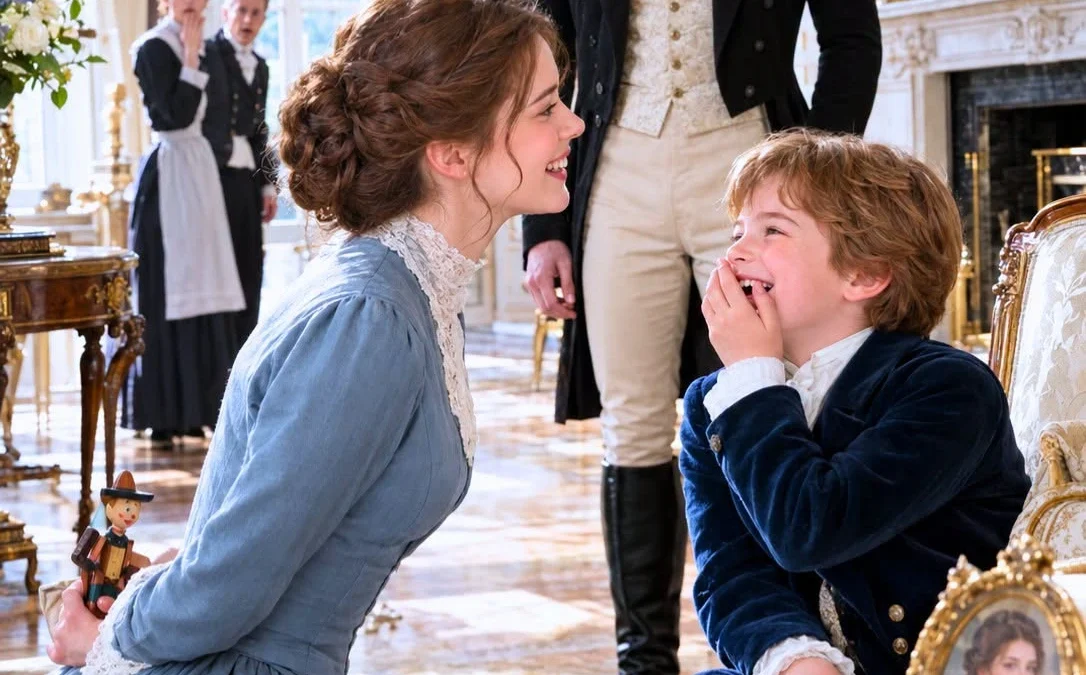
THE DUKE’S SON HADN’T LAUGHED IN A YEAR—UNTIL HIS NEW GOVERNESS MADE HIM SMILE… THEN THE DUKE FOUND HER KNEELING AT HIS DEAD WIFE’S GRAVE 😱
PART 1
For one year, six-year-old Charles Sinclair had not truly laughed.
Then a governess nobody knew walked into Blackthorne Manor carrying one battered trunk and an old wooden sword.
Twenty minutes later, the sound of a little boy laughing echoed through the mansion.
His father ran upstairs believing he was hearing a ghost.
By midnight, Duke Edward Sinclair would discover something far more unsettling.
His late wife had known the governess long before he did.
Blackthorne Manor had once been a warm house.
That was difficult to believe now.
The curtains remained half drawn.
The grand piano stayed closed.
The garden paths disappeared beneath weeds.
Servants spoke softly even when there was no reason to whisper.
Everything had changed the day Duchess Eleanor’s carriage overturned on the North Road.
Charles had been inside.
The boy survived.
His mother did not.
He had been carried from the wreckage with bruises across his face and blood on his coat, crying desperately for his mother.
After the funeral, the crying stopped.
Then almost everything else did too.
Charles spoke only when absolutely necessary.
Sometimes not even then.
Six governesses attempted to reach him.
One lasted three months.
Another three weeks.
The sixth left after one evening, weeping into her handkerchief.
Charles had not shouted at them.
That might have been easier.
He simply looked through them.
As if the world containing other people was no longer worth noticing.
His father was not much better.
Duke Edward Sinclair buried himself in estate accounts, tenant disputes, correspondence, and anything that allowed him to avoid the nursery.
He loved his son.
That was precisely why seeing him hurt so much.
Every glance at Charles reminded Edward of Eleanor.
The same dark eyes.
The same stubborn chin.
The same way one eyebrow rose when he was doubtful.
And guilt followed immediately afterward.
Edward had not been inside the carriage when it crashed.
Eleanor had been taking Charles to visit her sister.
Edward had remained behind for business.
That ordinary decision had haunted him for twelve months.
So when Mrs. Pratt appeared in his study one gray morning, he barely raised his head.
“The new governess has arrived, Your Grace.”
Edward continued signing a letter.
“Which number is this?”
“Seven.”
“Warn her.”
“I did.”
That made his pen stop.
“And?”
“She said she understood.”
“They all understand before meeting him.”
Mrs. Pratt hesitated.
“This one did not say she could fix him.”
Edward looked up sharply.
“Good. Because my son is not broken.”
Mrs. Pratt’s expression softened.
“I know.”
Edward regretted the sharpness immediately.
“Send her upstairs.”
“Her name is Miss Rose Winthrop.”
He nodded absently.
The name meant nothing to him.
Not yet.
Rose climbed the nursery stairs carrying her own trunk.
She was plainly dressed in brown wool.
No fashionable bonnet.
No expensive jewelry.
Her boots showed evidence of a long walk.
At the nursery door, Mrs. Pratt stopped her.
“One thing.”
Rose waited.
“Do not force him to speak.”
“I won’t.”
“Do not ask about his mother.”
“I won’t.”
“He may ignore you completely.”
“Then I shall try not to take it personally.”
Mrs. Pratt studied her.
“You are very calm.”
Rose smiled faintly.
“I learned some time ago that frightened children rarely need adults to become frightened with them.”
Something about the sentence stayed with Mrs. Pratt.
Before she could ask what Rose meant, the governess opened the door.
Charles sat beside the cold hearth.
A wooden horse lay near his knee.
He did not look at her.
Rose did something none of the previous governesses had done.
Nothing.
She did not kneel in front of him.
Did not touch him.
Did not introduce herself in an artificially cheerful voice.
She simply sat on the rug several feet away and opened her trunk.
Charles ignored her.
Rose removed two books.
A folded shawl.
A tin box.
Then an old wooden sword.
Charles’s eyes moved.
Only for a second.
Rose pretended not to notice.
She examined the sword solemnly.
“I was told this nursery once contained pirates.”
Nothing.
“I confess myself disappointed.”
Charles glanced again.
Rose continued.
“No ship. No treasure. Not one respectable cannon.”
Charles watched her now.
“There is, however, a sword.”
She placed it on the rug between them.
Then she began telling a ridiculous story about Captain Bartholomew Bumble, the most feared pirate in the Atlantic—except for one unfortunate problem.
He was terrified of parrots.
Charles’s mouth twitched.
Rose continued as though she had seen nothing.
Captain Bumble fled whenever anyone shouted “Polly.”
He once abandoned an entire treasure chest because a green bird looked at him suspiciously.
Charles reached for the sword.
Rose picked up a wooden ruler.
“Oh dear.”
Charles raised the weapon.
“I suppose diplomacy has failed.”
He swung.
She blocked clumsily.
Charles swung again.
Rose gasped dramatically.
“Mercy!”
Another strike.
Rose staggered backward.
“I have been defeated!”
And then it happened.
A sound escaped Charles.
Small.
Rusty.
Almost uncertain.
A laugh.
Rose froze for half a heartbeat.
Then deliberately fell over.
Charles laughed again.
Louder.
Again.
By the time Duke Edward left his study that evening, Charles was laughing so hard that the sound reached the entrance hall.
Edward stopped dead.
He knew that laugh.
He had heard it when Charles was a toddler chasing butterflies.
When Eleanor tickled him at breakfast.
When all three of them still believed happiness was ordinary.
Edward ran.
Up the staircase.
Down the corridor.
Toward the nursery.
Then he slowed outside the door because suddenly he was terrified.
Terrified the sound would stop.
Terrified he had imagined it.
He stepped into the doorway.
Charles stood in the center of the nursery brandishing a wooden sword.
Rose Winthrop lay dramatically across the carpet.
“I yield,” she declared.
“No!” Charles shouted between laughs. “Pirates never yield!”
Edward nearly stopped breathing.
A full sentence.
His son had spoken a full sentence.
Charles attacked again.
Rose rolled aside.
Then she saw Edward.
Her face changed instantly.
She scrambled upright.
“Your Grace.”
Charles turned.
The laughter faded.
For one terrible second, Edward feared he had destroyed it merely by entering.
He looked at Rose.
She looked frightened now.
Not of Charles.
Of him.
As though she expected dismissal for behaving improperly with a duke’s heir.
Edward swallowed.
“Captain Bumble?”
Rose blinked.
Charles answered.
“He’s afraid of parrots.”
Edward looked at his son.
Another complete sentence.
Something hot filled his eyes.
He turned slightly so Charles would not see.
Then he nodded toward Rose.
“Carry on.”
He left before his composure failed completely.
That night, for the first time in a year, Edward ate dinner somewhere other than his study.
Upstairs, Charles asked Rose for another pirate story before bed.
And Blackthorne Manor seemed to breathe again.
But after midnight, Rose opened her trunk.
From beneath her clothes, she removed an old envelope.
The handwriting across the front had faded.
For Rose Winthrop—if ever my son should need you.
Rose touched the signature beneath it.
Eleanor Sinclair.
The dead Duchess.
Then she whispered into the darkness:
“I came, Ellie.”
👉 Find Part 2 in the comments—or leave ANY WORD below and I’ll send it to you privately.
PART 2
“I came, Ellie.”
Rose returned the letter to her trunk and locked it.
Over the following weeks, Charles changed.
Not quickly.
Grief did not disappear because someone told amusing stories.
But he began returning to the world.
First, he spoke only to Rose.
Then to Mrs. Pratt.
One morning he shocked the footman by requesting honey at breakfast.
Three days later, Edward heard him ask his tutor a question.
The entire household pretended this was perfectly ordinary.
No one wanted to frighten the miracle away.
Rose began taking Charles outside.
Together they cleared weeds from Duchess Eleanor’s abandoned rose garden. They walked beside the pond. They opened nursery windows that had remained mostly closed for a year.
Edward increasingly found reasons to appear wherever they were.
He told himself he was observing Charles’s progress.
Mrs. Pratt knew better.
So, apparently, did Charles.
“You look for Miss Rose a lot,” the boy announced one afternoon.
Edward nearly choked on his tea.
“I look for you.”
“I’m usually with Miss Rose.”
“That is entirely different.”
Charles considered this.
“No, it isn’t.”
Rose hid a smile behind her cup.
For the first time since Eleanor’s death, Edward felt something dangerously close to happiness.
Which was precisely why suspicion struck him so hard.
One freezing night, unable to sleep, he saw a lantern moving across the lawn.
A woman’s figure.
Rose.
She walked toward the old family chapel.
Edward followed.
Hidden among the trees, he watched her enter the burial garden.
Rose knelt before Eleanor’s grave.
From beneath her cloak, she produced white lilies.
Eleanor’s favorite flowers.
Edward’s blood turned cold.
Rose placed them gently against the stone.
Then whispered:
“I promised I would protect him.”
Edward stopped breathing.
Protect Charles?
Not teach him.
Not care for him.
Protect.
Rose bowed her head.
“I know I’m late. I know I should have come sooner. But I didn’t know what happened until your letter finally reached me.”
Edward clenched his hands.
Letter.
Rose knew Eleanor.
His wife had contacted her.
And nobody had told him.
Rose returned toward the manor without seeing him.
Edward remained beside the grave.
The next morning, he entered Rose’s room while she and Charles were downstairs.
He hated himself for it.
But fear was stronger.
He searched nothing at first.
Then he saw the trunk.
Locked.
Beside it lay the wooden sword Charles loved.
Edward lifted it absently.
Something rattled inside the hollow handle.
He twisted the pommel.
A narrow compartment opened.
Inside was a tiny brass key.
Edward stared at it.
He knew that key.
It belonged to Eleanor’s private writing desk—the desk locked since her death.
Five minutes later, Edward stood in his late wife’s sitting room.
The key turned.
Inside the desk was a sealed letter.
His name was written across it.
Edward.
His hands shook as he opened it.
The first line made him sit down.
My darling, if Rose Winthrop has come to Blackthorne, then something has happened to me—and Charles may be in danger.
Edward read the sentence twice.
Then three times.
A floorboard creaked behind him.
He turned.
Rose stood in the doorway.
Her face went white when she saw the letter.
“You opened it.”
Edward rose.
“My dead wife says my son may be in danger.”
His voice broke.
“Tell me why.”
🔥 LIKE this post or COMMENT “ROSE” if you want Part 3. Once there are enough comments, I’ll post the complete ending.
PART 3
Rose closed the door behind her.
For several seconds, neither moved.
Edward held Eleanor’s letter in one hand.
The paper trembled.
“You knew my wife.”
It was not a question.
Rose nodded.
“Yes.”
“How?”
“She was my friend.”
Edward stared at her.
“My wife had many friends. I knew their names.”
“You didn’t know mine.”
“Clearly.”
There was pain beneath his anger.
Rose heard it.
That was the worst part.
“I never intended to deceive you.”
“You came into my house under another truth.”
“Rose Winthrop is my name.”
“You allowed me to believe you had no connection to my family.”
“I applied to become Charles’s governess because Eleanor asked me to.”
“A year after she died.”
Rose flinched.
“Yes.”
Edward unfolded the letter.
“Then explain this.”
He read aloud.
“‘If Rose Winthrop has come to Blackthorne, then something has happened to me—and Charles may be in danger.’”
He lowered the page.
“What danger?”
Rose looked at Eleanor’s desk.
“May I?”
Edward hesitated.
Then handed her the letter.
Rose read silently.
Tears formed in her eyes.
“I never saw this.”
“You had the key.”
“I had a key. Eleanor sent it to me three years ago inside that wooden sword.”
“Why?”
“Because the sword belonged to my brother.”
Edward’s anger faltered.
Rose sat.
“My family lived near the coast. Eleanor and I met when we were girls at Miss Halford’s school.”
“Eleanor never mentioned school.”
“She disliked it.”
That sounded like Eleanor.
Despite himself, Edward almost smiled.
Rose continued.
“She was lonely. I was worse. We became inseparable.”
“What happened?”
“My father lost almost everything. I left school. Eleanor married you.”
“You remained in contact?”
“For years.”
“Secretly?”
“No. Merely privately. Letters. Occasionally months apart.”
“Why didn’t I know?”
Rose gave him a sad look.
“Do you tell every person you love the name of every person who once mattered to you?”
Edward had no answer.
Rose looked back at the letter.
“Three years ago, Eleanor sent me the wooden sword with the key hidden inside. She told me only that if she ever wrote asking me to come to Blackthorne, I must come immediately.”
“And did she?”
“Yes.”
“When?”
“The letter reached me four months ago.”
Edward frowned.
“She died twelve months ago.”
“I know.”
“How does a letter take eight months?”
“That is what frightened me.”
Edward’s expression hardened.
Rose continued.
“The envelope had been redirected twice. Someone had opened it and resealed it.”
“Where is it?”
“In my trunk.”
“Show me.”
Rose did.
The envelope carried Eleanor’s handwriting.
Across one corner, the wax had clearly been disturbed.
Inside was a short message.
Rose, I may be imagining danger where there is none. Edward believes the carriage trouble last month was an accident. I am no longer certain. If anything happens to me, come to Charles. Do not trust appearances. Find what I left in my desk.
Edward’s face changed.
“Carriage trouble?”
“You didn’t know?”
He shook his head.
Rose stared.
“She wrote that one wheel nearly came loose during a journey several weeks before the crash.”
Edward sat heavily.
“She told me the axle had been repaired.”
“Perhaps it was.”
“Or perhaps someone interfered with it twice.”
The room became unbearably quiet.
Edward suddenly remembered the official explanation.
A broken wheel.
Wet road.
A frightened horse.
An accident.
Everyone had called it an accident.
He had needed it to be one.
Because accidents required no enemy.
No investigation.
No unbearable question of whether Eleanor could have been saved.
Edward returned to his wife’s longer letter.
The next paragraph had previously blurred beneath his shock.
He read.
You will want to dismiss Rose for keeping secrets. Do not. If she has come, trust her at least long enough to hear everything. She once saved my life, though she will insist she merely pulled me from a river because I was foolish enough to fall in.
Rose smiled through tears.
“She was furious because I ruined her new dress.”
Edward kept reading.
Then stopped.
My concerns involve Lord Marcus Vale.
His head snapped up.
“Marcus?”
Rose nodded slowly.
Edward’s cousin.
His closest male relative.
A frequent visitor to Blackthorne.
And, should Charles die before reaching adulthood, the next man positioned to inherit significant Sinclair property under an old family entail.
“No.”
Rose said nothing.
Edward stood.
“Marcus loved Eleanor like a sister.”
“Perhaps.”
“He carried her coffin.”
“I know.”
“You think he killed her?”
“I think Eleanor feared him.”
“That is not the same.”
“No.”
Rose met his eyes.
“That is why we need proof.”
The letter provided something close.
Eleanor described several troubling discoveries.
Marcus had accumulated enormous gambling debts.
He had secretly approached estate creditors.
More disturbingly, Eleanor had overheard him asking the family solicitor what would happen to Blackthorne property if Edward and Charles died within the same year.
Edward lowered the letter.
“He said it was hypothetical.”
“So Eleanor wrote.”
“What else?”
“Read.”
The last paragraph was different.
More hurried.
If I am wrong, burn this and forgive me. If I am right, Charles must never be left alone with Marcus.
Edward felt sick.
Marcus had visited Charles after the funeral.
Several times.
“Dear God.”
He ran.
Rose followed.
They found Charles in the schoolroom.
Safe.
Mr. Foyle was teaching him geography.
Edward crossed the room and pulled his son into his arms.
Charles squirmed.
“Papa?”
“I’m sorry.”
“For what?”
Everything, Edward thought.
For hiding in my study.
For allowing grief to convince me that distance was strength.
For leaving you lonely when you needed me.
But he only kissed the boy’s hair.
“Nothing.”
That afternoon, Edward ordered the manor gates watched.
Marcus was not to be admitted.
He was too late.
At four o’clock, Mrs. Pratt entered the study.
“Your Grace?”
Edward saw her face.
“What?”
“Lord Marcus arrived through the north gate before your instructions reached the lodge.”
Edward stood.
“Where is he?”
Mrs. Pratt swallowed.
“He asked to see Master Charles.”
Rose went white.
They ran upstairs.
The schoolroom was empty.
Mr. Foyle lay unconscious in the corridor.
“Charles!”
Edward shouted.
No answer.
Rose noticed the open garden door.
Outside, small footprints crossed the frost.
Beside them were larger ones.
They led toward the abandoned carriage house.
Edward’s terror turned almost animal.
He reached the building first.
The door was open.
Inside, Marcus stood beside an old carriage.
Charles was in front of him.
Marcus held one hand on the boy’s shoulder.
“Let him go.”
Marcus turned.
His expression was remarkably calm.
“Edward.”
Charles saw his father.
“Papa!”
He tried to run.
Marcus tightened his grip.
Rose entered behind Edward.
Marcus noticed her.
“So.”
His eyes narrowed.
“The mysterious governess.”
Rose moved slightly to the side.
“Let him go.”
Marcus laughed.
“You sound remarkably confident for hired help.”
“I am not the one trapped in a carriage house.”
Marcus’s smile vanished.
Edward took one step.
Marcus produced a small pistol.
Charles froze.
Edward stopped instantly.
“Marcus.”
“Stay there.”
“You will not leave this estate.”
“I do not intend to remain in England.”
“You sabotaged Eleanor’s carriage.”
Marcus’s face revealed nothing.
But Charles looked up.
“Mama?”
Edward’s heart broke.
Marcus exhaled.
“Eleanor always noticed too much.”
That was enough.
Edward’s hands clenched.
“You killed her.”
“I intended to frighten her.”
Rose stared.
Marcus continued almost irritably.
“The first carriage incident was a warning. She continued asking questions.”
“So you did it again.”
“The wheel should have failed gradually.”
Charles began crying.
“Mama died because of you?”
Marcus looked down.
Something like annoyance crossed his face.
That was his mistake.
Rose moved.
She grabbed a long carriage whip hanging from the wall and snapped it hard across Marcus’s wrist.
The pistol fired into the ceiling.
Edward lunged.
Charles ducked.
Marcus struck Edward across the jaw.
Rose pulled Charles away.
“Run!”
The boy ran toward the door.
Marcus saw him.
He shoved Edward aside and reached for the pistol.
Rose kicked it beneath the carriage.
Marcus turned on her.
“You should never have come here.”
Rose backed away.
“No.”
She picked up a wooden wheel chock.
“But Eleanor asked me.”
Marcus charged.
Rose threw it.
Not at Marcus.
At the carriage brake.
The old vehicle lurched forward.
Marcus jumped sideways.
Edward tackled him.
They hit the floor.
The fight ended moments later when two footmen and the gamekeeper stormed inside.
Marcus was restrained.
Charles ran into his father’s arms.
This time Edward held him without restraint.
“I’ve got you.”
Charles sobbed against his chest.
“I’ve got you.”
Rose stood nearby, breathing hard.
Charles lifted his head.
“Miss Rose?”
She knelt.
He reached for her.
Rose joined their embrace.
And for the first time since Eleanor’s death, grief was something the three of them carried together instead of something each person faced alone.
Marcus’s arrest uncovered everything.
Gambling debts.
Forged correspondence.
Payments to a stable hand.
Evidence that he had tampered with Eleanor’s carriage twice.
The first attempt failed.
The second killed her.
The stable hand eventually confessed.
Marcus was tried and removed permanently from Blackthorne’s future.
But healing was quieter.
And slower.
Edward began eating breakfast with Charles.
At first, both seemed uncertain what to say.
Rose solved that problem by refusing to help them.
When Edward looked helplessly at her one morning, she continued buttering toast.
“You are his father.”
“Yes.”
“Speak to him.”
“About what?”
Charles rolled his eyes.
“Pirates, Papa.”
So Edward learned about pirates.
Then horses.
Then clouds.
Then everything else he had missed while grief kept him behind his study door.
One spring morning, Charles opened the nursery curtains completely.
Sunlight flooded the room.
No one closed them.
Weeks became months.
Rose remained.
Her official title was still governess.
But the word gradually seemed insufficient.
She restored Eleanor’s garden with Charles.
She argued with Edward about his tendency to work through dinner.
She persuaded Mrs. Pratt that children would not perish from occasionally eating pudding before soup.
And Edward found himself watching her.
Not because of what she had done for Charles.
Not only that.
He watched the way she listened.
The way she never treated kindness as weakness.
The way she understood grief without worshiping it.
One evening they stood beside Eleanor’s grave together.
White lilies lay beneath the stone.
“I used to resent this place,” Edward said.
Rose looked at him.
“The chapel?”
“Her grave.”
Rose said nothing.
“I thought she was here and nowhere else.”
He looked toward Blackthorne.
“But Charles laughs like her.”
Rose smiled.
“He does.”
“And sometimes when you are angry, you make exactly the face she used to make.”
“That is deeply insulting.”
“It terrified half of London.”
“That sounds more complimentary.”
Edward laughed.
Then became serious.
“Eleanor brought you back into my life.”
“No.”
Rose looked at the grave.
“She brought me to Charles.”
Edward turned toward her.
“You stayed for more than Charles.”
Rose’s breath caught.
“Edward…”
It was the first time she had used his Christian name.
He noticed.
So did she.
He stepped closer.
“I spent a year believing that loving someone meant eventually losing them.”
Rose’s eyes softened.
“That is one possible ending.”
“And the other?”
“You love them while they are here.”
He reached for her hand.
Rose allowed it.
Their courtship scandalized exactly the people Mrs. Pratt expected it to scandalize.
A duke and a governess.
Edward ignored them.
Charles was considerably less subtle.
One evening he asked Rose at dinner:
“When you marry Papa, may I keep you?”
Edward nearly dropped his fork.
Rose turned scarlet.
“Charles!”
“What?”
Edward coughed.
“Perhaps allow me to conduct that portion of events.”
Charles frowned.
“You’re taking too long.”
Rose covered her face.
Edward laughed until his eyes watered.
Months later, beneath the roses Eleanor had once planted, Edward finally asked.
Rose said yes.
Not because she had replaced Eleanor.
She never tried.
No one could.
Instead, they built something new beside the memory of what had been lost.
On their wedding morning, Charles presented Rose with the old wooden sword.
“I think it belongs to you.”
Rose knelt before him.
“No.”
She placed it back into his hands.
“It belongs to the pirate who defeated me.”
Charles grinned.
At the wedding breakfast, he laughed loudly enough for the entire ballroom to hear.
Edward stopped speaking halfway through a conversation.
For just a moment, he listened.
That sound.
Once, it had been absent from Blackthorne for an entire year.
Now it seemed woven into the house itself.
Rose slipped her hand into his.
“What is it?”
Edward looked toward his son.
“Nothing.”
Then he corrected himself.
“Everything.”
Years later, people would tell the story of the seventh governess who succeeded where six others failed.
They would say Rose Winthrop possessed some special gift with children.
Perhaps she did.
But Rose always denied it.
“I did not teach Charles how to laugh,” she once told Edward.
“What did you do, then?”
“I gave him somewhere safe to remember how.”
And perhaps that was why Charles loved her.
Why Edward did too.
Because Rose had never entered Blackthorne intending to erase its grief.
She simply opened a door beside it.
A door toward sunlight.
Toward gardens.
Toward ridiculous pirates terrified of parrots.
Toward a father learning how to return to his son.
And toward a little boy discovering that loving his mother did not require him to remain sad forever.
The wooden sword remained above the nursery hearth for decades.
Beneath it was a small brass plaque.
Charles chose the words himself when he was older:
FOR THE WOMAN WHO TAUGHT THIS HOUSE TO LAUGH AGAIN.
And on every spring morning thereafter, the nursery curtains at Blackthorne Manor were opened all the way. ❤️
Disclaimer: This story is entirely fictional and created for entertainment purposes only. It does not represent any organization or individual, nor does it encourage inappropriate behavior. The content was generated with AI assistance.








