THE EMPEROR DRAGON WAS DYING OF THIRST—THEN A POOR WELLKEEPER’S DAUGHTER DID THE UNTHINKABLE FOR SEVEN DAYS
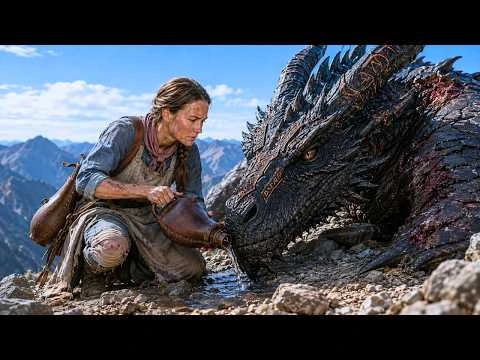
PART 1
THE EMPEROR DRAGON WAS DYING OF THIRST—THEN A POOR WELLKEEPER’S DAUGHTER DID THE UNTHINKABLE FOR SEVEN DAYS 🐉💧
By the time Junia Marsh found the dragon, his scales were already beginning to split.
Not break.
Not shed.
Split.
Fine white cracks ran along the edges of the enormous dark scales covering his flank, as though someone had taken a knife to black glass.
Junia stopped halfway up the barren ridge.
She knew that dragon.
Everyone in the empire knew him.
His profile was stamped on the silver coin in her pocket.
Emperor Malvern.
And he was dying alone on a mountain.
Three days earlier, an assassin had waited along the emperor’s usual flight path and fired a poisoned dart into the joint of his wing.
The poison was not meant to kill him.
It was worse in its own way.
It paralyzed.
Malvern had felt the numbness spreading while he was still hundreds of feet above the mountains. With seconds left before losing control entirely, he had forced himself toward the nearest patch of survivable ground.
He hit the ridge hard enough to crack a rib.
Then he lay there.
One day.
Two.
Three.
His guards searched the valleys below, unaware that the emperor had come down nearly two thousand feet above the nearest reliable water source.
The paralysis eventually began to fade.
But thirst did not.
Dragons could survive wounds that would kill ordinary creatures. Their scales could deflect blades, survive brutal cold, and endure astonishing heat.
But their scales needed water.
Without sufficient hydration, the protective plates began to crack.
First at the edges.
Then across the surface.
Eventually, the damage became permanent.
On the fourth morning, Junia noticed the dark shape on the ridge.
She was twenty-eight years old and had spent nearly all of those years walking these mountains.
Her father had once maintained the spring that supplied the scattered homes below. When age weakened his hands, the responsibility passed to her.
Every morning, Junia inspected channels, cleared debris, repaired pipes, measured flow, and made certain families who rarely thought about their water continued receiving it.
Nobody applauded.
Nobody paid much attention.
Water appeared.
That was enough.
But that morning, something above the tree line bothered her.
The shape had been there for days.
Healthy dragons did not remain motionless for days.
So Junia climbed.
When she finally reached the emperor, he could barely turn his head toward her.
His breathing was shallow.
His injured wing remained folded awkwardly against the rocks.
Junia crouched several paces away.
Her eyes went immediately to the cracks.
“You need water,” she said.
One enormous golden eye fixed on her.
“A great deal of it.”
Malvern attempted to speak.
Only a rasp emerged.
Junia looked down the mountain.
The nearest spring was hers.
A full descent.
Then another brutal climb carrying whatever she could manage.
She calculated silently.
Then aloud.
“I can carry two skins without collapsing myself.”
Malvern watched her.
“Two skins won’t be enough.”
Still silence.
Junia nodded slowly.
“All right.”
The dragon’s brow shifted.
Perhaps he expected her to leave.
Instead, Junia stood.
“One trip won’t save you,” she said. “But I don’t see why one trip has to be the only trip.”
For the first time, something changed in the emperor’s exhausted expression.
Junia tightened the strap across her shoulder.
“If it takes seven climbs, I’ll make seven climbs.”
Then she went down.
Before dawn the next morning, she filled two large waterskins at the spring.
The weight dragged at her shoulders immediately.
The lower trail was familiar.
The upper mountain was not.
Beyond the tree line, there was almost no path at all—only loose stone, narrow shelves and slopes steep enough to punish one careless step.
By midmorning, Junia reached him.
She did not simply empty the water into his mouth.
Years of working with supply and flow had taught her that too much, too quickly, could be its own kind of harm.
Small amounts first.
Then more.
Slowly.
Carefully.
Within an hour, the cracks stopped worsening.
Junia touched one damaged scale gently.
“Not healed,” she murmured.
Malvern’s voice finally came, rough and faint.
“No.”
“But better.”
A weak rumble answered her.
She almost smiled.
“That’s one trip.”
Then she picked up the empty skins.
“I’ll return tomorrow.”
The second morning hurt more.
Junia woke with muscles so sore that standing beside her bed required both hands against the wall.
She stood anyway.
Filled the skins.
And climbed.
Halfway up, a farmer named Farren Cobb spotted her.
He had known Junia since childhood.
He looked at the waterskins.
Then at her exhausted face.
Then at the mountain.
“What are you doing?”
Junia could have lied.
She didn’t.
“There’s an emperor dying on the ridge.”
Farren stared.
“An emperor?”
“Malvern.”
He blinked twice.
Junia continued walking.
“His scales are cracking. I’m carrying water.”
Farren hurried beside her.
“Junia, if that’s true, there are soldiers searching everywhere.”
“Then eventually they’ll find him.”
“And until then?”
“I climb.”
Farren looked at her legs.
“You’ll break yourself.”
Junia adjusted the straps.
“Possibly.”
“That’s your answer?”
“It’s the accurate one.”
Farren stopped arguing.
Instead, he promised to tell the households below that maintenance problems might delay their water slightly that week.
More importantly, he promised to watch the trail.
“If you stop coming back down,” he said, “I’m coming after you.”
Junia nodded.
“Fair.”
On the third day, her hands began bleeding.
The waterskin straps rubbed through old calluses and opened fresh blisters beneath them.
Malvern noticed immediately.
“You are injuring yourself.”
Junia poured water carefully between his teeth.
“I’m aware.”
“You should stop.”
“You didn’t ask me to begin.”
His eye narrowed.
“I am asking you to stop now.”
Junia wrapped her palm.
“No.”
Malvern seemed genuinely stunned.
Perhaps emperors were unaccustomed to hearing the word.
Junia glanced at him.
“Majesty, I did the arithmetic before the first climb. I knew it would hurt.”
“Knowing something will hurt does not make the hurt irrelevant.”
“No.”
She tightened the bandage.
“But it doesn’t make the work unnecessary either.”
Malvern stared at her bleeding hands.
“I have commanded armies.”
“Congratulations.”
His head lifted slightly.
Junia looked at him.
A strange sound escaped the dragon.
She realized, after a moment, that the Emperor of the Five Provinces was laughing.
By the fourth delivery, the cracking had visibly slowed.
Malvern could raise himself onto his forelegs.
His voice had strengthened.
And the conversations between emperor and wellkeeper grew longer.
He asked why she worked alone.
She told him about her father.
She asked why an emperor’s guards had followed the same flight path three journeys in a row.
Malvern grimaced.
“A question I intend to ask several people.”
“You should.”
“You speak to your emperor with remarkable freedom.”
“You’re currently lying on a rock waiting for me to bring you drinking water.”
Malvern considered that.
“A fair point.”
Then came the fifth morning.
Junia knew before sunrise that she was in trouble.
Her legs trembled as she filled the skins.
Her right knee had begun aching.
Her shoulders felt bruised to the bone.
Still she climbed.
The final ascent was the worst part—a steep pitch of unstable stone just below the ridge.
Junia planted her boot.
The rock moved.
Her exhausted leg failed to recover.
She fell.
Hard.
Her knee smashed against stone.
One waterskin tore loose.
Water spilled across the mountain.
“No!”
Junia clawed for it.
Too late.
Half the precious water disappeared into dust.
Pain exploded through her leg.
She lay motionless.
For the first time in five days, fear entered her calculations.
Not fear for herself.
Fear that she could no longer finish.
Junia slowly bent the knee.
Agony.
She tried again.
Nothing felt broken.
Badly bruised, perhaps.
Sprained.
But usable.
Maybe.
She gathered the surviving water.
Then she stood.
One step.
Another.
Another.
When Malvern saw her coming over the ridge, he pushed himself upright.
His expression changed the instant he saw her limp.
“What happened?”
“I argued with the mountain.”
“The mountain appears to have won.”
“Temporarily.”
She lowered the half-empty skins.
Malvern did not drink.
“Junia.”
“Drink.”
“No.”
“Your scales—”
“This ends today.”
She froze.
The dragon’s voice carried an authority she had not heard before.
Not an emperor commanding a subject.
A frightened man watching another person destroy herself for him.
“You will not make a sixth climb.”
Junia stared at him.
“That is not your decision.”
“It is if your next climb kills you.”
“It won’t.”
“You cannot know that.”
“No,” she said quietly. “I can’t.”
Malvern lowered his enormous head until his eyes were level with hers.
“Then stop.”
For several seconds, neither moved.
Junia’s knee throbbed.
Her palms burned.
Every muscle begged her to agree.
And for the first time since she had found him, Junia realized Malvern was no longer afraid of dying on the ridge.
He was afraid she would die trying to save him.
She sat beside him and looked toward the distant spring far below.
Then she made a decision that stunned even the emperor.
If you want Part 2, leave ANY WORD below—because what happened after Junia’s fifth climb changed everything.
PART 2
If you want Part 2, leave ANY WORD below—because what happened after Junia’s fifth climb changed everything.
Junia did not make the sixth climb the next morning.
Malvern waited.
Sunrise passed.
Then midmorning.
No figure appeared on the trail.
For five days he had argued that she needed rest.
Now that she finally listened, the silence terrified him.
“Junia…”
Far below, Junia sat beside her own hearth with her injured knee elevated beneath a poultice.
She had not surrendered.
She had calculated.
A leg destroyed on a sixth climb would never make a seventh.
So she did the hardest thing available to her.
She rested.
Farren arrived that evening.
He took one look at her knee.
“Finished?”
“One more.”
“Junia—”
“Tomorrow.”
Farren sighed.
“You are exactly like your father.”
“I’ll decide whether that’s an insult later.”
At dawn, she wrapped the knee tightly.
Filled both skins.
And began climbing.
Every step hurt.
But the mountain looked different that morning.
Not smaller.
Not kinder.
Simply finite.
There was an end now.
When Junia finally appeared on the ridge, Malvern rose fully to his feet.
For the first time since the assassination attempt, the emperor was standing.
Junia stopped.
A tired smile crossed her face.
“That’s encouraging.”
“You came back.”
“I said I would.”
“You also demonstrated yesterday that your judgment is occasionally questionable.”
“Drink your water.”
Malvern obeyed.
She examined the damaged scales.
No new fractures.
The old cracks had begun closing.
Seven days of careful hydration had achieved what one dramatic rescue never could.
Junia pressed her palm against his flank.
“That’s it.”
Malvern looked down.
“The cracking?”
“Stopped.”
“You’re certain?”
“I maintain water for a living, Majesty. Allow me one professional triumph.”
Malvern laughed softly.
Then his expression became serious.
“I have no words adequate for this.”
“Then don’t use inadequate ones.”
“I watched you tear your hands open.”
Junia said nothing.
“I watched you climb on exhausted legs. I watched you arrive bleeding, then limping, carrying water I never asked you to carry.”
“You needed it.”
“I command armies, Junia Marsh. Men swear loyalty to me before thousands of witnesses.”
He lowered his head.
“But I have never been given anything like what you gave me when no one was watching.”
Junia looked straight into the emperor’s eyes.
“I didn’t do it because you’re emperor.”
Malvern went still.
“I would have done it for anyone dying up here.”
A long silence followed.
Then the dragon smiled.
“Somehow,” he said, “that makes it worth even more.”
Hours later, Malvern spread his recovering wings.
The injured joint trembled.
Junia stepped back.
“You can fly?”
“I believe so.”
“That’s not especially reassuring.”
“Now you know how I felt watching you climb.”
She laughed despite herself.
With one powerful stroke, Malvern launched from the ridge.
Junia watched him descend toward the distant search parties.
She thought that was the end of their story.
She was wrong.
Because several weeks later, while Junia was kneeling beside her spring clearing leaves from the channel, an enormous shadow crossed the water.
She looked up.
Emperor Malvern was descending toward her.
Alone.
And when he landed, he said something no emperor had ever said to a wellkeeper’s daughter before.
LIKE this and COMMENT “WATER” if you want Part 3—the complete ending. 💧🐉 Once there are enough “WATER” comments, I’ll post the final part.
PART 3
Junia remained crouched beside the spring.
Malvern folded his wings.
For several seconds, neither spoke.
Then Junia stood.
“Did you get lost again?”
Malvern stared at her.
She smiled.
The emperor laughed.
“No assassination this time.”
“Good. I’m low on bandages.”
Weeks had passed since the ridge.
His scales were almost completely healed.
Only faint lines remained where the dehydration cracks had once spread across his flank.
His wing moved freely again.
Junia’s knee had healed too, though the injury still announced itself during cold mornings.
Malvern glanced toward the spring channel.
“You returned to work.”
“What else would I do?”
“You saved the emperor.”
“And the eastern pipe still leaks when the temperature drops.”
He looked genuinely amused.
“You remain remarkably difficult to impress.”
“I was impressed when you managed not to fall out of the sky.”
“A touching tribute.”
Junia went back to clearing the channel.
Malvern watched.
He had returned to the capital after rescue and found chaos waiting.
His security officers had nearly torn the mountain provinces apart searching for him.
The assassin had eventually been traced through intermediaries connected to factions seeking to destabilize the throne.
Arrests followed.
Interrogations followed.
Council meetings followed.
And through every one of them, Malvern kept thinking about a woman carrying two waterskins up a mountain.
Not soldiers.
Not nobles.
Not courtiers.
Junia.
He had seen courage his entire life.
Battlefield courage.
Ceremonial courage.
The loud kind that earned medals.
What Junia had shown him was different.
Nobody had commanded her.
Nobody had promised payment.
There had been no audience.
Only a problem.
And a woman who kept returning until it was solved.
“Confucius once wrote,” Malvern said, “‘It does not matter how slowly you go as long as you do not stop.'”
Junia glanced over her shoulder.
“Did Confucius maintain mountain springs?”
“I don’t believe so.”
“Then he had more time for writing than I do.”
Malvern laughed again.
“But I understood the sentence differently before you.”
That made her stop.
He stepped closer to the water.
“I thought it meant patience. Slow progress. Persistence in an abstract sense.”
“And now?”
“Now I think of you limping over that ridge.”
Junia’s expression softened.
“You did not save me with one heroic act,” Malvern continued. “You saved me with repetition.”
“Water tends to work that way.”
“Precisely.”
He glanced upstream.
“An empire may have the same problem.”
Junia lifted one eyebrow.
“Is this where you ask me to govern something?”
“Not today.”
“Excellent.”
“But I did come to ask you something.”
Junia set down her tool.
Malvern hesitated.
That alone was strange.
He could command thousands without hesitation.
Yet in front of one wellkeeper’s daughter, he seemed to be searching carefully for words.
“I want your spring properly protected.”
Junia’s expression hardened.
“It doesn’t need imperial ownership.”
“I didn’t say ownership.”
“Good.”
“I said protection.”
Malvern explained.
The households had depended on Junia and her father for decades, yet the spring’s channels were aging.
The main cistern needed repair.
Two sections of pipe should have been replaced years earlier.
Junia knew all of this.
She also knew what it cost.
“I can manage.”
“I know.”
“Then why are you here?”
“Because being capable of carrying something does not mean you should always be required to carry it alone.”
Junia became very still.
Malvern continued.
“I spent seven days watching you behave as though your ability to endure suffering made assistance unnecessary.”
She folded her arms.
“Careful.”
“I am learning.”
“Slowly.”
“So I’ve been told.”
He proposed an imperial grant—not for Junia personally, but for the spring system.
New pipes.
A second cistern.
A paid apprentice.
Emergency stores.
Maintenance funds legally protected from provincial officials who might decide rural water systems were unimportant.
Junia listened.
Then she asked questions for nearly an hour.
Who controlled the money?
Who owned the spring?
Could future officials redirect the funds?
Could villagers object to construction?
Would she choose the apprentice?
Malvern answered every question.
When he did not know, he admitted it.
Finally Junia nodded.
“That might work.”
Malvern blinked.
“That is the closest thing to enthusiastic approval I have ever received from you.”
“Don’t grow accustomed to it.”
Over the following months, the emperor returned several times.
At first, there was always a practical reason.
Surveyors.
Pipe plans.
Water rights.
Construction.
Then the reasons became thinner.
Malvern wanted to inspect a cistern.
Malvern wanted to ask about winter flow.
Malvern apparently needed a personal explanation of why moss accumulated faster on the north wall.
Junia eventually put down her shovel.
“You know you can simply visit.”
Malvern stopped.
“Can I?”
“Yes.”
“Oh.”
“The emperor of five provinces did not know he could visit someone?”
“The emperor of five provinces is accustomed to people wanting something when he arrives.”
Junia studied him.
“And you’re wondering what I want.”
“Occasionally.”
“Tea.”
He looked confused.
“If you’re going to stand there,” she said, “you can at least carry the kettle.”
So Emperor Malvern began carrying kettles.
It became a quiet ritual.
He would land beyond the spring so the wind from his wings did not scatter Junia’s tools.
She would finish whatever task she was doing.
Then they sat.
He told her about the court.
She told him about water.
He described ministers capable of arguing for three hours over the placement of a comma.
She described homeowners who somehow believed leaves should recognize property boundaries before falling into drainage channels.
He told her things emperors rarely said aloud.
That commanding people was easier than trusting them.
That the assassin’s dart had changed the way he looked at every predictable routine.
That he sometimes woke remembering the moment his wing went numb in the air.
Junia never offered empty reassurance.
She simply listened.
And when she spoke, she spoke plainly.
Perhaps that was why he kept returning.
Spring followed winter.
The repairs were completed.
Water flowed stronger than Junia had seen since childhood.
Her father, frailer now but still sharp-eyed, inspected the new system with suspicious thoroughness.
“Imperial workmanship,” he muttered.
“Good or bad?” Malvern asked.
“We’ll know in twenty years.”
Malvern nodded solemnly.
“A demanding inspection standard.”
“Water doesn’t care about titles.”
Junia covered a smile.
“I wonder where she gets it.”
Then, months after the ridge, Malvern asked Junia to walk with him.
They followed the spring uphill until the houses below disappeared behind the trees.
The emperor was unusually quiet.
Junia noticed.
“What is it?”
“I have rehearsed this badly.”
“That’s promising.”
“Junia.”
He stopped beside the running water.
She turned.
Malvern lowered himself until they were nearly eye to eye.
“I cannot offer you a life without difficult climbs.”
The humor left her face.
“I suspect,” he continued, “that life would make a liar of anyone who promised such a thing.”
Junia said nothing.
“But I can offer you a partner who finally understands that hard things are rarely solved by one dramatic gesture.”
Her breath caught.
Malvern continued quietly.
“They are solved by returning.”
Junia stared at him.
“Again.”
The spring rushed beside them.
“And again.”
His voice lowered.
“For however many days the problem requires.”
Junia’s eyes filled despite every effort to prevent it.
“Are you proposing marriage using a water-maintenance metaphor?”
“I had a more ceremonial speech.”
“What happened to it?”
“I met you.”
She laughed.
Malvern looked suddenly nervous.
It was perhaps the most astonishing thing Junia had ever seen.
An emperor who had survived an assassin.
A dragon who had fallen from the sky.
A ruler who had commanded armies.
Terrified of one woman’s answer.
Junia stepped closer.
“You understand that I am not moving permanently into some palace where forty people attempt to dress me every morning.”
“I suspected that might be unacceptable.”
“The spring remains my responsibility.”
“We can discuss how.”
“My father comes with me whenever he chooses.”
“Of course.”
“And if your ministers become ridiculous, I reserve the right to tell them.”
“I was rather hoping you would.”
Junia looked at him for a long moment.
Then she placed one hand against the scale where the cracks had once been.
Smooth now.
Strong.
Healed.
“All right,” she whispered.
Malvern’s eyes widened.
“All right?”
“I’ll marry you.”
His wings opened involuntarily.
The gust sent a bucket tumbling into the stream.
Junia stared at it.
Malvern stared at it.
“Your Majesty.”
“Yes?”
“Get my bucket.”
He laughed so loudly that birds lifted from the trees.
They married the following spring.
Not in the grand imperial hall.
Not beneath jeweled banners.
At the spring.
Junia insisted.
Malvern agreed immediately.
The villagers stood beside ministers.
Farmers stood beside generals.
Farren Cobb arrived in his best coat and told anyone who would listen that he had always known Junia would either do something extraordinary or die from stubbornness.
Her father sat near the channel he had maintained most of his life.
The water ran clear.
When the ceremony ended, Junia touched Malvern’s flank.
There was no trace of the cracks.
Years passed.
The story of the emperor’s disappearance grew famous.
People embellished it, naturally.
Some versions claimed Junia fought assassins with a shovel.
Others claimed she carried impossible barrels alone.
One tavern song insisted Malvern had been unconscious for all seven days and awoke instantly after Junia kissed him.
Junia hated that version.
“I carried water up a mountain until my hands bled,” she complained. “Apparently that wasn’t romantic enough.”
Malvern looked innocent.
“The song is quite catchy.”
“I will divorce you.”
“Noted.”
But beneath the exaggerations, the truth remained simple.
A dragon fell.
A woman noticed.
He needed more water than she could carry once.
So she returned.
And returned.
And returned.
Every year, on the anniversary of the final climb, Malvern and Junia walked the mountain trail together.
They did not fly.
That was important to her.
They walked.
Some years they moved quickly.
Later, more slowly.
When Junia’s old knee ached, Malvern matched her pace without comment.
When his wing stiffened with age, she waited beside him.
There was never any hurry.
One year, near the ridge where she had first found him, Malvern stopped.
Far below them, sunlight glittered on the spring.
“Do you ever regret it?”
Junia looked at him.
“The climbs?”
“Seven days. Your hands. Your knee. Everything it cost.”
She considered the question seriously.
Then she shook her head.
“No.”
“Why?”
“Because most things worth saving don’t announce themselves at convenient times.”
Malvern smiled.
Junia continued.
“And because people misunderstand persistence.”
“How?”
“They think persistence means never getting tired.”
She looked at the old scar on her knee.
“It doesn’t.”
“They think it means never falling.”
She remembered spilled water disappearing into stone.
“It doesn’t mean that either.”
Malvern waited.
Junia rested her hand against his healed scales.
“It means deciding the work still matters after you’re tired.”
The wind moved across the ridge.
“After you fall.”
Far below, water continued through the channels she had spent a lifetime maintaining.
“Even after nobody is watching.”
Malvern lowered his head beside hers.
Together they looked down the long trail.
Then, as they had every year, they began walking home.
Slowly.
At whatever pace the day required.
Because Junia had been right from the beginning.
The emperor’s scales were never going to heal because of one spectacular act.
They healed because someone came back with water the next morning.
And the morning after that.
And the morning after that.
Sometimes the greatest acts of love do not look heroic while they are happening.
Sometimes they look like tired hands filling the same waterskins again.
Like an aching body choosing one more climb.
Like ordinary work repeated until an impossible problem finally gives way.
And sometimes the person who changes an empire is simply the one who notices what needs doing—and refuses to stop showing up. 💧🐉❤️
Disclaimer: This story is entirely fictional and created for entertainment purposes only. It does not represent any organization or individual, nor does it encourage inappropriate behavior. The content was generated with AI assistance.








