The Lumberjacks Mocked the New Camp Cook on Day One. Then She Discovered the Secret Their Boss Had Hidden for Eight Years
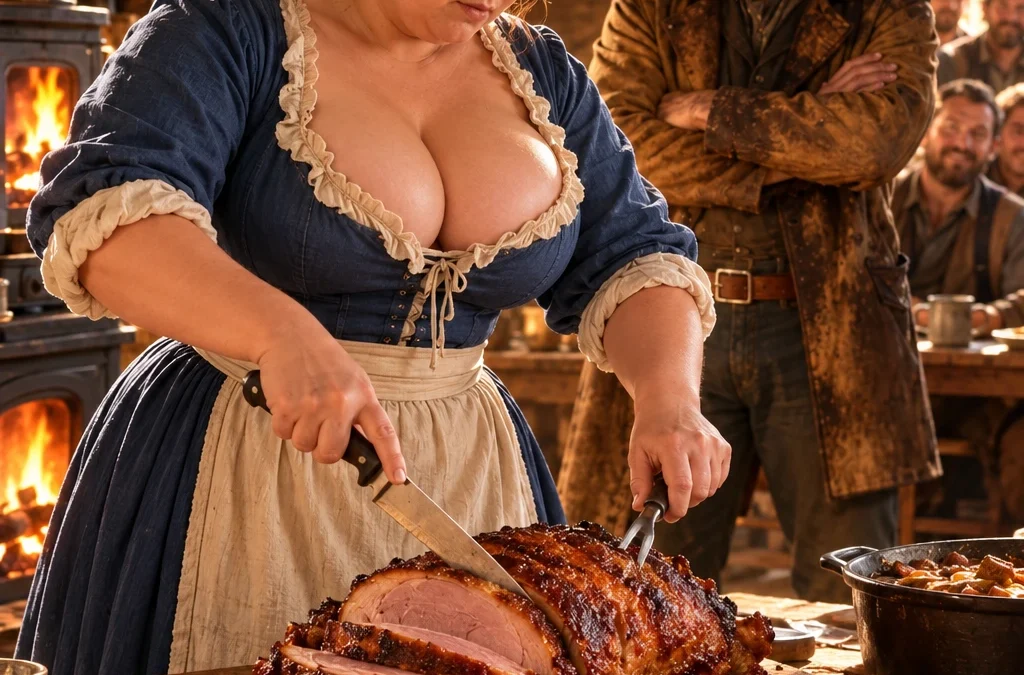
The Lumberjacks Mocked the New Camp Cook on Day One. Then She Discovered the Secret Their Boss Had Hidden for Eight Years
Part 1
She arrived at Blackwater Camp on the November supply wagon.
She was the largest woman the crew had ever seen step down from a wagon in those hills. Every man in the yard stopped what he was doing and stared. 🌲
Audra Whitfield had come to the British Columbia interior with a single trunk. She also carried a worn leather notebook full of recipes she had never needed to write down, because they already lived in her hands. She was twenty-nine and a widow. For three years she had cooked at a railway boarding house in Vancouver, in a city that reminded her of things she was trying to leave behind. When she saw Reed MacKay’s advertisement in the Merritt Gazette, she answered it. The wage was fair and the cook’s quarters were private.
She had no illusions about what she was walking into.
The camp sat in a narrow valley, an hour’s ride east of Merritt. Steep walls of Douglas fir rose on both sides. Below lay a log bunkhouse, a barn, two outbuildings, and a cook shack set apart at the edge of the clearing.
The nearest man was broad-shouldered, in his forties, with a jaw that looked as if it had been set wrong after a break. He looked her over the way he might look at a piece of equipment that was supposed to do a job and probably wouldn’t.
“You the new cook?” he said.
“I am,” Audra said. “And you’ll be eating what I make, so that look you’re wearing might be worth reconsidering.”
His mouth went flat. Beside him, a boy of seventeen with ears that stuck out bit down on a grin before it could fully form.
Then a door opened across the yard, and the whole camp seemed to hold still.
Reed MacKay came down the steps like a man who hadn’t rushed toward anything in years, because nothing in his operation moved without his say-so. He was taller than his telegram had suggested, with dark hair, a beard going gray at the edges, and eyes that took in everything from a distance before he closed the gap.
He stopped two feet from her and looked her over with no more ceremony than he’d give the wagon.
“Miss Whitfield.”
“Mr. MacKay.”
“Trip all right?”
“Cold,” said Audra. “But I’ve been cold before.”
Something near his mouth shifted. It might have become a smile if he had let it. He didn’t.
He walked her to the cook shack and stepped aside. She stood in the doorway and took stock. The wood range was thick with months of grease. The flour had been left open. There was one dull knife, a badly soldered pot that would leak if nobody watched it, enough hardtack to build a small wall, and no spice rack at all.
It was a kitchen that had kept men alive because men have to eat. Nothing more.
“Previous cook left in September,” Reed said. “We’ve been managing on hardtack and pork.”
“And how are the men holding up?”
A pause. “They work. That’s what matters.”
“Men work harder when they’re properly fed,” Audra said, already opening the flour tin. “That’s not opinion. That’s just how it is.”
He watched her a moment longer. “Supper’s at six. Eleven of us, counting me.”
“I read the letter, Mr. MacKay. I know how many I’m cooking for.”
He left without another word. She rolled up her sleeves. 🔥
The boy with the ears, Jasper, wandered in at four with an armload of wood. “Boyd says you’ll be gone by Christmas,” he said.
“Boyd says a lot of things, does he?”
Jasper’s eyes drifted, honest and unguarded, to the width of her hips before they came back to her face. She noticed it the way she noticed everything, without flinching. She had decided long ago that the opinions of seventeen-year-old boys were not something she needed to manage.
“Stack that properly,” she said, nodding at the wood. “Against the wall. Not in a pile.”
He did, without arguing. That told her something about him.
At six o’clock, they all filed in from the cold. These were men who had lowered their expectations so many times that they’d stopped bringing them to dinner.
It was only bean soup. But she had cooked the beans properly, which no one before her had bothered to do. She rendered the pork fat first, then added it back in. She found a dried onion at the back of a shelf, salted the pot twice, and tasted it twice. She baked a pan of biscuits that rose tall and lifted clean from the greased tin.
For a few minutes there was only the usual silence of men eating from hunger.
Then it changed.
Spoons slowed. Biscuits were picked up and looked at before they were eaten. Jasper took a second one before the basket had even gone around. Saul, the man who’d nearly grinned at her in the yard, stared into his bowl.
“How’d you do that with the beans?”
“Cook them properly,” said Audra from the stove.
He said nothing else. But he finished the bowl and refilled it. 🍲
Boyd ate without a word, and she decided to count that as progress.
That night she sat on the edge of her cot and listened to the firs breathe in the wind, slow and heavy, as if something had been alive in that valley for a hundred years before anyone came to cut it down. She thought about the way Boyd had looked at her. She had known that look since she was nineteen. People who decide everything about you from your body before you open your mouth.
By twenty-three, she had made what she called peace with it. Really, she had just stopped arguing. She let her hands do it instead.
Hands are harder to dismiss.
Over the next weeks, the camp began to change. The kitchen smelled like cinnamon and rendered fat and warm dough. Men lingered at the table. Even Boyd got a little quieter.
And every night, after the others went to bunk, Reed MacKay stayed behind in the glow of the lamp with his ledger open.
Audra started to watch him.
Then, one evening, she saw it.
Reed was squinting at his own columns. He leaned closer, blinked hard, and held the page at an angle, trying to hide it.
The man who ruled this entire camp could not read his own numbers.
And he had been hiding it from every one of them. 👀
Part 2
Audra said nothing that night. She was not a woman who struck while a wound was still open.
But the next day, the camp tested her.
It happened on a Saturday, with the cook shack warm and smelling of cinnamon. She had spent the morning curing a side of pork and the afternoon rolling pastry from a cache of dried apples. Boyd wandered in, poured himself a coffee without being asked, and stood watching her work. She could feel him gathering himself, the way you feel the air change before weather comes off the mountains.
“Funny thing,” he said at last. “Feeding all these men three times a day. On top of everything else you’ve got to carry around.” He shrugged. “Must take it out of you.”
The kitchen went dead silent. Jasper froze at the wood box with a log in his hands. 😳
Audra set down the rolling pin. She turned around slowly.
“Boyd,” she said pleasantly, “I’ve cooked for camps and boarding houses since I was sixteen. I’ve fed sixty men from a kitchen half this size with a stove that had two working burners. I’ve managed all of it, including myself, just fine.” She picked up the pin again. “What I don’t need is commentary on my body from a man who’s been eating hardtack for two months because nobody bothered to cook for him. Drink your coffee. Keep your observations to yourself.”
Boyd’s jaw worked. He set the cup down and walked out without a word.
Saul appeared in the doorway thirty seconds later, plainly having been just outside. He gave her a long look, and something in it had shifted from doubt to respect.
“For the record,” he said, “the pastry smells incredible.”
“Go do something useful,” said Audra. But she was almost smiling. ✨
That night Reed was still at the table after the others had gone.
“Boyd gave you trouble,” he said, not looking up.
“Boyd gave himself trouble. I just didn’t help him into it.”
The tension around his eyes loosened, the way it had been loosening for days, as if he were slowly letting himself believe she wouldn’t turn out to be a mistake.
Two nights later, she pulled a chair up beside him with a lamp of her own. “Show me your supply columns.”
He hesitated. Then he turned the ledger around.
She found the waste in minutes. He was ordering salt pork for fourteen men when he’d had eleven since August. He kept running out of flour ten days early, then paying a premium for rush orders from Merritt. As she pointed to the columns, he leaned close enough that she felt the quiet warmth of another person on a cold night.
And again, she saw the squint.
“Your eyes giving you trouble?”
She asked it carefully, practically, the way she’d ask about a tool that wasn’t performing. Not pity. Just the truth.
His face closed. “Fine.”
Audra turned back to the page. “There are reading glasses in the Merritt catalog,” she said mildly. “Birch ordered a pair last spring. Worked out fine.”
She didn’t look up. She didn’t say anything more.
After a long moment, he picked up his pencil and made a note in the margin beside her finger.
They worked another hour, his pencil scratching, her voice low. By the end, they had stopped being employer and hired cook. They were two people who found it easier to talk when their hands had something to do.
“You’re better at this than I am,” he said.
“I think in provisions. Numbers are just flour and salt, once you look at them that way.”
He gave her the shadow of a smile. 🕯️
By mid-December, the camp felt it. Six-day weeks for three months had hardened small irritations into real ones. August and Birch hadn’t spoken to Saul in four days over a saw. Two men were bolting their meals to leave the table sooner.
So Audra went to Reed on a Tuesday morning.
“I want to put on a proper dinner Saturday night. Something to remind these men they’re people, not just an operation.”
“We have a cut to finish.”
“I’m not asking for Sunday. I’m asking for supper.” She laid her list on the table. “Venison roast. Root vegetables. Gravy. Bread baked the right way.”
He read the list. He looked at her. He looked back at the list.
“All right,” he said.
Saturday evening came. The roast was glazed and resting. The table was set with a cloth, laid flat.
And when the men filed in and stopped in the doorway, stunned, Reed MacKay came in last.
He looked at the table. Then he looked at her.
And on his face was an expression she had never seen there before. 💛
Part 3
Reed stood in the doorway a long moment.
It was the look of a man who has found something he didn’t know he was missing until it was set directly in front of him. For eight years, he had run Blackwater on tight margins and harder seasons. He had never once sat down to a supper that told him someone had thought of him before he arrived.
“Is that for us?” Saul asked, staring at the roast.
“Who else would it be for?” said Audra. “Sit down.”
They sat. Even Boyd. Even the two men who’d been eating fast and leaving early slowed down, as if the room itself had changed its mind about being somewhere they wanted to leave. 🍽️
Audra carved the roast herself, clean and unhurried. The first bite silenced the table completely.
It was Jasper who broke it, with a low, involuntary sound of pure contentment that he tried to swallow and couldn’t. Saul laughed. And just like that, the table came alive, the way tables do when good food does what it’s meant to do and everyone in the room is allowed, for once, simply to be glad.
Boyd ate three helpings without a word.
On his third trip back with his plate, he paused near the stove and stared at the floor instead of at her, like a man returning something he’d held too long.
“I said some things when you first got here,” he muttered. “Nothing I’d be proud of repeating.”
“No,” said Audra. “You wouldn’t.”
He was quiet. “You’re a hell of a cook. For what it’s worth.”
“It’s worth something.” She held his gaze. “Thank you, Boyd.”
He nodded and went back to his seat. It was the closest thing to peace that kitchen had held since the camp began. 🤝
Reed spoke last. He waited until the table had settled into that half-drowsy conversation of men who are full and warm and haven’t had cause to argue for a whole hour.
“Eight years,” he said, looking at his plate. “I’ve run this camp eight years. Seasons that should have broken us. A man short, prices down, repairs eating the margin.”
He looked up. The men went quiet.
“I’ve never once sat down to a supper in this camp that made me feel what we’re doing out here means something beyond getting the cut done.” He paused. “Audra’s changed that.”
Audra stood very still by the stove.
“It’s not only the food,” he went on. “Though the food is better than anything I’ve had at any outfit. It’s what she’s done to this place. The supplies are running right for the first time in two years. The men are staying when better wages come calling. There’s a reason to come in from the cold that isn’t only because the day is done.”
He looked directly at her.
“That’s what you’ve given this camp. I should have said it sooner.”
Nobody moved.
Saul cleared his throat. “He’s right. I said things the first day I’m not proud of. Hadn’t been here an hour and I’d already made up my mind.” He met her eyes. “I was wrong about all of it.”
“Same,” said Boyd into his plate.
“Best cook in all of BC,” Jasper added, loudly, which was not much of an apology but was completely sincere, and it broke the last of the tension into laughter. 😊
Audra stood with her hands folded in her apron, feeling the full weight of it.
Years of being measured before she was heard. Years of walking into rooms that had already reached their verdict. And here, in a battered cook shack in the middle of a British Columbia winter, she was receiving the plainest recognition she had ever been given, which somehow made it the most real.
“Thank you,” she said, steady. “Now eat the rest of that bread before it goes cold.”
Later, when the men had drifted to the bunkhouse, full and quiet in a way that felt different from every other night, Reed stayed behind. His ledger lay open. His pencil lay untouched.
“You didn’t need them to say it,” he said.
“No. But it was kind.”
“I meant every word.” He looked up at her. “I wasn’t sure when I put that advertisement in the paper. I thought I was making a practical decision. Camp needed a cook. A cook came. I didn’t think much beyond that.”
Audra sat down across from him, something she had never done before. The lamplight held steady between them. Outside, the firs moved in the wind, that slow old sound she had come to know by heart. 🌲
“And now?” she asked.
He held her gaze, and what she saw there was plain and unguarded. It wasn’t the careful arithmetic of a man weighing an investment. It was honesty that had been working its way to the surface for weeks and had finally arrived.
“Now I think I made a better decision than I knew how to make,” he said. “And I’d be a fool not to say so plainly before another month goes by.”
She was quiet. It was the quiet of someone choosing a word with care because the word mattered.
“I came here for a wage and a kitchen I could actually work in,” she said at last. “I didn’t expect to find anything worth staying for beyond that.”
“And now?” he said, echoing her.
She looked around the cook shack. The shelves she had organized. The spice rack she had built from scrap lumber. The stove that finally drew properly. The window she had scrubbed so the morning light came in right. The table where eleven men had just sat down, and lingered, and laughed in a place they had chosen to be.
“Now I can’t imagine being anywhere else.”
He reached across the table and covered her hand with his, rough and certain, the hand of a man who never made a gesture he hadn’t already decided on.
She did not pull away. 🤍
The lamp burned between them. The camp breathed around them. Neither said anything more that needed saying, because some things settle better in silence than they ever could in words.
December finished hard and January came in harder. But Blackwater Camp held.
The men held. The kitchen ran steady and warm, the center point of an operation that had finally found its footing. Reed began wearing a pair of spectacles at the ledger, ordered from the Merritt catalog. He never mentioned them, and nobody dared to mention them to him. But Audra noticed that his columns grew cleaner, and that he looked at her across the lamp with a different ease.
When spring thawed the valley, the first supply wagon crested the switchback. The driver brought news from Merritt. Two other camps were hiring at better wages.
Not one man in Reed MacKay’s crew handed in his notice.
Later, in town, someone asked Jasper why.
He thought about it for a moment.
“The food, mostly,” he said.
Which was true.
But anyone who had been at that table in December, and watched the way Reed MacKay looked across it, knew it wasn’t quite the whole of it. 🕯️
This story is entirely fictional and created for entertainment purposes only. It does not represent any organization or individual, nor does it encourage inappropriate behavior. The content was generated with AI assistance.








