THE MERMAN WAS DYING ON THE ROCKS WITH A CURSED HARPOON IN HIS SHOULDER… THEN A CLUMSY MAID SHARED HER SOUP, AND THE MAN WHO HUNTED HIM CALLED HER BY A NAME SHE HAD NEVER HEARD
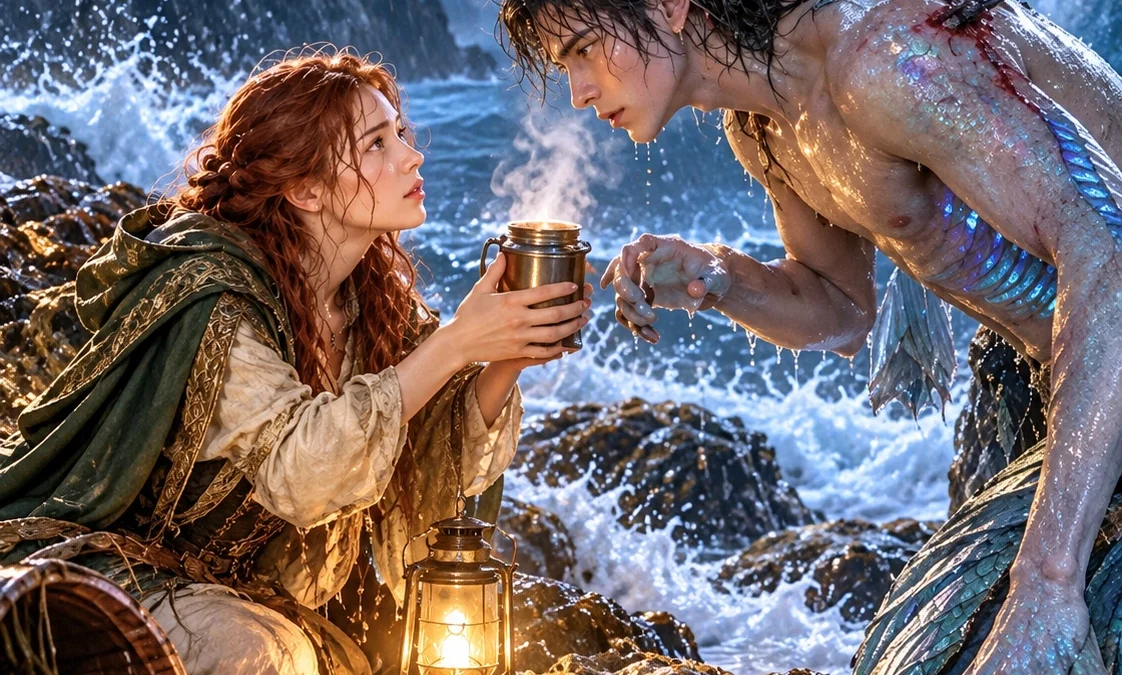
THE MERMAN WAS DYING ON THE ROCKS WITH A CURSED HARPOON IN HIS SHOULDER… THEN A CLUMSY MAID SHARED HER SOUP, AND THE MAN WHO HUNTED HIM CALLED HER BY A NAME SHE HAD NEVER HEARD 😱🌊
Part 1
The rain came sideways off the North Sea like a punishment.
Elspeth Moray had lived in this crofting village on the Scottish coast for twenty-three years, and she had never seen the sky so bruised. The lighthouse on the cliff had gone dark two hours ago. Her father would have called that a mortal sin.
But her father was six months dead, and the lamp mechanism was older than the Queen. 🕯️
She was hauling a bucket of coal up the stair when she heard it. Not the wind. Not the waves. Something lower, a sound that trembled in her breastbone like a plucked harp string.
The bucket clattered down the stone steps. She did not go back for it.
Outside, the rain hit her face like handfuls of gravel. The path to the cove was slick with kelp, and she slid twice before she reached the shingle. The tide was coming in fast, the foam glowing faintly white in the dark.
There, near the rock pool where she had caught crabs as a girl, lay a shape too long for a seal and too still for a swimmer.
She lifted her lantern.
The light caught wet skin the color of pewter, and the skin was not skin. It was scaled in tiny iridescent plates that shifted from gray to green to deep violet as the creature breathed. Its tail was pinned between two boulders. A fishing net bound its torso. And from its left shoulder jutted a black iron barb, bleeding something dark and slow, like crude oil.
Every child on this coast knew the stories. The selkies who shed their skins. The blue men of the Minch who sang sailors to their deaths.
This was neither. This was something older, something that had been hunted. 🌊
The creature opened its eyes. They were the color of sea glass, and they held an intelligence that made her step back. Not animal. Not human. Something in between, and far more dangerous.
A sound escaped its throat, a rasp like a rusted hinge.
Elspeth thought of the flask in her satchel. Barley and leek soup, still warm. She did not know why she did it. Perhaps because the creature was shivering and she had nothing else to offer. Perhaps because her father always said the sea takes, and the sea gives, and you never turn your back on either.
She knelt on the wet stones and unscrewed the flask. Steam rose between them.
Its hands were webbed, tipped with claws that could have opened her throat. It did not move. It only watched.
She took a sip herself to show it was not poison, then held the flask out again.
One long, cold hand reached for it, slow and deliberate. Its fingers brushed hers. Then it drank.
The effect was immediate. The shivering stopped. The dark bleeding slowed. Along its ribs, the scales began to glow with a soft blue light, like plankton in the bay on a summer night. ✨
Then Elspeth saw the barb clearly. It was not a simple hook. It was carved iron, blackened by salt, with a tiny raised emblem at its base: a hawk with spread wings.
The sigil of the Dryden family.
Malcolm Dryden owned half the fishing rights from here to Aberdeen. He had been seen in the village lately, asking questions about old songs and older maps.
Out in the dark, a boat engine hummed low and slow.
Elspeth made a decision she did not know was good. She gestured toward the cliff path, toward the dark shape of her cottage. The creature did not move. But when she turned and began to walk, she heard the scrape of scales on stone behind her. Slow. Pained. Following. 🐚
In her kitchen, she barred the door, drew every curtain, and set a basin of salted water on the flagstones. She let him choose. When he lowered his wounded shoulder into it, she saw what the iron truly was: two pieces, locked together like puzzle teeth, the flesh grown around both. She could not take one without tearing out the other.
Her father’s sea chest had fallen open beside the stove. Inside lay a folded chart in his small, precise hand, a tidal pool circled in red ink, and a single word in the margin she could not read.
The creature saw it and went rigid.
Three flat knocks struck her door, spaced with the patience of men who knew she was inside.
She hid him in the pantry among the potato sacks. At the door stood three men in the rain, and the first held a copper lantern shaped like a hawk, its flame burning green.
“Malcolm Dryden sends his regards,” said the man softly. “A boat lost its cargo in the storm. Something valuable.”
She told him she had slept through it. The man smiled coldly and left.
When she pulled back the pantry curtain, the creature was staring at the chart. His fingertip left a smear of silver on the paper. The ink shifted, and one name dissolved to reveal another hidden beneath it, written in a hand that shook.
Morwenna Carew.
Elspeth’s heart stopped. Every child in the village knew that name. A fisherman’s widow, hanged for witchcraft two hundred years ago.
Then a voice outside called, calm and cold and very near, and it did not say Moray.
“Open the door, Elspeth Carew. Your father promised my family you would never find that well.”
Part 2
“Open the door, Elspeth Carew. Your father promised my family you would never find that well.”
Elspeth did not breathe.
Carew. Her father had never once spoken that name aloud. The creature gripped her sleeve and shook his head hard, and there was something in his sea-glass eyes she had not seen before. Not fear. Warning. 😨
“Cailen,” he rasped, touching his own chest. It was the first word he had given her.
“Elspeth,” she whispered.
The silver on the chart had drawn a second map in the margin: a tunnel beginning at the tidal pool and ending at a circle she knew. The ruined cottage at the harbour wall. Morwenna Carew’s house. Her father had told her a thousand stories about the widow, and never once called her a witch. A woman who kept a promise to something older than the village. He had also told her, every time, never to look in the well behind it.
The knocking became splintering wood.
Elspeth stuffed the chart in her coat, pulled Cailen’s arm over her shoulders, and ran out the back door into the storm. The silver in his wound trailed behind them, beading on the grass and rolling toward the harbour wall like a compass needle.
Halfway down the path, she saw it. A green lantern burned on the flat rock at the foot of the lighthouse, and beside it, driven upright into the turf, stood a black riding crop with a silver hawk’s-head handle.
Not his men. Him. 🦅
Malcolm Dryden was not waiting. He was hunting.
They stumbled along a narrow ledge below the sea wall, spray misting her face, Cailen’s breath rattling like shells in a tin. Frost was spreading from his wound in thin white veins. Behind them a horse snorted, close, too close.
The Carew cottage stood half swallowed by storm drift, roof collapsed, windows dark. Yet the air inside was warm, and a circle of flat stones in the floor glowed with a silver light. Spirals were carved into every one, the same spiral that marked the iron barb.
Cailen pulled her through a gap in the back wall, into a yard choked with nettles. In its center stood a waist-high well, its stones coiled with the same pattern, a rope hanging over the lip. From below rose a hum that traveled through her teeth and her bones.
Boots crunched in the cottage behind them. Slow. Unhurried.
Malcolm Dryden filled the broken doorway, green lantern held low, a short wooden staff banded in silver in his other hand. He was tall, narrow, and calm, and his calm was the most frightening thing about him.
“You led me here, Miss Carew,” he said gently. “Exactly as my grandmother promised someone would.”
Elspeth looped the rope under Cailen’s arms and lowered him into the dark. Then she swung her legs over the rim and let go.
She landed on wet stone in a round chamber where the walls glowed silver. In the center stood a stone table, and on it lay a scale the size of a dinner plate, pressed over a black book wrapped in a chain that had no lock.
Above her, Malcolm’s silhouette blocked the gray sky.
“The merman is dying,” his voice fell down the shaft. “That book holds the only cure. Hand it up, or watch him turn to frost from the inside out.”
Cailen’s lips had gone blue. The white veins had reached his jaw.
And the silver chain around the book began, very slowly, to glow. 🔥
Part 3
The chain did not snap. It softened.
The fused links sagged like wax held too near a flame, ran in slow silver rivulets down the black leather, and drained into the spirals on the floor as though the stone were drinking. The book fell open under its own weight.
The pages were not paper. They had the texture of pressed kelp, translucent and veined, and they smelled of salt and iron. Elspeth turned the first one with trembling fingers.
The diary of Alistair Dryden.
The early entries were mundane: weather, sheep prices, a quarrel over fishing rights. Then, in the winter of the third year, the handwriting changed.
A storm drove a ship onto the rocks. In the wreckage I found no cargo and no bodies. I found a woman tangled in kelp, with a tail where legs should be, and eyes that held more fury than any human face could contain.
I have kept her in the well. The well was built for it. The spirals are not decoration. They are a cage with no bars.
Elspeth felt sick. She read faster.
Alistair had cut a single scale from Morwenna’s tail while she lay chained. He had pressed it into the book and sealed the cover with a chain forged from the creature’s own sea-iron. It cannot be opened by force or by tool, he wrote. Only by a hand that does not seek to possess.
That was why Malcolm had never touched it. That was why the chain had waited.
On the last page lay a second, smaller scale, and beneath it a note. One scale, ground to powder and mixed with fresh water, reverses the frost. But it must be given freely. Taken by force, it only hastens the decay.
At the very bottom was a drawing of the well, the spirals marked, and at the center a small circle labeled with two words. Second door. 🚪
“Miss Carew.” Malcolm’s boots scraped on the shaft wall. He was climbing down. “The book is my family’s property.”
Elspeth seized the great scale from the pedestal. It was hot as a living thing. She pressed it into Cailen’s cold fingers and folded his hand shut around it.
“Take it,” she whispered. “I’m not taking anything. I’m giving it.”
The scale flared blue. The frost on his jaw cracked like river ice in spring.
Malcolm dropped into the chamber and the staff in his hand began to glow amber. The spirals on the walls turned, stone grinding on stone, and the floor beneath the pedestal split along a seam that had been invisible for three generations. A black shaft opened, descending into darkness, its walls carved with spirals crowded together like the rings of a tree grown for a thousand years.
At its bottom, something glowed pale green.
The smirk fell off Malcolm’s face. What remained was hunger, old and patient. “The book was never the prize. The book is a map. The scale is a key.” He looked at Cailen. “And the boy is the lock. My family never hunted his kind for scales. We hunted them for the bloodline that opens that gate.”
The green light below swirled and thickened, and from it rose a woman made of luminous water, her hair drifting, her eyes closed, her hands folded over her chest. She was beautiful the way deep water is beautiful. Cold. Ancient. Complete.
“Morwenna,” Malcolm breathed, like a curse and a prayer.
Her eyes opened. They were the same blue as Cailen’s, and they fell on Elspeth with a weight that bent her knees.
She did not speak. The pressure in the air spoke for her, and in the space between two heartbeats Elspeth understood what the Drydens never had.
Morwenna had never been a prisoner. She was the door. Her blood, her line, her children were keys shaped by the sea itself. Alistair had chained her and stolen her scale, but the gate would never open for him. It would open only for her blood.
And Cailen was her son. Her last one. 💔
Malcolm lunged for him.
Elspeth did not think. She threw her whole weight against the stone pedestal and sent it toppling into the shaft. The green light swallowed it. The whole chamber shuddered. The staff in Malcolm’s hand cracked down the middle, its amber light dying, and he fell to his knees at the edge, clawing at empty air.
“You’ve ruined it! My grandfather waited! My father waited! I waited!”
He rose in a single motion, and the sudden calm in him was worse than the screaming. He drew a silver hook from his belt. “A key does not need to be willing.”
Cailen turned his head slowly, every joint a negotiation with pain. His gills flared, pink and raw, drowning in air. Morwenna’s shimmering hand rose and pointed at the wall behind Elspeth, and the spirals ignited green. A vertical seam split from floor to ceiling, and behind it hung a sheet of water, impossible, held by nothing.
The door.
Malcolm raised the hook to drag Cailen toward the shaft. Elspeth snatched the scale from the boy’s hand and struck it against the glowing wall.
It did not crack. It chimed, a low bell note, and the door answered. Black seawater roared down from the drowned tunnel above, filling the chamber in seconds, lifting Elspeth off her feet and slamming her to the wall. The scale slipped from her fingers into the dark.
A cold hand closed around her wrist. Cailen. His gills were wide open, drinking the flood, and the frost was gone from his chest. He was in his element.
Malcolm was not. He thrashed, mouth opening and closing, the silver hook spinning away into the black. He reached for the green light, for the door, and his fingers touched its edge and recoiled as if burned.
It had never been for him.
Morwenna’s figure was fading, dissolving into the water like ink, her blue eyes locked on her son. She poured the last of her salt and her blood into the lost scale, and it blazed like a small sun. Cailen’s eyes closed. When they opened again, they were her blue. He spoke a word like water over stone, and the door swung open. 🌊
Elspeth did not drown. The water that took her in was the oldest water in the world, pressed under the earth since before the first fish crawled ashore, and it held her the way a hand holds a small bird.
Beyond the door there was no floor and no ceiling, only a green endless dark, and in its center a column of still salt water rising from an infinite depth. Memories hung inside it like insects in amber. A coastline that was not Scotland. A sky with two moons. A small boy with gills and blue eyes, laughing. A woman who had loved a human man, and paid for it with exile and three hundred years of waiting.
Cailen drifted toward her and his gills fluttered. He was not drowning. He was taking in the last of his mother.
Then the water began to thin. The door was closing.
Cailen swam back and pressed the great scale into Elspeth’s palm, warm and faintly glowing, the last physical piece of Morwenna in the world. Then he laid his other hand flat over her heart.
There was a single pulse, not a word. Her lungs filled with air that had no source and tasted of salt and stone. He was sharing the only thing he had left: the ability to live where humans were never meant to.
Because she had shared her soup in the freezing rain. Because she had not run when she saw his gills. Because she had held his hand when he was dying. 🥹
The column dissolved. The green light faded. The cold of the real sea slammed back, and Elspeth was in the flooded tunnel with Cailen’s hand in hers and the scale gone cold and ordinary in her fist, a thing that had finished its work.
Above them, the tide was turning.
Together they swam toward the light.
They surfaced in the tidal pool at dawn, gasping, the sky gray with the last of the rain.
The village was already waiting. The storm had thrown Malcolm Dryden’s body onto the harbour wall, alive, barely, his green lantern shattered beside him. Half the fishermen stood over him in silence. When he woke, he found Elspeth Carew standing above him with Alistair Dryden’s kelp-paged diary open in her hands. She had pulled it from the flooded chamber before the tunnel gave way, and the spirals had dried it whole.
She read it aloud on the quay. Every line. Every chain. Every scale. The woman in the well. The prison built by his grandfather. A debt his family had pretended for three generations was owed to them.
No one spoke. Then old Rory the fishmonger, who paid Dryden rent every quarter, turned his back on the man and walked away. The rest followed, one by one, until Malcolm lay alone on the stones with nothing but a broken staff and the truth, which was the one thing he had never been able to buy. The constable came by noon. 🌅
Elspeth climbed the cliff path that evening to the dark lighthouse and, in her father’s keeper’s logbook, found what she should have read months ago. A last entry, in his careful hand.
If you find this, Elspeth, then the Moray name was only ever a cloak. Your mother’s line was Carew. Morwenna’s widowed daughter hid her child inland, and every Carew since has kept the lamp lit above that well, so the sea would know someone was still watching the door. I could not bring myself to tell you. I wanted you to have a life with no debts. Forgive me.
She read it three times, and she wept. Then she climbed to the lamp room, wiped the salt from the brass with her sleeve, struck the match, and lit the light her family had tended for three hundred years.
It swept across the black water, long and steady, and on the rocks below, a slim figure with sea-blue eyes raised one hand in answer.
Cailen did not go back to the deep, not entirely. The door was closed, the cage was broken, and he was the last of his kind, seventeen years old and without a mother. But the sea was his and the shore was hers, and on the lowest spring tides he came to the foot of the lighthouse. She would bring a flask of barley and leek soup, still warm. They did not need many words. He told her stories of the two moons. She taught him to laugh like a human boy. Some friendships are a kind of door, too, and neither of them ever tried to lock it.
In the village they say that if you stand on the cliff on a stormy night and the lamp is burning, you can hear something singing below. Not a song to drown sailors. A song to guide them home. 🕯️🌊
This story is entirely fictional and created for entertainment purposes only. It does not represent any organization or individual, nor does it encourage inappropriate behavior. The content was generated with AI assistance.








