The Mistress Slapped Me in a Madrid Courthouse While My Husband Looked Away and His Mother Smiled. “After Today, You’ll Be Nobody,” She Whispered. I Smiled Back. 😏
The Mistress Slapped Me in a Madrid Courthouse While My Husband Looked Away and His Mother Smiled. “After Today, You’ll Be Nobody,” She Whispered. I Smiled Back. 😏
Part 1
I smiled when she hit me.
That’s the part everyone remembers.
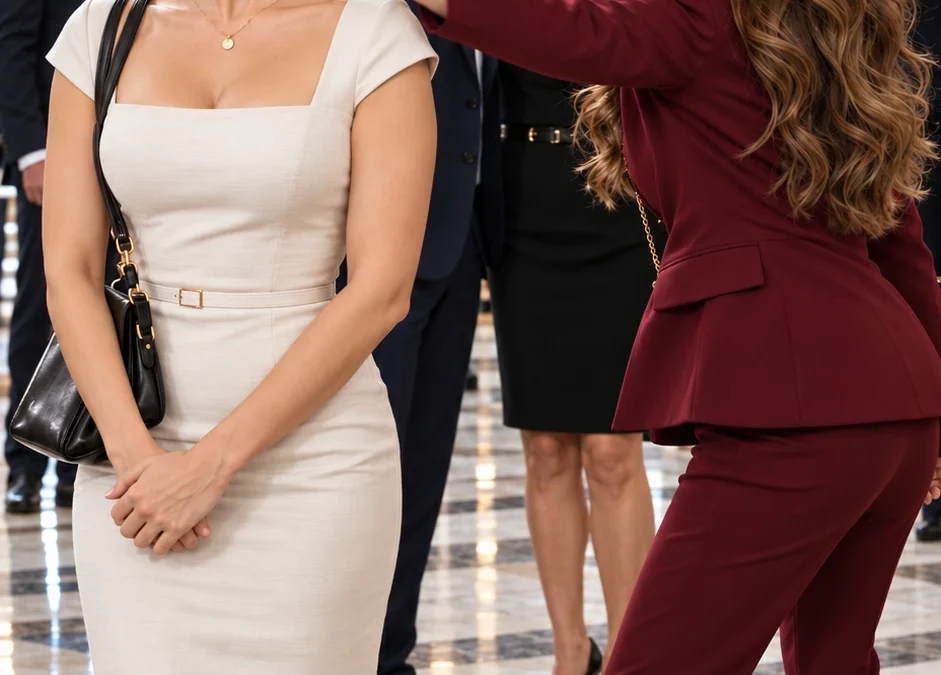
The slap echoed between the marble columns of a Madrid courthouse, in front of lawyers, clerks, and families waiting their turn. Inés Robles, flawless in an ivory suit, still had her hand raised when she leaned in close.
“Maybe now you’ll finally understand that Álvaro doesn’t love you anymore.”
A few steps away, Mercedes Serrano, my mother-in-law, let out a dry little laugh.
And Álvaro, the man I had been married to for 14 years, adjusted his shirt cuff.
“Don’t make a scene, Lucía,” he said.
No question. No glance at my cheek. Not even shame. 💔
I held a burgundy folder against my chest. I wore a plain gray dress, my hair pulled back, and the same black handbag Mercedes had sneered at for years as “too ordinary.”
For a long time, the Serranos had told one story about me: the girl from the neighborhood who got lucky and married into a well-known Madrid family. The quiet wife. The one who didn’t understand companies, investments, or assets. The one who signed where she was told and said thank you.
That morning, they all believed I was about to do exactly that.
The divorce agreement gave me an apartment, a comfortable sum of money, and a confidentiality clause that practically demanded I disappear. I had signed it two days earlier without arguing over a single figure.
Mercedes read that as surrender.
Inés read it as victory.
Álvaro read it as final proof that his wife had never understood anything.
None of them remembered. Or maybe none of them wanted to.
Before I gave up my career to hold up our family life, I was a lawyer. I specialized in corporate restructuring. I spent years reading contracts, shareholder pacts, and the movements other people preferred to bury in annexes.
Only one Serrano had never forgotten.
Joaquín. Álvaro’s father.
“Don’t let them make you small so they can feel big,” he told me one afternoon, shortly before he died.
Weeks before the end, he pressed a USB drive into my hand and asked me to keep it, unopened, for as long as the numbers kept adding up.
For years, I obeyed.
Until they stopped adding up.
Three weeks before the divorce hearing, I noticed that 2,800,000 euros had left a company tied to assets built during our marriage. Through two shell companies, it had landed in a newly created consultancy.
The administrator of that consultancy was Inés Robles.
I didn’t shout. I didn’t threaten anyone.
I hired a lawyer and told no one. I had an expert review every document. And the night before the hearing, I filed an urgent request to suspend any division of assets based on incomplete financial information.
When the clerk opened the courtroom door, Inés leaned toward my ear one last time.
“After today, you won’t be anybody.”
I smiled again. 🕯️
Because inside that room, an envelope was already waiting with Álvaro Serrano’s name on it.
And an order that could freeze far more than a divorce.
What happened when the judge opened it still gives me chills. Part 2 is in the comments, or leave any word below and I’ll send it to you privately.
Part 2
What happened when the judge opened it still gives me chills. Part 2 is in the comments, or leave any word below and I’ll send it to you privately.
Álvaro’s lawyer stopped smiling the moment he switched on his tablet.
I watched him read the electronic notification three times. Then he leaned toward his client.
“Why didn’t you tell me she filed measures last night?”
Álvaro frowned. “She? What measures?”
The judge entered a few minutes later and called for silence. On her desk sat a fresh file, a sealed envelope, and several certified copies from the Commercial Registry.
“Señora Navarro. You request a review of the agreement for possible concealment of assets, and you appear represented by counsel. Do you maintain your request?”
“Yes, Your Honor.”
Mercedes scoffed. “But she hasn’t practiced in years.”
The judge looked at her over her glasses.
“And you are not a party to this proceeding. You do not get to interrupt.”
Mercedes’s face changed.
I opened the burgundy folder. I didn’t start with the affair. Not with the dinners where Inés already sat in my chair. Not with the trips Álvaro called “meetings.”
I started with dates.
Then accounts.
Then companies.
I showed a transfer of 350,000 euros, another of 600,000, and finally the 2,800,000 operation.
Álvaro’s lawyer tried to present them as ordinary business movements.
“Then they should be simple to explain,” my attorney said.
Álvaro stared at her. “Who is she?”
“My client hired me six months ago.”
Mercedes spun toward her son. “Six months?”
That silence was crueler than any scream.
When Inés’s name appeared in the documents, she shot to her feet.
“This is absurd! I had no idea where that money came from!”
Álvaro turned on her.
“Shut up.”
The judge tapped the desk gently.
“Nobody here tells another person what to say.”
Inés went pale.
And I realized I didn’t need to destroy them. I only had to let their own versions collide.
For months, Álvaro had insisted Inés had no connection to the family companies. Inés had just admitted she’d received funds from one of them. And a recording from the access system of an office in Pozuelo showed they had both attended a meeting the night one of the transfers was authorized.
During the recess, Mercedes cornered me.
“Joaquín would be ashamed of you.”
I slipped two fingers into my bag and touched the USB drive.
“No. Joaquín knew exactly who I was.”
Before admitting it, the judge asked how the contents had been obtained. My lawyer explained that the drive had been cloned by a forensic expert, with the extraction documented before a notary. It wasn’t a screenshot. It wasn’t a file forwarded that morning.
Álvaro stopped looking at me. He turned to his lawyer, who was already flipping through the copies, frowning.
When the session resumed, my attorney handed up a notarized copy of the drive’s contents.
Among the files was a document signed years earlier by Joaquín. In the event of extraordinary movements in certain family companies, the person empowered to request a temporary review was not Álvaro.
It wasn’t Mercedes.
It was Lucía Navarro.
And he hadn’t chosen me because I was his daughter-in-law.
He had chosen me because I was a lawyer.
If you want to know what Álvaro said when he understood, LIKE this post and comment “USB.” When enough people comment, I’ll post Part 3.
Part 3
Álvaro took several seconds to react.
His confidence came apart almost visibly. He looked at the document, then at me, then at his lawyer, as if one of them might explain how a woman he’d spent years treating as clueless was holding a key he never knew existed.
“My father gave you that?”
“Yes.”
“And you never told me?”
I held his gaze.
“You never asked what I did before I became ‘your wife.'”
It didn’t sound angry. It sounded tired.
And that tiredness was the only thing that pierced his arrogance.
For 14 years, I was the one who ran the house, remembered birthdays, hosted partners at endless dinners, took Mercedes to her medical appointments, planned trips, and solved crises without ever appearing in a photograph. When I left my firm, Álvaro promised it would be temporary.
First one year passed.
Then three.
Then eight.
Whenever I hinted that I wanted to practice again, he said there was no need, that the family needed stability, that we were fine financially.
Over time, “there’s no need” turned into “don’t complicate things.”
Then “that’s not really your thing anymore.”
And finally, “you don’t understand how my companies work.”
I had started to believe him.
That’s what shames me most to admit.
Not the affair. Not Mercedes humiliating me. Not even Inés slapping me in front of dozens of strangers.
What hurt most was realizing how long it had taken me to trust my own judgment again.
The file didn’t make me owner of the Serrano companies. It didn’t hand me a fortune. It didn’t erase corporate decisions by magic.
It did something far more uncomfortable. It proved that Joaquín had foreseen the possibility of irregular movements, and that he had trusted me to demand answers if they ever appeared.
My commercial attorney, waiting outside the courtroom, had used that map to reconstruct operations, link companies, and locate public documents.
The investigation hadn’t begun with jealousy.
It began with an invoice.
Two months before Álvaro asked for the divorce, I found a bill for 18,700 euros in a household folder, issued by “I.R. Estrategia y Desarrollo.” The description was so vague it caught my eye.
I looked up the company.
Then another.
Then the administrators.
Then the accounts I could legitimately review within our family documents.
Each step led to the next, until the 2,800,000 appeared.
Álvaro now insisted everything had a commercial explanation.
“Perfect,” I said. “Then an audit shouldn’t bother you.”
He leaned toward me. “You know an audit can do damage even if nothing illegal happened.”
“I know. I also know that hiding information in a marital agreement does damage before any audit begins.”
The judge ruled that the agreement could not be approved on those terms until the financial picture was clarified, and ordered certain documents preserved while checks were carried out. She declared no one guilty. She handed out no punishments. She didn’t turn the room into a spectacle.
But she made the questions stop being private.
That was enough to start breaking their alliance apart.
Inés went first. Trying to protect herself, she claimed Álvaro had presented the transfers to her as consulting payments, and that she hadn’t known the origin of some funds.
Álvaro said Inés knew exactly which companies they came from.
Mercedes cut in to declare that her son would never do anything to harm the family’s wealth.
Álvaro’s lawyer asked for a recess, with the look of a man no longer defending one version, but trying to stop three different ones from surfacing.
I stayed in my seat.
I didn’t enjoy it.
That surprised even my attorney. For months I had imagined this moment. I thought I’d feel triumph watching them lose their certainty.
I didn’t.
I felt an enormous sadness for Joaquín. He had trusted each of them in different ways. To Álvaro, he left responsibility. To Mercedes, security. To me, a specific task: to look when everyone else chose not to.
And now that foresight was in a courtroom because of his own son’s dishonesty.
At the end of the session, a court officer handed the judge a note.
There were cameras in the lobby. Several witnesses had reported the slap.
Inés stopped breathing normally.
“She provoked me,” she said.
I looked straight at her for the first time since we’d entered.
“I never said a word to you.”
The judge explained that the incident would have its own separate proceeding, and that any further intimidation could be taken into account if I requested protection.
Mercedes looked down.
Álvaro clenched his jaw.
For the first time, nobody said I was exaggerating.
When we walked out, the hallway looked the same, but it wasn’t.
Hours earlier, Mercedes had laughed. Inés had raised her hand. Álvaro had looked away.
Now they walked apart.
Inés stuck close to her lawyer. Mercedes murmured into her phone. Álvaro followed me.
“Wait.”
I kept walking toward the elevators.
“Lucía, wait.”
I stopped.
“You planned all this?”
“I prepared my defense.”
“You let us believe you’d accepted the agreement.”
“I accepted it on condition that the financial information was complete.”
“You knew it wasn’t.”
“I suspected it wasn’t. That’s why I checked.”
He studied me with a mix of rage and bewilderment.
“When did you become like this?”
I almost smiled again.
“I’ve always been like this. You stopped seeing me.”
The elevator doors opened.
Before I stepped in, he asked one last question.
“Are you really going to destroy 14 years over money?”
I turned slowly.
“I’m not destroying 14 years over money. I’m done destroying myself so the rest of you can stay comfortable.”
The doors closed.
The months that followed were far less cinematic and far more exhausting.
Expert reports. Formal requests. Meetings with advisors, tax checks, accounting reviews. Some operations turned out to be legal but poorly documented. Others had to be corrected. Several amounts were added to the asset inventory Álvaro had submitted incomplete.
Inés’s consultancy had to justify services, contracts, and invoices.
She stopped appearing at dinners, events, and anything connected to the Serranos.
Her relationship with Álvaro didn’t survive the pressure either.
I didn’t celebrate that.
I didn’t need him to suffer an equal betrayal. I had understood that spending your life waiting for someone else’s punishment is just another way of staying tied to them.
The lobby assault ended with a formal apology, an acceptance of responsibility, and a no-contact commitment. I didn’t want to turn it into an endless war.
I only insisted that it be on the record.
That mattered to me. For years, so many things had happened without leaving a trace, because someone always said afterward that it hadn’t been that bad.
This time there would be a record.
Date. Time. Cameras. Witnesses.
My divorce was finalized nine months later.
I didn’t walk away with everything. I never asked for that. The division was redone with the assets correctly identified and an independent valuation. I kept the home I’d bought with Álvaro early in our marriage, received the share the law entitled me to, and turned down two private offers that included new silence clauses.
Mercedes called me one night.
“Think about the Serrano name.”
I let a few seconds pass.
“I’ve spent too long thinking about that name.”
“Joaquín wouldn’t have wanted this.”
“Joaquín wanted the numbers to add up.”
She hung up.
It was the last conversation we had for almost a year.
The hardest part came afterward, when there were no hearings, no lawyers waiting on answers, no clear enemies.
I had to build a routine again.
I rented a small office near Alonso Martínez. Two rooms, a desk too large for the space, and a coffee machine that worked when it felt like it. On the first day I put the burgundy folder in the bottom drawer and stood staring at the plaque on the door.
Lucía Navarro. Abogada.
My hands shook.
So many years had passed.
I was afraid I’d forgotten the law, the procedures, the reflexes. I was afraid I’d walk into a meeting and hear Álvaro’s voice again, telling me that wasn’t my thing anymore.
But in those first weeks I discovered something I hadn’t expected: I hadn’t forgotten much.
What I’d lost wasn’t knowledge.
It was confidence.
I started with small matters: contracts between partners, reviews of shareholder pacts, separations of property. Slowly, clients began arriving through recommendations.
And then the women began to come.
One said her husband handled all the accounts because “she was bad with numbers.”
Another confessed she’d spent 11 years signing documents without keeping copies.
Another explained that her father-in-law talked about the companies at family dinners, then went quiet every time she walked in.
I never promised them a victory. I never said every couple was hiding something. I never turned my story into a recipe.
I only repeated four things.
“Read before you sign. Keep copies. Ask questions even if they get angry. And don’t confuse trust with giving up on understanding your own life.”
Joaquín’s USB drive went into a wooden box.
I didn’t display it like a trophy. Neither did I the burgundy folder.
They were reminders of a chapter I didn’t want to romanticize.
Because my silence hadn’t always been intelligence. For many years it had been fear, habit, and exhaustion.
The difference came when I decided to use that silence to observe instead of disappear.
Almost two years after that slap, I walked out of my office one autumn afternoon and saw Álvaro waiting beside a café.
He was thinner. There was new gray at his temples.
“I only want to talk for five minutes.”
I checked my watch.
“You have three.”
He let out a short laugh. “You haven’t changed.”
“I have. Now I bill for my time.”
For the first time, we both smiled, without affection and without hatred.
He looked down.
“We could have fixed everything as a family.”
“I tried for years.”
“My mother says you abandoned her.”
“Your mother mistook my patience for obligation.”
“Inés lost her company.”
“Inés lost clients. It’s not the same thing.”
Álvaro breathed deeply.
“And you? Did you win?”
I looked up at the building where my office was. On the third floor, a lamp was lit. A new case file waited on my desk. In my bag I carried my keys, my planner, and a pen with my name on it.
I thought of the woman in the gray dress. The dry sound of the slap. Mercedes’s laugh. Álvaro’s eyes sliding away from mine.
And most of all, I thought of that smile that had thrown everyone off.
I hadn’t smiled because I knew I would win.
I had smiled because, for the first time in a long while, I knew I no longer depended on them believing me.
“I don’t know if I won,” I said. “But I stopped losing myself.”
Álvaro opened his mouth as if to add something.
He didn’t.
I crossed the street when the light changed.
The cold Madrid air brushed my cheek.
For a second I remembered the blow, but not the pain.
I remembered the exact instant when everyone had expected to see me break.
And I understood that was the last moment the Serranos got to decide who I should be.
After that, every document I read, every question I asked, and every limit I set was a way of taking back my own voice.
The same voice they had spent years telling me to lower.
The same one Joaquín had listened to.
The same one I now use to say my full name, without asking anyone’s permission:
Lucía Navarro. ❤️
Disclaimer: This story is entirely fictional and created for entertainment purposes only. It does not represent any organization or individual, nor does it encourage inappropriate behavior. The content was generated with AI assistance.








