THE RANCHER CAUGHT AN APACHE WOMAN STEALING BREAD AT 2 A.M. — BUT WHAT HE FOUND HIDING IN HIS BARN MADE HIM DROP THE LANTERN AND SAY SIX WORDS THAT SHOCKED THE WHOLE TOWN
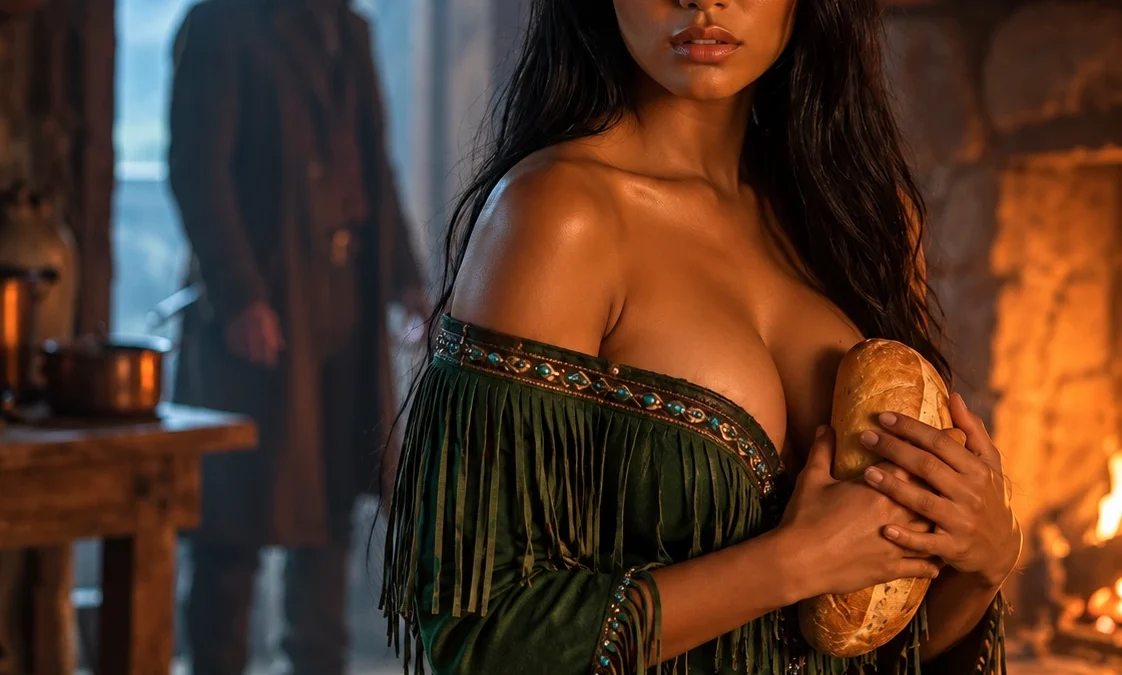
THE RANCHER CAUGHT AN APACHE WOMAN STEALING BREAD AT 2 A.M. — BUT WHAT HE FOUND HIDING IN HIS BARN MADE HIM DROP THE LANTERN AND SAY SIX WORDS THAT SHOCKED THE WHOLE TOWN
Part 1
Arizona Territory, 1881.
That night, Cole Bennett caught a stranger’s trembling hands stealing bread from his kitchen shelf. And by sunrise, her desperate plea would change his life forever. 🌵
The high desert around Larkspur went so still after midnight that Cole could hear his own pulse in his ears. And that was exactly the silence that woke him.
Not the wind working the shutters. Not some fox worrying the henhouse.
A sound too careful to be either.
A single floorboard, groaning under a foot that did not want to be heard.
Cole had lived alone on the Cottonwood spread for six years. Long enough to know every creak his house made in its sleep. And this one belonged to no ghost he recognized.
He came up off the mattress without a sound, pulled on his trousers in the dark, and lifted the oil lantern from its hook. Not the rifle leaning by the door. Some old instinct told him this was not a threat that wanted killing.
He skipped the third step from the bottom, the one that sang like a barn cat when weight found it wrong. By the time his boots touched the packed-earth floor of the hall, his heart had climbed clean into his throat.
Lamplight from the kitchen doorway laid a thin gold seam across the dark.
Someone was inside his house. 😳
He crossed the last few feet and raised the lantern. There, at his own table, in a wedge of moonlight, stood a woman with a half loaf of bread clutched to her chest. She was wrapping it fast and clumsy in a torn strip of cloth, her whole body shaking like a branch in a gale.
“What are you doing in my house?”
She spun. The bread hit the floorboards with a soft, terrible thud.
Her eyes came up to his, wide, dark, and so full of raw animal fear that Cole nearly stepped back himself.
She was young, he thought, though hunger had aged her, carving hollows under her eyes and along her jaw. Her black hair hung loose past her shoulders, tangled with hay dust. Her clothes were worn thin and stained with the red dirt of the flats.
An Apache woman. Alone. In his kitchen at two in the morning. Holding his bread like it was the last solid thing in the world.
She did not scream. She did not beg.
She ran.
Out through the back door he had left cracked for the night air, her bare feet slapping the hard-packed yard toward the black shape of the barn.
Cole went after her without thinking, lantern swinging wild light across the fence rails. He caught the barn door as it swung shut and shouldered it open on its rusted hinge. He lifted the lantern into the dark.
What he saw stopped him cold. 🥺
Buried in the loose straw at the back of the stalls, wrapped together under an old feed sack for warmth, were two children. A girl no older than seven, with enormous solemn eyes. And a boy who could not have seen more than five summers.
Both so thin their collarbones stood out like the ribs of a starved dog.
They flinched from the light as one animal. The boy’s face crumpled into silent tears. The girl pulled him behind her small body with a fierceness that had nothing childlike left in it.
The woman dropped to her knees between the lantern and her children, both hands raised. Not in surrender.
In shield.
Her voice broke on the word please.
“Punish me. Do whatever you want to me. But do not hurt my children. They have done nothing. It was only bread. I am the one who took it.”
Nobody in that barn dared move.
The girl’s arms tightened around her brother. The boy’s small chest hitched with a sob he was trying, and failing, to swallow whole.
And something in Cole’s chest, something he had kept locked down for six long years, cracked clean open. 💔
He had been that hungry once.
He remembered it the way a man remembers a fever, in flashes. The ache low in his belly that never fully left. The shame of watching other boys eat while he stood at the edge of a ranch yard hoping for scraps. The particular indignity of being seven years old and already understanding that the world did not consider you worth feeding.
Then an old rancher named Elias Cordell, with no sons of his own, had looked at a starving orphan mucking stalls for a crust of bread and decided the boy was worth the risk of kindness.
Cole had inherited this ranch, this house, these two hundred acres, because a stranger once decided his hunger mattered.
He lowered the lantern so the light fell soft instead of hard. He crouched down so he was no longer looming over any of them.
“How long have you been hiding in my barn?”
Her chin came up, some pride surfacing even through the terror.
“Four days.” Her voice was hoarse, worn down to almost nothing. “We hide by day. At night, when you sleep, we look in your garden, your kitchen, for anything. I am sorry. I am so sorry.”
“And the children’s father?”
Her gaze dropped to the straw.
“Gone to the mountain mines, north of here, more than a year past. He swore he would return with money for land of our own. He never came back. We think the mine took him, the way it takes so many.” A slow breath shook on its way in. “We had nothing left. No family who could take three more mouths. I did not know what else to do but come to a stranger’s kitchen in the dark and pray he would be a decent man.”
Cole looked past her to the two children, who watched him the way a rabbit watches a hawk that has not yet decided to strike.
He could take all three of them into Larkspur come morning and hand them over to Sheriff Coburn. No one in that town would think twice. Most of Larkspur wanted nothing to do with the Apache bands still moving through the territory. A woman caught stealing would find little mercy from men who had buried friends in the old border wars.
That was the easy path. The expected one.
But Cole had spent too many nights of his own childhood on the wrong end of somebody else’s easy decision.
“What’s your name?”
She blinked, thrown by the sudden gentleness.
“Doli.”
“All right, Doli.” He tried the name slow, testing its shape. “Here is what is going to happen. Tomorrow at first light, you are going to come back to this barn, and you and your children are going to stay.”
Doli stared at him as though he had spoken in a language she did not recognize.
“There is work on this ranch. More than I can manage alone. Horses to break, a garden gone half to weeds, fences that need mending before winter. You work, I feed you, and nobody troubles your children while you’re under my roof.”
“Why would you do this?” Her voice trembled. “We are strangers to you. We are Apache. Your people do not want us near.”
“Some of my people don’t,” Cole allowed. “I’m not asking them. This is my land, and I decide who eats at my table.”
Tears stood bright in Doli’s eyes. She looked less like a woman braced for punishment and more like one who had forgotten, somewhere along the last hard year, that mercy still existed anywhere in this territory. 🥹
Cole rose, brushing straw from his knees, and paused at the barn door.
“The girl. The boy. What do I call them?”
Doli’s hand found her daughter’s dark hair.
“Aiyana. And my son, Ahiga.”
He nodded once, the way a man nods when a bargain has been struck.
He walked back out into the desert dark and stood a moment beneath a sky so thick with stars it looked close enough to touch. He did not fully understand what had just moved him to make that offer.
He only knew it felt, in some old and unshakable way, exactly right.
Behind him, Doli gathered her children into her arms and wept without a sound. The silent weeping of a woman who has spent a year learning not to be heard.
But Cole had made a promise to protect them.
He had no idea how soon that promise would be tested. Or that the first men to come for them would not be strangers at all, but neighbors he had known for years. 😨
Part 2
Cole had no idea how soon that promise would be tested.
Dawn came up thin and gold over the eastern ridge, painting the desert the color of a struck match.
Doli had not slept at all. She had spent the black hours turning Cole’s offer over in her mind, hunting for the trap in it. A year on the run had taught her that kindness from strangers usually came with a hidden cost worse than the hunger it replaced.
But when the rooster sounded and she woke her children, she found herself walking toward the ranch house anyway. Running again, with two children too weak to run far, had stopped being a real choice sometime around midnight.
Aiyana’s small hand tightened in hers.
“Mama, I’m scared.”
A mother’s lies only work on children too young to feel the tremor in a held hand. So Doli gave her the truth.
“So am I. But sometimes the only way through is to trust, even when trust has hurt us before. I saw something in that man’s eyes last night. I do not think it was cruelty.”
Ahiga pressed his face into her skirt.
“Will there truly be food?”
The question broke something loose in her chest. No four-year-old should ever have to ask it and mean it the way he meant it.
“Yes, my love. I believe there will.”
Cole was already at the corral when they crossed the yard. He set the fork aside and came to meet them, and something like relief crossed his face before he tucked it away.
“You came. Good. Follow me.”
In the kitchen, the very table Doli had stolen from the night before held a spread that made both children go utterly still. Fresh bread. Eggs scrambled soft. Beans stewed with peppers. A full pitcher of milk.
“Sit. Eat as much as you want. Nobody’s rushing you.”
The children fell on the food with the desperate, half-frightened speed of the truly starved, as if some part of them still expected it to vanish. Doli watched with tears standing unshed in her eyes. It had been so long since she had seen either of them look even close to safe. 🍞
Then Cole set down his cup and looked at her straight.
“One more thing. Larkspur is not going to like this. Some folks in that town buried kin in the old fighting, and they will say ugly things about you being here. Maybe worse than words. But this is my land, and I decide who is welcome on it.”
“Why do this for us?” Doli whispered. “You do not know me.”
He turned his coffee cup slowly between his palms.
“Ten years back, I was nothing. No land, no money, no family left living. A rancher named Elias Cordell gave me a chance nobody else in this territory would. When he died, he left me this whole spread. He used to say life hands you chances to pass on what you were given.” He looked out over the corrals gone gold in the new light. “You are my chance to honor him, Doli. That is the whole of my reason.”
The weeks that followed felt like a dream she was afraid to wake from.
The children’s color came back. Ahiga’s ribs stopped showing through his shirt. Doli healed a gray gelding’s stubborn leg wound in four days with a poultice of river willow bark and yarrow, and Cole stared at the smooth new hide in something close to wonder.
“What is it you know that our territory doctors don’t?”
“It is not a secret. Only listening.”
Her garden roared back to life. Ahiga walked fearless among horses twice his size, humming a tuneless little song that settled even the most skittish of them.
And on the eve of Aiyana’s eighth birthday, Cole brought down a wooden box he had not opened in six years. It had belonged to his late wife, Eleanor. Brushes. Paints. Good paper.
Then he led Doli to the far corner of the barn and pulled away an old canvas tarp.
Doli gasped. 😭
Beneath it sat a tiny playhouse with real glass windows, a working door, and a little porch of its own. He had been building it in secret, night after night, after they had all gone to sleep.
The next morning, Aiyana threw both arms around Cole’s middle.
“Thank you, Mr. Bennett. It is the best gift of my whole life. I love you so very much.”
No one had said those words to him since Eleanor died. He blinked hard against the burn behind his eyes.
“I love you too, little one.”
But in town, word was spreading. An Apache woman and her children. Living on Bennett’s spread. Eating at his table.
And on a bright autumn Tuesday, while Cole was away buying feed, the sound of hoofbeats came tearing into the yard.
Three riders. Not slowing at the gate.
Doli knew the lead rider at once. Grady Kessler, the town butcher. A heavyset man with a long scar down one cheek. 😰
He spat into the dirt.
“Well, look what we’ve got here. An Apache and her cubs, living like royalty out on Bennett’s land.”
Doli pulled both children behind her, heart hammering.
“Pack up whatever’s yours,” Kessler said, that cruel smile spreading, “and be gone before Bennett gets back. Or things get considerably less pleasant for the three of you.”
Aiyana was crying silently. Ahiga’s small fists were balled at his sides.
And then, from the barn, something moved.
The gray gelding Doli had healed months ago trotted out on its own and planted itself between her and the three riders, ears pinned flat. Then more horses came, one after another, forming a half-circle around Doli and her children, as though some silent order had passed between them. 🐎
One of the hired hands backed his mount up a nervous step.
Then, far down the road, came the sound of a wagon tearing toward the ranch at full speed.
Part 3
Cole had spotted three strange horses tied outside his own house from half a mile away. He had known instantly that something was wrong.
He hauled the wagon to a stop and was on the ground before the wheels stopped turning, his face gone thunderous.
“What in God’s name is going on here, Kessler?”
Kessler forced an easy smile that did not reach his eyes.
“Just came by to talk some sense into you, Bennett. Town’s got concerns.”
“My decision to hire good workers on my own land is none of the town’s concern.” Cole’s voice dropped low and dangerous.
“Be reasonable, Cole. An Apache woman and her young ones, living out here so close to town. Folks don’t know what to expect from her kind.”
Cole crossed the yard until he stood almost nose to nose with the bigger man.
“Let me explain something to you plainly, Grady. Doli and her children have worked this ranch harder in four months than you’ve worked in your whole life put together. They’ve shown more honor, more dignity, and more plain courage than you and these two combined.”
“Now, Cole…”
“I’m not finished.” His voice cut clean through. “This is my land. I decide who’s welcome on it, and right now, the three of you are riding off it and not coming back.”
One of the hired hands stepped forward, blustering about rights. The gray gelding screamed and struck the ground with a forehoof so hard the whole yard seemed to shake. The other horses did the same, stamping and snorting in unison. All three riders took a nervous step back. 🔥
Cold humor edged Cole’s voice.
“Seems my horses agree with me. I’d mount up and ride, gentlemen, before they decide to make their opinion a good deal more physical.”
Kessler looked around the yard and saw plainly that he had lost whatever ground he had ridden in with.
“This isn’t finished, Bennett. The whole town’s going to hear about this.”
“Let them hear it. And tell every last one of them this besides. Any man who rides onto my land to threaten my people answers to me directly. And I will not be nearly so polite about it the second time.”
The three men rode off in a hurry, Kessler shouting some final threat that got lost in the dust of their own retreat.
Cole turned to Doli, who stood trembling, both children gathered against her skirts.
“Are you hurt? Did they touch you or the children?”
“No.” Her voice had gone small. “You came in time. But Cole, perhaps it would be better if we left. We do not wish to bring this trouble down on you and your whole town.”
“Trouble?” He shook his head, firm. “Doli, listen to me carefully. You and your children stay here as long as you wish it. I do not care one bit what Kessler thinks, or what the rest of Larkspur whispers. This is my land, and you are welcome on it for as long as you want to stay.”
Aiyana let go of her mother’s skirt and ran to him, wrapping both arms around his legs.
“Thank you for keeping us safe, Mr. Bennett.”
Cole knelt to meet her eyes.
“Nobody is going to lay a hand on either of you while I’m standing here, little one. That is a promise I intend to keep.”
Ahiga followed his sister’s lead. Soon Cole had two small children clinging to him at once, both crying now from sheer relief instead of fear.
Something in his chest gave way entirely. Some old wall he hadn’t realized he was still keeping up. 💔
Doli watched with tears sliding down her cheeks. This man. This stranger she had once crept past in the dark to steal bread. He had just risked his whole standing in this town to keep her children safe.
That night, on the porch beneath a sky thick with stars, she spoke quietly.
“It’s going to get worse before it gets better. That town will not simply let this go.”
“I expect you’re right. But Elias Cordell used to say a man isn’t measured by how much land he holds or how much money sits in his strongbox. He’s measured by how he treats the people who cannot defend themselves.” He looked at her, something steady and certain in his face. “You are a good man’s kind of chance, Doli. And I don’t intend to waste it.”
Soft, under the stars, the words came anyway.
“You are a good man, Cole Bennett.”
“I don’t know that for certain. But I know this much. You’re staying. And whatever comes at us from that town, we will face it together. The four of us.”
Two weeks passed. The town went on murmuring, but no one else rode out to trouble them. Cole kept making his weekly trips into Larkspur, facing cold stares in the mercantile, never once lowering his eyes or turning his wagon around early.
And something quiet and fine kept unfolding on the ranch.
Doli’s garden produced vegetables so rich that even the most stubborn skeptics began, slowly, to change their minds once they tasted them.
“Mrs. Osgood bought three whole baskets today,” Cole reported one evening, grinning. “Announced to the whole mercantile she’d never tasted squash that sweet in her life. Loud enough for half the town to hear it.”
Doli smiled, slicing carrots.
“The earth is generous to those who treat it gently. My grandmother taught me that.”
Aiyana filled three notebooks with drawings, each one catching small true details most grown eyes overlooked, like the exact way morning light lay along a horse’s back. Ahiga became something close to a small legend among the horses.
But not everything turned easy. Kessler and his men kept the rumor mill grinding. A few merchants still refused Cole certain goods.
Then, one week, the town blacksmith appeared at the ranch gate.
Amos Fenwick. A broad, quiet man. In his arms, his coughing eight-year-old grandson. Awkward, half-ashamed to be asking at all, he got the words out anyway.
“Word is your woman knows medicine plants. Town doctor’s given up on the boy. Please.”
Doli examined the child and recognized the illness at once. She brewed a strong tea from river herbs, sweetened with wild honey.
“Three cups daily, six days running. The cough will clear entirely.”
Six days later, Fenwick returned with a grandson running and laughing, the cough gone. And a set of hand-forged horseshoes as thanks. 🙏
“I don’t rightly know how to repay you. I spoke ugly words when you first came here. I was dead wrong about you.”
“Children bear no blame for the mistakes grown folks make,” Doli said gently. “And every person deserves the chance to heal, regardless of where they came from.”
Word spread. A woman plagued by headaches. A farmer with a wound refusing to close. An old man crippled with pain in both hands. Doli treated each without asking a single coin, taking only what folks could spare. Eggs. Sometimes only a grateful word.
One Saturday afternoon, while Cole repaired the barn roof and Doli planted flowers around the children’s little painted house, the sound of many horses brought him down off the roof in a hurry. Certain more trouble had come.
But when he saw who was riding in, his breath caught entirely differently.
Sheriff Coburn himself. Mrs. Osgood. Amos Fenwick. And a dozen more townsfolk behind them, wagons loaded down with lumber, tools, and supplies. 😳
Doli gathered her children close, bracing for the worst. Cole planted his boots and crossed his arms.
“Say your piece.”
Mrs. Osgood stepped forward first.
“Cole, we’ve come to apologize. And to help, if you’ll let us.”
Fenwick went next, gruff and plain.
“We’ve been fools, the lot of us. Prejudiced fools. That woman has shown this town more kindness than most of us have managed in our whole lives combined. She healed my grandson. Eased Mrs. Osgood’s pains. Helped half the folks here, and we treated her like dirt for it.”
Sheriff Coburn’s gray mustache settled into something like a smile.
“We’ve come to build Doli and her children a proper house. Two rooms, a real kitchen, good windows. They cannot go on living out of a barn, however fine that barn might be.”
Cole’s throat tightened hard.
“Doli. Come on out here. Bring the children.”
She came forward slowly, Aiyana and Ahiga gripping her hands. Mrs. Osgood crossed to her directly, hand extended.
“Doli, I’m Margaret Osgood, and I was cruel to you before I ever knew you. I judged you unfairly, and I am asking your forgiveness.”
Doli looked at that outstretched hand a long moment. Then at the sincerity in the older woman’s eyes. And finally she took it.
“We all deserve a second chance. That much I have learned firsthand.”
Tears slid down her face freely.
“I do not know what words could answer this kindness. Thank you. Thank you, all of you.” 🥹
For the next four weeks, the whole town turned out together. Men raised timber and fitted windows. Women brought food, sewed curtains, and stitched quilts thick enough for the coming winter. Larkspur’s children came out to play alongside Aiyana and Ahiga, forging friendships that would last for years.
The house rose fast and sturdy. Two good rooms, a real stove, a wide porch, painted clean white with blue shutters. It stood sixty yards from Cole’s own house. Close enough to remain part of one family. Far enough to grant Doli and her children a home entirely their own.
The day it was finished, the whole town gathered to celebrate. Aiyana received a fresh stack of notebooks and paints. Ahiga was given his very first real cowboy hat, which he refused to take off even at supper. Doli received new cookware, hand-stitched blankets, and plates painted with desert wildflowers.
Sheriff Coburn raised his voice to the crowd.
“Welcome to this community, properly. Doli and her children now belong to Larkspur same as any other family here. And any man who treats them poorly going forward answers to me and to this whole town besides.”
That night, once the last wagon had rolled away, Doli and Cole sat together on the porch of the new house. The children slept soundly in their own beds for the very first time, under clean sheets, in rooms built just for them.
Doli looked around at the warm lamplight filling her own kitchen.
“I can hardly believe this is real. Four months ago I was stealing bread from your table to keep my children breathing. Now I have a house, friends, an entire community standing behind me.”
“You earned every bit of it,” Cole said, his answer low and certain. “With your kindness, your work, your whole enormous heart. You showed this territory exactly who you are, Doli. And it finally saw you clear.”
She turned to look at him fully. Moonlight silvered the strong, quiet lines of his face, and she found she no longer needed to guard the feeling rising in her chest.
“Cole Bennett, I came into your life stealing bread in the dark, certain you would turn me over to men who wished us harm. Instead you gave me back a life I had stopped believing I deserved.”
“You gave me one right back.” His voice had gone rough. “This house was a hollow, silent place before you three walked into it. I did not know how much I’d been merely surviving in it until you filled it up again with noise, and laughter, and something that finally felt like a family.”
He reached for her hand where it rested on the porch rail.
She did not pull away. 💛
Beneath a sky heavy with stars, in a yard that now held two houses, two children finally safe, and horses that had chosen on their own to stand guard over a woman who once had nothing at all, they sat together in the kind of quiet that no longer needed filling with anything but each other.
In the seasons that followed, Larkspur came to know the Bennett ranch not as the place where a rancher had foolishly taken in an Apache woman and her children, but simply as home. Cole’s home. Doli’s home. Aiyana’s and Ahiga’s home. Four lives woven together out of one desperate night and one man’s decision to answer hunger with mercy instead of judgment.
Aiyana’s paintings eventually hung in the front window of the Larkspur mercantile, admired by the very people who had once refused to buy vegetables grown by her mother’s hands. Ahiga grew into the finest young horseman the territory had ever seen, exactly as Cole had once predicted.
And Doli, who had arrived in the dead of night with nothing but two starving children and a stolen loaf of bread, found herself in time standing beside Cole Bennett as something far more permanent than a hired hand or a stranger given shelter.
She was the woman who had turned a quiet, grieving house back into a home.
And she stayed to keep it that way. Together. For every single day that followed. ❤️
This story is entirely fictional and created for entertainment purposes only. It does not represent any organization or individual, nor does it encourage inappropriate behavior. The content was generated with AI assistance.








