The Sawmill Dumped Hardwood Slabs Behind Her Barn for 12 Years and Everyone Laughed. Then One Freezing Night, a Widow Swung a Maul and Discovered What Was Hiding Inside the Pile…
The Sawmill Dumped Hardwood Slabs Behind Her Barn for 12 Years and Everyone Laughed. Then One Freezing Night, a Widow Swung a Maul and Discovered What Was Hiding Inside the Pile…
Part 1
By the time Mara Collins finally understood what had been piling up behind her barn, Mercer Sawmill had been dumping it there for twelve years. 🪵
From the kitchen window of her small Missouri farmhouse, the heap looked almost like a second building. Hundreds of hardwood slabs lay tangled beneath peeling bark, weeds, oak leaves, and twelve seasons of weather. Some had faded silver-gray under the sun. Others had darkened almost black where rainwater collected between the layers. Oak, hickory, maple, cherry.
To Mercer Sawmill, it was waste. For most of those twelve years, Mara had seen it as something worse: a problem she could not afford to fix.
The arrangement had started with her father. Mercer needed somewhere nearby to dispose of the irregular, bark-edged pieces left after logs were squared for lumber, and he had allowed the trucks to dump them in a low patch behind the barn. Sometimes he pulled out a slab for a fence repair. Sometimes he burned one in winter. Nobody imagined the pile would keep growing.
Then her father died. The trucks kept coming.
Years later, Mara lost her husband too. After that, there was nobody left to divide the emergencies with her. A broken gate belonged to Mara. A sick calf belonged to Mara. A tractor that refused to start on a freezing morning belonged to Mara, and so did the mortgage. At thirty-nine, she had become very good at deciding which problem could wait.
The mountain behind the barn always waited.
People in town did not look past it. Some called it the Collins Lumber Dump. One neighbor joked that she ought to charge admission to see Missouri’s biggest pile of useless wood. Mara laughed. She had learned to laugh when she did not want anyone to know something hurt. Then she went home, opened the kitchen drawer where she kept the bills, and tried to figure out how to stretch another month out of money that was already gone. 💔
That December, a brutal cold front settled over the county. The furnace ran longer. The propane gauge dropped faster. One evening Mara stood beside the stove and listened to the house creak in the cold. Her seventeen-year-old son Caleb was upstairs. The stack of purchased firewood beside the porch had dwindled to almost nothing.
For several minutes she stared through the kitchen window at the dark shape behind the barn. Twelve years of ugly wood.
She pulled on her coat. Then she carried a splitting maul outside.
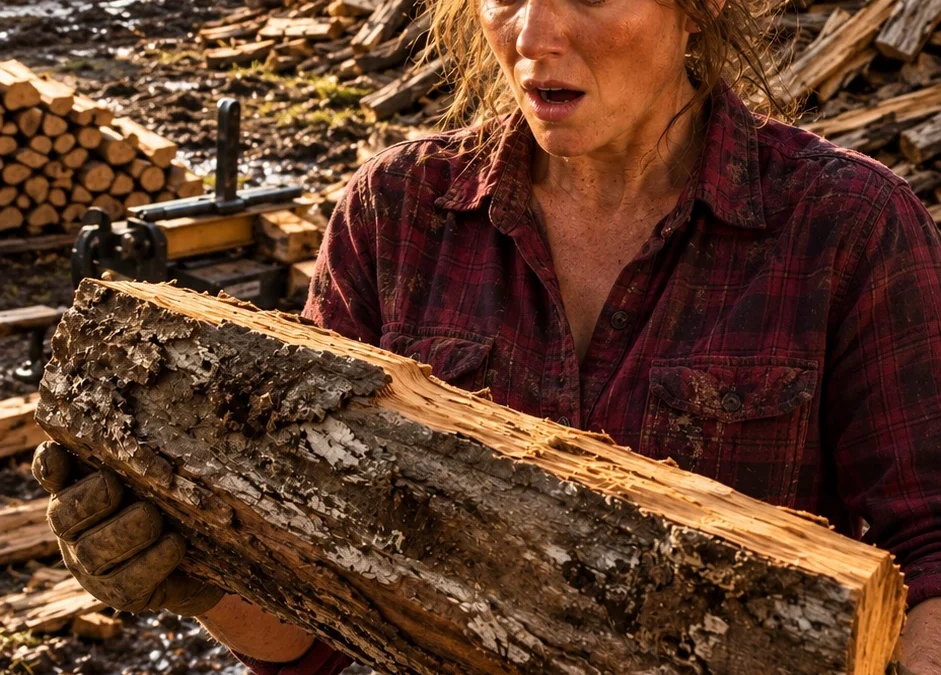
Near the edge of the pile, she dragged loose a heavy gray slab. It looked terrible. Cracked, dirty, half-covered in bark, exactly like the worthless material everyone said it was. Mara raised the maul and struck.
The slab split with a sharp, clean snap.
She froze. Inside, the weathered shell was dense, dry hardwood. She split another piece. Then another.
That night she fed several pieces into the stove. Within minutes, the room changed. The fire burned hotter than she expected. Hours later, the coals were still glowing.
Before sunrise she came downstairs with a coffee mug and stopped in front of the stove. Orange light flickered across the kitchen. She thought about all the money she had spent trying to heat the house. Then she slowly turned toward the window.
Behind the barn stood a mountain everyone had spent twelve years calling trash. For the first time, Mara did not see something she needed to get rid of. She saw something she needed to understand. And what she did with that mountain would soon make the man who dumped it there regret he had ever laughed. 😨
Part 2
That winter gave Mara very little time to think about possibilities. Feed prices had climbed again. The old Ford tractor had developed a hydraulic leak. A veterinary bill for a sick calf sat unopened on the kitchen table. Every evening she worked through the numbers in a battered notebook, moving expenses from one column to another, as if rearranging them might create money. It never did.
So she kept going back to the mountain. She cut slabs into stove lengths and split the thick ones by hand. Bark crumbled onto her gloves. Sawdust stuck to her coat. But beneath the weathered surfaces, she kept finding solid hardwood. Oak burned steadily. Maple caught easily. Hickory seemed to burn forever.
That was when curiosity replaced desperation.
“You planning to burn all that?” Caleb asked, noticing the growing stack.
“At this rate, maybe by the time I am ninety.”
He laughed, then pointed toward the highway. “Why do not you sell some?”
She almost dismissed it. Farmers sold truckloads of firewood. Men with chainsaws posted handwritten signs beside rural roads. Why would anyone pay for scraps from a sawmill? Still, she had nothing to lose.
That Saturday, she and Caleb split enough oak and hickory to make twenty bundles, tied them neatly, and nailed a piece of plywood to a post at the farm entrance: Dry Hardwood Firewood. They set a cash box beneath it.
By lunchtime, six were gone. By sunset, all twenty had sold. Mara counted the bills twice. It was not much money. But it had come from something she had received for free. 💛
The next morning the same pickup returned. The driver did not ask if she had firewood. He asked if she had more of the hickory.
Then Dale Mercer, owner of the sawmill, drove up. Late fifties, broad-shouldered, dusted with sawdust, a man whose family had been cutting timber in the county for three generations. He looked at the bundles and laughed.
“You are selling mill scrap now? Nobody pays real money for mill scrap.”
Mara did not argue. She had learned that numbers changed minds, not arguments. So she began keeping records. Every customer, every bundle, every species. The pattern surprised her. Homeowners with wood stoves wanted oak for steady heat. Campers liked maple because it started easily. One man drove thirty miles to buy twelve bundles of hickory.
“The stuff they sell near my place is half green,” he told her. “Yours actually burns.”
That sentence stayed with her. She began checking moisture levels with a borrowed meter. Nobody had intentionally seasoned this wood. Time had done the work. Years of Missouri summers and dry winter winds had slowly pulled the moisture from the outer slabs. She started separating stacks by species: Dry Oak for Wood Stoves. Hickory Long Burn. Maple Campfire. Sales climbed. Then a hunting lodge called, wanting half a cord every week through February for six cabins.
She stood beneath the towering slabs and remembered Dale’s words. Nobody pays real money for mill scrap. Maybe he was right about scrap. But what she was selling was not scrap anymore. It was dry, sorted, dependable hardwood.
She bought an old hydraulic log splitter at a farm auction for $1,450, nearly every dollar of savings she could safely touch. Buying it felt reckless. Walking away felt worse. 🔧
With the machine, production changed. Caleb designed a label on the family computer. Collins Hearthwood. Naturally Seasoned Missouri Hardwood. A convenience store near a campground took twenty bundles. They sold in four days. A second store took thirty.
Then she visited Mercer’s yard and watched logs enter the mill. Every straight board Dale sold created pieces he did not want. Those pieces had to be hauled somewhere. For twelve years, somewhere had been the Collins farm.
She realized she was not sitting on a lucky pile of wood. She was standing beside a waste stream.
By the following autumn, Collins Hearthwood looked like a brand. She hired her first employee, Luke, the nephew of a neighbor. Sales spread to seven locations. And the mountain behind the barn began to shrink.
One evening, a black pickup from Mercer Sawmill pulled in. Dale Mercer stepped out and looked at the branded bundles, the splitter, the covered storage bays. He did not laugh this time. “How much of this stuff are you selling?” Mara heard the change in his voice. A week later, the trucks stopped coming. 😱
Part 3
Dale called and told her Mercer Sawmill would no longer dump fresh slabs on her property for free. Mara was not surprised.
“I will pay something reasonable,” she said.
He named his price. She thought she had misunderstood him. It was several times higher than what she believed unprocessed mill residue was worth, and he wanted her to pay for every load regardless of species, condition, or usable volume.
“That does not work for me. You have been getting rid of it for free for twelve years because you needed somewhere to put it.”
The conversation ended without agreement. Three days later, the trucks stopped.
At first nothing looked different. There was still so much wood behind the barn that no outsider would have known the supply had been cut off. But word traveled. A retailer called to make sure his winter deliveries were still coming. Even Caleb was worried. “What happens when we run out?”
“We are not running out tomorrow.”
That night she opened every notebook she had kept. Average bundle production, weekly sales, waste percentage, usable volume left in the old pile. She walked outside with a flashlight and measured sections of the mountain, working past midnight. By morning she had her answer.
Dale had assumed Collins Hearthwood depended on the slabs Mercer produced each week. It did not. Not yet. Twelve years of dumping had created an enormous reserve. Even at her current rate, she had more than a year of usable hardwood, and much of it was better seasoned than anything Dale had just stopped delivering. 💛
That year was all she needed.
She began calling other mills. The first was not interested. The second already sold its waste. The third laughed when she explained. “You will haul the slabs yourself? All of them?”
“If the price makes sense.”
“When can you start?”
Within six weeks, she had agreements with three smaller sawmills within delivery distance. Two charged modest amounts. One was simply happy to have the material removed. And meanwhile, behind Mercer Sawmill, a fresh mountain of hardwood slabs began to grow. For twelve years, that mountain had been her problem. Now it was Dale’s. And Collins Hearthwood had not missed a single delivery.
She stopped reacting and started planning. She divided the old pile by age, species, and condition. The driest wood went directly into production. She drove to campgrounds, cabin operators, hardware stores, and farm supply shops with sample bundles in the pickup and let managers feel the difference. Any man with a chainsaw could sell firewood. Far fewer could promise fifty bundles on Friday and actually arrive with fifty bundles on Friday.
Then winter arrived early. A powerful cold front moved across Missouri and stayed. Retailers who normally wanted forty bundles asked for eighty. For ten days, the splitter barely stopped. Mara worked before sunrise, ate standing up, and finished some nights after Caleb had gone to bed. Order sheets covered one wall of the barn. At the height of the rush, she stood alone beneath them and felt something inside her tighten. The old feeling. Too much. Too many people depending on me. Too many ways to fail.
Then she looked outside. Luke was loading a trailer. Caleb was checking labels. Another customer waited to pay. And she understood why this pressure felt different. Years earlier, people had been waiting for money she did not have. Now they were waiting to give her theirs. 🔥
By the end of winter, Collins Hearthwood supplied fourteen retail locations, cabin properties, and commercial customers. When she totaled the year’s revenue, she assumed she had made an error. She calculated again. More than $250,000.
She opened an envelope containing the remaining balance on the farm loan. That number had followed her through her father’s death, through losing her husband, through broken equipment and bad cattle prices. She wrote the payment.
Weeks later, the confirmation arrived. Paid in full.
She carried the letter behind the barn, where nobody could see, and pressed it against her chest. Her eyes filled before she could stop them. For twelve years she had wanted that pile gone. Now it had helped make sure the farm would stay. 🕊️
Then Dale came back, carrying a contract. Mara had expected it. What surprised her was how little it frightened her. The price was higher than what she paid elsewhere, and the terms favored Mercer in almost every way. She read it once, closed it, and pushed it back across the table.
“The slab is the beginning,” she said. “Someone still has to haul it, sort it, reject the rotten pieces, season the fresh ones, cut it, split it, measure it, package it, sell it, deliver it, and replace it if the customer is not happy. That part is Collins Hearthwood.”
She placed her own proposal on the table. Selected slabs on a regular schedule. Price reflecting usable material. The right to reject loads with excessive rot or unwanted species. Guaranteed minimum pickups for Mercer. But Mercer would never be her exclusive supplier.
“You want to inspect my waste before you buy it?”
“I want to inspect my raw material before I buy it.”
The room went quiet. For twelve years, the difference between those two sentences had not existed. Now it defined everything.
Dale left without signing. The next morning, production continued. The other mills delivered. Nothing collapsed.
Three weeks later, he called. His yard was filling. A disposal company had raised its hauling rate. This time he was not calling to explain what his waste was worth. The second negotiation lasted less than an hour. He accepted inspection rights. He accepted rejection standards. And he accepted, finally, that Mercer Sawmill would never control her supply.
Several days later, a black Mercer truck backed toward the raw material area. Luke climbed on the side to inspect the load first. Only after he nodded did Mara point toward the designated section. The bed lifted. Hardwood slabs crashed down, exactly the sound she had heard behind the barn for twelve years.
But now she smiled. This was not garbage someone else needed to get rid of. It was inventory, arriving on her terms. 💛
The number appeared on her computer shortly after midnight. $420,000. Annual revenue, not profit. She understood that distinction better than anyone. But none of it changed what the number represented. She looked at the same kitchen table where she had once moved overdue bills from one side of a notebook to the other, and wished she could tell that tired, cold woman something. Not that everything would become easy. It had not. Just: Keep going.
She repaired the barn roof that had leaked for years. She replaced fencing instead of patching the same sections. Several local families now depended on the business for part of their income. One afternoon she walked behind the barn and could see almost the entire back wall for the first time in more than a decade. Bare ground stretched across places that had been buried since Caleb was a child.
“You know what is weird?” Caleb said, finding her there. “I almost missed the mountain.”
She laughed. “I do not miss it. But I am glad it was here.”
One Saturday in early autumn, she carried one ugly slab into the barn. It had faded gray, rough bark on one edge, deep cracks. Judging by its position, it might have been one of the first pieces Mercer ever dumped. She could have split it and sold it. Instead, she and Caleb mounted it high on the barn wall. He reached for sandpaper. She stopped him.
“Leave it.”
The dirt stayed. The bark stayed. The cracks stayed. She wanted to remember exactly what it looked like when nobody wanted it.
Months later, Dale Mercer noticed the slab. “You saving that for something?”
“I already used it.”
His eyes moved from the slab to the workers outside, to the pallets. He understood. For most of his career, Mercer had looked at those curved pieces and seen everything they could not become. Mara had asked a different question. What could they become?
Heat. Then bundles. Then repeat customers. Then Collins Hearthwood.
She turned off the barn lights and stepped outside. The mountain was gone now. For the first time in twelve years, nothing blocked the western edge of the field. Warm orange light stretched across ground that had once disappeared beneath hundreds of tons of unwanted hardwood.
For years she had asked how she would ever get rid of that mountain. Now she understood that had been the wrong question.
Sometimes the thing everyone wants to throw away is not worthless. It just has not met the person who knows what to do with it. 🌅💛
This story is entirely fictional and created for entertainment purposes only. It does not represent any organization or individual, nor does it encourage inappropriate behavior. The content was generated with AI assistance.








