The Sheep Refused the Pen and Stared at a Crack in the Hillside
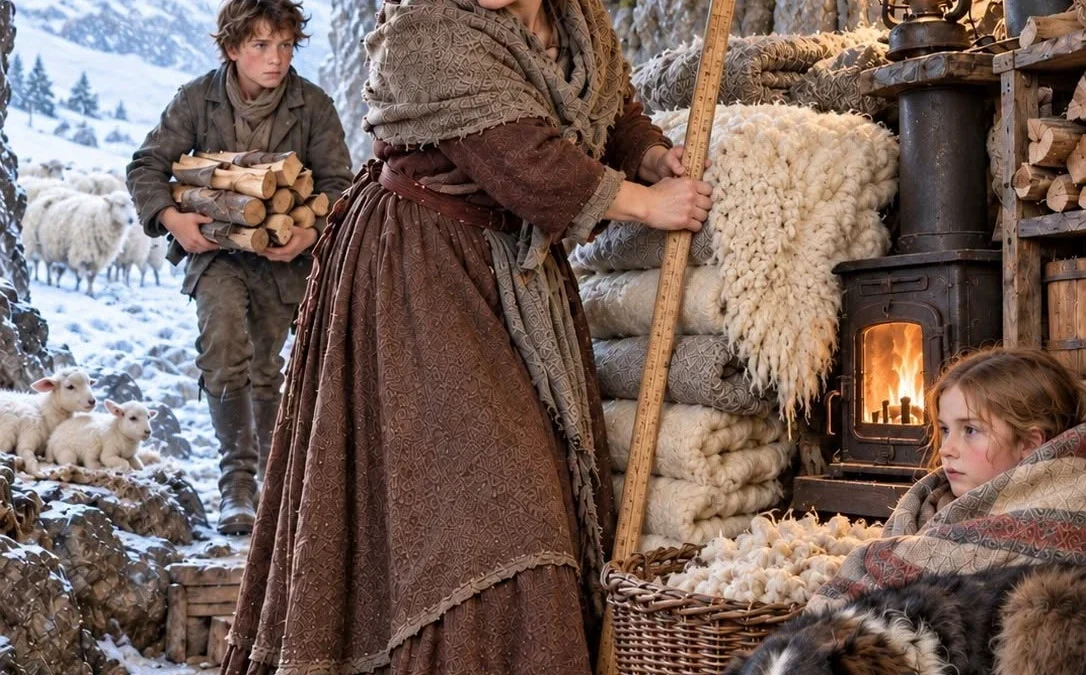
The Sheep Refused the Pen and Stared at a Crack in the Hillside. A Grieving Widow Followed Them, and Seventeen Days Later, Every Cabin in the Valley Was Buried Except the Hole She Packed With Wool…
Part 1
Nora Whitlock stood in the open doorway of her cabin with a lantern held low, watching the sheep refuse the pen. 🐑
All fourteen of them lined the fence along the northern edge of the yard, bodies pressed shoulder to shoulder, faces turned toward a dark seam in the hillside. Their breath rose in thin white threads and vanished. Finn, her dog, sat in the frozen grass between the house and the fence, ears pricked, refusing the warmth of the kitchen even when she called him twice. He had never ignored her before.
The cold had already settled deep. It bit through the soles of her boots and climbed the backs of her legs. Inside the cabin the stove held a low fire, and seven-year-old May lay wrapped in the red wool blanket on the cot, the one her father always said was too thin for true northern weather. Thirteen-year-old Eli stood at the window with his hands in the pockets of his father’s old coat, the sleeves too long on his wrists. He had stopped asking when they would move the sheep. He already knew what his mother would say.
Nora could have forced them. She had driven sheep through worse since her husband Jonah died the winter before, when fever took him in three days and left the woodpile half-finished and the roof leaking in the northeast corner. She had learned the hard work of a farm without a man beside her. Mending fences alone. Calving a ewe in the dark while the children slept. Walking the ridge road to the trading post with a sack of wool that no longer brought what it used to. 💔
Instead she set the lantern on the step, crossed the yard, and climbed the slope where the sheep were staring.
The crack was barely wider than her shoulders, the stone around it cold enough to sting through her gloves. She had walked past it a hundred times in summer. Tonight the animals stood quiet, and that troubled her more than panic would have. Frightened sheep ran. These sheep waited.
Eli followed with a coil of rope. Inside, the chamber opened behind the crack, tall enough that neither had to duck. She held the lantern near the ground and watched the flame bend, not toward the outside, but toward a thin gap above the doorway where air moved in a steady thread. She had expected damp earth and dripping water. She found dry air and the faint mineral scent of old rock. She pressed her palm to the wall. Cold, but not the killing cold of the open wind.
Three days earlier, a trapper at the trading post had repeated an old warning. The rivers north of the valley had frozen a month early. The birds had left in a single morning. The storm coming south might hold the valley for seventeen days. Most people laughed. Nora did not. She had two children, a woodpile that would not last half that time if the cold came hard, and no husband left to cut more.
Her brother-in-law Silas rode over before full light. Jonah’s younger brother, broad through the shoulders, slow to speak, the only man in the valley who still checked her roof and her wood without being asked, looked at the bales of wool she was already carrying up the slope.
“A cabin was built for people. That crack can fill with damp. It can ice over. It can bury its only door under snow and leave you and the children inside with no way out.”
“I know what a cabin is for. I also know what the woodpile will do if the cold lasts seventeen days.”
“You have wood for a week. Ten days if you are careful.”
“I have already counted.”
He was quiet. The wind rattled a loose shutter on the barn. “Jonah used to say that part of the hill breathed different in winter. I thought he meant the wind. I never asked him.”
Nora turned the old measuring stick Eli had found behind a barn shelf. She had not held it since the funeral. “He said it to me once. I never asked either.”
She had no proof, only a flame that bent the wrong way and sheep that would not leave the fence. And before the storm even arrived, the hill would show her where her plan would fail. 😨
Part 2
Nora measured the chamber the way Jonah had taught her to measure a fleece, charcoal marks on the barn wall, and then counted what remained of the wood. The numbers were ugly. The stove would eat the pile faster than she could cut more, and the ridge road would close before she could reach the post. The chamber offered a different arithmetic. Stone blocked wind. Wool slowed the loss of heat. A small fire might last longer underground than a large fire fighting open drafts. It was not proof. It was a question she had only days left to answer.
She and Eli carried a small iron stove up the slope on poles, set it on flat stones near the back wall, and built a low rock barrier across the entrance with one narrow gap above it. She lit a fire of three sticks. The smoke rose, curled against the ceiling, and slipped through the gap. She pressed folded wool against the northern wall and left for an hour. When she returned, the stone behind the wool felt less bitterly cold than the bare wall beside it. 🔥
On the fifth night of testing, May coughed before dawn. Nora reached for a blanket she had left near the entrance, and her hand came away damp. Wet wool meant lost insulation. Lost insulation meant more fire. More fire meant less wood. Eli watched from the barrier. “Does this mean we stop?”
“No. It means we found where it fails.”
She spent the next day on her knees with a candle, her palm against the rock. The damp had not come from a spring. A narrow seam above the entrance had let cold air creep in all night, carrying moisture into the fibers. She found two more hidden seams. Eli dug clay from the frozen stream bed. Nora gathered moss from the shaded ridge. Together they packed each opening until it sealed, leaving only the one gap above the barrier for smoke. Eli suggested moving the two youngest lambs inside. Even modest breath was heat the firewood would not have to make.
Food went on dry boards above the stone floor. Firewood rested on boards too, so it would not draw damp from the rock. It was no longer a guess. It was a system built from failures already found.
Silas came on the last clear morning and watched her carry water containers up the path. “If the entrance ices shut, you will be sealed inside. If the smoke backs up, you will choke.”
“I know.”
“Jonah would have done the same thing. He would have hated it. But he would have done it.”
“Then I will hate it too, if I have to. But I will not leave the children in a cabin that runs out of wood while the hill is still breathing.” 🪨
By afternoon the sky had turned the color of old iron. The wind arrived before the snow, tearing a shutter off a barn two farms away. Nora wrapped May in every spare blanket until the girl could barely move. Eli carried the dried meat, oats, and candles. Finn followed uphill unbidden. Behind them, the cabin vanished into blowing snow.
Inside the chamber the stone changed the storm’s voice. Outside, wind screamed against timber. Inside, it became a distant, steady pressure. The smoke climbed cleanly. For several hours she allowed herself to believe the worst uncertainty was behind them.
Then Finn began to bark.
Someone was shouting outside. Four shapes were stumbling through knee-deep snow. And Nora recognized the woman at the front, the one who had laughed at the shelter only days before. 😱
Part 3
Lydia Mercer, her husband Grant, and their two children had lost the road in the whiteout and followed the dim orange glow of the shelter. Lydia was the woman who had laughed when Nora carried the first bales past the trading post. Now her youngest child could barely stand.
Nora looked behind her. The food had been measured for three people. The wood, the wool, the water, the air, and the space had all been planned for one family. Outside, the wind erased the Mercers’ footprints almost as soon as they made them. There was no calculation left to make.
“Bring the children in.” 💛
Seven people now depended on a shelter built for three. Nora recalculated everything while Grant and Lydia pulled the children from their wet coats. The smallest slept near the warm northern wall, Finn curled beside them. The lambs stayed in the outer chamber. The first rule was simple: no fire larger than necessary. The second was harder. Nobody ate because fear made the hours feel longer. They ate when Nora said it was time.
On the third day, snow sealed much of the outer entrance, and Eli and Grant dug a narrow breathing channel from inside. On the fourth, smoke hung lower until Nora cleared ice near the ventilation gap. Lydia stopped apologizing on the fifth day and began keeping the younger children calm. By the ninth day, the storm had a rhythm. Hours of shrieking wind, then heavy silence, as if the valley itself were breathing in long, uneven pulls. They learned to live by those breaths, melting snow in the calms and speaking quietly through the violent hours.
On the twelfth night, Nora woke because the chamber smelled wrong. Damp. The flame was bending toward the sleeping families instead of the entrance. The wind had shifted from north to northeast, striking the hillside at an angle the barrier had never been built to handle. The steady upward draft faltered, then reversed. Cold, wet air pushed in. Smoke rolled along the ceiling and settled lower. May coughed once, then again. 😰
“If we open it, the smoke can clear,” said Grant.
Nora knew the cost. Opening it might let the storm pour in and strip away heat they had fought twelve days to keep. “Trust it. Change the fire, and wait for the wind to shift again.”
“No proof.”
“No guarantee either. Eleven nights taught me how it breathes. Tonight it is breathing backward.”
She moved the fire farther from the entrance and narrowed the gap above the barrier with a folded hide. Then she wrapped more wool around May and laid a hand against the child’s chest. The reversal lasted six hours. She measured them by May’s breathing, counting every slow rise. Grant sat beside the barrier, ready to pull it apart if she gave the word. She did not give it.
An hour before dawn, Eli noticed first. A thread of smoke lifted from the coals, paused beneath the ceiling, and bent toward the narrowed opening. May’s breathing slowed. The wind weakened, shifted, and returned to its northern pattern. Smoke drew outward. No one celebrated. They simply listened. 🕯️
Days fourteen, fifteen, and sixteen passed under a constant low roar and cold so deep that frost formed near the fire. The children stopped asking when they could leave. Nora stopped counting hours and counted only the wood that remained and the breaths that still rose and fell.
On the seventeenth morning, she woke to silence. At first she thought something was wrong with her hearing. No wind. No snow scraping stone. Only sleeping children, two lambs shifting, and the faint crackle of the smallest fire.
“Is it over?” Eli whispered.
She eased the barrier open and climbed toward daylight. The valley outside was white beyond recognition. Fence posts had vanished. One barn had collapsed. Several chimneys stood silent. Above the ridge, for the first time in seventeen days, the sky was clear. Finn bounded into the drift, sank to his chest, scrambled back. For the first time in days, May laughed. Seven people stood before the hillside crack, alive. 🌅
By mid-morning Silas reached them on foot, his horse unable to cross the drifts. His eyes moved from Nora to the children, to the Mercers, and finally to the crude barrier of stone, moss, and wool. He said nothing about being wrong. He crossed the snow and embraced her. “I checked every cabin I could reach. Half are empty. The other half are burning furniture. I thought I would find you under your own roof or not at all.”
“The sheep would not go in the pen. I followed them.”
“Jonah used to stand on this slope and say the hill breathed different. I thought he was talking to himself.”
“He was talking to me. I just did not understand the sentence until the sheep showed me where to look.”
In the years that followed, the valley told the story differently. Some said the sheep had known before anyone. Some said Jonah had understood the hill and left Nora the answer. Others called it luck. Nora rejected all three. She had not known. She had noticed. The sheep gave her a reason to look. Jonah’s old remark gave her a reason to stay. The trapper’s warning gave her a reason to hurry. Everything after came from what the chamber showed her. Damp wool. Moving smoke. Cold seams. A wind from the northeast bending the flame the wrong way. None of it had felt like an answer while it was happening. It had felt like problems. That was the point. 🕊️
The stone never created warmth. It only slowed how quickly the valley could take warmth away. For seventeen days, that difference was enough. Enough for Eli to step into daylight. Enough for May’s cough to fade. Enough for two families to walk out of a place everyone had dismissed as useless.
Years later the crack was still there. No monument marked it. In summer the grass grew across the slope, and the sheep wandered past without stopping. To anyone who did not know the story, it was only a dark seam in ordinary stone. Nora remembered every damp seam, every reversed draft, every hour measured by the rise and fall of a child’s chest. She had not trusted the cabin. She had trusted the work of noticing what failed and changing it while there was still time. That was the only answer the hill had ever offered her, and it had been enough. 🏔️💛
This story is entirely fictional and created for entertainment purposes only. It does not represent any organization or individual, nor does it encourage inappropriate behavior. The content was generated with AI assistance.








