The Town Laughed When an 18-Year-Old Orphan Dragged Her Last Food Up the Mountain. Nine Days Later, 22 Lives Depended on the Shelter They Mocked..
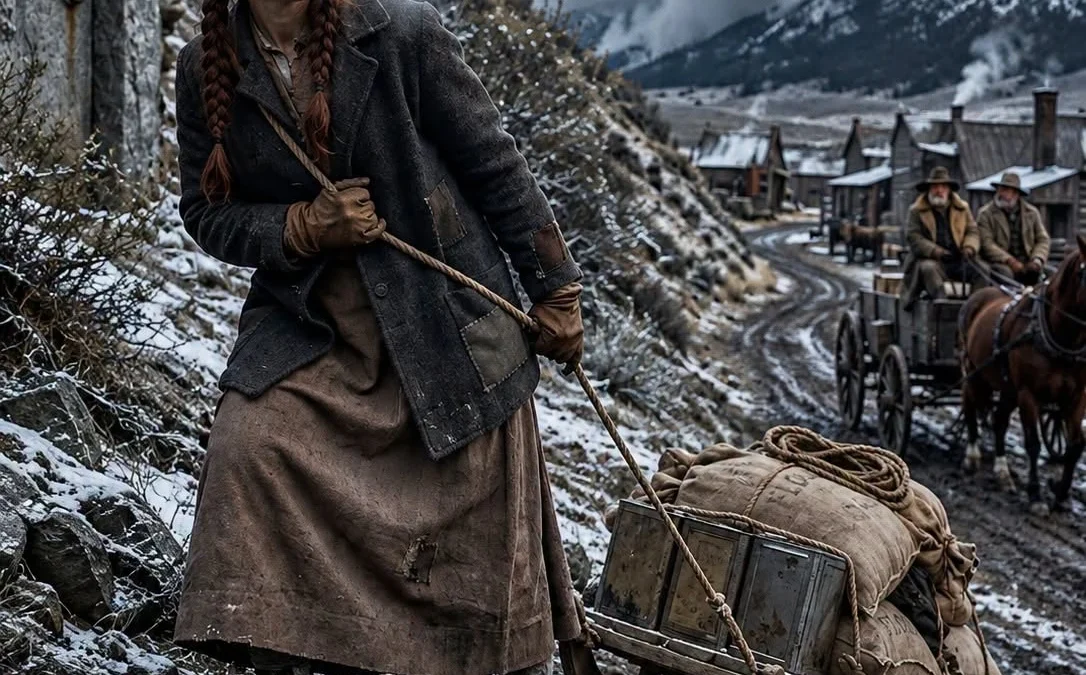
The Town Laughed When an 18-Year-Old Orphan Dragged Her Last Food Up the Mountain. Nine Days Later, 22 Lives Depended on the Shelter They Mocked… 😱
Part 1
The first warning came from a bucket of water. 🪣
It was mid-October in Cinder Gap, Montana, and afternoon sun slanted through the dusty windows of Bell’s Mercantile. Wagons rattled through the mud outside. Ranchers argued over the price of hay. Nothing suggested disaster.
Inside, eighteen-year-old Norah Vale stared at a thin skin of ice on a bucket of water sitting three feet from a roaring stove.
She touched it. It cracked under her finger.
“Something wrong with that bucket?” asked Mr. Bell from behind the counter.
“My father used to say winter does not always announce itself from the sky.”
Outside, the Bitterroot Mountains stood under a clear, pale sky. The high meadows should have been white by now. They were bare, and that frightened her more than snow would have. For two weeks she had watched the animals. Deer were drifting down the slopes in broad daylight. Mice had vanished from the grain bins. Geese flew south so low their wings nearly brushed the cottonwoods. Every morning, chimney smoke crawled sideways instead of rising.
Her father, Eli Vale, would have understood. But he had been dead eleven months, killed when a harness chain snapped on the western road. She still remembered his coat, smelling of leather, cedar smoke, and the peppermint candies he kept in his pocket.
After the funeral, her half-brother Wade promised her a place under his roof. For a while he meant it. Then grasshoppers ruined the fields, the cow went dry, feed prices doubled, and his wife Nell was expecting a third child. One September evening Wade called Norah into the kitchen, counted six sacks of grain in the pantry, and looked at his family.
“We cannot feed another grown person through winter.”
He set their father’s wool coat on the bench beside her. “I can give you two weeks.”
Four-year-old Thomas asked, “Is Aunt Norah going somewhere?” Nobody answered.
“Papa helped build this house,” Norah said.
“I know. But I have children to think about.”
It hurt more than any shouted insult. She packed a blanket, a skillet, and eleven dollars sewn into her cuff. Nell handed her half a loaf of bread. At the gate, Thomas wrapped himself around her knees. “Will you come back before Christmas?”
“I hope so, sweetheart.” 💔
For three nights she slept in the hayloft of an abandoned assay office, until the owner found her. “That roof will come down in the first storm, girl. I am sorry.”
With nowhere left, she remembered the mountain. When she was nine, her father had led her up an old survey trail past the cemetery to a granite ridge. Beneath tangled roots he showed her a rusted iron ring. He pulled it, and a stone door swung inward onto a chamber cut into the rock by railroad surveyors long ago. The railroad was never built. Her father called it the high room. Timber braces crossed the ceiling and a crude chimney ran up through a crack in the granite.
People down below watch the calendar, he told her. Up here, you watch what the world is doing.
Nine years later she climbed that trail alone. The ring was still there. The door groaned open. The sleeping platform had collapsed and the stovepipe was rusted, but the roof held and the air was dry.
“This will do,” she whispered.
That night she took her father’s brass compass from her pocket and held it to her chest. “I found it again, Papa.”
Over the next days she cleaned the chamber and mended shelves. But she kept watching the valley, and on the morning the geese flew lowest, she made a decision. She would spend nearly everything she had on winter supplies. Not when snow came. Now.
At the mercantile she bought flour, beans, oats, salt, onions, lard, lamp oil, and rope, and strapped it all to a battered hand sled.
“You feeding a logging camp, Miss Vale?” Mr. Bell asked.
“Just myself. For as long as the mountain decides.”
As she dragged the sled through town, men outside the blacksmith’s shop stopped working. Cal Rusk leaned in the doorway. “Little Norah Vale is opening a store on the mountain!”
Laughter followed her down the street. Cal called out, “What are you running from, girl?”
She stopped, hands raw from the ropes. “Nothing. I am paying a debt before winter comes to collect.”
One man laughed so hard he had to lean on the wall. By evening, children were dragging crates through the street pretending to be Norah Vale. Women whispered that grief had addled her. Even Wade shook his head over supper. “She is going to freeze to death up there.”
Nell looked at the empty chair. “Maybe we should bring her home.”
Wade looked at the small portions on his sons’ plates and said nothing.
High above town, Norah kept hauling. She did not know that within weeks, the people laughing at her would be fighting for their lives. Or that someone hidden inside the mountain had been watching her every move. 😨
Part 2
By the third week of October, her palms were so blistered she wrapped them in cloth every morning. Every evening she climbed back with something useful. Coal. Flour. Rope. A cracked iron kettle tossed behind the smithy. A blanket with a burned hole, which she washed, cut, and stitched whole again. Nothing was wasted.
The high room slowly became a home. She built shelves, raised her bed on cedar poles away from the damp, packed moss and clay into the cracks, and tested the chimney with wet grass. Her father had taught her an underground shelter becomes a deathtrap if the chimney fails. In a little notebook she logged every pound. Enough for one person for a hard month, maybe longer.
Then the deer vanished from the lower slopes. Even the squirrels went silent.
At the hotel dining room, she spoke to the sheriff and a table of cattle buyers. “A hard storm is coming. Bring your cattle down. Fill your water barrels. Cut twice the wood you think you need.”
“Where did you hear this?” asked Sheriff Hollis.
“From the mountains.”
A young man smirked. “And the bucket at Bell’s told you too?” A few people chuckled.
“Cold air is settling in the high country. When it drops into the valley, it will happen fast.”
“We have had strange Octobers before, Miss Vale.”
“Not like this.”
“You have anything more reliable than birds and buckets?”
“No, sir. Only what I have seen.”
He told her not to frighten people without a proper reason. Outside, old Adah Pike, the midwife who had delivered half the town, caught her arm. She glanced at the cloudless northern sky. “My mother called weather like this the widow’s smile. It looks kind right before it takes your husband.”
A chill ran down Norah’s back.
“Keep carrying, child.”
At the mercantile, Mr. Bell hesitated when she asked for more coal on credit. Then he opened his account book, went to the storeroom, and came back with coal and an extra sack of cracked corn. “I cannot pay for that,” she said.
“You can tell me I was foolish come spring.”
At the ridge that evening, she found fresh boot prints, much larger than hers, leading to the hidden door and back among the rocks. Nothing inside was taken. But beside the stove lay a new section of stovepipe, cut to fit. Her old pipe had been rusting through at the bend.
Behind an angled timber at the rear wall, she had felt a thin draft, as if a second passage lay beyond. That night she heard leather scraping on stone.
“Whoever you are, I know there is another passage,” she called, gripping a maul.
Silence. In the morning, a bundle sat by the entrance. Two cleaned hares and a tin of rendered fat. No note.
Someone else believed the storm was coming. 🔥
By late October, the afternoons felt warm. Children played without coats. The hotel owner called it the finest autumn he could remember. Norah called it borrowed time.
Passing Wade’s farm with her sled, she was swarmed by her nephews. “Papa says you live in a cave!” Thomas said. “Does it have biscuits?”
Wade came to the fence. “People are talking. You are making a fool of yourself.” When she warned him about the snow, he laughed tiredly. “You sound like Papa and his notions.”
“He was right more often than people realized.”
“You cannot spend your life chasing his ghosts.”
She flinched. He saw it. Regret crossed his face, but pride held his tongue.
Near midnight a few nights later, Norah stepped outside. The town glittered below. Music drifted from the hotel. Then the northern stars began to vanish, swallowed by a low gray wall rising from the ground. A distant roar rolled through the valley like a thousand wagons crossing a wooden bridge.
Her father had described that sound. It came before a storm that trapped a survey crew for six days.
She ran inside, barred the stone door, and checked the chimney. She had prepared for one person. Something told her that would not be enough.
At eleven o’clock, the wind struck the mountain like a wall. The stone door slammed against its pin. Every flame bent sideways. Then the snow began, and Cinder Gap disappeared. 😱
Part 3
By dawn, the world outside had ceased to exist. Wind screamed through the granite. Around three in the morning, smoke rolled back into the room. The chimney had iced over. Norah tied a wet cloth over her face, climbed the woodpile, and drove the maul upward through the pipe. Once. Twice. A third time. Ice broke loose, the draft caught, and smoke rushed up. Without that new section of pipe, she might already have been dying.
“Whoever you are,” she whispered toward the rear wall, “thank you.”
By sunrise she dug her way out with a coal shovel and crawled into a white world. The church steeple rose from a field of snow. The hotel’s upper windows barely showed. Barns looked like shallow mounds. Smoke rose from only three places in town.
Then she saw something dark crawling toward the mountain near the cemetery.
She tied a rope to a granite brace and the other end around her waist, pulled on her father’s coat, and went down into the storm. Her eyelashes froze. A gust slammed her against a buried rock, wrenching her shoulder. She kept moving.
The figure was Ben Larkin, the schoolmaster, blood frozen on his cheek, with his ten-year-old nephew Jaime strapped to his back. The schoolhouse chimney had collapsed. The hotel roof was gone. The boy’s pulse was faint. Norah took him beneath her own coat, put the rope in Ben’s hands, and hauled them both uphill. It took ten minutes. It felt like a night.
Inside, she thawed the boy’s frozen feet beside the stove. Ben stared at the stacked wood, the jars of food, the coal, the blankets. “You knew.”
“I was afraid.”
“Everyone laughed at you.”
“I remember.”
“God forgive us.”
She handed him broth. “Drink. You will be more use to him conscious.”
Twenty minutes later, Jaime coughed and opened his eyes. Ben wept.
Then three desperate knocks hit the door. Cal Rusk stood there with his wife and infant daughter lashed together with harness leather. “My shop is gone. Please!”
“Get inside.”
Then Adah Pike with two frightened children. Mr. Bell, bleeding from the hand. A widow. Three miners. Every time the door opened, the storm fought to enter, and every time, Norah made room. Eleven people the first night. Sixteen the next morning. By the third day, twenty-one.
She had prepared for one.
Each morning she opened her ledger and recalculated. On the third afternoon, someone knocked again. It was Wade, snow on his shoulders, Nell leaning against him, their boys clinging to his coat. He looked ten years older. Nell doubled over with a cry.
“How long have the pains been coming?” Adah asked.
“Since this morning.”
“Clean blankets and hot water,” Adah said. Norah was already moving. “Cal, move that woodpile. Ben, take the boys. Mr. Bell, put on another kettle.”
Wade stood frozen. “Wade,” Norah said. “Your wife needs you.”
Fourteen hours later, near midnight, a baby’s cry rose above the wind. “A girl,” said Adah. She wrapped the newborn in one of Eli Vale’s old shirts, the faded blue stitching at the collar. Norah recognized it and tears stung her eyes.
Nell caught her wrist. “I am sorry. For letting you leave.”
“Save your strength.”
“What should we name her?”
“Give her a name that belongs to a warmer future.” 🕯️
But in the morning, Norah counted again. Twenty-two people. Four days of flour. Five of beans. She cut every portion by a third. Nobody complained. Ben distributed food. Cal repaired tools. But Jaime’s toes were darkening, a miner burned with fever, and the chimney iced over twice.
On the fourth evening, she scraped the last flour into a bowl. “How long?” Adah asked.
“Two days.”
Adah reached under her shawl and brought out a cloth pouch of dried beans and apple slices. “Been carrying it in the pocket of my burial dress. Decided I was not ready to wear it yet.”
It started something. Ben opened his coat lining and produced two packets of oats. Cal revealed a slab of bacon. Mr. Bell had rice and coffee sewn into his bedroll. Then Wade stood, ashamed, and pulled three pounds of cornmeal from under his shirt. “I was keeping it for my boys.”
“You were trying to protect them from everyone else,” Norah said quietly. “Now everyone else is protecting them too.”
He set the cornmeal on the shelf. One by one, others added what they had. Socks. Blankets. Candle stubs. 💛
That night, behind the rear wall, came one scrape and three knocks. The timber shifted. And a voice said, “Miss Vale. Your father told me about you.”
She went through the narrow passage with her lantern and found an old man in a buffalo coat beside a mountain mule and a loaded freight sled. “Gideon Shaw. I helped Eli survey this grade. Three of us reinforced this room one winter, long before you were born.” Under the hides were barley, dried peas, smoked elk, hardtack, candles, and oil.
“Why did you wait?” she asked.
“Because supplies change people. I wanted to see who you brought inside.” He nodded toward the room. “Food alone does not save anyone. Someone has to make sure it is shared.”
They carried it in sack by sack. Nobody cheered. Little Thomas woke and asked, “Does that mean we can eat tomorrow?” Norah pulled him close. “Yes, sweetheart.”
On the sixth night, a crack shook the mountain. A beam split from its socket under the weight of the snow. Men wedged timbers beneath it. Wade held the heavy support upright, arms shaking. “Do not let go!” “I will not!” The brace settled.
Afterward he slid down the wall. “I almost let go. I let go of you, when I sent you away. There was a choice, and I did not make it.”
“I slept in a barn that nearly collapsed. I wondered why my own brother did not want me.”
“I wanted you.”
“Then you should have acted like it.”
“Will you ever forgive me?”
“I do not know yet. What matters tonight is keeping everyone alive.”
It lasted nine days. On the ninth morning, Norah woke because something was missing. The wind had stopped. 🌅
They descended roped together into a ruined valley. The hotel roof had caved in. The schoolhouse was split. Cattle lay frozen at the south fence. Mr. Bell stood before his sagging store. “Twenty-eight years to build this place.”
“You can build it again.”
A week later, in the church, the mayor asked what the town could do for her. People proposed naming the room after her, naming the road. Norah put her ledger on the pulpit.
“I want every family to keep winter supplies, and the high room filled before every first freeze. Money can buy flour, but it cannot carry it uphill. Every family must help, even those who can spare only a candle or a pair of socks. Winter keeps accounts. It counted every warning we ignored. And it counted what we shared. I do not want it named for me. I want it ready for the next person who needs it.”
Adah rapped her cane. “That is what Eli Vale would have wanted.”
That spring, Cal forged a stronger door. Ben brought books and slates. Adah filled a chest with bandages and herbs. Families carried jars of salt, dry socks, a single candle. Wade climbed the mountain every Saturday to haul coal and repair shelves. One afternoon he told her, “There is always a place for you at our table.” This time she believed him, because he had earned it.
“I would like to come Sunday,” she said. “And I would like to hold my niece.”
Gideon stayed through summer, telling her stories of her father. “He worried you would give away the last piece of bread. He was not scolding you. He wanted you to save enough for yourself.” Before leaving, he gave her his old brass compass. “Mountains are easier to promise things to than people.” She never saw him again.
Years passed. The railroad came. Brick replaced timber. Every October, the town still climbed the trail together, checking the chimney, counting blankets, restocking the shelves.
One autumn, silver-haired Norah watched a little girl, the great-niece of the baby born in the blizzard, carry a jar of beans up the path, refusing help. “For the winter room!”
“Why do we bring food up here every year, Aunt Norah?”
“Because once, a terrible storm came when nobody expected it.”
“And you saved everybody?”
“I did not do it alone. I made sure there was a place where people could help one another.”
The girl looked at her empty hands. “Can I bring another jar?”
Norah laughed. She closed the old ledger, its yellowed pages still carrying the careful numbers of a frightened eighteen-year-old, and set it beside her father’s compass. The girl who climbed the mountain believed she was alone. She could not have known an entire town would one day follow her trail. 💛
Survival was never a miracle waiting to happen. It was a promise people made to one another, and kept with their own hands. 🏔️
This story is entirely fictional and created for entertainment purposes only. It does not represent any organization or individual, nor does it encourage inappropriate behavior. The content was generated with AI assistance.








