The Town Threw Her Out Into a Freezing Storm for a Crime She Never Committed. Fourteen Miles Later, a Crippled Stranger Opened His Door and Said Five Words That Changed Everything
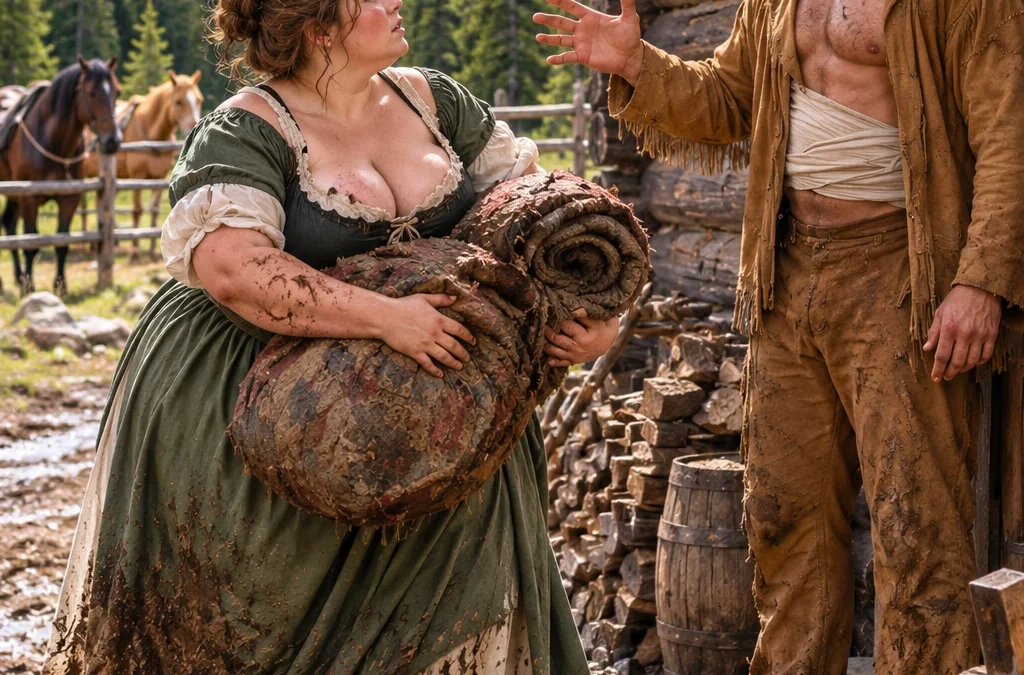
The Town Threw Her Out Into a Freezing Storm for a Crime She Never Committed. Fourteen Miles Later, a Crippled Stranger Opened His Door and Said Five Words That Changed Everything
Part 1
They fired her at noon for a theft she never committed.
By dark, they had her on a fourteen-mile mountain road in cold rain.
Nobody expected Naomi Prentice to reach the other end of it. That was the whole point of putting her on it. 🌧️
For four years, she had lit the range at the Bonton eating house at four every morning, alone in the dark. She fed forty-one boarders three times a day. She knew the weight of every kettle in that kitchen, and she could lift all of them.
Mrs. Agnes Trowbridge, who owned the Bonton, never once used her name. She called her “the big girl.” She called her “the freight wagon.” She said it in front of the dining room, and the dining room laughed, and Naomi kept her eyes on the plates.
There were no wages left at the end of any month. Board came out, and lodging, and breakage, and a dollar every time a boarder complained. In four years, Naomi saved nine dollars and spent seven of them burying her mother.
The only thing truly hers was a canvas-backed daybook, small enough to fit in one hand. In it, she wrote every meal she cooked, the date, the place, and the men who ate it. Her father had kept a freighter’s daybook the same way. It was all he left her. 📖
In July, she was hired out for eleven days as camp cook to a government survey crew. She fed nine men on the flat by Sand Coulie and cut her own stove wood from the cottonwoods by the seep. She wrote every day of it down.
In August, a man named Ellis Vanderver took supper at the Bonton. He was the deputy surveyor who held the government contract, gray-haired and pleasant, telling the table how his crew had been chaining Township Nine North through the middle of July.
Naomi set down his plate and said he couldn’t have been. His crew had eaten her beans at Sand Coulie on the fourteenth, thirty miles south.
The table laughed. Vanderver did not. By the door, his compassman, a bearded slab of a man named Cass Renfro, stopped chewing. 👀
Eight days later, forty dollars went missing from the till.
Agnes Trowbridge announced it at the dinner hour with the room full. She said there was only one hand in that kitchen big enough to close over forty dollars at once. She looked down the room at Naomi and waited for tears.
Naomi gave her none. It was the first defiant thing she had ever said out loud, and it cost her everything. They searched her room while she stood in the hall with her hands at her sides. A deputy came down the stairs holding thirty-eight dollars knotted in a sock, taken from her trunk, tucked under her mother’s folded shawl.
Somebody had climbed those stairs to put it there.
Agnes Trowbridge untied the apron off her at the foot of the staircase and kept it. No wages. No character reference. She said no decent house in three counties would take her now, and about that she was entirely right.
The complaint was sworn before the justice that afternoon, then never served. It sat there, signed and dated, like a rock held over a dog.
Later, Naomi learned why they wanted her running instead of jailed. They put her out the front door because the front door had an audience. Men came off the hotel porch to watch. Someone called out that she wouldn’t starve, not her. The street laughed a long time. 😞
She tried the cattleman’s hotel, the laundry, and two boarding houses. Every one had heard by supper. At the last door, the woman wouldn’t open past the chain.
On Friday, the deputy found her behind the freight office. He wasn’t unkind. He told her to be gone by Sunday, because on Monday he’d have to serve the paper, and then it was jail and hard labor for a woman who couldn’t pay a fine.
Her carpet bag came out the Bonton’s back door and landed in the alley mud. Agnes Trowbridge stood in the doorway in dark green poplin, white hair pinned high, and said it was a mercy, since the girl had eaten more than she was worth for four years.
Cass Renfro leaned on the wash house corner, watching. He said Slate Fork Road was the only way out that didn’t run past a sheriff. It was fourteen miles, and October was late this year.
He smiled. She thought he was being helpful.
She counted what she owned on a nail keg by lantern light. One dollar and fifteen cents. A carpet bag with two dresses and her mother’s shawl. And the daybook, which nobody had thought to look for. 🕯️
A freighter told her there was a man at the head of Slate Fork. He had buried his brother in June and crushed his right hand in September. He had a full smokehouse and no way to cook out of it. Then the freighter said he had no room on the wagon.
So she walked out of Owl Butte at first light, the carpet bag in her right hand and the daybook buttoned inside her dress against her ribs.
The first six miles were nothing. She had stood eighteen hours a day on a plank floor for four years, and her legs were iron. But on the seventh mile, the road left the flat and started up the ridge, and it began to teach her something.
By noon, the sky closed and the rain came, gray and cold and patient. Her dress took on water until it weighed as much as a sack of flour. The bag handle cut a line across her palm. She fell twice. The second time, she lay in the wheel rut with the rain hitting the back of her neck and thought, very calmly, that this was exactly what they had wanted.
That thought got her up.
She walked the last two miles by the pale of the road itself. Then she smelled wood smoke and pitch on the wet air, and it was the finest thing she had ever smelled.
The cabin stood at the head of the creek. Lamplight spilled from one window. A hound came off the porch. Then the door opened, and a shape filled it that stopped her where she stood.
He turned his shoulders to come through his own doorway. Black hair loose to the jaw, a beard, a white scar down his temple. His right hand was splinted and wrapped and held against his ribs like something borrowed.
Green eyes went over her once, top to bottom.
Naomi set her jaw and waited for it. She knew that look the way a dog knows a boot. The flick down to the belly. The flick back up. The mouth doing something at one corner. She had eaten that look three times a day for twenty-three years.
It did not come.
He looked at her hands instead, at the raw line the handle had cut across her palm. Then he said five words that turned both their lives over. 💥
Part 2
“That stove’s been cold eleven days.”
That was all. He didn’t ask who she was or why she was walking in that weather. He said it plainly, with a splinted hand against his ribs, like a man confessing the one thing he couldn’t fix.
“I don’t know how to make it stop.”
Naomi stared at him. She had braced for a filthy hovel. What she found was a room swept to the boards, a bed made square, tools hung on nails by size, and a shelf of books running the whole north wall. Only the kitchen end had gone to ruin. Ash spilled from the firebox. Sacks of flour and beans stood unopened. A good six-lid range had not been touched since June.
His brother Wilmer had done all the cooking. In June, a dead spruce fell across the pack trail and killed Wilmer where he sat his horse. In September, a rope parted and dropped a bucket of ore across Garrett’s right hand. 💔
He told her all of it plainly, asking nothing. Then he made her an offer. The kitchen was hers. A bed behind a curtain. Six dollars a month, if she would cook and put up his winter meat.
She lit the fire before she even got out of her wet dress. It was the only thing she knew how to do without thinking. By midnight, there were biscuits, gravy, and a venison steak the size of a dinner plate in front of him.
He ate three plates and said not one word. When he finished, he looked at the empty plate.
“Again, tomorrow.”
It was the first compliment anyone had paid her in four years. She went behind her curtain and shook. 🥺
For nine days, she made herself as small as a woman her size can make herself. She waited every day for the other thing to start. It never did. He never commented on what she ate. He never stood in doorways to watch her pass. When she moved, he moved out of her way without making a performance of it.
On the fourth night, she caught him hauling water left-handed and took the buckets from him. He let her.
“Thank you,” he said. Like she had done work, not a trick.
Snow dusted the peaks. She scrubbed the kitchen to bare wood, rendered forty pounds of tallow, put up twelve gallons of chokecherry, and packed the smokehouse until the door barely shut. One afternoon he watched her carry a hundred-and-ten-pound hog quarter up from the springhouse on one shoulder without changing hands.
He did not laugh. He did not look away.
Then a rider came up the road, and light flashed off a badge. Naomi sat down hard on the woodbox. She told him everything. The forty dollars. The sock in her trunk. The paper waiting on the justice’s desk.
Garrett listened without moving. “A warrant goes looking for a name,” he said finally. “The paper says Prentice. It doesn’t say Ferris.”
A name, he said, was a wall a man could put around somebody when he had nothing else to give.
They were married on the eighteenth of September, by a circuit preacher at the Slate Fork crossing, with two freighters for witnesses. It took eleven minutes. There was no kiss, and neither reached for one. 💍
Then came the first of October, and the mail sack came up with the freight.
And with it, the handbill. It offered fifteen dollars for information on the whereabouts of Naomi Prentice, late cook of the Bonton. It described her hair, her eyes, and then her weight, in printed figures, the way a man describes a horse he wants back.
Pinned to the corner was a half sheet in a clerk’s fine hand, addressed to the deputy and never meant to travel anywhere near that handbill.
She went up Slate Fork on foot on the 29th of August. Do not trouble yourself to bring her in.
Naomi did the arithmetic. Fourteen miles. Cold rain. No coat. No food. Nobody on that road for days at a stretch. 😨
They had not jailed her because a jail keeps a roster. A road keeps nothing at all.
Garrett read it twice. Then he opened the firebox with his left hand, laid the note and the handbill on the coals, and watched until not one corner was left.
“You are never walking anywhere again while I’m above ground,” he said.
She cried then, hard, for the first time in four years, standing straight up with her fists closed. He did not touch her. He put a chair behind her knees and waited.
Weeks later, the rain returned. A rider came up the creek on the twenty-eighth, and Naomi knew his whistle before she saw his face.
Cass Renfro sat his horse in the yard in a dark gray canvas coat, with two men behind him. He looked at her in the doorway. “County put fifteen dollars on you,” he said. “By the look of you, they underpriced considerably.”
The two men laughed.
Then he got to it. He wanted the daybook.
Part 3
Renfro’s smile hung in the rain.
“A paper in Owl Butte with your name on it could go into a stove as easy as it could go to the district court,” he said. “All it costs is one little canvas-backed book.”
Garrett Ferris came around the corner of the cabin with a rifle in his left hand. He said nothing at all.
Renfro looked at the rifle. He looked at the mud. He turned his horse. “A man ought to think,” he said over his shoulder, “about what a house full of dry wood does in a wind.” 🔥
That night, the story came together.
Weeks before, Naomi had read the daybook aloud to Garrett. Eleven days in July. Nine men, their names, what each one ate. The fourteenth, the fifteenth, the sixteenth, all at the seep, thirty miles south of the township those men had sworn they were chaining.
Garrett had gone quiet. “A crew that never goes on the ground still has to write returns,” he’d said. “A corner set with a pen instead of a chain moves a fence three-quarters of a mile.”
He had ridden down the creek to find a man named Orville Gant. When he came back two days later, he stood in the doorway with his hat in his good hand. Naomi asked what he wanted.
He said he wanted to kiss his wife, but he wasn’t going to do it without being told he could.
No one had ever asked her for anything. She told him he could. 🤍
Now, with the rain drumming and Renfro’s threat still in the air, a widow rode up the creek on a mule that evening. Pearl Hendrick, in dark red calico, a tan shawl over her gray head. Gant had sent her. Her husband had been found in August, face down at a corner mound on the east line of their land, the back of his head broken in. The coroner called it a fall from a horse.
There had been no horse within four miles.
Orville Gant reached the cabin the next noon on foot, an old chainman with hands like knots in rope. He had carried head chain for Vanderver six years before walking off in July, and he had been drinking about it ever since. He laid it out at Naomi’s table. Vanderver held a contract on forty-one townships and had run nine honestly. The rest he wrote up in a Cheyenne hotel room, moving corners on paper for a cattle company that wanted ninety thousand acres of other people’s water inside its fence.
Ellis Vanderver himself came up the creek on the last day of October in a spring wagon with the top up. He was pleasant about all of it. He sat at her table with his hat on his knee and offered three hundred dollars for the daybook. When she didn’t answer, he made it five hundred and a letter of character that would open any kitchen in the territory.
Then he explained the world to her, kindly, the way a man explains things to a calf. She was a fat cook discharged for theft. In court he was an officer of the government, and she was a joke a jury would laugh at.
Naomi looked at him across her own table.
“The fourteenth of July. Sand Coulie,” she said. “Nine men. Beans, bacon, and dried apple pie. And you, Mr. Vanderver, ate two pieces of the pie and complained about the coffee.”
He put on his hat. At the door, he said in that same pleasant voice that the creek was rising and she ought to be careful what she started in weather like this. ⛈️
It rained all night, and the next day, and the day after. The gray gumbo clay under Slate Fork takes water and never gives it back. By Thursday, the yard was a foot deep in something that held a horse like a closed hand.
A little after nine that night, the hound began, and would not quit.
Garrett blew out the lamp and went out with the rifle. The yard lit twice. Naomi heard him go down.
She went out into it barefoot.
He lay twenty feet off the porch with a hole through his left shoulder, his horse thrashing across his legs, men shouting in the dark beyond the woodpile. He weighed two hundred and thirty pounds, and the mud had hold of him. She got both hands into his coat, set her feet, and pulled him out of it, across the yard, and over the sill, and she did not stop once.
She barred the door and dropped the shutters. A ball came through the glass and buried itself in the ridge pole. She pressed a folded dish towel to his wound with her whole weight and felt the bleeding slow.
The rifle was still in the yard, under the horse. The shells were in the root cellar. The trapdoor was beneath the kitchen floor, and the six-lid range had stood square on top of it since June, loaded with water and a fire in the box. That range weighed better than four hundred pounds. 🔥
Naomi put her back to the wall, her hands under the near end, and lifted.
Something tore across her shoulders. The iron rose off the boards, and she walked it around on one corner, screaming through her teeth, until the trap was clear.
In the cellar she found a second rifle in oilcloth, two boxes of shells, and the tin box that held her daybook. She came up out of that hole in her own kitchen floor, and she was no longer the woman who had walked up that road in August.
She fired four shots through the window into the dark, deliberately high. Two horses bolted from the yard. One went down in the flat below the ford, and a man cursed in a voice gone thin with panic.
Then she went out the back door with an armload of breadboards and stovelength planks. She laid them end over end across the gumbo and walked on them. Where she stepped, she did not sink. Every man in that yard was in to his knees. 💪
She came up behind Cass Renfro while he was still hauling at his own boot. A doubletree lay across the chopping block, four feet of ash with iron at both ends. She swung it across his shoulders and put him face down in the mud. When he rose, she hit him again, knelt on him, and tied his wrists. She dragged him to the porch post by his collar and left him there.
Then she went looking for Ellis Vanderver.
His spring wagon stood at the ford with both wheels sunk to the hubs and both horses down in the water. He had abandoned it and gone out across the flat on foot, the last mistake available to him that night. He had made eighty yards before he sank to the middle of his thighs. By the time she came along her plank road, he was in to the waist, and every push of his arms drove him deeper. The sound he made was not words.
She stood on the planks a yard from him. She took the field notes and folded returns out of the inside of his coat, put them in the tin box, and shut the lid.
Then she went back for rope and more planks.
She got the loop under his arms, set her boots, and pulled two hundred pounds of Ellis Vanderver out of ground that did not want to give him up. It took eleven minutes. Nothing else living within four miles could have done it.
He lay on her planks in the rain, sobbing, asking her why.
“I have never once in my life let a thing die that I could carry,” said Naomi. 🌧️
By dawn, the rain quit. Renfro was tied to the porch post. Vanderver was tied to a kitchen chair. Garrett’s shoulder was packed and stopped. A fire burned in a range standing crooked in the middle of the floor. The sheriff walked in at two in the afternoon, leading his horse.
Garrett came up out of the fever that evening and found her on the floor beside him, her hands split open, her shoulders one solid bruise.
He said her name. Then he said he had read about queens his whole life and never expected to wake up looking at one. 👑
The district court sat at Owl Butte in February. Naomi Ferris took the stand in a mustard wool dress with a white apron folded in her lap, because her hands wanted something to hold. She read from her daybook. Eleven days. Nine men. Three meals a day. Thirty miles from where those men swore they stood. Orville Gant testified that he had carried head chain on nine townships and watched thirty-two more written up on hotel paper. Pearl Hendrick spoke of a corner mound, and the back of her husband’s head.
In April, Naomi led the whole court out to Sand Coulie. She walked them to a cottonwood at the edge of the seep and showed them the blaze she had cut for stove wood in July.
Beneath the new bark, the old scribed government marks of the original bearing tree still stood.
Vanderver’s returns had sworn no tree ever grew there.
The General Land Office canceled his contract and rejected the returns on thirty-two townships. Facing manslaughter for the Hendrick killing, Vanderver turned on the men who had paid him and gave up the cattle company’s officers, books, and the whole account of the ninety thousand acres in open court, while his employers sat behind him and listened.
His sentence is the part people still talk about. As a condition of his plea, he was ordered to walk all thirty-two townships with the resurvey party at his own expense and reset every corner he had moved with his own hands. It took six years, and it broke him. Cass Renfro got seven years at the territorial penitentiary. The cattle company’s fence came down in a single summer, ninety miles of it, cut and rolled by the ranchers it had shut out.
Agnes Trowbridge lost the county boarding contract, and the Bonton went to sheriff’s sale.
Naomi bought it for four hundred and ten dollars. She hired every girl in Owl Butte that Agnes Trowbridge had ever called a name. ✨
In May, she stood on a resurveyed line above Sand Coulie, with the chainmen and half the county watching. When the new stone went into the true corner, she took her husband’s face in both hands and kissed him in front of all of them, and did not hurry.
The resurvey put six hundred and forty acres of hay meadow back inside the Ferris line, and the limestone ledge above the creek with it. They built two kilns and burned lime for every new town on that side of the divide for twenty years.
They could have gone anywhere. They stayed at the head of Slate Fork and built onto the cabin instead of leaving it. The kitchen they built was forty feet long, with two ranges standing in it. By 1893, nobody in three counties called it anything but the Ferris table. Survey crews ate there. Freighters ate there. Any rider who came up that road ate there.
Nobody was ever asked for money. And nobody ever ate alone.
They called her the Queen of Slate Fork and did not mean it small. She was a large woman who had carried a wounded man out of the mud and then pulled her own would-be murderer out after him. And in that country, a woman’s size quit being a thing she apologized for. 👑
Pearl Hendrick ran her own cattle on her own restored land and never married again. Orville Gant lived in a cabin below the ford until the day he died, and he had a chair at that long table with his name burned into the back of it.
On summer evenings, Garrett and Naomi sat on the porch, and he put his right hand into hers, stiff fingers and all.
They had been strangers in the rain once.
Now the light went off the hay behind their own house, and the woman they had sent out to die watched it go, and she was home. 🌄
This story is entirely fictional and created for entertainment purposes only. It does not represent any organization or individual, nor does it encourage inappropriate behavior. The content was generated with AI assistance.








