“The Ugliest Woman in This Room,” the Duke Laughed Before 40 Guests. She Said Nothing, Curtsied Twice, and Walked Out. By Monday Morning, the One Man He Owed Everything Was Reading Her Secret Letter
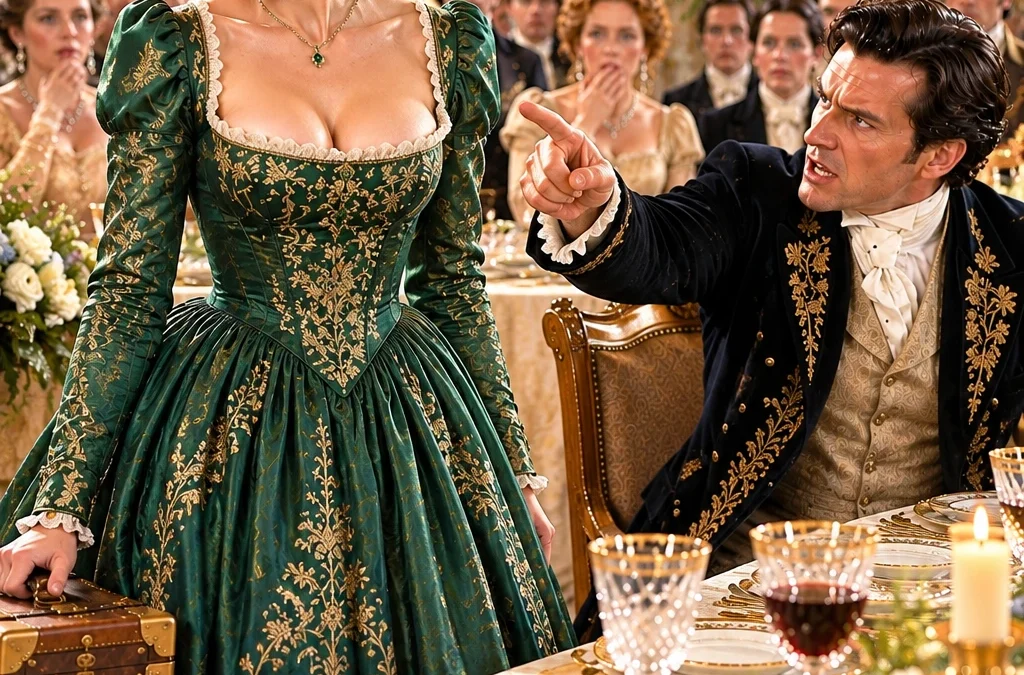
“The Ugliest Woman in This Room,” the Duke Laughed Before 40 Guests. She Said Nothing, Curtsied Twice, and Walked Out. By Monday Morning, the One Man He Owed Everything Was Reading Her Secret Letter 😱👑
Part 1
The silence that followed the Duke’s words was so heavy that Eleanor Whitmore could hear the candles hiss. 🕯️
Forty guests sat at the long table in the great dining hall of Harcourt Hall. Silver glittered. Crystal shone. Not one person moved.
“Look at her,” said Edmund Harcourt, the Duke of Ashbourne, raising his glass with a lazy smile. “The ugliest woman in this room, and she sits at the head of my table. Let us be honest, my friends. I married her father’s name. Her face was never part of the bargain.”
A lady near the end of the table gasped. A young footman nearly dropped his tray, and the silver spoons rattled against each other like tiny bells. Lord Henry Collins, the richest guest of the evening, slowly put down his fork and stared at his plate.
Eleanor felt every eye turn toward her. Her cheeks burned. Her hands, hidden beneath the tablecloth, were shaking. 💔
For three whole days she had planned this dinner. She had chosen the flowers, tasted every dish, and checked every place card with her own hands, all so that her husband could look like a great man in front of the people he wanted to impress.
And this was his thanks.
She waited for a laugh. Perhaps someone would break the silence and turn the cruel words into a joke, as people so often did in this house.
But nobody laughed. Nobody spoke at all. The room seemed to be holding its breath, waiting to see what the Duchess would do.
Edmund leaned back in his chair, enjoying the attention. He had always been charming in front of others. Behind closed doors, he had spent seven years teaching Eleanor to feel small. A comment about her plain dress here. A sigh about her love of books there. A cold look whenever she spoke at the wrong moment.
Each one had been a tiny thing. Together, they had built a quiet prison, and she had learned to live inside it.
But tonight, he had done something new. He had said it out loud, in front of everyone.
Eleanor looked at him for a long moment, and she noticed something she had never seen before. Under the smile, his eyes kept sliding toward Lord Henry Collins. 👀
Edmund was not only trying to hurt her. He was showing off. He wanted the powerful guests to see how little he cared for anything but his own power.
Why did that matter so much to him tonight?
The answer sat in her memory like a locked box. She was the only person in the house who kept the account books. She knew things about the Duke’s money that he believed no one knew. And Lord Henry Collins was the very man to whom the Duke owed the most.
A strange calm settled over her, like the stillness before a storm breaks.
Slowly, Eleanor placed her glass on the table. The small click echoed through the hall like a bell. She pushed back her chair and stood. Every guest watched her rise.
Then she did the one thing no one expected.
She turned to her husband and curtsied, deep and graceful, with her back perfectly straight. She turned to the guests and curtsied again.
She did not cry. She did not argue. She did not say a single word.
She simply walked out of the room, her silk skirts whispering across the marble floor, while forty people stared after her, and the Duke’s smile began, very slowly, to fade. 😳
Behind her, the great doors closed with a soft, final sound.
Upstairs, in the dark of her bedroom, Eleanor stood at the window and made a choice that would change both of their lives forever. Her maid, Margaret, found her there minutes later, still in her dinner gown, her eyes dry and bright.
“Margaret,” Eleanor said softly, without turning around, “how quickly can you pack a trunk?”
Margaret’s face went pale. And then, to Eleanor’s surprise, she smiled.
“Faster than you would believe, Your Grace. I have been ready for years.”
The two women moved at once, like people who had waited a long time for a door to open. Eleanor took only three things from her jewelry box: her late mother’s pearl brooch, a small silver locket, and a purse of coins from her grandmother that Edmund had never known about. The diamond necklace, the emerald earrings, and the gold watch he had presented on their wedding day with a speech about how lucky she was, all stayed on the dressing table.
She looked at them and felt nothing at all. That surprised her most of all.
Then she sat at her writing desk and pulled out two sheets of paper.
The first was for her Aunt Beatrice in Bath, the only person in her family who had ever asked whether she was truly happy. “I am coming to you. I will explain everything when I arrive. Please do not tell anyone.”
The second letter was harder. She could have written a hundred angry words. But anger was a rope, and she was done being tied to him. So she wrote only facts. She listed the debts she had found hidden in the account books. She named the three tenant families who needed patience, not punishment. She explained which servants could be trusted and which merchants would cheat him. She told him where the keys to the strongroom were kept, and which papers Lord Henry Collins would ask to see on Monday. 📜
She did not ask him to forgive her. She did not ask him to follow her.
At the bottom she signed her name, Eleanor, with no title at all. Then she sealed the letter and left it on his pillow.
A sudden noise in the hallway made both women freeze. Heavy footsteps. A man’s voice, slurred and loud.
“Eleanor! Come down at once! You are embarrassing me!”
Margaret blew out the candle. The room fell dark. The footsteps stopped right outside the door, and the handle rattled once.
Eleanor held her breath, one hand pressed over her racing heart.
Then, at last, the footsteps turned and moved away.
Neither woman spoke for a full minute. “The coach will not be ready until the household sleeps,” Margaret whispered finally. “We must wait for the clock to strike four.”
Eleanor sat down on the trunk in the dark. She had four hours to wait and a whole life to leave behind.
And when the great clock finally struck four and they crept down the back stairs, a voice spoke from the shadows.
“Your Grace.”
Her heart nearly stopped. 😨
Part 2
“Your Grace.”
A tall figure stepped out of the dark holding a lantern. It was Oliver Bridges, the steward, a quiet man in his fifties who had worked at Harcourt Hall since before she arrived.
For one terrible moment, no one moved.
“I saw the light under the kitchen door,” Oliver said in a low voice. “I think you should know that His Grace is asleep in the library, and he will not wake for hours. He drank a great deal after the guests left.”
Eleanor swallowed. “Oliver, I can explain.”
“There is no need.” He lowered the lantern and glanced at the trunk. “For seven years I have watched you save this estate with no thanks. When the harvest failed, you found money for the tenants. When the roof leaked, you found a builder. I have been waiting for someone to notice. I never thought it would take a night like this.” 🥹
He stepped aside and opened the servants’ door himself.
“Samuel is waiting with the carriage at the end of the lane. He has been there since midnight. He guessed what was coming.”
Eleanor stared at him. “Everyone knew?”
“Everyone who cared,” Oliver said gently. “Go quickly, Your Grace. The sky is turning gray.”
She wanted to thank him properly, but her throat was too tight. She only reached out and pressed his hand.
Then she and Margaret slipped out into the cold morning air. A thin mist lay over the gardens, and the grass was silver with frost. They hurried down the lane dragging the trunk, their breath rising in white clouds, until they saw the dark shape of a carriage waiting under the old oak trees.
Samuel, the young groom, lifted the trunk as if it weighed nothing. “Quickly, Your Grace. The road to the north is clear.”
The carriage rolled forward with a jolt. Eleanor looked back through the small window. Harcourt Hall stood tall and dark against the pale sky, its hundreds of windows empty and cold. She had arrived there at nineteen, full of hope. She had spent seven years trying to make it a home.
She expected to cry. Instead, she felt something lighter, like a heavy coat sliding from her shoulders. 🌅
Then, far behind them, a bell began to ring.
Margaret gripped her arm. “They have found out!”
“Perhaps,” Eleanor said. “But we are already at the gates.”
The carriage thundered through the great iron gates just as the first golden line of sunrise cut across the hills. Edmund would wake soon with a pounding head and a lost wife. He would read her letter. He would see the list of debts in her neat handwriting, and he would understand that she had known all along.
Eleanor leaned back and closed her eyes. For the first time in seven years, no one was waiting to tell her what she was.
Bath welcomed her with pale golden stone, busy streets, and an aunt who opened her arms before the carriage had even stopped. “My dear girl,” said Aunt Beatrice, holding her tightly. “I have waited a very long time for this letter.”
Within a month, Eleanor had something she had not known for years. She had mornings that belonged to her.
But back in Yorkshire, the news ran faster than any horse.
The guests from the dinner told the story in drawing rooms across England, and each version made Edmund look worse. By the end of the first week, invitations to Harcourt Hall stopped arriving. By the end of the second, his closest friends were crossing the street to avoid him. 😏
Then came Monday.
Lord Henry Collins arrived at exactly ten o’clock, carrying a leather case. He asked very politely to see the account books.
Edmund opened the strongroom, searched for the right papers, and realized with a sinking feeling that he had never understood any of them. For years, Eleanor had kept them in order. Now he could not find a single page he needed.
Her letter lay open on his desk. Every word in it was correct. Lord Henry read the list of debts slowly, one line at a time, while Edmund’s face turned from red to white.
“Your Grace,” Lord Henry said at last, “your wife wrote a clearer report of your troubles than you could have written yourself.”
He did not shout. He simply gave the Duke thirty days to repay a large part of what was owed.
And then he left. 💥
Part 3
After that, things began to fall apart quickly.
Without Eleanor, the tenants stopped trusting the estate. The cook gave notice. Two maids left in the same week. Oliver Bridges stayed, but he stopped smiling whenever the Duke gave orders. And wherever Edmund went, he heard the same whisper.
“She held that house together. We all saw it.” 🤫
In Bath, Eleanor knew none of this at first. Aunt Beatrice took her to a Thursday gathering at the home of a kind widow named Mrs. Charlotte Fenn. The room was full of women reading poems aloud, arguing about books, and planning charity work. When Eleanor was introduced, nobody asked about her family name or her fortune.
A woman with silver hair leaned forward. “Beatrice tells us you can manage an entire estate on paper alone. Is that true?”
Eleanor hesitated, then laughed for the first time in months. “Only if the estate is very badly managed to begin with.”
The whole room laughed with her. Something inside her chest, tight for so long, finally loosened. 💛
By autumn, Mrs. Fenn had asked her to help run a small school for girls who could not afford lessons. Eleanor taught reading in the mornings and kept the accounts in the afternoons. The girls adored her. They did not care what her husband had once said about her face. They only knew she listened when they spoke.
One evening, as the lamps were being lit, a small girl named Lucy tugged on her sleeve.
“Miss Eleanor, you have the kindest face I ever saw.”
Eleanor stood very still. Her eyes filled with tears, but they were not sad ones.
“Thank you, Lucy,” she whispered.
She did not yet know that a visitor was already on the road to Bath. 🛤️
The knock came on a gray afternoon in March, just as Eleanor was closing the school ledger. Aunt Beatrice appeared in the doorway, unusually pale.
“My dear, there is a gentleman in the parlor. He says he has traveled three days to see you.”
Eleanor did not need to ask his name. She smoothed her plain gray dress, lifted her chin, and walked down the hall.
Edmund stood by the fireplace. He looked thinner. His coat was wrinkled, his boots were muddy, and the proud shine had gone from his eyes. For a moment, he looked like a stranger.
“Eleanor.” His voice cracked on her name. “Thank you for seeing me.”
“Hello, Edmund.”
He glanced around the modest room, then at her calm face. “You look well.”
“I am well. Better than I have been in years.”
He swallowed hard. “The estate is nearly lost. Lord Henry gave me thirty days, and I sold half the horses and two of the paintings to meet it. The servants have gone. The tenants will not speak to me. Society will not receive me.” He took a shaky breath. “I was a fool. I said terrible things, and I was wrong. Please come home. I will change. I swear it.”
Eleanor listened in silence. She had once dreamed of hearing those words. She had imagined them a hundred times on lonely nights in Harcourt Hall.
Now they felt like a letter delivered to the wrong address. 📬
“Edmund,” she said gently, “I believe you are sorry. I truly do. But you are sorry because you lost your home, your friends, and your money. You are not sorry because you finally see me.”
His mouth opened, then closed.
“For seven years you taught me to think I was small. It took one terrible night and one quiet walk out of a room for me to learn that it was never true. I will not go back to be reminded of it.”
A long silence stretched between them. A clock ticked on the mantel. At last, Edmund bowed his head.
“Is there anything I can do?”
“Yes,” Eleanor said. “Treat your tenants fairly. Pay your debts honestly. And when you meet people who are kind and quiet, do not mistake them for people who are weak.”
He nodded slowly. Then he turned and walked out of the house, a lonely man who had learned the price of his words too late. 💔
The lawyers settled the separation within the year. Eleanor asked for nothing from the Hall except her mother’s books.
Years passed. The little school in Bath grew into three schools, then ten. Girls who once could not read now taught others. People began calling Eleanor Whitmore one of the finest champions of women’s learning in England.
On a bright June morning, she stood on a wooden platform in front of the first graduating class. Rows of young women sat before her in white dresses, their faces glowing. At the back of the room, Aunt Beatrice dabbed her eyes, and Margaret beamed beside her. 🌸
Eleanor finished her speech with a smile. Then she did something that made the whole room go quiet.
She curtsied to the graduates, deep and graceful, with her back perfectly straight.
This time, the silence was filled with respect. And the room rose in thunderous applause. 👏✨
This story is entirely fictional and created for entertainment purposes only. It does not represent any organization or individual, nor does it encourage inappropriate behavior. The content was generated with AI assistance.








