The Vampire King Chose Another Woman in Front of 500 Immortals, and the Servant Holding the Chalice Vanished That Night. Three Years Later, He Found the Secret She Was Hiding
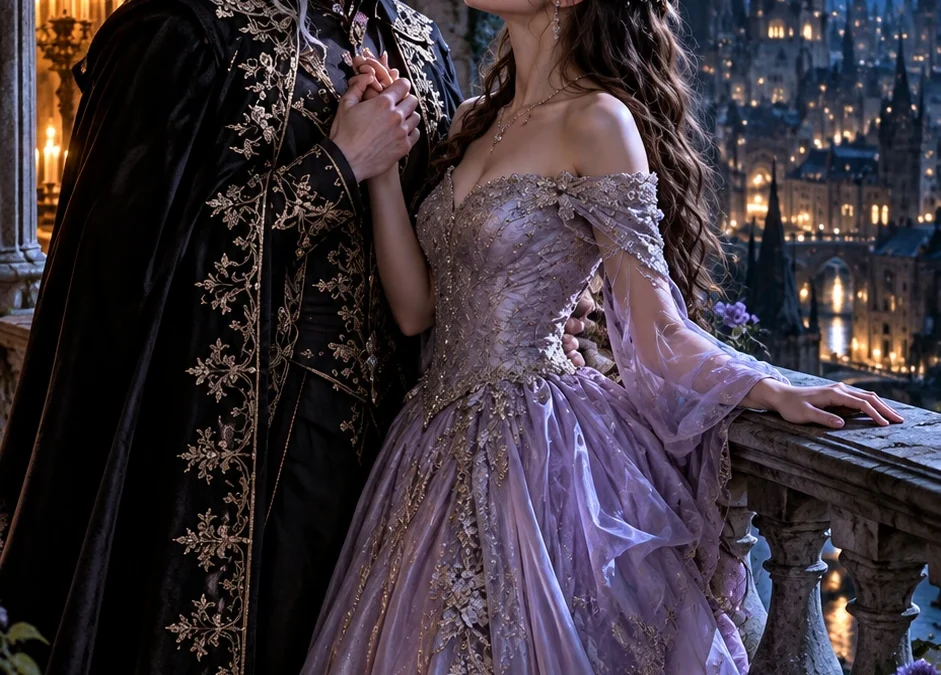
The Vampire King Chose Another Woman in Front of 500 Immortals, and the Servant Holding the Chalice Vanished That Night. Three Years Later, He Found the Secret She Was Hiding 😱🩸
Part 1
On the night the Vampire King chose another woman before his entire court, a servant stood ten paces away, holding a ceremonial chalice she had prepared with her own hands.
No one looked at her when her heart broke.
No one saw her leave the castle before dawn, swearing she would never set foot in the kingdom of Ombravia again. 💔
Her name was Selene Aramar.
For seven years, she had been the healer and archivist of the Night Court, the court of King Lucian Draven, lord of the five blood clans, ruler of an empire of shadows that had gone four centuries without a queen.
She arrived at Corbenar Castle at nineteen. An orphan with ink-stained hands and a strange gift her old master, Orion, had taught her to hide.
Her blood healed.
Not like herbs or ointments. It truly healed. One drop could close a wound that had been open for days. Two could bring color back to a dying man.
In a kingdom of vampires, a secret like that was not a gift. It was a death sentence. 🩸
On his deathbed, Orion made her swear never to tell anyone. Not even the king. Especially not the king.
“The clans would tear themselves apart over you, child. They would turn you into a chalice. A thing. Promise me.”
She promised. And for seven years, she became a shadow among shadows.
The problem was that the king saw her.
Nobody else did. But he did.
It began in her second winter. She was alone in the archive tower past midnight, translating an ancient codex, when she felt a cold that was different from the cold of stone.
She looked up. Lucian stood in the doorway, with that impossible stillness only beings who have gone centuries without breathing possess. Four hundred years old. Hair black as well water. Storm-gray eyes that blazed amber when hunger or fury woke inside him.
The most dangerous man on the continent.
“Who taught you to read the Baetmir?” he asked.
She should have knelt. She should have lowered her eyes.
Instead she answered, “Master Orion, Your Majesty. He said an archive no one can read is only a graveyard of paper.”
Something crossed his face. She would learn later that no one ever spoke to him like that.
“A graveyard of paper,” he repeated, as if tasting the words.
He corrected a single symbol she had misread, with one pale finger. Then he left without another word.
He came back the next night. And the next. 🕯️
That was how it began. Not with balls or roses, but with an immortal king sitting across from a mortal archivist, night after night, for years, arguing over dead codices and blood treaties.
Sometimes he arrived wounded from clan disputes, with silver cuts that refused to close. She cleaned them in silence with common bandages, biting back the urge to heal him for real.
Sometimes he stayed until the sky began to pale, and she watched him tense the way all vampires do before dawn.
“The sunrise is the only rival I cannot execute,” he would say, with the half smile he used only in the tower.
And she would laugh. And he would watch her laugh like she was an inexplicable phenomenon. A laugh with no price.
Selene knew what was happening to her. She loved the king. She had loved him since the third winter, maybe the second. The silent, absurd love of someone who loves a star, knowing it is fire and distance.
But there was something else. Something she didn’t dare name.
Whenever he was near, her blood sang. 🎶
It wasn’t a metaphor. She felt it humming in her veins, warm and insistent, as if recognizing something.
And some nights she caught him staring at her throat, her wrist, her pulse, his eyes burning amber, his hand closing on the table’s edge until the wood cracked.
In the archives, she found the explanation. Of course it was in the archives.
The blood bond. The destined mate.
Once every few centuries, a pure-blooded vampire meets a single blood that calls to him. All other blood turns to ash in his mouth.
The codices said one more thing, and she read that line so many times the ink should have worn away.
The bond cannot be forced, faked, or bought.
She closed the codex and forbade herself to open it again. Because loving a star was one thing. Believing the star could love you back was another.
But a year before the disaster that would end her sleep forever, there was a night.
The Morvane clan had brought tribute: blood from volunteer maidens in crystal goblets. Selene was passing through the gallery with her scrolls when she saw the king reject cup after cup with a gesture of boredom.
“It tastes like ash,” he said. “All of it has tasted like ash for years.”
Then he lifted his eyes over the goblets, over the nobles, across the entire gallery, and found her, hidden among the columns, scrolls pressed to her chest.
He looked at her for three seconds that lasted a century.
She fled like a thief, her heart hammering and her blood singing so loudly she feared every vampire in the castle could hear it.
That night she understood two things.
First: perhaps, only perhaps, the red thread had two ends. And the other one ended in her.
Second, far more bitter: it didn’t matter at all.
Because she also copied the council records. She knew better than anyone the storm gathering over Lucian Draven’s throne. Four centuries without a queen. Without an heir. The five clans, held together only by the weight of his sword, were beginning to sharpen their own.
One word kept repeating in the minutes she copied, like a funeral drum.
Choice.
At the Eclipse Ceremony, the king would have to choose a consort from the clans’ daughters. Seal the peace with a marriage. Or the clans would choose for him, with fire and silver.
She copied the summons with her own hands. A tear fell on the fresh ink and smeared a word. She had to copy the whole page again.
The word was destiny.
What Selene didn’t know, as she copied that page, was that the Chancellor already knew her secret.
That he had been watching her for months.
And that the Eclipse Ceremony was not going to be a wedding.
It was going to be a trap. 🕸️
👇 What did the Chancellor know about Selene’s blood? And what happened the night the king looked across the room and said her name? Part 2 is waiting in the comments! Can’t see it? Leave any word below and I’ll send it to you privately. 💬
Part 2
The night of the Eclipse Ceremony, Corbenar Castle burned with black candles and ambition.
All five clans had come. Five hundred immortals filled the great hall. And in the center, seven noble maidens stood in a line before the throne like seven offered chalices.
First in line was Lady Vespera Morvane, beautiful the way winter is beautiful. Perfect. Symmetrical. Incapable of warmth.
And Selene was where she always was, at the margins.
But tonight she could not hide in the tower. Ancient protocol demanded the oath chalice be prepared by mortal hands in service to the crown. The castellan had chosen her.
So there she stood in her gray servant’s dress, holding an obsidian cup on a tray, where the king would mix his blood with that of his chosen.
Lucian entered. Five hundred immortals knelt.
Selene saw what no one else saw. The king walked toward his throne like a man walking toward the gallows.
One by one, the maidens offered their wrists. One by one, he bent over each pulse.
Ash. Ash. Ash.
Then, bending over the wrist of Lady Vespera, the sixth and most celebrated, he lifted his head.
And his eyes did not settle on her.
They crossed the hall like an arrow and pierced Selene.
The entire room followed his gaze. Five hundred predators turning toward her corner. And her traitorous blood chose that moment to sing so loudly the tray trembled in her hands. 😳
She saw his nostrils flare. She saw the gray of his eyes ignite into amber. She saw his lips part, and though no sound came out, she read her own name on his mouth like a forbidden word.
For one instant, she believed he would come to her. Walk down the steps. Cross the hall before the five clans. Reach out his hand.
He took one step.
Then Chancellor Baltazar Creon slid forward like a shadow and whispered something in the king’s ear.
Lucian froze, as if chained.
His eyes flew back to Selene, and there was something in them she had never seen before.
Fear.
The king who feared nothing was afraid.
Only years later would she learn what the Chancellor had said.
“One more step toward that mortal, Majesty, and you will not see dawn. Three silver crossbows are aimed at her heart right now. Choose the Morvane, and the girl lives.”
But that night, she knew none of it.
She only saw the man she loved close his eyes, breathe the way the living breathe when they are about to die, and turn to Lady Vespera Morvane.
“Before the five clans,” he said, in a voice like stone, “I choose the Morvane clan.”
The hall erupted in cheers. Lord Aldrick smiled like a hawk closing its talons. And the Chancellor found Selene across the crowd and smiled.
Smiled at her.
That was the moment she understood. This hadn’t been a choice. It had been an execution. And that smile meant: I know what you are. I know what he feels. And I have just won.
She remembered the rest in fragments, like a shipwreck.
The protocol dragged her forward, step by step, to the foot of the throne. The king had to take the chalice from her hands. His icy fingers brushed hers and lingered one second too long.
She could not look up. If she did, she would shatter in front of the entire kingdom.
“Selene,” he murmured, so softly only she could hear. One word. It sounded like an apology and a sentence.
“Long live the king,” she answered, in the deadest voice she had ever owned.
She slipped out before the final toast.
And that was when everything changed. To reach her room without crossing the party, she took the service passage behind the old chapel. In the dark, she heard voices on the other side of a ventilation grate.
The Chancellor’s silky voice. And Lord Aldrick’s.
“Tonight, Chancellor. While everyone is drunk on triumph.”
“Patience, my lord.”
And then the Chancellor’s voice dropped to a whisper that froze her marrow.
“I did something more. Something you don’t know. That girl’s blood doesn’t only call to the king, Aldrick. Her blood heals. I have tested it.”
Selene pressed both hands to her chest, certain they would hear her heart.
“If the king marks her, we won’t just have a commoner queen. We’ll have an invincible king, bound to a living chalice that mends every wound. Eternal in truth.”
Silence.
“Then we agree,” said Lord Aldrick.
“She dies tonight,” the Chancellor confirmed, with the calm of a man ordering wine. “The men are already posted in the servants’ wing.”
She backed away from the grate in bare feet. She had taken off her shoes without noticing. She didn’t remember deciding anything.
Her body decided for her.
She reached her cell. She did not light the candle. She packed Orion’s codex, his tinctures, her seven years of savings, her gray wool cloak.
She paused only once. Over a strip of parchment where the king, one ordinary night, had written a sentence in the ancient tongue she never dared translate aloud.
Vaet ser Immoralet.
Where you are, my night will be. 🌙
She pressed it to her chest. She left the key to the archive tower on the table.
And she slipped out through the kitchen tunnel, into the black forest, while behind her the whole castle toasted the king’s wedding.
It was raining. She did not look back once.
If she had, she would have seen the windows of the east wing lighting up, one by one, frantic, before dawn.
Because that same night, King Lucian Draven discovered she was gone.
And the kingdom of Ombravia was about to learn what happens when you take from a four-hundred-year-old vampire the only thing his blood has ever called to.
Hours later, he stood in the doorway of an empty cell, a single key clenched in his fist until black blood ran between his fingers.
And three silver crossbowmen waited in the shadows, twenty paces from her door, for a woman who would never arrive. 😱
👇 Want to know what the king did when he found the empty room, and what secret Selene carried with her into the night? LIKE or COMMENT “REVEAL” below to see Part 3! It will be posted once we reach enough comments! 🔥
Part 3
The scream the king let out was not a scream.
Those in the courtyard swore it was as if the night itself had torn open. The crystal windows of the east gallery shattered in their frames. The horses in the stables went mad. In the great hall, three hundred paces away, every black candle went out at once, and five hundred vampires with centuries of battle behind them felt something many had forgotten.
Pure fear.
Selene saw none of it. She was told later, many times, by many voices that agreed on everything important.
The king found the three assassins in the servants’ wing, mortals armed with silver-tipped bolts, twenty paces from her cell. He did not ask who sent them. He only needed to understand what they were there for.
Commander Darien, captain of the Royal Guard and the only being in Ombravia the king called friend, arrived in time to see the end.
“I saw Lucian in the War of Ash,” he would tell her years later. “I never saw him like that. He didn’t use a sword. He didn’t need one. And when it was over, he looked at the bodies and said only one thing. ‘They came for her.'” 🩸
Before dawn, the king stood on the dais in a ceremonial coat spattered with blood that wasn’t his.
“Tonight Selene Aramar, royal archivist, has vanished from my court,” he said, perfectly calm. That was the most terrifying part. “And tonight I found armed assassins twenty paces from her door. I will find her. And I will find whoever sent those men. I suggest my court pray, each to whatever abyss they prefer, that she is unharmed.”
He turned to the Chancellor, and the old spider, four hundred years of intrigue behind him, took half a step back without realizing it.
“Chancellor. I am patient with serpents only until I find their fangs.”
Then he closed every road, port, and mountain pass in Ombravia. He gave Darien the royal signet and absolute authority over any noble, clan, or border. Find her. And if you find her before I do, swear to me that not even the wind touches her.
Then he climbed to her tower, sat in her chair, and opened her translations one by one, searching for any trace. He found only seven years of patient, orderly ink.
He clutched them to his chest like a body.
And that is where the dawn caught him.
A vampire of four centuries knows exactly how much sun he can endure. Minutes of indirect light, with pain. Direct light, never.
That day he did not retreat. He stayed at her window, watching the sun rise over the forests she had fled through, his skin smoking, his eyes burning, until Darien dragged him into the dark by force.
“You’ve gone mad!”
“She is out there,” the king whispered, “under this light. Alone. I wanted to know how much the world hurts that I left her in.”
Far to the south, soaked and freezing, a fugitive archivist paid for passage on a merchant barge with her apprentice’s ring.
She had been feeling strange for days. A sweet dizziness in the mornings. A new tiredness. A hunger she didn’t recognize. She blamed grief. Healers always make the worst patients.
Two truths traveled with her on that gray river.
The first: the entire kingdom had just locked shut like a steel trap, and the most powerful creature of the night had put a price on any news of a brown-eyed woman in a gray cloak.
The second was smaller.
It beat inside her, the size of a pomegranate seed.
She was not fleeing alone. 🤍
She left the barge before the next checkpoint, crossed the mountains on goat paths, and sold her silver pen, the last luxury of her old life, for bread, a knife, and the name of a smuggler who crossed people over the Needle Pass into the mortal lands of Solaria, the country of sun, where no vampire could follow.
His name was Bruno. A scar split his eyebrow.
“Do you know who the whole north is looking for, girl?” he said, spitting in the fire. “A woman named Selene. They say the Night King went mad over her.”
“My name is Ana,” she lied. “A miller’s widow.”
He held her gaze a long moment. Then he shrugged. “In the Needles, the snow doesn’t ask questions.”
They crossed in two nights she would not wish on anyone. Blade-sharp wind. Ice cliffs. And at the final gorge, the campfires of a Royal Guard post. They crawled along a ledge thirty meters above nothing while soldiers below warmed wine.
On that ledge, with numb fingers clinging to rock, a cold certainty ran through her.
If I fall, it isn’t one who falls. It’s two.
She reached Solaria on a morning of golden mist, and she wept at the border marker. Not from relief. Because every step toward the sun was a step he could never take.
She had put between them the one wall a vampire king cannot tear down.
In a village called Willow Ford, forty houses of pale stone beside a slow river, she became Ana the widow. She healed the innkeeper’s fever with common herbs and patience, and soon the whole village said the northern widow had saint’s hands.
Within a month she had a whitewashed cottage at the edge of the olive grove, paid for in hens, oil, and gratitude. And on an autumn afternoon, counting dates with her heart in her mouth, she stopped lying to herself.
“I’m expecting a child,” she said aloud.
And then the impossible part, the one that made her laugh and cry at once in an empty house.
A child of a man who had never kissed her.
Because that was the part she hadn’t told. Half a year before the ceremony, someone had poisoned the king’s ritual cup with distilled silver, a venom that could kill even an immortal of his age. Lucian did not fall before the court. He was too proud. He stood through the entire audience, then collapsed where he always ended up when something hurt: her tower.
She found him on the floor, black veins webbing beneath his skin. He wasn’t breathing. And she knew that stillness. It was true death.
She broke Orion’s oath.
She opened her wrist with his own signet ring and pressed it to his lips. His fangs barely grazed her skin, gentle even in agony. He drank three swallows. The black retreated like a tide.
And in his delirium, eyes shut, he bit his own tongue, and his blood mingled with hers in the open wound.
A full exchange. No mark. No ceremony. No words in the ancient tongue. But complete.
Months later, in the chapter Orion had sewn apart as if hiding it, she found what no mortal healer would have believed.
From the full exchange between pure lineage and his sung blood, life may be kindled even without union of bodies. The bond begets not through flesh, but through blood. The fruit is called a Child of the Bond. None has been born in a thousand years.
She buried the codex under the seventh olive tree, along with Lucian’s strip of parchment. She planted rosemary over the soil, because rosemary grows fast and keeps no secrets.
“No one will find you,” she promised her belly in the dark. “Not those who wish us harm. Not the one who would wish us well.” 💔
Her daughter was born one early summer night between two chimes of the hermitage bell. Hair black as well water. Eyes gray as a waiting storm.
She named her Alba. Dawn. Because she was everything he could never have.
The girl grew like miracles do: quietly, in full sun. She slept at night like any mortal child. But Selene was a healer, and healers see.
Alba’s scrapes closed in hours. The village dogs followed her with ancient devotion. On full-moon nights she woke and stared north through the window, listening to some far-off music.
And when she was a year old, she picked up an injured sparrow, touched a scratch on her own finger to its wing, and the bird flew away.
Selene dug up the codex that night. The Child of the Bond inherits the doubled song: the blood that heals and the blood that calls. And that call grows with the child. Whoever must hear it will hear it, however far.
Then Alba, at three, asked casually:
“Mama, my papa was a wolf. He’s very far away and very sad. He’s always looking for something he lost.” 🥺
The basket of bandages fell from Selene’s hands.
“Who told you about your papa?”
“Nobody. I hear him when I sleep.”
Meanwhile, four hundred leagues north, the king was coming apart.
They began calling him the Sleepless King. He scoured the kingdom himself, riding village to village, scent open to the wind. When divers pulled a drowned woman from the river, he lifted the canvas with his own hands, saw it wasn’t her, and had to lean on Darien like an old man.
“She is not in the river,” he repeated all night, like a prayer.
Then he questioned the court, clan by clan. He didn’t torture. He didn’t need to. He simply looked each noble in the eyes and asked quiet questions, and the oldest vampires in the realm left trembling like novices.
One thread remained: the silver bolts. Mined in the north. Morvane territory. Not proof. But Darien began to pull on it, silently.
And whenever the real search found a promising lead, someone arrived first.
An innkeeper who thought he’d seen a gray-cloaked woman was found drowned in his own well. A bargeman who spoke of a quiet passenger died in an absurd fall the night before he could testify.
“Someone inside is leaking every report,” Darien told the king in the one room with no ears, the archive tower.
“I know,” Lucian said. “I knew the night of the Eclipse, when a voice whispered about three crossbows. The man who organized the ceremony. The man who chose the chalice bearer. He wanted her near me to confirm what he suspected. He used me as a hound against her.”
“Then why not execute him?”
“Because a dead spider cannot lead me to his web.”
So there would be two searches: one loud, to feed the spider. And one silent, between Darien and the king.
Then the third moon after the Eclipse brought the unthinkable. Lady Vespera, tired of competing with “the ghost of a maid,” demanded an audience. And the king, for the first time in months, set down his maps.
“You are right, my lady. It is unworthy to make you wait. The betrothal is dissolved. Your clan keeps every concession. But there will be no wedding. Not with you, nor anyone whose blood does not sing to mine. I should have said so the night of the Eclipse, and I was a coward. No longer.”
“The clans will dethrone you!”
“Let them try.” Amber flared in his eyes like a bonfire. “I will find that woman if I must take this kingdom apart with my own hands. And when I find her, if she accepts me, she will be queen. And if the kingdom will not accept her, the kingdom will have to find another king.”
In the end, it was a pen that betrayed them.
Royal archivist’s pens carry a tiny hallmark on the shaft: a raven and a star. The old peddler had sold one three years ago. It passed from hand to hand, until it landed on Darien’s desk like a bubble rising from the bottom of a lake.
Darien traveled to question the peddler himself. The old man remembered the gray-cloaked girl. “She asked if it was true that in Solaria the sun shines three hundred days a year.”
“And what did you tell her?”
“The truth, sir. And she said, very softly, ‘I don’t think it was meant for me.'”
When Darien repeated those words in the tower, the king stood so still the candles burned out.
“Solaria,” he said at last. “She is in Solaria. On the other side of the one border I cannot close, under the one sky I cannot cross.”
And then he did something Darien had not seen in two centuries of friendship.
He laughed. A short, broken, wrecked laugh.
“She didn’t flee where I couldn’t find her, old friend. She fled where I couldn’t follow.”
“Majesty, I can send mortal agents—”
“No.” The word fell like an axe. “Hired men can be bought, and the spider pays better than I do.” The first gray of dawn touched his skin, and he did not step away. “I will go myself.”
“It is the country of the sun. Every noon is an execution. A vampire king cannot—”
“A king cannot. That is why the king will not go. Prepare the regency council. Say the king has retired to the crypts in mourning, as my grandfathers did.”
“And you, Majesty? What will you be?”
“A man looking for a woman,” said Lucian. “The only thing I should have been from the start.” 🌙
He crossed Needle Pass on a moonless night, dressed as a poor traveler, hands wrapped in muleteer’s bandages.
It cost him everything.
He traveled by night, buried by day, sometimes literally, in cool ravine earth, wrapped in his cloak, still as the dead, while the Solarian sun sought his skin through every crack. At an inn, he paid for a windowless room with an ancient gold coin and declined food with a sad courtesy. At a river ford, two shepherds swore they saw a man standing in the freezing current, motionless, head raised to the south, like a hound that had finally found the right wind.
One said it frightened him. The other said it made him sad.
And there was a trail no smoke could erase. The blood she had given him three years before. A song that goes and returns. And now, strangely, a second, newer song, running parallel to hers.
Two songs. Two red threads, braided, pointing at the same place on the map.
He found Bruno in a foothill tavern and dropped a heavy purse on the table. “Three years ago you crossed a woman over the pass. Ana. Brown eyes. Northern accent. I won’t ask where you left her. Only if she arrived alive.”
Bruno, who had survived twenty years reading dangerous men, looked into those gray eyes ringed in amber and understood three things. That this was no man. That “Ana” was no ordinary fugitive. And that the answer mattered to this creature more than his own life.
“She arrived alive,” he said. “Half-frozen, but alive. She walked down into the golden mist like someone who no longer expects anything.”
The stranger closed his eyes. When he opened them, he set down a second purse.
“This is for what you did for me and never knew. You saved her life. If you ever need anything, go to the Ombravia border and ask for the debtor of the Needles.”
For forty nights he combed southern Solaria, following a song that swelled and ebbed like the tide, in the only disguise he’d worn in four centuries, a tired man searching for his family.
He wasn’t lying. That was why it worked.
And one late-summer night, on a ridge of olive trees, the song stopped fading.
Below, beside a slow river, slept a village of forty houses. At the edge of the olive grove, a whitewashed cottage with an old tile roof, a garden of rosemary, and a candle burning in a small window.
He stayed there until dawn. Then buried himself in the ravine and waited for the next night. And the next.
Three whole nights the King of Ombravia stood on that hill, looking at her window, and did not come down. 😭
He told her later, in the quietest voice she had ever heard from him: “As long as I didn’t knock, every answer still existed. You were alive. I could see that. I watched you carry a basket. I watched you laugh with the innkeeper one noon, and that laugh held me up for three days under the earth. As long as I didn’t knock, the world where you had forgiven me still existed. Let me live one more night in that world.”
What finally brought him down was not courage. It was terror.
On the third night, he saw a rider on the eastern road, lingering too long in the moonlight, spying on the olive grove through a spyglass. An armed mortal who jotted something down and turned north.
The spider’s spies had come back to confirm the report.
On the fourth night, while Selene mended a tiny apron by candlelight, and her daughter slept in the back room with her rag sparrow, someone knocked on her door.
Three soft knocks.
No one knocks on a healer’s door at midnight unless something is wrong. She took the candle and the knife she had kept since Broken Bridge.
“Who goes?” she asked, in her best miller’s-widow voice.
Silence. Long, dense, strangely alive.
Then a voice. That low voice that once filled towers. The voice she had spent three years banishing from her dreams with work and rosemary. For the first time in four centuries, it sounded unsure.
“Vaet ser Immoralet. Where you are, my night will be.”
The candle fell from her hand. Hot wax splashed her bare feet. She felt nothing. She stood in the dark of her own house, heart wild, her blood, her traitor blood, singing so loudly and happily and festively that she hated it more than she had ever hated anything.
“Selene. I know you are there. For three years I have known only where you are not. I came alone. No one knows I am here, not even my guard. I haven’t come to take you anywhere. I have come to…”
A pause. Something she had never heard in that voice.
“I don’t know what I have come to. I came so there would be a door between us instead of a continent. Even if you never open it, I can stay on this side. I am good with centuries.”
And then, from the back room, at the worst possible moment in the history of the world, a sleepy little voice.
“Mama, the sad man isn’t far anymore.” 🥺
The silence that fell was so absolute she heard, through the door, a four-hundred-year-old immortal’s heart, which had not beaten in centuries, stop.
“Selene,” said the voice, slowly, like someone stepping on black ice. “Who spoke?”
There is an instant between disaster and the next heartbeat in which a mother calculates everything that exists. She could lie, say it was a neighbor’s child. A vampire of four centuries would smell the lie before she finished. She could stay silent and he would tear down the door, not with violence but with patience, which was worse.
Or she could do what she did.
She opened.
Because there was a truth larger than her fear. If the spider already had riders on the eastern road, she and her daughter had days left either way. And the only being in the world who could destroy the spider was standing in her garden among her rosemary with a broken voice.
She slid back the bolt. And there he was.
Three years she had imagined this moment, with rage, with grief, with every sharp word one prepares at night and stores in a sewing basket. And all of them died in her mouth, because the man at her door was not the King of Ombravia.
He was thinner, if that was possible, for a being carved from marble. Threadbare muleteer’s clothes. On the backs of his hands and the edges of his cheekbones, the iridescent scars the sun leaves on his kind, scars she knew a vampire accumulates only by exposing himself again and again.
And his gray eyes looked at her the way a beggar looks at bread.
“You’re alive,” he said, as if he hadn’t believed it for three years. “You’re more beautiful. The sun has—”
The words ran out. The King of the Night ran out of words on a village healer’s doorstep.
“Lower your voice,” she said, and her voice came out calm and cold, thank every heaven. “You’ll wake her.”
The word fell between them like lightning. She watched him go pale, he who was paleness itself. He looked over her shoulder at the dark hallway, the half-open door at the back, his nostrils flared, and she understood he was finally smelling, hearing, feeling up close the second song that had baffled him for forty nights.
“How old is she?”
“Two and a half.” Because codices and arithmetic exist for immortals too, she added, with all the serene cruelty she had saved for three years: “She was born nine moons after the night a dying king drank from his archivist’s wrist and mixed his blood with hers without asking permission. A Child of the Bond, your codices call her. None has been born in a thousand years. Congratulations, Majesty. You are a father. It’s a girl.”
A being who could stop a cavalry charge with bare hands gripped her doorframe like a man whose knees were failing.
“You knew,” he said. There was no accusation in it. Only a pain so raw it was hard to hold his gaze. “When you left. You knew.”
“I learned it here, months later.”
He closed his eyes. And then he asked the right question. The only one. The one that proved three years of hell had taught him something.
“What did you flee from that night, Selene? From me, or from something I did not see?”
And there on the threshold, with the candle dead at her feet, she told him everything. The service passage. The voices. She dies tonight. The Chancellor. Her blood. Her secret. Orion’s oath. The spider’s smile above the crowd.
She spoke and spoke, and he listened without moving, interrupting only twice with the low, broken sound a vampire’s rage makes when it has nowhere to go. A sound that silenced every cricket in the grove.
When she finished, he said, very quietly:
“I found them. All three, that same night in your hallway. I thought I had come too late.” His jaw trembled. “Three years, Selene. Three years not knowing if I had lost you through cowardice or blindness. And it was both. I chose the Morvane because Baltazar whispered that three crossbows were aimed at your heart. He sold me your life for my obedience, and I paid. I would pay a hundred times over. But I should have paid and then burned his web with him inside.”
“And in the end you saved my life, because you made me flee through the chapel passage at the exact hour. So we are even, Majesty. Your cowardice and my broken heart paid each other. The account is at zero. You may return to your kingdom.”
“Now I speak, Lucian.” Her voice shook, and she let it. “Three years I’ve been building this. This house. This village. Here my daughter runs in the sun. Here no one knows what her blood is worth, or mine. And do you know why? Because here there’s nothing you touch. Everything you touch becomes politics, and all your politics have fangs. If I go back with you, my daughter becomes what Orion made me swear I would never be. A chalice. A war prize. The most coveted heiress in the history of the clans. So no. Not now. Not ever. That is my answer, and you will respect it.”
She took a breath.
“Because if you proved anything tonight, it’s that you know how to obey when someone threatens the one you love.”
It was a low blow. She knew it. She aimed it with an archivist’s precision, and watched him take it without defending himself.
“You are right,” he said. And his docility disarmed her more than any argument.
He looked at the olive grove, the moon, the rosemary. Her small whitewashed life.
“But your account is incomplete in one place, Selene. The rider on the eastern road. I’ve seen him. Spyglass. Weapons. Three nights confirming his target. The spider has found you. I took three years following the song of your blood. He took the same with gold and spies. And his report is already riding north.”
He stepped back from the door. Three paces, to the center of her garden, onto the very earth where she had buried his words.
The lord of the five clans, victor of the War of Ash, the monarch before whom five hundred immortals knelt, sank to one knee in her rosemary. 🌿
“Not as a king. The king stayed in Ombravia, in a crypt of mourning. This is what remains when everything is taken away. A man who spent four hundred years being wrong and three years learning. I do not ask you to come back. I do not ask your forgiveness, because forgiveness is earned and I have earned nothing yet.”
“I ask for a roof, Selene. A barn. A stable. The ravine will do. I’ve slept forty nights in earth, and the earth of your grove is softer. Let me stay on this side of your door. Let me guard your nights while you live your days. And when what is coming from the north arrives, because it will arrive, let it be my body in the way. It’s the only thing I know how to do that is worth anything.”
“If we survive and you ask me to go, I’ll go, and I swear by the blood that sings to us you will never see me again.”
The silence lasted as long as a world takes to change shape.
Then, behind her, bare little feet slapped the tiles, and a small head of well-water-black hair peeked under her arm.
Her daughter. Her secret. Her treasure hidden for two and a half years. She looked at the stranger kneeling in the rosemary with the same storm-gray eyes he had, and said, with the full solemnity of her two and a half years:
“You’re not sad so far away anymore.”
And the Vampire King of Ombravia, kneeling in her garden, began to cry. 💔
Selene had not known his kind could. In seven years at court she had never read it in any codex. They weep very still, silent, with tears that in the moonlight seem to have a red depth, like wine in water.
“Hello,” he told his daughter, in a shattered voice, not moving an inch, like someone speaking to a bird that might startle. “Hello.”
“Hello,” said Alba. Then, turning to her mother with tremendous reproach: “Mama, the man is full of cold. Why don’t you let him in?”
Children. And their way of knocking down in six words the walls a woman takes three years to build.
“He can’t come into my life,” Selene said, holding the gray gaze of the kneeling man. “Lords like him need a true invitation, and this house hasn’t been won yet.” She breathed deep. “But the barn has a roof, and the barn door has a bolt.”
In Lucian’s eyes, the amber lit slowly, like a dawn in reverse.
“The barn,” he repeated, with the reverence other men save for paradise.
“It leaks,” she warned.
“I have governed a court of vipers for four centuries,” said the King of Ombravia, rising, brushing rosemary from his knees. “I know what it is to live under a leak.”
That was the first of many nights the lord of the Night Court slept in a Solarian barn among tools and straw, guarding the sleep of a healer who did not forgive him and a child who already had.
Neither of the three knew that at that very hour, in the north, the rider’s report reached the spider. And that the spider, reading it, smiled.
Because the report did not say only found.
It said: found, with a daughter.
In Willow Ford they said he was her cousin from the north. A trader in old books, delicate health, unable to bear the sun. Small villages forgive any oddity if someone trusted vouches for it. And the healer of the olive grove was the most trusted person within ten leagues.
So began the strangest season of her life. The season in which a king learned to be a man.
The first week he repaired the barn roof by moonlight with the precision of four centuries of perfect hands. Marta told the market her cousin worked like ten men and spoke like none.
The second week he found the village mill’s axle split, beyond what the miller could pay to fix. It was repaired one Thursday morning, without explanation, in an alloy no Solarian blacksmith could name.
The third week, the weasels that had plagued the valley’s henhouses vanished to the last one, and the village dogs took to sitting in a semicircle before the barn at dusk, ears low, like courtiers.
“Your cousin has a way with animals,” the midwife said.
“You have no idea,” said Selene.
With Alba, she had no exact words, and words were her trade.
He moved around the girl with devastating care, as if she were blown glass, as if he couldn’t believe he was allowed to exist in the same garden. Alba, for her part, never had a single doubt. She annexed him into her kingdom on the first night, with the luminous tyranny of small children.
Mister Lucian mended rag dolls. Mister Lucian reached the high mulberries. Mister Lucian sat on the garden floor, a monarch before whom entire clans bowed, taking imaginary tea from little cork cups.
“The tea is cold,” Alba told him sternly.
“Unforgivable,” said the King of Ombravia, and pretended to reheat the cup between his hands with total gravity.
One night she found them both on the garden bench, the child bundled in a blanket against his side, both gazing at the stars. She heard him teach her the names of the constellations in the ancient tongue in that low voice that once filled towers, and her daughter repeating them in baby talk.
Selene had to go inside and press her apron to her mouth.
Because there are things a besieged heart cannot watch for long without surrendering.
And she was not surrendering. Let it be clear. She was still at war. She spoke to him with a steward’s courtesy. She left his dinner on the barn doorstep: bowls of blood from the butcher’s cattle, arranged with Marta under the story that her cousin had a delicate stomach and could only tolerate dark broths. She retrieved the empty bowl without comment.
When he tried to speak of the past, of the north, of them, she raised an eyebrow and asked if he had checked the henhouse fence.
Three years of walls are not torn down in three weeks, and keys are not handed to the besieger just because he mends roofs and plays tea with your daughter.
But the walls had traitors inside. And the first traitor was her blood.
Every dusk, when the song drew near through the olive grove, her blood threw a festival like a village on the eve of a feast.
The second traitor was her memory. Because the man in the barn was, beneath the king she resented, exactly the man from the archive tower. The one who corrected symbols with a pale finger. The one who said graveyard of paper. The one who watched her laugh like an inexplicable phenomenon.
One stormy night, the first of autumn, she found him under the eaves, watching rain fall on the olive grove, and she stayed, she didn’t know why, instead of going inside.
They were silent a long while.
“May I ask you one thing?” he said at last. “Only one, and I won’t ask another. The strip of parchment I wrote you. Vaet ser Immoralet.” He wasn’t looking at her. He was looking at the rain. “It wasn’t in your cell. I searched everything for a clue, a farewell, anything. You left the key, you left the books, you left seven years. But not the parchment.”
Cursed archivist of himself, with a four-hundred-year memory that inventoried a cell’s objects three years later.
“It’s under the seventh olive tree,” she heard herself say. “With Orion’s codex. I planted rosemary on top.”
He turned to her, very slowly. “You took my words with you. And planted over them the herb that confuses trackers.”
“So no one would find them.”
“So no one would find them,” she said. “Not even me.”
The rain filled the silence with its long applause. He took one step, one only, and stopped. He always stopped. He had learned to.
“Selene, I buried nothing. Every word I said in that tower I have carried in the open ever since. That’s why I got here. A man with his words buried does not cross a country of sun, shut under earth by day like the dead, just to watch you water rosemary from a hill.”
He went into his barn and left her under the eaves with the first crack in the wall, listening to the rain.
The weeks went on.
The honey at her window now came in two jars, because Marta decided her pale cousin needed fattening too. Autumn harvest festivities rang out from the cracked hermitage bell, and at the plaza dance, which he couldn’t attend because of the crowds and bonfires, all of Willow Ford asked why the healer smiled so much that autumn.
She didn’t tell them it was because every dusk, coming home, she found her daughter asleep in her father’s arms on the garden bench. And her father motionless as a statue for hours so as not to wake her, wearing the face of a man holding the only empire he had wanted in four hundred years.
Nor did she tell them about the night she overheard, while arranging the medicine cabinet, Alba asking: “Are you going to stay forever and ever?” And him, after a silence:
“I will stay every night your mother permits me. And if she sends me away someday, I will go, because your mother must be obeyed. But listen well, little one, because this is an oath of the ancients. Far or near, there will not be one night in the world, not one, when you call and I do not come. Even if I’m asleep, those of my family sleep very little. Even if there are wolves. Especially if there are wolves.” 🐺
She should have been happy. She was happy, with the contraband happiness of someone who won’t admit it.
But she had lived in a court of predators, and she knew happiness, like rosemary, doesn’t confuse every tracker.
Every night after they all went to bed, Lucian left to patrol the valley. She knew. She heard him return before dawn. She noticed the week his patrols grew longer. That he climbed the eastern hill more often. That he checked the northern road. That one night he came back smelling of foreign gunpowder and told her nothing.
So one dawn she waited up for him on the barn doorstep with two bowls of dark broth. When he stepped out of the olive shadows, she said:
“Tell me everything. I’m the mother of your daughter, not a damsel to be shielded with silence.”
He sat beside her, took his bowl, and told her.
Four this time. Mortals. Hired mercenaries. Reapers, they were called. They worked for whoever could pay for distilled silver, and carried enough to kill ten of his kind. They were camped two valleys away, waiting for a fifth man with final orders.
“They never got to wait for him. And the fifth will come. And behind the fifth, more.” He turned to her, amber burning steady in his eyes. “I can kill reapers every night until the sun goes out. It’s possibly the one thing eternity has taught me to do perfectly. But they are mercenaries, Selene. Fingers, not the hand. The hand is in Corbenar, signing promissory notes in perfumed ink. And as long as the hand lives, it will keep sending fingers. One day there will be twenty. One day they will come by day, when I’m under the earth, you’re at the market, and Alba is running in the sun.”
He set down the bowl and took her hands for the first time in three years. His cold ran through her like a bell.
“I won’t ask you to come back for me. I lost that right at the Eclipse. But I will tell you what the strategist knows, not the man. This war is not won by hiding. It’s won in Corbenar, by tearing the web down with the spider in it, before all the clans, once and for all. And I cannot do it without you.”
“Without me you are the king. Execute your chancellor.”
“With what proof? The word of a fugitive archivist, they’ll say, against four centuries of service. Half the court owes him money, the other half owes him secrets. If I strike him without proof, the clans will cry tyranny, and they’ll be right. And the civil war I avoided by choosing the Morvane I’ll have bought with three years of interest.”
He tightened his hold, with a softness that belied the strength she knew was in his hands.
“But there is proof, Selene. You’ve known it for years without knowing. Think like an archivist. What is the one thing a four-hundred-year-old spider cannot resist keeping?”
And she saw it, in a vertigo, with the clarity of a mistranslated symbol after seven readings.
“The records,” she whispered. “Baltazar archives everything. It’s his nature and his power. Everyone’s secrets stored so he can collect. The payments to the reapers. His spies’ reports. Morvane’s letters. He would never destroy them. They are his treasure and his life insurance.”
“It’s all written down, Lucian. Somewhere in Corbenar, it’s all written down.”
“And only one person in the world,” said the King of Ombravia, looking at her with something half love, half reverence, “knows that castle’s archives better than its owner.”
Autumn wind swept through the olive grove, cold, smelling of north.
“You want me to go back into the wolf’s mouth.”
“I want her to stop living waiting for the man who made her wait,” he said. “And I want, if you’ll let me, to present my queen to the kingdom. But that last is not a condition. It’s a hope. Old and ill-mannered, like all mine.”
She looked at her whitewashed house. Her rosemary. The window where her daughter slept with her rag sparrow. Everything she had built to hide, which no longer hid anything, because the spider’s maps bore a cross over her grove.
“Alba does not set foot in Corbenar until the spider is dead,” she said. “That’s my first condition.”
“Granted. Marta and the village will hide her, and I’ll leave her guarded by the one being alive I trust more than myself. He’s already on his way. His name is Darien.”
“Second. I’m not your queen, or your lady, or your archivist. I’m your ally, with voice and vote in every decision.”
“Granted. With more pleasure than you imagine.”
“Third.” And here her voice trembled for the first time, because damned walls choose the worst moments to fall. “When this is over, if it ends well, you’ll ask me again. About the door. And that time, the answer may be different.”
The Vampire King of Ombravia looked at her beneath the stars of Solaria, his eyes lit like two dawns in reverse, and smiled.
“In four centuries of recorded history,” he said, “no archive, and I say this with professional authority, has ever recorded a smile so graciously granted.”
Plans, like codices, have secret lives. They say one thing and do another.
Ours said Darien would arrive in seven nights with trusted men, that we would leave for the north once the valley was guarded, and that we would give the war in Corbenar, on the spider’s ground but at our own pace.
The spider had a different pace.
They came at dawn on the fifth day, by day, exactly as Lucian had feared, when the sun already gilded the hills and he had been an hour underground in the sealed cellar beneath the barn. Selene was hanging laundry. Alba was chasing hens among the olive trees.
Alba felt it first. She froze with a protesting hen in her arms and turned her head toward the eastern road.
“Mama. Wolves are coming.” 🐺
Selene saw nothing. The road was empty, the morning honey-gold. But she had learned never to doubt her daughter’s ears, so she scooped her up and walked toward the house, because running confirms you are prey. From the doorway she swept the valley.
Twelve riders, fanning out from the eastern ravine at a trot, sunlight striking sparks off their silver crossbows.
And behind them, on the ridge, a thirteenth rider, still. In a pearl-gray cloak too elegant for a mercenary, watching her house through a spyglass.
The reapers had come with the full hand.
She hid Alba in the hidden space beneath the pantry floor with her rag sparrow and the hardest order she’d ever given her. Silence. Whatever happens, silence. She barred the door and stood by the window with bandages, a knife, and a fire poker, because a healer also knows exactly where the human body hurts.
The first four riders surrounded the house. They did not shout. Professionals never do.
“Miss Aramar. There’s no point. Come out with the girl and it will be quick.”
“My name is Ana,” she answered. “And the only girl in this house is my late husband’s shotgun.”
A double lie. She had no shotgun. But she was buying seconds, the only coin left to her. Because beneath her barn, under two meters of earth, was a being of four hundred years who did not need to hear to know.
The song goes and returns. Her blood screamed, and his heard it.
The door of Lucian’s cellar did not open into the barn. That was the part none of them had told anyone. Two nights before, he had confessed it: a tunnel he’d dug in the pre-dawn hours, meter by meter, with his marble hands, from his cellar to her pantry. In case one day fire comes and Alba must be taken out without crossing the sky.
He did not use it to take Alba out.
The pantry trapdoor opened without a sound and out of the hole climbed the King of Ombravia, in broad daylight, hair full of earth, eyes like two coals.
The first thing he did was kneel beside his daughter’s hiding place and whisper one sentence in the ancient tongue. Alba stopped trembling at once, as if the sentence were a blanket.
The second thing he did was look at the light spilling through her shutters in blades.
Golden Solarian morning. For him, a field of bonfires.
“Lucian,” she said. “Twelve outside. One on the ridge in a gray cloak.”
“Thirteen,” he said, with a frost-calm. “The cloak is Reinard Creon, the spider’s nephew. He’s come to certify the work.”
He straightened, and in the dimness of her kitchen he seemed to grow, the way shadows grow when the candle moves.
“Selene. Sun is going to come in. It will hurt. It will smell bad. And I do not want Alba to remember me for it. Your shutters open outward?”
“Outward.”
“Good. Open them all when I say. The light will make them look at the windows.” He set a cold hand to her cheek. One second. The oldest gesture in the world. “It will burn you.”
“I already burned three years,” he said. “This is only fire.”
And then, “Now.”
She threw open the shutters. Light entered like an army, and the King of Ombravia walked out the door of her house into the noon of Solaria.
She wouldn’t tell all the half hour. She would tell what she would never forget.
That he moved among the bolts like smoke. That the sun lit his skin with a terrible glow, like embers under ash, and he did not stop. Not when the third silver bolt pierced his shoulder. Not when the sixth grazed his throat. Because every reaper that fell was another meter between the crossbows and the pantry, where a child breathed silently with a rag sparrow.
Nine fell.
The last three fled toward the ridge, where the thirteenth rider was already turning his horse. And only then did Lucian drop to his knees among her olive trees, smoking in the sun like a burning church, two silver bolts in him and white venom running through his veins in black branches.
She reached him before he hit the ground. She dragged him into the barn’s shade. Don’t ask how mothers and lovers carry what must be carried.
And she saw what the healer knew and the woman refused to know.
Distilled silver. Double dose. A body already worn by the sun. Not even a young, healthy vampire survived that.
“Selene,” he murmured, his voice already far away. “The ridge. Reinard will report. You must go before—”
“Be quiet,” she said. “Be quiet, Majesty. For once in four hundred years.”
She opened her wrist with his raven signet, as on that night in the tower, and put it to his lips. This time he was conscious. This time his gray eyes, fading again, looked up from the bottom of the pain and refused.
“No,” he whispered, turning his face. “Your blood is yours. I will never ask for it. Never.”
“You’re not asking.” Her voice shook and she did not care. “I’m giving it. Listen to me, you stubborn, impossible man. There is a world of difference between having it taken and giving it. I spent my life hiding it for fear of being a chalice. I am not a chalice. I am Selene Aramar, healer and archivist, and this blood is mine, and I give it when I want and to whom I want. And I want. Do you hear me, Lucian? I want.”
Something broke in his face. Four centuries of something.
And he drank.
And the world, I swear this is true and not an archivist’s poetry, the whole world stopped a moment around them. The wind in the olives. The hens. The road dust. Everything still, like when the priest lifts the chalice in the hermitage. The song of her blood and the song of his met halfway for the first time without death between them. With permission. With truth.
It was no lightning. No fire. It was like two voices that have sung the same song for years in separate rooms, finally opening the door.
The black branches retreated from his veins. She pulled the silver bolts out herself with her midwife’s tongs, steady healer’s hands and tears falling on him, which the codices say also heal. Perhaps it’s true.
When Darien arrived at the valley, early, with two riders, driving hard because a shepherd had told him of armed men, he found this:
Nine reapers laid out under a tarp. A king asleep in a barn, new skin already showing beneath the burns. A two-and-a-half-year-old girl feeding mulberries to a rag sparrow on the sleeping king’s chest. And a healer on the doorstep with a bandaged wrist, sharpening tongs.
The commander of the Royal Guard of Ombravia, veteran of the War of Ash, removed his helm and looked at the scene a long time.
“You must be Selene,” he said.
She nodded, and the hardest soldier in the north knelt in her garden on what was left of her rosemary and bowed his head.
“Three years I’ve searched for you, my lady. Not for the reward. For him. Thank you for existing.” 🥹
That night, around her table, with Alba asleep and the valley guarded, they planned the war.
“Reinard escaped,” Darien reported. “In ten days the spider will know the blow failed and the king is not in mourning in any crypt but here. Do you know what he’ll do then?”
“What spiders do when the web trembles,” said Lucian. He was pale, bandaged, and still command returned to his body like a tide. “He’ll run first. Declare the king has abandoned the throne, bewitched by a mortal witch. Bring out my forged seals. Seat a puppet of Morvane blood on my throne, and denounce me as usurper of my own crown. He’s rehearsed it for decades. He only lacked the excuse.”
“Then we arrive before the news,” said Selene.
They all looked at her.
“Reinard is riding north by roads. It will take him ten days.” And she unrolled on the table the map she’d drawn from memory, because archivists draw from memory even the kingdoms that broke them. “But I spent seven years copying Ombravia’s post and barge registers. There is a route couriers don’t use because it’s expensive and armies don’t use because it’s narrow. The upper Umbrio gorge by night barge, then the salt caves of Besa, which connect to the cellars of Corbenar’s old wing. It’s in the archives, in a toll codex two hundred years old that no one has read. No one but me.”
Lucian looked at the map, then at her, and in his eyes was that exact blend of the archive tower. Wonder, and something deeper than wonder.
“Seven days,” Darien calculated. “Three days before Reinard.”
“Three days inside the castle, hunting his treasure of secrets in a hall of nine hundred rooms,” said Lucian.
“Not nine hundred.” For the first time in three years, she smiled with teeth, the way they smile at court. “I know exactly where to look. I’ve known for three years without knowing, just like you.”
“The night of the Eclipse, when the spider and the hawk spoke alone of murder, they didn’t choose a hall or an office. They chose the old chapel. And who chooses an abandoned chapel for secrets worth kingdoms? The man who has it fitted out. The man who knows no one ever goes there. The man who keeps something there he needs to visit unseen.” She put her finger on the castle plan. “His archive is behind the ventilation grate of the old chapel. The same grate that opens onto the service passage. The passage I fled through.”
“We leave tomorrow at dusk. The archivist is going home.”
Leaving Alba was tearing her heart out with her own tongs.
She left her sleeping, because they both knew awake she couldn’t have. She left her handkerchief under the pillow, smelling of rosemary. She left Marta instructions, mother’s and healer’s, for three weeks. And to Darien’s six men who stayed to guard the valley, disguised as olive harvesters, she left a warning: if anything happened to that child, the king’s wrath would be the least of their problems, because mine would come first.
Lucian knelt a long while beside his daughter’s bed. He said nothing. He brushed her hair from her forehead with one finger, with that care of someone touching blown glass. And on the nightstand beside the rag sparrow, he left a small thing that glinted in the candlelight. The raven signet. The personal seal of the King of Ombravia.
“If I don’t return,” he told Marta simply, “when she’s of age, tell her everything this ring opens is hers. And that her father did not break his oath. The night she called, he came.”
Marta, who by now had understood more or less who she’d been sharing honey jars with, wept for both of them.
They traveled north as Selene had mapped: dead roads, the upper Umbrio gorge in a smuggler’s boat. And who took them across the border? Life has such symmetries. Bruno, of the Needles, who touched his split brow upon seeing Lucian and said he always paid his debts, and upon seeing her stared a long while and said only, “Ana. The miller’s widow.”
He spat in the river, smiled, and asked nothing more.
Seven nights later, as the toll codex had promised, a salt passage spat them out, dusted in white, into the cellars of Corbenar’s old wing.
My castle. My trap. My home.
She couldn’t explain what it was to smell that stone again. Seven years of her life steeped in it. The ink, the black candles, the noble cold of the walls. And beneath it all, like a false note in a familiar chord, something new.
The castle smelled of fear.
Servants walked pressed to the walls. The patrols had been doubled, but half the uniforms, Darien whispered, were new men hired by the Chancellor to protect the regency during the king’s mourning.
The spider no longer wove the web. He lived at its center.
They moved like ghosts through the service passages, the three of them, the king, the soldier, and the archivist, to the old chapel corridor. And there, before the ventilation grate through which, three years before, a girl with a tray had overheard her own death sentence, she knelt and examined it with an archivist’s fingers.
Greased hinges. In an abandoned chapel’s ventilation grate. Greased and dust-free.
“Gentlemen,” she whispered, “welcome to the private archive of Chancellor Baltazar Creon.”
The chapel had been stripped of saints centuries ago, but the spider had put it to a votive use. Behind the rotted altarpiece, in the old reliquary crypt, a door of iron. She didn’t need a key. Lucian’s hands open whatever they want.
Inside, they found the complete memory of four centuries of treachery.
Entire shelves, ordered with a tidiness that in other circumstances would have earned her professional praise. Ledgers of payments to the reapers, year by year, signature by signature. Lord Aldrick Morvane’s letters, compromising to the point of ridicule, carefully preserved, because the spider collected his allies’ debts with more care than his enemies’. The reports of his spies on her, from the first, dated months before the Eclipse: The archivist heals what should not be healed. Recommend observation. The mule trader’s report. Reinard’s. A map of Solaria with a cross over Willow Ford that chilled her veins.
Then Lucian, going through the rear shelves with an ever more dangerous stillness, drew out a thin, very old folder, and went motionless in the way his kind do when the world breaks in them.
“Selene.” A voice she did not know. “Come read this. I need you to tell me I’ve read it wrong.”
He hadn’t.
She read it twice with her heart in her throat.
The distilled silver in the ritual cup. Three and a half years ago. The night a dying king crawled to her tower. It had not been paid for by the Cravent clan.
It had been paid for by Baltazar.
It was there in his own meticulous accounting. The essence. The alchemist. The bribed cupbearer. And a note in the margin in his spider script: If he survives, the crisis will make him docile to the choice. If he does not, the regency is prepared.
And below, dated a week later, a second note, the reason everything that followed happened:
He survived. Impossible. The dose was definitive. Something or someone cured him in the archive tower. Find out what. Find out who.
She dropped the parchment. Her hands shook.
“It was me,” she whispered. “I put him on your trail, Lucian. By saving you that night, I lit the lantern that led him to me. All these years I thought my secret was betrayed by my blood. It was that I wouldn’t let you die.”
Lucian took her face in his cold hands, in the middle of the crypt of secrets, and said with a soft fierceness she’ll remember all her life:
“Listen to me. That night you did the one thing everything I love is made of. You chose me over your own safety. If that lit a lantern, blessed be the lantern. It brought us here. It gave us Alba. And tonight it will burn the whole web.”
“Tonight?” Darien looked up from the ledger. “Majesty, the plan was to convene the council in three days, when the lords of Elsinor and Noctis—”
“The plan has changed.” The king pointed at the last shelf by the door, where a half-written parchment awaited tomorrow’s fresh ink. A proclamation to the five clans: the king having abandoned throne and reason, bewitched by a witch of impure blood. Dated tomorrow.
“Reinard arrived sooner than we thought. The spider knows everything, and tomorrow at dusk he seats his puppet on my throne. So there will be no three days. No council prepared. No chosen ground.”
He turned to them, and for the first time since Solaria she saw the whole king. The one who united five clans on a field of ash, and who, miraculously, was still the man in the barn.
“There is a full council. Tomorrow at midnight. The spider himself has summoned all five clans for his coup. He has gathered every witness I need. We will let his play begin. Then the dead man will walk into his own funeral.”
He looked at her, held out his hand.
“Do you remember what Orion taught you? You taught it to me in the tower a thousand years ago. ‘An archive no one can read is only a graveyard of paper.’ Tomorrow, Selene Aramar, you will read this archive to the whole kingdom aloud. Do you accept?”
She looked at the crypt. The shelves where, orderly and neat, slept all the evil that had cost them three years, a kingdom, and almost their lives. She looked at the outstretched hand of the man she had loved since the second winter, maybe the first.
“I accept,” she said.
And for the first time in her life, that word sounded exactly the size it deserved.
The great hall of the Eclipse was as she remembered it from the worst night of her life. Black candles. Five hundred immortals. Ambition thickening the air like incense.
Only now the throne was empty, draped in a mourning cloth. And before it, on the dais, the spider officiated.
Chancellor Baltazar Creon had put on his finest humility. Gray velvet. A single silver chain. The pained face of a man bearing a kingdom against his will. At his right, Lord Aldrick Morvane, a embalmed hawk, victory ill-concealed in his feathers. At his left, rigid and pale, Lady Vespera, beside a weak-chinned Morvane cousin who was plainly the puppet chosen for the mourning cloth.
They listened to the beginning from the service passage behind the columns of the upper gallery. It was, she admitted, a masterpiece. The spider had been rehearsing for centuries.
“With a broken heart, lords of the clans, I must confirm what the kingdom murmurs.” The oily voice filled the hall. “King Lucian is not in the crypts of mourning. He has abandoned Ombravia. Our agents found him in Solarian lands, enslaved to a mortal who once already unsettled his judgment. A woman whose blood, we have reason to believe, exerts unnatural influence on the will of our kind. A blood witch. It pains me to say it.”
A murmur rippled through the clans. The spider let it ripen, then signaled a scribe to unroll a proclamation.
“Therefore, until the king recovers his judgment or the throne declares itself vacant, this council must name a regent—”
“Forgive me,” said a voice from the upper gallery. “I hate to interrupt so well-prepared a funeral.”
Five hundred immortal heads turned as one.
Lucian descended the great stair unhurried, without guard or crown, still bearing across his cheekbones the iridescent scars of the Solarian sun. And she swears no ceremonial mantle ever suited him so well as those scars.
The silence was so absolute that candles could be heard crackling.
“Majesty.” The spider recovered in a heartbeat. One had to grant him that mettle. “Praise the abyss. You are safe. We were just informing the council of our anguish at—”
“Baltazar,” said the king, almost gently. “You have talked for four hundred years. Tonight you will listen.” And, turning to the hall: “Lords of the five clans, you have been summoned to judge your king’s conduct. That seems just. Let us judge it. But a trial needs evidence, and evidence needs a reader. Fortunately, this kingdom has the finest archivist in its history. Many of you remember her. You last saw her holding a chalice, the night your king committed the most cowardly act of his four centuries.”
And he held out his hand toward the gallery.
She came down that staircase in the gray dress of an archivist, which she herself had asked to wear. No silks, no jewels. Working gray. Gray of a shadow among shadows, because she wanted them to see her exactly as she was.
She came down with the folder under her arm and her heart beating the alarm, and crossed the hall among five hundred immortal predators who had looked at her once without seeing her and now could not look away.
And she read.
She read for an hour in the clear, measured voice of an archivist, without adornment.
She read the payments to the reapers, date by date, matched against the deaths the whole hall remembered. The innkeeper drowned in his well. The bargeman and his absurd fall. She read the spies’ reports. She read the map with the cross over a village of olives where a girl slept. She read Lord Aldrick’s letters, and by the third, the lord of Elsinor rose very slowly with his mourning mask in his hand. By the fifth, the Cravents were on their feet, because the fifth letter detailed how the blame for the ritual poisoning had been pinned on them.
Then she read the note. The one in the spider script.
If he survives, the crisis will make him docile to the choice. If he does not, the regency is prepared.
The hall of the Eclipse, which had witnessed coronations, wars, and four centuries of intrigue, made a sound it had never made. A low collective roar from five hundred ancient throats.
Because the blood clans tolerate every betrayal but one. The hand raised against the royal line by a servant of that line.
“Forgeries!” The spider’s voice was no longer oil. It was vinegar. “That woman is an archivist! She can imitate any handwriting! It is her poisoned word against my centuries of—”
“He is right,” said Selene, and her calm unsettled him more than any shout. “I am an archivist and can imitate any hand. That is why I do not ask you to believe my word, Chancellor. I ask you to believe your own.”
She turned to the clans.
“My lords, every document read tonight bears the Chancellor’s private seal, the one he wears at his neck and which has never left its chain. The royal archives hold ten thousand documents sealed by him across the centuries. Compare the matrix. The silver of the seal has a notch to the left of the bird, visible here in wax, identical on all of them. Either the Chancellor sealed these papers, or someone has been stealing the seal from his neck for forty years without his noticing. Choose which is likelier.”
A silence of the good kind. The kind that precedes verdicts.
And then Lord Aldrick Morvane, a hawk to the end, did what hawks do when the ship burns. He tried to fly.
“I knew nothing of the poison!” he squawked, pointing at the spider. “The regicide was his, only his!”
“He always spoke to me of politics, of marriages. Never of killing a king,” said a clear, cutting, aristocratic voice. The whole hall turned to Lady Vespera Morvane, who had risen, white as candle wax.
“Enough, Father. We have lost.” And before the council of the five clans, the woman who might have been queen did the only noble thing Selene ever saw her do. “I confirm my father’s hand in those letters. And something more. The night of the Eclipse I heard the Chancellor boast to my father of bending the king with three crossbows aimed at a servant. I stayed silent because I wanted to be queen.” Her gaze found Selene’s, and her pride did not bend even then, but her voice did. “I was a dismal rival, archivist. I competed three years against a ghost and could not even hate you properly. The king never looked at me once the way he looked at you the night he chose me and named you. We all saw. The entire hall saw. You chose wrong, Majesty, and we were all accomplices to the error.”
She drew herself up.
“The Morvane clan submits to the judgment of the throne.”
Sometimes Selene thinks those words cost Vespera more than the spider all his shelves. Pride, too, knows how to pay its debts.
What followed was fast, because cornered spiders are fast.
Baltazar Creon, seeing himself lost, made his final play, the one he’d kept four centuries inside the hollow of his chancellor’s staff. He drew a hidden blade of distilled silver. And he did not lunge at the king. Spiders never attack the strong.
He lunged at her.
He was very fast. Four hundred years of fast.
Lucian was faster. Three years of hell, forty nights under the earth, and a love the size of a continent are another kind of speed. A kind the codices do not record. She didn’t see the movement. No one did. Only the outcome: the silver blade stopped a hand’s breadth from her heart, caught in the king’s bare hand, smoking between his fingers. And Chancellor Baltazar Creon, lifted from the floor by his velvet collar, kicking in the air before the throne he’d coveted for centuries.
“Look at her,” said the king, in a tomb of silence, forcing the spider to turn toward her. “It is the last thing I will ever order you. Look at her well. All your web, all your centuries, all your spider patience, undone by an archivist with a folder.”
“I told you once I am patient with serpents until I find their fangs.” He opened his hand and the silver blade rang on the marble. “I have them in my hand, Baltazar.”
“The council,” gasped the spider. “I have the right to the council’s judgment.”
“And you will have it,” said Lucian, dropping him at the foot of the dais like a sack. “That is the exact point where you and I will never be alike.”
The council of the five clans deliberated about as long as a short candle. Attempted regicide, with the note in his own hand as proof. Treason against the line. Murder of witnesses. Conspiracy against royal blood, which under the old laws includes, the lord of Elsinor read aloud wearing his mourning mask, and she remembers it word for word, the sung companion of the king’s blood and any fruit of the bond.
Her daughter. Protected by a law a thousand years old that the spider knew better than anyone. That is why he had wanted to kill them before anyone knew they existed.
Baltazar Creon was granted the dawn.
It is the ancient execution for blood traitors. They chain him to the Dawn Tower facing east and let him appear before the one judge who takes no bribes. They say he spent his last night offering secrets, lists, treasures to every guard who passed. Four hundred years collecting other people’s debts, and in the end he found not one soul in the whole kingdom who owed him compassion.
She did not go to see. Healers don’t watch death if they can avoid it, not even a spider’s.
But she confesses that the next dawn, when the first light entered the window of her reclaimed tower, she looked at it for a long time and felt no pity.
She felt the world weigh less.
Lord Aldrick Morvane was stripped of title and lands and condemned to perpetual exile in the frozen marches, where he left a week later, become what he’d always been beneath the feathers: an old hawk without prey, on the road to the cold.
His clan passed to Vespera, who accepted on one condition that surprised everyone: to renounce forever, in the name of House Morvane, any claim to the throne. “I have seen up close what it costs,” she said. “It isn’t worth it if you aren’t loved.”
When everything was finished, with the hall still standing and the black candles burning down, the King of Ombravia climbed to the dais beside the throne draped in mourning. Instead of sitting, he tore off the cloth and let it fall to the marble.
“One last matter,” he told the council. “The most important this hall will hear in a century.”
“Three years ago, in this room, this throne demanded I choose against my blood, and I obeyed. And that obedience almost cost the life of the only woman my eternity has ever called, and of a daughter I did not know I had. So listen well, because I will not repeat it. I will never again choose between the throne and her. Never. If the clans demand a king married for politics, here is my crown. On the seat I leave it. Let politics wed it.”
“But if you want me as king, it will be with the queen my blood sings. Mortal, commoner, archivist.”
He turned to her, in the middle of the Eclipse hall, before the five clans.
And the lord of the Night Court knelt on the marble for the second time in his life. Both times for the same woman.
“Once I told you there was a door between us, and that I could stay on the other side as many centuries as it took. This is the last time I knock.”
“Will you let me in?”
Five hundred immortals held a breath they did not need.
And she, the ink-handed orphan, the shadow among shadows, the healer of Willow Ford, the woman who had fled this hall with a shattered soul and returned with a folder that tore down a four-century web, walked to the dais and took his face in her hands the way one takes a very ancient and very beloved book.
And she answered what she answered. The whole hall heard it. She cared only that he did.
“Come in,” she said. “And close the door.” ❤️
“It’s no longer needed, my love. The house is yours.”
She arrived at Corbenar three weeks later, once the kingdom was clean, escorted by Darien in person. By Marta, who flatly refused to be parted from the girl and ended up, she, the Willow Ford innkeeper, as housekeeper of the royal house. And by Bruno the smuggler, whom Lucian repaid his debt of the Needles in the most unexpected way, by naming him Royal Warden of the Mountain Passes.
Which was like making the fox bishop of the henhouse. And there were never better-guarded passes in the history of Ombravia.
Selene waited for her daughter in the courtyard and confesses she feared that moment. She feared the castle would frighten her. So huge, so dark, so full of centuries.
Alba stepped down from the carriage. She looked at the black towers against the stars. At the five hundred courtiers bowing. All the clans had insisted on being present, because in three weeks the tale of the Child of the Bond had crossed the continent.
Then she looked at her father, waiting at the foot of the stair, afraid to breathe.
“Is this your house?” she asked.
“Is this your house?” said the king.
Alba considered it with the solemnity of her nearly three years. Then she raised her arms, a rag sparrow in one hand.
“All right,” she conceded. “But I want a garden.” 🌿
She has her garden. In Corbenar’s south courtyard, where the guard once drilled, there is now a garden of rosemary, no longer planted to hide anything but to remember. And an olive tree brought from Solaria, root ball and all, the seventh of her grove, under which no secret is buried anymore, because in this house words are no longer buried.
The wedding and the coronation were the same ceremony, on a night of lunar eclipse, as the ancient rites demand.
She did not wear gray. Marta and the ladies of the five clans, who fought over the honor with a ferocity that made Vespera weep with laughter, dressed her in deep red, “the exact color,” Lucian said when he saw her, “of the thread that crossed a continent twice.”
Before the council, the clans, and Darien, serving as witness with his stone face betrayed by shining eyes, and before a little girl sitting on the throne steps swinging her feet, because a thousand years of protocol had not foreseen Alba and Alba had not foreseen the protocol, the King of Ombravia and his archivist sealed the bond of blood.
She will tell what can be told.
The vows are spoken in the ancient tongue, and they spoke them. She his, he hers, because that is the rite. Each swears with the other’s voice. The blood is shared in the obsidian chalice, the same one she once held with her soul breaking, now held for them by Darien. And at the end comes the mark.
The mark is not a bite, whatever mortal tales say. It is a word. The vampire writes with his fang’s tip on his companion’s wrist, over the pulse, a single sign of the ancient tongue, the one his blood chooses, and no vampire knows which until he writes it.
The wound does not bleed. It blooms. It stays forever as a thin line of silver under the skin.
When Lucian took her wrist, the same wrist that had twice returned him to life, his hands shook. The victor of the War of Ash.
The sign his blood chose was Serin. Home.
Vaet ser Immoralet. Where you are, my night will be.
And when the mark bloomed in silver and the bond closed over them like a book finally understood whole, she felt his eternity enter her life and her life enter his eternity.
That is what the bond with a sung companion does, and that is what the spider never understood. It was not the power it would give her that he should have feared. Nor the invincibility it would give the king.
He should have feared it because it does something far more dangerous to the spiders of this world.
It makes two beings impossible to buy, because they already have everything they want.
The Eclipse hall roared her name. Selene, Queen of Ombravia. And the black candles burned golden that night, something that had never happened. Young archivists have searched her own records for it going back nine hundred years.
But her favorite moment was not that one.
It was afterward, near dawn, when the feast was dying and the three of them went out onto the battlements. The king, the queen, and the little princess asleep in her father’s arms, to look at the night kingdom spread beneath the stars.
Lucian was silent a long while, his daughter against his chest, his hand at her waist.
“For four hundred years,” he said at last, very low, “I thought eternity was a sentence to be administered. No one ever told me it was simply time. Plenty of time for this.”
“And what is this, Majesty?” she asked, with the raised eyebrow of the archive tower.
He looked at her. The storm-gray of his eyes almost never burned amber now. He had learned to rest.
“The only kingdom I ever wanted,” he said.
The years have passed. She counts them herself, because he keeps losing track.
Vespera governs the north with a hand both cold and just. Every solstice she sends, without a letter, a shipment of northern silver for the hospital Selene founded in the lower city, where mortal and immortal healers learn from each other and no one ever asks what color anyone’s blood sings.
Darien teaches fencing to Alba, who tyrannizes him. Marta tyrannizes everyone.
Bruno climbs to the castle once a year for dinner, and tells the princess, exaggerating more each time, the story of the night he crossed the Needles with a half-frozen girl who walked like someone who no longer expects anything.
“And that was Mama?” Alba asks, who knows it by heart.
“That was the queen,” says Bruno. “Only nobody knew yet. Not even her.”
Her daughter grows in sun and moon, with both bloods singing in peace inside her. What that girl will be capable of, who already heals sparrows and hears sorrow across a continent, they do not know, and they have decided not to fear it. They will teach her as everything important is taught: slowly, at night, in a tower full of books.
Because the archive tower is still theirs.
There they keep Orion’s codex, dug up and restored, and the strip of parchment with its sentence framed in silver, still with little stains of Solarian earth she refused to clean.
And there the two of them still go on many nights when the castle sleeps. He to read, she to translate, as a thousand years ago, as at the beginning of everything.
Only now, when the sky begins to pale and he tenses like every vampire before dawn, he no longer says the sun is the only rival he cannot execute.
Now he takes her hand, snuffs the candle, and says:
“Let’s go home, Selene.”
And they go.
If there is one thing to keep from this story, let it be this, which she wrote down in her best archivist’s hand so it would last.
It was not the king who saved her, nor she who saved him, though they saved each other as many times as it took. What saved them was simpler, and harder.
He learned to kneel. She learned to open the door.
And both learned that true love is not the lightning of the blood that sings. It is the man who mends your roof in silence and demands nothing.
It is the woman who says “the barn leaks” when she means stay.
It is the house where words are no longer buried. ❤️
If this story gave you chills, share it with someone who believes love is worth opening the door for. 💌
This story is entirely fictional and created for entertainment purposes only. It does not represent any organization or individual, nor does it encourage inappropriate behavior. The content was generated with AI assistance.








