THE VAMPIRE KING MOCKED HER LINEN DRESS IN FRONT OF 500 IMMORTALS. THEN HIS ANCIENT MOTHER ROSE FROM HER THRONE FOR THE FIRST TIME IN 100 YEARS, POINTED AT THE NECKLACE AROUND HER NECK, AND WHISPERED ONE NAME THAT SILENCED THE ENTIRE PALACE
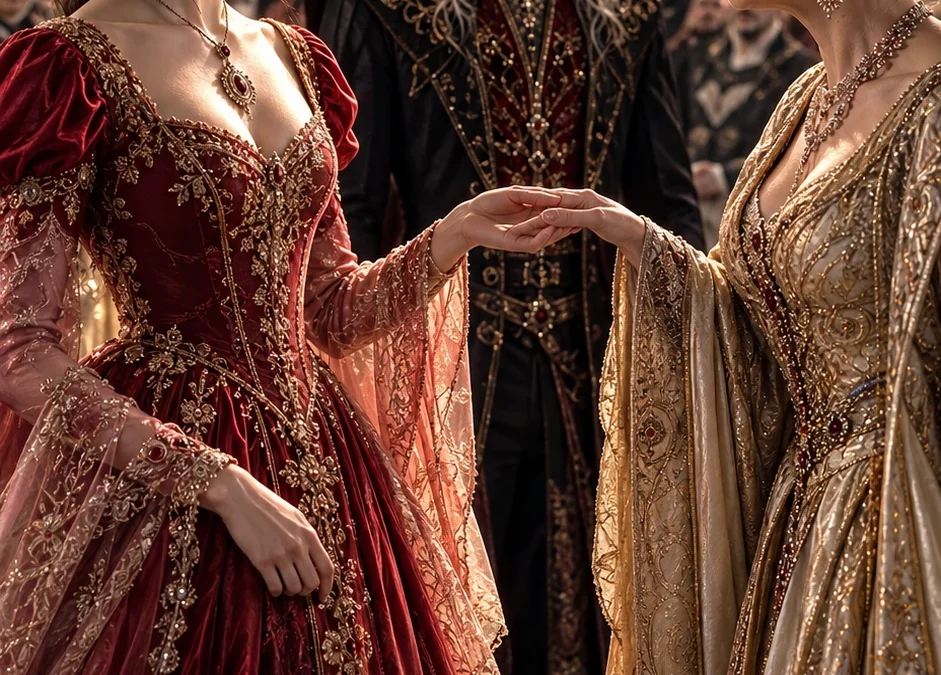
THE VAMPIRE KING MOCKED HER LINEN DRESS IN FRONT OF 500 IMMORTALS. THEN HIS ANCIENT MOTHER ROSE FROM HER THRONE FOR THE FIRST TIME IN 100 YEARS, POINTED AT THE NECKLACE AROUND HER NECK, AND WHISPERED ONE NAME THAT SILENCED THE ENTIRE PALACE 😱🩸
Part 1
When the vampire king mocked my linen dress in front of his entire court, five hundred immortal throats laughed at the same time. 🦇
None of them knew that the oldest and most feared woman in the kingdom was about to rise from her throne for the first time in a hundred years. And that she would do it for me.
My name is Isabela.
On the night of the Winter Gala, I was twenty-two years old, with three silver coins in my pocket and a raw linen dress my grandmother had sewn by hand before she died.
Let me tell you how I got to that golden door.
I grew up in a stone house at the edge of the Valdemora forest, where winter lasts eight months and the fog never fully lifts. My grandmother Elvira raised me alone. We were poor in the real way. Counting candles. Patching the same cloak for ten years. Eating bread with lard and saying thank you.
But she had something poverty could never take. An ancient, exact, almost holy elegance.
She taught me to walk with my spine like a lit candle. She taught me to pour tea without the porcelain making a sound. And she taught me a bow I never saw anyone else perform.
The old form. Left hand over the heart. Right knee barely grazing the floor. Head lowered to exactly the height of the other person’s eyes. Not one inch lower.
“The head bows for respect, Isabela. Never for fear. Lower is fear. Higher is arrogance. The old form lives in the exact spot between.”
“And who’s going to ask me to bow, Grandma?” I laughed, hands full of flour. “The chickens?”
“One never knows who will be standing tomorrow.”
Something in her eyes went dark, like a window closing.
She died in February, in her sleep, hands crossed on her chest as if even death had been received with protocol.
She left me the house, her sewing needles, a box of letters I wasn’t allowed to open until I turned twenty-three. And a medallion.
Old silver. A seal engraved on it that I didn’t recognize: a tower split by lightning, wrapped in thorns, with three words beneath it in a language that wasn’t ours.
“When they ask who you are,” she told me on her last night, her voice thin as paper, “don’t answer with your name. Show the seal. The seal answers better.”
“Who’s going to ask me that?”
“Someone who has been crying for sixty years, child.”
I thought it was the fever talking. God forgive me.
The invitation came in October. A black envelope sealed in red wax, delivered by a messenger with skin too pale, who left no breath-fog in the freezing air.
The crown of the night invited one representative from every family of Valdemora to the Winter Gala. A gesture of peace between the immortals and mortal bloodlines.
Everyone knew what that really meant. Every hundred years, the vampire king opened his palace to mortals for a single night. Political theater dressed as hospitality.
For some reason I didn’t yet understand, my family was in the registry. And as the last of my blood, the invitation was mine.
“Don’t go,” the baker told me, crossing herself. “That kind plays with mortals like cats with mice.”
“If I don’t go, the village pays for the insult. And if I go, what can they take from me? Three coins?”
I had no gown. No jewels, except the medallion. So I took down the linen dress my grandmother made for my birthday, plain as a sheet of paper, no embroidery at all, and pressed it until the seams were straight as lines of writing.
I braided my hair the way she taught me. Fastened the medallion. And told the mirror, out loud:
“The head bows for respect. Never for fear.”
The carriage was black, pulled by horses that never sweated. Six hours of frozen roads, watching the known world fall behind. Then, on a cliff that cut the sky, the Nocturnal Palace, a thousand windows burning with a blue light not of this world.
The ballroom was so vast its columns vanished into darkness. Black crystal chandeliers floated without chains. Ice carved into swans. Fruit from no season. A vampire orchestra with flawless faces playing strings that sounded like mourning.
And them. The court of the night. Five hundred immortals in velvet the color of dried blood, brocade worth more than my entire village.
When I walked among them in my linen, the conversations went out one by one, like candles pinched by fingers.
The first giggle came at ten steps. The second at fifteen.
“Is that a guest, or has a washerwoman wandered in?”
A woman with black-painted lips, just loud enough for me to hear. Vampires always measure the exact volume of their cruelty.
I kept walking. Spine like a lit candle.
At the far end, on an obsidian dais, stood two thrones. One held a tiny figure wrapped in gray veils. The Queen Mother, someone whispered. The oldest creature in the realm. She hasn’t left that throne in a century. Even the clan elders fear to look at her.
And on the other throne, crystal glass between his fingers and the most elegant boredom I have ever seen, sat King Alaric of House Draven.
He was beautiful the way dangerous things are. Black hair to his shoulders. Marble skin. Eyes gray as an old coin. Four hundred years on the throne, and clearly two hundred since anything had surprised him.
I didn’t know yet that every gala needed a victim. That the king always chose someone to be the target of one perfect line the court would celebrate for a decade.
I didn’t know that tonight, it would be me.
A chamberlain pounded his staff and announced my name. It meant nothing to anyone. I stepped to the foot of the dais to pay my respects.
King Alaric looked me over, slowly, like a man choosing words for an audience. He tilted his head and smiled.
The whole room held its breath, delighted. They knew that smile.
“How touching,” said the king, his voice reaching the farthest corner without rising. “The provinces sent us the tablecloth. They forgot the table.”
The hall exploded.
Five hundred perfectly tuned voices laughing in the same key, like an instrument he played with two fingers. It bounced off the onyx columns, climbed the chandeliers, fell on me from every direction.
I stood in the exact center of that ballroom, wearing the dress my dead grandmother had stitched by one candle, because we couldn’t afford two.
I’ll confess something. For one second, my eyes burned.
And then I heard her voice, clear as if she stood behind me fixing my braid.
The head bows for respect, Isabela. Never for fear.
I waited. I let the laughter wear itself out. And I discovered something strange: laughter with no answer starts to sound nervous at the end.
Into that silence, I performed the old bow. Held it for three seconds, the length of sincere respect. Rose. And spoke in a voice that did not tremble, because I had pressed it along with the dress.
“His Majesty is right. It is linen. Woven by an old woman with arthritic hands, by candlelight, so her granddaughter wouldn’t be cold. Where I come from, we call that wealth. I’m sorry it can’t be seen from a throne.”
I didn’t say it with anger. Anger is a gift to the one who mocks. I said it with the calm courtesy of someone announcing the time.
It landed like a knife on a glass table.
The king blinked. The court hadn’t seen that in two hundred years.
And then I heard it. First, the rustle of ancient fabric, like pages of a book no one had opened in a century. Then a gasp from a lady-in-waiting. Then the most impossible sound of that impossible night.
The strike of a silver cane against obsidian.
The Queen Mother was rising from her throne. 😳
All five hundred vampires took one step back at the same time. The king’s glass shattered on the floor. And she lifted a hand like bone, pointed at my throat, and said in a voice like a thread of tarnished silver:
“That seal. Child… where did you get that seal?”
🔥 Want Part 2? Comment “PART 2” below or drop any word and I’ll send it to you privately! 👇
Part 2
“That seal. Child… where did you get that seal?”
My fingers rose on their own to the medallion. The tower split by lightning. The thorns. The three words I couldn’t read.
“It was my grandmother’s, my lady. She wore it every day of her life.”
“Your grandmother.” The cane trembled against the marble. “And that bow. Hand on heart. Knee that grazes and doesn’t rest. Head at the height of the eyes. Who taught you that bow?”
“She did. She said the head bows for respect, never for fear.”
And then I saw something the night court had never seen in all its existence. The most ancient and feared creature in the kingdom began to cry. 😢
Tears of the very old are not like ours. They are thin, silver as mercury, and when they fall, they ring like tiny bells.
“Sixty years,” she whispered. “Sixty years I’ve said that sentence in my head every night, in her voice.” She took my hand with a strength that didn’t belong to that bird-sized body. “Who are you, child? Tell me everything.”
“Isabela, my lady. Isabela of Valdemora. My grandmother’s name was Elvira.”
The silver cane fell from her hand and cracked against the floor like a gunshot.
“Elvira,” the Queen Mother breathed, and the name broke in her mouth. “Elvira of Valdemora. My sworn sister. The woman who carried me burning out of the siege of Dragenfeld with her bare mortal hands.”
She turned to the kneeling hall. To her son, the king, frozen beside his throne.
“The woman this crown owes its very existence. And this crown let her die in poverty.”
Her voice swelled into thunder. The chandeliers shook.
“ON YOUR FEET, ALL OF YOU. Stand before the granddaughter of House Valdemora. And let no child of the night ever laugh at this linen again. This linen is worth more than every silk in this hall combined.”
Five hundred vampires rose. And slowly, in a velvet whisper I will never forget as long as I live, five hundred of them bowed to me.
I looked for the king without meaning to. Maybe you always look for the eyes of the one who wounded you, to see if he understood.
He stood by his throne, pale even for a vampire, looking at me the way you look at a fire. And on his perfect face was something no courtier could name, because they’d never seen it there.
It was shame.
The Queen Mother didn’t release my hand all night. She led me herself to the dais, ordered a chair placed at her right, the side of honor, and studied my face like a map of a country where she’d once been happy.
“You have her chin,” she murmured. “And her way of never lowering your eyes.”
Hours later, in a private chamber hung with gray velvet, she told me the story my grandmother carried sewn inside her.
“Sixty years ago, before you were born, our kingdom nearly fell. The Eclipse Wars. Traitor clans allied with hunters from the south, and they trapped me in Dragenfeld. They burned the east wing with alchemical fire, a fire that burns even the immortal. My own guards fled. Eternal blood makes cowards of many, child. Those with centuries ahead have so much to lose. And do you know who walked into the flames for me?”
“My grandmother.”
“She was twenty-five. Three times she went in. The third time she carried me out with her back on fire, and still had the humor to say, ‘My lady, you weigh less than my conscience.'”
Her smile was the saddest I have ever seen.
“We mixed our blood that night. Sworn sisters. I promised that as long as there was a throne in the night, there would be a place of honor for Valdemora.”
“What happened?”
She took a long time to answer. The wind hit the leaded glass.
“Betrayal, child. Two years later, someone accused your house of conspiring with the hunters. Forged letters. Bought witnesses. Your great-grandfather died waiting for a trial that was conveniently delayed. Your lands were seized and divided. And the royal archive that held our blood oath burned in what everyone called an accident.”
The wood of her armrest cracked under her fingers.
“I was in the blood-lethargy then, the sleep that takes the very old for decades. When I woke, House Valdemora was gone. They showed me graves. I searched for Elvira for years. Nothing. Someone had erased even her trail.”
“She never said a word,” I whispered. “She sewed wedding dresses for farmers’ daughters. She sang while she cooked.”
“Because she was a soldier. And because she understood before I did what took me sixty years to accept. The betrayal didn’t come from outside. It came from this court. From someone powerful enough to forge royal seals, buy judges, and burn an archive guarded by immortals.”
Her golden eyes sharpened.
“Someone who profited from your family’s fall. And who is still sitting in this palace, child. Drinking from my cups. Smiling down my corridors.”
My skin went cold.
In the days that followed, I lived inside a broken mirror. Everything beautiful. Everything sharp.
The maid assigned to me, Casilda, a three-hundred-year-old vampire with a lightning tongue, was the first to treat me like a person instead of a scandal.
“Half the palace says you’re a trained impostor,” she told me, brushing my hair. “The other half says you’re the Queen Mother’s revenge with legs.”
And the king kept appearing. In the library. In the night greenhouses. In the cypress courtyard. Always coincidentally. Always with a perfect line ready.
And I did the one thing no one had done to him in centuries. I treated him like furniture. 🪑
Then, one night, Doña Piedad, the stooped, gentle chief archivist who had been helping me trace my family’s genealogy, caught me at dawn. Her hands trembled, stained with two centuries of dust.
“Miss… the trial records against House Valdemora burned, everyone knows that. But last night I found something that doesn’t add up. The archive inventory was written in triplicate. Two copies burned. The third was sent by law to the Monastery of Santa Humbría, up in the mountains.”
She lowered her voice until I had to read her lips.
“And on that inventory, miss, there’s a sealed accusation your great-grandfather filed three days before he died. Naming a forger. Only by his initials.”
“What initials, Doña Piedad?”
The old woman looked over her spectacles at me, and her hands shook harder.
“B.M.”
Baltazar de Morcastel.
The Chancellor. The most beloved man in the entire court.
And in the Nocturnal Palace, the walls don’t listen. The walls tell. 👁️
Three floors above us, in that very hour, the Countess Vespera was walking into her brother’s office without knocking, locking the door behind her, and saying the words that would set everything in motion.
“We have a problem in the archives.”
And the Duke, the man who remembered everyone’s birthday, kept signing documents with his golden pen and answered without looking up, with his usual kind smile:
“Problems of paper, sister, are solved the way they always have been.”
“With fire.”
👍 Want to see Part 3? LIKE or COMMENT “REVEAL” below! Part 3 will be posted once we hit enough comments! 👇
Part 3
The archive fire began two nights later, in the dead hour when even vampires lower their guard. That blue hour between the end of night and dawn.
The screams woke me, then the smell. A sweet chemical smoke with a bitter edge that made my skin crawl before I knew why.
Then I knew. Alchemical fire. The same fire as Dragenfeld. The same fire from sixty years ago.
Old criminals always return to old tools.
I ran through the corridors in my nightgown, against the current of fleeing servants, thinking of one thing. Doña Piedad slept in a tiny room beside the archive, among her papers, like a bird in a nest.
The guards found her before I did. Alive. Thank the eternal night. But her hands were burned, and she was barely conscious. The whole ancient wing was a throat of green fire no vampire could cross.
Almost nothing saved, they said. Almost.
Because when I laid her in my own bed and Casilda tended her hands, Doña Piedad opened one eye, found me, and with bandaged fingers made the smallest gesture toward her scorched apron.
Inside the inner pocket, folded eight times, wrapped in a lead case the poor woman had carried on her body since the night she told me about the inventory, was the inventory.
“Old papers, miss,” she whispered, with half a broken smile, “are kept far from fire. First lesson of an archivist.”
I cried. I kissed her bandages. And then I stopped crying, because the time for crying was over.
By morning the palace was wrapped in theater. Duke Baltazar himself directed the rescue, moved, tireless, magnificent. He donated gold from his own treasury to restore the archive. He proposed a tribute to Doña Piedad, wounded in the line of duty.
“How admirable the Duke is,” I said aloud, in the middle of a ring of courtiers.
“Admirable,” they all agreed.
“He arrived dressed in ten minutes,” I added. “With gala buttons. Such reflexes.”
A tiny silence. A hairline crack. But I saw two courtiers exchange a glance, and in the night court, a glance is a seed.
The Queen Mother had taught me: fear is a magnificent gardener. I was learning to plant.
That night I was summoned to her chambers. And she wasn’t alone. Standing by the fireplace, crown off, was the king.
“Sit, child,” she said. “It’s time the three of us spoke without court, without protocol, and without lies.”
I laid the lead case on the table and told them everything. The inventory. The monastery. My great-grandfather’s sealed accusation. The initials.
“Baltazar de Morcastel,” Alaric said slowly, dragging a hand over his face. “The man who runs my tribunals, my archives, my treasury. The man I trusted with half the kingdom because he was always there, always solving, always smiling.” A laugh with no joy. “Mother, if this is true, the killer of House Valdemora has spent half a century signing with my pen.”
“If it’s true, your court was built on the corpse of my sworn sister, son. And your famous wit laughed at the last scrap of her linen.”
The king took the blow without dodging. “Yes. I laughed. I’ll carry that as long as it takes. But tonight, something else matters.” He turned to me, and for the first time he spoke to me as an equal. No fencing. No gallantry. Soldier to soldier. “Miss Valdemora, the inventory proves the documents existed. Not what they said. If the Santa Humbría copy survives, Morcastel will send men with fire the moment he confirms it.”
“Then we get there first,” I said. “Three days through the mountain passes.”
“I’ll go.”
“No,” said the Queen Mother and I together.
“You can’t vanish for three days without Morcastel smelling it, hijo. The girl goes, with guards from my old house. The ones from before the Eclipse. The ones who owe nothing to anyone. And she goes as what the world thinks she is. A poor girl from Valdemora going home. Nobody looks twice at a linen dress. You proved that yourself before five hundred witnesses.”
The king closed his eyes. The arrow was clean, and it came from his own mother.
“Fine,” he said at last. Then he looked at me, and the gray eyes held something that looked dangerously like fear of losing something. “Miss Isabela.” It was the first time he’d said my name. He said it carefully, like lifting someone else’s porcelain. “Come back. This palace has become strangely unbearable in the hours you’re not arguing with me.”
“I’ll try, Majesty. I still have several arguments to win.”
And though the night was grave and the green fire still lingered in the halls, all three of us smiled.
I left for Santa Humbría the next night in a patched cloak, with six of the Queen Mother’s old guard disguised as muleteers. Their captain was Ulrick, an old, silent vampire with a scar splitting his eyebrow.
On the second night we found the pass inn burned. Still warm.
The innkeeper, hiding with his family in the stable, told us that riders in unmarked livery had asked the way to the monastery. One said as they left: “No one climbs after us.”
“How many?” Ulrick asked.
“Eight. With green flasks in their saddlebags.”
They meant to burn the monastery with the copy inside. Probably with the monks inside. They’d call it an accident. The world would say what a tragedy and go on eating dinner.
“We’ll arrive too late,” said Ulrick, staring at the snow. “They have half a day on us.”
“Then we don’t take the road,” I said.
Everyone looked at me.
“I grew up in these mountains, Captain. Roads were built for mules and tax collectors. The poor have always had other paths.” I pointed to the black, vertical north face under the stars. “Smugglers’ ledges. My grandmother showed me as a child. She called them the veins of the mountain. She said a Valdemora must know the veins of her land, even when the land is no longer hers.”
“Those ledges, with ice, are death, miss.”
“So is alchemical fire, Captain. And it doesn’t negotiate.”
He held my gaze a long moment. Then he did something no vampire at court had done for me. He struck his chest with his fist. The war salute of the old guard.
“The Valdemoras were always this impossible. It’s an honor, miss. Lead.”
We climbed all night, single file, pressed to the rock, the abyss whistling below. And as the ice bit my fingers into the cracks my grandmother had taught me to read, I understood something that warmed me more than any fire.
Every hard thing poverty had forced me to learn was becoming an exact weapon at the exact moment.
The king had five hundred courtiers, four hundred years, and a palace. I had the veins of the mountain. And I wouldn’t have traded.
We reached Santa Humbría at dawn, half a day ahead of Morcastel’s riders. The abbot, a tiny man, deaf in one ear, who’d spent forty years guarding papers no one came to read, studied the inventory and the Queen Mother’s seal for a long time. Then he said:
“Sixty years, miss. Sixty years waiting for someone to climb for these papers. My predecessor left word: one day someone will come from the tower and the thorns. Open the chest for no one else.” His eyes filled. “I was dying of doubt, you see.”
The chest lay in the crypt under three keys and a slab. Inside, wrapped in wax and linen, better preserved than the memory of the entire court: the blood oath between the Queen Mother and Elvira of Valdemora, two signatures, one in ink and one in blood that sixty years hadn’t fully darkened. The service records of my house. Ten generations guarding the frontier. Three wars. Forty-one dead, with names.
And my great-grandfather’s sealed accusation.
We opened it right there, with the abbot as witness and a notary from the valley Ulrick had hauled up on a mule. He wrote in a soldier’s hand, straight, without adornment, and every line was a nail.
Baltazar de Morcastel, then secretary of the tribunal, had forged the hunters’ correspondence using seals stolen from the very archive he guarded. Two witnesses had received gold from his sister’s hand. And the writer had recognized the forger’s hand because he closed his capital letters with an inverted hook, a habit he couldn’t disguise.
If this accusation never reaches trial, he wrote, let whoever reads it in the future know that House Valdemora fell for loyalty, not for treason. And let my children walk with their heads at the height of anyone’s eyes.
At the height of anyone’s eyes.
I had to sit on the crypt floor. The abbot put a hand on my shoulder and said nothing, because men who guard papers know when a paper weighs more than a tombstone.
No time to grieve. The riders would arrive with the night. And Ulrick smiled for the first time all journey, a smile I was glad was not aimed at me.
“Miss, we have half a day, six guards of the old school, a monastery with one entrance, and eight arsonists who think no one is expecting them. Know what that is in military terms?”
“What, Captain?”
“A gift.”
The monks took the valuable manuscripts down to the crypt. The guards put out every light in the monastery except the library’s, so the moth would see the flame. And when the eight riders in unmarked livery came through the single door at midnight, green flasks and torches in hand, they found an empty library, windows boarded from outside, and Ulrick’s calm voice from the choir loft.
“Gentlemen. You’re under arrest in the name of the crown for arson, conspiracy, and interrupting matins. The first two are paid for with trial. The third I collect personally, and I wish it on no one.”
There was a fight. I won’t lie. They knew what awaited them if they talked. But the Queen Mother’s old guard had not forgotten their trade. By dawn all eight sat bound in the chapter hall. The youngest, whom Ulrick spoke to quietly in a corner for ten minutes, signed before the notary a confession with names, dates, and payments.
The name that appeared most often closed its capitals with an inverted hook.
We returned by the king’s road, in plain sight, papers in a chest and prisoners in a line, because there was nothing left to hide. Now silence was the enemy’s friend, and light was ours. In every village, Ulrick had the crier read one line under the Queen Mother’s seal: House Valdemora returns to the protection of the crown.
And something happened we hadn’t expected.
In the third village, an old man pushed through the crowd, looked at the medallion at my throat, the tower and thorns, and took off his hat. Then his son. Then the entire village.
An old shepherd cried out in a broken voice: “My father served with the tower, girl! He always said it was a lie!”
And I understood that the archives of the powerful can be burned. But there is another archive, the one belonging to simple people, where truth is stored in triplicate in every generation. And no alchemical fire reaches that one.
We reached the palace under a full moon. And waiting for me was a scene no night of poverty had prepared me to imagine.
The king was standing on the front steps. Not on the throne. Not on the dais. On the steps, outdoors, crownless, coat thrown on carelessly, like a man who had been going out to watch the road for hours.
When the carriage stopped and I climbed down, cloak patched and hands still bandaged from the rock, King Alaric took the stairs two at a time. He stopped one pace from me. He looked at the bandages. I saw him want to take my hands. I saw him hold back, because I hadn’t given permission, and that man was learning, at four hundred years old, that people must be asked.
“You’re hurt.”
“It’s exaggeration. The mountain greets firmly.”
“They told me you went up the northern ledges, with ice, at night.” His voice was rough. “Eight arsonists, Isabela. Eight.”
“We outnumbered them, Majesty. You just count badly.”
And the king of the night laughed, in front of the guards, the coachmen, the prisoners, and the moon itself, with that new laugh that had loosened in him since the night of the fox and the hen. Then, very slowly, so I could refuse, so everyone could see I could refuse, he took my bandaged hand in both of his like a bird with a broken wing.
He bowed his head and pressed it against my knuckles. A long moment.
It wasn’t a courtier’s kiss. It was a king of the night lowering his head in public. Far below the height of my eyes.
“Welcome home,” he said.
And God forgive me, I was still the granddaughter of the woman he mocked. My resentment was my spine, and I needed it for what was coming. But when he said home, something small and tired in me, an orphan since February, curled up inside that word like in a warm bed.
The Queen Mother examined the oath with her golden eyes, and when she touched my grandmother’s blood signature, she traced it with one slow finger, the way you touch the cheek of someone sleeping.
“Good,” she said at last, her thread-voice edged like a sword. “We have the accusation, the confession, the inventory, and the oath. We have the fox by the tail.”
“Then we arrest him tonight,” said the king.
“No,” his mother and I said at the same time.
The king threw his hands up and muttered something about the unbearable habit of the women of his house to tell him no in stereo. His house. Nobody corrected him. Neither did I. Keep that detail.
“If you arrest him tonight,” the Queen Mother explained, “half the court, which owes him gold and secrets, will rush to burn what remains and swear they knew nothing. No, son. We won’t arrest Baltazar de Morcastel. We’ll invite him.”
She smiled with all her teeth.
“Convene the full court tribunal in seven nights. Announce the solemn review of House Valdemora’s restoration. Give the fox seven days and a stage. Guilty people with an audience, child, you’ve learned this, commit their finest mistake.”
Seven nights. And remember them, because everything happened in them. The whole court choosing sides like passengers choosing cabins on a sinking ship. The king and me waging the strangest war that palace has ever seen. And Duke Baltazar, cornered and smiling, preparing his filthiest blow.
During those seven nights, King Alaric of House Draven launched the most humiliating campaign of his four hundred years.
Courting a woman who wasn’t afraid of him, owed him nothing, and didn’t need him.
He started badly, naturally. The first night he sent a ruby necklace from the royal treasury with a note: So the linen may have worthy company. I returned it with another note: Linen doesn’t need company, Majesty. It needs memory. Rubies remember nothing.
Casilda swore the king locked my note in his desk drawer.
The second night, he appeared at the library door with something wrapped in cloth and the face of a man committing the greatest imprudence of his reign. “It isn’t a gift,” he rushed to clarify. “It’s a restitution.”
A book. Old, worn covers. The Chronicles of the Northern Frontier. The register of the guardian houses, where ten generations of Valdemora appeared with names and deeds. Removed from the royal library fifty years ago by administrative order, signed by the chancellery. By Morcastel.
“Page two hundred forty,” he said, awkward as a student. “There’s a captain who held the Raven Pass for three days with twenty men. They describe her as impossible to frighten and with a tongue improper for her rank. It sounded familiar.”
I accepted the book. Restitutions, yes. Gifts, no. He learned fast when the subject interested him.
The third night I found him in the kitchens.
Read that again. The king of the night in the palace kitchens, sleeves rolled, letting the head cook teach him how to knead northern rye bread. The bread I’d mentioned exactly once, in passing. The bread of my childhood. He had flour to his eyelashes, and his loaves came out like funeral stones.
“Your third one is burning, Majesty.”
“It isn’t burned. It’s intensely baked.” He kept pounding the dough with fierce clumsiness. “Somebody told me what I broke can’t be bought. It’s rebuilt with hands, slowly. I’m starting with bread. Bread tells you when you do it wrong, and in this palace no one tells me anything anymore.”
I sat on the kitchen bench by the oven, where I used to sit as a child. And that night the king and I talked for three hours with flour and without crowns. About my grandmother. About his father, dead in the Eclipse Wars. About growing up heir to everything, and heir to nothing, and how by opposite roads we’d both learned never to show anyone our throats. His fourth loaf came out edible. We split it hot.
I swear by the memory of Elvira of Valdemora that no banquet of the night court ever tasted like that. 🍞
The test came on the fifth night, and I didn’t arrange it. The Countess Vespera did, who in her desperation made the classic mistake of the cruel: believing cruelty always works because it always has.
At the great council dinner, with two hundred courtiers present, in the silence between two courses, she rose with her glass, beautiful as a well-served poison.
“A toast to Miss Valdemora, who has so enlivened our season. And, Majesty, in honor of old times, I propose an entertainment. Grant us one of your famous semblances. The one about the tablecloth, for example, was exquisite. Those of us who weren’t near that night deserve to hear it from your own lips.”
Two hundred pairs of eyes swung toward the king like a single animal.
A perfect trap. If he repeated the joke, I was lost forever, and Morcastel would have me alone before the court again. If he refused clumsily, he’d look dominated by a weak provincial, and the Duke’s faction would harvest the humiliated.
I saw him set down his glass. I saw the Queen Mother narrow her golden eyes. I saw Vespera savor her second of glory.
“The Countess is right,” said King Alaric, rising. “I owe you a semblance.”
My heart fell to my knees.
“That night,” the king continued, sweeping his gaze across the tables with all his centuries of calm, “I saw a linen dress enter my ballroom and said the provinces had sent us the tablecloth without the table. Five hundred people laughed. It was technically a triumph.”
A pause.
“This week I read the Chronicles of the Northern Frontier. Do you know what linen cost in the Eclipse years, gentlemen? Nothing. It was the one thing not requisitioned for the war. The guardian houses wore linen because wool was for soldiers, silk for paying informants, velvet for shrouding their dead. On the frontier, linen was the uniform of those who gave everything.”
He raised his glass toward me. His voice didn’t tremble, but it didn’t fence either. For the first time in four hundred years, the king of the night spoke naked.
“That night I made five hundred people laugh with the uniform of the house that guarded the sleep of every one of them for ten generations. That is the complete semblance, Countess. The joke was me.”
Cathedral silence. Two hundred courtiers staring at their plates, because every one of them had laughed that night, and the king had just handed the laughter back with interest.
Vespera stood with her glass raised, alone, a statue of her own toast.
“Aren’t you drinking, Countess?” I asked pleasantly from my seat. “Your poison will get warm.”
I swear I couldn’t help it.
And I swear the laugh that burst from the Queen Mother, the first in a hundred years according to the archivists, will ring in that palace’s chronicles until the columns fall.
But while the court discovered which way the wind blew, in the purple-and-gold wing the Morcastel siblings were no longer discussing winds.
The captured arsonist had vanished from his cell that afternoon, with bribed guards in the mix. And Duke Baltazar, always smiling, always immaculate, unrolled on his desk a plan with three names and a date. The date was the tribunal. The first name was mine. And the other two, God help us, were the kings’.
On the sixth night, the eve of the tribunal, I didn’t sleep. And thank heavens. I was in my chambers reviewing documents with Doña Piedad when Casilda came in without knocking, a thing she’d never done, her face the color of ash.
“Miss, the tea. The tea they brought up an hour ago, on your table. I didn’t order it from the kitchens, and the girl who delivered it isn’t from this wing. I just saw her slip out the service passage toward the purple wing.”
The three of us stared at the steaming teapot like a sleeping viper. Doña Piedad dipped a silver spoon and held it to the light. The silver clouded with a delicate gray veil, like breath on glass.
“Black nightshade tear,” she whispered. “It doesn’t kill, miss. It does something worse. It clouds. Confuses the tongue, erases names, tangles memory for a day. Whoever drinks it tonight tomorrow before the tribunal couldn’t string two sentences together.”
There was the fox’s plan, or so we thought. A stammering plaintiff before the entire court. The impostor of Valdemora couldn’t even recite her invented story. Case closed amid laughter. More laughter.
“No one touches that teapot,” I said. “Casilda, bring an empty flask. Doña Piedad, can you certify the poison before a notary tonight?”
And then, while we decanted the tea with the hands of church thieves, came three knocks of an iron fist at the door.
Ulrick’s voice. And for the first time since I’d known him, it sounded afraid.
“Miss, are you all right? Open up.”
He came in with four guards and didn’t look at me. He looked at the teapot, the flask, the gray spoon, and understood everything in an old soldier’s glance. Then he said the sentence that froze my blood.
“Miss… you’re not the only one. They just caught the Queen Mother’s chief cupbearer leaving the royal cellars with an empty green flask. But the cupbearer tastes the Queen Mother’s cup in front of her. He’s done it for two hundred years. He couldn’t have poisoned her without falling first. I don’t understand the plan. Something’s slipping past us.”
It was Doña Piedad, the woman of details, who saw it.
“The cupbearer tastes the Queen Mother’s cup,” she said slowly. “And who tastes the king’s?”
Silence.
“No one,” Ulrick answered, going pale. “The king abolished the post a century ago. He said a king who fears his own cup doesn’t deserve the table.”
“What time is it?”
I looked at the clock on the wall. Midnight.
The hour when the king, every night, as the whole palace knew, drank his last cup alone in his study while reviewing dispatches. A four-hundred-year routine.
Assassins love routines. 🩸
I don’t remember deciding to run. I remember the corridor flying backward, the tapestries like smears, Ulrick shouting orders behind me, and one cold, perfect certainty drilling my chest.
The tea in my room was never meant to confuse my tongue. With the tribunal twelve hours away and the entire court as witnesses, the fox didn’t need fog. He needed a dead king and a foreign upstart to hang the crime on. The tea on my table wasn’t for me to drink. It was for them to find.
The girl who delivered it would testify I’d served it. The accusation, the tribunal, my restoration, everything would be buried under the only headline that would matter in a thousand years. The mortal who poisoned the king of the night.
I reached the study doors with my lungs on fire.
Two guards crossed their halberds. “No one passes at this hour, miss. Orders.”
“The cup!” I screamed. “They’ve already brought up his cup!”
And through the gap of the half-open door, I saw the whole picture, sharp as an engraving. King Alaric standing by the fireplace with dispatches in one hand and in the other, already raised, already touching his lips, the silver cup.
I did the one thing a woman of Valdemora does when words won’t arrive in time.
I ducked under the halberds, crossed the study in four strides, and tore the cup from his hand with a slap that sent it crashing into the fireplace. The wine hissed on the embers.
Hissed.
Wine does not hiss. And where the drops landed, the flames turned for three long seconds a deep, chemical green that two people in that room knew far too well.
Alchemical fire. Essence of it, in the wine. Not fog. Not nightshade. The only substance under the moon capable of burning an immortal from the inside out. The same signature as Dragenfeld, as the archive, as the pass inn.
Old criminals always return to old tools.
The study filled with guards, shouts, drawn steel. I stayed where I was, trembling from head to foot now that my body could afford it, wrist aching from the slap. And the king wasn’t looking at the green fireplace, or the guards, or the dented cup on the floor.
He was looking at me.
“You…” his voice failed. The king of the night’s voice failed. “You just crossed half the palace in your nightgown to knock a cup from a vampire king’s hand.”
“I knocked a cup from a man about to drink poison. That he was also a king, I didn’t check.”
“Tomorrow that tribunal decides your name, your house, everything you’ve sought. If I’d died tonight, you’d have been the first suspect. You knew that.”
“I thought of it while running.”
“I know you. You think while running. You knew that entering here was putting a rope around your neck, and you came in anyway.”
“Well,” I managed, in a thread of insolent, exhausted voice. “Somebody in this palace had to teach His Majesty that some things aren’t bought. They’re done with the hands. Slowly. Like knocking over cups.”
And then King Alaric of House Draven, in front of twelve of Ulrick’s guards, Casilda, and the Queen Mother herself, who arrived at that moment like a small storm wrapped in gray veils, did what no court chronicler had recorded in four hundred years.
He knelt.
Both knees. In the floor of his own study, between the poisoned wine and the dented cup. He took the hem of my nightgown, the humble provincial fabric, and brought it to his lips like another man would kiss a relic.
“My whole life they taught me eternal blood makes us superior,” he said, head bowed, far below the height of my eyes. “Tonight a mortal in a nightgown crossed my palace barefoot to save the man who humiliated her before five hundred witnesses. I don’t know what that’s called in the mortal tongue, Isabela of Valdemora. In the ancient one it has a single name, and I don’t dare say it yet, because I haven’t earned it.”
The Queen Mother said from the doorway, in a perfectly serene voice, “You’re earning it, son. Now get up. There’s a fox to catch, and you’ve been kneeling since dawn.”
But I barely heard her. Because at that moment, with the hem of my nightgown still between his fingers, the king lifted his gray eyes to mine. And somewhere very deep in my mortal blood, something ancient turned over and stood up.
For the first time, I understood, with a vertigo I wish on no one, what he’d meant in the kitchen. Like recognizing a wound you didn’t know you had.
By the next night everything pointed cleanly at the purple-and-gold wing. The cupbearer was in custody, the poison certified, the tea girl had wept the name of whoever paid her.
What we didn’t know was that Duke Baltazar de Morcastel, smiling in the dark of his study after his poisons failed, had just opened the last drawer of his desk. The lowest one. The one you open when there’s nothing left to lose.
And from that drawer came no flask, no letter, no gold.
Out came a black parchment sealed in gray wax, with a seal that made the Duke’s own hand tremble as he touched it.
The Blood Summons. The oldest and most terrible right of the clans. The one no king can refuse without breaking the very law that holds him up.
The fox no longer wanted to escape the trial. The fox wanted to turn the trial into a battlefield.
The court tribunal met the following midnight in the very ballroom of the gala. The Queen Mother demanded it. Where the mockery was planted, she said, justice is harvested.
Five hundred immortals again, but how different. No one laughing. The clans sat by color like armies. The Corbinos in storm gray, the Dravens in black, and at the front, immaculate, smiling, suicidal, the full purple and gold of Morcastel.
Duke Baltazar arrived last, greeting everyone by name, asking after everyone’s health, spreading his moneylender’s warmth as if tonight were one more dinner.
I wore linen. What else would I wear? White linen, newly sewn by my own hands in the small hours of that week, cut exactly as my grandmother taught me.
The accusation took three hours and it was a demolition.
Doña Piedad, bandaged hands raised before the entire court, presented the triplicate inventory and explained, in a patient teacher’s voice, how a kingdom’s memory is kept, and how it is murdered. The valley notary read my great-grandfather’s accusation. When he reached the line about capitals closed with an inverted hook, the tribunal’s chief scribe, on the Queen Mother’s order, projected two enlarged documents on a white cloth. A forged hunters’ letter from the trial sixty years ago. And an administrative edict signed by the Duke last month.
The hooks were identical. Five hundred immortal pairs of eyes compared them in silence. Half a century of impunity in a single handwriting.
Then the captured arsonist from Santa Humbría testified, brought from the secret cell where Ulrick had hidden him after faking his escape. A silent checkmate the fox had not seen coming. Then the tea girl, weeping, pointing at Countess Vespera. Then the cupbearer. Then the analysis of the wine, with the clouded silver spoon and the green flask and the alchemical fire burning in a brazier before the tribunal, so the whole court could see with their own eyes the exact color of treason.
And with each proof, I watched Duke Baltazar. And Duke Baltazar smiled, serene, almost paternal, like a man listening to children recite a lesson with mistakes.
That smile frightened me more than all the poisons.
When the tribunal president asked if the defense wished to speak, the Duke rose, smoothed his purple-and-gold coat, and said in his usual warm voice:
“I wish to congratulate the young lady on her tenacity. It is moving. Almost as moving as it is useless.”
And he drew out the black parchment.
The whole room recognized it before he unfolded it. The whole room stopped breathing. The Queen Mother straightened on her throne. Beside her, the king closed his hand on the obsidian armrest until it cracked.
“I invoke the Blood Summons,” said Baltazar de Morcastel, and his kind voice suddenly unfolded to its true size, cold and enormous as a slab. “First law of the clans, older than this crown and all crowns. When the honor of a founding house is questioned, the accused house may reject the judgment of papers and demand the ancient trial. The challenge before the assembled clans. My champion against the accusation’s champion. Blood decides what ink cannot.”
He swept his gaze across the room.
“Unless, of course, the crown prefers to trample the first law before the clans and explain to everyone which other laws it plans to trample next.”
It was diabolical, and it was perfect. If the king refused, he broke the founding law and handed Morcastel the clan rebellion he’d spent decades buying. If he accepted, our entire edifice of proof became a duel.
And Morcastel’s champion, who entered at that instant amid murmurs of dread, was Gundram the Red. An immortal mercenary two meters tall with a reputation for never losing a challenge in three hundred years. The most expensive blade ever bought.
“And the accusation’s champion?” the Duke savored each syllable. “House Valdemora, present, consists of a mortal of twenty-two. The law permits her to name a champion, of course. If she can find anyone willing to die for a cause about tablecloths.”
And there, ladies and gentlemen, there the old fox made his public mistake, the one the Queen Mother had been waiting for. One word. Tablecloths.
Reminding that court of the mockery. Reminding the king of it, in front of me, in front of his mother, in front of the entire night.
The silence that followed had a texture I have never felt again. Five hundred immortals understanding, one second before it happened, what was about to happen.
King Alaric of House Draven stood. Took off his crown. Set it carefully on the throne, like someone leaving something he might not recover.
He descended the obsidian steps. Crossed the whole ballroom beneath the black crystal chandeliers. And stopped at the exact spot on the marble where months ago a girl in linen had received his perfect joke.
Then he looked at me, and in that look he asked permission. And I, who had sworn to make him work for everything, discovered there were things that could no longer be charged to that man. I nodded.
“House Valdemora guarded the sleep of everyone here for ten generations,” the king said. His voice reached the farthest corner without rising, as it once had, only now it didn’t cut. It burned. “Its blood bought our borders. Its linen dressed our war. And when this court owed it everything, this court buried it amid laughter. And I conducted the orchestra.”
He turned to the Duke.
“Miss Valdemora has the right to name a champion. I offer her my sword. Not as king, for the crown stays on that chair. As Alaric of Draven, debtor to her house. If she accepts me.”
The Duke went pale for the first time in sixty years, because his ancient law had never contemplated madness. No king stakes his blood on another’s cause. That was the blind spot in all his calculations. Baltazar knew exactly what each person in that court was worth, and he couldn’t conceive of anyone giving something that didn’t trade.
Five hundred faces turned to me. And I said what a Valdemora should say.
“I accept my champion. And as tongue is my inheritance, I’ll add: try to return him whole. Gundram is learning to bake bread, and it would be a shame.” 🗡️
The duel was fought that same night in a circle of salt and ash the chamberlains drew in the center of the hall, according to the rite of the first law.
I won’t beautify it. It was brutal, and it was long. And there was a moment when Gundram’s greatsword caught the king across the shoulder and immortal blood spattered the marble, and I discovered I was praying. I, who hadn’t prayed since February. Nails dug into the chest of documents.
But Gundram the Red fought for gold, and three hundred years of gold weighs like gold. And Alaric of Draven, for the first time in four hundred years, fought for a debt.
It ended with the mercenary on his knees in the ash, disarmed, the king’s sword at his throat. The ancient law permitted killing him. The room waited for the death. Called for it, almost, with that old hunger of courts.
“Go,” said the king, lowering the blade. “And tell whoever hires blades in this kingdom that blood no longer decides. Truth decides.”
He turned toward the dais, toward the Duke. Bleeding. Disheveled. Crownless. More king than ever.
“The Blood Summons is satisfied, Chancellor. The first law spoke in your favor for sixty years. Tonight it changed its mind.”
What followed was swift as a landslide.
Countess Vespera, seeing the champion fall, tried to reach the doors with documents sewn into the lining of her cloak. The Queen Mother’s old guard was waiting at every exit, because the Queen Mother had spent sixty years learning the exits.
The documents were the Duke’s secret ledger. Every bought judge. Every paid witness. Every noble chained by debt. Sixty years of web, names and figures, kept by the fox himself, because blackmailers can’t live without their archives.
And Duke Baltazar de Morcastel, Chancellor of the Realm, the most beloved man in the court, was taken prisoner in the center of the gala ballroom. As the guards led him away, he was still smiling. Still greeting everyone by name.
And not one of the five hundred returned his greeting. 🌑
By dawn, before the assembled clans, the tribunal president read the verdict that sixty years of fire had not been able to burn.
House Valdemora was innocent of all treason. Restored in honor, lands, and seat. Recognized in perpetuity, by blood oath of the crown, as guardian house of the realm of night.
The Queen Mother wept her mercury tears, which rang like tiny bells.
And I finally opened my grandmother’s box of letters, the one I wasn’t to read until twenty-three. On top lay an envelope in her straight soldier’s hand: For the day they give us back our name. Because that day comes, Isabela. Archives burn. Truth doesn’t.
The letter was long and was mine, so I won’t share most of it. But there’s a part you must hear, or the ending won’t make sense.
Don’t hate the court on our account, child. Hatred is a tenant that pays no rent and keeps the house. We lost lands, titles, and our dead. And still I tell you, what they truly took from me was your right to walk without suspicion. Everything else I carried away on my person. The straight back. The bow. The exact point between fear and arrogance. That cannot be confiscated.
And if one day, daughter of my daughter, someone powerful laughs at you for being what you are, don’t wish him harm. Wish him the most terrible thing you can wish on the powerful. That one day he understands. The day he understands, the laugh will fall apart inside him. And if there’s any good beneath the vanity, that day another man begins. I have watched men be born of shame. Some of the best I ever knew were born there.
I read it on a March dawn by the window and cried everything I hadn’t cried since February of the year before. Then I folded it, tucked it beside the medallion, and thought of a man, four corridors away, being born of shame, with a bandaged shoulder and flour on his desk.
The sentence was carried out with the terrible thoroughness of night justice. Duke Baltazar de Morcastel was stripped of title, lands, and name. Condemned to perpetual exile in the Sun Cells of the north, where immortals don’t die, but don’t command either. For a man like him, the only true hell: a place where no one cared about his smile.
His stolen holdings were returned one by one, to my house and half a dozen others the secret ledger exposed. Restoration opened the door, and through it came others. Grandchildren of houses buried under bought trials. Widows of erased surnames. Simple folk who’d spent generations guarding medallions and papers and ancient bows in boxes of letters.
They called it the Tribunal of Memory. It sat two full years, and every restored house was another nail in the door of the old world.
Countess Vespera, who sold her testimony for clemency, received exactly the clemency she’d dispensed in life. They let her go free, intact, with a modest income, and condemned her to something no executioner administers better than a court: irrelevance. No one invited her again. No one feared her again. She went from poison to anecdote, which for a woman like her was the fall from queen to furniture. I saw her once more, years later, in a provincial market, haggling over the price of fabric.
It was linen. Life has a very fine sense of humor.
And the king kept his promise to rebuild with his hands, slowly. He came with me to Valdemora when I went to reopen the stone house. He insisted on coming without retinue, in traveling clothes, and the whole village leaned from their windows to watch the king of the night carry timber to repair the roof of a dead seamstress’s house.
He didn’t know how to carry timber. He learned. He hit his thumb twice, and both times the baker, the same one who’d told me don’t go, handed him cold water and ended up telling him the life story of every neighbor. Because that was the other change. The king had learned to ask. Names. Stories. And to listen to the whole answer without fabricating a line while the other person spoke.
“Your method is exhausting, Miss Valdemora,” he told me one night, sitting on my village kitchen step, thumb bandaged, a loaf of rye cooling between us. By then, his two hundredth. Now perfect. “Four hundred years believing I knew my kingdom because I knew its taxes. Turns out the kingdom was this. People who tell you their lives if you hold their gaze. Roofs that teach more than state councils. Bread that warns you. Everything worth having demands hands.”
He glanced at me sideways. “And can’t be hurried. You can’t rush the oven without burning the loaf. I’m learning not to rush the oven, Isabela, even if it costs me centuries.”
He knew exactly what he was saying. So did I.
By then the entire court, the entire kingdom, even the baker’s hens knew that the king of the night was courting the lady of Valdemora, and that the lady of Valdemora was saying neither yes nor no. She was saying still. There were bets in the palace kitchens. Casilda lost twice and swore off betting.
It wasn’t cruelty. It was precision.
I already loved him. Why lie at this point? Since the night of the poisoned cup. Or the bread. Or maybe, and I told no one for years, since the cypress courtyard, when he asked what he’d have to do with his naked voice.
And I knew about the bond. The Queen Mother confirmed it one afternoon, no detours, as she said the big things.
“My son has borne the mark since the night of the gala, child. His blood stood up when you walked in. Hence the joke. Though you needn’t forgive it, the men of this family have always made noise when something truly frightens them. His father insulted my hairstyle the night he met me. The fright lasted him a hundred and twenty years. I didn’t rush him either.”
“And why don’t you rush me, my lady?”
“Because your grandmother taught me the exact point.” She smiled with her golden eyes. “Between fear and arrogance there’s a place where things are well made. Love has one too. You tell him when you arrive. He waits. It’s good for him. It’s the first throne that’s ever cost him work, and that’s why it’s the only one that matters.”
And then, a year and a day after the verdict, because the old terms are a year and a day, came the Winter Gala.
The king himself convened it, with a strange decree the court read three times without understanding. The gala would be held with doors open. Not every hundred years. Every year. And not only for the clans. For mortal bloodlines. For restored houses. For the frontier villages.
The Nocturnal Palace, said the decree, in a line that made Doña Piedad weep and register it in the new fireproof archive, will never again laugh at anyone who crosses its doors. For a hall that laughs at its guests is only a tomb with an orchestra.
I went, of course. I was lady of a guardian house. My seat was in the front row beside the Queen Mother’s throne. I wore white linen, sewn by me, without a single embroidery.
The hall was lovelier than ever and fuller than ever. Silk and wool and velvet and village calico mixed beneath the black crystal chandeliers. The orchestra was playing something that, for the first time, did not sound like mourning.
Then the music stopped.
No announcement. No chamberlain. The musicians lowered their bows one by one, like candles being snuffed, and the murmur of a thousand guests died behind them. And in the new silence, I heard footsteps I would have known among ten thousand.
King Alaric of House Draven crossed his own ballroom alone. To the exact center of the marble. To the exact spot.
Those who’d been there that night recognized it first, and the news ran through the hall like cold through glass. It’s the place. It’s the same place. The Queen Mother straightened on her throne. Casilda squeezed my arm. My heart climbed into my throat and stayed there, waiting, like the whole court of the night.
The king searched for me over a thousand heads. Found me. And knelt on the marble and began to speak in the Ancient Tongue.
You have to understand what the Ancient Tongue means to children of the night. It isn’t a conversational language. It’s the language of blood oaths, coronations, and funerals. Every word spoken in it is spoken forever. Inscribed in the memory of the clans. Impossible to withdraw, impossible to qualify, impossible to turn later into a joke.
That’s why vampires avoid it. A whole court can go a century without hearing it. And their king was kneeling in the center of the hall, speaking it.
I didn’t understand it then. But I didn’t need to, because beside me the Queen Mother began translating in a low voice for me alone, in her thread-of-silver voice, each phrase falling on the hall’s silence a half-beat behind the echo of her son’s.
“He says: In this place, two winters ago, I, Alaric of House Draven, mocked a linen dress before my assembled court.”
She swallowed.
“He says: What was spoken here in laughter is withdrawn here in blood of the word, which is what we call the Ancient Tongue, child.”
“He says: I mocked loyalty because I did not recognize it, poverty because I never suffered it, and dignity because for four hundred years I had not seen it up close. The offense was mine and no one else’s. Those who laughed, laughed at my blindness, guided by my vanity.”
“And before the assembled clans, the mortal bloodlines, my mother, and the lady of Valdemora, I declare, for the perpetual memory of the night…”
She stopped. Her voice shook. The entire court stood motionless, a thousand people and not one breath.
“He declares that no one shall ever mock what they have not understood, because this court watched its king laugh at the highest honor in the realm, believing it a tablecloth. And he declares…”
Her golden eyes filled with mercury.
“…that linen is raised from this night to the cloth of honor of House Draven, and that the crown’s new standard be woven in it, so that each time the night looks upon its banners, it remembers that greatness doesn’t always come dressed as greatness.”
The king fell silent. The silence lasted three strokes of the ballroom clock.
Then, still kneeling, he raised his head, looked at me across a thousand people, and said, in the everyday language of mortals, the one of bread and kitchens, in a voice that reached everyone but belonged only to me:
“Isabela of Valdemora. I’m not asking you to forgive what I said that night. That is no longer mine to ask. It was withdrawn in the Ancient Tongue and judged by the one who should judge it. I’m asking something else.”
He breathed, and I watched the most powerful man in the night search for courage and find it where real men find it. In the entire possibility of losing.
“I have carried the mark of your name in my blood since you walked through that door with three coins and a medallion. I have waited a year and a day without rushing the oven. And tonight, in the same place where I was the smallest man in my kingdom, I ask whether you would do me the honor, which I do not deserve but intend to spend centuries deserving, of being my wife, my queen, and my companion. With the blood bond or without it. With a crown or without one. With the one condition you set.”
A thousand faces turned to me again, as on that other night, only that night they were laughing. And tonight, see how ballrooms change, ladies of the five clans were weeping tears of mercury, and the baker from my village, invited with the whole village by royal decree, was blowing her nose with a roar that echoed off the onyx columns.
Blessed be she forever.
I walked to the center of the hall. My steps sounded in my chest. I stopped before the kneeling king on the exact spot of marble, and the circle of this story closed so perfectly it hurt.
“I have a condition, yes,” I said. And though I was shaking all over, my voice came out pressed flat, like that first time. “Whatever it is. Get up.”
And because astonishment held him still, I added:
“The head bows for respect, Alaric. Never for fear. And a man who asks what you just asked, the way you just asked it, has nothing left to do on his knees. That place is settled.”
He rose slowly. Up close, I saw his gray eyes shining as they hadn’t shone in any of his victories.
“That’s a yes.”
“It’s a still,“ I said, and the whole hall, which already knew my stills, let out the groan of a thousand throats. And Casilda, I was told later, lost her third bet.
“You still have to hear my other condition. By the eternal night, we marry in winter. In this hall. With the doors open and my village inside. With rye bread, the kind you bake, on the table of honor. And I marry in linen. Not because I can’t afford silk, Alaric. In linen because I could have all the silk in the world and I choose it. That’s the difference your court needs to see with its own eyes. That no one ever again confuses humble with small.”
The king of the night looked at me a long moment, with that face I knew now, the one he wore when the bread finally came out right.
“Is that all?”
“That’s all.”
“Then, lady of Valdemora…” He held out his hand, and his voice broke on the last word, the way true things break. “That’s a yes.”
I put my hand in his. The hand that had patched cloaks, kneaded poverty-bread, climbed the veins of the mountain, and knocked a king’s cup into the fire.
“Yes,” I said. “Now it is.”
I never knew who started it. The baker or the Queen Mother, who accused each other of it for years, with great affection. But the whole hall erupted. Mortal applause mixed with the velvet whisper of immortals, and the orchestra struck up on its own. And above the din, I saw the Queen Mother on her throne, small and ancient, touching two fingers to her heart and then pointing at me. The first half of the old-form bow. The one you make when the other person is already at the exact height of your eyes.
We married the following winter, on the date that marked two years since the mockery.
I’ll tell you the ending the way I wish someone had told it to me that February night I was left without a grandmother and believed the world held nothing in store for a poor girl with a useless bow and an unexplained medallion.
The hall of the Nocturnal Palace, doors flung wide, snow drifting in to the threshold. The five clans in full gala. My entire village there on a Sunday, mixed with immortal dukes who had learned to ask names. The king’s rye bread on the table of honor: two hundred perfect loaves, baked by him in three sleepless nights, because some men pray that way.
Doña Piedad stood as Godmother of the Archives, because our marriage record was the first document in the new archive, kept in triplicate. One copy in the palace. One at Santa Humbría. And one by decree that made the whole kingdom laugh and cry: in the bakery of my village, behind the counter, where simple people’s memory keeps what no fire can reach.
Ulrick led me to the altar with the marching step of the old guard and eyes like two undisguisable puddles.
I walked in dressed in white linen, sewn by my own hands with my grandmother’s needles, without a single embroidery. The medallion of the tower and the thorns on my chest. And when I crossed that hall, the same hall, over the same marble, a thousand people from two worlds rose to their feet. And the five blood clans of the night court, velvet and silk and brocade as far as the eye could see, bowed to the linen. All at once. In the most beautiful silence the night has ever heard.
The Queen Mother officiated the blood bond in the ancient rite. When she joined our wrists with a ribbon of linen, what else?, she said aloud, in the everyday language, so it would be on record:
“Elvira. Sister. The debt is paid. Look at your girl.”
The head at the height of anyone’s eyes.
My husband wept. Let the chronicles record it, because he denied it for decades, and I was there. The king of the night wept at his own wedding before the whole world and no crown fell for it. If anything, he’d never been more of a king. 👑
Many years have passed. The linen standard flies over the Nocturnal Palace. And on the northern frontier, House Valdemora once again guards the sleep of the kingdom, with schools in every village where children learn to read, to bake bread, and to make the old-form bow. Hand over the heart. Knee that grazes and does not rest. Head at the exact height of the other’s eyes. For respect. Never for fear.
And every winter, at the open-door gala, when some guest walks in with worn clothes and hunched shoulders, bracing for laughter, my husband steps down from the dais, greets them at the exact center of the hall, asks their name and their story, and listens to the whole answer.
It’s the most famous tradition of our court. They call it the Place of the Tablecloth.
Because now a sentence is carved into that spot of marble, in the Ancient Tongue and in everyday speech. The sentence a king learned late, with his hands, slowly. And which was taught to me, for free, by a poor seamstress who walked into burning buildings three times.
Never mock what you have not understood. It might be linen. It might be a tablecloth. Or it might be the greatest wealth of your kingdom, waiting at the height of your eyes for you to learn how to look. 🕯️💫
This story is entirely fictional and created for entertainment purposes only. It does not represent any organization or individual, nor does it encourage inappropriate behavior. The content was generated with AI assistance.








