The Whole Town Called Her a Fool For Taking Her Sick Child Into the Wilderness — Then the Blizzard Came, and the Truth Buried Them All
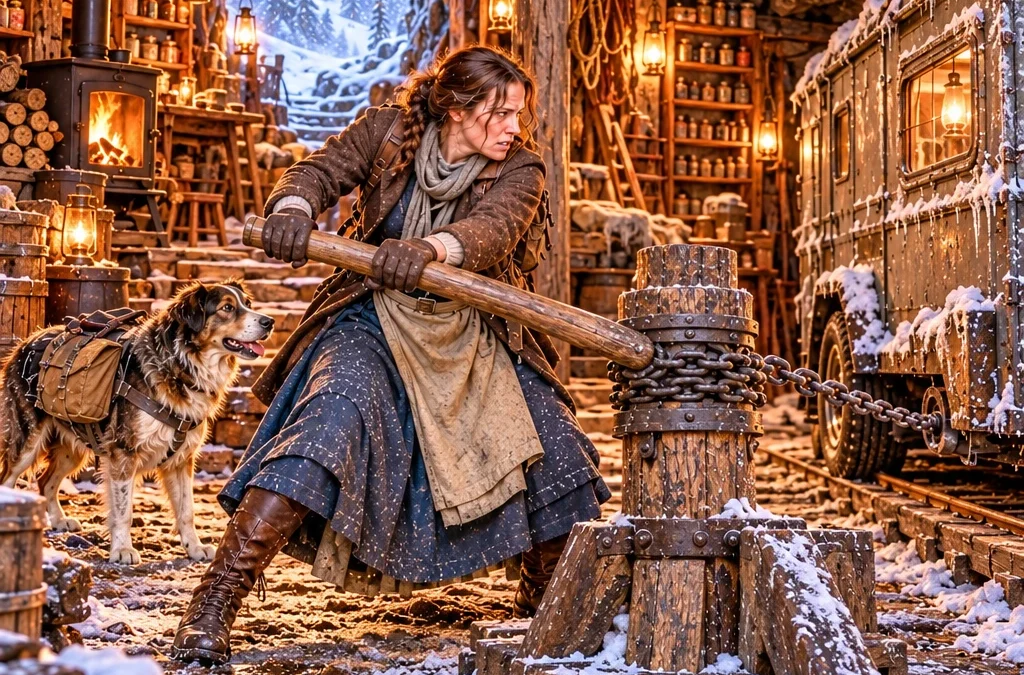
The Whole Town Called Her a Fool For Taking Her Sick Child Into the Wilderness — Then the Blizzard Came, and the Truth Buried Them All 💔
Part 1
The wagon track broke away from the trail like a secret kept to itself.
Every other family in Hollowford, Montana, turned south that gray November morning — toward the town, toward the mill, toward walls they believed would hold when the storm hit.
Their ruts ran deep and straight, hurried marks of people clinging to safety.
Hers curved east, climbing toward a shelf of black granite jutted from the hillside like a forgotten promise.
No cabin waited there.
No neighbor.
No fire already lit.
Just wind, and gathering dark, and a silence so heavy it felt like the sky itself was holding its breath.
Cordelia Ashworth was 34, a widow, a mother — and in the eyes of every soul in the valley, she was about to murder her child.
Pastor Endicott had said it from the pulpit three days earlier, his voice steady and sorrowful: She tempts the Lord.
The storekeeper had begged her to reconsider.
Even old Silas Grenan, who rarely spoke more than two words at a time, had ridden out to warn her personally.
But Cordelia had spent five winters watching that black ledge.
Five winters standing in the snow, scribbling in a tattered brown notebook, tracing wind patterns and snowdrifts no one else bothered to see.
Cold air seized her nine-year-old daughter Litty’s chest so fiercely it sometimes stole her breath.
Damp air made it worse.
Crowded rooms, drafty corners, bodies pressed shoulder to shoulder — those were the things that truly threatened her.
She had seen it happen in ’84.
She had watched a little girl cough herself into a fever in the church basement, surrounded by well-meaning strangers, and she had watched that fever take her.
She would not watch it take Litty.
So she loaded the wagon before dawn: flour and salt pork, dried apples her late husband Bennett had helped can, coffee, sugar, lanterns, kerosene, heavy iron pots, deer hides she had cured herself, and cords upon cords of firewood stacked piece by piece all through October while the other women were busy making jam.
She packed Litty’s wool dresses, extra stockings, the knitcap Bennett’s mother had sent, a rag doll with one button eye.
Her prayers were short that morning, stripped of all formality: Lord, keep her breathing.
Just keep her breathing.
When Litty appeared in the doorway in her nightgown, barefoot, shawl wrapped tight around her small shoulders, Cordelia’s heart tightened.
“Go back inside, sweet pea.
It’s cold.
”
“Papa said the rock is a hard place,” Litty said, as casual as if she were commenting on the weather.
Cordelia’s hands stilled on the wagon wheel.
It had been nearly a month since anyone had spoken Bennett’s name in her home.
“When did Papa tell you that?”
“Before.
” That was all the answer Litty had — before the coughing, before the quiet bed, before the empty chair at the supper table.
“He was right,” Cordelia said softly, kneeling in the thin snow.
“It is a hard place.
But that’s why the wind doesn’t know how to hurt it.
That’s why we’re going.
”
Litty considered this, her face grave.
“Will the wind find us anyway?”
“It will look,” Cordelia told her.
“But it won’t find us the same way.
”
Litty nodded, as if this made perfect sense.
“Because of your book? I saw the pictures.
The arrows.
”
Cordelia stared.
She had never shown anyone those pages.
“You looked in my notebook?”
“Only the drawings,” Litty whispered.
“The lines showing where the snow doesn’t pile up.
”
Something loosened in Cordelia’s chest.
She stood, brushing snow from her knees.
“Go get dressed, then.
Two pairs of stockings.
The thick wool dress.
”
Litty turned — then paused.
“Mama? Is Pastor Endicott right?”
The question landed soft and heavy, sinking into the quiet like snow.
Cordelia crossed the frozen yard in three steps and knelt so she was eye level with her daughter.
“Listen to me.
The Lord gave me eyes to see, and a mind to understand, and five winters to watch and learn.
Do you think He gave me all that just so I would close it up and sit in a crowded basement and hope for the best?”
Litty shook her head.
“No,” Cordelia said, her voice steadying.
“He did not.
”
They reached the fork in the trail just as the sun struggled above the horizon — pale, watery, light that felt tired before it even began.
Fifteen wagons stretched south toward town.
Every family in the valley but theirs.
Cordelia paused, reins loose in her hands, glancing once toward the safety everyone else was rushing toward — then turned east.
Silas Grenan caught up to her before she had cleared the last homestead, riding his bay mare alongside the wagon without speaking until she slowed to match his pace.
“Cordelia,” he said, his voice rough with concern.
“That ledge will bury you.
I’ve seen storms come off that ridge and swallow barns whole.
Come south with us.
Please.
”
She looked at him — weathered, honest, a man who had never lied to her.
“Silas, if I take her into that town, she will not come out again.
The air will kill her before the snow does.
You know how it is there — drafts everywhere, no room to breathe properly.
I’ve checked.
I’ve watched.
”
“And the rock?” he pressed.
“What if you’re wrong?”
“I’m not,” she said, quieter than she felt.
“I’ve seen how the drifts fall.
How the wind splits around it.
The snow stays thin underneath.
The sun holds the stone’s warmth even at night.
”
He searched her face a long moment, then sighed, his shoulders settling.
“I will pray for you both.
”
“Thank you,” she whispered.
He turned back toward the valley alone.
Cordelia flicked the reins, and the wagon climbed on — up the deer path, over loose stone, along stretches so steep she had to unload the water barrel and roll it up one section at a time.
Litty napped through most of it, wrapped deep in blankets, her chest rising and falling in that fragile rhythm Cordelia knew by heart.
They were nearly there when she saw it: something dark huddled beneath a lodgepole pine beside the trail.
At first she thought it was fallen game, or a bundle abandoned long ago.
Then it moved.
Cordelia pulled the wagon to a halt so sharply the horse tossed its head.
She climbed down slowly, hands raised, approaching the shape the way you approach a frightened animal.
An old woman lifted her head.
Long silver-black hair framed a face like cracked leather.
Her eyes were dark, clear, and unflinching.
She sat propped against the tree trunk, her legs stretched at an angle that told Cordelia instantly they could not bear her weight.
“Are you hurt?” Cordelia asked, kneeling.
The woman touched her hip, then her knee, then made a small, weary gesture that needed no translation: I cannot walk.
The woman paused, then spoke in slow, halting English, each word seeming to cost her effort.
“Two days.
”
Two days in freezing temperatures, alone, unable to move.
Cordelia’s mind raced — her supplies were measured carefully for two people, every blanket counted, every pound of food rationed.
There was barely enough.
And yet… she thought of the story she had loved since childhood: the man beaten and left by the road, the priest passing by, the stranger who stopped.
“I am Winona,” the old woman said.
“I am Cordelia.
” She took a breath.
“I am taking my daughter to the black rock shelf up ahead.
There is shelter there — not much, but it is out of the wind.
Will you come with us?”
Winona’s gaze sharpened.
“You know that place?”
“I’ve studied it for years.
”
Winona nodded slowly, something like recognition softening her face.
“I will come.
”
Getting her into the wagon was harder than the climb itself.
She was slight, bird-boned, but her legs were stiff with cold and would not support her.
Cordelia half-carried, half-dragged her to the bed, laying her gently on the deer hides.
Litty woke halfway through, staring wide-eyed — not with fear, but with curiosity.
“This is Winona,” Cordelia explained, tucking a blanket around them both.
“She is coming with us.
”
Litty reached out and placed her small hand over Winona’s.
“Hello,” she said simply.
“I’m Litty.
”
Winona looked at the child, and for the first time, her expression softened entirely.
The black shelf came into view as they rounded the bend — massive, solid, rising from the slope exactly as Cordelia had pictured it a hundred times.
But as she stopped the wagon and climbed down to survey the spot she had dreamed of for so long, Winona pushed herself up on one elbow.
She was not looking at the sheltered hollow.
She was looking at the stones themselves.
“You do not know what this place truly is,” Winona said, quiet but firm.
Cordelia froze.
“I know it blocks the wind.
”
Winona shook her head slowly.
“You know what it does.
But you do not know what it has been, since long before your people came.
”
Part 2
Cordelia crossed the frozen ground and knelt beside her.
“Then tell me.
”
Winona’s hand rested lightly on the nearest black stone.
“My grandfather’s grandfather came here to pray.
When the buffalo vanished, when sickness walked through the camp, when the children grew too weak to walk — they brought them here.
These stones hold the sun’s heat through the night.
They have always done so.
My people did not need to measure it in notebooks.
We felt it.
”
Cordelia placed her own palm against the rock.
It was warm — not hot, but steady, living warmth lingering from daylight long past.
She thought of the verse she had carried in her heart: The stone which the builders rejected…
By sunset, they were settled.
The wagon sat tucked beneath the ledge, canvas stretched tight.
A small fire burned in a pit dug into the earth.
Cordelia opened her Bible to Psalm 91 and read softly so she would not wake the sleeping girl beside her.
He shall cover thee with his feathers, and under his wings shalt thou be safe…
The first three days passed in a strange, fragile calm.
The sky threatened but did not unleash.
Cordelia built a wall of pine boughs against the wind, sealed the canvas seams with clay and moss, stacked firewood in a curved barrier to deflect gusts.
Winona could not help — her legs still would not hold her — but she watched, and Litty sat beside her, chattering about her doll, about Bennett’s whistling, about how her chest felt lighter already.
Then came the night the clay failed.
Cordelia woke to a sharp, rhythmic slapping: canvas working loose from the stone.
She grabbed the lantern and crawled forward — and saw it.
A thin gap no wider than her hand had opened along the seam.
Cold air streamed through, aimed directly at the corner where Litty slept.
And then she heard it: a small, wet cough, deep and ragged — the sound she had dreaded for months.
“No,” she whispered, scrambling for moss and grass to stuff the crack.
It was not enough.
The clay had dried and pulled away, brittle and useless.
Litty coughed again, harder this time.
“Mama… it hurts.
”
“I know, sweet pea, I know — just a moment.
” Cordelia’s mind raced.
The clay had failed because it was rigid.
It cracked as the temperature dropped.
She needed something that would give, something that would move with the wind instead of fighting it.
She looked at the two deer hides spread beneath Litty and Winona — the warmest, softest bedding she owned.
If she took them, they would be cold.
If she did not, Litty would get worse.
There was no choice.
“Litty — come here.
Now.
” She lifted the coughing child into her arms and wrapped her in every spare blanket, setting her close by the fire.
“Stay right here.
Winona — I need the hides.
To seal the gap.
”
Winona nodded without hesitation.
“Take them.
”
Cordelia pulled both hides free and pressed them over the opening, packing grass behind until the draft stopped.
She wedged strips of hide into every other seam she could reach, her hands numb, her breath coming in gasps.
When she finally crawled back to the fire, Litty’s coughing had quieted — but the night was far from over.
“I am sorry,” Cordelia told Winona, her voice shaking as she settled beside them.
“You will be so cold.
”
Winona reached out and touched her arm.
“I have been colder.
And you were wrong about the clay.
”
Cordelia looked at her.
“You will not be wrong about what comes next,” Winona said.
“Because now you are listening.
”
The next morning dawned dark and heavy — clouds pressing low, gray streaked with bruised purple.
The storm was arriving, and fast.
Winona was sitting up, her eyes clearer than Cordelia had seen them yet.
“Today we build it right,” she said.
“The way my people did.
”
Together they built double circles of black stones around the fire pit and their sleeping space — the inner ring to catch and hold the flame’s heat, the outer ring to keep it from escaping.
Green pine boughs woven into a flexible wall replaced the rigid barrier.
A strip of wet hide pressed into the weave would dry hard and tight, bending but never breaking.
They dug a drift tunnel behind the wall — a buffer zone to trap the cold before it reached them.
Litty helped carry small stones, her color bright, her breathing easy.
That night, the first real wind struck.
It howled over the ridge, battering the ledge — and the pine-and-hide wall swayed, absorbed the force, and held.
The stone circles radiated gentle warmth long after the fire had burned low.
Litty slept through the night without a single cough.
For nine days they lived in the shelter of the rock.
Winona taught them.
Litty blossomed.
Cordelia learned that the God she prayed to and the Great Spirit Winona spoke of were not different beings at all — just different names for the same watchful presence.
Then the wind shifted.
It happened before dawn on the twelfth day.
The gusts changed direction — northwest gave way to east, sudden and violent.
Winona sat bolt upright, every line of her body tense.
“Get up,” she commanded.
“Now.
This is not the wind we prepared for.
”
Cordelia rushed outside, lantern in hand — and her blood ran cold.
Snow was piling against the east side of the wagon, rising fast, burying the wheels, climbing toward the canvas.
The weight would crush the frame if it kept building.
“Dig,” Winona called from inside.
“There is an ancient water channel worn into the rock beneath the snow — it will carry the drift away if you open it.
Three arm-lengths from the largest stone, angled southeast.
”
Cordelia plunged the shovel into the deepening drift.
It was heavy, packed solid, the tool bending under the strain.
Her hands went numb.
Three feet down — nothing.
Four feet — nothing.
The snow kept rising.
She could feel it pressing against the wagon.
Then the shovel blade scraped something smooth.
Stone worn glass-smooth by centuries of water.
It was there.
The channel was real.
She dug faster, clearing a path, following the curve Winona had described — and the snow began to move, sliding away down the slope exactly as promised.
She was still shoveling when the sky lightened.
The drift had been diverted.
They were safe.
But as she turned back toward the shelter, she saw Winona in the wagon bed, her face pale, her breathing shallow and labored.
Winona met her eyes and gave a faint, sad smile.
“That took what I had left,” she whispered.
“I knew it would.
”
Part 3
Cordelia dropped to her knees beside the old woman, suddenly terrified in a way the storm had never made her feel.
“No.
You’re just tired.
We’ll rest.
The fire is warm —”
Winona shook her head gently and reached for her hand.
“Listen to me.
I was already fading when you found me.
Two days alone in the cold… my time was nearly done.
I was given these weeks — this gift — because someone needed to remember what the stones can do.
And you needed to learn it.
”
Cordelia’s throat tightened until she could barely breathe.
“But we saved each other.
That’s how it works.
”
“We did save each other,” Winona agreed softly.
“Just not in the way you thought.
”
Litty crept forward, clutching her doll, sensing the shift in the air.
“Winona? Are you going away?”
The old woman smiled and drew a cord from beneath her blanket — strung with a small, polished bird bone, worn smooth by generations of hands.
“Come here, little one.
” She placed it over Litty’s head.
“This belonged to my grandmother, and to her mother before her.
It is yours now.
To remember.
”
“Remember what?” Litty whispered, touching the pendant.
“That you are never truly alone,” Winona said.
“That help sometimes comes from the direction no one expects.
” She turned her gaze to Cordelia.
“Read to me, please.
The shepherd’s song.
”
Cordelia opened her Bible, her fingers trembling so badly the pages slipped.
“The Lord is my shepherd; I shall not want…”
She read every word, her voice breaking but steady, Winona’s breathing slowing to match the rhythm of the verses.
When she finished, the old woman’s eyes were closed, her face peaceful.
She did not speak again.
She simply breathed, and then was still.
For a long time, no one moved.
Litty sat quietly, holding the pendant, as if she understood that something precious had just passed through their lives.
Cordelia closed the Bible and bowed her head.
She did not weep — not yet.
There was work to do.
When Silas Grenan rode up the next afternoon, he found a small fire burning outside the pine-and-hide wall, smoke curling clearly against the blue sky.
He reined in slowly, taking in the intact wagon, the cleared ground beneath the ledge, the stone circles still radiating warmth.
Then he saw the grave marked at the top of the ridge, and Cordelia’s face, and he understood.
He dismounted and removed his hat.
“Cordelia… the church roof fell.
Under the weight of the snow.
Seven did not make it.
”
She went still.
“Who?”
He named them one by one.
Mrs.
Hallowell, who had tried to warn her gently.
Two children.
And finally — “Pastor Endicott.
”
The silence stretched long and hollow.
All those people who had called her reckless, who had urged her toward safety, who had turned away from the ledge — the very place she had found refuge — had perished there instead.
Three days later, Cordelia and Litty walked down the mountain to attend the funerals.
She stood in the pulpit where Endicott had preached against her, facing the faces of those who had judged her.
She spoke simply, without bitterness, asking forgiveness for the pride she had carried in her own certainty, and offering hers to anyone who had feared for her.
She told them that God was not confined to buildings or books or a single path — that He had kept them safe through stubbornness and kindness and ancient wisdom alike.
Afterward, no one spoke much to her.
But as she descended the steps, Mrs.
Hallowell’s daughter stepped forward and took her hand, holding it tight, and Cordelia knew it would be all right in time.
They buried Winona at the highest point of the ridge, where she could see the valley below.
With a chisel, Cordelia carved one word deep into the largest black stone: Ebenezer.
Hitherto hath the Lord helped us.
It was the stone of remembrance, the marker where heaven and earth met.
Litty grew strong.
The cough left her entirely as the years passed.
She became a nurse, spending her life tending to the sick and vulnerable, and she never took off the bird bone pendant.
Cordelia visited the grave every summer, reading the twenty-third Psalm aloud, keeping the memory alive.
The black granite shelf still stands today, hidden away where most people no longer know how to find it.
And carved deep into its face, weathered but still legible, is that single word — a reminder that help can come from where we least expect it, that the shelter we need may not look like the shelter everyone else rushes toward, and that sometimes the bravest thing you can do is turn toward the hard place and trust what your eyes have seen.
This story is entirely fictional and created for entertainment purposes only.
It does not represent any organization or individual, nor does it encourage inappropriate behavior.
The content was generated with AI assistance.








