THE WHOLE TOWN CALLED HIM A DEVIL AND SEVEN BRIDES FLED HIS MOUNTAIN.
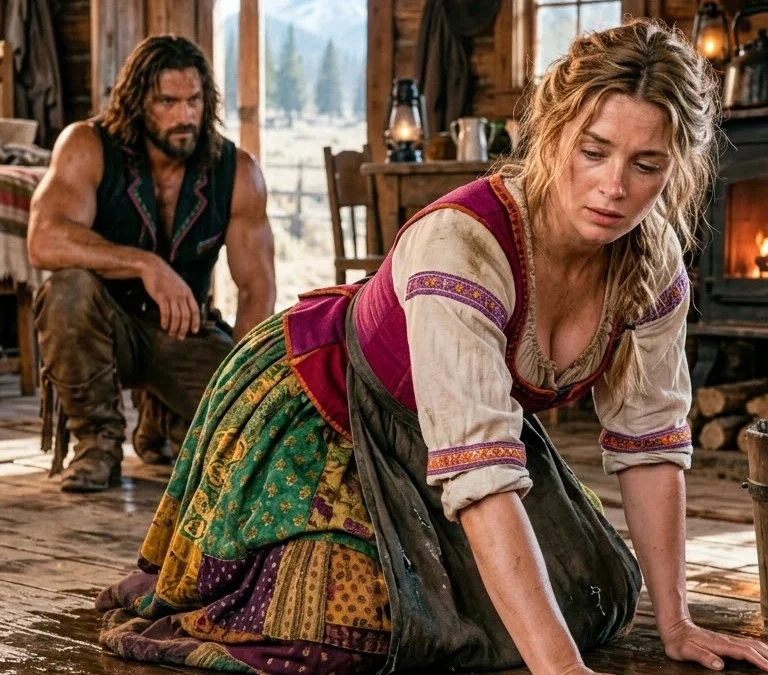
THE WHOLE TOWN CALLED HIM A DEVIL AND SEVEN BRIDES FLED HIS MOUNTAIN… BUT WHEN THE EIGHTH STEPPED OFF THE TRAIN AND DIDN’T FLINCH, A MAN WITH A BLOOD-RED SEAL RODE UP SAYING HE KNEW HER SECRET NAME 😱🔥
Part 1
Three riders came up the frozen road, their horses too fine for honest work.
Ambrose Voss stepped around the barn with nothing between him and those men but his own two hands and six feet eight inches of cold December air. One rider’s hand dropped to his holster. Then the man looked up, and up, and his fingers froze on the grip.
The leader never moved. Dark wool coat. A silver watch chain catching the gray light. A smile that had never once told the truth.
“Mrs. Voss,” he said, tipping his hat to the porch. “Or is it still Winthrop?”
Nobody in this valley knew her old name.
On the porch, Cella went rigid.
“You’ve got ten seconds,” Ambrose said, low and grinding.
The man reached slowly into his coat and drew out a folded paper sealed in blood-red wax. “Your mother’s land, Mr. Voss,” he said softly. “Belongs to me.”
But to understand why Ambrose’s blood turned to ice, you have to go back to the beginning. 👇
They called him a devil before they ever called him a man.
Not for cruelty. Not for one unkind word in thirty-eight years. They called him that because of his size. Because a boy who grows into a mountain frightens people who were never taught to look up without flinching.
Ambrose stood six feet eight in his boots. His shoulders filled the doorway of the stone smithy like a wall filling a gap in a fence. His hands could bend iron.
Seven women had come up that mountain in four years. Seven wagons rolling in with hope folded into their trunks like Sunday dresses, and seven wagons rolling back down before the first snow. One left screaming into the wind so hard the horses spooked. One never even climbed out. She took one look at him on the porch and told the driver, “Turn around. Don’t you dare stop.”
The town whispered about why. At the mercantile, behind gloved hands. At church socials, under the hymns. At the barber’s, over the scrape of a razor.
They said it was his size. All of him. They said no woman alive could bear it.
And Ambrose heard every word, because a small town keeps no secrets from the man it’s keeping them about. He had come to believe it, too. He was a mistake wearing the shape of a man.
That was before the autumn of 1884. Before a train came grinding up through the rain with something on it that no whisper in Stonebridge Hollow had prepared anyone for.
The rain hadn’t stopped in three days. It hammered the tin roof of the depot like a fist on a locked door. Ambrose stood under the narrow eave with his hat in his hands, water running off the brim.
He didn’t want to be there. But he’d paid a matchmaker in Denver good silver, and a man raised the way his mother raised him did not leave a stranger standing alone on a wet platform. Even if that stranger was about to look at him the way all the others had.
He thought about his mother. She’d been gone twenty-four years. Fever, they said. She used to pull him down by the collar so she could look him square in the eye. “Ambrose, the Lord made you strong so you could be gentle where other men can’t.”
He had built his whole life on it. And they still called him a devil.
The train screamed around the bend in a wall of white steam. His heart did its stupid, hopeful lurch, like a green colt that never learns the iron is hot.
Passengers trickled down. A whiskey drummer. Two ranch hands arguing about a horse. And then she stepped down.
She was small. The crown of her bonnet wouldn’t have reached his collarbone. She wasn’t young, either, not the way the matchmaker’s letters promised. Silver threaded her brown hair at the temples. Fine lines fanned from her eyes, the kind that come from a life that asked hard questions and got hard answers.
She carried a worn carpetbag and a wooden case with a brass clasp, holding both against her chest like a woman long used to being the only one she could count on.
Ambrose braced. He knew this moment like he knew the weight of his axe. The wide eyes. The chin pulling back. The whole body flinching.
She didn’t flinch.
She looked at him, all the rain-soaked length of him, and something crossed her face he couldn’t name because he had never once seen it aimed at him.
Relief.
She crossed the platform, stopped a respectful pace away, and held out a small, chapped hand, steady as a fence post.
“You’d be Mr. Voss. I’m Cella Winthrop. I’m told you were expecting me.”
He looked at that hand the way a starving man looks at bread. Then, slow and careful, like gentling a bird, he folded his enormous fingers around hers. She did not pull back.
“I expect you’ve heard things about me on the way up,” he said.
“I have.”
“Then you know why the others left.”
Cella looked at him a long moment while the rain kept falling between them.
“Mr. Voss, I’ve buried a husband and outlived two men who thought they owned me. I did not ride four days on a mountain railroad to be frightened off by a story told by people who’ve never once been kind to you.” She settled her case against her hip. “Now. Is there somewhere in this town a person might get a cup of coffee? I’m chilled clean through.”
Ambrose, the biggest, loneliest man in Montana Territory, could not make his voice work.
Then he took the carpetbag from her hand before she could argue.
“Yes, ma’am. Right this way.”
At the Copper Kettle, he ducked through the doorway like he ducked through every doorway in the territory. The room went quiet. Two men at the bar suddenly found their whiskey fascinating. The girl pouring coffee wouldn’t meet his eyes.
He watched Cella take it all in, waiting for the moment she’d understand what she’d walked into.
She looked at the staring room. Then at him. Then she said, dry as dust, “Friendly place.”
A sound came out of Ambrose he barely recognized. It took him a second to realize it was a laugh.
That’s when Odessa Puitt came out from behind the bar, seventy years old and nearly as wide as she was tall, with a face like a walnut and a voice like a rusted hinge. She was the one soul in Stonebridge Hollow who had never been afraid of Ambrose Voss, because she had never been afraid of anything.
She looked Cella up and down without a shred of manners. “You’ve got more sense in your face than the last six put together.” She jerked her chin at Ambrose. “This one bothering you, honey? I’ve thrown bigger men out that door.”
“Odessa, you have never thrown me anywhere.”
“On account of you go peaceable, you great lummox.”
Her walnut face softened. “He’s the gentlest soul on this whole mean mountain. Every fool in this valley is too busy being scared of a shadow to see it.”
Over coffee, Cella told him how she came to be on that train. A first husband, a doctor in Ohio, who taught her everything he knew. Eleven years of setting bones and delivering babies. And then a second marriage.
“A man who didn’t care for a wife who knew things he didn’t,” she said, turning her cup a quarter turn. “He spent my money. When it was gone, he found ways to spend me, too.”
Ambrose’s hand curled slowly into a fist on the table. Then, with visible effort, uncurled.
“You needn’t look like that,” she said gently. “I’m telling you because I want no lies between us. I stopped believing in strong men who wouldn’t sooner or later use that strength on someone smaller. I came because I heard about a man the whole territory feared who had never once hurt a living soul. I had to know if he was real.”
She looked at the great gentle giant who’d carried her bag.
“I’m beginning to think he might be.”
Then she made her offer. A room of her own. His honest word never to lay a hand on her unless invited. Leave to hang her shingle and doctor the valley. “And we’ll see over an honest winter whether two people the world threw away might make something worth keeping.”
Ambrose felt something in the great locked vault of his chest turn over for the first time in longer than he could remember.
“I accept.”
The house on the ridge was the finest thing he owned and the loneliest thing he’d ever built. Ceilings high enough that he never stooped. Door frames broad enough that he never turned sideways. At the last door down the hall, he showed her her room.
Fresh quilt, aired and beaten. A glass vase of the season’s last purple asters. He’d fussed over that vase at dawn like a nervous boy before a dance.
“It’s lovely,” she said, and he could hear she meant it.
“The lock’s on the inside,” he said low, staring at the floor. “I put it there this morning. So you’d have proof in your own hand. You can lock that door against the whole world. Against me. No power on this earth will open it but you.”
When he made himself look up, something bright and startled shone in her eyes, like he’d handed her something she’d spent her whole life being told she’d never have.
“Thank you, Ambrose.”
He carried the sound of his name in her mouth around his chest all day like a warm coal.
That night he slept in the barn. He told her a mare was near her time. The truth was he didn’t trust himself to be gentle enough, careful enough, small enough.
He didn’t sleep at all. And before dawn, hoofbeats woke him.
Not the mare. Real hoofbeats on the road below. Slow. Careful. Not caution. Calculation.
Two horses, maybe three, passing the turn onto his land and not stopping. Just looking.
Nobody got lost on that road this late in the season. Not unless they meant to be exactly where they were.
He sat up the rest of the night with his rifle across his knees.
He didn’t tell Cella why. 👇
Three weeks later, he began to understand.
Word of the new lady doctor traveled down the mountain faster than he’d have believed. A boy with a pitchfork wound through his foot. A ranch hand with a broken wrist. Old Mrs. Kettering, who had coughed for six years until Cella listened a full quarter hour and quietly changed her tea.
The town’s fear began to crack like ice in an early thaw.
But hauling feed sacks to the mercantile one morning, Ambrose heard old Otis Marlin talking low about the seventh bride, the one who never climbed down from the wagon.
“Heard she took a room at the Kettle that same night. Paid cash. Left on the morning stage with more coin in her purse than she came up with.”
Somebody laughed about a woman smart enough to charge for her own fright.
Ambrose stood in the doorway and felt something cold settle in his stomach. That didn’t sound like fear.
That sounded like payment.
At home, he found Cella’s wooden case open on the kitchen table. He wasn’t snooping. But his eye caught a small vial of dark earth tucked among her surgical tools, labeled in her careful hand: Copper Ridge, Sample Three.
Then a stranger passed through town, lean and quiet, asking Odessa careful questions about the new lady doctor. Where she came from. What name she went by before. Odessa told him nothing, but she never got around to warning Ambrose.
And three days after that, Ambrose’s own father rode up the ridge road on an old mule.
Cornelius Voss hadn’t set foot on Ambrose’s land in eleven years. He stood turning his hat in his hands.
“There are things I ought to have told you a long time ago, boy. About the North Ridge. About a man named Reeve.”
“Then tell me now.”
Cornelius’s jaw worked. For one long moment, Ambrose thought he might finally say it.
Instead the old man climbed back on his mule.
“You take care of that woman. Whatever comes.”
On a snowy Tuesday, a letter came in his father’s cramped, careful handwriting. Come down Sunday alone. I should have told you this eleven years ago, and I am a coward for waiting.
Ambrose rode down on the first clear day in two weeks and sat on his father’s porch step, which groaned under him the way every step in his life had.
“Your mother didn’t die of fever, boy.”
The whole mountain went silent.
“There was a mine collapse. North Ridge. She was down there that morning taking food to starving miners. Gideon Reeve owned that mine. Cut every safety timber to save on lumber. She got three men out before the second collapse crushed her leg. The infection killed her.”
Twenty-four years of grief cracked apart like ice.
“Reeve came to me after. Offered to cover the funeral. I was a broken man with a fourteen-year-old son twice the size of grown men. I took his money. God forgive me. A year later he said it had been a loan. The only way to settle it was to sign over the North Ridge acreage.” Cornelius’s voice broke. “Your mother’s grave is on that ridge. I signed it away to the very man who put her in it.”
He pulled out a yellowed survey map with a small mark in the corner.
“There’s copper under that ridge. Enough to make a man richer than God. That’s what Reeve wanted. It was never about your mother at all.”
Ambrose rode home slower than he had ever ridden anything.
Cella waited on the porch. One look at his face told her everything.
“I need to ask you something. And I need you to tell me true.”
He held up the map.
“The soil you’ve been collecting off my north fence line. You knew about the copper, didn’t you?”
For a long moment she said nothing, and in the silence something that had only just begun to warm in his chest started to go cold again.
“Yes,” she said.
There it was, he thought, wild and terrified. The eighth wagon.
Except she didn’t move. She didn’t reach for her bag. She walked down off the porch instead, sure-footed on the ice, and stopped in front of him.
“I worked two years in a mining camp. I know copper when I see it. I saw the color of your soil my second week here and couldn’t stop myself checking.” Her eyes never left his. “And I didn’t tell you because I was afraid of exactly this moment. Afraid you’d think I married a devil for his mountain instead of for the man underneath it.”
Something in his chest began, slow and disbelieving, to warm again.
“I have been poor, Ambrose. Poor enough to know what copper under a man’s land does to the way people look at him. I never wanted you to wonder, for one single second, whether I was in this house for what’s buried under it instead of what’s living in it.”
He told her what he’d begun to suspect. That the seven women hadn’t fled because of him. That someone had paid them to go.
“I think Reeve has been keeping me alone on purpose. No wife, no children, no heir to fight him for what’s under this ground.”
Cella took his enormous trembling hand in both of hers and pressed it flat against her heart.
“Then we don’t let him win. Not one more inch of this mountain, Ambrose Voss. Not while I’m standing on it beside you.”
And that’s when he saw the riders.
Three of them. Horses too fine for honest work. Slow and deliberate up the road, like men who already believed they owned it.
👇 Want Part 2? Comment any word below and I’ll send it to you privately, or find it in the comments!
Part 2
“Ten seconds,” Ambrose said again, standing in his own yard with the whole mountain at his back. “Say what you came to say.”
Gideon Reeve held up the paper sealed in blood-red wax. “There’s a matter of some irregularity with the deed to your North Ridge acreage. Your mother’s father transferred that land under something of a cloud. Unpaid debts. Improper witnessing. These old territorial filings are full of holes if a man knows where to look.”
“That deed’s clean. Signed and recorded thirty years back.”
“A judge in the county seat is prepared to hear the argument that it wasn’t.” Reeve’s smile widened. “Should he agree, the land reverts to the estate that held the original claim. Which, as it happens, is mine.”
The yard went still. Only Ambrose’s pulse, loud and slow in his ears.
“You cut the safety timbers in that mine,” Ambrose said, quiet and dangerous. “Twenty-four years ago my mother died pulling three men out of a collapse you caused to save yourself the cost of good lumber.”
Something flickered across Reeve’s face. Gone almost before it arrived. But Cella saw it, too.
“That’s a serious accusation. One I’d think twice about repeating without proof.”
“My father has the original bill of sale.”
“Your father,” Reeve said, his smile coming back slow and certain, “is an old, broken, illiterate man whose word means nothing against a properly filed judgment. You have until the spring thaw to vacate the North Ridge. After that, courts tend to favor the man who can afford the better lawyer.”
His eyes slid to Cella with the cold, appraising look of a man pricing something he intends to take.
“The pleasure is always mine, Mrs. Voss.”
Then the three riders turned and rode back down the mountain.
Ambrose’s heart was going like a hammer on an anvil. Cella put her hand flat against his chest.
“He’s got a judgment. What have we got?” Her eyes were steady and fierce. “We’ve got the truth. And your father is still alive to tell it.”
They found Cornelius whittling something small and aimless on his porch. He took one look at their faces and the last of his hope quietly died behind his eyes.
“He came, didn’t he?”
“I need that bill of sale, Pa.”
For a long time, Cornelius looked out at the mountains.
“If I hand that paper over, everyone in this valley finds out what kind of man I was. Weak enough to sign away my dead wife’s land. Coward enough to stay quiet twenty-four years while my own son believed his mother died of bad luck.” His voice cracked, old and raw. “Eleven years back, I rode up to your porch meaning to tell you all of it. I lost my nerve at the last second. I looked at you, already a grown man carrying more of this world’s cruelty than any boy should, and I thought, if I tell him, I lose him. I was already so small in your eyes. I couldn’t stand to be smaller.”
Cella stepped forward, gentle and steady.
“Mr. Voss. Shame doesn’t undo anything. It just keeps a person small. And I think you’ve been small long enough.”
Cornelius stared at her. “You sound like his mother.”
“I never met her. But I imagine we’d have gotten along.”
Something in the old man’s face broke open, slow, like ice giving way to a current that had been pushing against it for years. He went inside and came back out with a small rusted tin box. Inside, folded so many times the creases had gone soft as cloth, lay the original bill of sale. Gideon Reeve’s own signature. Dated the very week of the funeral. Terms that made it plain the transfer had been forced under duress and false pretense.
“I kept it all these years. Told myself I’d never have the nerve to use it. But I kept it anyway.”
Ambrose crossed the porch and pulled his small, old, finally honest father into an embrace that swallowed him whole.
“You’re brave enough now, Pa. That’s the only part that ever mattered.”
But winning, it turned out, was going to cost more than a piece of paper.
Two days later, a boy came running up the ridge road, hat gone somewhere behind him. “Mr. Voss! Come quick! Somebody set the Copper Kettle on fire!”
By the time they reached town, the roof was gone. Black smoke rolled into the gray winter sky. Half the valley stood in the street watching helplessly. And in the middle of it, soot-streaked and shaking, stood Odessa Puitt, watching thirty years of her life burn to the ground.
For the first time anyone could remember, the old woman looked afraid.
Ambrose heard talk of the Ashford barn in his memory. A fire right when old man Ashford refused to sell. And now Odessa’s dining hall burned right when Ambrose refused to hand over the North Ridge.
Old Otis Marlin came shuffling through the smoke and grabbed his sleeve.
“Voss, listen. There was a man in my store not an hour before the fire started. Lean fellow. Quiet. I’ve seen him before. He took a room at the Kettle back in the fall. Asked Odessa a whole mess of careful questions about your wife.”
Ambrose felt something cold click into place. The hoofbeats on the road the very first night. Riders who looked and moved on into the dark.
“This wasn’t an accident,” he said, louder now, to no one and to everyone.
The whole street turned.
“The Ashford barn wasn’t an accident. And I believe, though I can’t yet prove it, that those seven women who left this mountain didn’t leave out of fear of me. I think somebody paid every one of them to go.”
A murmur rolled through the crowd. The particular silence of a town not yet ready to believe the man who holds all their debts might also hold a match.
“It’s more than a feeling now,” Cella said, her voice cutting clean through the murmur. “Gideon Reeve has spent twenty-four years quietly clearing every obstacle between himself and that ridge. And I believe that includes Ambrose’s own mother.”
The crowd went dead silent. Nobody had expected to hear that name aloud. Not today. Maybe not ever.
Odessa straightened up out of her grief like a woman finding a second wind. “Well, if that don’t beat all. Man’s been robbing this valley blind while we’ve all been busy being scared of the one fella who’s never hurt a soul.” She turned slow, taking in the whole crowd. “So here’s what we do. We rebuild. And we find out exactly what Gideon Reeve has been hiding. Every last inch of it.”
That night in the ashes of the Kettle, something shifted in Stonebridge Hollow that had been frozen for thirty years.
But Ambrose knew Reeve wasn’t a man who lost quietly.
It came three nights later. Glass shattering below. He was out of bed, rifle in hand, before his mind caught up. A rock wrapped in paper lay among the glass on the kitchen floor.
Give up the North Ridge or the next thing through this window won’t be a rock.
Behind him, Cella stood in the dark doorway wrapped in a quilt. “It’s a threat. Nothing more tonight.”
“Nothing more tonight,” she repeated.
He set the rifle down and smoothed the note flat with hands the size of dinner plates.
“We fight him. But not with fists. With the truth. My father’s bill of sale. Your ore samples. Otis can place that stranger scouting this house the very week you arrived. And a threat pointing at exactly one man’s motive.” His jaw set hard. “Enough of it stacked together stops being circumstantial. It becomes a pattern. And a pattern is the one thing Reeve can’t buy his way out of.”
A slow, fierce smile spread across Cella’s face, the kind that meant she’d been three steps ahead of him the whole conversation.
“There’s a circuit judge coming through in eight days. Odessa mentioned it before the fire took her mind off everything else.”
Eight days.
For eight days the whole valley woke from thirty years of fearful sleep. Cornelius rode into town himself and stood in the rebuilt frame of the Kettle and told the crowd everything. Odessa crossed the space and took the old man’s trembling hands in both of hers. “It took you long enough, Cornelius Voss. But I reckon better late than never.”
Cella rode to three mining camps in two counties, gathering sworn statements from old miners too afraid of Reeve’s reach to ever speak. One by one, they signed their names.
And Ambrose, the devil of Stonebridge Hollow, walked door to door asking each family one simple question. Had Gideon Reeve ever threatened them? Ever burned anything? Ever made an offer on their land that felt less like a choice and more like a warning?
The answers painted a portrait twenty-four years wide.
On the eighth day, the courthouse, which was really just the back room of the land office, held over a hundred people, with another fifty standing in the cold outside. Ambrose stood near the front with Cella’s hand tucked in his arm, and he had never in his life felt so many eyes on him without a single one flinching away.
Nobody was afraid of him today.
Judge Harlon Whitcomb sat behind a table borrowed from the mercantile. Gideon Reeve sat opposite, his smile thinner than usual.
Cornelius rose, the tin box clutched in both hands like it weighed more than paper ever should, and laid the bill of sale before the judge.
Reeve’s lawyer objected. An old man’s word. Memory fades. Grudges grow.
Then Cella stood. She held up a small tin of rust-colored soil. She spoke of the copper seam. She spoke of the sworn statements from the men who survived the collapse, a collapse caused by timbers Reeve ordered cut.
And then Odessa Puitt, never once having waited to be asked, rose in the front row. “Then explain the fires! Explain my dining hall! Explain why every family in this valley that ever refused to sell you has had something burn within the month!”
“Careful,” said Judge Whitcomb, sharp and final. “This is my courtroom, Mr. Reeve.”
The judge ordered an injunction on the North Ridge and told Reeve not to leave the county.
The room erupted. Not in violence. In relief. Thirty years of held breath let out all at once, like a frozen river cracking wide open.
But the story wasn’t done unraveling.
That evening, a boy came running up to Ambrose. “Mr. Voss! There’s a man at the Kettle asking for you. Says he used to work for Mr. Reeve. Says it’s urgent.”
They found him alone in the rebuilt frame, hat pulled low, hands wrapped tight around a cup of coffee he wasn’t drinking.
“Name’s Jonas Maher. I used to handle certain arrangements for Reeve he didn’t want traced back to him.” He looked up. “Those seven brides. The ones before your wife. They didn’t leave scared of you, Voss. Not one of them.”
The room went very still.
“Reeve paid every one. He paid the matchmaker in Denver, too, to keep sending desperate women your way. And once they got one look at you and got scared, he had me waiting at the depot with cash and a train ticket east.”
Ambrose’s voice came out barely above a whisper. “Why?”
“Because he needed you alone. An unmarried man with no heir, no wife, no children to fight for that land.” Maher looked him in the eye. “It was never about you being too big, or too strange, or too fearsome for any woman to love. It was about keeping you exactly the way Reeve needed you. Alone.”
Twenty-four years, Ambrose thought, wild and reeling. Twenty-four years I believed I was cursed.
And what Cella did next, kneeling to take his enormous face in both her small hands, would change him forever… 😱
👇 Want to see what happens next? LIKE or COMMENT “REVEAL” and Part 3 will be posted once we have enough comments!
Part 3
Cella knelt in front of him, small and fierce.
“No,” she said, steady and absolute. “It was never true. You were never the curse in this story, Ambrose Voss. You were only ever the thing a greedy man was afraid of. Because a strong man who chooses gentleness is the one thing men like Gideon Reeve can never buy and can never control.”
Ambrose closed his eyes and let the words settle into him, the way water finally settles into ground that’s gone dry for far too long.
“He built an entire lie just to keep me alone on this mountain,” he said, slow and disbelieving. “And it worked.”
“For twenty-four years it worked.” Her voice softened. “Right up until the day I stepped off that train and decided I didn’t care what any of them whispered.”
Eyes wet in a way he hadn’t allowed since he was fourteen, standing over his mother’s grave, he looked at this small, silver-haired, unafraid woman who had walked into the middle of a conspiracy and simply refused, from the first moment, to be frightened of it.
“You saved my whole life.”
“We saved each other’s.” Her small, fierce smile was the last thing that broke him open completely. “That was always the bargain. I told you on the very first day. Two people the world threw away, seeing whether they might build something worth keeping.”
Jonas Maher set a small coin purse heavy with silver on the table. “What’s left of what he paid me. It belongs to you now.” Then he walked out into the cold evening, and Ambrose never saw him again. Word reached the valley later that he testified to everything he knew before disappearing east.
The investigation moved faster than anyone had dared hope. Maher’s testimony. The mining witnesses. Cornelius’s bill of sale. Pattern after pattern of fires and forced sales stretching back two decades.
Gideon Reeve was arrested eleven days later, trying to board an eastbound train with two locked trunks and considerably more cash than any honest banker should have been carrying.
The trial that spring was short. Twenty-four years of quiet, patient greed, undone by a bill of sale hidden in a rusted tin box, by ore samples gathered in secret by a woman who never stopped being curious, by the sworn word of miners who had finally stopped being afraid, and by one hired man’s conscience cracked open at the sight of an entire valley choosing courage over fear.
Reeve was sentenced to fifteen years for fraud, arson, and conspiracy, and ordered to forfeit every claim to the North Ridge, which reverted fully and finally to Ambrose Voss.
The copper beneath it proved worth more than every other property in the valley combined.
But standing on that ridge the week after the trial, snow beginning to melt off the high peaks, Ambrose found he couldn’t think about the copper at all. He could only think about his mother, buried in that ground twenty-four years, finally truly at rest, her memory freed from the lie that had stolen it.
Cella came to stand beside him, her hand slipping into his. “She’d be proud of you.”
“She always said I was made strong so I could be gentle where other men can’t.” He looked out over the gray, quiet, finally peaceful valley. “I spent thirty years thinking that meant I had to be small. Had to shrink myself down so the world wouldn’t be afraid. Now I think she meant something different. I think she meant strength was for standing between the people you love and every hard thing this world can throw. Not for being smaller. For being exactly, fully, unapologetically what I was built to be.”
Cella rose up on her toes and pressed her lips to the corner of his jaw.
“Then be that. All of it. I fell in love with every impossible inch of you, Ambrose Voss.”
They were married that spring on the first true warm day, in the little church at the center of Stonebridge Hollow. The whole valley came. The Kesler boy, his foot long healed, sat proud in the second row. Old Mrs. Kettering, her six-year cough finally gone, dabbed at her eyes through the entire ceremony. Odessa sat in the front pew, already weeping into a handkerchief the size of a bedsheet before the vows began.
And Cornelius stood at his son’s side, spine straight, eyes clear, a man who had finally set down the full weight of his shame.
Cella came down the aisle in a simple gray dress sewn by half the women in the valley, who would not hear of their doctor being married in anything less. She carried the last of the season’s purple asters, the very flower Ambrose had put in her room that first day.
She had never once forgotten it.
They wrote their own vows.
“Ambrose,” Cella said, her voice clear in the hushed little church. “I came up this mountain a woman who’d learned to expect nothing from the world but hard use. I came looking for a place to disappear. Instead I found the gentlest heart I have ever known, hidden inside a body that a cruel and greedy man spent twenty-four years teaching a whole valley to fear. I vow to see you clearly every day left to us. Not the devil they called you. Not the giant they were told to be afraid of. But the man who locked the door from the inside so a stranger would know she was safe. I love every single inch of you.”
Ambrose’s own vow came rough and slow, his enormous voice unsteady, but he pushed through.
“Cella. For thirty years I believed I was a mistake the world made too big to love. And then you stepped off that train and you didn’t flinch. You looked at me like I was just a man.” His voice cracked and he pressed on. “I vow to hold you gentle every single day I’m given. To keep my strength forever between you and every hard thing this world can throw. And to spend the rest of my life grateful, past all speaking, for the woman brave enough to look at the devil of Stonebridge Hollow and see instead a home.”
There was not a dry eye left in that church.
The old preacher pronounced them man and wife, and Ambrose gathered his bride into his enormous arms, light as one of her own asters, and kissed her while the whole valley rose up roaring loud enough to rattle the rafters. The very town that had once whispered devil was now on its feet, celebrating the giant and the doctor and the love that had finally thawed an entire hard mountain. 🥹
The feast spilled out of the church and down the length of the town’s one street, because no roof in Stonebridge Hollow was big enough to hold that much joy. Odessa’s wedding cake was five tiers and leaning slightly, exactly as legend would later insist it had to be. There was a fiddler. There was dancing.
When Ambrose took his bride out for the first dance, the whole crowd fell back to make room, and then fell silent to watch. Because who had ever seen such a thing? This mountain of a man moving with surprising, careful grace, spinning his small silver-haired bride slow beneath the budding trees like the most precious cargo he had ever carried.
Cella laughed as he turned her, bright and free. And something in Ambrose’s chest that had been clenched tight for thirty years finally, fully let go.
He threw back his great head and laughed, too. A huge, booming, joyful sound that rolled down the valley like thunder. The laugh of a man who had at long last stopped being ashamed to take up space in the world he was born into.
They did not rush what came after. True to every gentle promise between them, they came to each other slowly, in their own good time, with no fear and no shame left standing in the room.
And two years later, on a bright morning, with the valley green and blooming below the ridge, Cella stood on the porch of the house Ambrose had built too big for any ordinary life, one hand resting on the swell of her belly, watching her husband come up from the lower pasture.
He saw her, and his whole weathered face broke open into the grin she had taught him he was allowed to wear. He crossed the yard and knelt the way he always knelt now, unashamed, so she would never have to crane her neck to meet his eyes. He pressed his ear to the curve of her belly and listened.
“Your mama,” he murmured, low and rumbling, to the child not yet born, “came up this whole mountain and wasn’t afraid of me. Not for one single second.” He looked up at her, his eyes bright with something that had taken thirty-eight years and one impossible winter to understand about himself. “And she taught me the thing I mean to teach you, little one. That being made different isn’t the same as being made wrong. That the size of a person’s body tells you nothing about the size of their heart.”
Cella laced her fingers into his dark hair, looking down at the giant kneeling at her feet.
“We’ll teach it together.”
And they did, down all the long good years that followed in the tall warm house on the ridge. The copper wealth built a free clinic for the whole valley, and a schoolhouse besides. They taught it to their children, and to their children’s children, and to an entire valley that had finally learned to look past the size of a thing and see instead the size of its heart.
Cornelius lived to see his grandchildren born, spoiling each one outrageously, finally at peace. Odessa Puitt lived to see the Copper Kettle rebuilt twice over, each time a little grander, and ruled it with the same rusted-hinge voice until the day she passed peacefully in her sleep, mourned by half a valley.
And Ambrose and Cella grew old together on that ridge, the very thing the world had once sworn neither of them would ever get to do. His dark hair went to iron and then to snow. Her steady hands slowed, but never stopped their healing work. And on fine evenings, the folks of Stonebridge Hollow would still see them on that porch. The great old man and the small silver woman, his arm around her, her head against his chest, watching the sun go down over a valley that had once feared him and had come, in the end, to love him nearly as much as she did.
They had called him the devil of Stonebridge Hollow.
But Cella knew the truth of him, and carried it in her steady doctor’s hands every day of her life.
He was never a devil at all. He was only ever a mountain of a man, waiting his whole long, lonely life for someone brave enough to climb him.
And when at last she came, small and silver-haired and entirely unafraid, she did not find a monster waiting at the top.
She found a home. ❤️
THE END
This story is entirely fictional and created for entertainment purposes only. It does not represent any organization or individual, nor does it encourage inappropriate behavior. The content was generated with AI assistance.








