“THERE IS NO ONE DOWNSTAIRS,” HER STEPMOTHER TOLD THE ALPHA KING. BUT HE SMELLED SNOW PINE AND WILD HONEY RISING FROM THE CELLAR… AND WHAT HE FOUND IN THE DARK MADE HIM BREAK EVERY RULE
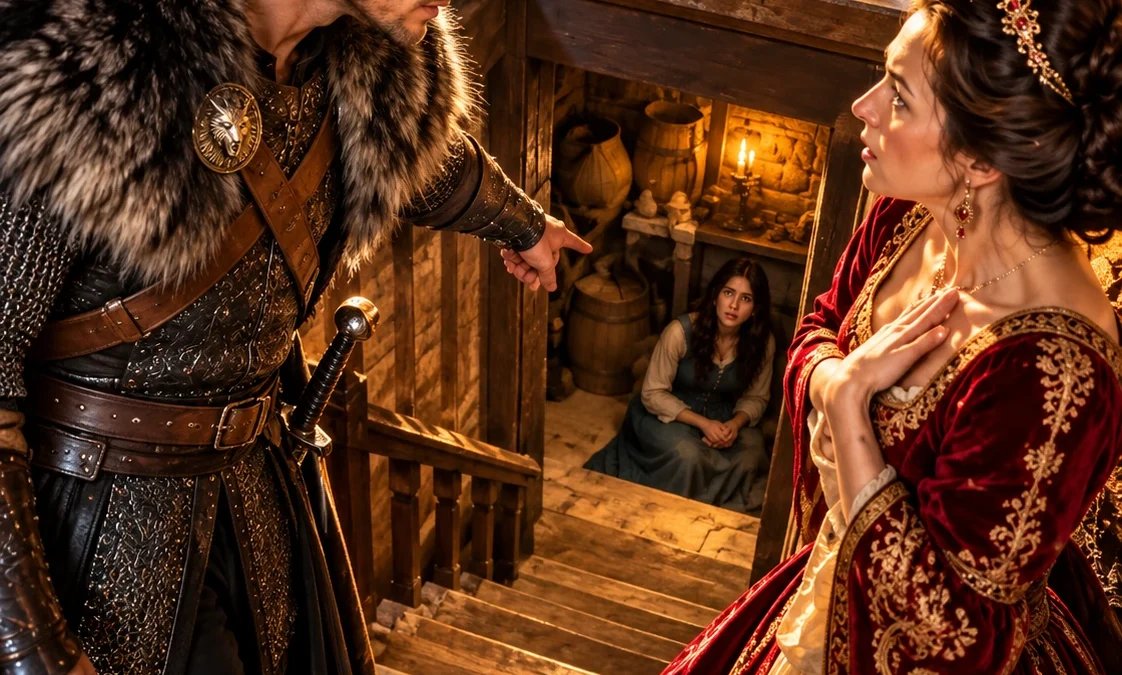
“THERE IS NO ONE DOWNSTAIRS,” HER STEPMOTHER TOLD THE ALPHA KING. BUT HE SMELLED SNOW PINE AND WILD HONEY RISING FROM THE CELLAR… AND WHAT HE FOUND IN THE DARK MADE HIM BREAK EVERY RULE 😱🐺🔒
Part 1
“There is no one downstairs, Your Majesty.”
My stepmother’s voice came through the iron grate above me the way cold comes through stone: slowly, evenly, from every direction at once.
I stood in the farthest chamber of the cellar with my back against a cider cask and a dead candle stub in my fist, and I did not breathe.
The grate was an air shaft no wider than a loaf of bread, cut through the foundations of Havenmir Hall so the stores would not spoil. For three winters, it had been my only window. Through it, I had learned the whole house. The quick slap of the kitchen girl’s shoes. The dragging step of old Agatha, who had carried trays up and down those passages for forty years. The clipped, measured heel of Lady Vorna, which always meant a decision had already been made.
Now, beneath all of those, I heard something new. The unhurried weight of boots that belonged to a man no one dared hurry.
“Salt pork, turnips, and cider,” my stepmother continued. “My late husband’s stores. Nothing worth the dust on your cloak.”
“Nothing,” said a second voice, low and level, roughened at the edges like a blade used more often than polished. It was not a question. It was a man turning a word over to see what lay underneath.
My heart stumbled against my ribs. Everyone in the valley knew who he was.
The runners had come up the road three days ago, shouting it at every door. The Alpha King was making his winter count. Aiden of Eldermoor had taken the crown at twenty-six, and he had spent six winters since riding from holding to holding, counting every omega in his lands and offering each one the protection of his banner. Raiders and border lords had been carrying omegas off for years while the old king looked away. The young one did not look away. Every house was to bring its omegas before him by candlelight, and the king himself would stand before each one.
A wolf’s nose does not lie. And I was an omega.
Not the common kind, either. The rare kind my mother used to call still water. The kind whose scent settles a restless pack the way rain settles dust on a road.
For three years, Agatha’s gray tea, willow bark and ash leaf and one pinch of something she would never name, had kept that scent shut tight as a closed door. But the kitchen had been under the steward’s watchful eye since the king’s outriders were sighted at dawn, and Agatha had not been able to slip down to me.
My last cup was two nights gone. I could smell myself now. Snow pine and wild honey, rising off my skin like warmth off a hearthstone.
Any wolf in the valley could have followed it to my door. 😰
“The Lord’s daughter is not here,” my stepmother said. “She has lived with the Gray Chapel sisters these three years, recovering from the wasting sickness, and they keep a vow of silence.”
“I have sent riders north,” said the king. “They will return within the week.” A pause. “I am told Havenmir also has a cellar.”
“A cellar full of turnips—”
“Then it will not take long to look.”
“Your Majesty, the stair is steep, and the damp is unkind to Lady Vorna—”
He did not raise his voice. He did not need to. The hall above went so quiet that I heard a log shift in the great hearth.
“I did not ask.”
Then came the sound I hated more than any other in the world. The long iron scrape of the kitchen bolt being drawn back.
I closed my eyes. Three years, and that sound could still unmake me.
I should tell you how a lord’s daughter came to live among the cider casks.
My father, Lord Edwin of Havenmir, held the valley for the crown. A big, laughing, ink-stained man who read his ledgers aloud to me when I was small and called me his still water, because I could quiet any hound or horse or furious steward with a hand laid on a sleeve.
My mother died when I was nine. He did not marry again until I was seventeen, and then only because the valley’s grain stores were failing, and a widow from the southern marches arrived with coin, a carriage, and cold gray eyes. Lady Vorna was beautiful the way frost is beautiful: pale, exact, and impossible to touch without leaving a mark. Forest-green velvet. A gold brooch at her collar. Dark hair in a coiled braid so tight it seemed to hold her whole face in place.
Four winters ago, my father’s lungs failed. On the last night, he held my hand and told me the seat of Havenmir would be mine on my twenty-first name day. That the registrar’s roll said so. That I was never to let anyone persuade me otherwise.
At the funeral feast, Vorna rose before two hundred guests and announced that the Lord’s daughter was too grief-stricken and too frail to remain at Havenmir. The guests nodded and lowered their eyes into their cups, because Vorna’s grain had filled their granaries that winter, and it is easy to believe a lie that feeds you.
I stood up in front of all of them and said I was not going anywhere. That was my mistake. I have measured every day since by how dearly it was priced.
“Poor child,” Vorna said, smiling at the hall. “She does not know her own mind.”
That night, I took a mule and rode for the mill bridge, meaning to beg the wardens to carry a petition to the crown. Vorna’s men were waiting on the far bank as though someone had told them which road I would choose. She met me in the kitchen. She never shouted.
“A girl in the Gray Chapel cannot be on the mill road. So you will not be on the mill road. You will be where I put you. You will be quiet, and in time you will stop being a question anyone asks.”
Then the cellar door. And the bolt.
The first winter, I counted stones. There were four hundred and twelve in the vaulted ceiling of the cask room. The second winter, I counted days toward my twenty-first name day, and then counted past it, because the day came and went beneath the floor and nobody sang. The third winter, I stopped counting and began quietly to believe what the bolt was telling me. That I was a small thing, easily put away. That perhaps the valley was better for my silence.
That was the wound, if you want to know. Not the cold, nor the hunger. It was how reasonable the silence began to feel.
Only Agatha kept me from sinking all the way. Sixty years old, sturdy as an oak post, silver hair beneath a plain linen cap, her apron always dusted with dried herb powder. She came down when the steward’s back was turned, with bread in her sleeves and the gray tea in a stoppered flask. She sat on the bottom step and told me about the world above, and before she left, she whispered my name through the dark like a lamp she was handing back to me.
Ivy. Still here. Still Ivy. 🕯️
I was twenty-four, and that whisper was the last thing in Havenmir that belonged to me.
The door swung open at the top of the stair. Light fell down the steps in a long yellow tongue, with the smell of bread and wood smoke. I flattened myself into the shadow between two casks. My teal linen dress, the one good dress I owned, mended at the elbow by Agatha’s careful hands, felt suddenly like a banner.
“Stay on the stair,” said the king’s voice. “Closer now. All of you.”
“Sire,” said a deeper, gruffer voice, “a king does not go into a cellar alone.”
“A king does what he likes in a cellar, Gavrick, provided no one has put turnips on the throne.”
Then a single set of boots descended slowly, with a care I did not expect from a man that size.
He came around the last cask and stopped.
I had pictured the Alpha King a hundred ways in three days, and none were right. I had imagined a giant with a face carved from granite. He was tall, yes, broad through the shoulders beneath a shirt of fine gray mail, a heavy dark fur mantle on his shoulders, two leather straps crossed over his chest. But his hair was brown and wavy and wind-tangled, as though he had ridden three days without thinking to comb it, and his jaw was shadowed with a short beard. His eyes were the lightest blue-gray I had ever seen, the color of a river under thin ice.
Those eyes found me in the dark at once.
He did not move. He drew one long breath through his nose, and I watched something happen to him that I could not name. The line of his shoulders, held so hard for so long that it looked like part of his armor, loosened by a hair’s breadth. His eyes closed for a heartbeat, the way a man’s do when he steps into a warm room after a long night in the snow.
When they opened again, they were very careful.
“Forgive me,” he said quietly. “I did not mean to frighten you.”
“I am not frightened.” My voice cracked on the lie. Three winters of whispering had left it rusty. “Your Majesty, I am only the cellar maid.”
“Are you?”
“I tend the casks.”
“Then you tend them in the dark with no candle, in a dress that has been mended by someone who loves you.” He looked at the straw pallet in the corner. The single gray blanket. The wooden bowl still holding a heel of yesterday’s bread. A muscle moved in his jaw. “And you have been drinking something to hide your scent. It wore off two days ago, I think.”
My knees nearly gave. “How?”
“I caught it at the east gate this morning. A breath of it on the wind. Snow pine and wild honey. I have been riding this valley since dawn, following it like a fool.” He said it as if confessing a crime. “For six winters, I have not slept more than two hours together, miss. Since the day my father’s crown was set on my head, it is as though my wolf has been pacing a cage. This morning, for the first time, it stopped.”
No one had ever told me my scent was a place a person could rest.
“What is your name?”
I looked up at the grate in the ceiling. I could see a pale slice of the hall beyond it and the edge of a green velvet skirt, motionless as stone. She was listening. Of course she was listening. For three years, my name had been something I only said to myself.
“Ivy,” I whispered.
The velvet skirt did not move.
I thought of my father’s voice saying, Never let anyone persuade you otherwise. I thought of Agatha’s whisper. I thought of four hundred and twelve stones.
“Ivy of Havenmir,” I said. “Daughter of Lord Edwin.”
The silence that followed was the loudest I had ever heard.
“The Gray Chapel,” the king said slowly, “has a remarkable cellar.”
Then he did something that undid me more thoroughly than any threat. He unclasped the heavy fur mantle from his shoulders, and instead of draping it around me as a stranger might have, he held it out at arm’s length, like a question, and waited.
“You are cold. You may refuse it.”
No one had asked my permission for anything in three years.
I took it. It was warm from his shoulders and smelled of cedar smoke and horse and the clean cold of mountain air. I pulled it around myself with trembling hands. 🥹
“Can you walk?”
“Yes.”
“Then I would very much like you to walk up these stairs with me, Ivy of Havenmir, and not be carried. But if your legs fail, you have only to say so.”
At the top of the stair, the lady of the house waited with her hands folded in front of her green velvet gown, her braid perfect, her gold brooch gleaming. Thirty faces turned toward me in the great hall, looking at me the way you look at a ghost.
“Majesty,” Vorna said, and her sweetness made my skin prickle, “that poor creature has wandered the kitchens for years. She believes herself my late husband’s daughter.”
“She is not wandering the kitchens,” said the king. He did not raise his voice. The hall leaned toward him anyway, like wheat in wind. “She has been kept in the dark behind a bolted door and fed bread.”
Behind the pantry door, I saw Agatha, hands pressed over her mouth, tears running down her weathered face. She did not make a sound. Still here, I thought at her.
Still Ivy.
And as the king lifted his voice to name me a ward of the crown, I looked up, and I met my stepmother’s gaze. There was no fear in it at all.
It was a promise. 😨
Part 2
It was a promise.
The East Tower chamber had a fire.
I stood in the doorway a long while before I could cross the threshold. A narrow bed heaped with clean wool blankets. A jug of steaming water. A bowl of soup with a spoon beside it. A bunch of dried lavender on the sill. And on the outside of the door, a pale scar in the wood where the bolt had been, and four small holes where the screws had been pulled out.
I closed the door. I opened it. I closed it again and opened it once more, just to be sure.
“It opens,” said Agatha behind me. “It truly does.”
For the first time in three winters, I walked into her arms, and we wept without sound, as people do who have learned that sound is dangerous.
“You said your name,” she said into my hair. “Before the whole hall. I only said it to the dark.”
“You said it to the light.”
She made me eat the soup, and told me what she had been too afraid to say through three winters of stolen visits. How Lady Vorna had been writing sealed letters all autumn. How the grain wagons that arrived every month came from the north, from a hold that flew a silver hawk on a field of black. How she had once seen a name written at the foot of a page.
“Whose name?”
But exhaustion pulled at me like a tide, and Agatha said it could wait for morning.
I did not sleep. Past midnight, I rose and went to the door. At the far end of the corridor, beneath a narrow arrow slit, a tall man stood with his back to me in shirtsleeves, hands braced against the stone.
“I am sorry,” said the king without turning. “I could not sleep.”
“Nor could I.”
He glanced over his shoulder. The hard mask of the crown had slipped, and for a moment he looked exactly as old as he was: a lonely man of thirty-two who had been carrying a kingdom since he was twenty-six, with nobody to hand any part of it to.
“I told you my wolf had stopped pacing. I was wrong. It has simply changed its pacing. It walks in front of your door now.” A rueful, tired half-smile. “That sounds a great deal more alarming aloud than it did in my head.”
“It does not sound alarming.” I was surprised to find it true. “It sounds like the first honest thing anyone has said to me in three years.”
I told him about my father: the ledgers, the ink on his fingers, the day I fell into the mill pond and he laughed so hard he had to sit down in the grass. When I stopped, he said very gently, “He would be proud of you.”
“I did nothing but hide.”
“You stood up in a hall full of cowards and said your own name. That is not hiding. It is the bravest thing I have seen in this valley.”
Then the horn sounded.
A long, deep, brazen note from the gatehouse, the signal of an armed company seeking entry in the dead of night. Then shouts. Then the heavy groan of Havenmir’s great gate being cranked open from within, by hands that had been told to expect this.
The king was at the arrow slit in two strides. I looked past his shoulder.
Thirty riders poured through the gate in black cloaks, black pennants snapping above them, and on every pennant a silver hawk. At their head rode a lean, pale man in a long fur-trimmed coat, with a face as sharp and cold as a knife held to firelight. And on the lit threshold of the hall stood Lady Vorna, not confined to her chambers at all, smiling.
It was the first true smile I had seen on her face in seven years.
“Lord Caspian,” she called. “You are just in time.”
Beside me, Aiden went absolutely still.
I knew that name now. It was the name Agatha had seen at the foot of the page. The name on the grain wagons. The name that had paid for three winters of silence beneath a kitchen floor. And I understood, with a slow, cold certainty that settled in my stomach like a stone, why Vorna had never let me be found.
I had not been hidden to keep me from the king. I had been kept like grain in a cellar, for a buyer. 😱
I went down to the courtyard behind him, because I had told him in the corridor, in a voice I did not recognize as mine, that I would not be spoken about while I stood in a tower.
“You may stay at the stair.”
“I may,” I agreed, and kept walking.
Caspian bowed from the neck, exactly as deep as courtesy required. “Majesty, forgive the hour. I came for a betrothed, not a count.”
The word dropped into the courtyard like a stone into a well.
“Lady Ivy. I have waited a long time to be introduced.”
“We have not been introduced,” I said, “because I have never heard your name spoken in this house.”
He drew a rolled parchment from inside his coat, sealed with the green heron of Havenmir. “Lady Vorna, as regent of this holding, signed the contract of betrothal three winters ago, in return for a yearly tithe of grain to a valley that had none.”
Aiden read it by torchlight. “The seal is genuine. The signature is Vorna’s. And there is no mark here from the omega herself.” He lifted his gaze. “No consent.”
“A guardian’s consent binds a ward until her twenty-first name day.”
“The Lady Ivy passed it nearly three years ago. And the oldest law in my kingdom says an omega’s bond is hers alone to give.”
“Then the law is a sentimental one,” said Caspian mildly. “And kings who lean on sentiment have short reigns.”
Aiden did not answer at once. Then, to my astonishment, he turned toward me. “Ivy,” he said, so quietly that only the nearest riders could hear. “This is yours to answer. Not mine.”
Every instinct I had learned in the dark told me to shrink, to let the strong men settle it over my head. But I had said my name before two hundred candles that night. I could not go back to being a question.
“I do not know you, Lord Caspian. I have not consented to you, and I will not. If there is a bargain between you and Lady Vorna, it is between the two of you. It does not include me.”
Something moved behind those iron eyes. A flicker of recalculation, quick as a fish in dark water.
“Spirited,” he murmured. “Good. That will be useful.”
“Useful for what?” Aiden demanded.
“For the hearing, Majesty.” Caspian smiled, the most patient smile I had ever seen. “The contract is registered with the Council of Lords. I invoke my right of challenge. Let the matter be tried before the full council at Elderlmoor, as the old custom allows. Nine days. Until then, I will not press my claim by force.”
It was neatly done. He had named the one forum where Aiden could not simply command. Where thirty lords who had grown comfortable under the old king’s neglect would sit in judgment, and where a king’s quarrel would look like a king’s private appetite.
Before he left, Caspian paused beside Vorna and said something too low for me to hear. Her smile deepened by a fraction.
That fraction kept me awake until dawn.
We rode to Elderlmoor at noon: thirty of the king’s riders, Gavrick at the head, Agatha beside me on a patient gray cob, and Vorna in the middle of the column under guard. I insisted on crossing the mill bridge.
“We can go by the north ford,” said Aiden.
“No. It is the road to Elderlmoor, and I would like to cross it this time with nobody waiting on the far bank.”
The far bank was empty. I waited for the old terror to rise. It did not. I felt only a great, tired lightness, as though I had set down a sack I had not known I was carrying.
On the second dusk, the sky turned the color of a bruise. The first thunder rolled up from the south, and every horse in the column threw up its head. These were seasoned men, but they were also wolves, and I saw a dozen of them flinch at once, shoulders tight, nostrils flaring. A young rider barely twenty gripped his reins until his knuckles blanched. A pale-faced packhand began to scream.
“Stand!” Aiden shouted. “Dismount and hold your beasts!”
Then Aiden was at my bridle, his face tight and pale. “There is an inn a mile on. Can you ride?”
“I can.” And because I could feel the fear rolling through the column like a tide through a harbor, I added, “Let me ride in the middle.”
He did not ask what I meant. He wheeled his horse and cleared a path, and I rode into the very center of the frightened column and did the only thing I had ever known how to do.
I breathed. I let the scent come. Snow pine and wild honey, unshielded, unashamed.
The rain took it and carried it down the whole length of the line. I felt it settle over the riders like a hand laid on a trembling shoulder. The young rider’s grip loosened. A big bearded guard let out a long, shaky laugh. The packhand stopped screaming. And the column moved forward through the storm in a slow, steady, almost peaceful line. 🌧️
At the inn, the stout innkeeper threw open the door and stared out at thirty soaked riders, one king, and a lady in a mud-spattered cloak, none of whom seemed in any hurry at all. “What in the name of all the old gods did you do to them?”
“Nothing,” I said, and slid wearily from the saddle into Aiden’s waiting arms. He did not let go until I was steady. And then he did, instantly, and cleared his throat, and went to see about the horses.
That night, by the fire, I asked the question Gavrick had hinted at. “You count omegas because of your mother.”
For a moment, I thought he would turn to stone. He did not. He sat a long while with his hands loose between his knees, a big man made small by something that had happened twenty-three years ago.
“She was an omega. A gentle, ordinary one. She sang when she thought no one was listening, and she smelled of apples. I was nine. We were on the autumn road when a company of border raiders came out of the trees. My father took one look at their number and turned the column around.” His voice roughened. “We left her wagon behind. He said afterward a king cannot risk a hundred men for one. And the border lords who watched him do it understood that omegas could be taken from this kingdom and nothing would come of it.”
The fire popped.
“The first thing I did when I took the crown was begin the count. I tell the lords it is for the realm’s safety. It is not. I am counting every omega in my kingdom so that I will know, if one ever goes missing, exactly where to begin.” His eyes were very bright. “I have never told that to anyone.”
I reached out slowly and laid my hand on the back of his. It was warm and scarred, calloused along the knuckles. He went completely still.
“I think my gift is only that I do not look away.”
He turned his hand over under mine and held on.
At Elderlmoor, in the council hall of thirty lords and a thousand watching faces, the registrar read the contract aloud. The old northern lord said, “By the letter, Lord Caspian holds a lawful claim.” I rose and told them everything: the cellar, the bolt, the roll of Havenmir with my father’s mark on the twelfth leaf.
“The crown’s copy has the twelfth leaf,” Aiden said softly.
The registrar swallowed. “It is missing, Majesty. Cut out recently by a clean blade.”
The galleries buzzed like a kicked hive. I felt the floor tilt. My father’s mark. The only proof I had.
And through the noise came Caspian’s calm voice. “May I? I fear there is a larger matter here than a missing leaf.” The iron eyes turned to the king. “Majesty has told this hall he counts omegas to protect them. May I ask him the question many here have wished to ask for twenty-three years?”
Aiden’s hand went white at the knuckles. “Ask.”
“Where is your mother?”
The hall went silent. Not the silence of waiting. The silence of a blow.
Caspian drew a second paper from his coat, sealed with black wax. “She is alive. She has lived for twenty-three years under the protection of my house. And she has asked me, in her own hand, to bring this to her son before the whole council.”
My heart stopped.
For the first time since I had known him, the Alpha King of Elderlmoor looked like what he was: a boy of nine standing at the edge of a road, watching a wagon disappear into the trees.
And Lady Vorna, between her guards, finally smiled. 😱
Part 3
Aiden did not take the letter.
He sat motionless on the council dais with thirty lords watching, and the paper trembled very slightly in Caspian’s outstretched hand, black wax catching the candlelight. I knew that look. I had worn it in the cellar. It is the face of a person who has built a whole life around a door that has just been opened, and cannot bear to see what is behind it.
So I crossed the black and white flagstones, took the letter from Caspian’s fingers, and carried it up the dais steps myself.
“You do not have to read it aloud,” I said, too low for the hall to hear. “But you do have to read it.”
He looked at me, and for a heartbeat the crown was gone, and there was only a boy at the edge of a road.
“Will you stay?”
“I have not moved from the spot where I stand,” I said, “since the night you opened the cellar door.”
He broke the seal. The letter was short. I watched his eyes travel down, then back to the top, then down again more slowly. When he finished, he lowered the page to his knee, closed his eyes, and drew one long breath through his nose, the way he had in the dark at Havenmir.
When he opened them, they were wet, and he did not hide it.
“Read it,” the white-bearded northern lord rumbled, not unkindly. “The council has the right.”
Aiden handed it to me. I read it standing at his shoulder, in a clear voice, because the hall deserved to hear it, and because I wanted him to hear it from someone who would not flinch.
My son, I am alive. I have been safe for most of these years, though not free. The raiders who took my wagon sold me north to the old lord of the Hawkhold, and when he died, to his son. I have no wish to accuse. I wish only to say that I have been cared for, and that I am tired, and that there is a sickness in this hold that I cannot cure alone. The wolves here have not slept in ten winters. They are not wicked. They are exhausted, and exhausted wolves frighten the children. Lord Caspian does not know how to ask for what he needs. I am asking for him. Come if you can, and come in peace. I would like to see you before I die. Your mother, Rosalind.
The silence in the hall was complete.
“Sickness?” said the northern lord at last. “Exhaustion? What is this?”
“The Hawkhold has had no omega for ten winters,” Caspian said quietly. The patient smile had left his face, and without it, he looked very tired. “My wife was the last. She died in childbed, and the whole pack lost its center with her. Since then, my wolves have not slept a night through. They quarrel. They wander the walls. Children wake screaming.” His iron eyes moved across the council. “I begged the old king for an omega. He sent me nothing. So I took what I could. I held the Queen Dowager because her gentle scent was the only thing that let my people rest, and I could not bear to let her go.”
“And now you want Ivy,” said Aiden, very quietly.
“Not as a prisoner. I swear it.” Caspian turned to me, and I was startled to see something almost like shame. “I was a coward, my lady. I thought a contract in law would be cleaner than asking. I told myself the girl in the Gray Chapel would be better beside a hearth. I did not know there was a cellar. On my word as a lord, I did not.”
I believed him. That was the dreadful part. Beneath the cold polish, I could smell it: grief, old and stale, like a house where no one had opened a window in a decade.
I turned to Lady Vorna. The color had drained from her face, and her neatly folded hands were shaking.
“The twelfth leaf. Who cut it out of the roll?”
She said nothing.
“Lady Vorna.” Because I could feel her terror rising like cold water, and because I had known that terror myself, I let a little of the still water come softly across the space between us. “I am not asking for revenge. I am asking for the truth. You were afraid of something.”
Her lip trembled once. “He had my sons.”
A murmur ran around the hall. Two boys in the southern marches, with their uncle, under Caspian’s riders stationed at the border.
“I never threatened your sons,” said Caspian sharply.
“You did not have to.” It tore out of her at last, high and ragged. “That is what power is, my lord. It is never having to say.”
Nobody moved. I looked at the woman who had slid the bolt on my door for three winters, and found to my own surprise that I felt no triumph at all. Only a heavy, tired grief.
“I cut the leaf with my own knife,” she whispered. “It is in my writing case at Havenmir, folded in a handkerchief. I could not bring myself to burn it. It has Edwin’s mark.”
When I opened my eyes, Aiden had come down from the dais, past Gavrick, past the thirty lords, and stopped in front of Caspian, a king facing the man who had held his mother for twenty-three years. The hall held its breath. I held mine.
“I could have you locked in a cell,” Aiden said.
“You could.”
“I could take the Hawkhold by my father’s old levy, and every lord in this room would stand beside me.”
“They would. And your mother would remain a hostage inside my walls for however long it took, and my children would go on waking screaming.”
Aiden looked at him for a very long moment. Then he said, in a voice I would hear in my head for years:
“I am done with kings who turn the column around.” ⚔️
He faced the council. “I will not make war on a hold that is sick. I will ride to the Hawkhold myself, under Lord Caspian’s safe conduct, in a small company. I will bring my mother home, and I will see what can be mended. And the Lady Ivy will make her own choice, as the law gives her.”
All eyes came to me. And I realized that the thing I had spent three winters believing, that I was small and easily put away, had never been true.
I had only been standing in the wrong room.
“I will go,” I said. “Not as a bride. Not as a bargain. As a guest who has something to give, and who is free to leave.”
“Ivy,” Aiden began. “You said it yourself in the cellar.”
I met his light eyes. “I may refuse. I may also choose. Those are the same freedom, my lord. You cannot give me one and keep the other.”
For a long moment, he only looked at me. Then the Alpha King of Elderlmoor, before thirty lords and a thousand watching faces, did something no king had done before him. He put his right hand over his heart and bowed his head to me.
“As the lady wishes.”
The Hawkhold sat on a black crag above a frozen lake, a fortress of dark stone with one tall tower, bleak as a clenched fist. I felt it before I saw anything else: a thrumming, restless pressure in the air, like the moment before a storm that never comes.
When the gates swung open, hundreds of people crowded the courtyard. Gray-faced, hollow-eyed, with the raw, strained look of people who have not truly slept in years. Children clung to their mothers’ skirts. A big man near the gate paced in a tight circle, back and forth, as if he did not know he was doing it.
“Stay here,” Aiden murmured. “Let me go first.”
“No.” I swung down from my horse. “I know what this is. I have lived in a place like it. You cannot calm a hold like this with a sword at your back, my lord.”
He held my eyes a long moment, and I saw the whole argument pass through his face. King against man, wolf against heart. Then he nodded once. “Gavrick. Hold the riders. No one touches a weapon.”
I walked into the middle of the courtyard alone. The wind snatched at my teal gown. For three years, I had been taught that the thing in me was a flaw to be suppressed with willow bark and gray tea.
I let it go. All of it, like a held breath. Snow pine and wild honey rolled out across the courtyard. Not a wave. Slower than that, like a tide coming in over a flat shore.
The pacing man stopped mid-step. A woman by the gate let her shoulders fall. Somewhere in the crowd, a child gave a long, shuddering sigh and put her head on her mother’s shoulder. One by one, the pale, hollow faces softened. People sat down on the cobbles where they stood, slowly, as if their legs no longer remembered how to hold them up. 🌙
And from the great doors of the hall, a woman came out.
She was perhaps fifty-five, small and slight, with gray-streaked brown hair and a weathered, gentle face I knew at once, because I had seen it in the shape of a man’s jaw. She stopped at the top of the steps with one hand pressed to her mouth.
“Oh,” said Queen Rosalind, in a voice that cracked on the single syllable. “Oh, you have come.”
I heard Aiden dismount. I heard him walk slowly at first, then faster, and then not walk at all. I stepped aside, and the Alpha King of Elderlmoor crossed the courtyard of the Hawkhold at a run, as though he were nine years old, and fell to his knees on the stone steps before his mother, and she took his face in both her hands.
I will not say what they said. I do not think any of us who stood there heard it. Gavrick was staring fiercely at the sky. Agatha was crying openly into her shawl. Idis blew her nose with a sound like a trumpet. 😭
Lord Caspian stood a little apart by the gate, arms hanging empty at his sides. The iron had gone out of him.
“Lord Caspian,” I said. “Does your pack sleep tonight?”
His eyes were bright. “I think they might.”
“Then I would ask you to sit down. Before you fall.”
He sat right there on the cold stone steps, a lord of the north in his dark fur-trimmed coat, with his face in his hands. His shoulders shook once, silently. I laid a hand on his arm, and neither of us said anything at all.
The Hawkhold slept that night, from dusk to dawn, for the first time in ten winters.
Later, in the high tower room, Rosalind brought me two cups of warm spiced milk and sat beside me on the bed. “I stayed because of the children. Not because I was a prisoner, though I was at first. And in the end, I wrote to my son because I am an old woman and wish to see him. He has the habit of counting things, my son. Stones, stairs, stars. I used to think it was a worry. I think now it was a prayer.”
I thought of four hundred and twelve stones, and my throat went tight.
“You love him,” she said. It was not a question.
“Yes.”
“Good.” She patted my hand. “He does not know how to be loved. He will do it badly. Be patient with him.”
“I have been practicing,” I said, “all my life.”
We stayed a month. It was not long enough to heal ten winters of sleeplessness, but it was long enough to begin. I walked the walls every evening, and the wolves who had paced them for a decade began to sit down. Idis turned the storerooms into a sleeping hall for the youngest children. Gavrick and Caspian discovered they had both lost the same friend in the same border skirmish many years before, and sat up half the night over a flask of mulled wine, saying very little.
On the last evening, Caspian came to find me. “I have drafted a treaty. The Hawkhold will place itself under the crown, send ten young people each year to Elderlmoor to learn healing, keep no hostages, and take no contracts.”
“The council will not punish you. I have already spoken with them.”
He almost smiled. It looked like something unused for a long time. “I was wrong about you. I believed a gift like yours was a tool, a thing to be held in a hand. I see now it is only a door. You open it, and others find they can come through.”
When we returned to Havenmir in the first week of spring, the orchards were in bloom, and the whole valley came out to meet us on the road. The miller. The seamstress. The stablemaster with his cap in both hands, and beside him the old black mare, who threw up her head and whinnied so loudly that the whole company burst into laughter. 🐴
At the long table in the great hall, the registrar unfolded the missing twelfth leaf beside Vorna’s confession and read it aloud.
On the day of her twenty-first name day, I, Edwin of Havenmir, give the seat of this holding to my daughter Ivy, who is my still water, and who will keep it well.
My father’s mark was at the foot, a heron’s wing in black ink. I read it standing in a silent hall with my hand pressed against my chest.
Vorna waited at the end of the table in a plain gray gown. No velvet. No gold. Her hair cut short and unadorned. At her side clung two thin, wide-eyed boys of nine and eleven, brought from the southern marches under the king’s own escort.
“I do not ask for mercy.”
“No,” I said. “I did not think you would.” I had spent a month deciding what to say. In the end, I found I only wanted the truth. “You took three years of my life, Lady Vorna. You put a bolt on my door and told a whole valley I was ill. I will not call that anything but what it was. But I have been alone in the dark with no one to speak for me, and I know what fear can make of a person. Your sons shall stay at Havenmir. They are children, and they did nothing. You will go to the great chapel, the real one, and take the vow of silence you invented for me. You may write to your sons once a season. I will answer every letter.”
For the first time in seven years, I saw Vorna’s composure break completely. Tears ran down her sharp, pale face. “Why?”
I thought of Agatha sitting on the cellar stair with bread in her sleeves.
“Because someone once whispered my name to me in the dark, when it was the only thing I had left. I would like to be the kind of person who does the same.” 🕯️
The king rode up the road alone on a mild golden afternoon in the middle of the apple blossom. I was in the orchard when I heard the hoofbeats. I did not run. I walked, because I had learned by then that there is great power in not running, and because my knees had suddenly become unreliable.
He swung down in the lane, tall and sunbrowned, hair windblown, no armor and no crown.
“I have come to ask a favor. I have ended the count. Not the registry. The law. I took it to the council last month, and the lords agreed. No omega in this realm is bound to the crown, or to any hold, or to any contract made on her behalf. Each has the right to refuse. Each has the right to choose.”
Behind the orchard wall, someone sniffed loudly. It was Gavrick, weeping, then pretending he had not.
“I counted you,” Aiden said. “I counted a woman in a cellar before I knew her name, and I should have asked first. I am sorry.” He dropped to one knee in the grass, and apple petals drifted down around him like snow. “So I am asking now. Not as a king. Not as an alpha. You may refuse. You may take a year. You may take a lifetime and say no to me in the end, and I will ride away and love you from the road, and never trouble you again. Ivy of Havenmir, will you stay beside me? Not in a tower. Not under a banner. Beside. As a wife if you will, as a friend if you will not, as whatever you decide.”
I thought of four hundred and twelve stones. I thought of an iron bolt. I thought of a black mare with a white star on her brow, and a hall full of sleeping wolves, and a woman with a hand pressed to her mouth who had said, Oh, you have come.
I thought: This is the only door I have ever wanted to walk through of my own accord.
“Yes.”
He closed his eyes. His shoulders, held so hard for so many winters, dropped like a tide going out.
“Yes,” he whispered. “Yes?”
I knelt in the grass in front of him in the blossom and took both his scarred hands in mine. “I will stay. I will be a wife and a friend and a lady of my own seat. I will keep Havenmir, and I will come with you to Elderlmoor, and when the road is long, we will take turns being tired.” I laughed, and the sound was not rusty at all. “I choose it, Aiden. I choose you.” 💍
He kissed me briefly and gently, with the care of a man who had been taught all his life that tenderness was a risk. It tasted of apple blossom and sunlight.
We were wed at midsummer in the great hall of Havenmir, under my father’s banner of the white heron and the king’s running wolf side by side on the dais. Rosalind stood at her son’s shoulder in soft apple green, weeping unashamedly. Caspian came with fifty of his people, who slept soundly through the feast and woke astonished. Idis presided over the cake. And Agatha gave me away, in a gown Orla had cut and Idis had pinned.
“Still here,” she whispered, as she kissed my brow.
“Still Ivy,” I whispered back.
I am not sure when I stopped counting stones. I think it was the morning after the wedding, when I woke in the east tower with the door open and the sun on the blankets, and a king asleep in a chair beside me in his boots, because he had sat up half the night in case I needed anything.
I still hear the bolt sometimes, in the quiet hours. Old fears do not die all at once. They fade the way a scar fades, slowly, into something that is part of you and no longer a wound.
But I have learned now what Agatha was trying to tell me through three winters of stolen visits. What my father meant when he called me his still water. The thing I had been taught to hide was never a flaw. It was the stillness at the bottom of a deep lake that lets everything above it settle. A storm is loud, but it is the water that remains. 🌊
Each night, when the great hall has gone quiet and the lamps are banked and the long moors of the north lie silver in the moon, I walk out onto the battlements, and the king comes to stand at my side. We do not speak. We do not need to. His hand finds mine in the dark, warm and scarred and certain.
And below us, the valley sleeps. No one is downstairs. No one is behind a door.
Every door in the whole house is open. 🕊️🐺
THE END
This story is entirely fictional and created for entertainment purposes only. It does not represent any organization or individual, nor does it encourage inappropriate behavior. The content was generated with AI assistance.








