They Banished a 19-Year-Old Girl to a Freezing Cave for Defending a Child. They Never Imagined What the Mountain Was Hiding Inside Its Walls…
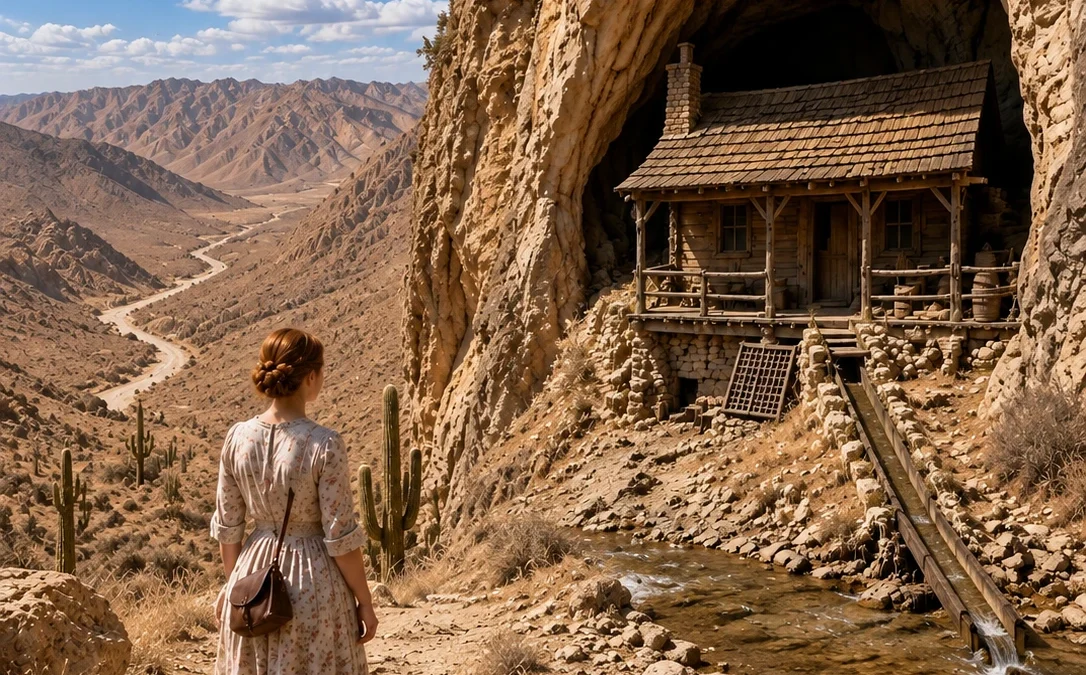
They Banished a 19-Year-Old Girl to a Freezing Cave for Defending a Child. They Never Imagined What the Mountain Was Hiding Inside Its Walls…
Part 1
“Let the rocks be your family now, Sadie Pike. There is no longer a place for you among decent people.” 🪨
Preacher Theron Blackwood spoke those words in front of every family in Bitter Creek. I was nineteen. I had never stolen anything or harmed anyone. I had spent most of my life working in other people’s kitchens, helping with harvests, mending clothes, and minding children whose mothers were too tired to manage alone.
None of it mattered. I was being driven from the only home I had ever known, and my crime was telling the truth.
The meetinghouse smelled of candle wax, damp wool, and the dust that blew through every crack in our settlement. Nearly sixty people stood along the benches. Most had known me since I was a baby. Some had fed me after my mother died. Now they looked at me as though I were a dangerous stranger.
Blackwood stood at his oak pulpit, black coat hanging from narrow shoulders. Beside him stood his seventeen-year-old son, Ezekiel, who would not look at me.
Three days earlier, I had seen Ezekiel take apples from the community storehouse. When ten-year-old orphan Martha Prim was blamed for the theft, I spoke up. I expected a correction, perhaps an apology. Instead, Blackwood accused me of lying to protect a thief, and when I refused to change my account, he declared I had challenged his authority.
In Bitter Creek, that meant challenging everyone.
“Do you confess your wrongdoing?”
“I told you what I saw.”
“Pride is a dangerous thing in a young woman.”
“Then perhaps your son should admit what he did.”
A murmur ran through the room. Blackwood struck the pulpit. Mrs. Gable, who had once held me on her lap when I was sick, lowered her eyes. Mr. Prim stood near the door with his daughter hidden behind his coat. Martha was crying. She had already apologized for something she had not done, and I could not bear to watch her carry that shame.
“I will not call that child a thief.”
He raised a trembling finger toward the western hills. “Then you will leave us. Take your pride into the wilderness, where it can trouble no righteous soul.”
Beyond the windows lay miles of sagebrush, limestone ridges, and dry canyons. Winter was coming. A woman alone out there could vanish without a trace.
I searched the room for someone willing to speak. Mrs. Gable turned to the wall. Mr. Prim stared at the floor. And at the back stood Silas Croft, the blacksmith’s son, jaw clenched, fists curled. He looked as though he wanted to say something.
He did not. That silence hurt almost as much as the sentence. 💔
“You have until sunset. Take only your personal belongings. There is a cave in Whisperwind Canyon where you may seek shelter.”
A frightened whisper passed through the congregation. Everyone knew it. People called it the Exile’s Cave. Unwanted wanderers and condemned souls had been sent there over the years. Some had returned. Most had not.
“If telling the truth makes me unwelcome here, Reverend,” I said, “there is nothing left for me to say.”
At home, I rolled up the blue quilt my mother made before I was born. I packed a second dress, two pairs of stockings, a tin cup, sewing needles, and a small Bible with pages softened by years of handling. I took down the faded photograph of my parents and wrapped it inside the quilt. Then I closed the door, not knowing whether anyone would ever open it for me again.
At the edge of town, Silas waited with an old gray mule with a white patch above one eye. “His name is Jude. He is stubborn, but he will carry what you need.” Beside him lay hardtack, salt pork, dried beans, and his grandfather’s axe, sharpened the night before.
“Your father will be angry.”
“My father does not own my conscience.” His voice broke. “I am sorry.”
“Why did you not speak?”
“Blackwood threatened to close the forge.”
“So you let him send me away?”
He flinched. I regretted the sharpness, but the hurt was real. “I was afraid,” he said. There was something terribly honest in it.
“I was afraid too,” I said, and took the rope.
A mile beyond the last cornfield, the old midwife Ilara waited at her fence. She pressed a smooth black stone into my palm, warm from her fingers. “Stone remembers fire, child. Not everything that looks cold is dead.” She handed me dried herbs, seeds, and a tin of salve. “You will need these more than pity. Survival is not a promise. It is work you do every morning.”
By late afternoon Bitter Creek had vanished behind the hills. Then I saw it, a dark opening in the mountainside like a wound in the earth. Cold air moved outward carrying the smell of damp stone. No lamp. No voice calling me home.
That first night I sat wrapped in my mother’s quilt, listening to coyotes. I ate one piece of hardtack. I cried until my throat ached. Nobody came.
When I finally looked up, the stars were bright over the canyon. “All right,” I whispered to the dark. “If this is where I am supposed to die, you are going to have to work harder than that.”
Jude flicked one ear. And for the first time that terrible day, I almost smiled.
But weeks later, while preparing a hearth against the cave’s back wall, I would strike a dark stone and see a thin yellow thread glinting in the quartz. And someone in Bitter Creek would soon hear about it. 😨
Part 2
The first morning taught me that courage does not fill an empty stomach.
I woke stiff, my feet numb in my boots. Frost silvered the sagebrush. I laid out everything I owned on a flat stone and divided the food into portions. Two weeks, if I was careful. After that I would have to find or grow something.
I began with water. The streambed was dry. But deeper in the cave I heard a slow rhythm. Drip. Drip. Drip. Water fell from a crack in the ceiling into a basin worn in the stone. I boiled some to be safe, drank it, and laughed. It was not a grand discovery. But it meant tomorrow was possible. 💧
Days became routine. I watered Jude, gathered wood, repaired my boots with leather strips, dug a drainage channel to keep rain out of my sleeping place. One day I fell while climbing the northern ridge and scraped my arm badly. That night, covered in dust and alone, I whispered, “Mama, I do not know how to do this.”
The cave answered with silence. For a moment I wanted to walk back into Bitter Creek, kneel before Blackwood, and say whatever he wished to hear. Perhaps they would let me in. Perhaps Mrs. Gable would open her kitchen door.
Then I pictured Martha, crying over that apple. If I confessed to a lie, I would teach her that truth mattered only when powerful people allowed it.
“No,” I told Jude. “We are not going back that way.”
Deeper in the cave I found an old fire ring and pieces of worked flint. Someone had sheltered here long before me. I was not the first person to look at these rocks and hope to live. And one afternoon I noticed a broad section of the rear wall that was darker and smoother than the gray limestone, crossed by thin branching lines like veins. When I pressed my palm to it, it felt faintly warm.
Stone remembers fire.
Then the first storm came, so hard the dry wash briefly ran brown. Water drove into the cave. The fire died. My food was soaked. I sat upright on a ledge all night, holding my quilt out of the wet, and by dawn I was shivering uncontrollably.
I wanted to scream. Instead I picked up a branch and cleared the ditch. There was no point asking the sky to be fair.
That afternoon I decided to build a cabin, against the cave, which would shelter it from behind and give Jude a stable. I had helped mix clay chinking before. Silas had taught me to sharpen tools. My father had shown me how to measure a foundation with rope and stakes.
The first tree took an entire morning. By the time the pine finally fell, my palms were raw and my shoulders burned. “You stubborn old thing,” I told it. But by dusk it lay beside the cave, dragged in stages by Jude and me. One log. I needed many.
Weeks passed. Blisters hardened into calluses. I made mistakes. One wall leaned so badly I took down three courses and started again. But I was learning. I set snares, gathered only plants I was certain of, and led Jude to a spring-fed meadow every third day. I talked to him constantly. “My father sang terribly while he worked. Mama said the chickens laid fewer eggs when he started.”
By late November, the walls stood shoulder-high. One evening, I heard hoofbeats. A rider on a tired bay horse stopped at the edge of the clearing.
“Sadie.”
Silas. 💛
“I tried to come sooner. Blackwood warned that anyone who helped you would be cast out too. I listened for a while. I am ashamed of that.”
He had brought nails, a saw, a hammer, blankets, flour, and a parcel in Ilara’s handwriting: For Sadie. Do not forget to eat. My eyes filled.
“I do not expect you to forgive me.”
“Good.”
“I deserve that. Would you let me work?”
“You can help with the roof. And Silas? Do not mistake this for everything being forgiven.”
We worked until dark. Before he left, he gave me an iron latch he had forged himself. “May I come back?”
“Yes. But come because you want to help. Not because you feel sorry for me.”
After he rode away, I went into the cave to level a spot at the base of the dark wall for my hearth. I struck the stone gently with a flint-worn tool. A small piece broke away. Beneath it was milky white quartz, and crossing it like a tiny streak of sunlight, a thin yellow line.
I knew gold when I saw it. My father had once owned a ring that he sold to buy my mother’s medicine. I scratched the line with a sharp point. It was soft. It did not crumble.
I covered the spot with a flat stone. Not because I knew its worth. But because something inside me understood the wall held a secret, and I was not ready for the world to find it. 🌟
Then a blizzard struck before Christmas. And in the middle of the second night, three knocks sounded on my door, and a desperate voice cried, “Please! We have got a child!” 😱
Part 3
By the first week of December, my cabin had a roof. It was not beautiful. The door scraped the threshold, and the chimney needed constant attention. But it kept out the rain. I made a narrow bed of split logs, hung my parents’ photograph above it, and sat in the doorway at dusk watching smoke rise from the chimney.
For the first time, I had made a home with my own hands. No preacher had given it to me, and no council could decide whether I was worthy of it.
A few days before Christmas, the sky turned heavy. By evening a blizzard roared down the ravine. In the night, a dead pine crashed outside. On the second day, with the wind still howling, I heard three dull knocks.
“Please! We have got a child!”
I pulled the door open. A man staggered in, half carrying a small boy wrapped in a coat, a white-faced woman behind him. I slammed the door and barred it. “Our wagon broke down,” the man gasped. “We have been walking for hours.”
The boy, Daniel, was five and burning with fever. “Put him there,” I said, pointing at the bed. “Put him down before you fall down.”
I warmed broth, gave the boy small sips of water, and remembered Ilara’s lessons about a sick child’s breathing. The father, Thomas Miller, and his wife, Elspeth, were bound for Dalton to seek work.
“You live here alone? Who built this place?”
“I did.”
“With only a mule?”
“He is a better worker than he looks.”
Thomas gave a tired laugh. Then his eyes found the white stone near the hearth, yellow threads catching the firelight. “Miss Pike, is that gold? I worked near a mining camp outside Virginia City.”
“Right now,” I said, “the only thing I am worried about is your boy.”
For two days the storm trapped us. On the third morning, Daniel opened his eyes and asked for bread. Elspeth covered her face and cried. 💛
“You saved our lives,” she told me when they left.
“The cabin saved us all.”
“No. You opened the door.”
She held me, and I did not realize how badly I needed it until I began to cry. Three weeks later Thomas returned with supplies and a gray-bearded geologist named Alister Davies, who studied the quartz with a hammer and lens. “The samples are promising. Unusually promising. I will need to assay them in Dalton. And Miss Pike, be careful whom you tell. Valuable minerals attract men who smile while trying to take them from you.”
The news still reached Bitter Creek before spring. The assays confirmed a rich gold-bearing formation that extended beyond the cave wall. Mr. Davies helped me file a mineral claim at the land office. When a syndicate offered me more money than I had ever imagined, he read the papers and pushed them back. “They are offering to buy your entire claim before you know what it is worth. Learn what you own.”
So I asked questions. I learned ore grades, royalties, and risks. I wanted security, but I did not want to trade my home for it. Eventually, I negotiated limited, professionally managed development that preserved the cabin, the cave entrance, the springs, and much of the land. Six months earlier, I had been counting pieces of hardtack. 🌟
One April afternoon a wagon arrived. Preacher Blackwood, aged and dusty, with Ezekiel beside him.
“Sadie. There have been misunderstandings.”
“You banished me to die.”
“Our community has rules.”
“Your community accused a child of stealing because your son was too frightened to admit what he had done.”
“She is right, Father,” Ezekiel said. His face was pale. “I took the apples. I took three. Then Martha was blamed. When Sadie told the truth, you asked me whether she had lied. And I said she had. I am sorry, Sadie.”
It did not give me back the hunger, fear, or loneliness. But it mattered that he had finally said it aloud.
Blackwood admitted the settlement was struggling. The storehouse was nearly empty. He hoped I might help the people who once cared for me. I thought of turning him away. Then I thought of Martha, of Mrs. Gable, of the widows and children who had made no decision about my exile.
“I will help the families of Bitter Creek,” I said. “But not through you. I will arrange food, seed, medicine, and tools directly with the households that need them. I will help hungry people, Reverend. I will not purchase your approval.”
He had no power here, and he knew it. As they left, I called after Ezekiel. “Have you apologized to Martha?”
“Not yet.”
“Then you know where to begin.”
Later, Silas told me Ezekiel had confessed publicly in the meetinghouse and apologized to Martha and her father. Several families had demanded Blackwood step down as the settlement’s sole authority. A new elected council was forming.
“Do you ever think about returning?”
I looked at the cabin, the glass windowpanes, the herbs in boxes, Jude asleep under the cottonwood. “I miss Mrs. Gable’s bread. But I do not miss being afraid to tell the truth.”
He gave me a beautifully forged iron key for my new workshop. I remembered the little house we had once talked about building, with a porch big enough for two rocking chairs. “I think I built something better than we imagined,” I said. “But I could still use another rocking chair.”
He smiled in a way I had not seen since before the exile. “I think I could make one.” 🪑
The mine grew carefully under my agreement. I bought surrounding land to protect the spring and the pasture. Thomas became foreman of a carpentry crew. Elspeth started a schoolroom. Mr. Davies supervised the geology. I invited Ilara to a cottage by the stream. “I am not some helpless old woman,” she protested.
“I know. That is why I need you. Somebody has to teach the younger women what you taught me.”
The settlement became Pike’s Hollow. A store, a smithy, a school, a small medical room. No one was expelled for questioning a leader, and the rules were written down so that no one’s word stood above everyone else’s. A year after my banishment, lanterns hung from the fence posts, children ran between tables with pie, and a fiddle played under the cottonwoods. A painted sign read: Built on courage, sustained by kindness. Little Daniel threw his arms around my waist. “Miss Sadie! Papa says you saved us!”
“And you helped save me. You reminded me that a home is meant to have people in it.”
Silas found me at the edge of the gathering with two cups of coffee. “I wish I had been brave enough to walk beside you.”
“You have been walking beside me since.” For the first time, I took his hand without remembering the shame of that day. “Would you dance with me?”
“Yes. I would like that.” 💃
Later, alone in the cabin, I sat by the hearth. The quartz still caught the firelight, its gold veins shimmering. Ilara’s black stone rested beside my Bible. I finally understood. The stone held no magic. But fire had shaped this mountain long before any of us were born, and hardship had shaped me. Every morning I had risen and done the next necessary thing.
“You wanted me to live among the rocks, Reverend,” I whispered, smiling. “So I did.”
And the rocks had become the foundation of everything I loved. Though the mountain made me rich, its greatest gift was something no one could ever take from me again. A place to belong. A life built on my own terms. And the freedom to open my door whenever someone lost and frightened came knocking. 🌅💛
This story is entirely fictional and created for entertainment purposes only. It does not represent any organization or individual, nor does it encourage inappropriate behavior. The content was generated with AI assistance.








