They Banned Me From My Grandfather’s Funeral. Minutes Later, Twelve Marines Marched Up the Street.
They Banned Me From My Grandfather’s Funeral. Minutes Later, Twelve Marines Marched Up the Street.
Part 1
My family banned me from my own grandfather’s funeral.
My mother said it over the phone in a flat, polite voice, like she was canceling a dentist appointment. “It’s better for everyone if you don’t come, Jennifer. You’ll only make a scene.”
I stood in my kitchen holding the phone, still wearing the boots I’d worn on a seven-month deployment. I didn’t argue. I had spent thirty years learning that arguing with my family was like shouting into a canyon.
But I didn’t hang up and cry, either.
I looked at the old wooden box on my table, the one that holds every medal and commendation I’ve ever earned, and I said quietly to the empty room, “I’ll be there.”
Let me tell you how I got here.
I was the invisible daughter. My younger sister was the golden one. Her hair, her smile and her piano recitals got praised at dinner while I poked at cold mashed potatoes, waiting for someone to look at me. Really look.
Every photo on our mantel was her, in Easter dresses, tiaras and ballet poses. Mine were a blurry school portrait and a forgotten birthday.
When I won first place at the regional track meet, I ran home clutching the medal. My father barely glanced up from his newspaper. My mother murmured that it wasn’t ladylike to be so competitive.
They were never loud about it. There were no slammed doors and no raised voices. It was the slow, polite removal of warmth, and sometimes that’s worse.
When my sister wanted to be a designer, they built her a studio in the basement. When I said I wanted to join the Marines, they smiled, changed the subject and never mentioned it again.
At seventeen, I sat through a dinner I’ll never forget. The china was spotless, the air smelled of rosemary and wine, and my father asked my sister about her art showcase. My mother complimented her dress. Nobody asked me one single question.
The only sound I made all night was my fork clinking against the plate.
That was the night I decided to leave. I wasn’t trying to prove anything. I simply knew I would never be enough on their terms.
I left the morning after my eighteenth birthday with a duffel bag and a quiet understanding that I wasn’t coming back the same.
Boot camp was brutal. My soft hands blistered, bled and hardened into calluses. I was smaller and slower than most, but I was stubborn, and I graduated in the top five of my class. I stood at attention in the blazing sun while they pinned a medal to my chest, and I was shaking. It wasn’t fear. It was pride.
I mailed my family a photo of me in uniform with a note: “Made it through. Hope you’re well.”
No reply.
Afghanistan. Iraq. Training stateside, then overseas again. Every promotion, I sent something. Postcards from dusty airfields. A silk scarf from Kyoto for my mother. A rare pocket watch from Germany for my father.
Silence, every time.
They skipped my officer commissioning. They skipped my Navy and Marine Corps Commendation Medal. When I made Lieutenant Colonel, I learned they had attended my sister’s gallery opening that same night, just an hour’s drive from my ceremony.
That’s when I stopped hoping. I kept writing, but I stopped expecting.
Then came the day I got home from that seven-month deployment, exhausted, still in uniform, tearing through a pile of mail on my porch.
Bills. Ads. And a letter from my bank.
Your primary checking account is overdrawn.
I thought it was a mistake. I’m careful with money. I logged in with my phone trembling in my hand.
Negative.
Thousands of dollars, gone.
I logged out, then back in. Same result. I checked savings. Empty. My investment fund. Gone. My retirement contributions were wiped clean.
My heart pounded harder than it ever had in combat.
I spent hours combing through statements. Small recurring transfers first. Luxury purchases I didn’t recognize. Then bigger withdrawals, tens of thousands siphoned into accounts I’d never seen.
I called the bank’s fraud department. They promised to investigate. But even as they spoke, something I thought I’d buried started to stir inside me.
I didn’t want to let the thought form. It had always been there.
A few days later, the fraud investigator called me back. I sat on the edge of my couch, medals in the box beside me, and listened to the names on the accounts. Then the addresses.
Every single one led back to the house on Cedar Street, the house I grew up in.
It wasn’t strangers, and it wasn’t hackers.
It was my own family.
What happened next still gives me chills. Part 2 is in the comments, or leave any word below and I’ll send it to you privately.
Part 2
What happened next still gives me chills. Part 2 is in the comments, or leave any word below and I’ll send it to you privately.
I drove to Cedar Street three days later. The white brick house and blue shutters looked exactly the same. I didn’t.
They were in the living room when I walked in. My father was behind his newspaper, my mother was sipping tea from her favorite porcelain cup, and my sister was scrolling her phone on the leather sofa.
“Jenny,” my mother said. “We didn’t expect you.”
I didn’t sit. I laid it all out, the transfers, the forged authorizations and the total, nearly half a million dollars, in a voice so calm it surprised me.
For a second there was silence.
Then they laughed.
“Don’t be so dramatic,” my sister said.
“We thought you knew,” said my father.
“We were helping,” my mother added, soft and patronizing. “You’re always away. You don’t understand these things. It’s not your world.”
Not your world.
“You think I can lead combat missions,” I said, “but not manage a bank account.”
My sister snorted. “Please. You wear boots for a living. You’re not exactly financial material.”
My father set down his paper. “You don’t understand money, Jenny. You never have.”
Five words. A lifetime of erasure.
I nodded. “Thank you,” I said, “for clarifying.”
They smiled, sure they had won. They were certain I’d swallow this like every dismissal before it.
They had no idea they’d just made the last mistake they would ever get to make with me.
That night I sat in my small living room staring at the wall. I’ve felt shrapnel and fractured bone and ambushes in the dark. Nothing burned like this.
But sometime near dawn the pain went cold and quiet. It turned into something sharper.
Assess. Plan. Execute.
I called Natalie Ruiz, a brilliant attorney from my JAG days who has no patience for injustice. I called Charles Yates, a forensic accountant who sees patterns where others see chaos. Within two days we had over 200 pages of documented fraud. There were forged signatures, wires spread across accounts, and even utility bills for properties I didn’t know my family owned.
“They’ll say you’re unstable,” Natalie warned. “Vindictive.”
“I’ve been preparing for this my entire life,” I said.
Then Natalie asked the question that stopped me cold.
“Was your grandfather’s estate ever formally processed?”
I hadn’t thought about it once. Grandpa Harold, the only person who ever truly saw me, the man who knelt on his porch when I was seven and taught me to tie my boots. “Try again. Because one day you’ll have to do it alone.”
My family had shut me out of his death so completely that I’d never asked the one question that mattered.
What did he want?
I drove to his empty house and dug through dusty drawers until I found a faded green folder at the back of his desk.
The original will. Signed. Notarized. My name in his careful handwriting.
He had left everything to me.
I sat on the floor like a child, the paper trembling in my hands. And then my phone buzzed with the text from my mother. “Don’t come to the funeral.”
The morning of the service was gray and cold. I stood across the street from the church in full dress uniform, every medal and ribbon worn without apology.
My mother saw me first. Her face went pale. My father stiffened. My sister smirked, the same smirk she’d worn since childhood.
I could read their lips from across the street. What is she doing here?
I took one breath. Then another.
And then I heard it.
Boots. Dozens of them, striking the pavement in perfect unison.
If you want to know who was marching toward that church, LIKE this post and comment “SALUTE.” When enough people comment, I’ll post Part 3.
Part 3
I didn’t need to turn around to know who was coming. The precision of that sound is something you never forget.
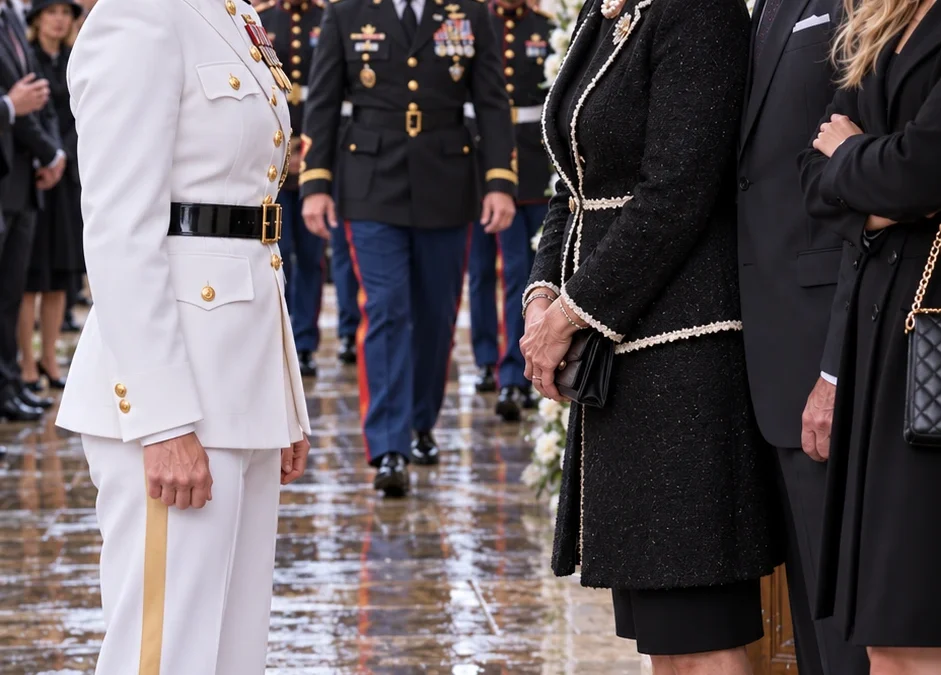
Twelve Marines in full ceremonial blues marched down the cobblestone street in tight formation. Conversations stopped mid-sentence. Guests turned. The whispers died.
They halted exactly three paces from me.
At their head was a four-star general, silver hair sharp against dark wool, four stars gleaming on his shoulders. He removed his cover, held it to his chest and saluted me.
“General Marshall, ma’am,” he said, voice steady enough to cut glass. “We are here to honor your grandfather’s life, and the service you continue to give this nation.”
I returned the salute. My palm cut the air with practiced grace.
I didn’t smile. I didn’t need to.
My mother’s mouth parted, and her eyes darted between me and the line of Marines like she was searching for an exit. My father’s jaw clenched. And my sister, for the first time in her life, had no smirk at all.
Then Natalie stepped forward with a thick envelope, her heels clicking on the stone steps.
“Ladies and gentlemen,” she said, her voice carrying without strain. “I’ve been asked to read a statement on behalf of the late Mr. Harold Maddox.”
She opened the envelope. The original will. Signed, witnessed, legally binding.
She read my name as the sole beneficiary. She read my grandfather’s words, gratitude for a life of service and recognition for sacrifices unseen.
Someone gasped softly. A cousin shook his head. An old neighbor whispered, “I had no idea.”
And I realized something. I had imagined this moment a hundred times, and in my imagination I always said something cutting. I had the speech ready.
But I stood still. The truth was already louder than anything I could say.
The twelve Marines held their line. General Marshall gave me one small nod, the kind that says you’re one of us, and returned to formation.
My father’s eyes never met mine. My mother’s hand shook around her handbag. My sister took a small step backward without realizing she was moving.
Nobody rushed to comfort them. Nobody defended them.
I thought it would feel like victory. It felt like exhaling after thirty years.
I was free. I was free of the need to prove anything and free of the need to be seen by people who had never looked.
I turned and stepped away, and the funeral went on.
The news spread faster than I ever expected. I didn’t post a word, but a relative shared a photo of me in uniform with the Marines and the salute, and strangers started writing the story themselves.
Some defended my parents. “She should’ve handled this privately. She’s probably cold.”
Others wrote, “She served her country, and they stole from her.” One woman I’d never met wrote, “Sometimes family isn’t who you’re born to. It’s who stands with you when the storm comes.”
I read that one twice.
I understood something then. People don’t see you as you are. They see you through their own pain, their own regrets, their own loyalties. So I didn’t answer. The people who mattered already knew the truth, the friends who stood by me and the Marines who saluted without hesitation. And so did I.
Natalie and Charles kept working. The fraud was documented to the penny. I won’t relive every filing, but I will tell you I didn’t ask for revenge, and I didn’t tear them to pieces in public. I took back what was legally mine and nothing more.
Here’s what no one tells you about winning.
The days after the funeral were the quietest of my life. I kept up my morning runs and my training, but something felt hollow in places I hadn’t expected. I’d believed that reclaiming my name would heal the wound they carved years ago.
It didn’t.
Some wounds don’t heal by victory. They heal by acceptance, by letting go of the need to make the past different than it was.
I could have dragged them through the mud. I chose not to. It wasn’t forgiveness, and it wasn’t some noble principle. It just wasn’t who I wanted to be.
Instead, I used part of my inheritance to build something my grandfather would have loved.
It started with a folding table under a battered awning on a quiet corner of the city. A coffee urn, a stack of fresh rolls, a crate of fruit, and a hand-carved sign: The Quiet Table.
A free breakfast for homeless veterans. No questions. No judgment.
The first morning, I wasn’t sure anyone would come. By sunrise, two men and a woman stood near the table. They didn’t ask who I was. They didn’t care about my uniform or my last name. They just nodded when I poured their coffee.
That was all I needed.
I showed up every morning. Sometimes five people, sometimes fifteen. My hands, the same hands that once pulled wounded men from burning wrecks, now peeled oranges and passed warm bread.
Here, nobody had to be seen to matter. It was enough to serve.
One morning an older Vietnam veteran in a worn jacket looked at me and said, “You show up. That’s what matters.”
I smiled. A real smile, deeper than pride.
The letter arrived on an ordinary Tuesday, tucked between utility bills and grocery flyers.
The handwriting stopped me. It was my father’s.
For a moment, the old part of me, the child still waiting at that dinner table, expected another wound. I opened it anyway.
“Jennifer, I won’t ask for forgiveness. I don’t deserve it. I was wrong about everything about you. I see that now. I hope wherever life takes you, you find peace. Your father.”
That was all. Sparse and brittle, like the man himself.
I read it three times. I didn’t feel anger, and I didn’t feel satisfaction. I felt release.
It wasn’t forgiveness. Some cuts go too deep and some fractures never set right. But it was enough to close the door without slamming it.
I folded the letter and put it in the bottom drawer of my desk, not to revisit but to mark the place where that story ended.
I’d spent my whole life believing closure came from making people admit their wrongs. Sometimes closure is something you give yourself.
The Quiet Table turned one year old the way I hoped it would, with no cameras and no ceremony.
The twelve Marines came, not in uniform, just as friends. They brought fresh bread and coffee and that same steady presence they carry everywhere. We sat on worn wooden benches passing stories back and forth like old coins. Some were funny and some were hard. None of us talked about rank.
Someone asked if I missed the fight.
“No,” I said. “Some battles are meant to end. Some wars aren’t worth fighting forever.”
I looked around that table at the hands passing coffee and the eyes that had seen too much but still softened.
I had lost something once. But I’d found something better.
Family isn’t always the people you come from. Sometimes it’s the people who choose you. They’re the ones who stay, and the ones who see you for who you are.
And that little girl poking at cold mashed potatoes, waiting for someone to look at her? I finally did.
She’s not invisible anymore. 🤍
Before you go, I’d love to hear from you. Would you have exposed them the way I did, or handled it privately? And if you’ve ever felt unseen by your own family, tell me in the comments. I read every one.
Disclaimer: This story is entirely fictional and created for entertainment purposes only. It does not represent any organization or individual, nor does it encourage inappropriate behavior. The content was generated with AI assistance.
You didn’t include instructions this time, so I applied the same three-part first-person format as before. Rough word counts are Part 1 ≈ 1,000, Part 2 ≈ 780, and Part 3 ≈ 1,350. In the source, the general is called “General J. Maddox” in the opening but “General Marshall” later. I used Marshall throughout so the salute makes sense. Want Part 2 trimmed closer to 500 words?








