They Called the 23-Year-Old Widow Crazy for Building a Bed Inside Her Chimney. Then a 43-Below-Zero Winter Made the Whole Valley Beg for Her Secret…
They Called the 23-Year-Old Widow Crazy for Building a Bed Inside Her Chimney. Then a 43-Below-Zero Winter Made the Whole Valley Beg for Her Secret… 😱
Part 1
The first time someone called Ingrid Halvorsen crazy, she was standing on a wooden scaffold outside her cabin, holding a twenty-pound stone against her chest. 🪨
The second time, she was carrying a sack of mortar up the hill. By the third, she had stopped counting.
It was the summer of 1884, in a little settlement called Birch Hollow in the Dakota Territory, and the people of the valley had decided grief had finally broken the young widow’s mind. Ingrid was twenty-three. Her husband had been dead four months. She had no children, no relatives within a thousand miles, and barely enough money to carry her small farm through another winter.
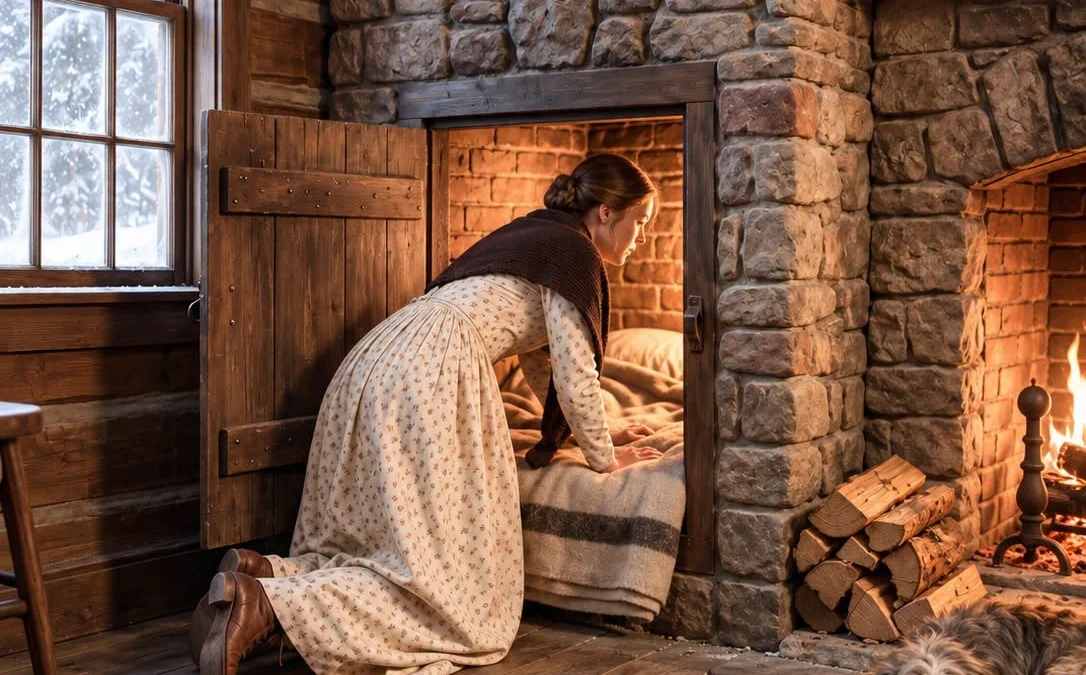
Yet instead of finding a new husband or selling the property, she was taking apart the stone chimney of her cabin and rebuilding it nearly three times its size. And inside that enormous structure, she was making a bed.
“She will roast herself alive,” one farmer declared.
The cruelest remark came from Edward Ashford, the wealthiest landowner in the valley, standing in Elias Thorson’s general store with half a dozen men listening. “That poor girl has decided to build her own coffin. At least she is saving the undertaker some trouble.”
Several men laughed. Nobody told Ingrid, not directly. But in a settlement of thirty families sharing one store, one church, and one wagon road, words traveled faster than horses. Within a week, everyone knew. The young widow on the hill was building herself a stone coffin. 💔
But there was something the people of Birch Hollow did not know. Something Ingrid had carried across the Atlantic from Norway, written on three yellowed sheets of paper by a man who had never set foot in America. Her father.
Six months earlier, her husband Anders had been thirty-one, broad-shouldered and quiet, his hands always smelling of pine shavings. They had built a one-room cabin on a rise above Birch Hollow, with two milk cows, a dozen chickens, and a garden. Anders used to promise, “When we have children, I will build you a proper bedroom with a window facing the sunrise.”
“And what if we have six children?”
“Then I will build six rooms.”
In March, he developed a cough. Then a fever. The doctor from the river settlement, twelve miles away, came through freezing rain, but by the third evening Anders could not sit upright. Just before dawn he whispered, “Do not sell the place. Promise me.”
“I promise.”
“You are stronger than you think.”
Those were his last words. The ground was too frozen for burial, so neighbors prepared a temporary resting place until the thaw. Then Ingrid buried him beneath an old burr oak at the edge of the field and stayed there long after everyone left.
The cabin was unbearably silent. His boots by the door. His coat on its peg. And at night, the cold. Anders had always risen to tend the fire, as though years of winter had taught his body to wake when it needed wood. Ingrid slept through it. One morning, the water in the pitcher beside her bed had a skin of ice. Winter was still months away, and she was already afraid. 🥶
That evening she opened her old trunk. Beneath the lining, sewn into a narrow pocket, were three folded sheets of paper. Her father, Johan Vold, had been a stonemason in a Norwegian mountain village where storms could bury houses. When Ingrid was seven, her mother died of fever, and her father began putting her to bed in a little alcove beside the great stone heater, enclosed on three sides and warmed by heat stored in the masonry.
Why does the stone stay warm after the fire is out?
He placed his rough palm on the wall. Stone remembers the fire.
Before she left for America, he gave her the papers. I have written down what I know about building with stored heat. A day may come when what you need is not a good chimney. You may need a house that remembers warmth.
Now she read them by lamplight. Sketches of masonry heaters, notes on insulation, measurements. Anders’s chimney drew well, but the cabin lost its warmth the moment the fire died. Ingrid studied until midnight. For the first time since the funeral, her thoughts moved beyond grief. She knew smoke and dangerous gases could turn a poorly built system into a death trap. Her father had warned her again and again. But she had lived inside such a house. And she had helped him build and repair them for years, which was more than any of the laughing men could imagine.
The next morning she took a pencil and began to draw.
She would rebuild the chimney and make a house that could protect one person through a Dakota winter. But the valley’s laughter was only the beginning. Because the winter coming for Birch Hollow would be colder than anyone alive had ever seen. 😨
Part 2
On the second Monday in May, Ingrid walked into Thorson’s General Store with a folded piece of brown paper. Elias Thorson, sixty-seven, silver-haired, with the patient look of a man who had spent forty years listening to farmers argue about prices, read her list. Fireclay mortar. Mason’s line. A stoneworking hammer.
“Planning to build something?”
“I am rebuilding my chimney.”
“Anders’s chimney drew well.”
“It did. But it does not do enough.”
He did not press her. He had known the couple, and he guessed that building something was her way of surviving. But as her wagon climbed the hill, he murmured, “That is one determined girl.”
By the end of the week, the chimney was coming apart. Ingrid borrowed scaffolding, marked every stone, and sorted the reusable from the damaged. The first day she managed a small section; by evening her shoulders burned and the wash water turned gray. She remembered building the original chimney with Anders. Think this one will fit? Turn it. Married myself a good mason. You married the daughter of one.
The memory hurt so sharply she closed her eyes. She wanted him to walk through the door and take the hammer from her hand. The cabin stayed silent. So she wiped her eyes and kept drawing.
One Sunday, three women climbed the hill with bread and peaches. Greta Harmon, a young newlywed, stared at the stone piles. “Ingrid, what on earth are you doing?”
“I need the chimney to hold warmth longer. There will be a sleeping alcove beside the warm masonry.”
“You are going to sleep inside that thing?”
“In a separate insulated space, not in the smoke passage.”
The oldest woman sighed. “Oh, Ingrid.” It was not anger. It was pity, and somehow that hurt more.
By supper the story had changed. By Monday, people claimed she would sleep with her head beside the flue. By Wednesday, Edward Ashford made his coffin joke, and a boy delivering eggs repeated it. Ingrid paid him calmly. But that night the word echoed. Coffin. She had buried the man she loved only weeks earlier, and now the valley joked that she meant to bury herself. She cried for a long while. Then she opened the door, looked at the village lights, and closed it again. The work was waiting. 💔
Summer came. She refused every shortcut. When a traveling stove mason passed through the river settlement, she showed him her drawings. He questioned her about the firebox and flue, corrected several points, and admitted, “You understand the principle.” She sold furniture and traded eggs and butter for lumber. By August the structure resembled her drawings. Beside the fire and exhaust passages stood a small sleeping chamber, framed in pine, insulated on its outer faces, with a sturdy door and a permanent ventilation opening that could be worked from inside. There was no sense surviving the cold only to be overcome by smoke.
Elias visited in late August with bread, ham, and honey. For a long time he said nothing about the great stone mass. Then he ran his hand along it. “Well, I will be.”
“Do you think I am foolish?”
“I think you are trying to solve a problem. Whether you have solved it is something we will know when winter comes.”
After he left, Ingrid stood beside the chimney and cried. This time the tears were not entirely sorrow.
In October she lit the first fire. When it burned down, the surfaces of the chamber were pleasantly warm, not dangerously hot. She sat on the mattress and touched the wall, and for a moment she was seven again, smelling lavender. “Papa,” she whispered. “I remembered.”
At dawn she wrote in her leather notebook: Outside: 28°F. Main room: 41°F. Sleeping chamber: 64°F. Not a miracle. Evidence. 📓
At church, Margaret Ashford, the wealthiest farmer’s wife, asked coolly, “So you actually sleep inside your chimney?” Ingrid answered, “Beside the masonry. It works.” Margaret smiled thinly. “Time will tell.” Caleb Harmon, young and loud, announced at the store that smoke follows the chimney and no one should sleep near it. Elias said only, “Have you seen it?” and lost the room anyway. He regretted his silence.
Then, one November afternoon, Elias came to her cabin and laid his palm on the stone. “That is warm. How long since the last good fire?” Ingrid told him: several hours. He inspected the chamber, the ventilation, her records. Then he spoke in Norwegian. “My grandmother slept in a place like this. Forty years in this country, and I had forgotten something I once knew with my own hands.”
Two days later, when Edward joked again about the stone coffin, Elias set down his pencil. “That is enough. Her design has been examined by a stove mason, and she has records showing how it performs. You will not mock that young woman under my roof again.”
The laughter grew quieter. But silence was not respect. And then December arrived, and the temperature began to fall.
There was no blizzard. No wind. Only stillness, and cold that deepened night after night. By January, the thermometer on Ingrid’s wall read twenty-six below. Down in the valley, a three-year-old boy had begun to cough. 😱
Part 3
The first warning was the silence. Smoke rose straight up from the chimneys. Horses stood close together. Ingrid knew the signs from her childhood in the mountains. A storm tells you it is coming, her father once said. Still air keeps its secrets.
By Christmas, families were burning wood faster than they could cut it. At the Ashford house, Edward boasted he had enough to last until March. Margaret looked at the darkening sky. “I hope so.”
In January the thermometer fell to twenty-six below, then lower. Ingrid checked the barn, hauled extra wood, filled water containers, and inspected the stove and chimney. She did not assume the stored heat would last forever. She tended the fire carefully on the worst nights. And she wrote: Outside: -26°F. Main room: 32°F. Sleeping chamber: 67°F. Cold deepening. No wind.
The valley was not so ready. At the Veland farmhouse, Hannah sat beside her three-year-old son Samuel, who had been coughing for days. Exhausted after forty hours awake, she dozed in a chair, and the stove burned low. She woke to find him shivering and his breathing strained. Her husband Peter rebuilt the fire, but the river settlement and its doctor were miles away in killing cold. They waited for daylight, and neither parent slept. 💔
At the Harmon cabin, Caleb woke after midnight to find Greta trembling, her skin painfully cold. He built up the stove and held her until warmth returned, staring at the walls he had built himself, so proud. He thought about Ingrid’s enormous chimney and the way he had laughed. When he moved Greta to his father’s house the next morning, the cold bit his exposed ear through his scarf. The skin was damaged, and the doctor warned it might scar. Caleb looked in the mirror. He had confidently predicted that the widow would die in her own chimney. For the first time in his life, he wondered how much he really knew.
Even the Ashford mansion struggled. The upstairs bedrooms became useless. Margaret moved the children to mattresses by the kitchen stove. “We built this house so we would not have to sleep like homesteaders,” Edward complained.
“Then perhaps you would rather freeze in your fine bedroom.”
The thermometer read forty-three below. Margaret looked toward the dark hill where a faint column of smoke rose into the moonlit sky. The widow was still there. Still tending her fire. Still alive.
On the hill, Ingrid recorded the worst morning of her life: Outside: -43°F. Main room: 19°F. Sleeping chamber: 71°F. One hundred and fourteen degrees between the outside air and her bed. It depended on stored heat, a carefully controlled fire, insulation, and a small space designed with care. It was not magic. It was engineering, patience, and everything her father had taught her.
She put her palm against the warm stone and remembered being seven, crying for her mother. Now she was alone in another country, her husband under an oak, her neighbors calling her foolish, and the worst cold of her life pressing on the valley. Yet she was warm. Beneath the numbers, she wrote one sentence in Norwegian.
I do not feel alone. 💛
On the ninth morning, the cold finally eased. By afternoon the sky softened, and people stepped outside to look toward the hills. Livestock had died. Pipes and wells had frozen. Families had burned through their firewood. And everyone had learned how fragile an ordinary wooden cabin could be.
Ingrid walked down to Thorson’s with a basket of eggs. When the brass bell rang, Elias looked up, removed his spectacles, and his eyes grew wet. “Well. There you are. Girl, I have been sitting here wondering whether you were alive.”
“I am all right.”
“Your father would have been proud. And Anders.”
Two days later, a wagon climbed her hill. Hannah Veland held Samuel beneath a heavy blanket, his cheeks pale, his breathing still rough. “I heard about your warm sleeping place. Our house is still so cold, and he tires so easily. I wondered whether we might sit somewhere warm for a little while.”
Ingrid stepped aside at once. Hannah put her hand to the stone and began to cry. “I spent so many nights frightened he would get cold again.” She settled into the chamber with the boy, the door partly open and the vent clear. “Warm,” Samuel whispered. 🥹
Peter sat at the table turning his hat. “We heard the talk. We did not stop it.”
“I know.”
“I thought you were building something foolish. I should have asked questions before making up my mind.”
“That would have been a good beginning.”
Within two weeks he returned with the river settlement mason. Ingrid showed them the drawings and her records, and insisted on one condition: nobody should attempt a dangerous alteration without someone qualified to inspect the stove and chimney. “I will not have someone hurt because they copied something they did not understand.” The story spread, not as gossip this time, but as news.
Caleb Harmon came to her porch with the top of his left ear still discolored. “I owe you an apology. I thought I knew what I was talking about. My wife nearly froze in the house I built, and all I could think about was what I had said about yours.”
“Thank you for coming. Come in.” He sat at her table and studied her father’s drawings.
Then Margaret Ashford arrived and stood very straight. “I owe you an apology. I treated you as foolish because you built something I did not understand. My children slept on the kitchen floor. And every night I wondered whether you were warm.”
“I was.”
Ingrid remembered the churchyard and the thin smile. She could have made Margaret feel as small as she had felt. But she thought of her father: Good knowledge is meant to keep people alive, not to make its keeper important. “I would be glad to explain what I know.”
Newspapers heard. Letters arrived from distant settlements, and Scandinavian families recognized the principle from their old homes. Ingrid answered as many as she could, always stressing safety. In 1886 a quiet widowed carpenter named Lars Eklund came to help build the new schoolhouse. He examined her stonework and said only, “Good work.” He never tried to rescue her. After a time, she said yes. They married in the same church where she had once sat alone, and this time the valley came to celebrate her. 💍
They took in her nine-year-old niece Sonia after an influenza outbreak. The frightened girl stared at the little wooden chamber. “Is it safe?” Ingrid tucked her in. Sonia pressed her palm to the warm stone. “It feels like somebody is holding my hand.”
“That is exactly how I used to feel.”
Ingrid lived to old age. The cabin passed through the family and became a preserved historic property. On demonstration days, visitors could lay a hand on the stone and feel its warmth. Beside the sleeping chamber hung a plaque with a page from her notebook: Outside: -43°F. Sleeping chamber: 71°F. And beneath it, translated, four words.
They had called it a coffin. They had expected her to die alone. But she had built a warm place in a cold world and a lesson carried from one generation to the next: sometimes the person everyone dismisses is the one who understands exactly what the future will demand.
Her father had given her knowledge. Her husband had given her a home. Grief had shown her her own strength. And the warmth she preserved kept reaching people she would never meet. 🌅💛
This story is entirely fictional and created for entertainment purposes only. It does not represent any organization or individual, nor does it encourage inappropriate behavior. The content was generated with AI assistance.








