They Chained Her to a Wagon and Dragged Her Across the Plains… Then a Scarred Rancher Stepped Out of the Shadows and Said Four Words That Started a War
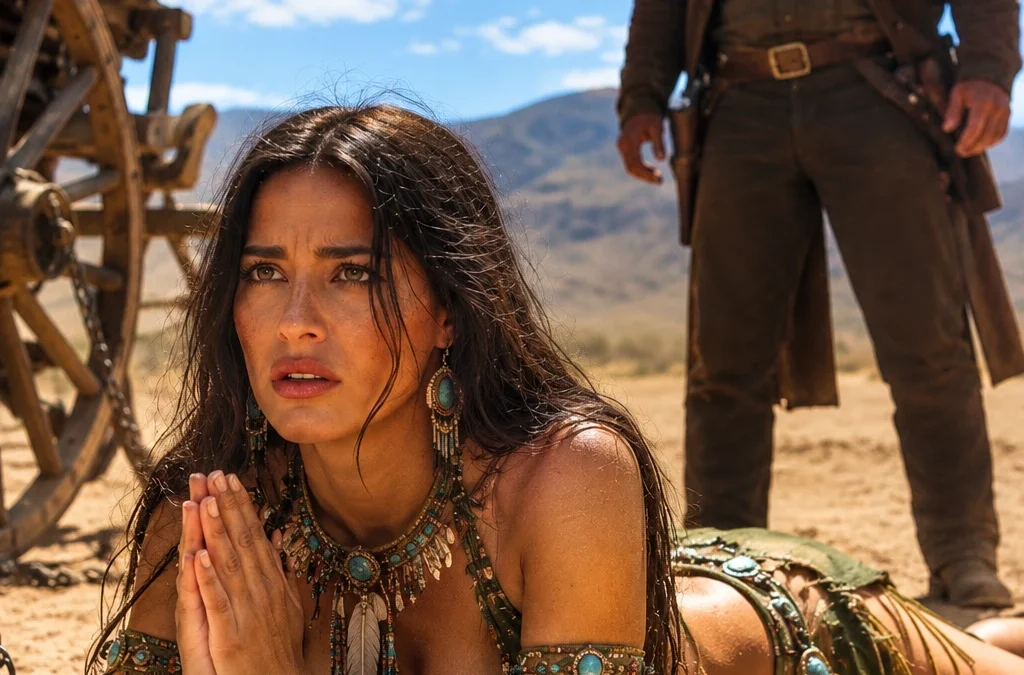
🔥 They Chained Her to a Wagon and Dragged Her Across the Plains… Then a Scarred Rancher Stepped Out of the Shadows and Said Four Words That Started a War 😱
PART 1
Late summer on the Ash Creek Flats, Montana Territory. 🌄
The evening light stretched long shadows across the land as Asa Merrick crested the ridge above a dry creek bed. He had spent most of the afternoon tracking a wayward calf through scrub oak and sage, following hoofprints and broken brush.
At thirty-one, Asa moved like a man who had seen too much violence and chosen solitude as his refuge. The war had left its marks: a scar from his left temple to his jaw, a hitch in his stride from shrapnel that still worked its way to the surface on cold mornings, and eyes that carried the particular weariness of someone who had witnessed humanity at its worst. 💔
His small ranch sat in a valley where Ash Creek wound through cottonwoods and willows, so remote that weeks could pass without seeing another soul. That suited him fine. He had built the cabin with his own hands. Raised the barn timber by timber. Carved out a life that asked nothing of the world except to be left alone.
The cattle were good company. They never asked about the nightmares. They never asked why he sometimes stood at his window in the small hours, watching the dark as if it might swallow him whole. 🌑
Then he heard it.
A metallic clink-clink-clink carried on the evening air. It was a sound he knew from his soldiering days: the rattle of chain against iron. The kind used for prisoners. Or cargo.
He guided his horse toward the sound, keeping to the shadow of the ridge. What he saw below turned his stomach.
A ramshackle wagon lurched along the rough trail, pulled by two weary mules. Two men sat on the driver’s seat, passing a bottle back and forth, laughing at some private joke that involved glancing back at what they were hauling.
And what they were hauling made Asa’s blood run cold. 😨
Chained to the rear axle was a young woman. Heavy iron shackles bound her wrists, and they had worn bloody grooves into her skin. She stumbled behind the wagon, barefoot, trying to keep pace with every jerking lurch. Her dress hung in tatters. Her long black hair was matted with dirt and sweat, falling across her face like a veil of suffering.
Her shoulders shook with exhaustion. Her legs trembled with every step. And the two men on the wagon didn’t care. 😡
Their drunken voices carried across the flats. They were talking about her like livestock.
“Reckon we’ll get a good price for her in Billings,” said the heavyset one, a graying man with a gut that spoke of too much whiskey and not enough honest work.
“Hell, Jed, we should’ve sold her back in Bozeman,” the thin one answered, a nervous man with shifty eyes. “This drag is wearing her down something fierce.”
“She’s tough enough, Vern. These Apache women are bred for hard work. A few marks ain’t gonna hurt the price. Some folks like ’em roughed up.”
Their laughter made Asa’s jaw clench so hard he thought his teeth might crack.
He had told himself he was done with violence. Done with being the man who stepped into situations like this. His ranch was supposed to be a sanctuary, a place where the worst thing he had to face was a sick calf or a broken fence post.
But as he watched the woman stumble, nearly fall, and be jerked upright by the chain, something inside him snapped. The soldier he had tried to bury came roaring back to life. 🔥
He dismounted, ground-tied his horse, and made his way down the slope on foot, silent as the four years of war that had kept him alive.
Just before he moved, the woman lifted her head as if sensing him. Across the dusty distance, their eyes met. Even through the dirt and exhaustion, he saw it: fierce intelligence. A will that refused to break. She didn’t cry out. She didn’t signal him. Perhaps she had learned better than to hope.
But the defiance and desperation in that single look told him everything he needed to know.
Asa stepped out of the shadows and into the wagon’s path, one hand resting casually on his revolver. The mules shied and stopped.
“Evening, gentlemen,” he said, his voice carrying the quiet authority that had once commanded a company of Union soldiers. “Might I have a word?”
Jed squinted down at him, his hand drifting toward the rifle across his knees. “You got business with us? Because if you don’t, move along. We got places to be.”
Asa glanced at the woman. She had sunk to her knees in the dust, her chest heaving. Her wrists were slick with blood.
“Depends,” he said. “I’m wondering about your cargo. Seems like unusual freight for this part of the territory.”
“Ain’t no concern of yours,” Vern said with a nervous laugh. “We got papers for her. Legal and proper.”
“Papers.” Asa tested the word. “What kind of papers would those be?”
“The kind that says she’s ours to do with as we please,” Jed snarled. “Now move along before this gets unfriendly.”
“They wouldn’t happen to be slave papers, would they?” Asa never took his eyes off Jed. “Because I was under the impression that particular institution had been abolished some years back.”
The silence turned heavy. Somewhere above, a hawk cried out. 🦅
“She ain’t free,” Jed spat. “She’s a prisoner. Captured fair and square after her people raided a settlement down south.”
It was a lie, and they all knew it. The woman wore the plain cotton dress of someone who had been living peacefully, a seamstress or a domestic in some frontier town. Her hands were calloused from work, not war.
Then, for the first time, she spoke. Her voice was cracked from thirst but carried clearly through the still air.
“Please.” One word, containing worlds of suffering. “My name is Nalin. I was working in Cedar Falls when these men took me from the boarding house where I lived. I have done nothing wrong.”
Her English was accented but precise, spoken with the pride of someone who had learned it carefully. And something in Asa’s chest twisted at the dignity of it.
“You hear that?” he said, his voice hardening. “The lady says you kidnapped her. I don’t know much about the law, but I’m pretty sure that’s a hanging offense in most territories.”
Jed’s hand tightened on his rifle. Vern reached for a pistol at his belt.
“You’ve got a choice here, gentlemen,” Asa said, his own hand now openly on his gun. “Unlock those chains and ride away, or we settle this in a way likely to leave some of us permanently horizontal.”
Nobody moved. The standoff stretched like a taut wire.
Then Vern broke. He yanked his pistol free.
Asa’s Colt cleared leather in a single smooth draw. The shot cracked across the flats like thunder, and Vern’s pistol went spinning into the dust, along with two of his fingers and what remained of his dignity. 💥
Before Jed could swing his rifle, Asa had moved the wagon between them. But instead of fighting on, he did something that surprised even himself. He holstered his gun, walked calmly to the back of the wagon, and knelt beside Nalin. With a small folding knife, he worked at the lock on her shackles.
“What the hell do you think you’re doing?” Jed shouted.
“Freeing this woman,” Asa said, as if it were the most natural thing in the world.
The lock was old and poorly made. It sprang open in seconds. The chains fell from her wrists with a clatter that seemed to echo across the whole territory. Nalin looked up at him with eyes full of gratitude and disbelief. When she tried to stand, her legs buckled, and he caught her arm.
“Easy,” he said gently. “You’ve been through enough for one day.”
“This ain’t over,” Jed said, his voice thick with impotent rage. “You got no idea who you’re messing with, mister.”
Asa gave him the cold stare that had once made Confederate prisoners think twice. “Then you tell them that someone finally said no. You tell them not everybody in this territory is willing to look the other way while men like you trade in human misery. And if they want to do something about it, they know where to find me.”
He lifted Nalin onto his horse and swung up behind her. As they rode off, Jed’s voice followed them. “What’s your name? So I know what to put on your headstone!”
Asa paused, one hand on the reins. “Asa Merrick. I’ve got a spread five miles north along Ash Creek.” A cold smile touched his scarred face. “Come calling anytime you feel lucky.”
The ride home passed in silence. Nalin’s arms wrapped tight around his waist, trembling from cold and shock. Stars began to prick the sky. And Asa found himself wondering what he had just gotten himself into. He had built his life around avoiding exactly this kind of complication.
But when he felt her shiver and pulled his coat around her, he found he didn’t regret a thing. 💛
At the cabin, he lit a lamp, built up the fire, and heated yesterday’s stew. Nalin ate slowly, carefully, like someone who hadn’t had a real meal in far too long. Then he cleaned the raw wounds on her wrists and picked the gravel from her cut and swollen feet.
“You’ve done this before,” she said.
“Field medicine. You learn.”
“Why did you help me?” she asked suddenly.
Asa was quiet for a moment. “Because I’ve been running from fights for too long. I told myself after the war I was done with violence. But some things you can’t walk away from.”
Nalin nodded slowly. Then she said something that made the warmth in his chest turn cold with surprise.
“My people have a saying. The person who saves a life becomes responsible for that life. I am your responsibility now, Asa Merrick.”
He gave her his loft to sleep in, took the floor by the fire, and drifted off hoping, for the first time in years, that his running days might be behind him.
He had no idea that three miles away, the two men he had humiliated were not riding for a doctor. They were riding for a man named Colonel Hargrove, the one who had paid for Nalin. And Hargrove wasn’t a slaver.
He was Nalin’s husband. 😱
PART 2
Asa woke before dawn to find Nalin already awake, sitting by the cold hearth with his blanket around her shoulders. She had been watching the door all night. When he stirred, she didn’t look away. “They will come for me,” she said quietly. “Not Jed and Vern. They are only hired dogs. The man who sent them.” Asa sat up slowly. “Hargrove?” The color drained from her face. “How do you know that name?” He didn’t answer right away, because he didn’t know. The name had come to him from nowhere, a ghost from a world he thought he’d left behind. A world of Union camps and quiet orders and men who looked the other way. His hand drifted to the scar on his jaw. 😰
Nalin told him everything. Colonel Silas Hargrove, a retired army officer turned land baron, had held a “guardianship” over her people’s reservation papers for ten years. When her father died, the Colonel had forged documents that named Nalin his legal ward, and then his wife, so that every acre her family owned would pass to him. She had run to Cedar Falls and built a quiet life as a seamstress. Then, two weeks ago, Jed and Vern had broken down the boarding house door. “He doesn’t want me,” she whispered. “He wants the land under my name. And a living wife can sign. A dead one cannot.” Her voice cracked. “But I think he would rather have me alive, until I do.” 💔
Asa stood and walked to the window. The valley was silver and still. He thought of the soldiers he’d commanded, of the orders he’d followed in the war, and of a man named Hargrove who had once signed a document sending Asa’s company into a village that had not deserved what came next. He had never learned the name of the officer who gave the order. But he remembered the signature. And he remembered the ink. “I know that man,” he said, his voice hollow. “I think I served under him.” Nalin’s eyes widened. “Then he will know you, too.” Asa turned. For the first time, she saw the fear in his face, not of Hargrove’s guns, but of what he might have once done in the Colonel’s name. 🥹
By noon, a dust cloud rose on the south road. Not two men this time. Twelve. Asa barred the cabin door, loaded his rifle, and pushed Nalin toward the loft. “Stay hidden.” But she shook her head, picked up the old Spencer carbine from the wall, and checked the load with practiced hands. “I was raised on this land,” she said. “I will not hide on it.” Asa almost smiled. Then the riders fanned out across his yard, and a tall, silver-haired man in a pressed blue coat rode forward on a black stallion. He tipped his hat with perfect courtesy. “Captain Merrick,” said Colonel Hargrove. “It has been a long time.” 😱
Asa’s blood froze. Hargrove smiled, and he said something that made Asa’s grip slip from the rifle. “I am not here for her, Captain. I am here for you. You see, the village you burned at Wolf’s Crossing in sixty-four? There was a survivor.” His eyes slid to the cabin door. “And she has been looking for you for eleven years.” 🔥
PART 3
For a long moment, the only sound was the wind in the cottonwoods.
Asa stood frozen on the porch. Behind the half-open door, he could feel Nalin’s presence, rigid and silent, the Spencer carbine still in her hands. Hargrove sat easy on his stallion, enjoying every second.
“Wolf’s Crossing,” the Colonel said. “A Cheyenne farming settlement, wasn’t it? Forty-three souls. Your company went in at dawn under my written orders. You were told they were harboring Confederate sympathizers. You didn’t ask questions.”
“I didn’t know,” Asa whispered.
“Of course you didn’t. That was the beauty of it.” Hargrove smiled. “I needed the land cleared. I needed a name on the order that wasn’t mine. A young captain with a clean record and an obedient streak. You were perfect.”
The words struck harder than any bullet. Eleven years of nightmares. Eleven years of standing at a window in the small hours. And all of it had been engineered by the man now smiling down at him from a black horse.
“And the survivor?” Asa asked, his voice cracking.
Hargrove tilted his head toward the cabin door. “Why don’t you ask her?”
The door swung open.
Nalin stepped onto the porch. The carbine hung loosely at her side. Her face was pale, her eyes shining with tears, but her voice came out steady.
“I was fourteen,” she said. “I hid in a root cellar beneath my mother’s kitchen. I heard the soldiers break down the door. I heard my mother beg in my language. I heard the shots.” She drew a shaking breath. “And I heard one soldier say, No. Not the children. I will not.”
Asa’s knees nearly gave out.
“That soldier,” Nalin said, “ordered his men to stand down. He took a bullet in the shoulder from his own sergeant for it. He dragged an unconscious boy from a burning barn and carried him to the river. I saw it through a crack in the cellar wall.” Her voice broke. “I never forgot his scar.”
She lifted a trembling hand toward his face. “That was you, Asa. I have been looking for you for eleven years. Not for revenge. To thank you.”
The world tilted. Asa stared at her. He remembered it now: not the order, not the burning, but the one thing he had buried deepest. A boy of seven or eight in his arms, soaked and coughing. A sergeant’s pistol. A choice made in a split second that had cost him his rank and sent him home in disgrace.
“The boy,” he said. “He lived?”
“My little brother,” Nalin whispered. “He is nineteen now. He is waiting in Cedar Falls. He has told his sons your story.”
Asa dropped to his knees in the dust, overcome. Hargrove’s smile slipped.
“This is touching,” the Colonel said coldly. “But it changes nothing. Seize them both.”
Twelve riders lifted their rifles.
“Wait!”
The cry rang from the ridge behind the cabin. Every head turned. Dozens of figures crested the hill, some on horseback, some on foot, spreading out in a long line against the sunset. Cheyenne and Apache families. Cedar Falls shopkeepers. The sheriff of Bozeman, his badge catching the light. And at their head, a tall young man with Nalin’s eyes and a scar across his chin.
“Little brother,” Nalin breathed.
“We heard what Hargrove did,” the young man called. “We have the papers, Colonel. The forged guardianship. The false marriage record. Your signature on the order at Wolf’s Crossing, saved in a drawer by an army clerk who lost sleep over it for eleven years.”
A murmur spread through Hargrove’s riders. One lowered his rifle. Then another.
The Colonel’s face went white. “You have nothing.”
“We have everything,” said the sheriff, stepping forward with a sheaf of papers. “Including a federal warrant out of Fort Ellis. Silas Hargrove, you’re under arrest for forgery, kidnapping, fraud, and murder.”
Hargrove reached for his pistol.
He never cleared the holster. A single shot from Nalin’s Spencer struck the ground inches from his stallion’s hooves. The animal reared, and the Colonel crashed to the dirt. Two of his own men dragged him up, snapped the cuffs on, and handed him to the sheriff without a word.
As the dust settled, the long, sorrowful silence of eleven years broke at last. 🌅
But the story wasn’t over. 💛
That evening, the valley glowed gold. The Cedar Falls families gathered in Asa’s yard, building fires and sharing food, and for the first time in his life, Asa found himself surrounded by laughter instead of ghosts. Nalin’s brother, Tahmo, shook his hand and wouldn’t let go. “You gave me my life. I want to give you something.”
Asa shook his head, overcome. “I don’t deserve this. I followed that order. Forty-three people died.”
“You are not the man who gave the order,” Nalin said gently, stepping up beside him. “You are the man who stopped. Eleven years ago, you chose. And last week, you chose again.”
He looked at her. The firelight picked out the bronze in her skin and the fierce, tender strength in her eyes. For the first time in over a decade, the weight on his shoulders felt lighter.
“I told you my people say the one who saves a life becomes responsible for that life,” Nalin said softly. “But I have been thinking. I think it goes both ways.”
“What do you mean?”
“You saved my brother. You saved me. And you have been carrying a life that was not yours to carry, one made of guilt and silence.” She took his scarred hand in hers. “I would like to be responsible for yours.”
His throat closed. He couldn’t speak. He just nodded, tears sliding down his weathered cheeks, and she pulled him into her arms. 🥹
Autumn came gently to Ash Creek.
Hargrove stood trial in Helena. The papers held. The court restored every acre of reservation land to its rightful families, and Nalin’s name was entered beside her father’s on the new deed. The Colonel was sentenced to thirty years in a federal prison. At the trial, the old army clerk who had saved the original order testified, tearfully, that he had never been able to forget the child’s cry from the cellar at Wolf’s Crossing.
Asa and Nalin were married in the spring beneath the cottonwoods, with Tahmo as witness and a hundred friends from three nations in attendance. The cattle grazed peacefully in the corral. The cabin gained a second room, then a third. A school was built beside it, where Nalin taught the children of the valley to read in two languages, and Asa taught them to carpenter, to track, and to listen. Their house became known across the territory as a place where no one was turned away.
On the anniversary of the day Asa stepped out of the shadows, the two of them stood on the ridge above the dry creek bed, the same spot where it had all begun. The wind swept across the golden flats. Far below, the old wagon trail was nearly grass.
“Do you ever regret it?” Nalin asked. “That you stopped?”
Asa watched the sun sink behind the hills. For the first time in his life, the dark at the edge of the world didn’t feel like it might swallow him.
“I used to think the war took everything from me,” he said. “Turns out it only took what I was willing to let go of.” He wrapped his arm around her shoulders. “What I held onto, I got to keep.”
She leaned her head against his chest. Below them, the lamps of their home glowed warm in the dusk.
“The person who saves a life,” Nalin murmured, “becomes responsible for that life.”
“And the person who is saved,” Asa said, kissing her forehead, “gets to choose how to live it.”
They stood there together as the stars came out over Montana Territory. Two people, once chained to the worst moments of their pasts, finally free. 🌄
Moral of the story: One brave moment of mercy can echo across a lifetime. Even a man who believes he has lost his soul can find it again by choosing, one day at a time, to stand up for someone who cannot stand for themselves. 💛
💬 Now it’s your turn: would you have stepped out of the shadows for Nalin, knowing the price? And do you believe a man can truly be forgiven for what he did while following orders? Tell us in the comments! If this story touched your heart, like it, share it with someone who needs a reminder that mercy matters, and follow the page for more unforgettable tales of the Old West. 🤠
Disclaimer: This story is entirely fictional and created for entertainment purposes only. It does not represent any organization or individual, nor does it encourage inappropriate behavior. The content was generated with AI assistance.








