They Dragged a Penniless Farmhand Before 200 Dinner Guests. One Woman Stood Up for Him, Unaware He Owned Her Entire Valley, and the Man Accusing Him Had Already Sold Her Farm
They Dragged a Penniless Farmhand Before 200 Dinner Guests. One Woman Stood Up for Him, Unaware He Owned Her Entire Valley, and the Man Accusing Him Had Already Sold Her Farm 💔🌾
PART 1
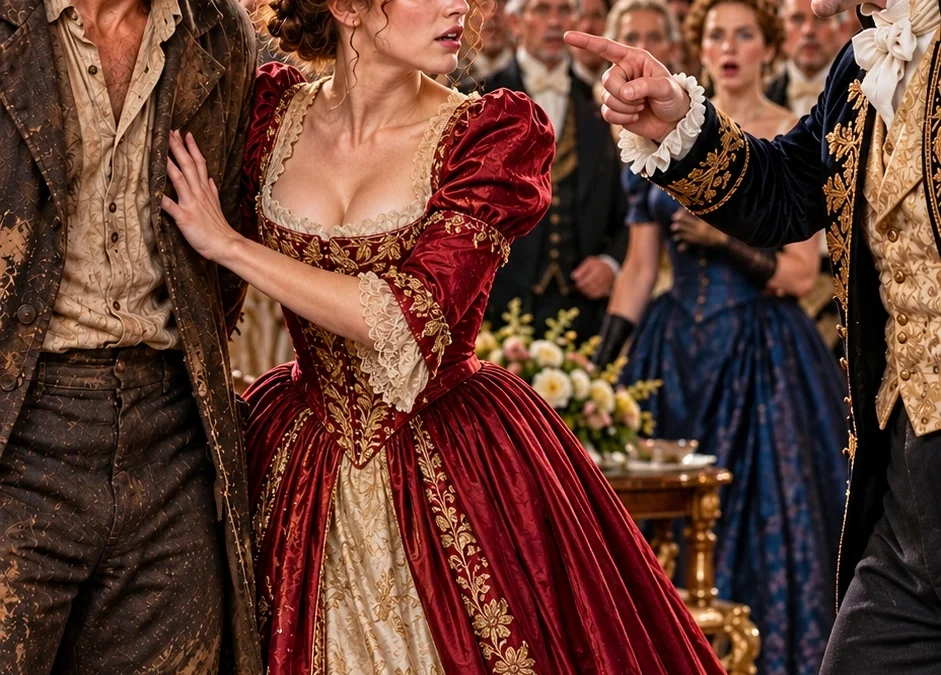
🕯️ Two hundred guests filled Harrove Hall when the steward dragged a penniless farmhand into the candlelight.
His boots were caked with mud. His coat was torn at the shoulder. A stolen ledger, they claimed, had been found beneath his bed. Every nobleman in the room demanded he be thrown out.
Then Georgia Whitham pushed back her chair and stood.
She had no idea the silent laborer was Nathaniel Hargrove, the Duke who owned the entire valley. But he knew something even she did not: the man accusing him had already signed away her future that very morning. 😳
In the spring of 1844, Nathaniel was thirty-five, master of twelve thousand acres, with a title older than most cathedrals and servants who anticipated his needs before he spoke them. When he raised his hand at a dinner table, a hundred noblemen fell silent.
And yet something had begun to trouble him.
It started with letters. Uneven handwriting on cheap paper, stained with candle wax and rain, from tenant farmers he had never met. Every letter described the same strange thing. The harvests had not failed. The fields had produced grain. The cattle had grown fat. Yet the farmers were being buried in debt and driven from homes their families had worked for generations.
His steward, Trent Maddox, blamed poor soil and ungrateful tenants, in orderly letters full of persuasive figures. Nathaniel had trusted him. Eight months earlier, he had signed papers granting Trent emergency authority over the estate, quickly, between other obligations.
Then one morning an unsigned note appeared on his desk, in a careful, frightened hand:
“Your grace, the harvest was never lost. Someone made it disappear.” 😨
If it was true, every report he had approved, every family that had lost its land, had suffered under his name.
He knew what an official inspection would bring: a polished carriage, a crest on the door, swept barns and coached farmers. So Nathaniel did something that would have scandalized his entire circle. He removed his signet ring, traded his tailored coat for a frayed one from a secondhand stall, and became Milo Tanner, a laborer who had lost his last position.
At a crowded inn in Stonebrook, he sat alone with weak ale and listened. The farmers whispered about rising rents, missing seed, and a woman named Georgia Whitham who refused to bow. Trent called her stubborn and dangerous. But an old wagon driver shook his head.
“She’s the only one left in this valley who still dares to tell the truth.”
The next morning, Nathaniel walked to Stonebrook Farm. Nailed to the fence post was a curling notice: FINAL NOTICE. PROPERTY SUBJECT TO REPOSSESSION. Trent’s signature sat beneath it. But it was the wax seal beside it that turned his blood cold.
His own family seal. 🥶
Georgia was twenty-eight, and had run those hundred and eighty acres longer than most people thought a woman should run anything. Her rent had doubled in less than a year. Investors introduced by Trent kept offering insulting prices for her lease. She kept refusing.
That morning she was mending a harness when a stranger appeared at her gate. Threadbare coat. Muddy boots. Hands smooth where they should have been rough.
“You don’t look like a farmhand.”
“Then give me a chance to become one.”
Against her better judgment, she gave him a week. He set a fence post crooked and watched half the rail collapse. He spilled a sack of feed across the barn floor. Georgia neither flattered nor mocked him. She simply pointed at each mistake and said, fix it.
He noticed she quietly shared her own thin seed stores with neighbors who had run short.
Then a storm ripped open the barn roof. Side by side, in freezing rain, they dragged tarps and timbers over the seed. A beam slipped and gashed his hand open. He wrapped it in a rag and kept working. Only when the last sack was safe did she pull him into the lamplight and bandage the wound herself.
“Why would a stranger work this hard for land that isn’t his?”
He said nothing. He couldn’t tell her that every acre around them was.
The next morning she handed him a heavy wool coat that had belonged to someone in her family who was gone. She had kept it folded in a trunk for years. “You’ll need it, if you’re going to keep working through the cold.”
All his life, people had given him gifts for what he could offer in return. Georgia had just given something precious to a man who could offer her nothing. 🧥
Days later, repairing the storehouse floor, he found a shipping receipt wedged in a crack. It declared that Stonebrook had received its full allotment of relief seed months ago. Georgia read it twice, her face pale with anger. Not a single sack had ever arrived.
He began following the trail. Eighteen wagonloads of seed recorded as delivered. Every named farmer swore they’d received nothing. The wheel ruts led to a private warehouse near the new railway line. Someone was stealing relief seed and selling it.
Then Trent arrived with two hired agents, offering to buy her lease for a fraction of its worth. She refused. He laid a document on the fence rail: an acknowledgment of debt for seed she had never received.
Nathaniel stood a few steps away holding a shovel. Every instinct told him to declare himself and order Trent off the land. But he knew every ledger would be burned and every witness silenced before nightfall. So he walked over, picked up the paper, and calmly pointed out figures that didn’t match the original lease.
Trent left, promising Stonebrook would regret its defiance. And Georgia stared at the laborer who read contracts like a lawyer.
Then the sluice gate upstream was thrown open in the dead of night, and the low fields began to flood. 🌧️
Nathaniel roused the neighbors, but strength was useless against water. It was Georgia who knew every dip and rise of that land. She shouted orders over the storm, and for the first time in years, the Duke of Hargrove obeyed without question, and discovered he didn’t mind at all. By dawn the fields were saved. Upstream, he found the iron lock smashed, with fresh tool marks. He slipped it into his coat.
In the barn, as she rebandaged his hand, he admitted he didn’t want her to lose this farm.
“Why does it matter so much to you?”
“Because you care about people who have nothing to offer you.”
Her hands went still. Something unspoken grew between them in that dim barn, but his secret stood like a wall.
Then a heavy cream-wax letter arrived from Harrove Hall. Georgia was invited to the annual harvest banquet before two hundred guests, where Mr. Maddox wished her to “speak about the difficulties facing Stonebrook.”
Nathaniel read it over her shoulder, and a chill spread through him. This was a trap.
But what he didn’t know was that Trent had already discovered the truth. A man sent to London had returned with one answer: the Duke has not been seen at his residence for weeks.
A few hours before the banquet, two of Trent’s men slipped into the room above the barn and hid an estate ledger beneath Nathaniel’s bed. Guards arrived within the hour and “found” it in front of witnesses.
In the shadowed corridor outside the great hall, Trent leaned close, his voice a whisper.
“I know who you are, your grace. The question is whether she will forgive you when everyone else knows.” 😱
PART 2
The great hall blazed with candlelight. Two hundred guests sat beneath glittering chandeliers among silver platters and fine wine. Priscilla Davenport, elegant and ambitious, in a gown of deep crimson, delivered a polished speech about the compassion of the wealthy for the poor. Georgia sat far from the head table in her simple blue dress, feeling the difference in rank in every glance. Two women beside her smiled behind their fans.
Then Trent raised his glass for silence.
With grave regret, he announced a theft. At his signal, two guards dragged Nathaniel into the light: old coat, muddy boots, a bandage wrapped around his injured hand.
Every conversation died at once.
“The missing relief fund ledger,” Trent declared, holding it high, “found beneath this man’s bed.”
“This is what happens,” Priscilla sighed, “when charity is wasted on people who do not deserve it.”
A few guests laughed. Others demanded the constable. Nathaniel stood silent, his eyes fixed not on Trent but on Georgia.
Then Trent turned toward her. “Miss Whitham of Stonebrook is the very woman who hired him. If she signs this paper confirming Milo Tanner is a dishonest man, the estate will kindly reconsider the debts of her farm.”
Every eye shifted to her. She could stay silent, let the farmhand bear the blame, and save the land her family had worked for generations. Or she could stand against Trent Maddox in front of every person who held power in the valley. 😰
Nathaniel opened his mouth to speak. But Georgia stood first.
The scrape of her chair echoed across the marble. An older lady caught her sleeve. “Do not involve yourself with a common laborer.” Georgia gently freed her arm and walked forward.
“Poverty is not evidence of guilt.”
“And what could a penniless laborer have done to earn your trust?” Trent smirked.
So she told them. How he spent his own meager wages to buy seed when the relief shipments never came. How he worked through a freezing storm to save her barn, and through a night of flooding to save her fields. How he hadn’t run when the sluice gate was smashed, though any sensible stranger would have. How he never once asked for anything from the people he helped.
She drew a folded seed receipt from her pocket. “It does not prove his innocence. But it proves he deserves a fair investigation, not a public condemnation.”
Around the room, the laughter faded.
Trent’s patience snapped. “If you defend this thief, I will revoke the Stonebrook lease entirely.”
Georgia slowly removed her gloves, one finger at a time, and laid them on the table before him. Her hands did not tremble.
“If protecting my land requires me to betray an innocent man, then you may take the land.” 💔
The hall fell completely silent. Nathaniel stared at her. He had heard hundreds of speeches about honor at noble banquets. This was the first time he’d seen someone willing to lose everything simply to keep their word.
“You would sacrifice your entire future,” Priscilla sneered, “for a man who owns nothing?”
“A man’s worth is not measured by what he owns,” Georgia said. “It is measured by what he refuses to become.”
Nathaniel lowered his head, not in shame at the accusation, but because he knew she was defending a man who had not been honest with her.
And Trent saw his moment.
“And what if the man you’ve defended has lied to you since the day he arrived?”
Georgia faltered and turned toward Nathaniel. He met her eyes, knowing he had no right to stay silent any longer. But before he could speak, Trent’s voice rang out across the hall.
“Ladies and gentlemen, allow me to introduce the man standing before you.” He paused. “The Duke of Hargrove himself.”
Two hundred guests rose to their feet. Noblemen who had laughed moments earlier stood stiffly, faces pale. Priscilla called it a most regrettable misunderstanding.
Georgia stood frozen. The man she had just sacrificed her future to protect was the Duke who owned her farm. 😱
Nathaniel accepted none of their apologies. He ordered the guards to release him and announced a full audit of the Hargrove Relief Fund. But Georgia looked at him as though seeing a stranger. Every conversation over supper. Every hour in the rain. Every gentle word.
“Was any of it real?”
“Every day I worked beside you was real.”
She shook her head slowly. “But the man I trusted was not.”
She turned and walked out before the banquet had ended.
Nathaniel moved to follow, but Trent blocked his path, holding another document: the letter of authority Nathaniel had signed eight months earlier. His signature was unquestionably genuine.
“You gave me the authority, your grace. I merely exercised it.”
Murmurs spread. Some guests began looking at Nathaniel with doubt. The next morning, Georgia met him at the Stonebrook gate and did not invite him in. She did not call him Milo. She said two words.
“Your grace.”
Those two words built a wall higher than any fence on her farm. 🚪
And shortly after he rode away, a clerk arrived with a document that nearly buckled her knees. On the very morning of the banquet, Trent had signed a conditional transfer of the Stonebrook lease to a company connected to Priscilla Davenport.
She had twelve days to object before it became final.
And Georgia, who had told Nathaniel the truth needed to belong to someone other than him, quietly dragged an old trunk out from beneath her stairs… 🗝️
PART 3
Georgia spent the night sorting faded documents by lamplight. Her father had once helped survey the valley and kept copies of lease papers for half the farms around. Near the bottom, wrapped in oilcloth, she found a certified copy of an old charter drawn up by an earlier generation of the Hargrove family.
It established the Hargrove Agricultural Relief Fund as property held in trust. And it required that any major distribution be supervised by representatives chosen by the tenants themselves.
Trent had quietly removed that condition from every summary ever shown to Nathaniel. 😮
If the charter was still valid, every debt he had manufactured, every acre steered toward Priscilla’s company, could be challenged in law.
Georgia did not take it to Nathaniel. She went to Miriam Lawson, the former bookkeeper who had been dismissed for objecting to suspicious entries. At Miriam’s kitchen table, the two women compared the charter line by line against the relief fund records. Payments had been approved by people who never attended a single management meeting. One signature appeared again and again, identical in every curve and stroke, as though traced from the same original.
Together they carried everything to the local magistrate, Frederick Talbert, and asked him to preserve the evidence.
Meanwhile, Nathaniel had barely slept for days, combing through ledgers and delivery logs. He confirmed that all eighteen wagonloads of seed had been redirected to a warehouse owned by a company tied to Priscilla. Farmers had been pressured to sign debts for goods they’d never received. When they couldn’t pay, they were forced into harsh new leases. Trent meant to drive them off before the land near the railway soared in value. But Nathaniel still lacked the original records to prove it.
He learned of Georgia’s move only when a formal summons arrived. He rode to Stonebrook and found her in the yard.
“Why did you not tell me first?” he asked, more hurt than angry.
She set down her bucket. “Because this time, your grace, I needed the truth to belong to someone other than you.”
He understood. She would not let the fate of dozens of farms depend on the goodwill of one nobleman, even him. 🌾
The emergency hearing was crowded with witnesses, estate officials, and tenant representatives. Trent arrived confident, carrying the letter with Nathaniel’s genuine signature. Priscilla presented herself as an innocent party. Both believed the Duke would never dare place himself where he might share the blame.
But Nathaniel stood before the magistrate and said it plainly.
“I signed that authority. I failed to supervise what was done in my name. I request a fully independent audit, including every decision I approved.”
A ripple of surprise swept the room. In a single moment, Trent lost his greatest weapon. A man who confesses his own failure cannot be blackmailed with it. ⚖️
Miriam rose next with her financial records. Money recorded as grants to tenants had flowed through accounts connected to Trent and Priscilla. Then Georgia stepped forward with the original charter and her father’s survey records. Talbert ordered it examined, and its authenticity was confirmed. The forged signatures, the debts created without any delivery, and the transactions benefiting Priscilla’s company formed one unbroken chain.
Trent tried to call it clerical error. Georgia calmly laid out several debt notices bearing the same document number but different dates and different amounts. Then a weathered wagon driver testified he had been paid to change delivery destinations on instructions from Trent’s office. Priscilla denied everything, but the payment records showed her company profiting from buying up leases at ruinous prices.
Nathaniel rose. He pledged to cancel every repossession notice issued beyond the steward’s lawful authority, and to repair the damage from his own lack of oversight from his private fortune, not from the relief fund.
Talbert halted every disputed land transaction and referred the records for investigation of fraud and forgery. Trent was stripped of his position. Priscilla faced the loss of her profits and demands for restitution. 🔨
As the hearing ended, Trent passed Georgia in the doorway, face twisted with bitterness. “You have destroyed everything I built.”
She did not look away. “No. I stopped you from selling what was never yours.”
Nathaniel stood beside her, silent. This time, he did not use his power to speak for her. He let her end it herself.
Six months passed. Debts with no lawful basis were reviewed. Wrongful payments were returned. Nathaniel reformed the estate from its foundations: he broke up the steward’s concentrated power, placed the relief fund under tenant representatives and an independent auditor, and rewrote the leases so that no obligation could ever again be changed by papers both parties hadn’t agreed to.
The tenants asked Georgia to represent them. She didn’t accept because Nathaniel offered. She was chosen because her courage had already been proven before the whole valley.
Throughout those months, Nathaniel sent no jewelry and hosted no grand dinners to win her forgiveness. He came back to Stonebrook in work clothes to repair irrigation channels and haul seed and do whatever work she truly needed. No secrets. No false names. At first she kept her distance. Slowly she realized his change was not a performance. 🌱
One evening they stood at the edge of a field being prepared for planting.
“Why do you keep coming back?”
He looked out across the turned earth. “Because the only life I ever wanted to return to was the one where you knew me.”
Georgia looked down at his hands. The calluses were real now. He told her he loved her. He did not ask her to become a duchess in exchange for the safety of her farm. He asked only whether she would give him the chance to build a life beside her with the truth from beginning to end.
She remembered the great hall, two hundred faces staring at him with contempt. She remembered standing up for him when, as far as she knew, he had nothing at all.
“I did not fall in love with a duke,” she said.
“I know.”
She stepped closer. “I fell in love with the man who stayed when the work became difficult.”
He took her hand, and Georgia smiled, giving their love a future. ❤️
The following autumn, Hargrove Hall held its harvest banquet once again, but this time the invitations made no distinction between landowners and laborers. The farmers who had once been dismissed sat as equals beside the wealthiest guests in the county.
Georgia entered the great hall at Nathaniel’s side. No one dragged him in like a criminal. No one demanded she choose between her honor and her land.
Before sitting, Nathaniel pulled out her chair. A guest nearby remarked how fortunate she was to have been chosen by a duke.
Nathaniel turned and gently corrected him. “No. I was the fortunate one. Two hundred people saw a poor man that night. She was the only one who saw a human being.” 🥹
Georgia smiled up at him, and together they sat down, not as a duke granting favor to a poor woman, but as two people who had learned to choose each other.
He owned twelve thousand acres, a magnificent estate, and a title respected across England. Yet the greatest thing he ever gained was the love of a woman who had defended him when she believed he owned nothing at all. 🌾👑
💬 Would you have stood beside him like Georgia did? Tell me in the comments, and let me know where you’re reading from tonight! 👇
Disclaimer: This story is entirely fictional and created for entertainment purposes only. It does not represent any organization or individual, nor does it encourage inappropriate behavior. The content was generated with AI assistance.








