THEY DRAGGED THE FALCON GIRL INTO THE CENTER OF THE ROYAL BANQUET TO LAUGH AT HER… THEN THE IMMORTAL KING PUSHED BACK HIS CHAIR, AND 200 NOBLES STOPPED BREATHING
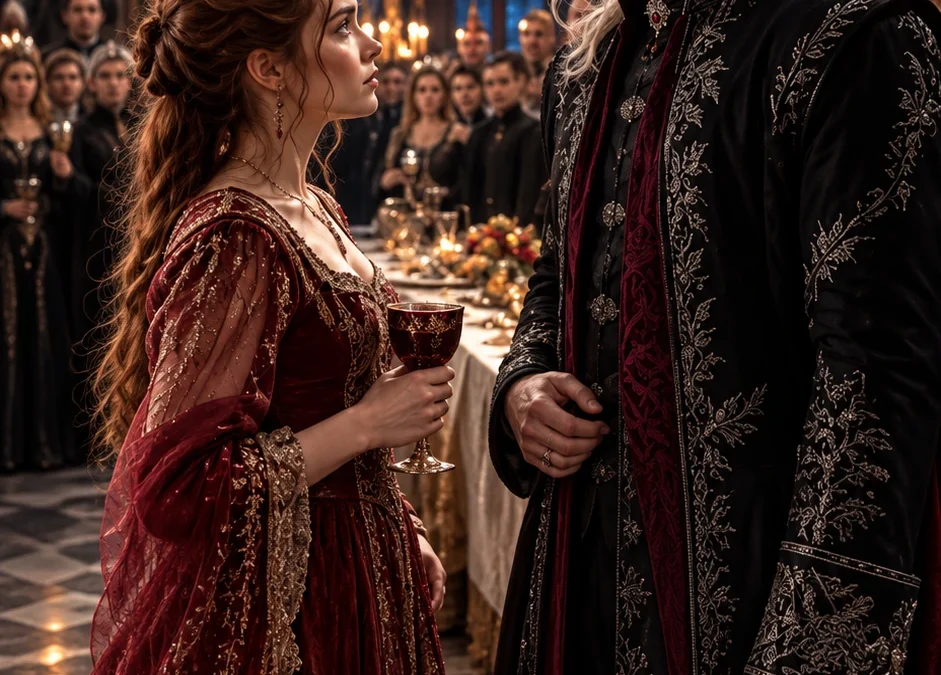
THEY DRAGGED THE FALCON GIRL INTO THE CENTER OF THE ROYAL BANQUET TO LAUGH AT HER… THEN THE IMMORTAL KING PUSHED BACK HIS CHAIR, AND 200 NOBLES STOPPED BREATHING 😱🦅🩸
Part 1
I tied the jesses around my fingers and felt Iris’s warm weight against my glove before the sky had finished opening over the battlements.
A quarter of an hour before the light touched the rooftops.
That quarter hour was mine. 🌅
The only moment of the day I shared with no one. The falcon house was silent except for the breath of the birds, the smell of old leather and dry straw, and the low song I broke the silence with every morning. The song my mother taught me before I could read.
“Easy,” I whispered to Iris, though she never needed asking.
The peregrine Gonzalo had trusted me with two winters ago went perfectly still the moment I began to sing, as if she recognized something older than my own voice. I slid the hood over her eyes and she surrendered to the leather darkness the way you trust someone without needing reasons.
My mother had chosen that song well. It was about a ship that returns, not one that is lost. “Never sing anything sad to a bird of prey,” she told me once, her hands full of patience. “They can feel it in the way they fly.”
I never sang to anyone else. Not once.
Because my mother, Inés Quintana, once sang in the palace chapel choir, back when they called young voices promising and paraded them from feast to feast like vases on display. She rarely spoke of those years. But she always ended the fragments with the same sentence, said without bitterness and without room for argument:
“A voice you cannot choose to give stops being yours, Salomé. Keep yours for whoever you want, and for whenever you want.” 💔
She died three winters ago, of a fever that rose in two days and never fell. She left me a trunk of sheet music I couldn’t fully read, an embroidered handkerchief with her initials, and that sentence.
I carried the sentence most carefully of all.
I had worked in the falcon house since I was fifteen, when Gonzalo, the master falconer, pulled me out of the kitchen where I scrubbed cauldrons. He had found me one afternoon murmuring to a fallen chick in the same cadence I used to hum while I worked. He said nothing. He just put a glove on my hand and pointed to the lowest perch.
I never scrubbed a cauldron again.
Gonzalo limped from an old wound, a badly trained goshawk had marked his calf twenty years ago. That morning he arrived with Bastián glued to his heels, as always. The boy was twelve, an orphan since eight, all elbows and noise, and he adored me with the loud, total devotion of someone who has been given very little love and cannot hide how much he needs it.
“You’ve sung already,” Gonzalo said. It wasn’t a question.
“I have.”
“Good.”
That afternoon we flew Iris in the field beyond the walls. She rose high against the clouds, a dark point in the wind, and Gonzalo squinted after her.
“If she keeps this up, we’ll present her at the next royal hunt. The king himself might carry her.”
“The king?” Bastián breathed, as other boys speak of heroes in fireside tales.
“Whoever trained her carries her,” Gonzalo answered, with a nod toward me that was, in his sparing language, enormous praise. “His Majesty respects the craft more than most of the nobles at his table.”
I didn’t yet know how right he was.
Everyone in the palace knew what was said about the vampire king. That he had sat on the throne longer than anyone could count without growing nervous. That he ruled with a firm hand and a quiet voice. That his long hair was a silver-white that looked less like age than a choice of his nature, falling over a black coat embroidered in silver and garnet. That his skin held a pallor older than sickness. That his warm eyes carried a coal-glow at their depths that sometimes flickered, and saw more than any man should.
They also said he had never raised his voice against a servant. That he had never taken a wife in all his years. A silent scandal among the noble houses that had waited generations for their turn. 👑
I knew all this the way one knows weather in a distant country.
That night, the great hall held the Autumn Banquet.
Two hundred guests. The minor houses had been invited too, “out of deference,” Marta whispered, though she thought it was so no one could say His Majesty snubbed anyone. She had lent me a clean white apron because mine bore a grease stain “no prayer would lift,” and made me tie my hair with more care than usual.
“New people will be watching everyone. I won’t have them mistaking you for a scullery girl.”
“I’m a falconer’s assistant, Marta.”
“And a clean apron never hurt anybody.”
So I carried trays of wine, water, and warm bread between the long tables, beneath hundreds of candles and garlands of dried leaves braided with gold ribbon. Nobles spoke over my head about land treaties and convenient marriages as if I were furniture with legs.
It had never bothered me before. I had my own smaller world waiting at dawn.
Near my tables sat two young men I recognized: Cosme Dezo, charming and quick to laugh, from a fading house that made up for its empty coffers with wit, and his quieter friend Aldo Ferreira, who laughed a heartbeat after everyone else, as if checking first whether the joke deserved it.
“Half this hall will be asleep before the third course,” Cosme muttered. “This banquet needs more than a harvest speech.”
I poured his wine and kept walking.
I didn’t notice that a few tables away, Rufina de Bell had been searching for exactly that for half an hour. 😶
She wore plum silk she had changed three times that afternoon, her braids pinned into a crown that cost her maids an hour. Beautiful, but in a way that invited comparison, not warmth. Her smile was always one breath short of kind. Two cousins and a lady-in-waiting laughed at everything she said with an enthusiasm that felt more like duty.
“This hall needs a surprise,” she announced, her voice pitched to reach exactly the ears she wanted. “Something nobody expects.”
“What surprise, Lady Rufina?” Cosme asked.
“I don’t know yet.”
Her gaze drifted across the servants.
And stopped, for one instant, on me. On my tray of bread. On my clean apron and carefully tied hair.
“But I’ll know it when I see it.”
I walked on, suspecting nothing.
At the far end of the hall, the king sat unmoving in his tall chair, barely touching his food, wearing a stillness that was not boredom but something deeper. The patience of someone who had watched more autumn banquets than any chronicle dared to count.
Neither of us knew that stillness was minutes from something worth breaking for.
I set down the last tray of candied fruit at the honor table near the dais and turned to leave.
A hand closed around my arm.
“Here she is,” said Rufina de Bell, sweet as poisoned honey. “The girl from the falcon house.” 😨
👉 Want Part 2? Find it in the comments, or leave ANY word below and I’ll send it to you privately!
Part 2
A hand closed around my arm. “Here she is,” said Rufina de Bell, sweet as poisoned honey. “The girl from the falcon house.”
“Cosme. Aldo. Haven’t you seen her in the courtyard, singing to the falcons as if they were her only audience?”
My heart lurched, not with fear yet, but with the instant discomfort of becoming the center of attention nobody asked for.
“I have,” Cosme admitted, smiling in a way that wasn’t cruel but wasn’t innocent either. “She sings softly. Almost to herself.”
“A little bird told me she has a lovely voice,” Rufina laughed, aimed more at the hall than at me. “We should test that. This banquet needs a new voice.”
The conversations nearby began to fade, drawn by the careful volume of her words.
“With your permission, my lady, I must return to the kitchen.”
“Just a moment.” She didn’t release me. “What’s your name?”
“Salomé, my lady. Salomé Quintana.”
“Salomé.” She tasted it like fruit to see if it was ripe. “Well, Salomé, tonight you’ll do us a small favor. You’ll sing for the whole hall. If you can sing to falcons every morning, surely you can sing to the court once.”
Laughter rippled across her table and spread like a spark through dry grass to the tables around us. 🔥
My face burned. Shame, and something harder underneath it. Closer to rage.
“I sing for no one, my lady. Only for the birds. It isn’t the same.”
“Nonsense. A voice is a voice.”
A cousin placed a goblet of wine in my hand and folded my fingers around the stem with a force that left no room to refuse.
“Toast with us, then sing. It’s only a game.”
“Rufina,” Aldo murmured, almost a warning. “Perhaps not now.”
“It’s exactly now. Look how bored everyone is.”
And that was the cruelest truth. The boredom of two hundred guests is a hungry creature, and without my choosing, I had become the meal it had been waiting for all night.
Hands pushed me. Not violent. Insistent. Rufina’s, her cousin’s, even a young noble at a neighboring table who had joined the fun without knowing my name. Laughing, they guided me toward the open circle of polished floor before the dais, where nobles dance.
And there I stood alone, a trembling goblet in my hand, in a white apron that suddenly seemed to shout that I did not belong on that floor. Two hundred pairs of eyes pressed on me like a physical weight. 😢
Not all the laughter was malicious. Much of it was the easy contagion of mockery. But the effect was the same.
I searched for Marta and found her by the kitchen door, tray frozen in her hands, face pale with an outrage she couldn’t voice without risking her post.
I searched for Gonzalo and remembered he was in the falcon house, miles from this circle, with Bastián.
No one could pull me out.
“Come, Salomé,” Rufina said, raising her own glass in a mocking toast. “The whole hall is waiting.”
And that was when it happened.
The scrape of a chair pushed back with force sliced through the noise like a knife through bread.
The king had stood. 🩸
It wasn’t sudden or theatrical. He rose with the same ancient stillness I had watched him hold all night. But something in the movement changed the air in the entire hall, as if the temperature had dropped several degrees in the space of a blink.
The laughter died in half-open throats.
Two hundred pairs of eyes that had been fixed on me swung toward the dais with a speed that would have been comic, if the moment had allowed comedy.
“Silence,” said the king.
He did not shout. He did not need to. His low, calm voice filled the hall as though the walls had agreed to carry it to the last corner, the musicians’ gallery, the kitchen door where Marta still stood frozen.
And the hall obeyed. Not a cough. Not the rustle of cloth. Not a goblet touching a plate.
He stepped down from the dais, slow and measured, the black coat embroidered in silver and garnet moving around him like a living shadow. He stopped a few paces from me, and for the first time in my life I was close enough to see what had only ever been secondhand description. The perfect pallor of his skin. The warm glow of his eyes with that faint ember in their depths, breathing more than burning.
I felt no fear. Something else. A different kind of shame, the kind of being truly looked at.
“Was she forced to come here?” he asked, not looking at Rufina, addressing the entire hall.
No one answered.
Rufina de Bell had lost every ounce of her earlier satisfaction. The hand holding her glass was no longer steady.
Then the king turned to me, and his voice dropped to something almost private, though two hundred people listened in breathless silence.
“You do not have to sing if you do not wish to. No one in this hall has the right to demand it of you. Set that cup down wherever you like and return to your post, and whoever laughs at you will answer to me.”
I looked at the trembling wine in my hand. Then at the king, who waited with a patience that asked for nothing, leaving the decision entirely in my hands. Something no one in that room, or any other, had offered me all night.
And then, I don’t know exactly why, perhaps because shame had curdled into a stubborn dignity that refused to leave that circle defeated, perhaps because I thought of my mother and her sentence, I understood something that made my back straighten.
I lifted my head.
“I will sing, Majesty,” I said, in a voice that startled me with how steady it sounded.
The hall inhaled.
“But because I choose to,” I said. “Not because I was told to.” 🌙
👉 LIKE or COMMENT “REVEAL” and Part 3 will be posted once we hit enough comments! 🔥
Part 3
Something shifted in the king’s face. A flicker of surprise, quickly dissolving into an expression I couldn’t name then, and would only recognize much later as the beginning of everything that followed.
He nodded once.
He stepped back, leaving the entire circle to me, and the hall stayed silent, two hundred people holding their breath, while I set the goblet down on the nearest table, full, untouched.
I closed my eyes to find the pitch.
And I sang my mother’s song. The one about the ship that returns. In the same low, clear voice I used each morning for a hooded falcon, except that, for the first time in my life, I sang it to two hundred people who were no longer laughing. 🕊️
I don’t know how long it lasted. When I sing truly, the way my mother taught me, time folds in on itself. Only after the last note did I become aware of the hall again, of the candles burned a little lower, of my hands clenched against my apron without my noticing.
The silence that followed was different from the one before.
The first had been imposed, held up by a king’s order and the fear of disobeying it. This one nobody had commanded. The whole hall seemed to hold it by itself, as if two hundred people had been stopped at once, unsure what to do with what they had just heard.
Then someone at the back began to clap, slowly. And the applause spread like fire through dry grass.
Only this time it wasn’t cruelty that spread. It was wonder. 👏
I didn’t look for Rufina’s face. I hadn’t sung for revenge. I had sung because I decided to.
I looked instead at the king, who didn’t applaud. Kings don’t applaud their own subjects, I suppose. But he watched me with an attention so complete that I felt, for the first time all night, truly seen. Not as a servant. Not as a spectacle. As a person.
“Thank you, Majesty,” I said, with a brief curtsy. “With your permission, I must return to my work.”
“You may go.” His voice dropped again to that near-private register. “And thank you for the song.”
I left the goblet full on the honor table, a small gesture I only later learned half the hall had noticed, and walked to the service door with a straight back and steady steps, determined that no one would see how my legs trembled.
Marta caught me in the service corridor and dragged me out into the cold courtyard, where the night air hit my face like relief.
“What just happened in there?”
“I don’t know,” I said. It was the most honest answer I had.
“The king never does that, Salomé. Never. Years of sitting on that dais watching entire banquets of schemes without lifting a finger. Tonight he stood up for you.”
“He stood because it was right.”
Even as I said it, the sentence felt too small for what I had seen in his face.
Back at the falcon house, Gonzalo sat awake on the stone bench with an oil lamp and a harness he was mending, Bastián curled asleep in the straw by Duque’s perch. I told him a shorter version of the story. When I finished, he said only:
“Rufina de Bell.” He pronounced the name like spitting out a bitter seed. “Your mother would’ve been proud of how you handled that cup. That says more than any song.”
Gonzalo rarely spoke of my mother, though he had known her when she still sang in the chapel and he was a young falconer new to the palace.
By morning the whole city was talking about me.
At first I didn’t know. My morning went on as always: the birds, the hoods, the low song that cost me a little more that day, as if my voice still remembered the weight of two hundred eyes.
But by midmorning the news arrived through the palace’s usual channels. Marta, who came with a handkerchief I didn’t need just to tell me that nothing else was discussed in the kitchens. A washerwoman who stopped to ask, with curiosity and a respect I didn’t know how to receive, whether the king really had come down from the dais himself.
“They say you sing like angels,” Marta reported. “They say the king has been quieter than usual all morning. And Rufina de Bell has locked herself in her rooms and didn’t even come down to breakfast.”
That should have been satisfying. Instead it left a vague unease, as though I knew, without knowing how, that her shame wouldn’t stay locked up forever. 😟
I was right.
Within days, small changes appeared in how the palace staff treated me. Some greeted me with a strange, uncomfortable deference. Others avoided my eyes with a chill that hadn’t been there before.
Marta brought me the missing piece one afternoon in the pantry.
“Rufina has started talking. Not about that night. About you. That you’re ambitious. That you’ve been looking for a way to catch the king’s eye for ages, and the banquet was only the start of a longer plan.”
“That’s absurd! She forced me into that circle!”
“I know. Half the palace knows, we saw it. But the other half prefers the more entertaining version.” She lowered her voice. “And there’s worse. I hear the king has asked about you. Your full name. Where you live. How long you’ve served.”
My stomach tightened in a way that wasn’t entirely unpleasant, nor entirely comfortable.
“Maybe he just wants to be sure I’m well.”
“Maybe.” Marta didn’t sound convinced. “But be careful. Rufina doesn’t let humiliation go unpaid. And you, without meaning to, humiliated her in front of two hundred people.” 🐍
Bastián was sitting on the floor of the falcon house when I returned, unusually miserable.
“The kitchen pages say you’re a schemer,” he blurted. “That you want to marry the king and that’s why you sang. But I know it’s not true, because you never sing for anyone, not even when I ask, and I’ve asked loads of times.”
Rage stabbed me, sharper than before, because the poison had reached a twelve-year-old boy who had nothing to do with courts.
“I’m not a schemer, Bastián, and you know it better than half this palace, because you watch me every morning singing only to the birds.”
“I told them they were wrong,” he said with a flicker of pride. “I told the steward’s son if he called you that again I’d shove his head in the horse trough.”
“You can’t go threatening people.”
“Gonzalo does.”
“Gonzalo is the master falconer, and even he doesn’t threaten anyone with troughs.”
“He thinks it, though.”
We both ended up laughing. A small relief in a week without much to laugh at.
Then the king came to the falcon house.
It rained for three days straight, that thin, stubborn autumn rain that doesn’t stop work but turns everything gray and slow. On the third day, the courtyard a mirror of puddles and the birds restless from confinement, he arrived alone. No herald. No guard. His black coat spattered with rain.
Bastián saw him first and dropped his broom with a crack that made Gonzalo spin around.
“Majesty,” Gonzalo said, bowing with a clumsiness almost endearing in a man so sure of himself with birds and so awkward with protocol.
“Forgive the interruption.” His voice sounded different within those low stone walls, softer, no longer stretched to fill an immense hall. “I come with no order and no affair of state. I come, if permitted, with a personal request.”
I stepped out from among the perches, hands still stained with bird feed, and found myself face to face with the vampire king, this time without a dais or two hundred witnesses.
“I haven’t come to ask anything of you, Master Falconer.” His gaze turned to me. “I came to ask Salomé, if she agrees, to teach me how to hold a bird.”
It was not what I expected.
“Hold a bird, Majesty?”
“I have ruled this kingdom for forty years and never once carried a falcon on my own fist,” he said, a half smile softening his face in a way I hadn’t seen. “At every hunt someone hands me a glove with the bird already perched. As if I couldn’t learn the gesture myself. I would like to learn it. And I would prefer to learn it from the person whose voice silenced a hall that had spent half an hour listening to nobody but itself.”
There was something in that last sentence that told me this request wasn’t entirely about birds. And yet nothing in his tone resembled pressure, nothing like Rufina’s insistent hands pushing me toward the center of a room. It was the same silent question he had asked that night, was she forced to come here?, now turned into an offer.
Here I am asking, not demanding. The choice remains yours. 🌿
“I’d be honored, Majesty,” I said. “But I warn you, birds don’t respect crowns. If your fist trembles, they’ll notice. If your voice sounds nervous, they’ll grow uneasy.”
“Fair enough. I’d rather be treated like any clumsy student than like a king who must be pleased.”
I showed him how to buckle the falconer’s glove, and Bastián bit his lips to keep from laughing at a king concentrating like a child over a simple knot. Then I led him to Iris’s perch. “Talk to her as you approach. It needn’t be important. Only calm.”
With sincere awkwardness, in stark contrast to his usual elegance, he began to murmur to her about a falcon he had once seen centuries ago in a land that no longer existed under that name.
Iris hesitated, then stepped onto his fist so gently that he laughed. A short, real laugh, the first I had heard from him.
“She weighs less than I imagined,” he said, wonder naked on his face. “And yet I feel her every movement.”
“That’s how it should feel. If you ever stop feeling it, it means you’ve stopped paying attention.”
He stayed another hour that afternoon, talking to Gonzalo about raising merlins, drawing Bastián into answers that began as trembling monosyllables and ended as confident explanations of his favorite bird, and asking me how I had learned the craft from my mother.
“I’ll return, if you allow it,” he said at last. “There are few places in this palace where I can sit without being spoken to about treaties and convenient marriages.”
“This door is always open to anyone who respects the birds, Majesty,” Gonzalo said, solemn enough to nearly blush.
We watched him cross the courtyard in the rain until he vanished beneath the arch.
“Well,” Bastián said, with a child’s total lack of tact. “I did not see that coming.” 😂
Ten days later, a liveried page I’d never seen before delivered a summons from Don Elías, the chamberlain, requesting me in his office that afternoon regarding a matter of interest to my future.
“When a chamberlain says ‘interest to your future,'” Gonzalo said darkly, “it usually means someone has already decided your future without asking you.”
Don Elías was an elderly man with a neat white beard and bright eyes that contradicted his slow movements. He received me with a courtesy that startled me, offering me a chair and waiting until I accepted it before sitting himself.
“The post of Mistress of the Chapel has been vacant since last spring. After what happened at the Autumn Banquet, several council members, and His Majesty, though he hasn’t asked me to say so, agree that your voice deserves more than the walls of a falcon house. I offer you the position, with a salary, rooms in the music wing, and the direction of the choir.”
It was offered with every good intention in the world. I understood that even in my first moment of surprise.
And yet my chest closed with an ache I couldn’t name, until it dawned on me a second later.
It was exactly what my mother had spent half her life warning me against.
“I thank you deeply, Don Elías,” I said, choosing each word with care. “But I must decline.”
He blinked, genuinely taken aback. “May I ask why? The post carries considerable advantages, and your talent, after what the whole palace witnessed, is undeniable.”
“My mother sang in that same chapel, years ago.” I hadn’t planned to tell him, but I felt I owed it to both of us, so my refusal wouldn’t sound like caprice. “They paraded her from feast to feast as if her voice were a palace object, available for any occasion. She stopped singing in public long before she died. Not because she lost her voice, but because she lost the wish to have it demanded of her. She told me, more than once, that a voice you cannot choose to give stops being yours.”
I drew a breath.
“If I accept this post, sir, my voice will stop being mine the way hers did. I’m not willing to repeat that, however generous the offer.”
The chamberlain sat silent for a long while, his expression slowly shifting from surprise to something like genuine respect.
“I knew your mother,” he said at last, more softly. “Inés Quintana. She sang with a grace this palace hadn’t heard again until the night of the banquet. And now that you mention it, I remember a year when I was still young in this post when she stopped accepting requests, to the displeasure of more than one noble. I never understood why. Listening to you, I begin to.”
He stood, and I with him.
“If you’ll permit me to anticipate His Majesty’s reaction, Miss Quintana, he will respect this decision more than he would have respected an enthusiastic yes. He values little those who accept everything offered to them, and greatly those who can say no when yes would betray something important.”
I left that office with a strange mix of relief and vertigo.
By the time I reached the falcon house, the news had already arrived ahead of me, as palace news always does. Marta waited at the door, arms crossed.
“You turned down the chapel? Salomé, have you lost your mind? Every maid in this palace would kill for that post!”
“I know.”
“And you still turned it down.” She stared at me a long moment. Then, to my surprise, she smiled, exasperation and pride tangled together. “You’re the most stubborn person I know.”
“So I’ve been told.”
“Well. At least you’re stubborn for good reasons.”
When I told her the whole story, including my mother, she fell silent, watching Bastián chase an escaped merlin across the courtyard.
“She’d be proud of you,” she said finally, almost word for word what Gonzalo had said weeks earlier. And this time the sentence didn’t tighten my throat. It loosened it, as if each person who said it was gently closing an old wound I hadn’t known was still open. 💫
My refusal, which I had imagined would be the natural end of the gossip, became the spark Rufina de Bell needed to light something bigger.
I learned it at the city market while buying thread to mend my worn falconry gloves. At the seamstress’s stall, two women discussed me without noticing I stood behind a stack of cloth.
“They say it was all planned. That the girl from the falcon house knew they’d dare her to sing. That she wanted to catch the king’s eye. That she might even have paid that noblewoman, what’s her name, the one from Bell, to stage the whole show.”
“Why would she pay a lady to humiliate her?”
“Because she needed to look like a victim so the king would pity her. And it worked. Now they say he visits her every week.”
My face flamed. Not with shame this time, but with an indignation that cost me all my effort to contain. The accusation was so absurd, so twisted, that in any other context it would have made me laugh.
“Good morning,” I said, stepping out from behind the cloth. Both women whirled with the pale look of people caught red-handed. “I only came for thread, if you don’t mind.” 🧵
Back at the palace, Marta pressed her lips together in a fury I rarely saw.
“This isn’t just kitchen gossip anymore. If it reached the market, Rufina has been feeding it carefully. And she’s not alone. I hear Doña Herminia has started saying, in small company, that a story this convenient for a mere falconer’s assistant deserves caution.”
“Doña Herminia believes I planned it?”
“I doubt she cares whether it’s true. It serves her. The more suspicious you look, the less of a threat you are to her position.”
It was Aldo Ferreira who gave me the final piece. I was flying Iris alone one afternoon and found him leaning on the hawthorn hedge as if he’d been there a while.
“I know what’s said about you,” he told me plainly, his voice low and serious. “And I want you to know not everyone believes it. Cosme and I were at Rufina’s table that night. I know exactly how it started, and I know you sought none of what followed.”
“Thank you, Master Ferreira. You can’t imagine how much that means.”
“There’s more.” He hesitated, weighing the risk. “Rufina didn’t do this out of wounded pride alone. Doña Herminia has been offering her favor in exchange for keeping the story alive. A place of honor in her house. Something for Rufina’s family, which isn’t as wealthy as it appears.”
Cold clarity settled in my chest. It wasn’t a bored lady’s whim. It was a calculated campaign, fed from two directions by two women with different interests that happened to converge.
“Why tell me this? You could be in serious trouble if either of them finds out.”
“Because I’ve spent years in this court watching reputations destroyed for convenience while no one raises a voice. This time, it seemed like enough.” He shrugged with a modesty that didn’t diminish what he’d done. “Cosme thinks the same, though he finds it harder to say aloud. He regrets laughing that night too.”
Cosme came a few weeks later, on a cold November afternoon, offering to carry a sack of grain I was hauling across the courtyard with such insistence that I gave in just to avoid a public argument about grain.
“I wanted to apologize. I laughed when I shouldn’t have, and though I wasn’t the one who put the goblet in your hand, I did nothing to stop it. That weighs nearly as much.”
“It weighs differently, Master Dezo. But it weighs.” I didn’t soften his guilt more than he was willing to carry. “Thank you for coming to say it.”
He gave a small, relieved grimace, the look of someone finding unexpected comfort in being met with honesty rather than easy forgiveness.
“My mother knows Doña Herminia’s mother,” he added, lowering his voice. “It isn’t the first time that house has used these maneuvers when something threatens its position. Years ago, a lady who began receiving too much attention from a noble Doña Herminia had in mind for her own sister left the city within a year, worn out by rumors. Nothing was ever proven.”
“Nothing ever is, in these things.”
A chill ran through me. Not fear for myself, since by then I had Don Elías’s open protection and, though I didn’t yet dare say it, the growing regard of the king himself. But sorrow for the women before me who fought similar battles with no king to stand up for them.
Over time, Cosme and Aldo became among the few young nobles who spoke for me in rooms where I had no way to defend myself, and slowly the court’s opinion began turning in a fairer direction. At the market, Marta told me, a different story was circulating, closer to the truth, fed by the very witnesses of the banquet who, tired of watching a lie grow, had begun telling what they had seen with their own eyes.
The solution came from Don Elías, from an idea so simple I wondered why no one had thought of it.
He appeared at the falcon house one frosty morning, wrapped in a thick cloak.
“The problem, as I see it, isn’t that you sang that night. It’s that people have decided there’s hidden ambition behind that song, and while that idea circulates unchallenged by facts, it will keep growing, however many posts of honor you refuse or however long you hide in this falcon house.”
He paused, measuring each phrase with the care of a lifetime at court.
“I propose something different. A public demonstration, not of your voice, but of your freedom to withhold it. Let it be known, officially and without ambiguity, that anyone may ask Salomé Quintana to sing on any occasion, and that she has the absolute right to refuse without consequence.”
“If people see you refuse again and again, whoever asks, the idea that you sought fame or favor will collapse under its own weight. No one who wanted those things would turn down so many chances to get them.”
I thought about it a long time. There was something in it that appealed to me, the chance to take back the narrative, to stop being a character in the story others told about me and become the author of my own silence. And something that unsettled me, too: the repeated public exposure it implied.
“And if someone insists too much? If they pressure me the way Rufina did?”
“Then you will have His Majesty’s express protection, announced alongside the rest. Any undue pressure on you will be treated as a serious offense against the court.” He smiled with a warmth that belied his office. “After what happened at the banquet, very few will dare test that warning twice.”
I accepted, cautiously.
And it unfolded exactly as he had predicted. The announcement was read officially in the council hall and repeated across court and city: Salomé Quintana, falconer’s assistant, held the recognized right to refuse any request to sing, without exception or consequence. And a bored court, with its insatiable curiosity, began testing it at once.
They asked me at the market. I declined with a firm courtesy that left no room for debate.
They asked me at church after Sunday service. An old man who wished to have heard my voice before he died. It cost me more to refuse him because of the tenderness of the request, but I told him no.
Two young nobles stopped me in a corridor with the same mocking tone Rufina had used that night. I answered with a calm that unsettled them more than any anger could have.
“I don’t sing for whoever asks, gentlemen. I sing for whom I choose, when I choose. You may tell that to whoever you like.”
Rufina de Bell herself, in what could only be a desperate attempt to dismantle the new narrative before it set, cornered me one afternoon in an inner courtyard, smiling with much of her old confidence gone.
“Well, Salomé. Now you’re a celebrity for refusing requests. What an elegant way of keeping everyone’s attention without actually singing.”
“You may ask me yourself, my lady, if you wish to test it,” I answered with a serenity I couldn’t have gathered months earlier. “I promise the answer will be the same I give everyone.”
She didn’t ask. She stared at me, caught between rage and what might have been the dawning realization that her plan was failing, then turned and left without another word. 😌
The one exception to my constant refusal came weeks later, on the anniversary of my mother’s death, a day I always kept private, shared only with Gonzalo and Marta, who knew to leave me my silence.
That year, I decided to do something different. I asked Don Elías’s permission to visit the small cemetery chapel where my mother lay among other members of the old palace choir. And there, alone before her plain headstone, with the dawn cold still settled on the frosted grass, I sang the same song from the banquet, the one about the ship that returns, softly, only for her.
I didn’t know until later that I hadn’t been entirely alone.
Gonzalo, worried by my early absence from the falcon house that morning, had followed at a distance, not to interrupt, only to be sure I was well. And with him, unknown to me, had come the king, who had learned from Don Elías the date and what it meant, and who stayed among the cemetery trees, listening without approaching, respecting a grief that was not his own but that he had chosen to keep company in silence. 🕯️
“I didn’t want you to find out sooner, in case it bothered you,” Gonzalo confessed that afternoon while we cleaned perches, with that clumsiness for emotional confessions I now found endearing. “But I thought you deserved to know. He was there. He kept the same distance I did. He never came closer. He just stayed until you finished and left as quietly as he’d come.”
When the news of that private song and the king’s respectful presence, which someone, perhaps Gonzalo without realizing, mentioned in some corner of the palace, finally reached the court, it had exactly the effect Don Elías predicted.
The story of the scheming falconer’s assistant, feigning humility to win royal attention, collapsed completely before a far simpler and truer image: a daughter singing to her dead mother, with no audience, no witnesses sought, no calculation possible.
Doña Herminia, Marta told me with obvious satisfaction, stopped mentioning the matter entirely, perhaps aware that insisting on so thoroughly disproven a slander would only make her look worse. And Rufina de Bell, though she didn’t vanish from court, was not publicly punished. The king, as far as I knew, always preferred restraint to vengeance, letting the evidence itself restore order without turning anyone into a cruel example. She was reduced in the court’s estimation to what she had always been: a young noblewoman of considerable social talent and poor judgment, whose cruel jokes no one found quite as amusing as before.
Winter came early that year, with a frost that whitened the palace roofs before November ended. And with it came a calm I hadn’t known since before the banquet.
The king kept visiting the falcon house with a regularity that no longer surprised anyone, though, Don Elías confided with a conspiratorial smile, it remained the constant gossip of the palace corridors. By then I had taught him to hold not only Iris, but old Duque, the gyrfalcon who distrusted nearly everyone and who, with patience and persistence, had come to accept him with the same reserved calm he gave Gonzalo and me.
Bastián, meanwhile, had developed with the king a relationship that oscillated between reverence and a growing familiarity that sometimes made me hold my breath at his childish boldness.
“Majesty,” he asked one afternoon while the king held a young merlin with total concentration. “Is it true you can live forever?”
“Bastián!” I scolded, cheeks burning. “You don’t ask His Majesty that.”
“It’s all right,” the king said, with the half smile that had grown more frequent. “It’s a reasonable question from someone who asks with so much curiosity and so little malice. I don’t know if I’ll live forever, Bastián. I know I’ve lived much longer than most, and that I’ve seen more autumns than I can count. But no one, not even I, truly knows when their own time ends.”
“It must be sad to watch so many people you know die,” Bastián said, with that sudden seriousness that sometimes surfaced.
The king was quiet a moment, looking at the boy with an expression I couldn’t read.
“It is very sad, yes. And that is why, when I find something worth keeping, I try not to let it slip away through carelessness or fear.”
He said nothing more. But I felt, listening, that the sentence wasn’t addressed only to the boy.
It was an early December afternoon, snow falling slowly on the courtyard, the birds restless from the cold, when the king came to the falcon house with a different expression. More serious. More restrained. Like someone who has carried something heavy for a long time before deciding to say it aloud.
Gonzalo, with his discreet instinct for knowing when his presence was surplus, found an excuse to take Bastián to inspect transport cages at the far end of the building, leaving us truly alone for the first time since the king began visiting.
“Salomé,” he said, and I noticed it was the first time he had said my name without distance, with a direct warmth that made the seriousness of the moment land at once. “I came today to say something I’ve wanted to say for weeks, and held back for fear my words would weigh more than I wish them to.”
I set down the hood I was adjusting and turned to him fully, my heart beating faster than I wanted to admit.
“I’m listening, Majesty.”
“I have ruled this kingdom for more years than most of my subjects can count, and in all that time I’ve watched entire courts wait for me to choose a wife, as if marriage were only dynastic convenience, one more treaty among the many I sign each year.” His usually serene voice carried a faint tremor I’d never heard in it. “I never found, in all that waiting, anyone whose presence made me wish to break that calculated distance. Until the night I saw you hold a full goblet, refusing to drink from it before two hundred people who expected to see you defeated.”
My throat closed. Not from fear this time, but from an emotion too large for anywhere to put it.
“Majesty, I…”
“Let me finish, please.” He raised a hand, a gesture that was not command but plea. “I haven’t come to ask you to accept anything this afternoon. I know better than anyone what is said of me at court. I know the weight it would place on you to become the center of every gaze and every envy, which you’ve already begun to suffer without seeking. And above all, I know what your voice means to you, what it cost you to decide it belongs to no one but you. I do not wish to be, for you, one more court demanding what it has no right to demand.” 🌹
He stepped closer, one step only, leaving a respectful distance between us.
“What I ask, if you ever decide to give it, is not your voice, nor your presence on any dais, nor your compliance with any court protocol. I ask only for the chance to keep coming to this falcon house, to keep learning to hold a falcon on my clumsy fist, to keep listening to you speak of your mother. Until, if that day comes, you yourself decide you want something more from me than these visits.”
Iris, on her perch, let out a short shriek, as if commenting on the scene, and both of us smiled, easing the tension of the moment.
“Majesty,” I said, when I finally found my voice. “All my life I’ve been taught to distrust any request wrapped in power, however kindly it comes. My mother paid dearly for mistaking generosity for demand in disguise. I’ve tried not to repeat her mistake. But what you ask today resembles nothing she warned me to fear.”
“What, then, am I asking, as you understand it?”
“Time.” The word came out with a clarity that surprised me. “You ask for time, and in exchange you offer your own, with no conditions, demanding nothing I do not choose to give. That I can accept, Majesty. With one condition of my own, if you’ll allow me to set it.”
“Any you wish.”
“I will sing when I wish and for whom I wish, whether you are king or the last stable boy in this palace. Neither love, if it ever comes, nor the crown, nor any other reason, however good it may seem, will ever buy my voice. If you accept that without reservation or future exception, then I accept what you offer.”
The king looked at me for a long moment, and I recognized in his face, for the first time without doubt, genuine astonishment, mixed with a respect that reached me deeper than any declaration of love could have.
“I accept that condition,” he said, with a solemnity that had nothing of ceremony and everything of sincerity. “And I accept it forever, not only for today. Your voice is yours, Salomé Quintana. Today and every day after, whoever you are to me and whoever I am to you.”
Then he took the final step, and with a slow gesture, like someone asking permission with every movement before completing it, he took off his own cloak. Not the embroidered coat, but a lighter cape he wore against the winter cold. And he laid it across my shoulders. 💫
A gesture so simple and so heavy with meaning that my eyes filled with tears I hadn’t anticipated.
“It’s cold in this falcon house in the middle of December,” he said, with a half smile that softened the previous solemnity. “And I don’t want my first show of care for you to be one you must refuse out of common sense.”
I laughed through my tears and accepted the cape without objection. And with a gesture even gentler, he raised a hand and touched my forehead with two fingers, barely a brush, a tenderness so restrained it felt, in that instant, more eloquent than any word.
“This will do for now,” he said. “The rest, if it comes, will come when you decide its moment has arrived.”
Gonzalo and Bastián, who had been pretending to inspect cages for far longer than any reasonable inspection required, reappeared with a discretion so unconvincing that the three of us, the king, Bastián, and I, burst out laughing together. A sound those stone walls had never heard so lightly, while Iris and Duque watched from their perches with that golden, imperturbable gaze birds of prey keep before any human commotion, however momentous it may be for those living it. 🦅
The official announcement waited until spring. Not from any doubt between us, but because the king insisted he wanted to do it with the time and ceremony a decision of this importance deserved, even if ceremonies seem as foreign to you as they did to me before I met you.
Through the winter months that turned slowly into the first mild days of March, my life went on as always: the birds at dawn, the flying field in the afternoon, the king’s visits that no longer surprised anyone. And that waiting, far from troubling me, gave me exactly the time I needed to grow used to a future that months earlier would have seemed as distant as impossible.
When I finally told Marta, after keeping the secret for weeks more out of modesty than prudence, she stared at me in a silence so unlike her that it felt like an eternity before she let out a shriek of joy that must have been heard in the kitchens.
“I knew it!” she gasped, once she could speak coherently. “I knew from the first time he stood up for you. Salomé is going to be queen!”
“I’m going to be whatever I decide to be, Marta, and he’s promised he’ll never ask me to be anything else.” I smiled, unable to fully contain my own joy. “But yes. Among the things I’ll be, I suppose that one will be included.” 👑
Gonzalo received the news with his usual sparseness, though I couldn’t help noticing, while I told him, that his eyes shone with a moisture he hurried to hide behind a sudden cough.
“I knew it,” was all he said before returning to the birds. “But I hope you don’t plan to abandon the falcon house just because you’ll be wearing a crown. The birds don’t understand protocol. They’ll still need someone to care for them properly.”
“I’m not abandoning anything, Gonzalo. I’ve made that clear, and he’s accepted it without argument.”
Bastián took the news with the grave seriousness of someone who senses something important is about to change in his small world, followed almost at once by an enthusiasm so loud that Gonzalo had to ask him more than once to lower his voice and not frighten the younger birds.
“Will I still be able to come to the falcon house when you’re queen?” he asked, with a vulnerability that rarely showed under his usual bluster.
“You’ll be able to come until you’re master falconer of this palace yourself, Bastián, and neither a crown nor any court protocol will ever change that. I promise you.”
The announcement came at last in the great hall, at a spring ceremony convened for the occasion, before the same two hundred and some people who had witnessed my public humiliation turned to song months before. Now gathered to see something entirely different.
I wore a simple but dignified dress Marta had insisted on helping me choose with near-ceremonial care, and I entered the hall on Gonzalo’s arm. He had agreed, not without first grumbling about how ridiculous it was to dress up in finery to escort a girl he himself had pulled out of scrubbing cauldrons, to fill the role no living father could fill for me.
The king, from the same dais where months earlier he had stood to silence an entire hall, waited for me to reach the center of that same open floor, where I had once been pushed with a trembling goblet in my hand. And this time, instead of mocking laughter, I found a different silence: expectant, respectful, almost solemn.
“Months ago, in this very hall,” the king said to the whole court, in a voice that filled the room without needing to rise, “this woman taught us all, without meaning to, something no chronicle of this kingdom had recorded until then: that dignity does not depend on the place one holds at a table, nor the surname one bears, but on the firmness with which one holds what is truly one’s own.”
“That night she left a full goblet on this very table, refusing to drink from a humiliation she had not chosen. Tonight, before all of you, I ask her to accept, this time, yes, something I offer with the same freedom with which she refused then: my hand, my name, and the throne of this kingdom, if she wishes it as much as I do.”
I felt the whole hall hold its breath, exactly as it had months before, waiting for my answer with an attention that no longer felt threatening, but strangely warm.
“I accept, Majesty,” I said, in a voice that did not tremble, the same firmness that had carried me that banquet night carrying me now, “with the same condition I set in the falcon house, which you already know.”
“The condition stands, now and always, and I announce it myself before the entire court so that no one will ever be tempted to forget it. The voice of Salomé Quintana belongs only to her. She will sing when she wishes and for whom she wishes, and whoever tries to demand otherwise will answer to me.”
The entire hall erupted in applause that had nothing to do with the imposed silence of months before. A genuine applause that spread, I was told afterward, to the corridors and kitchens of the palace, where the entire staff had been listening to the ceremony through half-open doors, with a curiosity no protocol could contain. 🎉
I sought out Rufina de Bell’s face in the crowd and found her at her usual table, pale but composed, applauding with the rest, without any visible trace of her old arrogance.
Later that night, she approached me with a formal curtsy she had never offered me before.
“I wish you the best, my lady,” she said, and though her voice held a trace of discomfort, there was no mockery in it. “I was unjust to you, and I regret it, though late.”
“Thank you for saying so, Lady Rufina.” I answered without any intention of humiliating her as she had humiliated me, because that was not the kind of queen I wanted to begin being. “I hope that in the future we both find kinder ways to entertain the court.”
Between us there was never, after that night, a true friendship, but there was a sustained courtesy that over the years turned into something like mutual respect. And Doña Herminia de Vasconcelos withdrew with dignity from any aspiration to the throne, finding at last, two years later, in a widowed nobleman from a neighboring house, the kind of companionship the court had spent a decade trying, unsuccessfully, to secure for her with the king. 🍂
I married that same spring in a ceremony modest by the crown’s standards but enormous by mine, with Gonzalo weeping without any disguise in the front row, and Bastián, now fourteen, insisting he be allowed to carry Iris on his own glove during the procession, an honor Gonzalo, after much debate, finally granted him.
What I remember most of that day, above every other detail that time has polished, is the smell of freshly melted beeswax from hundreds of candles, the sweet scent of the early March flowers the head gardener had insisted, this time with no protest from anyone, on cutting without restraint for the occasion, and beneath it all, barely perceptible, the familiar smell of leather and feathers that I carried on my skin after so many years in the falcon house, which no amount of rosewater managed to hide completely, to Marta’s quiet amusement. She whispered it in my ear just before the hall doors opened.
“You smell like falcon even today. I hope His Majesty doesn’t mind.”
“If I’ve learned anything about him, it’s that this is precisely what he doesn’t mind at all.” 🦅
Gonzalo, in his brief speech during the ceremony, spoke only a handful of clumsy, sincere sentences about the girl he had found murmuring to a fallen chick, who had become, without his being able to explain exactly how, the daughter life had not otherwise given him. He had to stop twice mid-sentence to steady his voice, while Bastián beside him wept openly, without any shame before the entire court.
The king kept, throughout the ceremony, that ancient stillness I had learned to read with growing precision over the months. But this time, beneath the serene surface, I glimpsed an emotion that escaped in small details: the way he held my hand a moment longer than strictly necessary as we exchanged vows, the slightly brighter shine in his eyes when he spoke my full name before all those present, as if the simple act of saying it aloud before witnesses, after so many years of calculated solitude, cost him the composure he had spent a lifetime cultivating.
The falcon house is still my favorite place. Though my court duties, which I’ve learned to bear with the same patience I once learned to hold a restless falcon, allow me fewer hours there than I once enjoyed without limit.
Bastián, now sixteen, with the gravity and skill of someone far older, has become Gonzalo’s right hand, and beside him works a new apprentice, a little girl named Casilda, an orphan like him, whom Gonzalo found last winter begging near the walls and who has shown in a few months a gift with birds that promises to equal mine someday.
In all these years, no one has asked me to sing in any hall, at any ceremony, on any state occasion. The condition I set that December afternoon has become so well known and so respected across the kingdom that no one even considers challenging it.
And yet every morning, before the sky finishes lightening over the battlements, I still go down to the falcon house. I still hood the birds with the same hands as always. And I still sing, softly, the same song my mother taught me, the one about the ship that returns, not the one that is lost.
For Iris, whose feathers are beginning to gray like any old noble. For Casilda and Bastián, who pretend not to listen while sweeping the nearby perches. And for the man who, years ago, had the wisdom never to ask me to sing, and who for that very reason, without seeking it, earned the right to hear me do it every morning of his life. 🌅
I’ve thought many times, in the quiet nights that followed that turbulent autumn, how different my story would have been if I had yielded that night to the goblet Rufina de Bell placed in my hand for the wrong reasons, if I had sung to please those who laughed at me instead of choosing, before a king who only asked me to choose.
A voice, as my mother taught me and as I learned myself in the worst moment of my life, is worth exactly what you are willing to defend of it. And mine, today, remains as entirely mine as it was that first morning I sang for a hooded falcon, without knowing that one day someone would rise from an entire throne just to make sure no one else tried to take it from me.
And if some young woman in this kingdom ever finds herself as I once did, with a borrowed goblet in her hand and a whole hall waiting to laugh at her shame, I hope she remembers the only thing that truly matters: that silence, when chosen, weighs more than any song imposed.
And that there are kings, few though they may be, and hard though they are to find, who will rise from their own thrones just to give a stranger back the right to decide for herself when, and for whom, she will open her voice. 👑🦅
Would you have sung that night, or walked away? Tell me in the comments! 👇
This story is entirely fictional and created for entertainment purposes only. It does not represent any organization or individual, nor does it encourage inappropriate behavior. The content was generated with AI assistance.








