THEY EXCLUDED HER FOR 15 CHRISTMASES—THEN SHE SHOWED UP WITH A LAWYER AND A LETTER FROM HER DEAD GRANDMOTHER
THEY EXCLUDED HER FOR 15 CHRISTMASES—THEN SHE SHOWED UP WITH A LAWYER AND A LETTER FROM HER DEAD GRANDMOTHER 🎄
PART 1
For fifteen Christmases, Mariana Salgado watched her family celebrate without her.
Every December 24, the same photographs appeared online: matching pajamas, champagne glasses raised beneath a giant Christmas tree, cousins laughing on the terrace, her sister Fernanda hugging everyone as though the family were complete.
“Nothing better than having the whole family together,” someone would write.
The whole family.
Except Mariana.
Whenever she asked why she hadn’t been invited, her mother always had an excuse.
“We thought you were working.”
Her father would sigh.
“Don’t ruin Christmas with unnecessary feelings.”
And Fernanda had eventually stopped pretending.
“You always bring weird energy.”
So Mariana stopped asking.
She spent Christmases working extra shifts at a clinic in Mérida, eating reheated tamales in borrowed apartments and, one year, sleeping in her car after a broken water heater left her with nowhere else to go.
Only her grandmother, Elena, remembered.
Every December 25, Elena called.
“I saved you a slice of walnut cake, my girl.”
Mariana never forgot those calls.
Then, in October, Elena died at 82.
Mariana thought losing that phone call would be the hardest part.
She was wrong.
Four days after the funeral, the family started messaging her.
Not to ask how she was coping.
They wanted to know about the house in Progreso.
The oceanfront property had pale walls, blue shutters and a terrace worn by years of salt air. For decades, relatives had treated it like a free vacation resort. They arrived with coolers, suitcases and children. They left sand in the beds, stains on the couches and unpaid expenses behind.
Mariana was the one who repaired the loose railing.
She drove Elena to medical appointments.
She stayed when Elena no longer had the strength to entertain anyone.
At the reading of the will, Aunt Patricia had spoken confidently.
“Mom always wanted the house to belong to everyone.”
The notary looked over his glasses.
“No. Elena Salgado left the property solely to Mariana.”
Twenty-three people turned toward her.
Mariana said nothing.
That was when everything changed.
By December, the family had apparently decided that the will was merely a technicality.
Messages started arriving.
“Christmas at Progreso this year.”
“Save the upstairs bedrooms for us.”
“Someone should clean before everyone gets there.”
Nobody asked Mariana for permission.
On December 23, she drove to the property before dawn.
The sea was still dark beyond the terrace.
The house smelled faintly of salt, old wood and the cinnamon Elena used to put in her coffee.
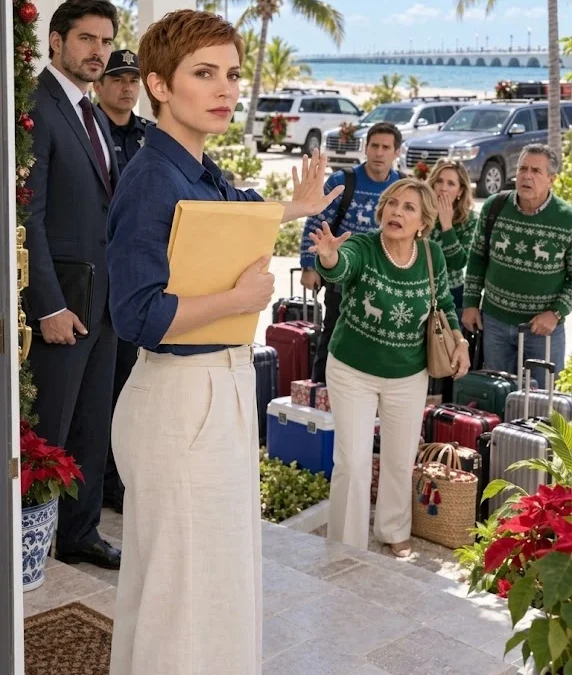
Mariana stood outside with Arturo Méndez, the estate attorney, and a municipal officer.
At 12:17 p.m., four rental SUVs appeared on the gravel road.
Suitcases.
Coolers.
Wrapped presents.
Children.
And adults wearing identical red Christmas sweaters.
Patricia climbed out first.
She smiled as though she had arrived at a hotel.
“Mariana, open the door.”
Mariana didn’t move.
Her father stepped out next.
Then her mother.
Then Fernanda.
They were laughing.
They looked happy.
For fifteen Christmases, Mariana had watched that exact happiness from a distance.
Today, she was standing between them and the house.
Patricia frowned.
“What is this?”
Mariana’s voice remained calm.
“This year, you’re not coming in.”
Patricia stared at her.
“Don’t make a drama. This house is a family tradition.”
Mariana slowly raised her hand.
Arturo stepped forward beside her.
“No one enters without Mariana’s authorization.”
Patricia laughed.
“You’re actually doing this?”
Mariana reached inside her coat.
She pulled out a thick envelope.
Her grandmother’s handwriting was visible on the front.
Patricia’s smile disappeared.
“What is that?”
Mariana looked at the people gathered behind her aunt.
“You’ve spent fifteen years telling me that excluding me was an accident.”
She held up the envelope.
“So before anyone takes another step, you’re going to learn exactly what my grandmother thought about your family tradition.”
The wind coming off the Gulf suddenly felt colder.
Mariana opened the envelope.
And the first sentence Elena had written made every person standing outside the house go silent.
“If my family is reading this because Mariana refused to let them enter, I want them to understand that she is doing exactly what I asked her to do.”
PART 2
“If my family is reading this because Mariana refused to let them enter, I want them to understand that she is doing exactly what I asked her to do.”
The wind swept sand across the driveway, but nobody moved.
Mariana read the next lines aloud.
“‘For years, my family treated my house as though it belonged to everyone. It does not. I am leaving it to Mariana, and I am giving her the right to decide who enters.’”
Her mother went pale.
“We’re your parents.”
Mariana looked at her.
“You were also my parents during the fifteen Christmases when nobody invited me.”
Her father lowered his eyes.
Fernanda folded her arms.
“This is because Grandma loved you more.”
Mariana shook her head.
“No. It’s because you loved this house more than you cared about what happened to her.”
Arturo handed Patricia a legal notice.
“The property has been placed into a private trust. No family member has automatic access without Mariana’s written authorization.”
Patricia stared at the document.
“You brought a lawyer and the police against your own family?”
The municipal officer calmly answered.
“This isn’t a family dispute. It’s a property matter. Mrs. Salgado is the legal owner.”
Patricia’s expression hardened.
Mariana opened the envelope again.
“The first page isn’t the important one.”
She pulled out another sheet.
It contained dates, amounts and handwritten notes.
Medical appointments Elena had canceled because relatives were arriving.
Repairs caused after family visits.
Money withdrawals.
Household expenses.
And beside several transactions were Elena’s handwritten words:
“They said they’d pay me back.”
“Mariana paid this.”
“I did not authorize this purchase.”
Patricia’s face changed.
“Where did you get those?”
Mariana looked directly at her.
“From the woman you remembered whenever you wanted the house.”
Arturo opened a second folder.
“And this is only the beginning.”
He placed the folder on the hood of one of the SUVs.
Inside were financial records that could change everything.
Then he said something that made Patricia stop breathing.
“Some of these transactions may require reimbursement.”
Mariana looked at her family.
For the first time, they weren’t looking at her like the difficult daughter who had ruined Christmas.
They were looking at the papers.
And at one another.
Because hidden inside those records was a secret Elena had been documenting for years.
A secret that could explain why she had left the house to Mariana—and why she had specifically warned her never to let certain family members enter without permission.
If you want Part 3, LIKE this story and comment “TRUTH” below. Once we reach the right number of comments, Part 3 reveals what Elena discovered, who had been taking money, and why Mariana was the only person she trusted with the house. ❤️
PART 3
The folder remained on the hood of the SUV.
Nobody reached for it.
For the first time that afternoon, the family seemed unsure who was supposed to speak.
Patricia finally stepped forward.
“This is ridiculous. Mom helped us because she wanted to.”
Arturo opened the folder.
“In some cases, yes.”
He pulled out a statement.
“In others, she specifically documented that she had not authorized the expense.”
Patricia’s face tightened.
“Those are old records.”
“Some are,” Arturo agreed. “But the pattern continued for nearly six years.”
He turned another page.
“Repairs after family visits. Unauthorized purchases. Transfers. Cash withdrawals. Repeated requests for money after Elena had already said no.”
Mariana stood silently beside him.
She had spent years believing her grandmother simply didn’t like conflict.
Now she understood.
Elena hadn’t been avoiding the truth.
She had been documenting it.
Month after month.
Year after year.
Every time someone asked for money.
Every time someone arrived at the house without warning.
Every time Mariana quietly paid a bill Elena couldn’t afford.
Patricia snatched one of the papers.
“This proves nothing.”
Arturo pointed to a handwritten note.
“It proves Elena was keeping records.”
Patricia read it.
Her expression changed.
Mariana recognized her grandmother’s handwriting immediately.
The letters leaned slightly to the right, just as they had in every birthday card Elena had ever written.
Mariana reached for the page.
“I’ll read it.”
She unfolded the paper.
Her grandmother’s words began:
“For years, I confused helping with keeping the peace.”
Mariana swallowed.
“I paid because I was afraid that saying no would cause arguments. I opened my house because I was afraid that if I closed the door, my children would stop coming.”
Her mother’s eyes filled with tears.
Mariana continued.
“But eventually I noticed something painful. Some people did not come because they wanted to see me. They came because I had something they wanted.”
Nobody spoke.
The ocean crashed against the shore below the terrace.
Mariana kept reading.
“Mariana was different.”
Her voice broke.
She stopped.
Arturo gently took the page.
“Would you like me to continue?”
Mariana nodded.
He read:
“She repaired my railing without asking for money.
She drove me to the doctor without telling anyone.
She stayed with me when I was too tired to entertain guests.
She never asked what she would inherit.
She never asked what the house was worth.
And I know that for fifteen Christmases, my granddaughter was left alone while everyone else gathered here.”
Mariana closed her eyes.
Her mother covered her mouth.
Fernanda looked away.
Arturo continued.
“I am ashamed that I waited so long to speak.
If this house belongs to Mariana, it is not because she is my favorite.
It is because she deserves one place in this family where she never has to wonder whether she is invited.”
The silence afterward was unbearable.
Even the children had stopped talking.
Mariana stared toward the sea.
For fifteen years, she had wondered whether she was imagining it.
Whether she was too sensitive.
Too distant.
Too difficult.
Too busy.
Too emotional.
Her grandmother had known the truth.
Elena had seen it.
And she had written it down.
Patricia suddenly stepped forward.
“So what? You throw us out on December 23?”
Mariana looked at the luggage.
“There are hotels in Progreso.”
“We have children.”
“There are family-sized rentals too.”
“We brought food for three days.”
“You can take it with you.”
Patricia’s eyes narrowed.
“You’re really going to do this?”
Mariana answered quietly.
“You did this fifteen years ago.”
Patricia looked confused.
“When?”
“Every Christmas.”
The words landed harder than shouting could have.
Mariana continued.
“You made plans without me. You took pictures without me. You celebrated without me. And every year you expected me to pretend it didn’t matter.”
Her mother whispered, “We thought you didn’t want to come.”
Mariana stared at her.
“You never asked.”
Her mother began to cry.
“No.”
“You never asked,” Mariana repeated.
Fernanda looked down.
“I thought you preferred being alone.”
Mariana’s voice softened.
“I preferred not being rejected.”
That sentence finally broke something in Fernanda.
She turned away and wiped her eyes.
Meanwhile, Arturo was sorting the financial records.
He separated the legitimate gifts from the questionable transactions.
Not every payment was wrongdoing.
Some were genuine gifts.
Some were loans.
Some were household expenses Elena had willingly covered.
But others were different.
There were purchases Elena had explicitly refused.
There were withdrawals she said she hadn’t authorized.
There were expenses connected to family vacations that had been presented to her as something else.
One cousin picked up a statement.
“Patricia, what’s this?”
She froze.
“What’s what?”
“A 38,000-peso withdrawal.”
“I don’t know.”
“It’s in your name.”
Another relative grabbed a different page.
“And this purchase?”
Fernanda looked over.
“That’s yours.”
“I thought Grandma paid for that.”
The family that had arrived as one cheerful group began to fracture into individual conversations.
Questions.
Accusations.
Confusion.
Patricia raised her voice.
“Stop this! Mom never wanted us fighting!”
Arturo took out one final letter.
“This is the last document Elena asked me to preserve.”
Patricia stared at him.
“No.”
Arturo unfolded it.
Mariana recognized the opening line.
“My children may be angry with me after I die.”
Her mother began sobbing.
“But I would rather they be angry with me than continue believing that love means unlimited access.”
Mariana looked at the sea.
Arturo continued.
“I gave too much because I was afraid of losing my family.
In doing so, I taught them that I could always be asked for more.
Mariana taught me something different.
She came when there was nothing to receive.
That is how I learned the difference between family and entitlement.”
Patricia stepped backward.
“No.”
Arturo looked up.
“Elena specifically instructed me that if anyone attempted to enter the property without Mariana’s permission, these records were to be shown immediately.”
The municipal officer nodded.
“The legal notice is sufficient.”
Patricia looked at Mariana.
“You planned this.”
Mariana shook her head.
“No.”
She held the letter against her chest.
“She did.”
The family slowly began loading their belongings.
Coolers.
Suitcases.
Wrapped presents.
Christmas decorations.
The matching red sweaters that had looked so cheerful only an hour earlier now seemed almost absurd.
One by one, the SUVs filled.
Mariana watched.
She expected to feel victorious.
She didn’t.
She felt tired.
When the last suitcase was loaded, her father approached.
He looked older than he had that morning.
“I don’t know where we’re going to have Christmas dinner.”
Mariana felt the familiar instinct rise inside her.
The instinct to solve it.
To make things comfortable.
To prevent disappointment.
She nearly said, “Come back.”
Then she remembered fifteen years.
She took a breath.
“You’ll find somewhere.”
Her father nodded.
He didn’t argue.
That surprised her.
Her mother approached next.
“I thought about calling you so many times.”
Mariana looked at her.
“Thinking about calling isn’t the same as calling.”
“I know.”
Her mother reached for her hand.
Mariana hesitated.
Then allowed it.
It wasn’t forgiveness.
Not yet.
But it was something.
Fernanda came last.
She wasn’t wearing the red sweater anymore.
She had taken it off and folded it over her arm.
“Can I ask you something?”
Mariana nodded.
“Were you really alone all those years?”
Mariana looked at her sister.
“Yes.”
Fernanda’s eyes filled.
“I didn’t know.”
“You never asked.”
Fernanda nodded.
“No. I didn’t.”
She looked at the house.
“Can I come back someday?”
Mariana thought carefully.
“Ask first.”
Fernanda smiled sadly.
“I will.”
At 5:42 p.m., the final SUV disappeared down the road.
Mariana closed the gate.
Then she stood there for several seconds, listening to the ocean.
The silence felt strange.
For years, silence had meant nobody had chosen her.
Now it meant she had chosen herself.
She went inside.
The house smelled like Elena.
Cinnamon.
Old wood.
Salt.
Mariana walked into the kitchen and opened the cupboard.
There was a blue plate Elena had always used for Christmas.
Mariana placed it on the table.
Then another.
She opened the refrigerator.
There was still the walnut cake she had bought that morning.
She cut two slices.
One for herself.
One for Elena.
She placed the second slice on the empty chair.
Then she sat down.
For the first time since the funeral, she allowed herself to cry.
Not because she was alone.
Because she finally understood how much her grandmother had loved her.
The next morning, Mariana began calling local hotels and rental properties.
Not for the family.
For herself.
She wanted to make sure nobody with children would be stranded.
She found several available places and sent the information to the family group.
Nothing else.
No money.
No reservations.
No rescue.
Just information.
Her mother replied first.
“Thank you.”
Patricia said nothing.
Fernanda sent a private message.
“I’m sorry.”
Mariana stared at the words for a long time.
Then she replied:
“I know.”
It wasn’t a complete reconciliation.
But it was honest.
The following months brought consequences.
The estate review determined that not every questionable transaction had been fraudulent.
Some were gifts Elena had willingly made.
Others, however, were not.
Several family members agreed to repay money.
Some returned property.
One cousin hired an accountant to review old expenses.
Patricia eventually repaid a substantial amount after documentation showed that several withdrawals had not been authorized in the way she had claimed.
Fernanda returned money connected to purchases she had genuinely believed Elena had approved.
The family was forced to confront something they had avoided for years.
Elena hadn’t been an endless source of money.
She had been a woman who was afraid to say no.
And they had taken advantage of that fear.
Mariana didn’t use the recovered money to punish anyone.
Instead, she honored Elena.
She helped establish a small reading program at a public library in Progreso.
Elena had always loved books.
Children could come after school.
Older adults could read newspapers.
Anyone could sit by the window and look toward the sea.
The house itself became quieter.
But it wasn’t empty.
Mariana invited the people who had genuinely cared for Elena.
Rosa, the nurse who had stayed during her final months.
Celso, the neighbor who checked the windows during storms.
A group of women from Elena’s reading circle.
And Abril, a young cashier Elena had often encouraged because she was studying at night.
There were no matching sweaters.
No staged family photographs.
No expectation.
Just people who asked before entering.
People who brought food instead of bills.
People who stayed after dinner to wash dishes.
Three months later, Fernanda returned.
Alone.
She stood at the gate holding two coffees.
“I won’t stay,” she said.
Mariana opened the gate.
“Then why are you here?”
“To talk.”
They walked toward the beach.
Fernanda stared at the waves.
“I repeated things I heard all my life.”
“What things?”
“That you were difficult. That you didn’t like family gatherings. That you preferred being alone.”
Mariana said nothing.
Fernanda’s voice cracked.
“It was easier to believe that than to admit we were hurting you.”
Mariana looked at her.
“That was the truth.”
“I know.”
They continued walking.
“I can’t fix fifteen years,” Fernanda said.
“No.”
“But I can stop pretending they didn’t happen.”
Mariana nodded.
“That would be a start.”
The next Christmas was different.
Mariana’s parents asked weeks in advance if they could visit.
Fernanda asked whether she could bring dessert.
Mariana agreed.
But she kept Christmas Eve for the people who had cared about Elena when there was nothing to gain.
Rosa brought cod.
Celso brought sweet bread.
Abril arrived late after work.
The reading group filled the living room with laughter.
Nobody demanded a bedroom.
Nobody assumed they could stay.
Nobody called the house a family tradition.
They simply asked:
“Is it okay if we come?”
And Mariana realized that question alone was worth more than any inheritance.
At 11:50 p.m., she placed Elena’s walnut cake on the table.
She looked around.
No one was missing because no one had been forgotten.
The room wasn’t perfect.
The family wasn’t perfect.
Some wounds would take years.
But for the first time, Mariana wasn’t measuring her worth by whether she had received an invitation.
She was deciding whom she wanted beside her.
She walked to the window.
The ocean reflected the moonlight.
For fifteen Christmases, she had watched her family celebrate from the outside.
Now she understood something her grandmother had known before anyone else.
A home isn’t made special because everyone believes they have a right to enter.
A home becomes special when the people inside know how to care for one another.
Elena hadn’t left Mariana a house so she could punish the family.
She had left her a place where Mariana would never again have to wonder whether she belonged.
And that was the secret hidden inside the envelope.
It wasn’t really about the property.
It was about permission.
For the first time in fifteen years, Mariana finally gave herself permission to stop chasing a seat at someone else’s table.
She had her own.
And this time, she chose who sat beside her. ❤️
Disclaimer: This story is entirely fictional and created for entertainment purposes only. It does not represent any organization or individual, nor does it encourage inappropriate behavior. The content was generated with AI assistance.








