They Exiled Two Widows at Sunset With Nothing but a Blanket and a Cooking Pot… Then a Barn Burst Into Flames, and the Woman They Called Worthless Ran Straight Into the Fire
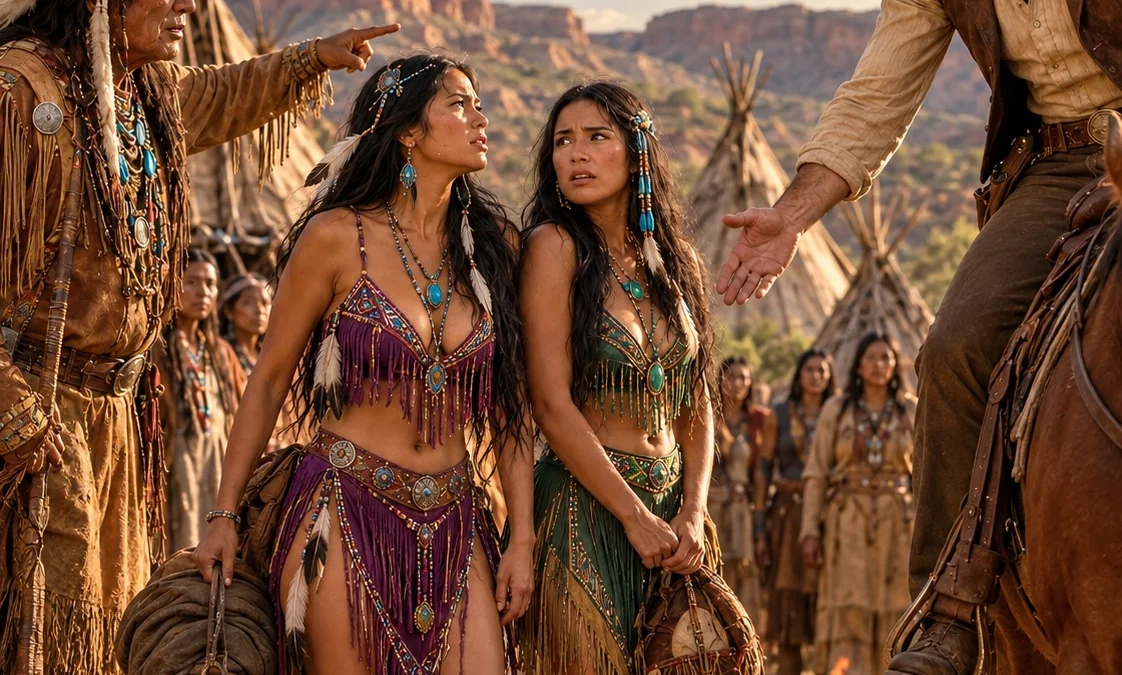
🔥 They Exiled Two Widows at Sunset With Nothing but a Blanket and a Cooking Pot… Then a Barn Burst Into Flames, and the Woman They Called Worthless Ran Straight Into the Fire 😱
PART 1
Nightfall hung hard over the New Mexico Territory in 1859. 🔥
Then a sudden bloom of orange light tore the darkness open across the valley.
The barn was burning.
Horses screamed inside, trapped and thrashing against walls already warping from the heat. Smoke rolled thick and black, swallowing the yard whole. Sparks leapt like living things, hungry for more.
A pair of hands plunged a blanket into the cold water trough and wrapped it tight around head and shoulders.
Then the figure disappeared into the fire.
A stallion’s cry cut through the smoke, raw and desperate. The east wall began to collapse inward in a shower of bright sparks.
She kept going. 😨
But to understand why, we have to go back to the morning she was told she no longer deserved to live.
The wind came down off the ridge before the sun did. Cold, thin, carrying wood smoke and something like dread.
Tazba felt it before she understood it. A tightness in the air, a held breath spread across the whole village. Mornings here always sounded a certain way: dogs, laughter, the scrape of grinding stones.
Not today. Today the quiet had teeth.
Nazcha found her near the fire pit, moving fast for a woman who usually moved like water.
“They’re calling the council.”
“I know.”
“You know what it’s about.”
Tazba didn’t answer. She knew the shape of it the way you know a storm by the ache in an old wound.
Six months. That was how long since her husband Kito died pulling an old trapper from the flood water and never came back up. Six months since she became a woman with no husband, no hunter, no name worth protecting. A widow with no one to feed her is a mouth the village must justify.
She hated that she understood the math. She hated worse that she couldn’t argue with it. 💔
The elders sat in the gathering circle like stones set into the earth long before anyone alive could remember placing them. Elder Tocho sat closest to the fire. Always closest. Always first to speak, last to be questioned.
Tazba walked toward the circle with her chin level. Not proud, because proud gets you noticed, and noticed is dangerous when you’re already standing on the edge of being unwanted. Nazcha stepped beside her. Two widows, walking together because there was safety in it, or the illusion of safety, which sometimes has to be enough.
“The harvest failed again,” Tocho said. Flat. Rehearsed. Like a man reciting weather instead of delivering judgment. “Every mouth in this village must earn its place.”
“We work every day,” Tazba said, keeping her voice even. “We gather. We carry water. We mend what needs mending.”
“You gather what others hunt. You mend what others build. That is not the same as providing.”
A murmur ran through the circle. Not agreement. Not disagreement. Just the sound people make when they know something is wrong but have decided it isn’t their fight.
She looked past Tocho toward Elder Delza, a quiet man who had once spoken up for a hunter falsely accused of theft and been proven right. His eyes were on the fire, not on her.
That told her everything she needed to know about how the morning would end.
“You and Nazcha,” Tocho said, “will leave the village before the sun sets today.”
The words dropped into the circle like stones into a well. You could almost hear them hit bottom. 😶
“On what grounds?” Tazba asked, because a small, stubborn part of her still believed there had to be grounds.
“On the grounds of survival. Nothing more is required.”
“My husband died pulling three people from that flood. He died feeding this village with his own hands, and now you tell me his widow isn’t worth feeding in return.”
“Your husband is not here to hunt for you,” Tocho said. Simple. Brutal. “That is the truth we must live with.”
Nobody in the circle said wait. Nobody said that’s not fair. And Tazba understood something colder than the decision itself: it had been made before she ever walked into the circle. The council wasn’t debating. It was performing.
So she stopped arguing.
Back in her lodge, the space felt smaller than it ever had. She looked around. A blanket. A cooking pot dented on one side. A pouch of dried meal, thinner than it should be this deep into a hard season.
And beneath a folded hide, a braided leather cord, worn smooth. Her father’s. The only thing she had left of the man who taught her to read a horse’s ears before it decided to bolt.
She wrapped it around her wrist and pulled her sleeve down over it. Small. Quiet. Hers. 🤍
By the time the sun hung low and orange over the western ridge, a small crowd had gathered at the village edge, just enough to make the leaving feel witnessed instead of private. Tazba found Delza near the back. Their eyes met for one long second. He didn’t look away this time.
But he didn’t step forward either.
Past the boundary marker, the wilderness stretched wide and indifferent. Two women. One knife between them. No shelter beyond what they carried.
Tazba told herself it would be fine. She did not believe herself.
Then, behind them, hoofbeats.
A rider came down through the wash at an easy pace, dust rising soft and gold in the dying light. Broad-shouldered. Hat low. A rifle in a scabbard, untouched.
He stopped twenty feet away and looked at them. Really looked, the way a man looks at a problem he intends to solve.
“Evening. You’re a long way from anywhere.”
“We know where we are,” Tazba said, sharper than she meant.
“Name’s Caleb Marsh. Got a ranch about four hours west.” He paused. “What happened?”
“We were told to leave. Our village. Today.”
Something moved behind his eyes. Anger, or its close cousin, grief for someone else’s grief.
“You can’t be out here when it gets dark.”
“We don’t have a choice.”
“You do now.”
He swung down from his horse. Then, to her quiet surprise, he led it by the bridle for the whole four hours so one of them could ride, because apparently he wasn’t the kind of man who rode while two women walked. 🌙
When they reached the ranch, a lantern burned in one window. A silver-haired man stood in the doorway. Gideon. He looked at Caleb, then at the two women trailing behind him, and his face did something complicated.
“You’re bringing trouble onto this ranch.”
“I’m bringing two people who need a roof,” Caleb said. “Trouble’s a different question.”
Gideon’s eyes found Tazba’s. She held them. Didn’t flinch. Didn’t soften.
He grunted, and stepped back from the door.
The next morning, a scream split the dawn.
In the corral, a young chestnut stallion, wild-eyed and lathered, reared hard enough to nearly topple the rail. Two ranch hands stood well back, one clutching an arm against his ribs.
“Damn animal’s been like this for a week! Can’t even get a rope on him!”
Tazba walked toward the fence. Slowly. Quietly.
“Tazba,” Caleb said, low, careful. “That horse has put two men on the ground this week.”
“I know.”
“You don’t know this horse.”
“No,” she said. “But I know horses.”
She climbed the fence. Crouched ten feet from the animal. And waited.
Minutes passed. The stallion’s breathing slowed. One hoof shifted forward. Then another. And at last, he lowered his head and let her touch his cheek. 🐎
Behind her, dead silence.
“Well, I’ll be damned,” Gideon breathed.
“Where’d you learn that?”
“My father. He could gentle any horse born.”
Gideon studied her, something shifting in his weathered face. “Man used to come through these parts years back, trading horses by the river crossing. Best hand with a spooked animal I ever saw. He had a way of crouching low, like you did just now. Rode a buckskin mare with one white sock on the off hind.”
Tazba’s breath caught. She remembered that mare. Remembered riding behind her father as a girl, the white sock catching dust at every trot.
“That was my father.”
Gideon went very still.
And that very evening, on a ridge above Caleb’s boundary line, a well-dressed rancher on a fine gray gelding lowered his binoculars, and watched a woman lead a once unmanageable stallion calm across the yard below.
Silas Crane had heard the talk in town for weeks. Now something cold and calculating moved behind his eyes.
“Seems Marsh has gotten himself some help,” he murmured.
“Don’t look like trouble to me,” said the wiry man beside him.
“Everything’s trouble, Pernell,” Crane said, “if you look at it the right way.”
Four hours east, in the largest house in town, he spread a map across his desk. A blue line traced the creek that ran through Caleb’s land and fed the only reliable spring for thirty miles. Crane’s own cattle drank downstream.
Which meant a soft-hearted, stubborn rancher held the one thing Crane wanted more than gold.
Eleven days later, a ranch hand rode in hard from the east pasture, face white.
“Cattle’s missing! Twenty head of Crane’s. Fence cut clean through. And there’s tracks, sir. Leading this direction.”
By afternoon, four riders came up the drive. Crane at the front, not dismounting.
“Tracks lead straight to your property line, Marsh. And we both know who out here has the skill to move twenty head quiet enough that nobody heard a thing.”
His eyes cut toward the corral. Toward Tazba.
Her blood went cold. It was the council fire all over again. Except this time, the accusation carried the weight of law.
She stepped forward before Caleb could answer.
“I’ll go. Because I didn’t take those cattle, and the only way to prove it is to follow the tracks myself.”
What nobody in that yard understood yet, except maybe Gideon, was that Tazba didn’t only gentle horses.
She read ground. 😳
Out in a shallow box canyon, Crane’s men watching, she knelt over a boot print half hidden beneath brush someone had dragged across it. One heel worn down hard on the outside edge.
She had seen that exact print three days earlier.
In the dust outside Caleb’s own bunkhouse.
Her stomach turned to ice. The trail didn’t lead away from Caleb’s ranch. It led back into it.
PART 2
“Found something?” Caleb asked quietly, reading her face before she said a word.
“Not here,” Tazba murmured. “Later.”
Crane called out, impatient. “Any conclusions, Tracker?”
She straightened and faced him directly.
“These cattle weren’t run. They were driven. Slow, careful, by someone who knew this herd’s temperament and exactly when the watch changed on your land last Tuesday night. And they weren’t taken away from your land, Mr. Crane. They were driven north, toward your own pasture.”
Crane blinked. “That’s absurd.”
“That’s a very good question,” she said, steady. “Maybe you should ask whoever actually did it.”
A few of Crane’s own hands exchanged uneasy glances. Pernell’s jaw tightened.
Crane wheeled his horse. “This proves nothing. We’ll finish it in town, in front of the marshal.”
“Fine by me,” Caleb said. “Marshal Hargrove’s a fair man.”
That evening, in the lamplit barn, Caleb called a young hand named Dolan in under the pretense of a lame mare. Gideon stood near the door, arms crossed. Tazba waited just outside.
Dolan cracked within minutes.
“It wasn’t my idea! Pernell said Crane would forgive my father’s debt at the store if I just told him things. Where the hands were posted. When the watch changed. I didn’t touch a single head!”
“But you knew what they were planning,” Caleb said, devastatingly quiet.
Dolan’s silence was answer enough.
“Get your things.”
Standing in the yard afterward, Caleb watched the young man’s shape vanish into the dark. “He’s young. Scared. In debt. Somebody like Crane finds a weak spot and presses.”
“That doesn’t make it right.”
“No. But the real weak spot is Crane, not the boy who fell for it.” 😔
Two weeks passed in uneasy quiet. Crane made no more public accusations. Rumor did its own work, twisted and uglier with each telling. Tazba kept working the horses, because stopping would have meant letting him win something he hadn’t earned. Nazcha kept healing, and saved a rancher’s wife whose leg was broken in three places, which did more to soften the town than any argument Caleb could make.
Then, one night, Tazba woke to a smell.
Not hearth smoke. Something sharper. Wrong.
She was at the window before she understood. Orange light, rising fast against the black shape of the barn.
“Fire!”
And that is where we began.
Flames licked up one whole side of the hay barn. The roar swallowed every other sound. And inside, screaming, the horses.
Caleb hauled the doors open against a wall of heat. “The east stalls! I can’t get past the fire!”
Tazba didn’t think. She grabbed a blanket, dunked it in the trough, wrapped it over her head and shoulders, and plunged into the smoke. 🔥
She found the first stall by memory. A young mare, rearing, eyes white-rimmed with panic.
“Easy. Easy now.”
Even here, with the fire roaring twenty feet away, it was the same language she had always known. Stillness. Patience. A voice that refused to carry the panic the animal already felt. She got the halter on and dragged the mare out into air that tasted like grace.
Then she turned right back around.
“Tazba, no!” Caleb’s hand caught her arm. “That side’s going up fast!”
“Ember’s still in there. I’m not leaving him.”
Something in her voice made his grip loosen, though his face had gone the color of ash.
“Then I’m coming with you.”
They found the chestnut stallion at the far end, rearing against a stall door warped shut by the heat. Caleb threw his shoulder against the wood. It wouldn’t give.
Tazba vaulted the rail and dropped down beside a horse in full panic, an animal easily capable of crushing her without meaning to.
“Ember. Look at me.”
The wild eye rolled toward her. She touched his cheek, same as that first morning.
“I need you to trust me. Same as you did that first day. I need you to trust me now.”
The fire roared. The smoke thickened. Behind her, Caleb finally forced the door half open.
And Ember’s head lowered, just slightly. Just enough. 🥹
The east wall of the barn gave way behind them in a shower of sparks as they burst out into the yard. They collapsed at the water trough, coughing, soot-streaked, alive.
Every horse was safe.
“You went back in,” Caleb said, voice rough, his face raw and unguarded in the firelight. “I thought I might lose you both. In there. Tonight.”
She didn’t have an answer. She just sat beside him, watching what remained of the barn collapse into embers, and something between them that hadn’t existed an hour before sat there in the dark, undeniable.
At first light, they found a kerosene-soaked rag in the brush. And boot prints leading toward Crane’s boundary fence.
Different prints from Dolan’s.
Tazba studied them a long moment. And a cold certainty settled into her chest. Whatever restraint Crane had shown until now had burned away right along with that barn.
PART 3
Marshal Hargrove arrived by mid-morning, a broad, unhurried man with a gray mustache and eyes that missed nothing. He walked the burn site in silence. Studied the kerosene rag without touching it. Crouched low over the boot prints the way Tazba had crouched a hundred times over a hundred trails.
“You’re the tracker.”
“I am.”
“Walk me through it.”
She did. Slow. Precise. No embellishment, because embellishment was the enemy of truth. The depth of the print. The direction of the drag marks. The char pattern on the east wall, consistent with kerosene poured low and lit fast.
Hargrove listened without interrupting, which she appreciated more than she could say after months of being spoken over by men who’d decided what her words were worth before she opened her mouth.
“You’d testify to this. In front of a judge. Even knowing what it might cost you.”
Tazba looked toward Ember, grazing calm in the corral, alive only because she’d gone back in when it made no earthly sense.
“I already lost everything once. For no reason at all. I’m not afraid of losing something a second time for a reason that matters.”
Something steadier than a smile crossed his face. “All right, then. Let’s find out who these boots belong to.”
It took four days. Nazcha helped her mix a plaster cast of the print from ranch supplies. Hargrove rode the county checking boot soles, and Pernell’s name kept coming up in half answers and averted eyes. On the fifth day they found him in a line shack twelve miles north, boots still caked in ash.
He talked fast once he was in irons.
“Crane paid me! Said the fire was just supposed to scare Marsh off! I didn’t know about the horses being trapped!”
“You poured kerosene on a barn full of living animals,” Hargrove said. “Meant has got nothing to do with it now.”
Crane denied everything with the smooth ease of a man who’d spent a lifetime believing his word outweighed anyone’s evidence. But Hargrove had Pernell’s confession. He had the plaster cast. And eventually, a paper trail of payments disguised as ranch supplies, unraveled by a sharp-eyed county clerk over a long grinding week of ledger work.
It wasn’t enough to hang him. It was enough to strip Silas Crane of his standing and have his water claim thrown out of court. 💥
Tazba stood in the courthouse the day the ruling came down. Judge Renner struck the earlier cattle-theft accusation from the record, declaring she had never borne any fault and never would. She watched Crane’s face go the color of old ash.
Caleb stood beside her. Close enough that she felt his warmth like a fixed point in a room that had spent months tilting beneath her feet.
“It’s done,” he said quietly.
“Not all of it.”
Because there was still the village. A debt no courtroom in this territory could settle.
Winter came early that year, and it came hard. The first storm buried the valley in three feet of snow in two days. The second brought cold enough to crack stone. Families who had once crossed the street to avoid Tazba now knocked on Caleb’s door in the dead of night, half frozen, asking humbly for whatever the ranch could spare. 🌨️
Nazcha never turned a single one away. She worked through nights so long Tazba lost count, boiling roots and barks into medicine, setting frostbitten fingers with a gentleness that made grown men weep.
Tazba worked the horses through blizzard and bitter cold, because half the ranches in the valley had no one left who could keep animals alive through a season this hard. One gray morning she rode out to a young mare with colic three farms over and found the rancher’s wife, Verlin, weeping at the barn door.
Tazba walked the mare through the night, hands numbed past feeling, voice low and even. By dawn, the animal stood and ate.
Verlin, who had once crossed the boardwalk rather than pass Tazba, gripped both her hands tight enough to bruise.
“I’m sorry for every unkind thing I ever thought about you. You saved everything I have left.”
Tazba rode home through snow gone pale blue, exhausted to her bones, and somehow lighter than she’d felt in a very long time.
Because this was the thing nobody at that council fire had understood. Value isn’t something a handful of frightened men get to decide in a single cold morning. Value is what you build, storm after storm, one saved life at a time, until the people who cast you aside have no choice left but to see you clearly. 💛
Word of the hard winter reached further than anyone expected.
In late January, a half-frozen rider arrived at the ranch carrying news from the village. Game scarce. Stores depleted. People sick. Three days later, Elder Delza came himself, on foot most of the way.
Tazba watched him approach through the snow and felt something complicated rise in her chest. Not quite anger. Not quite forgiveness.
“We need help,” Delza said. No pretense left. “Elders who taught us everything we know are dying in their sleep for lack of food.”
“Why come to me? You sent me away believing I had nothing left to give.”
“I know.”
“You didn’t stop it.”
“No. I didn’t.” The admission cost him. His eyes finally met hers, no longer sliding toward the safety of the fire. “I told myself I was only one voice among many. That was a lie I told myself to sleep easier. I could have spoken. I chose silence instead.”
Behind her, Nazcha stepped onto the porch. “You’re asking us to save the same people who left us to die.”
“I’m asking you to save people,” Delza said. “Whatever else stands between us.”
Snow kept falling, filling the space between old wounds and whatever came next. Tazba looked at Nazcha, and some wordless understanding passed between them, the kind that only comes from two people who have survived the same fire.
“We’ll help,” Tazba said. “But not for the council. Not for Tocho. For the people who never voted to send us away and never had a voice loud enough to stop it.”
“Understood.”
Caleb loaded the wagons himself, grain and dried meat and Nazcha’s medicine, blankets he packed without being asked twice.
“You don’t have to come.”
“I know. I’m coming anyway.”
The village looked smaller than she remembered. Thinner smoke. Gaunt faces. They set up in the center, and the people came, cautious at first, then desperate, then grateful in a way that cracked something open in Tazba she thought had scarred over months ago. 💔
On the second evening, she found Tocho alone at the council fire where her whole life had once been upended.
“You’re not helping.”
“I don’t know what to say to you.”
“You could start with the truth. My father’s horses. His tack, his saddle, everything he left me. It went missing the very week you pushed the council to cast me out. Where did it go?”
A long, telling silence.
“It’s in my stores,” he said finally, barely audible. “I told myself I was only holding it. Safekeeping until you…”
“Until I died out there.”
He didn’t deny it. “I was wrong. I don’t know how to make that right.”
“Bring it forward. In front of the whole village. Not whispered here in the dark.”
The next morning, with Delza standing witness and Caleb quiet at her side, Tocho spoke the truth plainly for the first time. He returned the leather cord, the saddle, everything that had once belonged to her father, laid out in the pale morning light. He admitted before everyone that his decision that cold morning had been driven by greed dressed up as necessity, and nothing more noble than that.
Some faces showed shame. Others showed relief, the relief of hearing a truth everyone had quietly suspected and no one had dared speak.
Then Delza stepped forward.
“This village owes Tazba and Nazcha a debt it can never fully repay. They were cast out for nothing more than being inconvenient. They returned in our darkest hour to save the very people who failed them. Let it be known from this day that they carry full standing in this village, whatever choices they make about where they call home.”
A murmur ran through the crowd. Not discomfort this time. Something warmer, that had been missing from that circle for far too long. 🕊️
Tazba stood at the center of it with her father’s leather cord back in her hands, and felt something long held finally settle. Not triumph. Something closer to peace.
Before they left, Nazcha climbed the small rise above the village where her husband Chosa lay buried, a place she hadn’t visited since the morning of her exile. She stood there alone a long while. When she came back down, something in her shoulders had settled that hadn’t been settled in over a year.
“I told him. About the winter. About the ranch. About all of it.”
“What did he say back?”
“Nothing.” A small, easy smile, the kind that comes only after grief has finished doing its worst work. “But for the first time, I didn’t need him to.”
By the time the first true thaw cracked the ice off the creek, the village stood steadier than it had in a long while. Tazba didn’t return to live there. That chapter, she had decided in the long nights of that hard winter, had closed. But the door between her old life and her new one no longer stood locked and barred.
And riding back toward the ranch, spring softening a landscape that had spent months trying to kill them all, she felt something she hadn’t let herself feel in a very long time.
Home. Waiting ahead of her, not behind.
The final piece of business waited in town. Caleb called a quiet meeting of ranchers up and down the creek, and laid out a new agreement on the table. Water rights, shared fairly along the whole length of the creek, not hoarded by whoever owned the highest ground. A cooperative, built to survive exactly the kind of hard season they had all just lived through.
“Why now?” one suspicious rancher asked.
“Because I watched two women save this whole valley through the worst winter in memory,” Caleb said, simple and certain. “And I figure if they can share everything they have without asking what’s in it for them, the rest of us can manage to share a little water.”
Nobody argued. By evening, the creek that had once been a weapon in one man’s hands belonged to everyone who depended on it. 💧
That night, the ranch stood quiet under a sky gone soft with the first warmth of spring. Ember grazed easy in the corral, coat gleaming. Nazcha sat on the porch steps drying herbs, humming something low and half-remembered. Caleb found Tazba at the fence line, watching the last light fade gold over the ridge.
“Quite a year,” he said.
“Quite a year.”
He was quiet a long moment. “I never did properly thank you. For staying. After everything this valley put you through, you could have gone anywhere.”
“I stayed,” she said, “because somewhere in the middle of all of it, this stopped feeling like somewhere I was staying and started feeling like somewhere I belong.”
Caleb turned to look at her fully, something open and unguarded in his face.
“I’d like it to keep feeling that way. For as long as you’ll let it.”
She let the quiet stretch, warm and easy, between two people who had earned every bit of this stillness through fire and frost. Then she reached over and took his hand.
“I think it will.”
Behind them, the ranch stood solid against the darkening sky, rebuilt barn, healed land, a whole valley steadier than it had been in years. All of it standing on ground that two cast-out widows had once crossed with nothing but a blanket and a cooking pot between them. ❤️
And for the first time in longer than she could remember, Tazba felt no fear at all looking into the horizon.
Because home, she had learned, was never a place handed to you by people deciding whether you deserved to stay.
It was something you built. One saved life, one hard winter, one small unbreakable trust at a time.
And she had built hers well.
THE END 🌄
💬 Have you ever been written off by people who later needed exactly what you had to give? Tell me your story in the comments. 👇
Disclaimer: This story is entirely fictional and created for entertainment purposes only. It does not represent any organization or individual, nor does it encourage inappropriate behavior. The content was generated with AI assistance.








