THEY FORCED A POOR COMPANION TO PLAY CHESS AGAINST A DUKE, BETTING SHE WOULD CRY—BUT WHEN SHE TOOK HIS QUEEN, HE RECOGNIZED A SECRET THAT COULD DESTROY THEM BOTH… AND WHAT HE DID TO HER THAT NIGHT WAS UNFORGIVABLE.
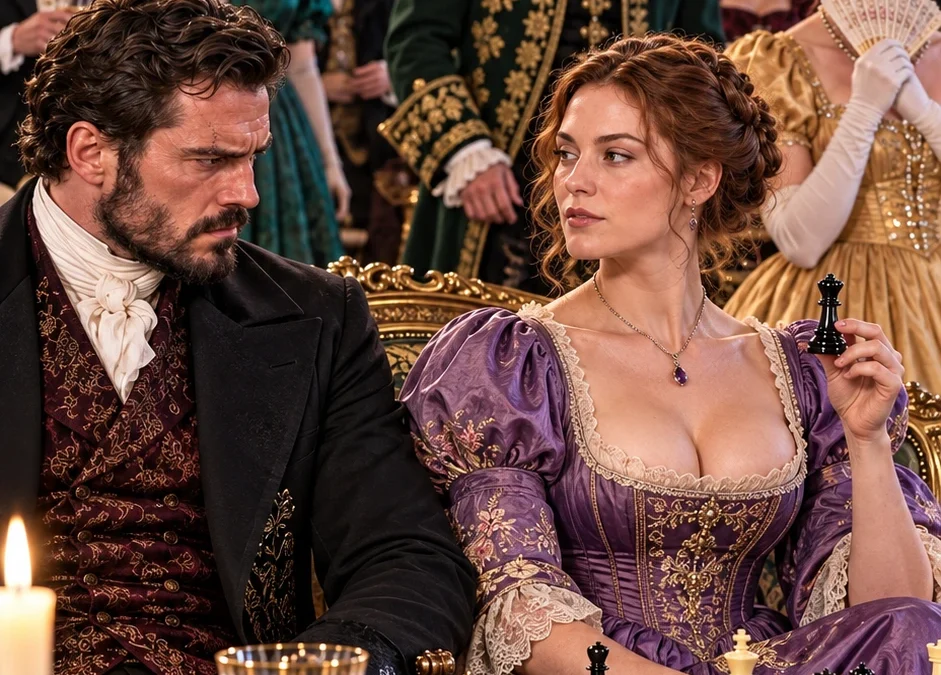
THEY FORCED A POOR COMPANION TO PLAY CHESS AGAINST A DUKE, BETTING SHE WOULD CRY—BUT WHEN SHE TOOK HIS QUEEN, HE RECOGNIZED A SECRET THAT COULD DESTROY THEM BOTH… AND WHAT HE DID TO HER THAT NIGHT WAS UNFORGIVABLE.
Part 1
For ten years, no one had defeated the Duke of Eisgarth at chess.
Kings had challenged him. Generals had studied his moves. Wealthy gentlemen had lost fortunes trying to outwit him.
But on a bitter winter evening at Strickland Park, the woman who would finally threaten his reputation was someone nobody considered important.
A poor companion in a faded gray dress.
And the entire room was waiting to watch her humiliation.
“Your Grace, I have found your next victim!”
Miss Farqua’s laughter rang through the elegant card room as she pulled an empty chair toward the chessboard.
“Miss Thomasina Karu. Our dear companion. Surely you won’t mind giving her a little lesson?”
The guests laughed.
Thomasina stood near the doorway, holding Mrs. Strickland’s shawl. At thirty-one, she had learned the painful art of becoming invisible.
She earned twenty pounds a year. She owned three plain dresses. And since her father’s death two winters earlier, she had no family to protect her.
“Sit down, girl,” Mrs. Strickland ordered.
Thomasina hesitated.
“I am afraid I should not—”
A jeweled hand pressed firmly against her shoulder.
“Sit.”
Her knees bent beneath the pressure.
Across the table, the Duke of Eisgarth barely acknowledged her.
He was a tall, broad-shouldered man with dark hair, pale gray eyes, and scars that spoke of battlefields far removed from fashionable drawing rooms.
He studied her shabby dress with unmistakable indifference.
“Twelve moves,” he announced. “That should be sufficient.”
Miss Farqua clapped delightedly.
“I have wagered my pearl bracelet that she will cry before the game ends!”
More laughter.
Then Mrs. Strickland bent toward Thomasina’s ear.
“If you embarrass me, your quarterly wages will be stopped.”
Thomasina went cold.
Five pounds.
That was the difference between having boots and walking through winter with holes in her shoes.
She lowered her eyes.
“Yes, ma’am.”
The Duke gestured toward the white pieces.
“Take white. You will need every advantage.”
Thomasina placed her trembling fingers around a pawn.
And moved.
At first, the Duke barely watched.
He answered her moves carelessly, occasionally glancing toward the fireplace.
Then came her fourth move.
Thomasina pushed a pawn forward, apparently offering it freely to his bishop.
The Duke’s hand stopped.
For one extraordinary second, his face lost its color.
Then he captured the pawn.
“You play like a parson’s daughter,” he remarked. “Giving things away without understanding their value.”
Thomasina looked up.
“I am a parson’s daughter, Your Grace.”
Something flickered in his eyes.
But he said nothing.
Near the fireplace, an elderly gentleman wearing a green coat decorated with gold braid slowly lowered his cards.
Count Bellski, the Russian ambassador.
A man whose chess victories were discussed throughout Europe.
He turned his chair toward the board.
Thomasina noticed.
Her father had owned books containing the count’s famous games. As a child, she had studied them beside the fire in a little garrison chapel.
Her father had been a military chaplain.
Soldiers had taught her chess before she could properly read.
During long winter evenings, wounded officers had challenged the quiet little girl.
By seventeen, she could defeat nearly every man in the garrison.
But her father had taught her something more important than winning.
“Never surrender your ability merely to make another person comfortable.”
She could still hear his voice.
Especially tonight.
“Your Grace,” Miss Farqua interrupted sweetly, “surely you needn’t be so serious. She’s only a companion.”
She opened her ivory fan and placed it along the edge of the board, casting a shadow over Thomasina’s pieces.
Thomasina carefully moved around it.
“How brave!” Miss Farqua giggled. “She moves those little soldiers as though she knows what she’s doing.”
“Remove your fan, madam.”
The voice came from behind Thomasina.
Count Bellski had risen.
Miss Farqua stiffened.
“I beg your pardon?”
“You are obstructing the board. I have seen that trick before.”
Her cheeks flushed.
“I was merely helping.”
“You were attempting to distract her.”
Silence.
The Duke looked at the ambassador.
Then at Thomasina.
For the first time, he began studying her moves seriously.
Behind him stood Gallagher, his former army sergeant and trusted attendant.
Gallagher had been watching the game closely.
He leaned toward the Duke.
“Careful, sir.”
“Stand back, Gallagher.”
“She’s setting a trap on your queen’s side.”
“I said stand back.”
But Gallagher did not stop watching.
The Duke advanced his knights.
Thomasina quietly repositioned her bishop.
He attacked her king.
She defended.
He attacked again.
She sacrificed another pawn.
By the tenth move, the entire card room had gathered around them.
Miss Farqua counted loudly.
“Eleven!”
Thomasina moved a pawn.
“Twelve!”
Everyone waited.
The Duke had promised to defeat her within twelve moves.
But both kings remained standing.
Miss Farqua laughed nervously.
“How generous of His Grace to prolong the entertainment!”
The Duke did not smile.
His attention had settled on the pawn Thomasina had sacrificed earlier.
Something about that move disturbed him.
He had seen it before.
Not once.
Dozens of times.
In letters written by someone he had never met.
Someone whose chess games had occupied his sleepless nights for nearly three winters.
Someone who always opened with that same reckless sacrifice.
Impossible, he thought.
Across from him sat a penniless woman whose fingers bore faint stains of violet ink.
He stared at those fingers.
And an old memory stirred.
Then Mrs. Strickland leaned close to Thomasina.
“Enough.”
Her voice was barely audible.
“Lose the game. Now.”
Thomasina remained motionless.
“If you defeat him, you will be dismissed without wages or references. Do you understand?”
Thomasina swallowed.
She could deliberately make a mistake.
Everyone would laugh.
The Duke would win.
She could keep her position.
But she remembered her father’s final winter.
He had been dying in their cold little house, his chessboard resting on the blanket.
“Promise me something, Thomasina.”
“Anything, Papa.”
“Never throw a game. Not for money. Not for kindness. Your mind is the one possession no one can take unless you surrender it.”
She had promised.
Now she looked at the board.
And moved her knight.
Not toward defeat.
Toward the trap she had been building since her seventh move.
The Duke studied the position.
“You were told to lose,” he murmured.
“Yes, Your Grace.”
“And you refuse?”
“Yes, Your Grace.”
His expression changed.
Then he sent his queen deep into her territory.
“Check.”
Thomasina moved her king.
“Check again.”
She moved again.
The Duke leaned forward.
“You are running out of places to hide.”
“I know.”
“Then why continue?”
Thomasina raised her eyes.
“Because I am not finished.”
The Duke advanced his queen once more.
Exactly where Thomasina had wanted it.
Her fingers closed around her knight.
She moved it.
A tiny click sounded against the polished board.
Count Bellski suddenly stood straighter.
Gallagher whispered a prayer.
The Duke froze.
Thomasina’s knight was attacking his king and queen simultaneously.
He had to save his king.
There was no other choice.
Slowly, he moved it aside.
Thomasina reached across the board.
And lifted his black queen.
Nobody breathed.
She placed it beside the pawn he had captured earlier.
“Your move, Your Grace.”
But the Duke was no longer looking at his lost queen.
He was staring at the violet stains on her fingers.
Because he suddenly remembered the handwriting in the letters he kept hidden against his heart.
And the impossible truth began forming in his mind.
The penniless woman he had just humiliated might be the mysterious stranger who knew the darkest secret of his life.
💬 Would you have obeyed Mrs. Strickland and lost deliberately—or risked everything to win? Find Part 2 in the comments, or leave ANY WORD below to receive it privately.
Part 2
The penniless woman he had just humiliated might be the mysterious stranger who knew the darkest secret of his life.
The Duke stared at Thomasina.
Then he looked down at the chessboard.
He could still recover.
Perhaps.
He advanced his remaining rook.
Thomasina answered immediately.
He moved his knight.
She closed the diagonal with her bishop.
And within minutes, his king was trapped behind his own pawns.
“Checkmate, Your Grace.”
The clock ticked.
The Duke looked at his king.
Then, with one scarred hand, he laid it on its side.
The room erupted.
“Good heavens! She’s beaten him!”
Count Bellski stepped forward.
He took Thomasina’s ink-stained hand and bowed over it.
“Madam, I have played in Paris, Vienna, and Petersburg. I have not witnessed such beautiful chess in thirty years.”
Thomasina blushed.
“Thank you, Count.”
“Will you honor me with a game tomorrow?”
Every guest stared.
The Russian ambassador was requesting a match with a servant.
“If my employer permits it,” Thomasina whispered.
Mrs. Strickland forced a smile.
“Of course! We have always known she was clever.”
Count Bellski turned.
“Madam, I heard you threaten to withhold her wages.”
The smile vanished.
Miss Farqua intervened.
“Surely it was a lucky trick!”
The count’s expression hardened.
“You arranged this spectacle to humiliate her. Instead, she has defeated one of England’s finest players. That is all anyone will remember.”
Miss Farqua fled the room.
The Duke remained silent.
Finally, he approached Thomasina.
“Your fourth move,” he said. “Where did you learn it?”
“From my father’s officers.”
“No officer I knew ever played that way.”
“Then perhaps Your Grace knew the wrong officers.”
His jaw tightened.
He summoned Gallagher and left without another word.
But the evening’s cruelty was not finished.
At midnight supper, Miss Farqua made one last attempt to recover her pride.
“Your Grace, you allowed her to win, didn’t you?”
The Duke slowly lowered his knife.
“No.”
Thomasina, standing beside the sideboard, felt a flicker of relief.
Then he continued.
“She was fortunate. I became careless. It will not happen again.”
The relief died.
Mrs. Strickland turned toward her companion.
“You hear that? Luck!”
Thomasina said nothing.
“You have made a spectacle of my household. You are dismissed.”
The dining room fell silent.
“Tonight, ma’am?” Thomasina asked. “It is snowing.”
“The night mail passes the crossroads at two. You will take it.”
Thomasina looked toward the Duke.
He was the only person powerful enough to stop this.
He lowered his eyes.
And said nothing.
An hour later, Thomasina packed her small trunk.
Three dresses.
Her father’s Bible.
His handmade pocket chessboard.
And a wooden box containing letters from a mysterious correspondent who signed himself simply A.
For three winters, they had exchanged chess moves and deeply personal letters.
She had never met him.
Until tonight.
For she had recognized the Duke’s expression when she sacrificed her fourth pawn.
Now she understood.
The man she had comforted through his darkest memories was the same man who had watched her be thrown into the snow.
Downstairs, the Duke sat alone in the library.
He opened an old letter.
Violet ink.
A familiar chess move.
And words he knew by heart.
You are not the worst hour of your life. Write whenever you cannot sleep. I will always answer.
His breathing stopped.
“Gallagher!”
The sergeant appeared.
“The companion. Her full name!”
“Miss Thomasina Karu, sir. Daughter of the late garrison chaplain at Chatham.”
The Duke closed his eyes.
“Oh, God.”
He finally understood.
“Where is she?”
“Gone, sir. The night coach left early.”
The Duke seized his coat.
“Prepare the horses!”
Outside, the storm was becoming a blizzard.
And miles away, the coach carrying Thomasina had already reached the most dangerous stretch of the heath.
A wheel slipped.
The horses screamed.
The entire carriage tilted toward a deep ditch.
Then came a terrible crack.
And Thomasina was thrown into the darkness.
💔 The Duke had discovered who she really was—but had he discovered it too late? LIKE or COMMENT “REVEAL” to see Part 3, which will be posted after enough comments!
Part 3
Thomasina struck the snow face-first.
For several terrifying seconds, she could neither breathe nor move.
The world was white.
The cold seemed to penetrate her bones.
Then instinct took over.
She clawed through the drift, dragged herself upright, and gasped.
Behind her, the mail coach lay overturned in a ditch.
One wheel continued spinning helplessly.
The horses screamed against their harnesses.
Someone inside the carriage was crying.
Thomasina staggered toward the wreck.
“Is anyone hurt?”
A groan answered.
The coachman lay beside the road, his right wrist bent at an unnatural angle.
The guard appeared through the snow, blood running down his forehead.
“Miss! Are you injured?”
“I don’t believe so. How many passengers?”
“Four inside. Another young fellow was on the roof.”
Thomasina looked toward the overturned carriage.
“Then we must get them out.”
The guard hesitated.
“I have orders to carry the mail through. There’s an inn five miles ahead. I can take one of the horses and bring help.”
“How long?”
“Two hours. Perhaps three.”
Three hours.
In a storm like this, three hours could mean death.
Thomasina looked at the helpless passengers.
Then at the guard.
“Go.”
“Miss, someone must remain in charge.”
“There is someone.”
“Who?”
She drew a shaking breath.
“Me.”
The guard studied the woman in the soaked gray cloak.
Then he nodded.
And disappeared into the storm.
The woman nobody thought mattered
Thomasina climbed onto the overturned coach.
The door now faced upward.
She pulled it open and lowered herself into the dark compartment.
“Can anyone hear me?”
Several frightened voices answered.
A young soldier’s wife was sobbing.
A wool merchant clutched his injured arm.
An elderly lady in a purple bonnet lay unconscious against the wall.
A young man in a brown coat tried to free himself from the broken seats.
Thomasina knelt beside the elderly woman.
She touched her cheek.
Cold.
Then she held her fingers near the woman’s mouth.
A faint breath warmed her skin.
“She’s alive.”
The young man found a tinderbox and helped light the carriage lamp.
In its trembling glow, Thomasina saw the terror on every face.
She had seen that expression before.
In wounded soldiers waiting outside her father’s chapel.
Men who had survived battles but feared they would not survive the night.
Her father had taught her that fear was contagious.
But so was courage.
“Listen carefully,” she said.
Everyone turned toward her.
“The guard has gone for help. Until he returns, we must keep warm, remain awake, and protect the injured.”
The merchant stared at her.
“Who are you to give orders?”
Thomasina almost laughed.
An hour earlier, she had been dismissed for refusing to obey an order.
Now five strangers were waiting for her to tell them how to survive.
“Nobody important,” she answered. “A companion.”
She looked directly at the merchant.
“But I know enough to keep us alive if everyone cooperates.”
The soldier’s wife nodded immediately.
“I’ll help.”
“So will I,” said the young clerk.
The old lady opened her eyes.
“Whatever you say, dear.”
The merchant finally lowered his head.
“Very well.”
Thomasina began.
She instructed them to pull cushions from the seats and block the broken window.
The clerk helped drag the injured coachman into the carriage.
Thomasina examined his wrist and secured it with strips of wood and cloth.
The man cursed throughout the painful process.
Then he began to cry.
“God bless you, miss.”
She squeezed his shoulder.
“Save your strength. We are not finished.”
She found blankets, spare stockings, and a heavy coat in the passengers’ luggage.
The merchant protested when she opened his bag.
“Those are expensive linens!”
“And they will be very useful if you wish to remain alive.”
He stopped protesting.
Thomasina wrapped the elderly woman carefully.
Then she turned toward the door.
The soldier’s wife caught her arm.
“Where are you going?”
“Outside.”
“Why?”
“The snow is gathering around the opening. If it seals us in, we may not get out.”
“You cannot go alone!”
Thomasina looked at the frightened young woman.
“Someone must.”
She climbed into the blizzard.
The wind struck her like a physical blow.
Twice, she fell.
Her hands became so numb that she could barely hold the spade she found among the coach equipment.
But she dug.
She cleared the opening.
She carved a narrow passage through the drift.
Then she built a rough snow barrier on the windward side to reduce the blast entering the carriage.
By the time she returned, her fingers were almost useless.
The soldier’s wife pulled her inside.
They wrapped her in a blanket and warmed her hands gently.
Pain returned with the feeling.
Thomasina began to cry.
She tried to hide it.
But the elderly woman took her hand.
“There, there, you brave girl.”
Thomasina laughed weakly.
“I’m thirty-one. I haven’t been a girl for years.”
“At my age, dear, everyone is a girl.”
For one brief moment, they all laughed.
Then the wind howled again.
And the little carriage trembled.
A chessboard in the darkness
Hours passed.
The lamp burned lower.
The injured coachman began shivering violently.
The elderly woman’s eyelids drooped.
Thomasina knew the danger of exhaustion in such cold.
“Nobody sleeps,” she ordered.
The merchant groaned.
“How are we supposed to stay awake?”
Thomasina reached into her gown.
Her fingers closed around the little folding chessboard her father had carved from an old cartridge box.
She opened it on her lap.
“We are going to play chess.”
The clerk looked astonished.
“Now?”
“Especially now.”
She taught him how the pieces moved.
Then she challenged the soldier’s wife, whose husband had taught her a few moves.
The merchant insisted he knew the game.
He proved terrible at it.
He argued about every captured pawn.
Thomasina encouraged him.
A man complaining loudly about chess was a man still alert enough to complain.
She asked the elderly woman about her daughter’s wedding.
She asked the coachman about his favorite horses.
She kept them talking.
Kept them thinking.
Kept them fighting the cold.
But as the night deepened, Thomasina herself began to struggle.
Her feet were numb.
Her head felt heavy.
She thought of her father.
Then of the letters.
For three winters, a stranger had written to her about battles, regrets, loneliness, and the terrible things he could not forget.
He had never told her his name.
Only the initial A.
She had imagined an elderly officer.
Perhaps a lonely widower.
Certainly not a duke.
And certainly not the arrogant man who had watched her lose her employment without speaking.
“Who taught you to play?” the clerk asked.
“My father. Some soldiers.”
She paused.
“And a man I had never met until tonight.”
“How can a stranger teach you chess?”
“Through letters. He sends a move. I answer. Sometimes we write about other things.”
“What sort of things?”
Thomasina looked down at the board.
“Things people cannot tell anyone else.”
The soldier’s wife watched her carefully.
“Is he someone you love?”
Thomasina’s eyes filled unexpectedly.
“I thought I knew him.”
“Then perhaps you do.”
Thomasina shook her head.
“Tonight, he let me be sent away like an unwanted servant.”
The soldier’s wife took her hand.
“Then perhaps he doesn’t deserve you.”
Thomasina said nothing.
Because the worst part was not that the Duke had hurt her pride.
It was that she had trusted the man behind those letters.
Trusted him with her father’s memory.
Her loneliness.
Her small hopes.
And now she could not reconcile that gentle correspondent with the man who had called her victory luck.
Suddenly, a sound pierced the wind.
A distant shout.
Thomasina raised her head.
Another shout.
Then a name.
“Karu!”
Her heart stopped.
“Thomasina Karu!”
She knew that voice.
Impossible.
She climbed toward the door.
“Miss!” the soldier’s wife cried. “Be careful!”
Thomasina pushed herself into the storm.
Below the carriage stood a tall man holding a lantern.
Snow covered his shoulders.
His dark hair was white with frost.
Behind him stood an exhausted gray horse.
The Duke of Eisgarth.
He looked up.
For several seconds, neither spoke.
Then he asked, almost desperately:
“Are you hurt?”
Thomasina stared at him.
“No, Your Grace.”
He closed his eyes briefly.
“Thank God.”
She had spent the night giving instructions.
Now the words came automatically.
“The coachman has a broken wrist. There is an elderly woman who must be kept warm. Another gentleman has injured his arm. We need blankets, more light, and help moving the passengers.”
The Duke listened without interruption.
Then he nodded.
“I brought blankets, brandy, a spade, and another lantern. Gallagher has gone with the mail guard to fetch a wagon.”
Thomasina held out her hand.
“The lantern first, please.”
He passed it up.
“And the blankets.”
He obeyed.
Without argument.
Without hesitation.
For the next hour, the Duke of Eisgarth did everything the poor companion told him to do.
He held the elderly woman beneath his greatcoat.
He cleared snow from the carriage entrance.
He helped the injured coachman settle more comfortably.
He gave his own dry gloves to the trembling clerk.
When the merchant finally recognized him, he almost fell over himself apologizing.
“Your Grace! Had I known—”
The Duke interrupted.
“Do as Miss Karu tells you. We all do.”
Thomasina looked at him.
It was the first time that evening he had publicly placed her judgment above his own.
But she was too exhausted to decide what it meant.
The confession that changed everything
Eventually, the wind began to weaken.
The passengers huddled together beneath their blankets.
The Duke sat beside Thomasina.
Between them rested her father’s little chessboard.
“May I see it?” he asked.
She hesitated.
Then handed it over.
He studied the pieces.
They were arranged in a familiar position.
White had sacrificed a rook to open a file.
Black had not yet answered.
The Duke’s breath caught.
“This position…”
Thomasina watched him.
“I posted that move three nights ago.”
He looked up.
“To my estate in the north.”
“Yes.”
He stared at the board.
“I have not received it yet.”
“It will be waiting when you return.”
He touched the sacrificed rook.
“You intended to bring your queen down this file.”
Thomasina nodded.
“In four moves, if you answered as I expected.”
He studied the position again.
Then, despite everything, a faint smile appeared.
“I would have spent half the night trying to escape.”
“I know.”
“And then I would have cursed.”
“I know.”
“And laughed.”
“Yes.”
His smile disappeared.
Because he understood that she knew him in a way nobody else did.
He had written to her for three winters.
About sleepless nights.
About the horrors of Badajoz.
About the men he had lost.
About carrying Gallagher down a ladder when he thought the sergeant was dying.
About the terrible things soldiers had done after the breach.
Things he had never told his family.
Things he could barely admit to himself.
And she had answered every letter.
Never excusing his failures.
Never dismissing his suffering.
Simply reminding him that a man was more than the worst moment of his life.
“Thomasina,” he whispered, “you knew who I was at the chessboard.”
“At the fourth move.”
“And you said nothing.”
“You did not recognize me.”
He lowered his head.
“No.”
“You called my father’s officers fools.”
“I did.”
“You called my victory luck.”
His face tightened.
“Yes.”
“And when Mrs. Strickland dismissed me, you let her.”
The Duke could not meet her eyes.
For a long moment, only the wind spoke.
Then he said:
“I was ashamed.”
Thomasina stared at him.
“Of losing to a companion?”
“Of discovering that the person I respected most in the world was sitting in front of me—and that I had treated her as though she were nothing.”
His voice broke.
“I recognized the opening. Then the ink. But I refused to believe it. I was angry at losing, and too proud to admit what I suspected.”
He looked toward the injured passengers.
“And because of that pride, you were sent into this storm.”
Thomasina’s expression softened slightly.
But she did not speak.
The Duke reached toward the board.
He took the little black king.
Held it between his fingers.
Then laid it on its side.
“I resign.”
The clerk looked up.
The soldier’s wife turned toward them.
The Duke continued.
“You defeated me in the card room. You defeated me through the post. And tonight, you have shown more courage than I have shown in years.”
His voice grew unsteady.
“I called it luck because I could not bear admitting you were better than I was.”
He looked directly at her.
“I was wrong.”
Thomasina’s eyes filled.
“Your Grace—”
“No. Please let me finish.”
He swallowed.
“I have faced cannon fire. I have climbed ladders under musket shot. Yet when a woman needed one word from me, I was too much of a coward to speak.”
He lowered his head.
“I cannot undo what happened. I can only tell you how deeply sorry I am.”
The little carriage became silent.
Even the merchant stopped moving.
“I did not ride into this storm expecting forgiveness,” the Duke said.
“I came because I realized the only person who truly knew me had been sent away by my own silence.”
Thomasina looked at the fallen black king.
For three winters, she had loved the mind behind those letters.
Now she saw the flawed man who had written them.
A man capable of pride.
Of cruelty.
But also of shame.
And perhaps change.
“Why didn’t you tell me your name?” she asked.
“Because I was afraid you would write to the Duke instead of the man.”
“And what is the difference?”
He looked at her.
“The Duke has spent ten years pretending he needs no one.”
“And the man?”
“The man waited for your letters like a starving person waits for bread.”
Thomasina turned away.
Tears slipped down her cheeks.
The elderly woman in the purple bonnet cleared her throat.
“Well,” she announced, “I should think that is a beginning.”
A faint laugh passed through the carriage.
The Duke smiled sadly.
“Only a beginning, madam.”
The morning after the storm
The rescue wagon arrived shortly before dawn.
Gallagher rode beside the driver, accompanied by two farmhands carrying lanterns and shovels.
The injured passengers were carefully helped into the wagon.
The coachman went first.
Then the elderly woman.
Then the merchant, the soldier’s wife, and the clerk.
Thomasina remained behind until everyone else was safe.
The Duke held out his hand.
“May I?”
She looked at him.
Then accepted.
He lifted her down from the broken coach and settled her among the straw.
Gallagher glanced backward.
For the first time in hours, he smiled.
The journey to the inn was slow.
The Duke sat beside Thomasina, his greatcoat spread over both their shoulders.
Neither spoke much.
But when the wagon jolted over a frozen rut, he reached out to steady her.
And this time, she did not pull away.
At the inn, the landlady immediately took charge.
Hot milk was brought.
Bread was warmed.
The injured were placed beside the kitchen fire.
A local surgeon was sent for.
And when the first pale sunlight entered the windows, Thomasina found herself sitting across from the Duke at a small wooden table.
Outside, the storm had finally stopped.
For the first time since leaving Strickland Park, she felt safe.
The Duke reached into his pocket.
“I brought something.”
He placed a small black chess queen on the table.
Thomasina stared.
It was the queen she had captured from him.
“You kept it?”
“I went back to the card room before leaving. I found it beside my fallen king.”
He pushed it toward her.
“It belongs to you.”
Thomasina touched the little crown.
“Why?”
“Because you took it fairly.”
He paused.
“And because it reminded me that I had lost something far more valuable than a game.”
She looked up.
The Duke’s expression was no longer proud or guarded.
He seemed suddenly vulnerable.
“Thomasina, there is something I should have told you long ago.”
She waited.
“My name is Archerald.”
She blinked.
“Archerald?”
“Nobody has called me that in twenty years.”
She repeated it softly.
“Archerald.”
He smiled.
“I like hearing you say it.”
Thomasina lowered her eyes.
“Your Grace—”
“Archerald. Please.”
She looked at him again.
“Archerald.”
He reached across the table.
“I have spent ten years winning every game I played. People praised me, feared me, and pretended to admire me.”
He glanced at the queen.
“But none of them knew me.”
His voice softened.
“You knew me without knowing my title. You answered my letters when you had barely enough money to pay the postage. You listened when I could not bear my own thoughts.”
Thomasina’s eyes filled again.
“I never thought of you as a duke.”
“I know. That was the greatest gift you could have given me.”
He took a breath.
“Thomasina, I want you to marry me.”
She went completely still.
Outside, a horse whinnied.
A kettle hissed in the kitchen.
But Thomasina heard only those six words.
“Marry you?”
“Yes.”
She stared at him.
“You barely know me.”
“I have known your mind for three winters.”
“You do not know what it means to live with me.”
“I know you are stubborn.”
She almost smiled.
“I am.”
“And you argue.”
“Frequently.”
“And you refuse to surrender when surrender would make your life easier.”
“My father taught me that.”
Archerald leaned forward.
“I want to know everything else.”
Thomasina’s lips trembled.
“Why?”
“Because I want to spend the rest of my life talking to you.”
He glanced toward the chess queen.
“I want to sit beside the fire every winter and lose to you.”
“You may grow tired of losing.”
“Never.”
His eyes shone.
“Winning alone was the loneliest thing I ever did.”
Thomasina looked down at her hands.
The violet ink remained beneath her fingernails.
The same hands Mrs. Strickland had considered fit only for carrying shawls.
The same hands that had defeated a duke.
The same hands that had kept strangers alive through the night.
And now a man who owned estates, titles, and fortunes was holding them as though they were precious.
Yet she remembered the supper table.
His silence.
Her humiliation.
“Archerald,” she said quietly, “I cannot marry a man who is ashamed of me.”
His expression changed.
“I know.”
“And I will never deliberately lose a game to protect your pride.”
“I would never ask you to.”
“I will not become another possession in your house.”
“You would never be one.”
She studied him carefully.
“Then if I say yes, it must be because we stand beside each other. Not because you are a duke and I am grateful.”
Archerald nodded.
“Agreed.”
“And when you are wrong, you must admit it.”
“I suspect I shall have plenty of practice.”
She laughed.
A real laugh.
The first one he had heard from her.
And something in his face brightened.
Thomasina picked up the black queen.
She turned it slowly between her fingers.
Then she looked at the man across from her.
“Yes, Archerald.”
He stopped breathing.
“Yes?”
“Yes. I will marry you.”
He reached across the table.
Past the little black queen.
And gently held her face between his scarred hands.
When he kissed her, she tasted warmth, tears, and the faint sweetness of bread.
For the first time since her father had died, she no longer felt entirely alone.
The scandal that swept through London
By spring, the story had traveled through drawing rooms across England.
The Duke of Eisgarth had married his former opponent.
A penniless companion.
A woman who had defeated him at chess before half the fashionable society of the county.
Miss Farqua became the subject of endless gossip.
Her wagered pearl bracelet was claimed by the gentleman who had accepted the bet.
He wore it on his watch chain for years.
Mrs. Strickland attempted to explain that Thomasina had always been treated with kindness.
Unfortunately for her, Count Bellski remembered the evening differently.
When Mrs. Strickland called upon him in London, she was informed that the ambassador was not receiving visitors.
The same message greeted her on her next visit.
And the next.
Eventually, she stopped calling.
Her next three companions resigned before completing their first quarter.
But Thomasina did not seek revenge.
She had spent too many years being overlooked to waste her new freedom making others feel small.
Instead, she used her position to create opportunities for women who had been denied them.
At Eisgarth, she established a small reading room where daughters of servants could learn mathematics, languages, and chess.
Archerald funded the books.
Thomasina taught the lessons.
Gallagher occasionally stood at the back, pretending he was merely checking the fireplace.
But everyone knew he enjoyed watching the girls defeat their instructors.
One afternoon, Thomasina found him studying a chessboard.
“Would you like a lesson, Sergeant?”
Gallagher grinned.
“Not from you, Your Grace. I’ve seen what happens to men who underestimate you.”
She laughed.
“Then perhaps you should play my husband.”
“With respect, madam, I prefer a challenge.”
From the doorway, Archerald groaned.
“Gallagher, you are dismissed.”
“Again, sir?”
“Again.”
Neither man could stop smiling.
The game Count Bellski never forgot
The following winter, Count Bellski arrived at Eisgarth.
He had traveled through heavy snow for one reason.
To play the new Duchess.
For three evenings, the library became a battlefield of ivory and ebony.
The first night, Thomasina won.
The second night, she won again.
The count stared at the board.
“Madam, you are a thief!”
Thomasina raised an eyebrow.
“A thief, Count?”
“You have robbed an old man of his sleep!”
“Then you must stay another night and win it back.”
On the third evening, the count finally defeated her.
He was so delighted that he rose from his chair and performed several steps of a Russian dance on the hearthrug.
Archerald watched, laughing.
Later, after the count had retired, he turned toward his wife.
“You let him win.”
Thomasina looked offended.
“I did no such thing.”
“He is sixty years old.”
“And an excellent player.”
“You were being kind.”
Thomasina folded her arms.
“Archerald.”
He smiled.
“Yes, my love?”
“What did my father teach me?”
He sighed dramatically.
“Never throw a game.”
“Not for money.”
“Not for kindness.”
“Precisely.”
He leaned across and kissed her forehead.
“Then I suppose the old fox earned his victory.”
“He did.”
Thomasina smiled.
“And tomorrow, I intend to win it back.”
The promise beside the fire
Years passed.
The story of the poor companion and the arrogant duke became something people repeated whenever they wanted to remind themselves that appearances could be deceiving.
But inside Eisgarth, the story was simpler.
It was about two lonely people who had found each other through letters.
About a man who had learned that admitting weakness required more courage than pretending to be invincible.
And about a woman who had refused to surrender her dignity, even when everything she owned was at stake.
Gallagher kept one small reminder of that extraordinary night.
The white pawn Thomasina had sacrificed on her fourth move.
He had recovered it from the card room the morning after the storm.
He kept it in a little wooden box.
Whenever someone asked why he treasured an ordinary chess piece, he answered:
“Because that pawn looked worthless until the whole battle depended on it.”
And every winter evening, when snow gathered outside the windows of Eisgarth, a chessboard stood beside the library fire.
Thomasina would sit in one chair.
Archerald in the other.
Sometimes they played in silence.
Sometimes they argued over strategy.
Sometimes they laughed so loudly that Gallagher could hear them from the corridor.
And occasionally, Archerald would sit down with exaggerated confidence and announce:
“Twelve moves. Somebody time it.”
Thomasina would smile.
Then, on her fourth move, she would sacrifice a pawn.
Archerald would look at it.
Shake his head.
And say:
“Not again.”
She would laugh.
“Your move, Archerald.”
He would study the board, remembering the cold night when he nearly lost her forever.
Then he would look across at the woman who had changed his life.
And smile.
Because the greatest victory of his life had not been defeating an enemy.
It had been learning how to love someone without needing to defeat her.
And Thomasina?
She had discovered that her father’s final lesson had been true all along.
A person’s worth was not determined by the clothes they wore, the money they possessed, or the title attached to their name.
Sometimes the person everyone laughs at is the one carrying the greatest strength.
Sometimes the quietest person in the room is the bravest.
And sometimes, the person society calls a nobody is the one who changes everything.
That winter, as the fire crackled and snow settled against the windows, Archerald reached across the board and took Thomasina’s hand.
“Do you ever regret it?” he asked.
“Regret what?”
“Taking my queen.”
She looked at the chessboard.
Then at her husband.
Her eyes sparkled.
“Not for a single moment.”
He laughed.
“Even though it nearly cost you everything?”
Thomasina squeezed his hand.
“No, Archerald.”
She glanced at the little black queen resting safely beside the board.
“Because it taught me that sometimes, to find the life you deserve, you must first refuse the life others have chosen for you.”
He kissed her fingers.
And outside, the snow continued falling.
But inside Eisgarth, neither of them was cold anymore. ❤️
THE END
This story is entirely fictional and created for entertainment purposes only. It does not represent any organization or individual, nor does it encourage inappropriate behavior. The content was generated with AI assistance.








