THEY GAVE HER A BLIND DRAGON TO MAKE HER FAIL — THEN HE FOLLOWED ONLY HER VOICE THROUGH THE DEADLIEST TRIAL
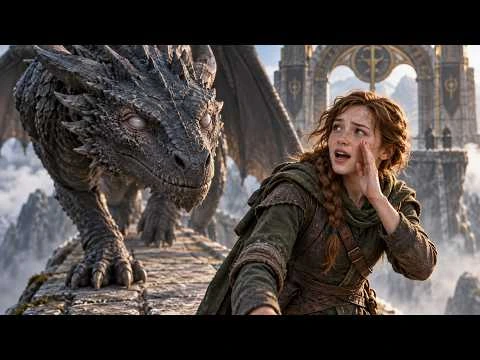
PART 2 — THE DRAGON WHO ANSWERED IN THE DARK
The ninth bell began to ring before Thea had time to think about whether she was afraid.
Across the causeway, nearly nine hundred people stood behind the iron rails, their faces blurred by fog, while the wind moved through the stone arches with a deep, hollow sound that seemed to come from everywhere at once. Barrow stood beside her, enormous and scarred, his milky eyes fixed on nothing, his claws resting against the stone as though he were listening to the earth itself.
The keepers had moved six feet farther back.
No one was going to save them if something went wrong.
Thea closed her fingers around the useless brass speaking horn hanging from her belt. She had tested it the night before and discovered what she already feared: the metal swallowed the small changes in her voice and returned only volume. Barrow did not need louder.
He needed her.
She stepped forward.
“Walk.”
Then she waited.
For a moment, there was nothing but wind.
Then Barrow touched one claw against the stone.
Tap.
Thea took one step.
He followed.
“Walk.”
Tap.
Step.
Again.
The rhythm was almost painfully simple, yet it carried everything they had learned together: one word, a pause, his answer, then movement. They crossed the first section of the causeway without difficulty, and somewhere behind the rails, the crowd became completely silent.
At the second arch, the wind suddenly shifted.
Thea’s voice was carried sideways, striking the stone wall and returning from somewhere behind them.
“Walk.”
The echo came back from the wrong direction.
Barrow’s head turned.
Thea felt her heart stop.
She did not repeat herself.
She did not shout.
She waited.
One second.
Two.
Then she felt the faint vibration beneath her boot.
Tap.
Barrow had heard the real signal through the stone.
Thea moved forward.
They entered the gallery.
That was where the real test began.
The bells above them rang together, their sounds crashing against the walls until every command seemed to split into several voices. The keepers had warned her that this was where previous candidates failed, because the dragon could no longer tell where the handler stood.
Thea remembered the first rehearsal, when she had shouted until Barrow nearly walked over the edge.
She would not make that mistake again.
“Step.”
Silence.
Tap.
Step.
She moved.
Barrow followed.
Thea kept her breathing slow as they passed beneath the bells, refusing to look at the crowd or the examiners. She watched only the space immediately ahead of Barrow’s claws.
Then they reached the turn mark.
Barrow stopped.
No tap came.
Thea waited.
The examiner raised his hand.
“Attempt suspended.”
Behind him, Dain already had the pen in his fingers.
Thea knew what they expected. They wanted her to panic, to issue another command, to prove that the blind dragon had finally lost the sequence.
Instead, she took two careful steps sideways, away from the strongest echo in the wall.
She turned toward Barrow.
“Again.”
Nothing.
Her voice softened.
“Walk.”
Barrow lowered his head.
For several seconds, the entire gallery seemed to hold its breath.
Then—
Tap.
Tap.
Thea smiled.
She moved toward the turn.
Barrow followed with absolute precision.
A murmur swept through the audience.
But they were not finished.
Halfway beyond the turn, Barrow stopped again.
This time Thea saw why.
Two slabs of the causeway had shifted slightly beneath the fog, leaving a narrow lip across the path. It was barely an inch and a half high, almost invisible to someone looking from the side.
For a sighted dragon, it would have been nothing.
For Barrow, it could become a broken leg, a stumble, and a fall into four hundred feet of empty air.
Thea could have called for a keeper.
She could have asked for the trial to be reset.
Instead, she understood what Barrow was telling her.
No.
Not here.
Not like this.
She moved closer and placed her boot against the stone beside his claw.
“Step.”
Barrow tapped once.
She shifted her weight.
He moved one foot.
Another.
The audience watched in silence as the enormous dragon crossed the damaged section one measured pace at a time, not because Thea forced him forward, but because she trusted the information he was giving her.
At last, the final gate came into view.
The count had already begun.
“Sixteen.”
Thea heard the examiner’s voice through the wind.
“Seventeen.”
The gate mechanism groaned.
She looked at Barrow.
They had only moments.
“Walk.”
Tap.
Step.
“Eighteen.”
Thea suddenly understood that the final distance was too long for her to guide him from behind.
So she ran.
Not away from Barrow, but ahead of him, moving into the wind where her voice would travel cleanly.
“Nineteen!”
She turned.
“Walk!”
Barrow moved.
Thea’s voice came again.
“Step!”
Tap.
Step.
The great dragon crossed the threshold.
The gate slammed shut.
“Twenty.”
Silence.
For one long second, no one moved.
Then Barrow lifted one enormous claw and touched the stone.
Tap.
Tap.
Thea laughed, breathless and almost unable to believe what had happened.
She placed her palm against the gate.
“I heard you.”
Behind the rails, the crowd erupted.
Dain looked down at the official sheet.
His pen hovered for a moment before he finally wrote the words that everyone had expected him never to write.
PASSED.
He looked toward Thea.
“On count twenty,” he said, his voice carrying across the gallery, “under full bells, in wind, without the speaking collar.”
Thea said nothing.
Dain closed the book.
“I was wrong about the animal.”
He paused.
“And I was wrong about you.”
There was no apology in his voice, and somehow that made the words heavier. He was not trying to make the moment sentimental. He was simply correcting the record.
Within a month, the rules of the keep changed.
Blind dragons, and dragons unable to respond to signal flags, could now enter the causeway trials if they demonstrated a reliable two-way communication system with their handlers. They would receive no softer route, no quieter bells, and no easier gate.
They would simply be allowed to prove that communication did not always require sight.
Barrow never returned to the training pit.
Instead, he became a route dragon, hauling timber and stone along the lower roads, where his blindness was no longer treated as a weakness. He remained difficult. He still stopped when he believed something was wrong, and he still refused commands when he had a reason.
Thea learned never to call that disobedience.
She called it information.
The gray coat she had once worn as a failed candidate disappeared from her shoulders, and Thea became a guide for others who came to the keep frightened, uncertain, or already convinced that they were not good enough.
She taught them the same lesson Barrow had taught her.
The command was only half of communication.
The other half was knowing how to wait for the answer.
Months later, the release paper Warden Devon had refused to sign was still folded on the clerk’s table.
Thea had never taken it.
One evening, Ree found her beneath the old causeway, where the wind was softer and the bells sounded distant.
He carried a route book beneath one arm.
“I have a question,” he said.
Thea looked at him.
“What?”
“Would you walk the low road with me?”
He began to explain where it went, how long it would take, and what they might see along the way.
Then he stopped.
For once, he did not fill the silence.
He waited.
Thea looked toward the distant road.
Then she smiled.
“Yes.”
And somewhere above them, beyond the stone arches and the fading light, a blind dragon lifted his head as if he had heard the answer too.








