THEY LEFT THE DUKE’S “DYING” BRIDE ALONE IN AN EMPTY MANOR TO WASTE AWAY… BUT SHE POURED HER TONIC INTO A POT OF DEAD FERNS, AND WHAT SHE FOUND IN THE DRIED SYRUP PROVED SOMEONE WANTED HER DEAD BY SPRING
THEY LEFT THE DUKE’S “DYING” BRIDE ALONE IN AN EMPTY MANOR TO WASTE AWAY… BUT SHE POURED HER TONIC INTO A POT OF DEAD FERNS, AND WHAT SHE FOUND IN THE DRIED SYRUP PROVED SOMEONE WANTED HER DEAD BY SPRING 😱
Part 1
“Leave her here. Close the East Wing, keep the fires low, and send the tonic on the first of every month. The doctor says she will not see the spring, and I find I cannot watch it.”
The Duke of Wrexham said it on the gravel drive of Hollowfield Manor, one boot already on the carriage step. He did not look up at the window where his wife stood. 💔
Harriet heard every word.
She stood behind the thin curtain of the upstairs landing, one hand on the cold glass, thirty pounds lighter than on her wedding day. She watched her husband’s carriage roll away down the avenue until the rain swallowed it. She was twenty-four. She had been married seven months. She had been told for five of them that she was dying.
“Your grace,” said the housekeeper behind her, very gently, in the voice people use with the doomed, “shall I bring you your tonic?”
Harriet turned from the window and looked at the little brown bottle on the tray, and at the glass beside it, and at the kind, frightened face of the woman holding both.
“Thank you, Mrs. Hale. Leave it on the table.”
She did not drink it. She could not have said why. Only that something deep and stubborn in her had spent five months being made weaker with every spoonful, and tonight, in an empty house with her husband gone and the rain coming down, she simply, for the first time, did not.
That was the first night of her life at Hollowfield. It would also turn out to be the night she started to live. 🕯️
Here is what no one in that great, cold house knew.
Harriet Lyle had never been sick a day in her life.
She was the only child of a country botanist, a gentle, ink-stained man who spent forty years cataloguing the wild plants of the West Country and raised his daughter in his herb garden like a seedling. She could walk twelve miles across moorland before breakfast. She knew the name, the use, and the danger of every leaf between the sea and the chalk. Her father used to say she had a greenhouse for a heart.
And then she married a duke.
It was an arrangement, a plain, honorable one. Edmund Cray, Duke of Wrexham, needed a wife with a small fortune and a good head. Harriet’s dying father needed to see his daughter safe. They met four times before the wedding and liked each other well enough. She came to Wrexham Hall in spring, healthy, brown-armed, and hopeful.
Within a month, the Duke’s aunt, Lady Beatrix Cray, noticed the new Duchess looked a little peaked. Within two, the family physician, Dr. Osgood, began to shake his head. By the third month there was a tonic, a sweet, dark syrup to build her up.
Every dose left her a little more hollow-eyed. A little more short of breath. A little more sure that something was terribly wrong with her. Nobody said the word poison. Nobody had to. And Harriet, weak and frightened and a stone and a half lighter than she should have been, had begun quite calmly to believe the doctor when he told her husband in the next room that the wasting sickness ran in the family and there was no cure.
The first week alone at Hollowfield, Harriet slept nearly all day. She had merely poured the tonic, with a small guilty wrench, into a pot of dead ferns on the windowsill. It was something like exhaustion of the spirit. The house was enormous and half-shuttered, a dour manor the family had let rot for twenty years, with a leaking roof, four servants, and a garden so overgrown that its walled gate had vanished under bramble.
Mrs. Hale brought her soup and tears. The old gardener, Tobias Marsh, eighty if he was a day and a man who had outlasted three dukes, brought her a single winter rose from a bush nobody else had bothered to cut back, and set it on her tray without a word.
On the eighth day, Dr. Osgood came. He arrived in his good gray coat with his black bag, all grave concern, his hand resting a shade too long on her wrist.
“Still very weak, your grace. I do not like this pallor.” He looked at the tonic bottle, and frowned to see it full. “You have not been taking it.”
“I have been sick to my stomach, doctor.”
“Then we must take it more faithfully, mustn’t we?” He poured a full measure into the glass himself and stood over her with a patient smile until, for a moment, she lifted it to her lips. She set it down again.
“I’ll take it after I’ve rested.”
He looked at her a long moment with something beneath the smile she did not like. At the door, he said pleasantly, “Lady Beatrix has asked me to say that his grace will be home to settle the estate in the spring. We all hope you will be comfortable by then.”
Harriet understood him perfectly, and it went through her like ice water.
By spring, she was meant to be dead. 😨
She did not weep. She did what her father had taught her to do when a plant wilted for no reason she could see.
She stopped guessing, and looked.
That night she took the brown bottle to the window, uncorked it, and tipped a few drops onto a white saucer to dry in the moonlight. Then she crept down in her nightgown to the old kitchen, lit a candle, and found a magnifying glass in the housekeeper’s drawer.
In the morning, at the bottom of the dried syrup, were fine gray-green flecks like dust. Under the glass, they were not dust. They were the shredded fibers of a leaf she had known since she was four years old. A soft, velvety, spear-shaped leaf that grew in every hedgerow in Devon, that her father had made her draw twenty times in her sketchbook, and swear never to touch.
Foxglove.
Digitalis. The little bellflowers children love, which in the right quantity will stop a strong heart as gently as a hand closing a book. Not enough to kill quickly. Quite enough, given daily in a sweet syrup, to make a healthy young woman weak, breathless, sick to her stomach, and, by the fifth month, quite ready to be believed dead.
Harriet sat on the kitchen floor with the saucer in her lap and did not make a sound.
Then she got up, wrapped the bottle in a clean cloth, and hid it under a loose board in her wardrobe, beside the four earlier bottles she had stubbornly, without knowing why, refused to throw away. And in her father’s old notebook, in his own careful hand, she wrote three things.
The date. The dose. The name of the man who poured it.
But the hardest thing Harriet would ever do at Hollowfield was go on pretending to die… 😳
Part 2
The hardest thing was to go on pretending to die.
She had done the sums at the kitchen table. She was alone with a hostile doctor, four frightened servants, a husband on the Continent, and a poisoner whose confidence she must not shake. If she confronted anyone, she would be dismissed as hysterical, a sick young wife raving of plots. There would be an accident, or a tonic twice as strong.
But if Dr. Osgood and Lady Beatrix believed the poison was working, they would stop watching.
So she played dying. She wore her shawl to dinner. She let her hand shake on the spoon. She learned to sway gracefully on the stairs and press the back of her wrist to her forehead like a woman with a fever. Each time Dr. Osgood left a fresh bottle, she thanked him faintly and tipped it into the dead ferns, keeping a little back for evidence.
And in the empty hours when the house slept, she began, very quietly, to get well.
She ate what Mrs. Hale’s kitchen girl, a sharp-eyed twelve-year-old called Dilly, smuggled up in her apron. Bread, eggs, apples, honey. She walked the length of the long gallery at midnight until her legs stopped shaking. By the second month the color began to return to her face, and she had to rub flour on her cheeks before the doctor’s visits.
On a bright, cold morning in the third month, she found Tobias Marsh at her door with his hat in his hands and his old eyes very steady.
“Your grace, I don’t believe you’re dying. I’ve seen dying. I buried a wife. Whatever’s been done to you, you’re mending. And if you’re minded to have a garden, ma’am, I’ve been saving the seed forty years.” 🥹
They started with the gate. It took Harriet, Tobias, and Dilly nine days to cut through the bramble and find it. When it swung open at last on its rusted hinges, they stood a while in silence, looking into the walled garden of Hollowfield. Three acres of old brick, and beneath the wild dead tangle, the ghost of a great design.
“Best kitchen garden in the county once,” said Tobias. “The old Duchess used to send peaches to the Queen.”
Harriet stood in the mud in a borrowed apron with her sleeves pushed up, and for the first time in seven months she felt entirely, unreasonably, like herself.
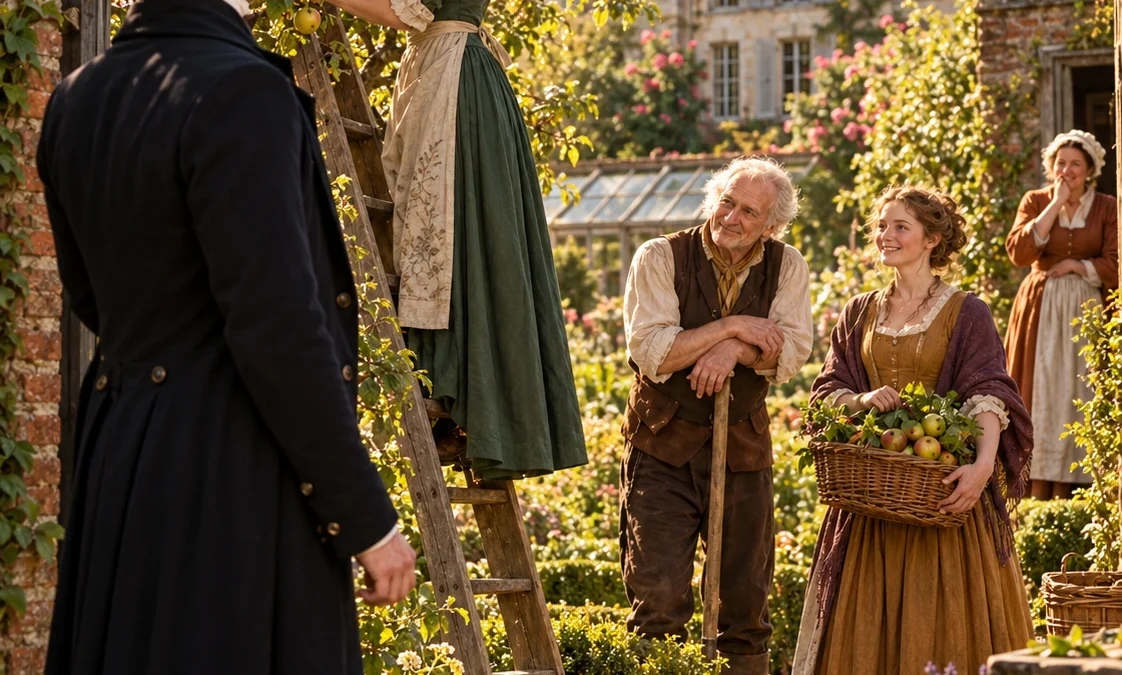
She dug and pruned and planted from dawn until the light failed, her father’s notebook in her pocket. Row by row, week by week, the neglected earth began to answer her. By midwinter there were cabbages under glass. By February, the espaliered pears along the south wall had burst, unbelievably, into bud. By March there was a barrow of early vegetables going down to the village every Thursday, and villagers who had thought the manor as dead as its Duchess began to come to the kitchen door, curious, with baskets.
The money paid the servants’ overdue wages. It mended a corner of the roof. It bought, best of all, glass panes for the greenhouse.
But the ledger Harriet kept of it told her something else, something that turned her stomach cold. The rents from the outlying farms, which should have paid for all this and more, had for two years been paid every quarter to Mr. Kemp, the Duke’s steward, and had never reached Hollowfield at all.
She was not the only thing being slowly drained.
Lady Beatrix Cray came on a bright morning in late March, unannounced, in a black carriage, with Dr. Osgood beside her and a face like ice over deep water.
Harriet had known she would come. She had not known she would arrive on a day when the sun was warm, the garden gate stood open, and the Duchess was on a ladder in the pear orchard with a pruning knife in her hand.
The pause in the sunshine lasted a full three seconds.
“Your grace,” said Lady Beatrix at last, in a voice like a drawn blade. “How very remarkable.”
“A remission, Lady Beatrix,” said Dr. Osgood swiftly, dabbing his forehead. “It happens. In these wasting cases there is often a last bright flare before the end. It is very dangerous. She should be in bed.”
Harriet smiled with all the sweetness she could summon and said nothing. But she watched Lady Beatrix’s eyes move from the pear trees to the open gate to the vegetable rows to the old gardener, to the glowing, sun-browned face of a woman who was supposed to be dead by Christmas. She understood that a cold, clever mind was revising its plans.
By nightfall the household had been reorganized. Dilly was sent back to her mother’s cottage. Tobias was dismissed with a month’s wages. One of Lady Beatrix’s own women moved into the room beside Harriet’s. Dr. Osgood would now reside at the manor, and the tonic, a fresh, strong dose, would be given morning and night in front of witnesses.
“You must trust us, my dear,” said Lady Beatrix at the bedside, her hand on Harriet’s, very warm and very cold. “We only want you to be well.” 😈
The next nine days were the worst of Harriet’s life. The nurse stood at her bedside with the spoon each morning and night and watched her swallow. The gates were locked at dusk. Every letter went through Lady Beatrix’s hands. Her one small mercy was a trick learned in her father’s herb garden: holding a mouthful under the tongue and letting it drain into a folded handkerchief the moment the nurse turned away.
But the doses were stronger now. Even the little that reached her blood brought back the dizziness, the fluttering heart, the dreadful gray in her hands. She felt herself slipping, day by day, back into the dark.
On the ninth night, lying alone in the shuttered room with the nurse snoring in the chair by the door and the letter she had tried to smuggle out lying torn in the grate, Harriet Lyle, who had never once cried at Hollowfield, cried.
She thought of her father. Of a walled garden coming back to green. Of a man in a carriage who had not looked up at the window.
And then, through the wall, very faintly, she heard hooves on gravel. Hard, fast, and coming up the avenue in the dark. 😱
Edmund Cray had not been meant to come home until spring. But in his coat pocket was a letter he had read forty times on the road…
Part 3
Edmund had come home in the last week of March, three weeks early, with no warning. The letter was from an old army friend, written in the plain, blunt hand of a man with nothing to gain.
I have been making inquiries about your Dr. Osgood. There is talk in London that he lost his license in Bath, and talk about the ladies he attended there. Come home, Wrexham. Take a physician of your own. I do not like it.
He arrived at Hollowfield at midnight in the rain, bracing himself for the funeral bell and the shuttered windows. Instead he found the house alight. Candles burned in the kitchen, in the gallery, and in one upstairs window. When he came round the side of the manor by the stable yard, his heart going oddly hard, he found the walled garden gate standing open. Beyond it, faint in the moonlight, tidy rows of new-turned earth, pear trees in white blossom, a cold frame full of green shoots, where he remembered nothing but brambles.
He stood in the wet grass in his traveling coat and thought, with a dreadful, slow wonder, I do not recognize it.
“Your grace.”
The voice was old, cracked, and very quiet. Tobias Marsh stood at the garden wall with a lantern, dismissed a week ago, and not gone.
“You’ll be wanting to see the Duchess.”
“Is she…” The Duke could not finish.
“She’s alive, sir. And you’d best come quick. There’s a woman in that house who means her harm. And I think, God forgive me, she means it tonight.” 😨
He took the stairs three at a time. The nurse in the chair woke with a gasp and tried to bar his way, and the Duke of Wrexham, who had never in his life laid a hand on a servant, moved her aside like a piece of furniture and pushed open the door.
His wife sat on the edge of the bed in the candlelight. Thin. Pale. The gray look of the poisoned about her, a wet handkerchief clenched in one hand, her hair down her back. But she was on her feet before he had crossed the room, and her eyes were not the hollow eyes of a dying girl. They were furious, and clear, and alive.
“You came back.”
He stopped. He looked at her hands. At her face. At the sun-brown on her arms that no invalid could have earned.
“Harriet. What has been done to you?”
She opened her mouth to tell him everything, all seven months at once. He took one step toward her and lifted his hand unsteadily toward her face.
And from the corridor came the brisk, precise click of a lady’s heels.
“Edmund. Good heavens. What a shocking hour to arrive.”
The moment broke like glass. Edmund’s hand dropped. Harriet’s mouth closed. His aunt stepped through the door in a dressing gown of black silk, Dr. Osgood at her shoulder, and looked at the two of them with an expression of such tender, pitying sorrow that for one dreadful moment Harriet almost believed it herself.
“My poor boy. I had hoped to spare you this.” 💔
She did it beautifully. That was the terrible thing. She drew her nephew aside with a hand on his sleeve and told him in a low, grieving voice, pitched so Harriet would just catch the words, that his wife was not well. Not in body, alas, but in mind. That such wasting illnesses in their last stages often brought delusions. That poor Harriet had accused the servants of theft and the doctor of poisoning and ordered the nurse from her room. That she had been found in the garden at night in her nightgown, talking to the roses.
“It is the fever before the end, Edmund,” said Dr. Osgood gravely. “They rally. They believe they are recovered. They see conspiracies. It is the cruelest part of the disease. You must not let her tell you otherwise.”
Harriet watched her husband’s face. She watched the man she had married stand between the poisoner and the poisoned, with both stories before him and no proof but her word against a doctor’s and a duchess’s. She saw the doubt begin. She saw him look at the thin, wild-eyed, sun-browned woman in the nightgown and try to decide which of two stories he could bear to believe.
“Edmund,” she said, very steadily. “I am not going to ask you to trust me. I am going to ask you to do something a great deal easier.”
“Name it.”
“Drink nothing your aunt hands you for one week. Send for the London physician you trust. And give me until Sunday.”
A long silence. Lady Beatrix’s smile had not changed by a hair.
“Sunday,” said the Duke slowly, “is the day I meant to hold the county dinner to announce the estate accounts.” His eyes went to his wife. “Very well. Sunday.”
She had five days, and she used every hour.
Edmund sent that night for his friend from the army, Dr. Whitlow, a blunt, clever London physician who had served as a surgeon in the Peninsula and had no patience with anything he could not see under a glass. He arrived Thursday afternoon, listened to Harriet an hour behind a closed door, examined her wrist, her eyes, her heart, and her five hidden brown bottles, and said only:
“Your grace, who taught you to identify digitalis in a syrup?”
“My father. He was a botanist.”
“Then your father,” said Dr. Whitlow grimly, “has just saved your life.” 🥹
Old Tobias and Dilly, smuggled back into the manor by the Duke himself, gave their sworn word to what they had seen. The tonic poured into dead ferns. The sickly Duchess’s swift recovery. The dismissals. Mrs. Hale, weeping, confessed the doses she had carried up the stairs and swore she had never known. Harriet’s little ledger of the estate’s produce proved, in figures no one could argue with, that the manor’s rents had been paid to Mr. Kemp and gone nowhere.
On Friday night, in the Duke’s study with the door locked, Edmund listened to the whole of it and did not speak for a long time.
“I left you. I stood on the drive and said I could not watch it. I set it in front of you.”
“Yes,” said Harriet. “I heard.”
“I have never in my life been so ashamed.”
“Good.” And then, more gently: “But not yet. Sunday first.”
The county dinner at Hollowfield was, by any measure, the most splendid the old manor had seen in twenty years. The long table blazed with silver and candles. The magistrate, Sir Rowland Price, sat at the Duke’s right hand. The vicar, the gentry, and their wives filled the benches. Lady Beatrix presided at the foot in black silk, serene as a marble saint, her son Julian at her side. Dr. Osgood sat below the salt. Mr. Kemp, the steward, in his best blue coat, tapped his fingers nervously on the cloth.
And at the head of the table, in a gown of deep green that Mrs. Hale had let out for her, her hair dressed, her cheeks brown, her eyes bright, sat the Duchess of Wrexham, who was supposed to have been dead by Christmas.
A murmur ran around the guests.
“Dear Harriet has been so brave,” said Lady Beatrix thinly.
“Thank you, Lady Beatrix,” said Harriet, and rose.
She said it plainly, in the warm candlelight, in a voice that did not shake. She told them she had been left at Hollowfield to die. She told them she had been given a tonic every month on the doctor’s order. And she set upon the white tablecloth, one by one, five small brown bottles. 🔥
Dr. Whitlow rose from beside the magistrate, set a saucer under the candlelight, and tipped out a few drops of the syrup.
“Sir Rowland, you will see the flakes. Digitalis, in a base of sweet syrup. Not enough to kill quickly. Perfectly sufficient to kill slowly if given daily for six months.” He turned his cool eyes on the man below the salt. “Dr. Osgood prescribed it. I should like to hear him explain.”
The silence at that table was the silence of a cliff edge. Dr. Osgood did not explain. He went the color of tallow, half rose, and sat down again. The magistrate said, in the mild, flat voice of a man who has heard it all before, “Sit still, doctor.”
It came apart quickly after that. Tobias Marsh, in his Sunday coat, testified to the ferns. Dilly, scrubbed and terrified, told of the soup and the bread. Harriet’s ledger went from hand to hand down the table, and Mr. Kemp made a small strangled sound as the county’s gentlemen read, in a plain small hand, how much had gone into his pocket.
And Lady Beatrix Cray, cool, impeccable, magnificent to the last, rose and looked down the length of the table at her nephew.
“Edmund. You will not take the word of a sickly, hysterical girl against your own blood. You know what I have done for this family. My son is your heir. I have kept this house together for twenty years. Dr. Osgood is a respected man. It is all nonsense.”
“Aunt Beatrix.” The Duke stood. His voice was not loud, but the whole room heard it. “I left my wife alone in a ruined house believing she was dying because a doctor told me so, and I was too great a coward to check. She spent seven months being poisoned by your physician on your orders, and she rebuilt that house. She rebuilt that garden from her own two hands while she did it. I do not know what my father would call the woman who did that. I call her the bravest person I have ever met.”
He turned to the magistrate. “Sir Rowland. I should like you to arrest my aunt.”
They took her out through the great hall, past the tall doors, past Julian, white and silent, past Dr. Osgood in irons and Mr. Kemp weeping. 😶
When the last carriage had gone, and the county had gone home to tell a story it would be telling for thirty years, Edmund found his wife alone in the walled garden under the pear blossom, in the last of the light.
“I don’t know how to ask your forgiveness.”
“You needn’t,” said Harriet, not turning from the tree. “You came back. You left the moment you were told the truth. That’s more than most men do.”
“Harriet, I mean it.”
She looked round, and in the blue dusk she was so thin, and so brown, and so entirely herself that he lost his breath.
“I was angry with you for a long time, Edmund. On the stair. In the cold. But I found something out in that garden. I found out I wasn’t the sort of woman who dies because she’s told to. I don’t think I’d have found it any other way.”
“I should have stayed.”
“Yes. You should.” She smiled, a little. “But you’re here now.”
He crossed the wet grass and stopped in front of her, and this time there was no carriage bell, no aunt’s cool voice, no open door. He lifted his hand and laid it gently against her cheek, and she turned her face into his palm and shut her eyes.
“Come home with me,” said the Duke of Wrexham. “Not to Wrexham Hall. Here. This is the only house I have ever come home to.”
“Then you’d better learn to hold a pruning knife,” said Harriet, and kissed him. 💍
They stayed at Hollowfield. Edmund sold the East Wing of Wrexham Hall to pay the estate’s debts and moved his books into the old manor library. In two years it was the finest small house in the West Country. The walled garden won a prize from the Horticultural Society. The espaliered pears were sent, in silver paper, to the Queen.
Tobias Marsh, at eighty-two, was made head gardener for life, and died at ninety in the same bed, by the same window, smelling the roses. Dilly grew up to run the kitchens. Mrs. Hale wept at every feast day. Lady Beatrix and Dr. Osgood answered to the assizes. Mr. Kemp made restitution in full, from a very much smaller house.
And on the first of every month, for the rest of her life, Harriet Lyle, Duchess of Wrexham, walked out to the old fern pot on the landing windowsill and looked at it a moment, quite quietly, with her hand in her husband’s. 🌱
They had left her in an empty manor to die. She had never once been sick.
She had only been alone, and had discovered, in a walled garden full of bramble, that a woman who knows how to make things grow is a great deal harder to bury than anyone supposed. ✨
Would YOU have kept pretending to be sick, or confronted them at once? Tell me in the comments, and share this with someone who needs to remember they are harder to bury than anyone supposes. 👇
This story is entirely fictional and created for entertainment purposes only. It does not represent any organization or individual, nor does it encourage inappropriate behavior. The content was generated with AI assistance.








