They Mocked Her Old Dress and Her Size in Front of the Whole Town… Then the Richest Cowboy in Texas Did Something No One Expected
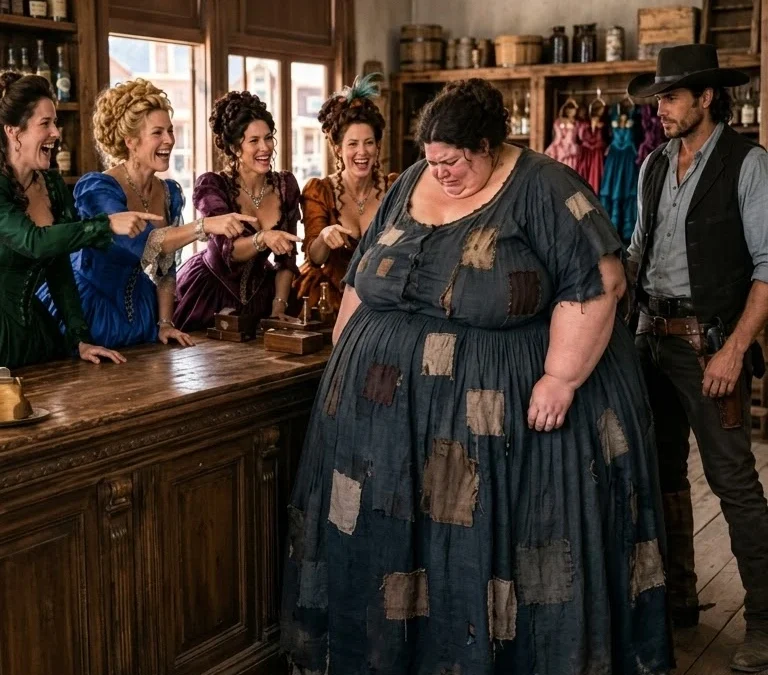
😱 They Mocked Her Old Dress and Her Size in Front of the Whole Town… Then the Richest Cowboy in Texas Did Something No One Expected
PART 1
Louisa Bennett pressed both hands flat against the store counter, lifted her chin, and looked every laughing woman in the room directly in the eye. 💔
Her brown dress was patched at the sleeve. Her boots were cracked at the sole. She had exactly a dollar and a half to her name, and she did not move one inch.
The laughter died before she did.
Then the door opened, and the richest man in Willow Creek walked in and went straight to her side.
👉 If this story already has your heart, follow along. Tell me where you’re reading from. I want to see how far Louisa’s story travels. 🌎
The summer of 1876 arrived in Willow Creek without apology and without mercy. The heat pressed down on the wooden storefronts until the whole town smelled of dust and dry grass. People moved slower, talked less, smiled less.
But they still found the energy to be cruel.
Louisa had come into Whitmore’s General Store for flour, brown thread, and a small tin of baking powder. She meant to be in and out in ten minutes.
She had not planned on Clara Ashford. She never did.
Clara stood near the bolts of fabric with her two friends, Harriet Bloom and Delia Marsh. All three wore pale summer cotton and little hats with silk ribbons. They looked like a page from a catalog.
Louisa was twenty-five. Her mama used to call her figure “generous.” She had wide hips, a soft belly, and arms strong from hauling water and kneading dough. She was not a small woman, and Willow Creek had never let her forget it.
She knew how she looked. She had always known.
She almost made it to the counter.
“Lord Almighty,” Clara said, loud enough for the whole store to hear. “Is that a dress or a flour sack somebody felt sorry for?”
Delia laughed, high and bright. Harriet pressed her lips together in a smile that was enjoying itself too much to call polite.
Every sensible part of Louisa said to keep walking. But something in her chest turned to iron, and her feet stopped on their own.
“That dress looks like it was stitched from old curtains,” Clara added sweetly. “The kind nobody wanted to sleep under.”
More laughter. The customers in the back shifted uncomfortably and said nothing. Mr. Whitmore found his ledger suddenly fascinating.
Louisa looked at Clara for a long moment. Clara’s father owned the biggest bank in three counties. Clara had never chosen between flour and thread, and she had never worn the same dress two years running. And Louisa knew she had been chasing Nathaniel Cole’s attention for the better part of two years.
None of that excused her. But it explained something.
“My dress,” Louisa said, voice perfectly even, “is clean. It’s mended. And it’s mine, which is more than I can say for your manners.”
Something flickered in Clara’s eyes. It wasn’t shame, since she didn’t have that range. It was surprise, and irritation at being talked back to.
“My goodness,” Harriet murmured. “She’s got a mouth on her.”
Louisa felt the words land in the soft place under her breastbone, where the body keeps its oldest hurts. She turned back to the counter.
“Two pounds of flour, Mr. Whitmore. A spool of number forty brown thread. And a small tin of baking powder, if you please.”
Her voice did not shake. That was the only victory she allowed herself.
Then she felt the room change. She hadn’t heard the door. But there is a kind of authority that doesn’t announce itself, and the room simply rearranges itself around it.
Nathaniel Cole was thirty-eight, tall and sun-browned, with lines around his eyes from squinting into wind and not from smiling. He dressed like one of his own ranch hands and moved through town like a man who happened to own half of it.
His gaze crossed the store and landed on Clara.
He had heard every word.
“Mr. Cole!” Clara’s voice went warm and liquid. “We were just—”
“I heard what you were saying, Miss Ashford.” His voice was low and absolutely certain, like a fence post that doesn’t argue with the wind.
Clara’s mouth closed.
He walked to the counter and stood beside Louisa, not close enough to crowd her but close enough to make a statement. His eyes were so dark they were nearly black, and as still as deep water.
“Miss Bennett,” he said. “Are you all right?”
It was such a plain question. Somehow its plainness cracked the composure she’d been holding together with both hands.
“I’m fine, Mr. Cole. Thank you.”
He turned to Mr. Whitmore. “Put whatever Miss Bennett is buying on my account.”
“That’s not necessary,” Louisa said, too fast and too sharp. “I don’t need charity. I have money enough for my flour.”
“I know you do,” he said. “This isn’t charity. Consider it a courtesy. People around here could stand to practice more of it.”
He said the last part without looking at Clara. He didn’t need to.
Louisa studied his face for a heartbeat. There was no performance in it, no man waiting to be thanked. He looked like someone who’d seen something wrong and done the nearest thing available to fix it.
“Thank you,” she said stiffly.
She walked out into the blinding heat with her hands shaking. She told herself it meant nothing. Rich men did kind things sometimes. He’d forget it by supper.
She almost believed it.
The next morning, he found her on the street.
“I need a cook,” Nathaniel said, leading his horse. “Fourteen ranch hands, and the man in my kitchen is a disaster with food. Three of my men got sick last week. Dollar and a quarter a week.”
“There are women in this town who’d take that in a heartbeat,” she said. “Why ask me?”
“None of them are you.” He held her gaze. “I’ve seen how you work. That’s the kind of person I want in my kitchen.”
Three days later she knocked on the kitchen door of the Ridgeline Ranch. Within a week, fourteen men were eating biscuits in reverent silence, and the owner stood in the kitchen doorway and said nothing, because nothing needed saying. 🍞
Louisa felt something she had no name for. She felt seen.
Then, on a Tuesday morning, two strangers in clean suits and polished boots drove up to the ranch house and sat on the porch for two hours, waiting.
When Nathaniel returned, he went white around the mouth.
“They made me an offer for the Ridgeline,” he said quietly. “Forty cents on the dollar.”
Louisa understood at once: this was no sales call but a pressure campaign. The next day she walked past the land office and finally read the survey notice posted in its window. In the tiny print in the upper corner was the name of the company behind it.
She knew that name from somewhere. Her blood ran cold.
It was tied, through two hidden partners, to the one man who knew every dollar Nathaniel owed… Robert Ashford. Clara’s father. 😳
👉 Want to know what Louisa did next? Find PART 2 in the comments, or leave any word and I’ll send it to you privately. 💬
PART 2
It was tied, through two hidden partners, to the one man who knew every dollar Nathaniel owed… Robert Ashford. Clara’s father.
Louisa stood on that boardwalk so long her shadow crossed the whole window. Then she turned and walked straight to the one man in town who remembered everything: old Jonas Healey, eighty years old and half deaf, a county land recorder for thirty-five years.
She brought him apple preserves and asked one question. Jonas talked for an hour. 🍎
By sundown, Louisa held the whole ugly picture. The company’s owners traced back to a Missouri partnership. Three nearby ranches had already sold for pennies. Every one of them bordered the creek land that would make the most valuable ranch in the county if someone could stitch it together. And the Ridgeline sat in the middle.
She found Nathaniel brushing his horse in the stable.
“I need to tell you something,” she said. “And I need you to hear all of it first.”
When she finished, he stood perfectly still, the brush frozen in his hand.
“This isn’t your fight,” he said. It wasn’t a dismissal. It was a door held open.
“No,” she said. “But I’m here.”
“Why?”
“Because somebody built this place right,” she said. “And I won’t watch it get taken apart by people who think money is the same thing as worth.”
For three nights they sat at the kitchen table and built a timeline: the strange water-rights dispute, the delayed permits, the sudden tax reassessment. Alone, each looked like bad luck. Together they looked like a plan. They’d been softening the ground so that when the offer came, it would feel like relief instead of robbery. 😠
Then Louisa told him the worst part. The Bower family had sold for twenty cents on the dollar. They had four children.
“I’m going to get them their land back,” Nathaniel said, very quietly.
“I already wrote a lawyer,” she admitted. “Jonas’s nephew, Thomas Healey. He’s not tied to any money in this county.”
Nathaniel stared at her. “Two days ago?”
“I overstepped.”
“No,” he said. “You didn’t.”
Thomas arrived on the morning stage and spent four hours with the papers. “This is a well-built fraud,” he said, “with one fatal weakness. The surveyor’s license had expired three months before he set foot on your land. His survey is void. Everything built on it is built on nothing.”
Word travels fast in a small town. Soon everyone knew Nathaniel Cole had hired a lawyer. And the night of the big town meeting, Louisa, who owned no land and had no standing, slipped into the back row.
Robert Ashford stood at the front, silver-haired and smooth, calling the land company “opportunity.” Her hands tightened in her lap as ranchers nodded, frightened, almost persuaded.
Then James Gallagher, whose wife’s baby Louisa had delivered, stood and asked why his offer was lower than the others’. Ashford smiled and buried the question in fancy words.
James sat back down, defeated.
Something in Louisa’s chest turned to iron, the same iron she’d felt in the general store. 🔥
She stood up.
“My name is Louisa Bennett,” she said, loud and clear. “I work at the Ridgeline. And I have a question. Who authorized the survey on Mr. Cole’s north boundary?”
The room went silent. Ashford’s smile stayed fixed. “I’m not familiar with—”
“The surveyor was Carl Briggs. His certification lapsed in February, three months before the survey. That makes the dispute void, and whoever started it knew.”
“You’re a cook,” Ashford said, his warmth finally cracking. “How would you know about county records?”
“I’m a woman who pays attention,” she said. “And a formal inquiry was filed in Abilene yesterday morning.”
From four rows ahead, Nathaniel said quietly, “That’s right.”
Ashford’s mask held, barely. But across the room, his daughter Clara was staring at Louisa with an expression Louisa couldn’t read.
Outside, under the cold stars, Clara caught her alone. Her voice shook.
“My father is going to ruin you tonight. I heard him. He has a letter. Something about your old employer… something that isn’t true.” Her eyes were wet. “I came to warn you.”
Louisa went cold. A letter from Warren Kates. Her old boss in Dodge City. The man who’d sworn to ruin her if she ever talked.
Then Thomas Healey ran up the church steps with news. The letter was already being passed around town. 😨
👉 Will Louisa’s reputation survive, and what is hidden in the tin box under her bed? Drop a word like “LOUISA” in the comments or hit LIKE ❤️ if you want PART 3!
PART 3
Thomas Healey’s face was grim in the lamplight.
“It says you stole from a household, Miss Bennett. That you chased a married man. It’s signed by Warren Kates.”
Louisa didn’t flinch. She had been bracing for this her whole life.
“It’s a lie,” she said. “I left his ranch because he was cooking his cattle counts for the rail company. I told him I wouldn’t be part of it. He swore no one in the territory would ever believe me.”
Thomas’s eyes sharpened. “Do you have proof of the falsification?”
She was quiet. Then: “I kept copies. Both sets of his ledgers, the real ones and the ones he showed the railroad. He kept them in the same room, the fool. I copied the entries before I left.” Her voice softened. “They’re in a tin box under my bed at the widow Garrett’s.”
Nathaniel looked at her as if seeing a new color. “You kept them for four years?”
“My mother taught me. Always take the evidence.”
That night she drove to the widow Garrett’s. The old woman sat by the window, her blind eyes turned toward the light.
“You’ve got that sound in your walk,” Mrs. Garrett said. “The sound of a girl moving fast so she won’t feel it.”
Louisa pulled out the tin box and sat down. And finally, her voice cracked.
“I’m tired. I’m tired of being the one who has to prove everything. Other people just live. Nobody makes them prove they deserve to be where they are.” 😢
The widow was quiet. Then she said, gently, “Child, what you just described, carrying twice the evidence, anticipating twice the attack… that is what made you the woman who stood up in that church. Do you think Warren Kates could have done that? Or Clara Ashford? The thing that was used against you your whole life is the thing that built you strong enough to matter.”
Louisa pressed the old woman’s hand to her cheek.
“Now go give that box to your lawyer,” Mrs. Garrett whispered. “And come back Sunday.”
Thomas spent two hours with the ledgers. When he looked up, a slow, dangerous smile crossed his face.
“This is criminal fraud. And the statute hasn’t expired. Anyone who uses that letter against you is holding a live wire.” He tapped the table. “Ashford doesn’t know you have this. We don’t tell him. Not yet. We let him commit to the letter publicly. Then we turn it around.”
The next day, Louisa and Nathaniel rode fifteen miles south to the Bower farm. The yard looked like a place loved by people who no longer had the strength to keep it up. Henry Bower stood in the dust, thin and weary, watching them come like a man who had stopped expecting good news.
Nathaniel told him everything: the void survey, the conflicted notary, the legal challenge. Henry’s wife Ruth listened from the doorway, arms crossed, holding back everything she couldn’t yet afford to feel.
“You’re saying we might get it back,” Henry said slowly.
“No promises,” Nathaniel said. “But there’s a real legal basis.”
Ruth spoke, her voice level. “The children were born on that land.”
“I know,” Nathaniel said. “And I’m paying for the lawyer, because this fraud touched my land too. It’s the same fight.”
Henry looked at Louisa. “Is he a man who does what he says?”
“Yes,” she answered, without hesitating.
Ruth uncrossed her arms, walked to the stove, and put the kettle on. It was the smallest gesture, and Louisa thought it was the most moving thing she had seen all week. ☕
On the ride home, the light turned the color of old copper.
“You didn’t hesitate,” Nathaniel said. “Why?”
“Because I’ve spent enough time around people who aren’t,” she said. “I know the difference. It’s in the small things. Whether a man fixes the shelf or lets it rot. Whether he shows up.”
“You show up too.”
“I try.”
“No,” he said softly. “You always do. That’s not the same thing.”
She was quiet. Then she asked the question she’d been carrying. “What happens to the kitchen after this?”
“That depends,” he said, “on whether the person running it wants to stay.” He turned to look at her. “And I’d want her to know that what I’m asking isn’t about the kitchen.”
Her heart pounded. “Ask me again when this is over,” she said. “When I’m not standing in the middle of someone else’s fight. You deserve a real answer.”
“All right,” he said. And they rode on in a silence that was no longer empty. 💛
Monday came with hard frost. Thomas filed the challenge the moment the county office opened, and by noon it was public record. By two, all of Willow Creek knew.
In the market, Mr. Whitmore handed Louisa her receipt without being asked. Old Jonas Healey boomed, “Well done, young woman!” so loudly that heads turned.
Then Clara found her on the boardwalk, pale and sleepless.
“I didn’t know about the letter until yesterday,” she whispered. “I’d never have let him.”
“I believe you,” Louisa said. “And I don’t hold you responsible for what your father does.”
Clara’s eyes filled. “I said terrible things about you. About your dress. I’ve thought about it more than you’d guess.”
“Fear says things,” Louisa answered gently. “What you do now is what matters.”
“What should I do?”
“Only you can answer that. But you came to me with the truth when you could have kept quiet. That was a choice. It means something.”
Clara stared, stunned. Then she nodded and left, and for once she didn’t look away.
On Thursday, Robert Ashford himself drove up to the Ridgeline alone. Louisa watched from the kitchen window. She couldn’t hear him, but she saw his shoulders. He was begging.
Nathaniel came inside afterward. “He offered to drop the land company and withdraw the letter if we’d drop the challenge.”
“What did you say?”
“That it’s not mine to withdraw. The Bowers and Hendersons are parties now. And that if his letter went one inch farther, Warren Kates’s business would become very public in Dodge City.”
Louisa picked up her spoon. “Then it’s almost over.”
Nathaniel almost smiled. “Pete wants to know if there’s apple cake tonight. He’s asked every day this week.”
“Tell him yes.”
The ending didn’t come in one dramatic blow. It came as a quiet pile of paper. The county confirmed the license had lapsed. The deed challenges were accepted. The notary, who had secretly been the land company’s own agent, resigned and left town. Ashford agreed to pay the Bowers and Hendersons the difference between what they’d been given and what their land was worth.
It wasn’t perfect justice. It was the kind that was possible. But Henry Bower’s face crumpled when Thomas brought the news, and he said, “Our children can stay where they were born.”
Then, in January, Thomas arrived with a letter that made Louisa grip the counter.
Warren Kates had been caught. An anonymous report had reached the rail company about the cattle counts, and to save himself, Kates had given a sworn statement to the county. He confessed that the letter about Louisa was false, written at the request of someone connected to Ashford. Every word was fabricated.
It was on record. Official. Permanent.
Louisa stood very still. Four years of carrying that lie, gone.
“The anonymous report,” she said slowly. “That was you.”
“Thomas,” Nathaniel admitted. “I asked him to. I should have told you. I knew you’d say no.”
“I would have.”
“I know. That wasn’t me fighting your battle. That was me making sure the man who tried to destroy you didn’t keep his own reputation.” He met her eyes. “There’s a difference.”
She thought about it. She thought about the difference between being rescued and being stood with.
“Yes,” she said finally. “There is.”
That same week, Robert Ashford did something no one expected. He walked into the Wednesday prayer meeting and asked to speak. He said, in plain words, that greed had overridden his judgment and that he had harmed families who trusted him. He announced that he was stepping down from the bank.
And then Clara stood beside him. She declared that she would use part of her inheritance to create a fund for small landowners who couldn’t afford a lawyer, and that she’d name it for the families who had been wronged, not for herself.
You could have heard a pin drop. 💫
When Jonas told Louisa the story in her kitchen, she only said, “Good.”
“That’s all?” he asked.
“I told her she’d know what to do when the time came,” Louisa said. “She did.”
Then one evening, at the kitchen table, with the stove crackling and the winter stars rising outside, Nathaniel set his big, calloused hands flat on the wood.
“Louisa. You told me to ask again.”
Her heart did something large and inconvenient. “I did.”
“I’m not asking about the kitchen. I’m asking about you. About you staying here, with me. Not because you have nowhere else to be. Because you choose to.”
She looked at this man who had stood beside her in a store and said, This isn’t charity, and meant it. Who had never once looked at her and seen only the dress, or the body inside it, or the poverty that shaped her. Who had looked and seen her.
She placed her hands next to his.
“I choose to,” she said.
His hands turned over and covered hers. No grand gesture, no audience. Just two people at a kitchen table, deciding together. 🤍
Then Louisa smiled. “Pete is going to be insufferable about this.”
“He’ll say he knew from the first week.”
“He’ll be right.”
Thomas Healey soon offered her a job as an investigator at his law practice. Pattern spotting, truth finding, helping people who couldn’t see the trap until it closed. She told Nathaniel nervously, expecting him to flinch.
“What do you want to do?” he asked. Not what should you do. What did she want.
“Both,” she whispered. “This, and that.”
“I’m not a man who wants a woman in his kitchen,” he said. “I’m a man who wants you. And when you come back from wherever your work takes you, you come home.”
Home. The word landed in the center of her chest. She hadn’t had one in three years.
“I want that,” she said.
When Louisa told Mrs. Garrett on Sunday, the old woman was silent so long Louisa thought she’d dozed off.
“Your mother would have liked him,” she said at last. “She’d have tested him first. And so did I. I asked what he saw when he looked at you.”
“What did he say?”
“That he saw a woman who had carried things that weren’t hers for so long she’d stopped noticing the weight. And that he wanted to be the kind of man who made it possible for her to put some of it down.”
Louisa couldn’t speak.
“Are you crying?” Mrs. Garrett asked.
“No.”
“All right,” the old woman said, with the patience of someone allowing a lie this once. “Come here and let me hold your hand.” 🥹
The Bower family got their land back in April. They planted in May. Margaret Gallagher’s baby, little Louise, learned to sit up and stared at the world with solemn, curious eyes. And in March, Clara Ashford came to the Ridgeline kitchen for advice about her fund. Louisa poured her coffee the way she poured it for everyone, and answered every question.
“You could’ve made this hard for me,” Clara said.
“I could have. But that wouldn’t undo what was done to me. And the people this fund will help are real.”
“I’m sorry,” Clara whispered. “For the dress. For all of it.”
“I know,” Louisa said. “You said it. That counts.”
Clara paused at the door. “I think what I wanted from him was never him. I just wanted to be seen. I was looking in the wrong direction.”
Louisa smiled. “Come back next week with the drafts. I’ll look them over.”
The old brown dress still hung in her room at the Ridgeline, mended and faded and entirely hers.
“I’m keeping it,” she told Nathaniel one evening, hanging it on the hook where she could see it. “I never want to forget where I started.”
“You know what I see when I look at that dress?” he said. “I see the woman who walked out of that store with her head up, when anyone else might have broken.”
“I spent years thinking the problem was the dress,” she said. “The problem was never the dress. It was a town that decided what a person was worth before it looked closely enough to know.”
“You didn’t hide.”
“I wanted to. Every day.”
“I know,” he said softly. “That’s what made you brave.”
In June, under a wide blue prairie sky, Louisa Bennett stood before everyone they loved. Pete and Cody. The Gallaghers. Jonas and Thomas Healey. The Bowers with their children. And in the best chair, carried out to the porch, the widow Garrett.
She wore blue, not brown. Nathaniel Cole looked at her with those dark, steady eyes and said “I do” in the same low voice that had once told a whole store, this isn’t charity.
She said it back, and she meant every word. 💍
Years later, little Louise Gallagher would stand in the bedroom doorway and ask why the old brown dress still hung behind the door.
“Because that’s where I started,” Louisa would say. “And I never want to forget it.”
“But it’s all patched!”
“Yes. It is.”
“Were you sad when you wore it?”
“Sometimes,” Louisa would answer honestly. “But I was also stronger than I knew.”
“How did you know you were strong?”
“Because I kept showing up. Every morning, when people were unkind, when I wanted to give up. I kept showing up and refusing to let anyone else’s opinion of me become my own.” She would smile. “That’s all strength really is. It’s not never being afraid. It’s showing up anyway.”
“And then the cowboy came,” Louise would say, because she knew the shape of the story.
“And then the cowboy came,” Louisa would laugh. “He was also stubborn, and occasionally infuriating, and completely unable to ask for help. I’ve spent fifteen years working on that, with limited success. But he looked at me and saw exactly who I was and decided that was exactly who he wanted.”
“That’s a good ending.”
Louisa would look at the faded fabric, the mended sleeve, the uneven hem, and think: It wasn’t the ending. It was the beginning.
The day a woman walked out of a store with her chin up and paid for her flour, and refused to let anyone’s cruelty become the last word on who she was. Everything after that was simply what became possible when she decided she was worth the space she took up in the world. 🌟
Not because anyone told her so. Because she finally stopped letting anyone tell her otherwise.
💬 If this story touched you, share it with someone who needs to be reminded of their worth. And tell me in the comments: have you ever had your own “Louisa moment”? ❤️
Disclaimer: This story is entirely fictional and created for entertainment purposes only. It does not represent any organization or individual, nor does it encourage inappropriate behavior. The content was generated with AI assistance.








