THEY REJECTED HER FOR SAYING “NO” — SO SHE SLEPT IN A BARN AND BUILT A LIFE THEY COULD NEVER TAKE AWAY
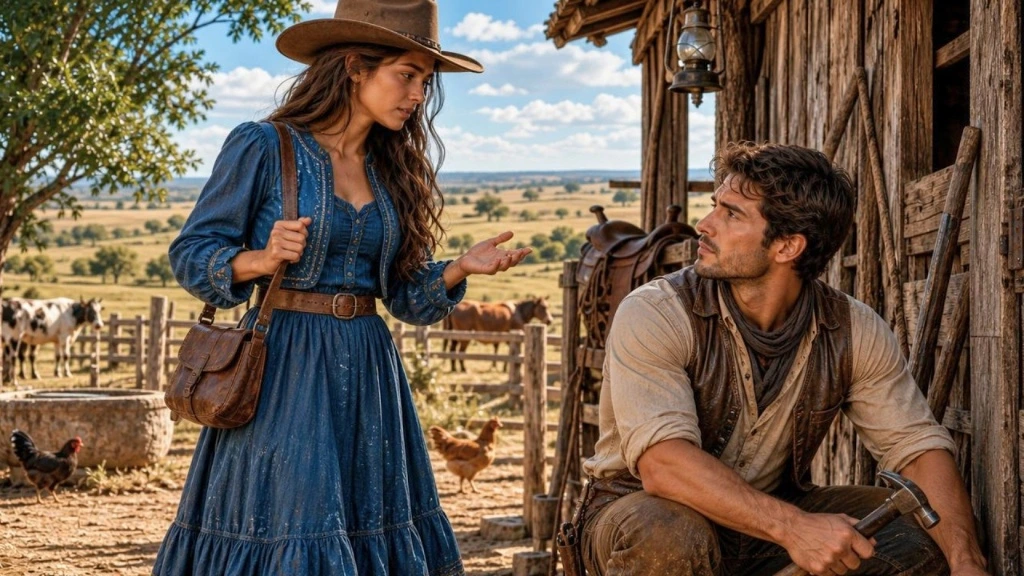
SHE LOST HER FAMILY FOR SAYING “NO” — THEN THE BARN BECAME THE HOME THEY COULD NEVER TAKE FROM HER
PART 2 — THE LIFE SHE BUILT AFTER EVERYONE WALKED AWAY
Coral’s father lowered his hand before it could strike.
Jed had stepped forward, but Coral shook her head slightly, telling him without words not to interfere.
Her father turned toward the wagon.
“Fine.”
Her mother remained behind.
She approached Coral slowly, close enough that Coral could smell rose water on her collar.
“Are you eating?”
Coral nearly broke.
“Yes, Ma.”
“Where do you sleep?”
Coral glanced toward the cellar doors.
Her mother followed her eyes and understood.
She said nothing. She simply squeezed Coral’s hand once before walking away.
Faith stayed longer.
“I’m angry at you,” she whispered through tears. “But I love you too.”
Then she left.
Cornelius was the last.
He stood before Coral with his hat in his hands.
“You could have said anything,” Coral whispered.
“I know.”
“People would have believed you.”
“I know.”
He put his hat back on.
“Then we’re square.”
And he walked away.
Coral watched the wagon disappear before returning to work, because there was nothing else she could do. She fed the calves, checked the cooler, latched the gates, counted the milk cans, and kept moving until the ache inside her became quiet enough to survive.
The farm nearly failed that year.
They paid the cattle note eleven days late, and Coral spent every one of those days terrified they would lose everything. But they survived.
The second year, they could finally breathe.
By the third, the herd had grown to forty-eight head, they had bought a cooling tank, and Mrs. Harrow agreed to sell them the property.
Coral finally moved out of the cellar after one year and seven months.
The first night in the house, she could not sleep.
The room was too warm, too quiet, and there was too much space above her head.
At midnight, she returned to the cellar and sat on the steps until morning.
Some shelters take time to stop feeling safer than homes.
Years passed.
Faith eventually married—not Landry, because he never stood against his father. She married someone else, and two years later secretly invited Coral to the wedding.
They embraced for only a few minutes.
“I almost married Landry because everybody wanted it,” Faith whispered. “You bought me time to understand what I wanted.”
After that, Coral’s mother began sending small messages with the milk wagon.
Nothing dramatic.
Just ordinary pieces of life.
Rain came.
Aunt Louise had her operation.
The preserves turned out well.
Her father never sent a message.
Seven years later, he died in the pasture.
Coral went to the funeral.
Nobody stopped her, but nobody spoke to her either.
She cried because she loved him.
And because loving someone does not mean they were always right.
Both truths could exist inside the same heart.
As for Jed and Coral, their relationship took almost two years to become something neither of them had planned.
It was slow, private, and imperfect.
They never married, which scandalized the county for a while, until the county eventually became bored and found something else to discuss.
They lived together for twenty-nine years.
They had a son, then a daughter.
Jed died before Coral.
Their daughter inherited the ranch and knew cattle better than Coral had at twice her age.
The old cellar still stood beneath the barn.
But it had become a cheese room.
The little ground-level window remained exactly where it had always been, and from it, a person could still watch boots crossing the yard.
Sometimes Coral stood there and remembered what it felt like to see the world only from the ankles down.
She remembered being twenty-three, hungry, rejected, and convinced that taking up less space was the safest way to survive.
But she understood something now that she had not understood then.
There does not always have to be a villain for your own will to matter.
You do not have to prove that someone betrayed you, abused you, lied to you, or became a monster before you are allowed to say no.
Sometimes, someone can be a good person and still be the wrong person for you.
Sometimes a family can love you and still demand something you cannot give.
And sometimes the hardest thing you will ever do is refuse to invent a reason simply because the people around you insist that your honest answer is not enough.
Coral had paid dearly for that answer.
She spent one year and seven months sleeping in a cellar beneath a barn.
She milked thirty-two cows before sunrise until her hands locked with pain.
She put every dollar she owned into a lease that might have failed.
She lost years with people she loved.
She watched her father die without ever hearing the apology she once wished for.
But she kept something no one could give back once she surrendered it.
Her own answer.
No grand tragedy.
No villain.
No dramatic excuse.
Just no.
And eventually, that little word became the foundation of an entire life.
The young woman who once whispered, “I won’t take up space,” eventually owned the place she had been afraid to occupy.
She built a home.
She built a family.
She built a future.
And most importantly, she stopped believing that her existence needed an apology.
Because sometimes the life you are forced to build after walking away from everyone else becomes the life that finally belongs entirely to you.
This is a fictional story.
#StoryTime #EmotionalStory #LifeLessons #FamilyDrama #StrongWoman #InspirationalStory #HeartTouching #WomensStories #FarmLife #HistoricalFiction #HealingJourney #SelfWorth #KnowYourWorth #ViralStory #StoryTok #BookTok #Part2








