They Said I Was Too Big to Be Loved,” She Told the Rancher. Then Twelve Cowboys Took One Bite of Her Cooking and the Whole Room Went Silent…
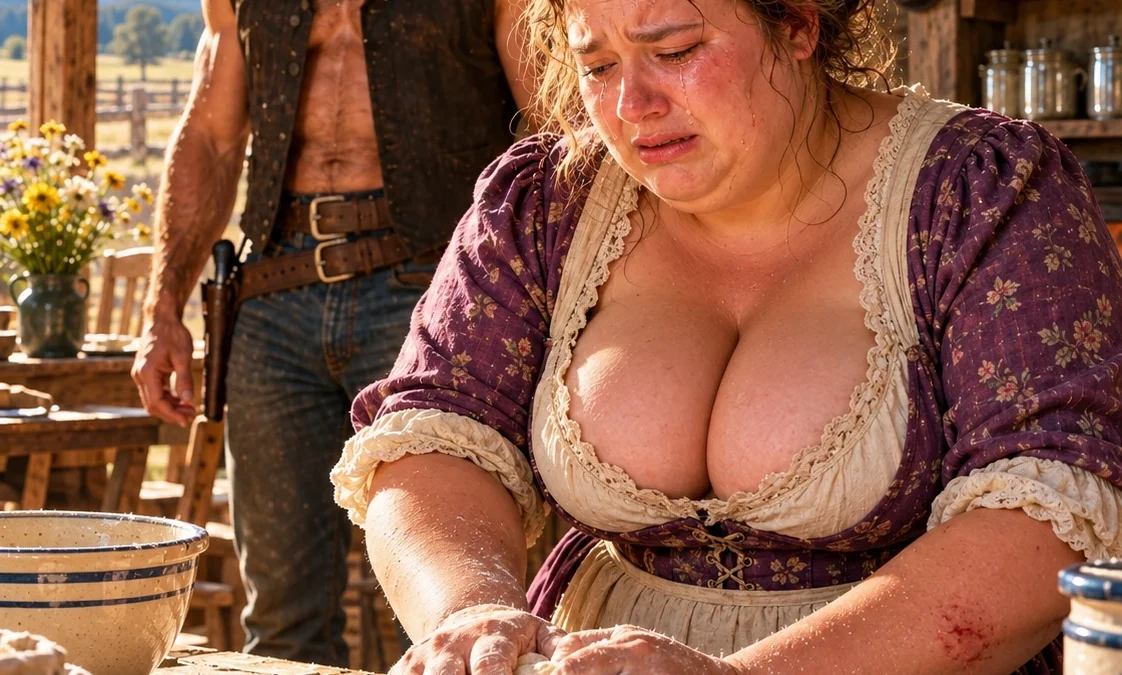
“They Said I Was Too Big to Be Loved,” She Told the Rancher. Then Twelve Cowboys Took One Bite of Her Cooking and the Whole Room Went Silent… 😱
Part 1
The wooden recipe box hit the counter harder than Clara Whitmore intended. 📦
Crack.
The sound was small. But in the quiet boarding house kitchen, it felt like a gunshot.
Mrs. Bellamy glanced at the split corner of the box, then back at Clara with the same uncomfortable politeness she had worn since Clara walked through the door.
“As I said, Miss Whitmore. Our guests expect a certain presentation.”
Clara had heard prettier versions of that sentence before. In one town, she had been told the hotel was “changing its image.” In another, a restaurant owner said his dining room required “a particular sort of woman.”
Now, in Willow Creek, Montana, another stranger had looked at her broad hips, heavy arms, and round face, and somehow decided those things mattered more than whether she could cook.
Clara picked up the box.
“Funny,” she said. “I thought you were hiring someone to feed people.”
Mrs. Bellamy’s mouth tightened. Clara did not wait for an answer.
Outside, the Montana sun was already bleaching the street white. Wagons rattled past. Horses stamped at hitching posts. Somewhere down the block, a hammer struck wood with the steady rhythm of a town still building itself.
Clara looked at the crack in her grandmother’s recipe box.
That hurt more than losing the job. 💔
Her grandmother had taught her to make something from almost nothing. A handful of flour. Yesterday’s meat. Two bruised apples. She had also been the only person Clara could remember who never suggested she should occupy less space.
Three years at the Hargrove Hotel had taught Clara another lesson. People could praise what your hands made while remaining embarrassed by the woman attached to them.
By noon, she had tried three more doors. One kitchen was suddenly fully staffed. One saloon owner barely let her finish speaking. Another woman studied Clara’s references for less time than she studied Clara herself.
Different doors. Different words. Same answer.
She sat on a bench outside the general store and counted the coins in her purse. Four nights. Three, if she wanted supper.
“Cook?”
The voice beside her belonged to an older man with a sunbeaten face and a silver mustache. He nodded toward the recipe box on her lap.
“Walter Reed,” he said.
“Clara Whitmore.”
Walter told her the Hayes ranch needed someone who could feed twelve men without poisoning them. Four miles east. Samuel Hayes owned the place.
“He fair?”
“Fair enough.”
“Friendly?”
Walter considered that. “About as friendly as a fence post in January.”
Clara almost laughed. “Friendly hasn’t paid me much lately.”
Walter gave her directions. Nothing more. No promise that Samuel Hayes would hire her. No offer to take her there.
Sometimes people imagined opportunity as an open door. Clara was beginning to suspect it often looked more like a long dirt road when you were already tired.
She walked.
By the time the Hayes ranch appeared beyond the cottonwoods, dust covered the hem of her dress. Cowboys near the corral stopped working. One stared. Another whispered something that made two men laugh.
Clara kept walking. She had spent years learning that not every insult deserved an answer. Some deserved only the humiliation of being ignored. 😤
Samuel Hayes opened the farmhouse door. He was tall, perhaps nearing forty, with tired eyes and the reserved expression of a man who had long ago stopped wasting words. His gaze moved from Clara’s dusty boots to the cracked recipe box.
Clara prepared herself.
“You the cook Walter sent?”
She blinked. “Yes.”
“Experience?”
“Three years at the Hargrove Hotel. Two restaurants before that.”
“Why’d you leave?”
Clara held his eyes. “They stopped judging my cooking.”
Something shifted in Samuel’s expression. Not pity. Attention.
Clara tightened her grip on the box. “If you need someone decorative, Mr. Hayes, save us both the trouble. If you need someone who can feed twelve hungry men, judge me after supper.”
Samuel looked toward the bunkhouse, then back at her.
“Seven days. Full week’s pay either way.”
Clara hesitated. It was that simple.
“No catch?”
He stepped aside. “The men will give you trouble.”
“I’ve been handling that longer than I’ve been cooking.”
The kitchen was a disaster. Greasy stove. Crooked shelves. Flour, beans, potatoes, tough beef, several tired apples, and a little cinnamon.
Clara placed her grandmother’s box beside the window. The afternoon light found the fresh crack across its lid.
For years, she had thought surviving meant finding rooms willing to accept her. Maybe she had been asking the wrong question.
She rolled up her sleeves and lit the stove.
By six o’clock, the Hayes ranch kitchen smelled like a place that had remembered what it was built for. The beef Walter had called tough was not bad meat at all. It had simply belonged to an animal that had spent its life working.
Clara understood something about that. Some things were not ruined because they were tough. They simply needed more time. 🍲
At seven, twelve men crowded around the long table, their voices filling the room until Clara began setting down plates. Braised beef. Potatoes soaked in broth. Biscuits browned at the edges.
Then came the first bite.
The room changed.
No compliments. No speeches. Just forks against plates.
Samuel Hayes entered halfway through dinner and looked around suspiciously. Twelve cowboys usually made enough noise to disturb cattle two fields away. Tonight they were nearly silent.
He tasted the beef. He looked toward Clara.
“What’d you put in this?”
“Time.”
“That’s it?”
“Most good things cost more time than money.”
By dessert, Ben Carter, the youngest hand, tasted the baked apples and froze. “My mother used to make something like this.” He swallowed. “Haven’t thought about that in years.”
Clara simply pushed the remaining apples toward him. “Take some tomorrow.”
Over the following days, the ranch changed in small ways. Ben carried firewood without being asked. Walter repaired the kitchen window. Hank Dawson started appearing ten minutes before meals, pretending he needed coffee.
Nobody announced that Clara belonged there. They simply started behaving as though she did.
Then, one afternoon, two well-dressed men rode out from Willow Creek.
Clara heard fragments through the kitchen door. Reputation. Standards. People are talking.
And finally, the words that made her hands stop. 😨
“…your cook.”
That evening, Clara packed her dresses. She knew this part. Someone complained. An employer apologized. Clara disappeared. But when Samuel appeared in the doorway and she told him why she was leaving, his answer was not what she expected. 🔥
Part 2
“You going somewhere?”
Clara looked at the suitcase. “I figured I’d save you the trouble.”
“Of what?”
“Choosing.”
Samuel’s face hardened. “I already did.”
Clara stared at him. “Those men can hurt your business.”
“Maybe.”
“And you’re keeping me.”
He shrugged. “Your work’s good.”
The simplicity almost angered her. “That’s all?”
“Should there be something else?”
She had no answer.
The next morning, she packed again. Then she walked into the kitchen. Twelve clean breakfast plates sat stacked beside the sink. On top lay a crooked piece of paper in Ben’s handwriting.
Don’t forget the apples Sunday.
Clara stood there for a long moment. Then she returned to her room and unpacked.
For years, leaving first had protected her from being abandoned. But protection could become another kind of prison if you never stayed long enough to discover who might ask you not to go. 💛
By the third week, the pressure grew. A merchant hinted that Hayes Ranch should consider its reputation. Two women from the church social committee visited Samuel to discuss “community expectations.” A county official sent an inquiry so carefully worded that nobody could accuse it of saying anything at all.
Clara recognized the pattern. People rarely called prejudice by its name. When they wanted to feel respectable, they called it tradition. Standards. Reputation.
The words changed. The door stayed closed.
Then Ben burst into the kitchen holding a folded newspaper.
“You need to see this.”
It was an announcement for the Montana State Cooking Exhibition in Willow Creek. First prize: twenty dollars and a contract to supply baked goods to a Bozeman hotel.
Clara laughed. Ben did not.
“You could win.”
“Ben, I’ve eaten food in Bozeman.”
He pointed at her biscuits. “This is better.”
Walter, drinking coffee nearby, studied her. “The cooking ain’t the hard part.”
Clara looked at him.
“Walking into a room full of people who’ve already decided what they’re looking at. That’s the hard part.”
The kitchen went quiet.
That night she could not sleep. Winning would not erase what people thought. But perhaps that was not the point. Samuel could defend her forever, and she would still be Samuel Hayes’s cook.
The competition offered something different. A name that belonged to her.
The next morning, Samuel offered to pay the entry fee.
“No.”
“Ranch expense. My competition. My cook.”
Clara narrowed her eyes. Samuel remained expressionless.
“I’m not buying you a favor, Clara. I’m investing in somebody who’s made my men stop complaining about supper.”
She accepted.
Three days later, Margaret Caldwell arrived. Everyone in Willow Creek knew the Caldwell name. Her family owned land, financed businesses, and helped sponsor the exhibition. She stepped into Clara’s kitchen wearing gloves too clean for ranch work.
“I hoped we could speak privately.”
Clara kept stirring gravy.
Margaret explained that the exhibition represented Willow Creek’s traditions. Certain tensions were already developing. Perhaps withdrawing would prevent unnecessary unpleasantness.
Clara stopped stirring. “The competition is open to everyone.”
“Technically.”
“That word usually means somebody wishes it wasn’t.”
Margaret stiffened. “This isn’t personal.”
Clara finally looked at her. “It always feels impersonal to the person holding the door closed.”
Something shifted in Margaret’s face. Not shame, exactly. Something less comfortable. Doubt. Her eyes traveled across the kitchen. Organized shelves. Fresh bread cooling beside the window. Walter’s repaired frame. Twelve clean cups waiting for morning.
She had expected evidence confirming what she believed. Instead she found a room functioning better because Clara was in it. 🌿
At the doorway, Margaret paused. “A reporter from the Bozeman Gazette will be judging.”
Clara could not tell whether it was a warning or a threat. Margaret left before she could ask.
That night Samuel looked at her over his coffee. “You scared?”
“Of cooking? No.” She looked toward the dark window. “Of walking into that room? Yes.”
Samuel took a sip. “Then walk in scared.”
No speech about courage. No promise that everything would be fair. Just permission to be afraid without obeying the fear.
At 3:30 on the morning of the competition, Clara was already awake. She packed the dishes she had practiced for six weeks. Slow-braised beef with wild herbs. Biscuits from dough rested overnight. Baked apples with cinnamon and nutmeg.
Nothing extravagant. She had decided against cooking food designed to impress people. She would cook the food she understood.
When she stepped outside, Samuel had already hitched the wagon. Hank stood beside it holding something wrapped in cloth.
“My best kitchen knife.”
Clara raised an eyebrow. “You own a kitchen knife?”
“Don’t tell anybody.”
The town hall held twelve cooking stations. The moment Clara entered, conversations softened. Women looked up. Men glanced twice. Whispers moved through the room.
She felt herself become twenty-nine and nine years old at the same time. She knew those eyes. 😔
Her hand touched the crack in her grandmother’s recipe box. Feed whoever sits down.
She took her station.
Soon the room filled with sound. Knives on boards. Oven doors closing. Metal bowls scraping wood. Clara browned the beef until its edges darkened, then lowered the heat. Gradually, the smell from station seven began traveling farther than the whispers.
Then she saw Margaret Caldwell cross the room and bend beside one of the judges, whispering.
Clara’s stomach tightened.
Of course. For one dangerous moment, her hands lost their rhythm, and the biscuit dough nearly tore. Then the head judge stood and began to read the winners aloud… 🔥
Part 3
Clara stopped.
She could not control Margaret. She could not control the judges. She could not control whether the room had decided who she was before tasting anything.
But she could control what left her hands.
Even if the judging became unfair, the food did not have to become afraid.
She started again.
When the judges reached her station, the reporter from the Bozeman Gazette tasted the apples.
“Where’d you learn this?”
“My grandmother.”
“So it’s her recipe.”
Clara glanced at the plate. “The beginning was. The rest is mine.”
The judges moved on.
Forty minutes later, everyone gathered. Third place went to Ruth Callaway. Second went to Virginia Marsh.
Clara’s chest sank. There it was, that familiar feeling. She should have known better.
Then the head judge unfolded the final card.
“First place. Clara Whitmore. Hayes Ranch.”
For one heartbeat, nobody moved.
Then Ben shouted from the back. 🎉
Applause followed. Some loud, some reluctant. Some hands never moved at all. Clara preferred it that way. A ribbon could recognize skill. It could not perform miracles on human nature.
Outside, Margaret approached her.
“I should explain something.”
Clara waited.
“I spoke to the judges. I asked them to make certain the talk around town wasn’t considered.” Margaret looked uncomfortable. “You told me a competition open to everyone should survive one honest competitor. I realized I was asking people to protect a tradition I wasn’t willing to test.”
It was not an apology. Not quite. But perhaps change rarely began with beautiful words. Sometimes it began when someone could no longer comfortably defend the person they had been yesterday. 🕊️
Samuel waited beside the wagon. He opened the door.
Clara looked at the blue ribbon in her hand. Winning had not made her worthy. That was the strange part. She had been worthy when Mrs. Bellamy rejected her. She had been worthy walking four dusty miles. She had been worthy before twelve cowboys stopped laughing.
No person should have to become extraordinary before being granted ordinary dignity.
She climbed into the wagon. Samuel closed the door behind her, and somehow the open door had meant more than the ribbon. 💛
The ribbon did not change Clara Whitmore’s life overnight. The contract did.
Two weeks later, an envelope arrived from the Bozeman Hotel. They wanted her biscuits, preserved apples, and seasonal baked goods.
Samuel read the offer once. “Price is too low.”
Clara took the letter from him. “Then I’ll tell them.”
She did. The second offer was better. Clara signed it herself.
Clara Whitmore.
Not Samuel Hayes’s cook. Not the large woman people whispered about. Just her name, attached to work good enough to have value before anyone knew what she looked like.
By winter, the Hayes Ranch kitchen had become the warmest room on the property. Hank still claimed he did not care for sweets while somehow taking two servings. Walter occupied the chair nearest the window every morning. Even Margaret Caldwell visited occasionally. She and Clara never became sudden friends. That would have been too easy. But Margaret listened more than she used to.
One December evening, Clara sat at the kitchen table repairing the old recipe box. Samuel watched from across the room.
“You ever going to fix that crack?”
She ran her thumb along the dark line. “I did.”
“The crack’s still there.”
“The lid closes.”
He understood.
For a while, neither spoke. Then Samuel looked toward the unused chair that had once belonged to his wife.
“After she died, I thought changing anything meant I was leaving her behind. So I kept everything. The chair. Her cup. Even the silence.”
Clara closed the recipe box. “Keeping a room empty doesn’t keep somebody in it.”
Samuel lowered his eyes. It was not what he wanted to hear. Perhaps that was why he believed her.
“This house feels different since you came,” he said. “Better food. More than that.” He looked at her. “I stopped feeling like I was just waiting to grow old.”
Clara’s breath caught.
He did not reach for her. He did not rescue the moment with prettier words.
“You planning on staying?”
Clara smiled faintly. “You offering me a job?”
“Something considerably less practical.”
She laughed. Then became serious. “I’ve spent most of my life confusing being wanted with being permitted to stay.”
Samuel nodded slowly. “Then don’t stay because I need you.” He stepped closer. “Stay because you want to.”
Clara looked around the kitchen. For years, every room had seemed to ask her the same question. Why should we make space for you?
This room no longer asked. 🌅
The next morning, sunrise came through Walter’s repaired window. Clara placed her grandmother’s recipe box in the light. Behind her, Ben and Hank argued over the last biscuit. Walter laughed. Samuel poured coffee.
Nobody noticed Clara standing there, listening.
Perhaps belonging was not the moment everyone finally approved of you. Perhaps it was the moment you stopped checking their faces to see whether you were allowed to exist comfortably beside them.
Clara touched the crack in the wooden lid. It remained visible. It always would.
She smiled and closed the box.
It fit perfectly. 💛
This story is entirely fictional and created for entertainment purposes only. It does not represent any organization or individual, nor does it encourage inappropriate behavior. The content was generated with AI assistance.








