They Sold Her at the Stockyard Like a Steer for Three Silver Dollars… But When the Law Came to Drag Her Back, the Valley Discovered the One Thing She Knew That Could Save, or Destroy, Every Man Who Had Called Her Worthless
🔥 They Sold Her at the Stockyard Like a Steer for Three Silver Dollars… But When the Law Came to Drag Her Back, the Valley Discovered the One Thing She Knew That Could Save, or Destroy, Every Man Who Had Called Her Worthless 😱
PART 1
New Mexico Territory, 1884. 🌵
The stockyard auction put Nascha on the block.
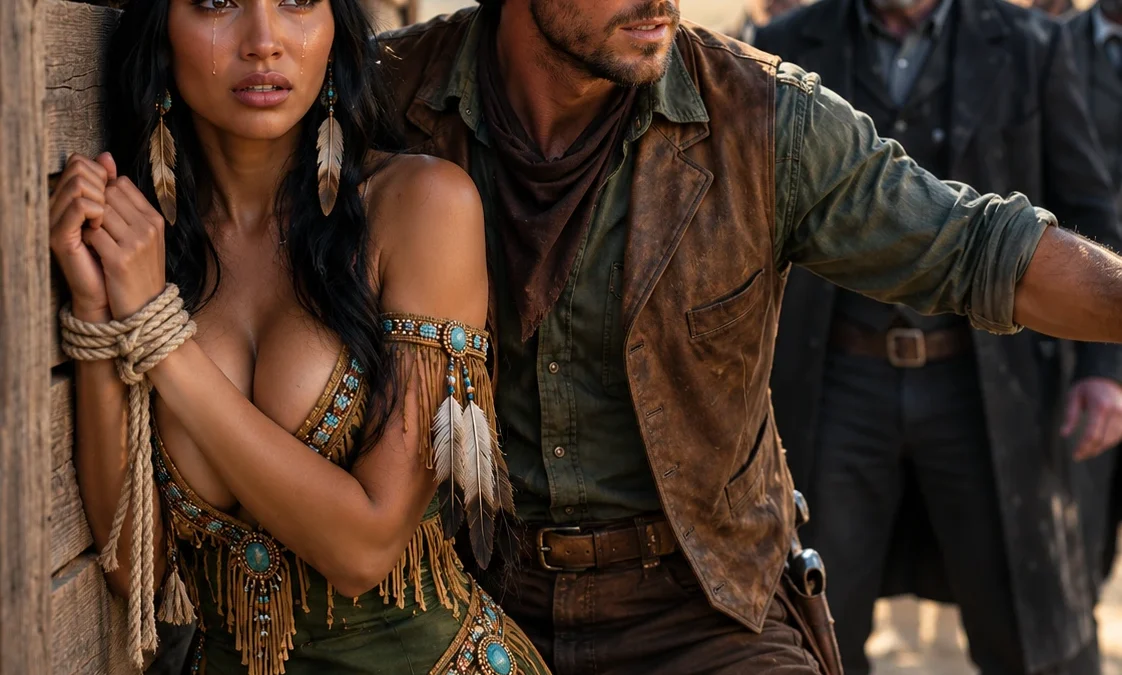
She stood bound in the dust, an Apache woman among cattle lots, while a freighter named Silas Tarrow cried out a price for a person instead of a steer. A half-circle of men who had come to buy livestock stayed to bid on something else entirely.
Her wrists were tied with a rope too thin to hold a horse. Proof enough, without a single word, that Tarrow had never expected her to run. Only to endure.
And enduring was something Nascha had already been doing for six weeks.
Tarrow was a barrel-chested man whose freighting outfit hauled goods between three territories. Somewhere in the arithmetic of that business he had decided that a Chiricahua woman he’d taken in off a drought-starved trail counted as inventory. He called it a debt: feed, a wagon seat, a length of canvas to sleep under. He priced it high enough that she could never work it off, and low enough that some buyer would think himself clever for the bargain.
He had done this twice before with captives no one in the territory ever missed. He expected today to go the same quiet way. 😔
He did not expect a rancher named Josiah Cole standing at the back of the crowd with three silver dollars in his pocket and nothing else.
Josiah had come for a length of chain and a spool of fence wire, not for a cause. He was thirty-two, broad through the shoulders from ten years of building his own spread out of raw scrub and stubbornness, with a reputation in Alma Valley for saying little and meaning all of it.
When he understood what Tarrow was selling, his first feeling was a disgust so total it nearly rooted him in place. His second, arriving right behind, was that he was going to do something about it whether or not he could afford to.
He couldn’t. When Tarrow’s price climbed past what any decent man would say out loud, Josiah stepped forward and said the only number he had.
“Three dollars.”
The yard went quiet. 😶
Tarrow laughed. Mocked the bid as an insult. Tried to shame him back into the crowd. But Josiah did not move, did not blink, did not lower the offer. And Tarrow, who had never in his life turned down money simply because the amount embarrassed him, finally took it, if only to end the spectacle he himself had built.
Nascha watched without moving her face. She had learned in six weeks under that rope that showing nothing was the only power left to her.
When Josiah cut the rope himself, instead of handing the knife to Tarrow, he spoke quietly, in a voice meant for her alone.
“You don’t owe me a debt. Not me, not him, not anybody in this yard. That man had no right to sell what wasn’t his, and I’m not fixing to collect on a thing I never should have had to buy.”
There was no softness in it. None of the sugar some men use to make cruelty sound like kindness. And Nascha heard in that plainness something her grandmother had taught her long ago: a true gift never arrives with strings sewn into the lining. 🤍
Tarrow pocketed the three dollars and turned toward his freight order. But he paused once on his way past.
“A man who pays good coin to buy trouble instead of quiet,” he said to no one in particular, “ought to expect a great deal more of it.”
Neither of them wasted another thought on him that afternoon. Neither yet understood how often they would hear his name before the year was through.
Nascha did not thank Josiah. She asked a single question.
“Where would you have me go?”
He didn’t pretend the territory was safe for a lone Apache woman with no band and no papers. He told her the truth: a spring-fed spread two hours west with more work than his own two hands could finish, wages for anyone willing to do it, and a bunkhouse with a door that locked from the inside. She was welcome to walk the other direction if she preferred.
She searched the wording for the trap, and found, to her own surprise, that she could not locate one. 🔍
She stayed only because nowhere else was anything but a different kind of danger wearing a friendlier face.
Three years earlier, Nascha’s life had held a different shape. She had grown up in a Chiricahua band that wintered in a canyon whose name meant the place where the water never fully freezes. Her grandmother, a woman other families walked two days to consult when a fever wouldn’t break or a wound refused to close clean, had taught her which plants pulled poison from a body and which only pretended to. Osha root for the lungs. Juniper berries for a fever that climbed too fast. Willow bark for pain.
She had learned to read animals too. Which mule favored a leg before it went lame. Which sick beast drifted to the margins of a herd days before it ever went down.
Then the soldiers came, at dawn, in smoke thick enough to blind. Gunfire meant for a raiding party three valleys away landed instead on people who’d had no part in it. Her band broke apart like a flock when a hawk drops through the middle, each direction chosen in half a second and never reunited. 💔
She rode three days alone, certain her family waited just ahead, until hunger and a lamed horse delivered her into Tarrow’s freight camp, where a bowl of food was slowly, deliberately reclassified into a debt.
She told Josiah none of this on the ride out. She said only her name, and that she expected wages, not charity, same as any hand he’d hire.
He agreed instantly. As if the question had never been in doubt.
Spring Creek Ranch sat in the lee of a low ridge, with a year-round spring rising cold and clean at its heart. It was the only spring in Alma Valley that had never run dry in living memory, even in the worst summers that emptied every other water source for forty miles.
Whoever controlled that spring controlled which of the valley’s cattle survived a dry year.
And there was a man who had spent three years trying to buy it out from under Josiah.
Cyrus Halloran ran the Circle H, the largest cattle operation for sixty miles, built by buying out or bankrupting every smaller outfit in his way. He did not need Josiah’s spring to survive. He needed it to finish what he’d started.
Word of the rancher who emptied his pockets at a stockyard to free an Apache woman reached Halloran within the week, carried by a cattle buyer who found it good gossip over supper.
Halloran, who had been looking for a wedge for three years, recognized instantly that fate had handed him one shaped exactly to his liking. 😈
He began carefully, the way a patient man begins a campaign meant to last. He never raised his voice. He never made a direct accusation. He simply planted a word, Indian-lover, in enough mouths over enough weeks that it grew roots without him.
Josiah’s answer, when Tobias, his one old hired hand, brought it home white-lipped with anger, was short. “Let them talk. I didn’t buy her freedom to satisfy anybody’s opinion of me.”
But three of his regular beef buyers quietly took their business elsewhere.
And one evening, Nascha held his eyes across the fire and said, unblinking:
“This will not stay at talk. Men like that one do not spend three years wanting your spring and then settle for gossip. He is only deciding which tool to use next.”
She was exactly right. Halloran’s next tool arrived wearing a badge.
Marshal Otis Pruitt rode out to Spring Creek on a gray winter morning and told Josiah, not quite meeting his eyes, that there was “concern in town about a woman living out here with no papers.”
“You’ve got every choice in the matter,” Josiah answered. “You’re choosing to ride out here on a rich man’s say-so.”
Pruitt left with a warning wrapped thin around a threat. The matter would be settled before winter closed the roads, one way or another.
That night, Nascha stood beside Josiah in the dark yard.
“You should let me go before it costs you the ranch. I have run before. I can run again.”
Josiah turned to her, something in his face gone very quiet and very certain.
“You’re not running anywhere. Not because I own you. I don’t, and I never will. But I’d rather lose the spring than lose the part of myself that let Tarrow’s rope cut in the first place.”
Something in Nascha shifted, the way ice shifts before it finally lets go of a river. 🥹
Then, in the dead of January, hoofbeats came through the snow.
Pruitt arrived with a deputy and a folded paper bearing a territorial judge’s signature. A judge, Josiah would later learn, who dined at Halloran’s table.
“She comes in for questioning,” Pruitt said, with something almost like shame in his voice. “And if she can’t prove lawful residence inside the week, she’s held. And Tarrow’s filed a counter-claim.”
Josiah’s blood went cold.
“Says she’s still bound to him by contract,” Pruitt finished. “And that he’s coming to collect her himself.” 😨
PART 2
“There is no contract,” Josiah said, low and hard. “There was a man who fed her for two weeks and decided that entitled him to sell her like livestock. That’s not a debt. That’s a crime.”
“Maybe so,” Pruitt said. “But the judge signed what Tarrow’s lawyer put in front of him, and I’m sworn to carry out what a judge signs.”
Josiah’s hands curled into fists. He was a heartbeat from putting himself bodily between Nascha and the deputy. And that, she understood at once, was exactly what Halloran wanted: a rancher assaulting an officer of the law. The perfect final nail. ⚠️
She stepped forward first.
She held her chin as she had at the auction block, spine straight, eyes level.
“I will come. And I will answer whatever your judge wishes to ask. But you will write down, Marshal, that I came without a hand laid on me, and that I came because I chose to, the same as I chose to stay on this ranch. Write it plainly, so whatever your judge decides, he decides it with the truth in front of him and not merely Tarrow’s paper.”
Pruitt, to his own visible surprise, took out a small ledger and wrote it down. Word for word.
Neither of them yet understood how much that small, unglamorous act would matter. 📖
They held her in Alma’s single-room jail for three days. Josiah rode the territory raising every voucher of character he could find. Neighbors she’d helped. A doctor two towns over who had watched her set a broken bone cleaner than he could have managed himself. A freight clerk who had witnessed Tarrow’s original taking of her and had quietly disliked the man ever since.
It was not enough. Halloran’s judge was inclined to favor the freighter regardless of the evidence. Josiah rode back into Alma on the third night with a saddlebag full of vouchers that might not matter, and understood that paper alone was not going to save her. 😞
What saved her came from an entirely different direction.
Two days earlier, cattle on the Circle H’s northern range had begun to die. Not from cold. Not from wolves. A wasting sickness dropped otherwise healthy steers within a week: fever, blood in the urine, a staggering weakness no rancher in the valley had seen before. By the third day of Nascha’s confinement, it had jumped to two smaller outfits downstream. Panic moved through Alma Valley faster than the sickness itself, because a valley’s whole winter rode on cattle now dying by the dozen with no one able to say why. 🐂
Josiah, hearing the talk in the mercantile, stopped mid-step.
He remembered a conversation by firelight months before. Nascha, watching a distant herd from the ridge one evening, remarking that three animals at the margin moved wrong. That sick stock always drifted apart before anyone noticed. That whatever ailed them would spread through contact, and through the ticks that rode every hide in numbers no one thought to count.
The knowledge no one in this territory had ever thought to write down.
He rode straight to the jail.
“She knows this sickness,” he told Pruitt. “Or one close enough that her grandmother’s teaching would tell her more than any of us standing here guessing. Not as a favor to me. Not as anything to do with the warrant. Because half this valley’s herds are about to die, and she may be the only person in three hundred miles who has ever been taught how to read what’s happening to them.”
Pruitt went very still. He had heard the same description from a frightened Circle H hand not an hour earlier.
He weighed a judge’s paper against a valley’s entire winter. And he did something that would matter enormously in the weeks to come.
He released Nascha into Josiah’s custody under a temporary writ, on one condition: that she examine the sick cattle under the marshal’s own witness, so that whatever she found would be entered as sworn testimony. ⚖️
Nascha rode out to the nearest afflicted herd that same afternoon.
She examined three dead animals and two still living. She checked the fine hair along their ears and briskets the way her grandmother had taught her to check a sick child’s scalp. And she found exactly what she was looking for.
Ticks. Dense clusters of them, far heavier here than on any healthy stock nearby.
“These came north,” she told Pruitt, “with the Texas cattle Halloran bought cheap this autumn.”
The Texas animals carried in their blood a sickness they themselves had grown resistant to. But the ticks that fed on them spread it into every native animal that had never built that resistance. 😲
She explained her grandmother’s method plainly. Separate the sick from the well. Cool water and shade instead of the exertion ranchers instinctively pushed a weak animal through. A wash of crushed juniper and strong soap along the hide to strip the ticks. And above all, speed, because every day of delay multiplied the loss tenfold.
Word reached Halloran within the day, delivered by his foreman, half-panicked at losing forty head already.
And Halloran’s first instinct was to dismiss the whole notion outright.
An Apache woman under a vagrancy warrant, diagnosing his cattle?
His foreman, a lean careful man named Weathers, looked at the dying herd, then at the man who had never once been wrong in his own eyes.
And quietly, without waiting for his employer’s blessing, he began to separate the sick animals from the well.
The next morning, Josiah rode out to the Circle H’s northern range, and what he saw there stopped him cold. 😳
PART 3
On the Circle H’s northern range, a prize breeding bull Weathers had nearly given up for dead was standing.
Standing, on legs that had buckled beneath him only the morning before, ears forward, drinking clean water in the shade of a hastily built windbreak. Three days of Nascha’s wash and separation had brought him back from the edge.
Weathers looked up as Josiah rode in, and for a long moment neither man spoke. Then the foreman took off his hat.
“Forty head already,” he said quietly. “And it stopped. The ones we caught early, it stopped.”
Within four days, the dying slowed. Then it ceased entirely among every animal caught in time. 🌿
Nascha worked from dawn until well past dark for two weeks, riding from range to range with a satchel of crushed juniper and lye soap. She showed each ranch’s hands the sequence her grandmother had drilled into her as a girl. Cut the sick from the well before the sun was an hour old. Work the wash into the hide at the brisket and the ears where the ticks gathered thickest. Keep the separated animals in shade with clean water. And move fast.
Two more ranches downstream, watching their own stock begin to sicken, sent riders directly to Spring Creek instead of the Circle H. Nascha rode out to every one. Not a single rancher who followed her method lost more than a fraction of what Halloran had lost before his foreman finally acted.
Halloran could not argue with a herd count. 🐂
The town’s temper did not turn all at once. But it turned unmistakably.
Men who had quietly cancelled their beef contracts began riding out to Spring Creek to thank her directly, some visibly uncomfortable at owing a debt of gratitude to a woman they had been calling a vagrant only weeks before. To their credit, most managed the reckoning anyway. The mercantile owner who had first spread Halloran’s ugly word over his own counter sent his ranch hand out, humbly, to ask whether Nascha might look at his herd’s first uneasy symptoms.
Weathers himself rode to Spring Creek a second time that winter, hat in hand, entirely without his employer’s blessing, to ask whether the same wash might save two calves the Circle H had written off.
Nascha rode out with him that same afternoon without asking a single question about Halloran’s feelings. The calves, in her accounting, had never done anything to deserve dying for a rich man’s pride. 🤍
Then came the hearing.
Marshal Pruitt’s small ledger, the one where he had written down, at her insistence, that she came to questioning of her own choosing, became the very document that unraveled Tarrow’s claim.
The freight clerk who had watched the original taking finally came forward, now that public sentiment had swung decisively against the freighter. He testified that no contract had ever existed. That Tarrow had simply decided, one desperate evening on the trail, that a starving woman’s gratitude could be reclassified as an unpaid debt whenever it suited him.
Faced with a judge suddenly far less inclined to favor Halloran’s preferred outcome, now that half the valley owed its surviving herds to the woman Halloran’s case sought to punish, Tarrow’s claim collapsed in a single afternoon. And the vagrancy warrant, stripped of the fraudulent debt that justified it, evaporated along with it. ⚖️
Tarrow was last seen riding out of Alma before sundown, his freight wagons grinding toward the road. No one stopped him. No one spoke his name.
Josiah stood in the courthouse doorway with Nascha beside him, and neither of them said a word for a long while. When she finally looked up at him, her eyes were wet, and she did not hide it.
“You never sent me the bill,” she whispered.
“There was never a bill to send,” he said.
Halloran rode out to Spring Creek only once after that, in early spring. He stood in the yard with his hat in his hands in a way Josiah had never expected to witness in his lifetime.
He did not apologize outright. Pride of that size rarely bends all the way. But he acknowledged, in his own clipped way, that he had misjudged both the woman and the man he’d spent a year trying to ruin. He offered, as close to amends as he was capable of, to withdraw every buyer pressure he’d applied, and to let the spring dispute rest permanently.
Josiah accepted without gloating. He had never wanted Halloran’s ruin. Only Nascha’s safety. And now that the second had been secured, the first held no interest for him at all. 🌄
Spring came to Alma Valley slow and green. New foals filled the corral Nascha had once worked alone. Tobias grumbled over a rebuilt bunkhouse wing and secretly loved it. Beef contracts flowed back faster than Josiah’s ledgers could track them, half the valley’s ranchers now preferring to buy from the outfit whose hand had saved their herds.
One evening in late April, on the ridge above the spring, in the gold light of the last hour before dusk, Josiah asked her to marry him.
No crowd. No ceremony planned. Only the two of them, and the plain truth he had been carrying since the night by the fire. He held her hands loosely, giving her, as he always had, every room in the world to say no.
“I’m not asking because I bought your freedom once. I’m asking because somewhere in the last year you became the reason I look forward to riding home at the end of a hard day. And I can’t picture this ranch, or this valley, or my own life without you standing exactly where you’re standing right now.”
Nascha did not rush. She had never in her life met anything of consequence with haste. But she did not hesitate out of doubt. Only out of the old habit of weighing every offer for a hidden invoice, a habit that, standing in that fading gold light, found nothing left to weigh. 💛
She thought of her grandmother. Of the canyon she would likely never see again. Of the family scattered to the four directions by a single morning’s violence. And she understood that a home could never be a replacement for what she’d lost. But it was, on its own terms, a true thing worth choosing.
“I told you once I would run again if it cost you the ranch. I am telling you now I have no intention of running anywhere, from anything, ever again. Not because I owe you a debt. You have made very sure of that. But because I have chosen this valley, and I have chosen you, the same way I chose to stay that first morning when there was nowhere safer left to go.
“This time, I am not choosing the least dangerous path.
“I am choosing the one I want.” ❤️
They married that summer, in a ceremony that honored both of their peoples plainly and without apology. A blessing was spoken in Chiricahua by an elder Nascha had at last located through a trader’s network, an old woman who had known someone from her mother’s side two generations back and wept openly at the news that a piece of that scattered family still walked the earth. She stood beside a territorial preacher Josiah’s mother had once trusted, the two traditions given equal weight under the same open sky.
Tobias gave Nascha away, at the elder’s request, since no blood family of hers stood near enough to do it. He did the job with a gruffness that fooled absolutely no one about how much the honor meant to him. 🥹
Half of Alma Valley turned out. Ranchers whose herds she had saved stood shoulder to shoulder with men who had once repeated Halloran’s ugliest word about her, and if any of them felt the discomfort of that history, they had the decency to keep it off their faces for one afternoon.
At the very edge of the gathering stood Otis Pruitt, who had resigned his badge that spring rather than carry out one more warrant written to satisfy a rich man’s grudge. He confided to Josiah, quietly, over a cup of wedding coffee, that he counted the small ledger entry he’d written at Nascha’s insistence among the few decent things he’d managed in eleven years of wearing that star.
Nascha never did find her parents, or her brother Chato, though not for lack of trying. She searched for years through every trader’s network and every scattered band’s word-of-mouth she could reach, and she never entirely stopped, the way a person never stops listening for a voice they loved, even after making peace with its silence. 💔
What she found instead was a valley willing to be taught. Young ranchers rode out to Spring Creek each spring, before their herds ever showed a symptom, simply to ask what signs to watch for. The mercantile stocked juniper and osha root on her word alone, because half its customers asked for it by name.
She built at Spring Creek something her grandmother would have recognized instantly as a true inheritance, not a lesser substitute for what the soldiers had taken. A home built on skill freely given and freely valued. A valley that had learned, the hard way, to measure a person by the worth of her hands and her judgment rather than the fear men had once chosen to wrap around her.
She kept the bunkhouse medicine box stocked with osha root and juniper and yarrow for the rest of her life. More than one family in Alma Valley owed a fever broken, or a herd spared, to a knowledge that had very nearly gone unwritten, unheard, and unpaid, in a stockyard where a man had once decided that the last three dollars in his pocket were worth spending on a debt that was never truly a debt at all. 🌵
And where a rancher’s plain refusal to collect on a person had, in its own quiet way, built the truest home either of them would ever know.
THE END 🌄
💬 Have you ever been counted as “worthless” by people who later needed exactly what you carried? Tell me your story in the comments. 👇
Disclaimer: This story is entirely fictional and created for entertainment purposes only. It does not represent any organization or individual, nor does it encourage inappropriate behavior. The content was generated with AI assistance.








