They Stole All 112 of His Cattle, But the Apache Chief’s Daughter Whispered: “Your Cattle Were Never the Target.” Then She Told Him Who Really Killed His Father…
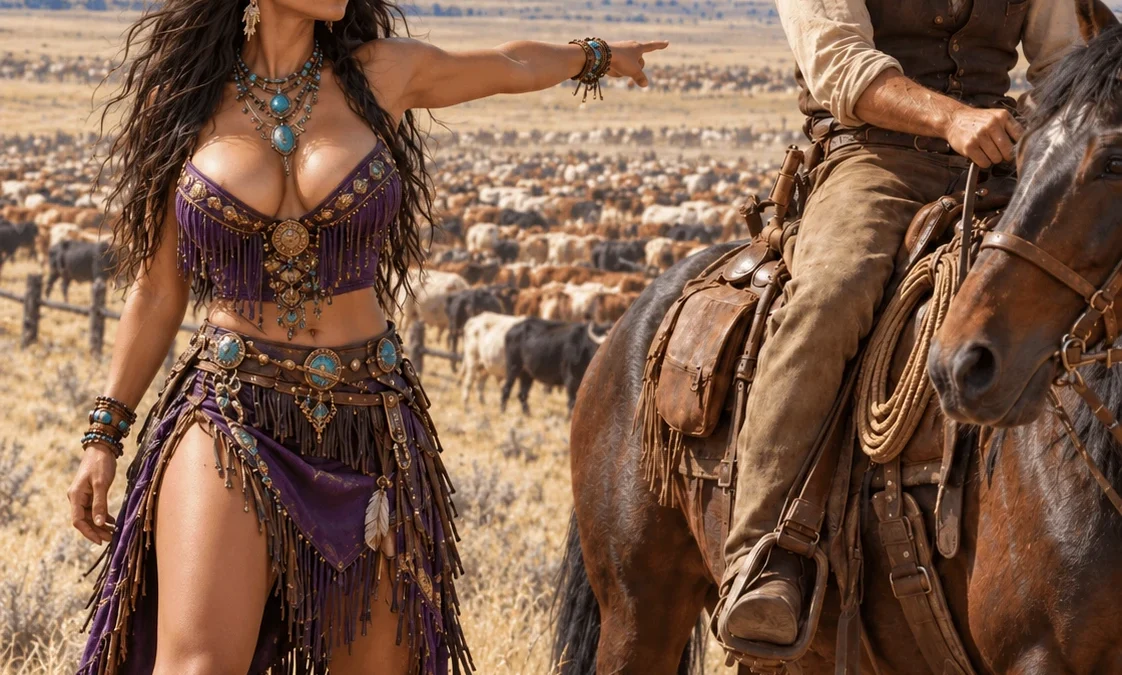
😱 They Stole All 112 of His Cattle, But the Apache Chief’s Daughter Whispered: “Your Cattle Were Never the Target.” Then She Told Him Who Really Killed His Father…
Part 1
The bullet split the rock an inch from Ansel Rourke’s ear.
Stone chips tore his cheek. He grabbed the Apache woman by the arm and threw them both behind a leaning slab as a second shot screamed off the canyon wall. His mare bolted. He was left with one rifle and a strip of red rock for cover.
“Two of them,” he hissed.
“Three,” Delfina said. “One behind the cedar.”
Then she told him something that turned his blood to ice. She had seen the shooter’s face. She traced a line from the corner of her left eye to the hinge of her jaw.
“A long scar. Here.”
Ansel went cold. Two weeks ago, that man had sat in his kitchen, and Ansel had poured him coffee. 😨
Ten days earlier, the gate was open.
Ansel saw it from the top of the rise at sunrise, swinging in the wind like a mouth that had forgotten what to say. He knew before he rode close. It was the way you know a stair is missing before your foot comes down.
The east fence posts were snapped off at the knee. The wire hung in loops. The pasture lay empty and silent. One hundred and twelve head, gone between midnight and dawn.
He was thirty-four years old, and he had ridden all night from Prescott after selling a mare he didn’t want to sell. The note at the Voss Bank came due on the twentieth of November, and sixty dollars was sixty dollars. He had been away again.
A small flat voice spoke in his head. You were away. You are always away.
He knelt and pressed his palm to the torn earth. The tracks bent toward the creek and climbed the far bank in single file, one on top of another like a squared deck of cards. This was no ordinary rustling. Somebody had thought about this very hard.
In the kitchen, nothing was touched. The stove was cold. One tin cup sat on the table. On a peg behind the door hung a woman’s green wool shawl, moth-nibbled at one corner.
Lina’s shawl.
He never looked at it long. A man can look at a thing for one breath, two at most, or the room starts to tilt. He took down the Winchester, filled his pockets, and at the door touched two fingers to the green wool like a man testing a stove.
“Back by supper,” he told nobody.
He had said that to her once, in December of ’85, before driving thirty head to Prescott. He was back by Thursday. She had died on Tuesday, of typhoid. 💔
The easy thing was to ride to the sheriff. Garnet Dolan wore a tin star and a warm voice and a habit of patting your shoulder while telling you nothing could be done. But Ansel knew Dolan took his supper every Tuesday at Corbin Voss’s long table. Voss owned the bank that held his note, the hotel, the freight line, and a good deal of the quiet in town.
Six days ago, Voss had sat on his porch rail and offered to buy the ranch for a third of its worth. Dry years coming, Ansel. I’d hate to see a good man lose everything out of stubbornness. Then Voss had looked at the east pasture a moment too long, like a man reading a page he’d already read.
Ansel’s father, Warren, had been dead a year that month. Thrown from a horse, they said, found in a ravine in the Black Mesa country with his neck broken and his hat still on. A careful man who had ridden every trail for thirty years and never taken a fall.
The sheriff had patted Ansel’s shoulder.
He followed the tracks into Split Rock Canyon. At the canyon mouth, he found a scrap of heavy dark wool on a catclaw bush, Denver cloth that smelled of cigar smoke. Farther on, a single brindled cow stood in the wash. Someone had scraped at her brand with a knife, turning his plain R into something else.
They weren’t just taking the herd. They were rewriting it.
Then, around a bend of boulders, he stopped so hard his hat slipped.
A woman stood in the shadow of a leaning slab. She was twenty-nine or so, with dark hair braided and pinned, a faded blue calico skirt, a gray shawl, and tall soft Apache boots. A bay mare waited behind her. She carried no weapon.
“Mr. Rourke,” she said.
“Do I know you?”
“No. I’ve been waiting since yesterday. I was afraid it would be the sheriff.”
“Is that an insult?”
“It’s a preference.”
Then she said six words that dropped like stones into a well. “Your cattle were never the target.” 😳
“They took the cattle so you’d follow. So you’d leave the house. So you’d be gone all day.”
“For what?”
“I know part of it. Not all.”
He didn’t trust her. So she said something that made his throat close.
“Summer of 1886. The Fort Apache road. A freight wagon with the army contract painted on the tailgate. You drove the third team. You wore a gray hat with a hole burned in the brim.”
He had never said it aloud to anyone. Eleven wagons of people with their hands bound, rolling north behind his mules. He had kept his eyes on the road.
“I watched from a ridge,” said Delfina. “My brother rode one of those trains.”
Then the first shot hit the rock beside his head.
“Can you trust me?” she asked, behind the slab, with bullets singing off the stone.
He thought of the shawl, his father’s hand, the eleven wagons.
“Yes.”
They crawled through a crack in the cliff to a hidden cleft with a trickle of water. His hat was gone. Afterward, Delfina climbed with him to a ridge above a sunken valley called the Hollow Pen, and 300 feet below were his cattle.
Six riders worked among them. Two he knew, ordinary men from his own town. And beside a freight wagon stood a tall figure in a dark coat, holding up a small brown pouch with a circle burned into its side.
His father’s pouch. Taken from his saddlebag three days ago.
The man tipped it, and a short black iron key slid into his palm. Then he turned his face to the sun, and Ansel saw the scar.
“That is what they came for,” Delfina whispered. 🔥
Her hand drifted to a pouch at her own waist. Her fingers curled over it, fierce and frightened.
“What’s in that?”
“Nothing that belongs to you. Not yet.”
Ansel did not know it yet, but the secret she carried would change everything he believed about his father, his past, and the land beneath his feet.
And below them, the riders had stopped herding cattle. They were riding straight toward his house, carrying shovels… 😰
Part 2
They were riding straight toward his house, carrying shovels.
“They’re going to dig,” Ansel whispered. “In my yard.”
“Yes. The cattle were to keep you away.”
They rode double on her bay mare through the dark, his arms around a woman he had known one day, her shawl smelling of sage and smoke. They came down on the Rourke place at twelve minutes before midnight.
The kitchen door swung open. Flour lay across the floor, the mattress was slit, and drawers were dumped. In his father’s room, the pine trunk lay torn open beside a stopped pocket watch. They had taken nothing, not the watch, not the silver cup, not the thirty dollars in the flour can.
They hadn’t come for money.
Out past the barn, men with lanterns were digging a neat row of holes. They weren’t hunting treasure. They were hunting a floor.
Then Ansel stared at the old smokehouse, and a memory rose whole. He was twenty-six, home from Kansas, and his father stood at that door with one hand flat on the boards. Don’t use this one. The floor is bad. It’s not safe.
He meant a lock.
They crept along the barn wall. Inside the smokehouse, beneath a skin of dirt, Delfina found an iron plate with a keyhole. “They have the key. They’re two hundred feet away with a shovel.”
“Do you have a crowbar?”
They pried together. The plate shrieked like a hinge in church, and outside a voice said, “What was that?” “Rats.”
The plate slid. Cold air rushed up, smelling of stone and clean water. Rough steps cut in rock fell into blackness. 🌑
At the bottom was a chamber, twelve feet across under a vault of fitted stone. Shelves along three walls held maps, ledgers, tin cylinders sealed with wax, letters in pigeonholes. In the far wall lay a pool of black water, so clear he could see the sand ten feet down.
“The spring,” he whispered.
“The spring,” said Delfina, hand pressed over her mouth, eyes bright.
She held a cream-colored paper with eleven signatures, one a small drawing of a bird. “My grandmother’s mother’s mark. They told her nothing she signed would count. Somebody wrote it down anyway, and hid it nine years.”
On the shelf lay a brown envelope sealed with red wax. In a hand he knew as his own, four words: For my son, when ready.
Ansel, if you are reading this, then I did not find the way to tell you myself. There is water under our land. It is not ours. It belongs to everyone who was promised it. I swore to guard it. Do not trust the law. Do not trust the bank. You are a better man than you think. You only needed something worth carrying. Your father, Warren.
The grief he had carried for a year broke loose and ran down his face in the dark. Delfina did not say it would be all right. She stayed, shoulder an inch from his, warm and steady. 💔
Then a voice drifted down the stairs, smooth as warm syrup poured over a knife.
“Ansel Rourke. I know you’re down there.”
Corbin Voss.
“Your father was a stubborn man. I admired it. Come up. We’ll discuss terms.” A pause. “You’re standing on a great deal more than you understand. Your father tried this too. Look how that ended.”
Ansel started to rise. Delfina’s grip tightened. “That is what he wants.”
Her fingers guided his hand along the cold wall to a seam too straight for nature. A false shelf, an iron ring. It swung out on a silent hinge onto a second tunnel.
“I’m coming down, Ansel. I carry no weapon. I only want to see it.”
Boots on the first step. They grabbed what lay nearest, two ledgers, a bundle of letters, an oilcloth packet, an armful of maps. They ducked through. The shelf clicked shut.
Through a crack, a match flared. A man’s shadow fell across the stone.
“You don’t know what you hold, Ansel. Or whose name is on the first page.” 😨
They ran through the dark for twenty minutes and came out at dawn on his father’s old lookout ridge. Below, in the yard, six men stood with lanterns. In the center, immaculate in black broadcloth, stood Voss. Beside him, laughing, a round man with sandy whiskers and a half-eaten apple.
A tin star glinted on his vest. Sheriff Dolan laid a warm, friendly hand on Voss’s shoulder.
“Oh,” said Ansel. It was all he could say.
“Every time something went wrong, he patted my shoulder,” he said. “He wrote my father’s death report.”
Delfina lay beside him, her eyes wet and ashamed. “I have to tell you something. Now. Before you read another page.”
She drew a soft roll of pale hide from the pouch at her waist and held it out on both palms like a bird.
“A year ago this month, my grandmother sent me to Black Mesa to meet an old white man. I sat in a ravine and waited. I heard a horse. A man riding alone, very fast, gray in the beard.”
Tears ran down her face, and she did not wipe them.
“Another rider came up behind him. A dark coat. A scar on his left cheek.”
Ansel did not make a sound.
“I climbed down. He was still breathing. He was your father.”
Part 3
“He said, ‘Find the boy. Tell him it was not an accident. Tell him not to trust the one with the kind voice.'”
Below them, in the yard of the ranch his father had built, a round man in a tin star lifted his hat and began to laugh.
“I did not know your name,” Delfina said. “It took me a year to learn it. I could not leave my people’s land without a pass. When I did, I walked. I have been looking for you for a year.”
Something in Ansel went very still, very cold, and very clear. The small flat voice that had whispered you were away fell silent.
Then another memory came loose. His father’s funeral, a raw wind, Dolan with his hat over his heart. Did he leave you anything, son? Anything at all? And Ansel, hollow with grief, grateful to be asked, had said it. Only a little pouch.
“I handed it to them myself,” he said. “I was lonely. It’s the same mistake I made with Galt in my own kitchen. Somebody was kind, and I said everything.”
“Then they were wrong about you,” said Delfina. “Weren’t they?”
He turned the roll of hide in his hands. “We can’t fight them. All we hold is paper. And paper burns.”
“Yes.”
“So it can’t be in one place. I drove freight two years. A divided load can’t be stolen all at once.” He sat up. “We copy it. Every page that matters, and it leaves this valley by different roads.”
“I’ve been telling myself that for a year. I didn’t think a white man would say it first.”
“I’m a slow white man. You’re a quick Apache.”
They hid in a red-rock cleft for two days, writing. Ansel’s hand was not made for it. Delfina took the pencil and copied the English pages in a clear upright script from a mission school. “They taught me to read what they wrote about us. It was educational.” He tried not to smile and failed.
He copied the maps. And in the middle of his own land, he found a small circle with three short lines beneath it, and a note: Easement in perpetuity for all signatories and their heirs. Beneath it a seal. A. Voss, surveyor. Corbin’s father.
Pinned behind it lay a clerk’s copy of a second survey, filed at Prescott three months later. Same creek, same bench, every mark identical.
Except the circle. The circle was gone, and the easement with it. 😳
Ansel had seen that seal on a crate in a long wooden warehouse that smelled of lamp oil. “Prescott,” he said. “I have a friend.”
On the first night, he could not sleep. Delfina sat at the mouth of the cleft with her shawl pulled tight. He told her the whole last trip, three days of it, eleven wagons, a woman near the back who sang low every evening. How on the second night the singing stopped and nobody said why. How at the railhead an officer paid him by the mile, and he took it.
“I took the money,” said Ansel. “That is the part I can’t get past.”
She watched the stars a long while. “I will not tell you it was nothing. And I will not tell you it is the whole of you.”
It was not forgiveness. It was something harder to come by. To be seen entire by a person with every right to look away.
On the second night, she vanished with the mare. He woke to her shawl folded against the rock and a single cold moment as a man in a kitchen with a green shawl on a peg. Then she rode in from the dark with a satchel.
“You went alone.”
“You snore, by the way, like a mule with a cold. They’ve moved forty head to the north corral. Two guards, drunk since noon.”
That night, Delfina walked down the slope alone, shawl over her head, stumbling like a lost woman. When the guards laughed, she kicked a lantern into the dry grass. In the confusion, Ansel stepped out with his rifle.
“Gentlemen, I’d take it kindly if you’d sit down.”
Delfina shook the boot of the man who kept shifting it. A small black iron key dropped into her palm. On the desk in the stockyard office lay a map of the valley in a hundred red marks, ringed round the Rourke land. At the bottom, in a firm hand: Boring to commence November 20. Rourke note due same date for close.
“They’re very organized,” said Ansel. “Then we will have to be wrong about something.”
A shot came from the ridge. A hammer blow across his left shoulder. Delfina dragged him behind the corral post. He did not remember the ride, only cold and a small hard arm around his waist, and a voice saying over and over in two languages, “Do not you dare.” 💔
He woke in the cleft with his shoulder bound in a strip of blue calico torn from her skirt.
“A graze. You’ll have a scar.”
“I’ve always wanted one.”
“Don’t be charming. I’m angry. I was frightened.”
He caught her wrist, and she let him. “Tell me your name,” he said. “Your own. I have not earned it.”
“I’d like to hear it anyway.”
She said it, three soft syllables with a catch in the middle. It meant she returns. Her grandmother had chosen it the winter she was born, when a hard cold took half the camp and the women said, We will see which ones come back.
He tried. He got it wrong. She corrected him twice. “Close. You are a slow white man.”
They rode to Prescott by night. Behind the old army corral stood a tin-roofed warehouse guarded by a bald, bent seventy-one-year-old named Obadiah Teague, who opened the door in a nightshirt with a shotgun in one hand and a tin of beans in the other.
“Rourke. You look terrible.”
“I’ve been shot.”
“Bring the lady in. I have beans.”
Obadiah heard it all, took off his spectacles, wiped them on his nightshirt. “I stamped every sheet that came through in the spring of ’79. One I did not like. Two surveys of the same ground, January and April. I kept the first in case. I never knew in case of what.” He lifted a floorboard and drew out a long tin tube sealed in red wax.
The first survey. The easement. A bold stamp: Received. Certified a true original.
“There’s something else. Your father came here five weeks before he died. He left this.” A small black iron box. “He said, ‘My boy will bring the key or he will not come at all.'”
Ansel’s hand was not quite steady. The key slid in as if it had always lived there. Inside lay a sworn, notarized statement naming Augustus Voss and the forged survey, Corbin Voss, who had offered to buy Rourke land three times in nine years, and Sheriff Garnet Dolan.
If I am found dead, do not let anyone call it a fall.
“He knew,” Ansel said.
“He prepared,” said Delfina softly. “For a son who would come late.”
Obadiah’s eyes went bright behind the lenses. “I know a mail-stage driver. Nobody searches a flour sack. One set to a lawyer in Tucson, one to a newspaper in Flagstaff, one stays under this floor. And Judge Whitlock sits the circuit court here until tomorrow. I’ll put the originals in his hand myself.”
On the road home, three hours out, a shot split the air. The mare screamed and Delfina went over her shoulder. A man set a black horse across the road forty feet ahead. Dark coat. A scar from eye to jaw.
“Mr. Rourke. I would like the sack.”
“I do not have a sack.”
“You are a poor liar.”
His right hand hung near the pistol under his long coat. Behind him, the lame, wild-eyed mare was plunging sideways, closer to the black horse with every jerk.
“Mr. Rourke. The sack.”
“Oh,” said Ansel, and stepped aside.
The mare slammed her shoulder into the black horse. The carbine flew. And Ansel Rourke did the one thing nobody expected. He reached for a hat he no longer had, so he threw his canteen. It caught Galt full in the face with a sound like a dropped pot. Delfina came up off the ground like a cat and wrenched the bridle round so hard that the horse bolted, carrying the half-fallen gunman off down the road in a cloud of dust.
“I threw a canteen.”
“At a man with a pistol. It was very effective.”
“It was an accident.”
“Then you are very lucky.”
They laughed until they cried, leaning on each other beside a lame horse. “You are a very bad hero.” “I know. I do not mind.” 😂
Ten days after the gate stood open, they walked into Mosquite Wells on foot at four in the afternoon. The street lay in long gold light. People stood in doorways, a blacksmith, a baker with flour to her elbows. And Ansel thought, They are going to hang us in the street.
A round figure stepped onto the boardwalk with a tin star and a half-eaten apple.
“Ansel, my boy, we’ve been so worried. You’ll surrender whatever papers you’ve removed from county property. And Miss Delfina, you are a long way outside the boundary. I must place you under arrest.”
“Take your hand off my shoulder, Garnet,” said Ansel. “You wrote my father’s death report. I have papers a federal judge will read, and copies. Three sets have gone out of this valley by three roads. Arrest me if you like. It no longer matters.”
Silence, a town holding its breath. Then a door banged. A small stout woman in a gray dress crossed the street and planted herself before the sheriff.
“Garnet Dolan. I washed that man’s wife’s face the night she died. You came to the funeral and ate three slices of pie. I do not believe a word you’ve told this town since the day you pinned on that star.”
The newspaper editor stepped out with a notebook already open. Then the blacksmith, then the baker. One by one, they crossed the gold light and stood behind a rancher with a bloody sleeve and a woman in a blue skirt. 🙏
From the end of the street came a bright, clear sound. A coach horn.
“That,” said the editor with odd delight, “would be the afternoon stage from Prescott. I believe we are about to have a judge.”
Judge Whitlock unfolded from the coach like a carpenter’s rule, tall and stooped, in a coat rained on in three territories. Behind him climbed Obadiah Teague, clutching a tin tube and an iron box. The judge looked at the rag around Ansel’s head, the blue calico on his shoulder, the woman at his side.
“The woman is a witness before this court,” said Whitlock, “under its protection from this moment. If you lay a hand on her, Sheriff, you will answer to me.”
“Where is the nearest room with a table and a roof?”
“The church,” said Permelia Haske.
They filled it to the rafters. When Voss arrived, black broadcloth and silver-knobbed stick, every head turned, and Ansel saw something older than fear cross the room. The habit of fear.
Whitlock laid the two surveys side by side. “Same creek, same bench, same hand. One carries an easement. One does not. Mr. Voss, why would a man draw over a survey he had already delivered?”
“I could not say. My father is dead.”
“You own the bank, the hotel, nineteen of the twenty-six deeds in this basin. And on the twentieth of November, a drilling company in which you hold a controlling interest intends to commence boring.”
He read Warren Rourke’s sworn statement aloud, slowly, to the whole church. If I am found dead, do not let anyone call it a fall.
Voss’s lawyer rose. “The witness is Apache. Her testimony has no standing.”
“Mr. Marchbanks, I have sat on this bench fourteen years. I have heard that argument four times. I have yet to hear it improved. This court weighs paper and sworn word. It does not weigh who swore.”
Then Whitlock opened a book. “Any person who made a mark on that agreement, or whose family did, or who was pressed to sign away a farm or a well under threat of a called note, may write it down. Not speeches. Names.”
Nobody moved. Then an old woman came down the aisle, eighty if a day, bent in a black dress gone green with age. She laid one knotted finger beside the little drawing of a bird.
“I made that mark in ’79. I kept goats. Warren Rourke held my hand when I wrote it, because I could not hold a pen. I have remembered it nine years.”
After her, another, and another. A slow line, the scratch of a pen, until the book was thicker than anything Voss could have burned. 🥹
The door banged open.
A man stood on the threshold with a long pale scar and half his face swollen purple where a canteen had met it. Marlon Galt walked down the aisle, one hand dragging along the pew ends.
“I was supposed to be a loose end. Two riders found me on the Prescott Road with a rope. I am not a good man. I will not pretend.” He stopped before the table. “I killed Warren Rourke. On the ridge above Black Mesa. I struck him with a rifle butt. His horse went over. Dolan gave me the day and the place. Voss paid the draft.”
He pulled a cream-colored paper from his coat. A bank draft for five hundred dollars, signed in a looping, confident hand. For services rendered.
“I kept it. I do not know why.”
“I do,” said Whitlock.
Dolan’s hand dropped to his holster. The revolver came half clear, swinging toward the table, the ledger, the tube. Ansel crossed the floor in two strides and drove his shoulder into the sheriff’s ribs. A bench cracked. A gun went off, and plaster rained from the ceiling like snow. His wounded shoulder screamed, and he held on.
“You patted my shoulder. You told me there was nothing to be done.”
The revolver spun across the boards and stopped against a small gray boot. Delfina picked it up by the barrel. “Sir. I believe you dropped this.”
Someone laughed, one cracked, startled sound, then the whole church, ragged and wet-eyed. The youngest deputy unpinned his star. “Your honor, I would like to resign. And then I would like to arrest somebody.”
Then Voss did the last thing a man like that can do. He swung his stick, hooked a brass lamp, and sent it crashing across the survey. Oil ran. Flame leapt up the cream paper.
“I have guarded paper from mice,” roared Obadiah Teague, and threw himself across the table, chest and elbows and the whole flapping bulk of his coat. Delfina beat at the edges with her shawl. For three long breaths, there was nothing but hissing and coughing and a bald old man’s muffled swearing.
Then it was out. He rose blackened to the elbows and held up the survey. The corner was scorched. The seal was whole. The circle was whole. “I will not lose it to a Voss.”
Whitlock placed Corbin Voss in the custody of the court. “My father built this valley,” said Voss softly.
“Your father stole it,” said the old woman at the back. “I was there.”
Something went out of him, the long smooth engine that had carried him through fifty-five years of being believed. He sat down on the pew.
“I would like a glass of water.”
Nobody moved. Then Delfina crossed the aisle, took a tin cup from the font, filled it, and held it out. He looked at the woman whose name he had never troubled to learn. He took it. His fingers shook.
“Thank you.”
“It is the least of what it owes you,” said Delfina. “It was never ours to withhold.” 🌅
Afterward, Whitlock found him in the vestibule. “The land above the spring is yours, Mr. Rourke. Deed unclouded. One signature and you’d be rid of the note and all of them. A wealthy man in a year. Or a joint compact, the spring held in common by every signatory and their heirs. Water by right, not by purchase. It would make you poorer and a great deal harder to kill.”
Ansel looked at the painted hide, the eleven small marks.
“My father signed it first. Then I am only finishing the line. Draw it up. I will sign tonight.”
One by one, the heirs made their marks. The goat widow first, then the Mexican families, then Delfina, who wrote her own name in full in the clear, upright hand a mission school had taught her. Then Ansel wrote his name below the eleven old marks, and under it, in smaller letters, so only the judge could read, one line more.
Teamster, Fort Apache Road, summer of 1886.
“That is not required.”
“It belongs with the rest of what I owe.”
Whitlock nodded once. He signed beneath it as witness and said nothing at all.
The note was forgiven. The bank was found to hold deeds to nineteen farms never lawfully conveyed, and the courts spent the better part of a winter returning them. Dolan, Voss, and Brandt stood trial at Prescott. Obadiah Teague went to Washington to testify, wearing a new suit and complaining about the food. The young deputy was made sheriff and wore his star pinned on the outside, where everybody could see it.
Deacon turned up on the ninth of April, gaunt and full of burrs, and stood at the kitchen door like a man who has composed an apology and forgotten it. “You are not forgiven,” said Ansel. Deacon blew out his lips. “A little forgiven.”
A parcel arrived from Obadiah. An old army campaign hat with a bullet hole through the crown. You have been bareheaded long enough. Do not make a fuss. It fit.
By the smokehouse, someone built a stone rail around the iron plate, with a bench and a plain wooden sign in a clear, upright hand. The spring at Sweetwater. Held in common. Drink.
Delfina came every day. At first for the papers, then for the stone, then by degrees for no reason either of them cared to name. She scolded him over the state of his kitchen. And one gray afternoon he came in from the barn and found the green shawl gone from its peg.
He stood very still. Then he saw it folded on the table, brushed clean, the moth hole mended with tiny, careful stitches in thread the exact color of the wool.
“I hope that was permitted,” said Delfina from the stove. “I did not throw it out. I only mended it. It seemed a shame to waste good wool.”
He crossed the floor in four steps. He had never been good at words. He put his arms around her and held on, and felt her go still, then softer.
“Lina would have liked you.”
“I know. You told me in your sleep. Nine times. Ansel…”
“Stay.”
“Is that a question?”
“It is a request. The third time I have asked.”
“I have been counting,” she said against his collar. “I have been busy being stubborn. And now I am tired of it.” 💛
They made their promise in June at the spring, in the long light before sunset. Not in a church. Delfina would not have it. The old goat widow came on a mule, and the families of the eleven came on foot and in wagons, Apache and Mexican and white, some of whom had not stood in the same field in nine years. Ansel took Delfina’s hands. He had practiced for three weeks in the barn before Deacon, who offered no corrections. He said her name, all three syllables, with the catch in the middle. He said it softly, so only she could hear.
Her eyes went bright and very still. “Close,” said Delfina, laughing and crying both. “That was close.”
“Is it right?”
“It is exactly right.”
In October, a year to the week from the morning the gate had stood open, they stood on the porch in the last of the light. A line of silver ran through the cottonwoods where a new ditch carried water to eleven farms. She had a hand on her stomach and had been standing that way a while, looking at the water.
“Ansel. Do you think a child ought to know where the water comes from?”
He looked at her hand, at the small curve beneath it, at the green shawl on its peg by the door, mended in thread the color of itself, and beyond it the whole bright valley drinking. He thought of a man in a ravine with his hat still on, of a letter in pencil, of a promise cut in stone by someone who had been afraid for his son and loved him anyway.
“Yes,” said Ansel Rourke, and his voice cracked, and he let it. “We will tell them everything. And we will tell it on time.”
She laughed, low and wet and delighted, and put her head against his good shoulder. Together they stood on the porch of a house that finally held more than one tin cup and watched the sun go down over the water.
It was not late. It was exactly when it was meant to be. 🌄
This story is entirely fictional and created for entertainment purposes only. It does not represent any organization or individual, nor does it encourage inappropriate behavior. The content was generated with AI assistance.








