They Stole His Dead Wife’s Last Memory. When He Tracked the Thieves Into Apache Country, What He Saw Tied Beside Her Horse Changed Everything
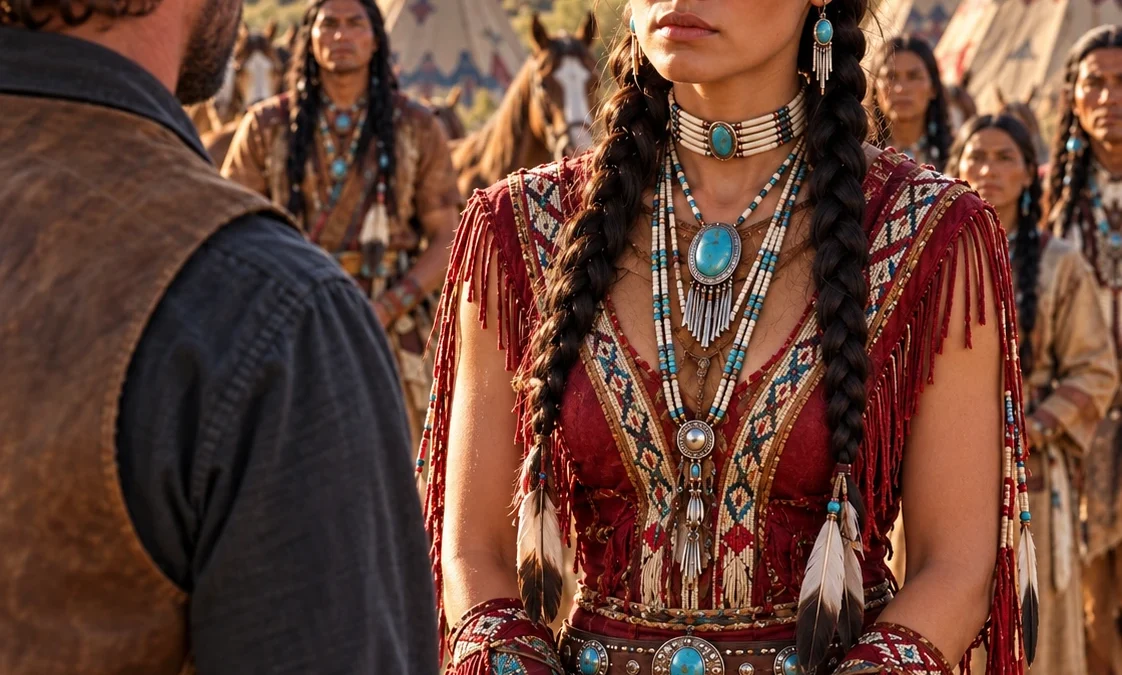
They Stole His Dead Wife’s Last Memory. When He Tracked the Thieves Into Apache Country, What He Saw Tied Beside Her Horse Changed Everything 😢
Part 1
The horse vanished before sunrise. 🌅
All it left behind was a broken gate, deep hoofprints in the dust, and one empty stall.
Elias Mercer stood frozen in the gray light, his heart pounding against his ribs.
Because Redbird was not just a horse.
He was the last living thing his late wife had left him.
Elias was thirty-eight years old, broad-shouldered, with weathered hands, dark hair going gray at the temples, and a thin scar running from his left eyebrow toward his cheek. He lived alone on a small cattle ranch tucked between two dry ridges in the Arizona Territory. Every working day demanded more strength than the last.
He had survived droughts, failed cattle sales, brutal winters, and years when the nearest town seemed determined to forget that people like him existed.
But the one thing he guarded more carefully than his land was a chestnut gelding named Redbird.
The horse had belonged to his wife, Clara.
Clara had died three years earlier, when a fever swept through the settlement and took her in less than a week. She had trained Redbird with her own hands, whispering to him, laughing with him, tying a strip of red fabric around his saddle horn for luck.
After she was gone, Elias could not sell him. Not even when money ran so thin that he skipped meals.
Redbird was all that remained of the woman who had once filled this silent ranch with laughter. 💔
Now the gate hung open. A section of fence had been cut clean.
Elias crouched beside the tracks and studied them carefully.
Three sets of hoofprints led away from the ranch. Only one belonged to Redbird. The others were from unshod horses, lighter and narrower.
Whoever had taken him had not come by accident.
They knew exactly which horse they wanted.
Elias followed the trail for nearly two hours, across dry creek beds and rocky slopes, until the tracks grew hard to read.
He almost turned back.
Then he saw it.
A torn scrap of red cloth, snagged on a thorn bush.
His breath caught.
It was the same fabric Clara had tied to Redbird’s saddle.
Elias held the strip in his palm for several long seconds. Then he put it in his pocket and kept riding.
By late morning, the trail led to a narrow canyon that locals avoided. Beyond it lay Apache territory.
Elias knew the stories. Some were true. Some were exaggerated. Some had been repeated so many times that nobody remembered where they began.
There had been raids in the region. Cattle had vanished. Families had lost loved ones. He understood why the settlers were afraid.
But he had also learned something during his years on the frontier.
Fear grew fastest when people stopped seeing those on the other side as human beings.
Near midday, he saw smoke rising beyond the rocks.
His hand rested near his revolver, but he did not draw it. Instead, he tied his rifle to his saddle, left his horse where the canyon narrowed, and continued on foot with his hands in plain sight.
Entering an Apache camp alone was reckless. Maybe even foolish.
But going home without Redbird would mean losing his last connection to Clara.
The camp was larger than he expected.
Several families sheltered beneath makeshift coverings. Older men watched the hills. Women worked over small cooking fires. Children moved quietly between the tents, but there was no laughter.
The whole camp seemed crushed by exhaustion. 😔
And Elias noticed what was missing.
No sacks of grain. No fresh meat hanging from poles. No bundles of firewood. Even the horses looked thin.
Several warriors stepped out from behind a rock formation, faces tense, weapons ready.
Elias did not reach for his gun.
He simply pointed toward the far side of the camp.
Redbird stood there, tied beside a weather-beaten shelter. Frightened, but unharmed.
Relief hit Elias first.
Then anger.
He had crossed miles of dangerous country, and now the only thing between him and Clara’s horse was a group of men who clearly had no intention of letting him walk away with it.
A man approached him. Nantan Hail, forty-five, long black hair streaked with gray, a deeply lined face. His right leg was stiff from an old injury, and he walked with the careful balance of someone used to pain.
Beside him stood a young woman named Marisol, twenty-seven, with sharp eyes that never left Elias. She wore a faded blue-gray dress beneath a buckskin jacket, her dark hair braided over one shoulder.
Elias expected hostility.
Instead, the older man looked tired.
Nantan pointed at the horse. Then at the camp.
And slowly, Elias began to understand.
Marisol led him to a shelter at the edge of the camp.
Inside, beneath a thin blanket, lay a small boy. Perhaps eight years old. His face was pale as ash, his breathing shallow and weak. An elderly woman sat beside him with trembling hands.
Elias recognized the signs. Severe exhaustion. Dehydration. A fever that had burned too long.
There was no doctor. No medicine. Almost no food.
Then Marisol showed him a small leather pouch lying beside the child.
Inside were a few coins and a folded paper bearing the name of a trading post many miles away.
They had tried to buy medicine.
But their horses had collapsed along the way.
Elias stared at the dying boy, then back at Redbird.
They hadn’t stolen him for his value.
They had taken the strongest horse they could find to save a child’s life. 😳
Then Elias noticed a second child hiding behind Marisol. A little girl, perhaps six, clutching a wooden toy horse with one broken leg. She was staring at Redbird as if he were the most beautiful creature she had ever seen.
Elias felt his anger twist into something he did not want to feel.
If he took Redbird and left, the boy might die.
If he stayed, he could be walking into a trap.
If he gave up the horse, he would lose the last living piece of his wife.
Then Nantan spoke, and what he proposed made Elias’s blood run cold.
The old leader offered to return Redbird, but only if Elias agreed to help them reach a distant, hidden water source, and carry their sick and elderly there. In return, the Apache would guide him through a secret mountain passage.
It was not a trade for a horse.
It was an agreement between people who had every reason to hate each other.
Elias closed his eyes. He remembered the last words Clara ever spoke to him.
“Never let grief make you cruel.”
When he opened his eyes, he untied Redbird.
Everyone expected him to mount and ride away.
Instead, Elias placed the reins in Marisol’s trembling hands and walked toward the dying child.
But before the sun disappeared behind the canyon, a hidden truth about why Redbird had been stolen would be revealed… and it would shake Elias to his core. 😱
Part 2
Elias knelt beside the boy and laid the back of his hand against the small, burning forehead.
The child’s name was Tomas.
He did not stir.
“How long has he been like this?” Elias asked, forgetting that the woman beside him might not understand every word.
Marisol answered in careful English.
“Four days. The fever will not break.”
Elias stood and went straight to his saddlebag. Inside he found a canteen, strips of clean cloth, dried beans, a pinch of salt, and a small bottle of medicine he had bought for one of his ranch hands.
He placed all of it in Marisol’s hands without a word.
She stared at him as if she had expected him to demand payment first. 🕯️
“Why?” she whispered.
Elias did not have an answer that made sense to anyone but him.
They left shortly after noon.
Nantan had gathered the strongest horses, but Elias saw at once that none could carry the sick boy without hurting him. Only one animal was calm enough, gentle enough, trained by a woman who had once whispered to him in the dark.
Redbird.
Elias knew what it meant. If he left with the horse, Tomas would have to be carried on someone’s back for miles.
If he let Redbird go with them, the boy might live.
He made his choice.
Tomas rested across the saddle beneath a blanket while Elias walked beside the horse, one hand on the bridle. Marisol stayed close, watching every rise and fall of the boy’s chest. Nantan and his men moved along the edges of the group, scanning the ridges.
As they walked, Elias saw things he had never allowed himself to see.
These were not raiders.
Elderly people leaned on walking sticks. Mothers carried exhausted children. Men carried empty water containers. Even the strongest moved carefully, as if every step cost something they could not spare.
They were not an attacking force.
They were refugees. 💔
By midafternoon, the group reached a hidden passage that opened into a sheltered valley. At its center lay a natural spring, clear and cold, guarded by tall rock walls and thick brush.
Elias understood why the place had stayed secret. It was invisible from every ridge.
The families rushed toward the water, but Nantan stopped them from crowding the spring. Marisol gave Tomas the first careful sips, then the other sick ones.
And then, slowly, the boy opened his eyes.
Something broke inside Elias.
For three years he had believed grief had made him hard. He had told himself that survival meant clutching the few things Clara had left behind.
But kneeling beside that spring, he finally understood.
Clara’s memory had never lived in a horse alone.
It lived in the kindness she had taught him. 🌿
But the peace did not last.
As evening crept over the valley, Elias caught a glint of metal on the ridge above.
His stomach dropped.
Riders. Seven of them.
At their head sat Gideon Vass, a local rancher who had lost cattle in an earlier raid and carried a deep hatred for the Apache. He had seen Elias’s tracks leading into the canyon and assumed the worst.
They had come for blood.
Elias knew what would happen if they rode into that valley. Fear would turn to gunfire before anyone had time to understand.
He did not hesitate.
He climbed the slope alone and stepped out in front of the horses.
“Mercer?” Gideon snapped. “They took your horse. They’ve got you captive, don’t they?”
“No one has me,” Elias said.
“They stole from you!”
“They did. And I’ll tell you why.”
Gideon did not listen. His jaw was locked, his hand already tightening on his rifle. Behind him, six men waited, hungry for a reason.
Elias spread his arms and stood in the path.
“If you want to get to that valley,” he said quietly, “you go through me.”
Gideon’s face hardened.
The rifle came up.
Elias heard the click of the hammer, loud as thunder in the stillness.
And then, from the edge of the valley below, came the slow sound of hoofbeats. 😨
Elias turned his head. What he saw coming toward them made every man on that ridge freeze…
Part 3
Redbird walked out of the shadows at the valley’s edge, slow and steady.
On his back sat Tomas.
The boy was wrapped in a blanket, swaying weakly, held upright by Marisol’s arm. His face was still pale, but his eyes were open.
Every man on the ridge went silent.
The horse Elias had crossed hostile country to recover was carrying the very child whose life depended on him.
Gideon’s rifle wavered. 🕊️
“That’s the horse,” one of his men muttered. “That’s Clara Mercer’s horse.”
“It is,” Elias said. His voice was rough. “And that boy was dying yesterday. They didn’t take Redbird because they wanted him. They took him because he was the only animal strong enough to carry a sick child to help.”
He reached into his pocket and pulled out the strip of red cloth he had found on the trail.
“They didn’t even hurt him. They tied him by water. They fed him before they fed themselves.”
Slowly, Elias walked down the slope. He did not look back to see whether Gideon would shoot.
He stopped beside Redbird and tied the red cloth around the saddle horn once more, just as Clara had done years ago.
The valley held its breath.
Then, behind him, he heard the creak of leather. The soft thud of a rifle being lowered.
Gideon came down the slope on foot.
He stood before the boy for a long time. His eyes moved over the thin arms, the cracked lips, the little wooden horse with the broken leg now clutched in the arms of the six-year-old girl beside Marisol.
His voice, when it came, was hoarse.
“I lost forty head of cattle in that raid,” he said. “I lost my brother’s boy, too. I’ve hated these people for four years.”
“I know,” Elias said.
“I never once thought…” Gideon swallowed. “I never thought they had children dying out here.”
Nantan limped forward, his stiff leg dragging in the dust. He stopped an arm’s length from Gideon. Neither man spoke at first. Neither man had to.
Then Nantan said, in slow, careful English:
“We did not raid your cattle. Another band did. We are not that band. But we know the grief you carry. We have buried our own.”
Gideon stared at him.
Something moved across the rancher’s weathered face. Not forgiveness yet. But the first crack in a wall that had stood for years. 💛
“Wagons are two miles back,” Gideon said finally. “We’ve got flour. Dried meat. Blankets.” He turned to his men. “Go get them.”
One of them started to argue.
“Go,” Gideon said.
They went.
That night, the valley glowed with firelight.
Settlers and Apache families sat on opposite sides of the spring at first, wary, silent. But hunger has a way of breaking pride. When the flour was passed around and the meat was roasted, the circles slowly closed.
A settler’s wife wrapped a blanket around an old Apache woman’s shoulders.
Nantan showed Gideon where the safest trails ran through the mountains and where the springs could be found in the worst of the drought.
Marisol taught two of the women how to make a fever tea from the herbs growing along the rocks. 🌿
And Tomas, sitting up for the first time in days, ate a bowl of broth and smiled.
Elias sat alone at the edge of the firelight, watching.
Marisol found him there.
“You could have taken your horse and gone home,” she said.
“I could have.”
“Why didn’t you?”
Elias turned the strip of red cloth over in his fingers.
“Clara used to say a person’s worth is measured by what they do when nobody’s watching,” he said quietly. “I think she was wrong about one thing. Somebody was watching. A little girl with a broken toy horse.”
Marisol laughed softly, and her eyes were wet.
“She has not let go of that toy since the day it broke,” she said. “Her father made it before he died.”
Elias looked across the fire at the child. She was asleep now, curled against an old woman’s side, the little horse tucked under her chin.
His throat tightened.
He had come to take something back.
And instead he had found something he did not know he had lost.
When the sun rose, Elias made his final decision.
He stood before Nantan beside the spring and placed Redbird’s reins in the old leader’s hand.
“Keep him,” he said. “Until the camp is strong again. He’ll carry your sick. He’ll carry your children. He’s earned his place here.”
Nantan stared at him.
“This horse is your wife’s.”
“Clara would want him here,” Elias said. “I know that now.”
Nantan was quiet for a long time. Then he placed his hand against Elias’s shoulder, the way one man grips another when words are not enough.
“You are not what we feared,” he said.
“Neither are you,” Elias answered.
He walked home alone.
The ranch felt painfully empty without the horse. For weeks, Elias woke before dawn and stared at the vacant stall. He sat in the dark and wondered whether he had given away the last piece of the woman he loved.
But every morning, when the silence pressed down hardest, he remembered the boy opening his eyes.
And he did not regret it. 💔
Months passed.
News came to him in pieces. The Apache camp had survived the drought. The mountain spring had been shared under an agreement that protected the water from being overused. Gideon Vass had stopped patrolling the canyon with rifles and started trading cattle for the trails.
Marisol had begun selling herbs and handmade goods in nearby settlements.
And Tomas had recovered completely.
Then, one autumn morning, Elias heard hoofbeats on the ridge.
He stepped out onto the porch and froze.
A chestnut gelding appeared at the crest, his coat gleaming in the early light, a strip of faded red cloth fluttering at his saddle horn.
Redbird.
Marisol rode beside him.
Elias’s hands began to shake. He walked down the steps and across the yard, unable to speak.
Redbird lowered his head and pressed his nose against Elias’s chest, just as he had when Clara was alive.
Elias buried his face in the horse’s neck and wept. 😭
“The camp found another way,” Marisol said gently. “We have stronger horses now. Because of you. Nantan said the horse should be where he belongs.”
“He belongs wherever he is needed,” Elias whispered.
“He is needed here, too.”
She dismounted and took something from her saddlebag.
“This is also for you.”
It was a small wooden horse. Carved carefully, with all four legs perfectly straight.
“Tomas made it himself after he recovered,” Marisol said. “He said it was for the man who gave his horse a second life.”
Elias took the little carving in his palm.
His eyes blurred.
For three years he had believed Clara’s last gift to him was a horse.
He saw now that her real gift had been a lesson. One she had given him in her final days, and one it had taken a stolen horse to teach him how to live.
A person’s greatest legacy is not what they keep. It is what they are willing to give when someone else has nothing left. 🌅
He looked up at Marisol, and for the first time in three years, he smiled without pain.
“Will you stay for supper?” he asked. “I’ve been told my cooking is terrible.”
Marisol laughed.
“Then I will definitely stay.”
Years later, people across the territory still told the story of the rancher who walked alone into an Apache camp to recover a stolen horse.
But those who knew the real story remembered something different.
They remembered that Elias Mercer entered that canyon expecting to take back an animal.
And came home carrying a lesson that changed the way he looked at every stranger who ever crossed his path.
Because sometimes the thing we think was stolen from us is not what we truly lose.
And sometimes the greatest deal we ever make begins with simply choosing not to walk away. 💛
This story is entirely fictional and created for entertainment purposes only. It does not represent any organization or individual, nor does it encourage inappropriate behavior. The content was generated with AI assistance.








