THEY STONED HER FOR GIVING HIM NO SON… THEN A LONELY WIDOWER FOUND HER COLLAPSED AT HIS FENCE POST
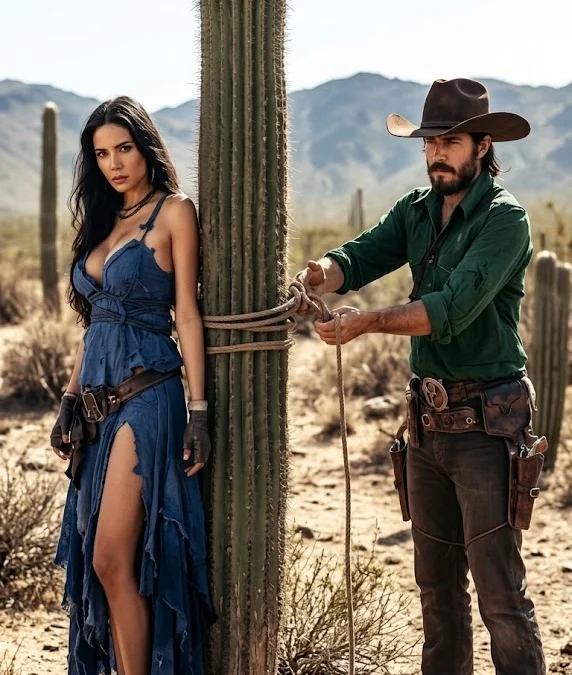
🌵💔 THEY STONED HER FOR GIVING HIM NO SON… THEN A LONELY WIDOWER FOUND HER COLLAPSED AT HIS FENCE POST 🤍
PART 1
They threw the first stone because she had not given her husband a son. 💔
By the time the sun sank behind the low Texas hills, Elena Márquez had stopped counting how many more followed. She only remembered the shouting, the faces she had known for years twisted into something she did not recognize, and one word repeated until it lost all meaning.
Barren.
She did not remember how she got out of the village. She remembered the dry creek bed where she slept two nights with her arms wrapped around her ribs. She remembered walking because stopping meant dying. And she remembered the endless gray plain of mesquite and dust, until a wooden fence post rose out of the earth like a promise.
She collapsed against it and could not get up. 🌾
Tomás Hale was carrying a bucket of feed to his cattle when he saw her.
At first he thought it was a trick of the fading light, or a stray animal from a neighbor’s herd. Then he took one step closer and saw a woman curled against the post, knees pulled to her chest, a torn dress hanging off her shoulder. Bruises darkened her cheek and arms. Dried blood crusted a cut along her forehead. She wore no shoes.
His chest tightened.
He was not a man who went looking for trouble. He had lived alone too long for that. Behind his cabin, on a quiet rise, stood three wooden crosses, his wife and two children, taken by fever ten years ago. Since then, no one had needed him.
He could turn around and pretend he had seen nothing. Or he could carry her inside and accept whatever came with it.
He set the bucket down and knelt. “Can you hear me?”
Her eyes opened, wide and brown, searching his face as if measuring whether he was a threat or a shelter. She tried to push herself up. Her arms gave out.
Tomás made his decision. He took off his coat and wrapped it around her shoulders. “I won’t hand you back to anyone,” he said.
Her cracked lips trembled. “Water,” she whispered.
She weighed almost nothing in his arms, all bone and bruises. Her head fell against his chest as he carried her across the yard and into the cabin that smelled of woodsmoke and morning coffee. He laid her on the cot, held a tin cup to her mouth, and let her drink in tiny, shaking sips. 💧
He wet a cloth and cleaned the dirt from her face. Up close, the cuts on her forehead told their own story. Stones.
“What’s your name?”
“Elena.” Her voice was a rasp. “Elena Márquez.”
He nodded and asked nothing more. A woman who crawls out of the plains like that carries her story with her. A man has no right to demand it. 🕯️
That night he cooked beans and set coffee on the stove, and slept on the floor beside the fire with his rifle close, as he always did when the world felt uncertain. But when morning came, he found her awake, staring at the ceiling.
He set a plate of bread and beans on the table. She sat up slowly and ate, chewing as though she did not trust the food to stay. When she finally lifted her eyes, they were full of shame.
“They said I failed him,” she said quietly.
Tomás stayed silent.
“No child. Not after all those years. They called me barren. They dragged me out and threw stones in front of the whole town.” Her voice cracked and the words came faster. “I thought I would die there. Instead I just kept walking.”
His jaw tightened. He had seen cruelty before. He had never heard it laid so bare inside his own house.
She dropped her gaze, waiting for him to agree with the others.
“You still made it here,” he said at last. “That counts for something.”
She stared at him, searching for mockery. Finding none, her eyes softened. 🥹
Over the following days, he gave her one of his old shirts, patched at the elbow and far too large, and tied it at her waist with a piece of rope. He handed her a broom. He showed her how to scatter grain for the cattle without wasting it. When the wind rattled the corral chain at night, she bolted upright, wild with fear, and he told her from his rocking chair, “It’s only the wind.” 🌬️
Then Mrs. Aldrich arrived, a stout woman with a sharp eye, to tell him what the town was saying about the stranger under his roof. Tomás stood straight and answered, “This is my land. What’s under my roof is my business.” She looked at him for a long moment. Then she set a sack of cornmeal and a spool of thread on his porch. “If she’s staying, she’ll need these.”
They went to town together for boots. Men whispered. Tomás stared one of them into silence. That night, over the lamp, Elena looked up from her sewing and caught him watching her. For the first time, she did not look away.
Soon the nights turned bitter. One evening she lifted the corner of the blanket. “Don’t sleep on the floor.”
Tomás, who had slept alone for ten years, hesitated. Then he lay down beside her. The cold melted. Neither of them spoke of it afterward, but something had changed.
Weeks passed. Then Elena began to rise slower each morning. The smell of bacon sent her running to the porch rail. Bread she had once devoured now turned her pale. Tomás watched, and understood before she did.
“A midwife lives two creeks over,” he said.
Doña Cayetana examined Elena on a straw mattress while Tomás waited in the doorway, turning his hat in his hands. He had not felt so helpless in years.
At last the old woman straightened, wiped her hands, and looked straight at Elena.
“You’re expecting a child, mija.” 😱
👉 Can the woman they called barren really be carrying a baby, and what will her old family do when they hear? Find PART 2 in the comments, or leave any word and I’ll send it to you privately! 🤍🌵
PART 2
“You’re expecting a child, mija.”
Elena did not move. For a heartbeat, the only sound in the little house was the wind pushing against the shutters.
“That’s not possible,” she whispered. “My husband said it would never happen. Everyone said so.”
“Everyone said many things,” Doña Cayetana replied calmly. “Your belly says otherwise. You’re strong. By spring, anyone with eyes will see it.”
Elena pressed both hands over her face. Tomás thought she was crying. Then a sound broke through her fingers, a high, startled laugh tangled with sobs. She reached for him blindly without looking. He crossed the room, took her hand, and felt the tremor run through her whole body. 🥹
On the ride home she leaned against his shoulder, silent except for one whispered sentence.
“They said God had cursed me.” Her hand rested on her stomach. “But I’m not.”
“No,” Tomás said. “You’re not.”
That night, while the wind beat against the cabin, he took down the old notebook he had not touched in years. The last entries recorded the deaths of his wife and children, names he had stopped speaking aloud. He dipped his pen and wrote one new line.
Elena Márquez. Child expected in spring. 📖
When Elena asked what he had written, he answered, “The truth.”
In the weeks that followed, the cabin changed. Tomás carried the water and split the wood. Elena sewed tiny shirts by lamplight with quick, certain stitches. And at night he lay with his palm over her belly while she covered his hand with hers.
But the world outside would not leave them alone. 🌑
A neighbor boy, nervous and embarrassed, repeated what was said in town. “That woman will bring you misfortune.” Then a note arrived, carried by a cousin of Elena’s former husband’s family. The handwriting shook with rage.
You have no right to begin again. You failed in your first home. You will fail in this one.
Tomás read it once and threw it into the fire. Elena watched the paper curl and blacken, her fingers white on the edge of the table.
“They’re not going to stop,” she said.
“No,” he said. “But neither am I.”
Then, one gray afternoon as the snow melted off the plains, Tomás heard hoofbeats. Four riders came over the ridge, dust rising behind them. The man in front sat tall in the saddle, a rifle across his knees.
Elena, hanging laundry on the porch, dropped the basket. 🧺
Every drop of color drained from her face.
“Tomás,” she breathed. “That’s my husband.”
The rider reined in at the fence, looked past Tomás to the swell of Elena’s belly beneath the borrowed shirt, and went rigid. His eyes lifted slowly, dark with something that was not shock. It was fear.
“Whose child is that?” he said.
And behind him, one of the men raised his rifle.
👉 Will Tomás stand alone against four armed men, and what secret is the husband so afraid of? LIKE this post and COMMENT the word “ESPERANZA” 🤍 to unlock PART 3! As soon as we reach enough comments, I’ll post it! 🔥🌵
PART 3
“Whose child is that?”
Tomás stepped between the fence and the porch. He did not reach for the rifle on the table behind him. He simply stood, broad shoulders squared, hands open at his sides, and let his silence do the work.
“Lower that gun,” he said to the man with the rifle. “You’re standing on my land.”
The man glanced at his leader. The leader, Ignacio Duarte, did not look away from Elena.
“She is my wife,” Ignacio said. His voice was steady, but his hands gripped the reins too tightly. “She left without my permission.”
“She was thrown out with stones,” Tomás said. “I carried her in myself.”
“Because she could give me nothing.” Ignacio spat the words, but they came out thinner than he intended. “Everyone knows it.”
Elena had stopped trembling. Something in her face had shifted. She stepped off the porch, one hand resting protectively on her stomach, and walked to the fence beside Tomás.
“Look at me, Ignacio,” she said.
He did not want to. But he did.
“Four years,” she said quietly. “Four years you told me the fault was mine. You told your mother. You told the priest. You told the whole town, until they believed it, until they were willing to throw stones.” She lifted her chin. “And now I’m standing here carrying a child. So tell me. Whose fault was it?” 💔
The rifleman lowered his gun. One of the other riders shifted in his saddle, suddenly unable to meet anyone’s eyes.
Ignacio’s face went gray.
“You’re lying,” he whispered. “That child isn’t…”
“The child is mine,” Tomás said. “And so is this roof, and so is she, if she chooses it. You have no claim here.”
The sound of a cart rattled up the road. Mrs. Aldrich climbed down in her gray shawl, with Doña Cayetana beside her, and two of the town’s ranchers behind them on horseback. She looked at the four mounted men, then at Tomás, then at Elena.
“I thought you’d come to this,” she said to Ignacio. “I heard you’d gathered men.”
“This is none of your concern, señora.”
“It became my concern when I saw what your family did to a woman in the street.” She drew a folded paper from her bag. “And it became more than that when your own sister-in-law came to me last week.”
Ignacio stiffened. “What?”
“Your brother’s wife has a conscience. She brought me a letter. A doctor’s letter, from three years ago, in the pocket of your mother’s dress.” Mrs. Aldrich unfolded it. “It says that after your first marriage, the physician in San Antonio examined you. It says you would never father a child.”
The silence that followed was total. 😶
Ignacio’s mouth moved without sound. His men stared at him. One by one, they pulled their horses back.
“Your family hid it,” Mrs. Aldrich said. “They let that girl be called barren and bruised and driven into the plains, while the proof was sitting in your mother’s drawer.”
“That’s a forgery,” Ignacio rasped.
“The doctor’s signature isn’t,” said one of the ranchers. “My cousin knew him.”
Elena pressed her hand to her mouth. All those years of whispers. All those nights lying awake, convinced she was broken. She had never been the broken one.
She stepped forward, and when she spoke, there was no shaking left in her voice.
“I was never a failure, Ignacio. You were just afraid someone would find out.” 🔥
He looked at her one last time. Then he turned his horse and rode back toward the ridge, his men trailing behind him without a word. The dust settled slowly over the empty road.
Elena stood motionless until it was gone. Then her knees gave out, and Tomás caught her. She buried her face against his chest and cried, not as she had cried before, from fear and exhaustion, but from the release of a weight she had carried too long.
“It’s over,” he murmured into her hair. “It’s over.”
Spring came early to the plains. Wildflowers pushed through the dry earth. Tomás rebuilt the north fence and built a small cradle from mesquite wood, sanding each edge until it was smooth. Mrs. Aldrich sent over a quilt. The neighbors who once whispered now stopped by with food, awkward and apologetic. Some looked at Elena as though they were seeing her for the first time. 🌸
In late April, the pains began before dawn.
Doña Cayetana arrived with her bag and rolled up her sleeves. Tomás paced the porch for hours, wearing a groove in the boards, boots heavy, hands clenched. He had been here once before, ten years ago, and the memory pressed on his chest like a stone.
Then he heard it. A thin, furious cry cutting through the cabin walls.
Doña Cayetana opened the door, smiling. “You can come in.”
Elena lay propped against the pillows, exhausted and radiant, a small bundle in her arms. She looked up at him with tears in her eyes.
“A girl,” she whispered.
Tomás knelt beside the bed. The baby had dark hair and a tightly clenched fist. When he touched it with one rough finger, she wrapped her tiny hand around it, and held on. 🥹
Something broke open inside him then, quietly, like ice breaking on a river in spring. Ten years of silence. Ten years of three wooden crosses on a lonely hill. He bowed his head, and for the first time since the fever took his family, Tomás Hale wept without shame.
“What will we call her?” Elena asked softly.
He thought for a long moment. “Esperanza,” he said.
Hope.
That evening, when Elena and the baby slept, Tomás walked up the hill behind the cabin. The wind moved gently through the grass. He stood before the three crosses and took off his hat.
“I don’t know if you can hear me,” he said. “I never thought I’d have anything to say again.” He swallowed. “But I wanted you to know I’m not alone anymore. I didn’t forget you. I never will. But I think you’d want me to live.”
The wind rose, soft and warm, brushing his face. He stayed there until the stars appeared. 🌟
When he returned, Elena was awake, nursing Esperanza by lamplight. He sat beside her, and she leaned her head on his shoulder.
“Do you ever wonder,” she said, “why you found me?”
“I wasn’t looking.”
“Neither was I.” She smiled. “But maybe that’s how the best things happen.”
He reached for the old notebook on the table and opened it to the last page. Beneath Child expected in spring, he wrote a new line in his slow, steady hand.
Esperanza Hale. Born in April. Loved before she opened her eyes.
Then, beneath it, he added a second line.
Elena Hale. My wife.
She read it over his arm and covered his hand with hers, fingers entwined.
Outside, the plains stretched wide and silent under a sky full of stars, the same land where she had once crawled half-dead toward a fence post. Now the cabin windows glowed gold against the dark, and inside, three people breathed in the quiet warmth of a family that no one had expected, no one had earned, and no one could ever take away. 🏡
Because a woman once called worthless was never broken. And a man who thought his heart was buried on a hill learned it was only waiting. 💛
THE END
Did this story warm your heart? Drop a 🤍 in the comments, share it with someone who needs to hear they were never “less,” and tell me which state you’re reading from so I can give you a shout-out in the next story!
Disclaimer: This story is entirely fictional and created for entertainment purposes only. It does not represent any organization or individual, nor does it encourage inappropriate behavior. The content was generated with AI assistance.








