THEY THOUGHT THE APACHE GIRL WAS ALONE ON THE ROAD — UNTIL SHE DID THE ONE THING NO ONE EXPECTED AND THE MOST FEARED MAN IN TOWN CHANGED SIDES
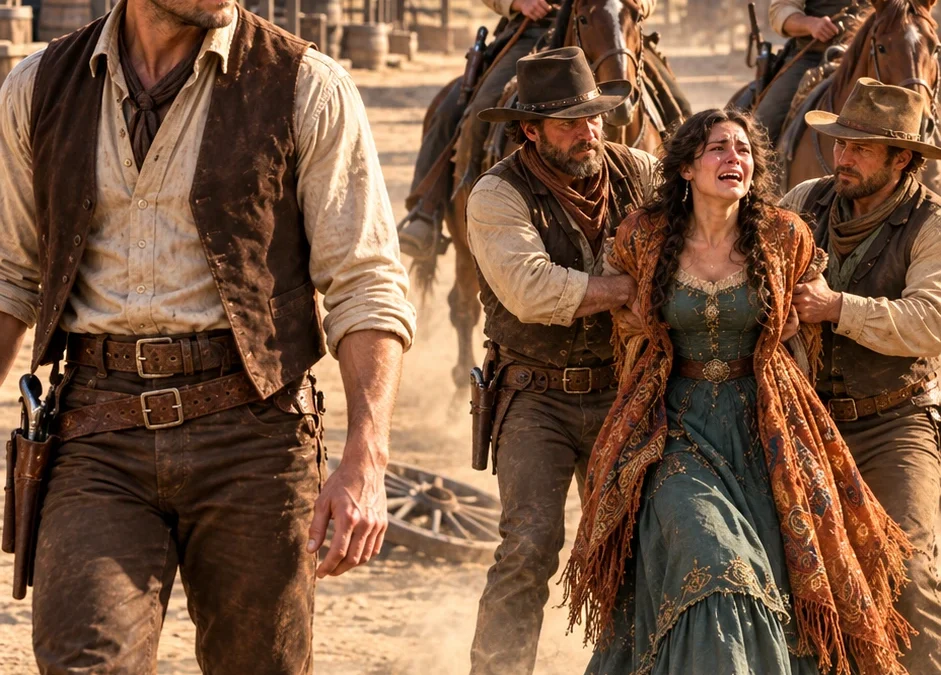
🔥 THEY THOUGHT THE APACHE GIRL WAS ALONE ON THE ROAD — UNTIL SHE DID THE ONE THING NO ONE EXPECTED AND THE MOST FEARED MAN IN TOWN CHANGED SIDES 😱
PART 1
Ayana Red Feather did not scream.
She sat perfectly still on her wagon seat while six armed men circled her in the summer dust. The town watched from a distance. Nobody lifted a hand. 🌵
They thought they knew exactly what kind of man Colton Vale was.
Before the summer ended, they would learn exactly what kind of woman Ayana was.
It was 1885 in the Arizona Territory. Ayana was twenty-six, Apache on her mother’s side. For four years she had lived on three stubborn acres outside Crestfall Junction, in an adobe house with a horse pen and a garden that refused to die.
That morning, on the Red Rock road, a heavy-shouldered man in a tan duster stopped her wagon.
Doyle Marsh worked for the Blackwell Land Company. Beside him sat young Cutter Ree, thin mustache and a permanent smirk. Four more men sat their horses behind them.
“Search it,” Marsh said.
They dumped her canvas sack in the dirt. Cutter dug through it and pulled out a folded, sealed paper, yellowed with age.
An agreement from 1861. It was signed by two territorial officials and held by her grandmother’s family. It granted water rights and land use over four hundred acres around a reliable spring in a country where water was rarer than gold.
Warren Blackwell had been trying to claim that land for two years.
Marsh tucked the paper into his coat. “Stay out of town, Miss Red Feather.”
Ayana said nothing. She only picked up her sack.
Marsh did not know this was not the only copy.
In town, the general store gave her a second blow. Agnes Pel, the storekeeper’s wife, refused to fill her order of flour and cotton fabric. “Mr. Blackwell’s instruction,” she said, eyes on the counter.
A lean, quiet man by the shelves watched it happen.
Colton Vale was thirty-five, eleven days in town, working day jobs at Patterson’s cattle outfit and carrying a Colt he rarely touched. He had once worked for men exactly like Blackwell, doing work he was not proud of.
He tried to buy her order himself. She declined. Outside, he apologized anyway.
Sheriff Harlen Greer logged her theft report as “no witnesses, under review.” He tilted his chair and warned her that Blackwell had fifteen years of influence and friends in the legislature. Lawyer Eli Pharaoh, nervous and ink-stained, had a certified, notarized transcription of the agreement. She told him to file it immediately.
On the walk home, Colton fell into step beside her.
“I’ll be honest,” Ayana said. “I don’t fully trust you. But a man I don’t fully trust is better than the road alone.”
“I spent years working for men like Blackwell,” he said. “I’d rather be on the right side of something. Even late.”
She offered him the lean-to to sleep in. “Ayana,” she said. “Use my name.”
Across town, Warren Blackwell, fifty, silver-haired, read the stolen paper twice. He had known about Ayana for a year. He smiled, because he suspected a second copy, and he sent Marsh to search Pharaoh’s office.
What he did not suspect was the third.
It was wrapped in oilcloth and hidden in a tin. When Ayana was seven, her grandmother had made her read the whole agreement aloud by firelight. Then she had said: “Take it far enough away that they can’t reach it before it reaches people who care.”
At dawn, Ayana sent Colton to town to learn what Blackwell’s men knew. Then she wrote to Joseph Hurst, a Tucson journalist. She rode twelve miles east to old Delgado, the Tejano way-station keeper, and paid him to carry the letter and the tin separately.
She rode home feeling lighter than she had in years.
Then she crested the last ridge and stopped breathing.
Her lean-to was ash. The outbuilding had collapsed. Inside the adobe, everything was torn open. Her grandmother’s blanket had been burned. Her mother’s photograph box was ash. Her herbs lay crushed on the floor.
Her horses stood unharmed in the pen. Blackwell wanted her to know he could have taken them too.
Hoofbeats. Colton rode in and swung down, and she knew by his face he had understood why she had sent him away.
“Blackwell’s men visited Pharaoh yesterday,” he said quietly. “And he’s calling in a favor with the territorial judge in Prescott to have your filed copy thrown out. We don’t have weeks, Ayana. We have days.”
💬 Part 2 is waiting in the comments! Can’t find it? Leave any word below and I’ll send it to you privately.
PART 2
Days.
Ayana stood in the wreckage of her home and let the word settle. Then she righted the overturned table, set a chair at it, and sat.
“I need to get to Prescott,” she said.
Colton went still.
“Pharaoh knows a clerk there, a man named Aldrich, who understands territorial land law and owes Blackwell nothing. I need him to see this before Blackwell’s lawyers get three days alone with the judge.”
“Four days’ ride. Three if we push.”
“You offered to help,” she said. “I’m accepting. I need someone who knows what men like Blackwell’s do when they want to stop a person reaching a destination.”
For a moment Colton thought of two years spent running errands for men exactly like Warren Blackwell.
“I can do that,” he said.
That evening Pharaoh wrote her a letter for Aldrich, twenty minutes without stopping. Handing it over, he admitted he had almost talked her out of the case eight months ago.
“I’m glad I didn’t,” he said.
“So am I.”
Two blocks from his office, Cutter Ree stepped out from between buildings, a heavy, silent man behind him.
“Prescott’s a long ride,” Cutter said. “Lot of empty country. A person riding alone could run into all kinds of problems.”
“Is that a threat?”
“It’s geography.” He smiled.
Ayana walked straight at him, not aside and not back. Cutter had two seconds to decide whether to stop a woman in a public street. He stepped aside.
That night she told Colton. “They’ll watch the south road.”
“Then we go north,” she said. “My grandmother walked the canyon route. It adds half a day, but nobody will expect it.”
They left before dawn. In the grey light, Colton asked what the agreement really meant.
“Water,” Ayana said. “If it holds, Blackwell’s eastern operation dies, his investors lose their money, and he becomes a much smaller man. That’s why he can’t let it stand.”
Two hours into the canyon, Colton raised a hand. Fresh tracks. One horse, moving fast.
“Blackwell’s men don’t know this route,” she said.
“No,” he said. “But somebody does.”
Around the next bend stood a riderless gray horse tied to a scrub tree.
Then a voice from the rocks above. “Don’t reach for anything.”
A thin young man crouched on a ledge, holding a rifle like he’d never learned how.
“I’m not here to hurt anyone,” he said, as though trying to convince himself. “Miss Red Feather. I know who you are.”
“Come down and talk,” she said.
He half climbed, half slid down. He stood in the trail shaking, his eyes ringed with sleeplessness.
“My name is Danny Marsh,” he said. “Doyle Marsh is my uncle.”
The silence that followed had weight.
“I saw something three weeks ago,” Danny whispered. “Something I can’t carry anymore. And I can’t go to the sheriff, because I know about the sheriff.”
He swallowed.
“I saw the judge who will decide your case, sitting in Blackwell’s land office at midnight, drinking whiskey with my uncle.”
💬 Want to know what Danny saw? LIKE or COMMENT “REVEAL” to unlock Part 3! It will be posted as soon as we have enough comments. 🔥
PART 3
Judge Harold Carver, Danny explained, had been secretly on Blackwell’s payroll for a year. It was no ordinary bribe. Carver held a silent stake in one of Blackwell’s northern properties. When Carver ruled for Blackwell, the land grew more valuable, and so did the judge’s share.
“Can you testify?” Colton asked.
Danny stared at the ground. “My mother’s sick. My uncle pays her doctor. If I do this, he cuts her off.”
Ayana looked at the frightened young man who had climbed a rock with a rifle he did not know how to use, because his conscience had grown too loud to sleep through.
“I can’t promise much,” she said. “But if this land is protected, I’ll help with your mother’s care. I don’t break promises.”
Danny looked at her for a long moment. “You’re Apache,” he said, as if revising something he’d been taught.
“Yes.”
He nodded. “All right.”
They camped in the canyon under a small, careful fire. Danny fell asleep the way people do when they’ve finally set something heavy down.
“You believed him?” Colton asked.
“He knew what Carver wore. He remembered Blackwell’s exact words. You can’t invent that under fear.” She watched the flames. “And he came alone with a rifle he can’t use. That’s not a deception.”
Colton was quiet. Then he said: “I’m sorry you had to carry all this by yourself.”
Nobody had said it to her before. Not as pity, but as someone who understood the weight.
“So am I,” she said softly. “I shouldn’t have had to.”
They reached Prescott on the third day. The town was bigger and louder, a place where power wore a coat and tie and worked through paper. Martin Aldrich, small and bald with ink on his left hand, read Pharaoh’s letter without expression.
“Judge Carver received a challenge from Blackwell’s lawyers yesterday,” he said. “A preliminary review is set for the day after tomorrow. That is irregular. It should be two weeks.”
“Is there someone above Carver?”
“Margaret Holt, the circuit appeals coordinator. Meticulous. Incorruptible. And she has been feuding with Carver for two years.”
An hour later Holt sat across from Ayana, listening to the whole story, from her grandmother’s role in the 1861 negotiations to the road robbery, without once interrupting.
“If I issue a hold on his hearing, he’ll fight it,” Holt warned. “If your evidence can’t sustain it, we lose the administrative route.”
“I understand the risk. Issue the hold.”
Holt picked up her pen. Then she paused. “The original document, the one taken from you. If it ever surfaces, it would be much harder to challenge.”
“I’m working on that,” Ayana said.
Back at the livery, Danny pushed his hat up. “My uncle’s in Prescott. Blackwell sent him.”
“Then we move tonight,” Colton said. “Sworn testimony, on record before Marsh knows you’re here.”
Danny’s jaw tightened. “Let’s do it before I talk myself out of it.”
Aldrich wrote it all down. Danny told it without a gap: how Blackwell stood by the window, how Marsh poured two glasses of whiskey, how the judge accepted one. Danny’s hand hovered over the paper for one breath. Then he signed.
They walked out of the courthouse into the evening, and two blocks from the livery, they ran straight into Doyle Marsh.
His face went through three expressions in one second. Recognition. Surprise. Something cold.
“Danny.”
“Uncle Doyle.” Danny’s voice shook, then steadied. “I signed a statement. I told them what I saw.”
“Do you understand what you’ve done?”
“Don’t use my mother,” Danny said, and something in him straightened. “You’ve used her to keep me quiet for three years. It’s done.”
Marsh turned to Ayana. “You did this.”
“Your nephew did,” she said. “Because what you’ve been part of is wrong, and he knew it. The statement is filed. The hold is in place. You can threaten me again, but the paperwork won’t change.”
Marsh’s hand drifted toward his hip.
Colton stepped between them. Not fast. He simply moved, and the temperature of the street dropped.
“I wouldn’t,” he said.
Marsh read it, the stillness of a man who had stopped being afraid of danger long ago. The hand fell away.
“This isn’t over.”
“No,” Colton agreed. “But this part is.”
The next morning Aldrich arrived with bad news: Blackwell’s lawyers had filed a thorough motion overnight, challenging Holt’s authority. Prepared before the hold was even issued.
“He has someone watching the courthouse,” Holt said grimly. “So we file our own. Recusal.”
She wrote a referral to Edmund Voss, the territorial administrator. “Not a warm man,” she said, with satisfaction. “But meticulous, and he has no tolerance for procedural violations.”
While she wrote, Colton slipped away. He came back with news from a contact in Tucson: Hurst had received the tin four days ago and was already building the story, with an editor holding space in the next edition.
“Send him the affidavit,” Colton said. “The legal fight and the public fight, they strengthen each other.”
Ayana wired Hurst: Publish what you have. The truth has waited long enough.
Then Colton told her what he’d learned that morning. “Marsh has the original, in his room at the Red Star Hotel. He’s alone. Let me get it.”
“That’s not a plan.”
“It’s a preference,” he said. “I did this kind of thing for men I shouldn’t have. I’m asking to use it once for something right.”
She thought of her grandmother’s hands pressing that paper into hers. It’s not taking, she decided. It’s returning.
“Be careful.”
Two hours later he set a folded, age-stained paper with a broken wax seal on the courthouse bench beside her.
“He wasn’t there. I left a note: The document taken from Miss Red Feather on the Red Rock Road has been returned to its rightful owner. I didn’t sign it.”
For a moment, Ayana’s face opened like a door long locked and finally unlocked.
“You’re a complicated man.”
“I’m working on it.”
By morning Voss had compared Carver’s written account against territorial records, found two direct lies, removed him from the case, and opened a conduct review. Carver was finished.
The hearing before Judge Clara Whitfield lasted four hours. Blackwell’s lawyers argued the transcription was worthless without the original.
Pharaoh stood and laid the original on the clerk’s table.
Whitfield lifted it in its archival sleeve. “I’m holding the original. How would you like to revise your motion?”
The silence stretched.
On cross-examination, a lawyer asked how she could prove sixty-four years of custody. Ayana answered calmly: “If the document were invalid, Mr. Blackwell would have had no reason to take it by force.”
He moved on.
The ruling came the next morning. Whitfield upheld the agreement. She declared the transcription accurate and the challenge without merit. She ordered Blackwell’s company off the four hundred acres and referred Doyle Marsh’s theft to the territorial marshal’s office.
Ayana did not cry in public. But something behind her eyes finally let go.
Colton waited outside on the courthouse steps.
“You didn’t need me,” he said.
“That’s not the same as not wanting you there.”
At the telegraph office, a wire from Hurst waited. The story would publish Friday. The Phoenix and Flagstaff papers had picked it up. Blackwell’s San Francisco investors were already asking questions.
“That’s his oxygen,” Colton said.
“He’s bleeding,” she said. “But he’s not finished.”
She was right to be wary. In Crestfall Junction, Blackwell’s senior man, Fletcher, rode down Main Street with four riders and the town went silent. “Mr. Blackwell would like a word.”
“Tell him the challenge failed,” Ayana said. “Tell him the ruling is filed with the sheriff. Tell him if he wants to discuss his water access, I’m open to it. Through lawyers, in writing, with witnesses.”
Fletcher stared. She had delivered terms.
Colton appeared at her shoulder, silent, present. Fletcher read the street, turned his horse, and rode away.
On Friday, the Phoenix Gazette arrived on the afternoon stage. The headline read: BLACKWELL LAND COMPANY ACCUSED OF SYSTEMATIC FRAUD; TERRITORIAL JUDGE REMOVED.
In the general store, Agnes Pel looked up as Ayana walked in. “I owe you an apology.”
“I know,” Ayana said. “I accept it.”
Three days later, two deputies from the marshal’s office escorted Warren Blackwell out of Crestfall Junction. He passed Ayana on the sidewalk. She did not say a word. She simply stood, straight-backed, chin level, and he looked away first.
Four days after that, Ayana sat beside the spring for the first time in three years. The water rose cold and clear through the rock, indifferent to everything that had happened above it.
Colton found her there as the light turned gold.
“The survey’s been ordered. The land is protected.” He paused. “I’d like to stop moving, Ayana. I know I don’t have standing to ask for anything.”
“I didn’t ask you to be perfect,” she said. “I asked you to be honest, present, and to mean what you said. You’ve been all three.”
This time his small smile stayed.
Years later, people told the story of the Red Feather case in different ways. A legal story. A political story. The story of Blackwell’s fall.
But the people who stood on Main Street that Friday told it as Ayana’s story: the woman who sat still while six armed men surrounded her, and then spent the summer proving that dignity had never needed anyone’s permission.
💬 What would YOU have done in Ayana’s place? Tell me in the comments! ⬇️
This story is entirely fictional and created for entertainment purposes only. It does not represent any organization or individual, nor does it encourage inappropriate behavior. The content was generated with AI assistance.








