They Threw a Widow Out in an October Storm With $11.40 and a Dead Husband’s Coat. Nine Matches Later, She Found a Secret Inside the Mountain That Would Make the Whole Town Beg at Her Door…
They Threw a Widow Out in an October Storm With $11.40 and a Dead Husband’s Coat. Nine Matches Later, She Found a Secret Inside the Mountain That Would Make the Whole Town Beg at Her Door…
Part 1
October had not even ended when Mara Vance lost her roof. 🌧️
The morning began with rain needling sideways through Bitterroot Valley, Montana Territory, the kind of cold rain that found the gap between a woman’s collar and neck no matter how tightly she fastened her coat. By noon, a thin crust of white had formed along the shaded wagon ruts. The cottonwoods stood mostly bare, their last yellow leaves trembling against a dark sky.
Her landlord carried her belongings outside one armload at a time. Two wool blankets. A dented kettle. A sack of oats. A sewing basket. A canvas bundle holding two dresses, three shirts, her mother’s Bible, and Elias’s old work coat.
That was nearly everything.
Hale Mercer set the last bundle beside the road and straightened. He was not a cruel man. Mara sometimes wished he had been. Cruelty would have given her something clean to hate. Hale was practical instead. He owned three rental cabins on the edge of town, had a wife, two boys, taxes, and a winter supply to protect.
“I gave you September,” he said.
“I know.”
“And October.”
“I know.”
“I cannot carry the rent through winter.”
Two winters had passed since the logging accident. A snapped cable. A rolling trunk. Four men unable to lift it in time. The foreman had brought Elias home wrapped in a canvas tarp because the coffin from town did not arrive until the following afternoon. Mara had been thirty-seven then. She was thirty-nine now, and she understood that widowhood was not one event. It was a thousand small removals. First Elias. Then his wages. Then the horse. Then the better cookware, her mother’s silver brooch, the spare quilts. Now the cabin. 💔
“Mara,” Hale said, lowering his voice, “I am telling you this because I do not want to hear in January that somebody found you frozen under a wagon. Nobody gets through a Bitterroot winter without a roof and a woodpile.”
She looked past him at the rows of split lodgepole pine stacked beneath his lean-to. Dry. Covered. Ready.
“How much for one cord?”
He named the price. Mara almost laughed. In her pocket were eleven dollars and forty cents. Enough for food if she was careful. Enough for fuel if she stopped eating. Not enough for both.
“You will be back before November,” Hale said.
“Maybe.”
The click of the lock was quieter than she expected. That hurt more. She sat on the upturned kettle and unfolded Elias’s coat, pulling it on over her own. It still smelled faintly of pine pitch when damp. For a moment she could see him on the logging road, grinning through a beard full of snow.
You solve the first problem first, Mare.
He had said it constantly. A wagon axle breaks, you do not worry about reaching town until the wheel is standing.
“All right,” she whispered.
She tied the blankets around the food sack, hooked the kettle on the rope, and walked toward the foothills. Her plan was painfully simple. Find wood. Make fire. Stay alive. By midafternoon she reached the lower timber and dropped her belongings beneath a granite overhang. She dragged deadfall until her gloves soaked through, then tore her palms on wet bark. By dusk she had a respectable pile of fuel.
That was when she noticed what she did not have. Shelter.
The overhang protected a strip of ground barely wide enough to sit on. Rain had turned to sleet. The wood was damp. She crawled under a sagging blanket and struck her first match from a box of twenty. The kindling caught. She fed it bark. Smoke rolled, the flame hissed and died. Six matches. Seven. The ninth burned a small blaze for almost two minutes, and then a drop of melting sleet fell from the blanket’s edge into its heart, and it went black.
Nine matches. Half her dry kindling. Nothing.
Before dawn she woke from a shallow sleep to find ice inside her kettle. That frightened her more than anything since Elias died. She had believed hard work could solve the cold. She had worked until her hands bled. The cold had not cared.
Elias’s voice came back, an accusation this time. Mountain cold does not kill only fools. It kills people who spend their strength on the wrong thing.
Even if she found dry wood today, what about tomorrow? What if snow buried the deadfall? What if she sprained an ankle? Fire was not a solution. It was a chore she would have to survive long enough to repeat every day until April.
She packed. Shelter first. Fuel second. Fire last.
Near midmorning, she noticed the ground. A narrow strip beneath a black outcropping held no frost. Everywhere else the grass glittered white. Here the earth lay dark, wet, soft. She pressed her fingers into it. Not warm. But not frozen. Fresh elk tracks crossed the strip and vanished uphill among boulders. A faint mineral smell hung in the air.
For the first time since the cabin door was locked, curiosity pushed fear aside. And what she found behind a choke of willow, where a rabbit had slipped through, breathed warm air against her face. 😨
Part 2
She spent two days studying that strip of ground. A spoon from her sewing basket dug three inches through soft soil, while farther north it struck earth hard as fired clay. Moss stayed green beneath the brush. She did not yet understand it, but she had learned one lesson in the freezing dark. When the mountain told you something, you paid attention.
Her second shelter collapsed under wet snow near dawn. Hours of labor had bought two hours of heat. She held her swollen hand against her chest. “If this is the plan,” she said aloud, “I am dead.”
On the third afternoon, a rabbit slipped through a thicket of willow and deadfall. Mara followed simply because she had nothing better. She pushed the branches aside and stopped. A crack split the black rock, barely wide enough for her shoulders. She put one hand near it.
Warm air touched her skin.
Not hot. Not strong. But warmer than the air behind her. The crack seemed to breathe. 🔥
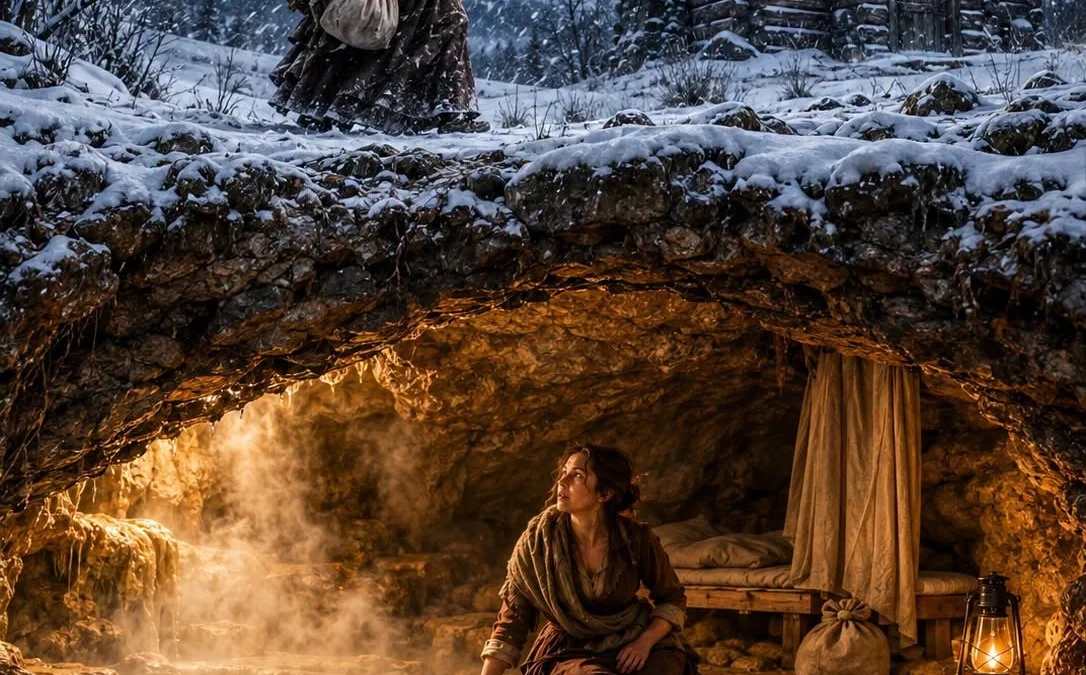
At first light she returned with a lamp, rope, and knife, cleared loose stones, and crawled in. Behind her, daylight narrowed to a gray slit. Ahead, the passage opened into a chamber the size of Hale’s rented cabin. Steam shimmered faintly. Beneath a fracture in the ceiling, clear water filled a small basin and escaped through a lower channel. She held her hand above it. Warm. Not enough to cook. But unquestionably warm.
Mara laughed. The sound echoed. She laughed harder, and then she cried, sitting on a stone with her face in her hands. For days she had fought winter with wet sticks, while heat had been moving through the mountain all along.
By sunset she believed the problem was solved. That lasted until morning, when she woke soaked. Water dripped from the ceiling. Her hair was wet, her blanket as heavy as canvas. Warmth without dryness. Another trap.
So she began testing. She hung strips of cloth near the basin, at the entrance, and on a shelf between. By evening the first was warm and damp, the second cold and dry, the third warm enough to dry. The cave had zones. She raised a sleeping platform on flat stones, stacked loose rock along the entrance to turn the worst draft downward, and left a gap above for warm air to escape. Flour stored low went sour; she moved it high. Every mistake became a rule. Do not sleep beside the water. Keep the bedding raised. Never seal the vent.
The last rule she learned in a storm. Near midnight she woke with a pounding headache and the air feeling heavy. For a moment she nearly packed the entrance tighter. Cold outside, warm inside, seal the gap. Then she remembered the cloth experiment. Movement mattered. She crawled out and pushed through snow packed against the upper opening. Fresh air flowed in below, warm air out above. Within minutes the pressure in her head eased. “Never seal it,” she said.
Standing outside afterward, she watched smoke rise from every chimney in Bitterroot. Down there, families cut, split, carried, and burned. She had burned nothing. She was not making heat. She was living where heat already existed.
In town once, two men laughed. “What are you burning?” “Nothing.” “Then you will not be staying long.” Hale stood by the flour barrel and did not laugh. “Where are you sleeping?”
“Somewhere that does not charge rent.”
At Christmas, a warm wind came over the mountains after three days of snow. The spring rose past a line she had scratched on the rock. Then past the second. Water spread across the floor and touched the stones beneath her bed. The thing that had saved her was now filling her shelter. She moved blankets, flour, lamp oil, and Elias’s coat to the upper shelf and dug a trench toward the outlet. The sides collapsed. She rebuilt. Near midnight she sat with her feet in water and whispered, “I am tired, Elias.”
Solve the first problem first. She stopped trying to force the water straight and followed the natural depression instead. Near dawn the basin fell by half an inch. 💧
Then the temperature plunged. For four nights timber split like gunshots across the valley. On the fifth afternoon a boy’s voice called from among her marker poles. “Anybody here?” He was holding up Hale Mercer, whose leg dragged behind him. And that was only the beginning. 😱
Part 3
Sixteen-year-old Daniel Cutter had seen her marker poles and thought they had to lead somewhere. A sled had broken while they hauled wood, twisting Hale’s knee beneath the runner. Inside, Hale stood staring. No stove. No chimney. No woodpile. Warm water moving through rock, blankets dry on an elevated platform, a drainage trench crossing the lower floor.
“You have been living here? All winter?”
“So far.”
“How?”
“Not one thing.” She pointed. “That stays open. I sleep there. Food stays dry up there. The spring rises after warm weather.”
She wrapped the knee, hung Daniel’s gloves high where moving air could dry them, and warned them not to sleep beside the basin. In the night Hale slept without a stove feeding. Near morning he woke and looked toward the dark entrance. “No fire?”
“No.”
“It is clever. But one easy night does not prove much.”
The old urge rose in her, to remind him of the road and the locked door. She let it pass. “Then we wait.”
January came harder. Wood shortages spread through Bitterroot. Snow buried deadfall. Families burned green wood that hissed and coated chimneys with soot. Daniel had told his mother, Ruth Cutter, about the cave. “Safe?” Ruth asked at the store.
“No. Useful if you know the rules. Never seal the vent. Do not sleep beside the spring. Food stays high. Watch the water. Do not count on anything staying the same.”
Then a mass of cold moved south, the worst in twelve years. On the third afternoon of the deep freeze, Mara heard many voices. Hale stood among her marker poles, leaning on a stick, with six people behind him. Two women. A man. Two children. An old woman wrapped in blankets. More appeared down the trail. “We need help.”
In October he had stood beside her belongings and said she would be back. She could have made him say more. She looked at the children, one boy’s lips blue, the old woman shaking under three layers of clothing.
“Come in.” 💛
Nine people crowded in by dark, and she had never tested the cave with nine. Bodies made moisture. Wet coats made more. Snow melted off boots. The vent narrowed as blowing snow packed outside. The old fear returned for a moment. Then she made herself stop. One at a time. Ada Bell, Ruth’s mother, sixty-eight, had been carried the last fifty yards by Hale. Their stove had split. Mara set the children and Ada on the sleeping platform.
“Can we make a fire?” asked a man named Silas Crowe.
“No.”
“Nine people and no fire?”
“Too much smoke risk. The air already has to move. Foul the chamber and warmth will not save us.”
“Do what she says,” Hale told him. “I have been here before.”
She wrapped Ada in Elias’s coat. Hale recognized it and said nothing. When the old woman finally stopped shaking, Hale sat beside Mara. “My wife told me I was wrong. About you. Most of it.”
“I almost came back, the first night. I used nine matches failing.”
“And after?”
“Found this. Luck found the ground. I noticed because frost was not there. But luck did not dig that trench. Luck did not keep that vent open. Luck did not move my food before the flood.”
All night the cave tested them. Snow packed the entrance twice, and Silas cleared it, then Hale. A child grew sick from fear and bad food, and warm cloths and clean water settled him. Ada’s breathing steadied. Nothing dramatic happened, which was the miracle, if anyone insisted on the word. Nobody froze. Nobody suffocated. Nobody walked through the storm carrying firewood. 🌟
At dawn Hale crawled outside, where the valley lay under a low smoke and the cold bit his nostrils. Later, the thermometer outside the general store would show the lowest reading in twelve years. When he came back, Mara opened the matchbox and turned it toward him. Eleven matches. Twenty, minus nine.
“None since?”
“Not for heat.”
Hale took off his hat. “I was wrong.”
For months she had imagined this. Hale humbled, Mara proven right. Instead she remembered floodwater climbing toward her blankets, soaked hair, sour flour, the vent she had nearly sealed. “I was wrong too. About nearly everything, before I learned better.”
Some families returned to town after three days. Others stayed. Mara repeated the rules at the entrance. No heating fires. No blocking ventilation. No sleeping alone. No children without adults. This place can kill you if you stop paying attention. A carpenter offered to build a door over the entrance. “It blocks the flow.” “You have become particular.” “I have become alive.”
Ruth brought bread and sat beside her. “Are you angry?” “Sometimes. At Hale. At the town. At Elias.” Ruth nodded. “My husband has been dead six years. Still makes me angry. People think grief makes saints of us. Mostly it makes us tired.” Mara laughed so hard the water echoed.
When March came, birds sang, and Mara stood still, then laughed, then cried. Spring was not victory. It was release. In town, people asked how warm the water was and whether it flooded. She refused to make the cave a legend. “It is not safe because it is warm.” Hale found her outside the store with his hat in his hands. The cabin was empty again. Six months free. She studied him. Guilt, gratitude, both. Two years earlier she would have accepted before he finished.
“No. I do not want to owe my winter to one stove and one landlord again. I want something smaller. Mine.”
He offered a strip of rocky land at the foothills, sheltered from the northwest wind, creek below, priced low. “Cheap or guilty?” “Both.” By May she owned it, paying through sewing and labor. She chose the site herself, sheltered from wind, above spring runoff, with southern sun. The house was small. One room, a sleeping alcove, a table by the window. She cried the first night she sat there, remembering the chair where Elias used to sit. She hung his coat on a peg by the door, not as a shrine. As a coat. 🏡
A modest stove went in. “I am not at war with fire,” she told Silas. “Depending on one thing is the problem.” On the first cold evening, one match lit it. She smiled.
The cave remained, with permanent posts and a sign Hale helped her paint. WARM SPRING CAVE. KEEP UPPER VENT OPEN. WATCH WATER LEVEL. NO UNATTENDED CHILDREN. NOT SAFE UNLESS UNDERSTOOD. She hated the legend that she had spent a winter in luxury beside a hot spring. They had never woken to condensation dripping into their hair, or crawled through snow to clear a vent with a pounding head. When a reporter wrote The Woman Who Defeated Winter Without Fire, she handed the paper back. “Winter was not defeated.”
Years later, Hale sat at her table with gray in his beard. “I was wrong.” “You have told me.” “It does not feel like enough.” She looked at him. Understanding was not erasure, but the cave had taught her two truths could share a place. Warmth and danger. Rescue and flooding. Anger and forgiveness. “A roof and woodpile would have been useful. They were not the only answer.”
Because of her, the town changed. Wood was stored earlier. Chimneys cleaned. Hale organized a community wood day every October for the old and the widowed. When a young widow named Clara Boone came asking whether she and her two children could live in the cave, Mara said, “First we will find out whether you need to.” Necessity did not have to become destiny just because Mara had survived it.
One autumn afternoon she crawled inside alone, knees complaining. The old water mark still showed on the wall. She sat on the middle shelf where Ada had stopped shaking. “You would have hated this bed, Elias.” She laughed. Love did not require making him perfect. He had been stubborn, impatient, a snorer. He had also taught her to inspect a rope before trusting weight to it. Grief eased when she let him be human.
“I stopped trying to make the mountain obey me,” she told people who asked how a homeless widow survived the deepest cold in twelve years. On the first night she had believed survival required fire because fire was the answer everyone knew. Only after losing the answer she expected did she begin noticing what was actually around her. Unfrozen earth. Elk tracks. A cave with zones. A spring that rose after thaws. The heat had always been there. Eviction took away every easier answer and sharpened necessity into attention. That was not justice. It was not destiny.
Her real victory was quieter. She did not humiliate Hale. She did not turn away freezing families. She chose a modest home of her own. She made sure the next frightened person did not have to learn it alone.
On cold nights, travelers could still see her posts climbing toward the foothills, and beyond them, hidden in black rock, warm water moving beneath the mountain. And in Mara Vance’s little house below, the stove might burn or it might not. Either way, she slept knowing she had more than one answer. 🌅💛
This story is entirely fictional and created for entertainment purposes only. It does not represent any organization or individual, nor does it encourage inappropriate behavior. The content was generated with AI assistance.








