They Threw Her Out Before Winter—Laughed When She Hid In A Cave… Until The Blizzard Came
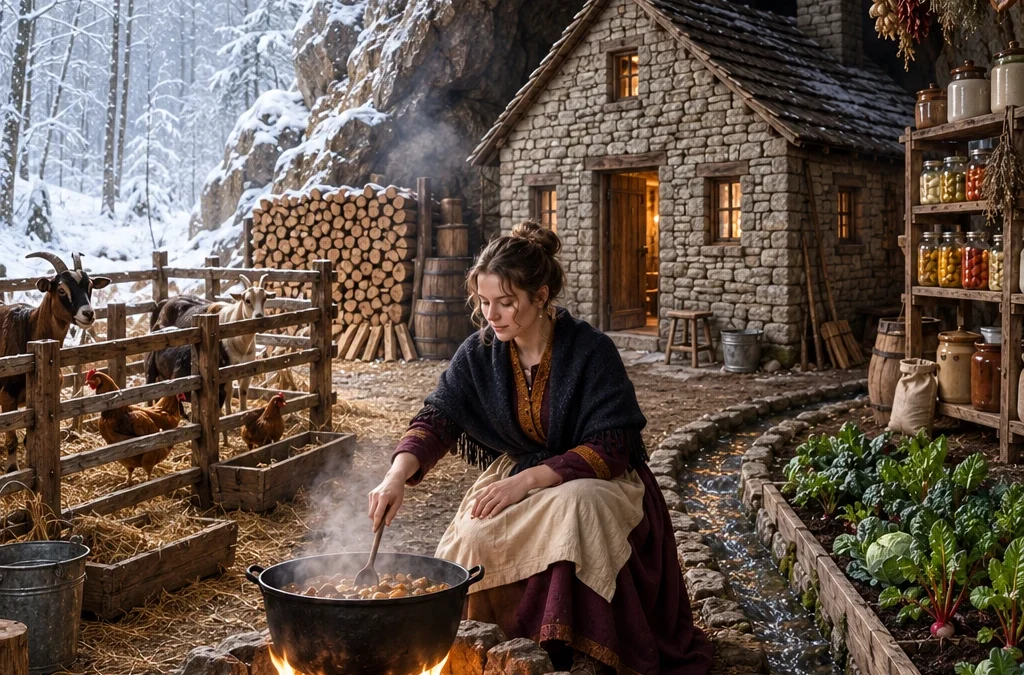
They Threw Her Out Before Winter—Laughed When She Hid In A Cave… Until The Blizzard Came ❄️😱
Part 1
The first snow hit Ruth Calder’s face before she even had a roof over her head.
It drove sideways across the Wyoming basin, fine and sharp as sand, stinging her cheeks as she walked away from the only home she’d known for seven years.
Behind her stood the cabin her husband had built.
Ahead, nothing but a gray limestone ridge and one dark, hollow opening tucked beneath its shoulder.
She carried very little: one thin wool blanket, a dented tin coffee pot, a worn hatchet, and thirty-two dollars sewn deep inside the lining of her coat.
Three days earlier, her brother-in-law Vernon had arrived with two wagons and a folded land claim in his pocket.
Ruth’s husband was gone—killed in an accident near Casper the previous spring—and the deed had never been properly transferred into her name.
Vernon knew it.
By noon, his family was moving in.
“You can stay until the weather clears,” he’d told her, avoiding her eyes.
Ruth had watched his wife arranging her own dishes inside Ruth’s cupboard.
“The weather is clear now.
”
He shifted uncomfortably.
“You know what I mean.
”
She folded her blanket slowly.
“Yes.
I do.
”
She left before anyone could pretend to be kind.
The men watching from the porch assumed she’d be back by dark—cold, hungry, ready to beg her way inside.
Ruth did not look back.
Her father’s voice echoed in her mind as she walked: Cold rarely kills all at once.
It works by inches.
He’d built stone cellars back in Pennsylvania.
“Wood gives its heat away fast,” he’d always said.
“Earth keeps what it gets.
” She hadn’t thought about those words in years.
Now they were all she had.
The hollow in the ridge wasn’t a deep, dark cave—more a broad shelter, twenty feet across, twelve deep.
Ruth stepped inside.
The wind stopped touching her face.
She pressed her palm to the limestone back wall: cold, yes, but steady, holding the slow, stored warmth of summer.
The floor was dry.
The ceiling showed no water stains.
And the opening faced south—afternoon sun would reach right in.
“This will do,” she whispered.
She spent the first day gathering dead branches from the creek below, dragging them up the steep slope until her shoulders burned.
But she didn’t light a fire.
Not yet.
Instead, she collected flat stones and began stacking them across the mouth of the hollow—low at first, just enough to break the wind, to shrink the space she’d need to keep warm.
By dusk, the cabin chimney far across the basin poured thick black smoke into the fading sky.
Vernon was burning plenty of wood.
Ruth sat behind her knee-high wall and ate cold beans, watching that smoke.
One wagonload might last a week if it stayed mild.
Less if the real cold came.
She had a different plan.
Before sunrise, she was up again.
She widened her wall, dug a shallow trench to carry melting snow away from her sleeping spot, and wrapped torn strips of petticoat around bleeding knuckles.
Then she began building something she’d only heard described—an efficient stone heater, its firebox connected to winding channels set deep within thick rock, so heat would soak into the stone and stay there long after the flames died.
The first structure collapsed before noon.
She took it apart and started over.
Late that afternoon, a rider appeared on the trail below.
Broad, middle-aged, wrapped in a heavy buffalo coat—Elias Boone, a cattleman from six miles east.
He reined in, studying her, the half-built wall, the clay-smeared structure rising inside.
“Building in here,” Ruth said, hand resting near her hatchet.
He nodded toward the northern sky, where dark clouds were swallowing the peaks.
“Army wire says a hard front crossed Montana yesterday.
Could be here in two days.
Maybe less.
” He looked at her unfinished entrance, her small pile of wood.
“I’ve got an empty bunkhouse.
You coming?”
Ruth fitted another stone into place, pressing clay tight around it.
“No.
”
Elias studied her a moment longer, then turned his horse.
“All right.
But don’t say nobody warned you.
”
The wind shifted that night.
By dawn, the sky had vanished into gray, driving snow.
The storm was coming faster than she was ready for.
Her heater still needed drying time.
Her wall was half its height.
Her wood might last four days if she was careful.
Four days would not be enough.
She grabbed her hatchet and went back down to the creek, fighting wind that seemed to push her backward with every step.
She cut only dry, dead branches—green wood would smoke, wet wood would steal more heat than it gave.
She dragged load after load up the slope until her fingers ached so badly she could barely close them around the handle.
When she tested the heater that evening, the truth hit hard: the smoke channel narrowed too sharply.
Flames caught, then smoke pushed back toward her face.
The draft was wrong.
To fix it meant tearing down half the structure she’d built all day.
Outside, the world disappeared.
She could no longer see the cabin.
For the first time since leaving it, that mattered—not because she wanted to return, but because it had been her only landmark.
Now there was nothing but white.
Ruth took a deep breath, reached for the first stone, and began to dismantle her work.
Part 2
She worked faster than her cold-stiffened fingers wanted, tearing out the narrow section, rebuilding the channel wider, packing clay firm and smooth.
By late afternoon, she was ready to try again.
The flame caught.
Smoke rose—and this time it flowed steadily away through the passages.
She placed her palm against the outer stone.
Nothing yet.
Then twenty minutes passed.
A faint, gentle warmth began spreading through the rock.
It held long after the fire died.
The principle worked.
But the storm was already here.
Before midnight, the wind hit like a battering ram.
The hide curtain she’d hung over the entrance snapped inward.
Snow forced its way through every seam.
She braced the opening with timber and heavy stones, watching the wall shudder under gust after gust.
A chunk of rock the size of a dinner plate crashed from the ceiling—landing exactly where her head had been moments earlier.
She dragged her blanket beside the heater and stayed close to the solid, warm stone.
Morning brought no real sunrise—only a dim, gray gloom.
Ruth fed the fire hotter, letting the stone soak up as much heat as it could hold.
Outside, water turned to ice in minutes; inside, beside the heater, it melted.
That difference told her everything.
But her wood was dwindling fast.
Three days, perhaps less.
And she could not go out to gather more.
Then she heard it—hoofbeats, faint through the roar of the wind.
A voice calling, barely audible.
She pulled aside the hide.
Nothing but white.
“Here!” she shouted.
A shape emerged from the storm: Elias Boone, half-dragging a smaller figure through deep drifts.
His beard was crusted with ice.
“My daughter Clara,” he gasped.
“She was caught out three hours ago.
”
They carried her inside together.
Seventeen years old, red hair matted and frozen, coat stiff, lips pale, one glove lost somewhere in the gale.
Her pulse was faint—but there.
Ruth looked at her shrinking wood pile, at the raging storm, at the girl lying so still beside her half-finished shelter.
This space was meant to keep one woman alive.
Now it had to keep three.
Clara woke slowly, breathing still shallow.
“Where are we?” she whispered.
“Somewhere warm,” Elias told her.
But outside, the storm was sealing the canyon shut.
Snow climbed higher against the entrance wall.
The timber brace began to bend.
And then Ruth noticed something worse: the smoke from her heater was drifting back into the room.
The chimney vent above the cliff had clogged with snow.
Elias stood immediately.
“I’ll climb out and clear it.
”
“It’s dangerous up there!” Ruth warned.
“If that vent stays blocked, the fire’s useless.
We’ll freeze.
”
He was right.
Ruth tied a rope around his waist, securing the other end to the heaviest timber brace.
“Stay close to the rock face.
If you get lost, follow the rope.
”
Elias stepped out into the white.
For a minute, the rope moved steadily.
Then it stopped.
“Elias!” she called.
The wind swallowed her voice.
She pulled gently—nothing.
Harder—no resistance.
The rope went slack in her hands.
The knot had come untied.
Ruth grabbed her coat and tied the remaining rope around her own waist.
Clara sat up, alarmed.
“What are you doing?”
“Bringing your father back.
”
She stepped through the hide into the blinding storm, and vanished from sight three paces from the entrance.
Part 3
Ruth kept one hand pressed flat against the limestone wall, inching sideways through wind that felt like it would tear her coat away.
Ice stung her eyes until they streamed.
“Elias!” she called again, her voice thin and lost in the gale.
Then her boot struck something soft half-buried in the drift.
A glove—Elias’s.
She dropped to her knees.
A faint trail marked where someone had slid down the slope.
She followed it ten feet upward and found him wedged between two rock ledges, hat gone, weight resting heavily on one leg.
“The rope came loose,” he gritted out, face tight with pain.
“Slipped on ice.
”
“I can try.
”
She slipped beneath his arm, supporting his weight as they climbed the last few feet to the vent.
Snow had packed solid over the opening.
Ruth swung the hatchet, breaking the plug free.
A thin stream of warm air rose from below—fresh air would flow again.
But as they turned back, a gust hit hard enough to throw them both sideways.
Elias caught the back of her coat, steadying her.
“That’s enough,” he said.
“We’re clear.
”
The descent was slower, every step deliberate.
When they finally stumbled back inside, Clara pulled the hide shut behind them, sealing out the wind.
Elias collapsed onto the floor, breathing hard, his left leg swelling fast.
Ruth examined it—painful, but not broken.
She bound it tight and helped him rest against the warm stone.
This time when she lit the fire, the smoke rose clean and true.
The stone drank the heat and held it, radiating gentle warmth long after the flames were gone.
The storm raged for two more days.
They measured time not by daylight, but by fires—one burn, then another, stretching each handful of wood as far as it would go.
They ate sparingly, slept close together beside the heater, took turns watching the entrance and the vent.
Clara’s color returned; Elias learned to shift his weight to his good leg; Ruth barely slept at all, listening, checking, saving every scrap of warmth.
Then the wind fell silent.
Ruth pulled aside the hide.
Bright morning light spilled through—blue sky, clear and endless.
She stared, then grabbed the pan.
Together they dug away the drift until the opening was wide enough to climb through.
Elias went first, leaning on Ruth’s shoulder.
Clara followed.
The basin stretched out vast and white beneath them, fences buried, sagebrush peeking through drifts.
Far across the valley, most chimneys sent up thin plumes of smoke.
One did not.
The Calder cabin.
Elias followed her gaze.
“Your old place.
”
“Yes.
” No smoke rose from its roof.
Ruth turned back inside and picked up her hatchet.
Clara’s eyes widened.
“They put you out.
”
“That doesn’t change the temperature,” Ruth said quietly.
The crossing took two hours, snow reaching their waists in places.
When they reached the cabin, drifts stood level with the windows.
The door was blocked.
Together they pushed it open.
The cold inside hit them instantly.
The fire had died long ago.
Chair legs and a broken stool lay in splinters beside the stove—everything burnable was gone.
Vernon sat on the floor holding his youngest son close, his wife and daughters huddled beneath thin quilts nearby.
All were alive, but barely, shivering too exhausted to speak.
“Our wood ran out,” Vernon said, looking at her as if seeing a ghost.
“Day before yesterday.
”
Ruth touched the boy’s hand—cold, but still flexible.
She looked at Elias.
“Help them move.
”
They made two trips.
By afternoon, six more Calders crowded into the limestone shelter they’d expected Ruth to flee within hours.
No one apologized.
No one boasted.
There was only the work to be done: warming water, feeding children, tending the fire, sharing space.
Vernon sat by the heater, watching his hands slowly warm.
Near sunset, he stood and walked to Ruth.
“I don’t know what to say.
”
She handed him a bucket.
“The creek hole needs clearing.
”
That was all.
For four days the cave held nine people.
The stone never went cold.
The youngest Calder boy laughed again by the second morning.
Elias walked unaided by the third.
Clara learned to tend the fire, watching the smoke and feeling the stone to know when it was time to feed it.
Vernon gathered wood without being asked.
When the roads opened, people came from across the basin.
They touched the thick limestone walls, felt the stored heat long after a fire had died, saw the shelter built not to fight winter, but to work with it.
They asked questions.
By spring, Ruth had helped build seven stone-heated shelters across the valley.
Vernon brought her the corrected land deed one bright April morning.
“The cabin is yours,” he said, placing it on the table.
Ruth looked at the paper, then at the sunlight falling across the cave floor, at Clara teaching other girls how to lay stone, at the warm, steady life she’d built here.
She pushed the deed back.
“I already have a house.
”
This story is entirely fictional and created for entertainment purposes only.
It does not represent any organization or individual, nor does it encourage inappropriate behavior.
The content was generated with AI assistance.








